If you’ve already read part 1 of this story on Facebook, go here for Part 2!
PART 1
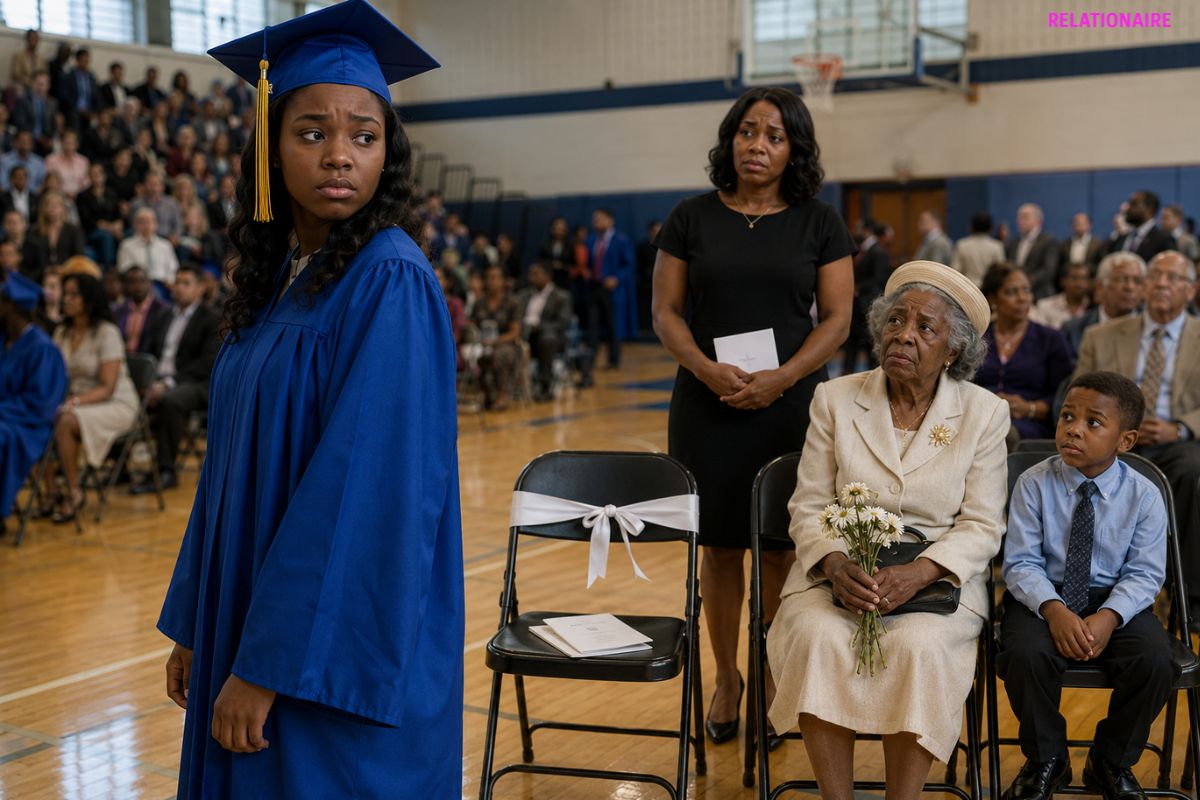
The empty chair was in the second row, right beside a grandmother holding wilted daisies and a little boy wearing shoes two sizes too big.
It had a folded program on it.
And a white ribbon tied around the back.
Nobody sat there.
Not during the band warm-up.
Not when the graduates lined up near the gym doors in their blue gowns.
Not even when the principal tapped the microphone and said, “Families, please take your seats.”
I noticed the chair because Maya noticed it first.
She was third from the end in the last row of graduates, standing straight with her chin lifted like she had practiced not needing anybody. Her cap sat low over her forehead. One of the gold tassels kept sticking to her lip gloss, but she didn’t fix it.
She was staring at that chair.
Then she looked away like it had burned her.
I had taught Maya English for two years. I had seen her sleep through first period with her pencil still in her hand. I had watched her write essays so honest they made me close my laptop and sit quietly for a minute. I had also watched her tear up a college fee waiver form and tell me, “It doesn’t matter.”
Maya was brilliant.
Maya was angry.
Maya was the kind of child adults called “difficult” when they were too tired to ask what made her that way.
She had almost not made it to graduation.
Not because she wasn’t smart enough.
Because by March, she had stopped coming.
At first, it was one absence.
Then three.
Then a full week.
Her counselor called. No answer.
The secretary mailed home a warning letter. It came back bent, with a yellow sticker on the front.
Wrong address.
Her emergency contact form had one name crossed out in black pen.
Mother.
Under it, in shaky handwriting, someone had written: Grandma Nell.
Grandma Nell came to school one cold morning in a thin church coat, carrying a plastic grocery bag full of Maya’s missing assignments. She apologized before she even sat down.
“I’m trying,” she said.
That was all.
Just those two words.
I’m trying.
And I believed her.
By then, Maya had been getting her little brother Eli ready for school every morning. Packing his backpack. Signing his reading log. Making sure he ate something, even if she didn’t.
She was seventeen and already tired in the way grown women get tired.
The kind of tired that sits behind the eyes.
When she finally came back, she walked into my classroom halfway through a quiz and dropped into her seat like she expected punishment.
I set a clean quiz in front of her.
She didn’t look at me.
“You still think I can pass?”
“I know you can.”
She laughed once, sharp and small.
“You don’t know anything.”
Maybe she was right.
Teachers know attendance codes, cafeteria duty, late buses, dry erase markers that quit during observations, parents who answer emails with silence, and children who swear they’re fine while holding their whole lives together with one broken zipper.
But we don’t know everything.
We guess.
We worry.
We notice.
Sometimes noticing is all we have to offer.
That spring, Maya worked like someone running from a fire. She finished essays during lunch. She took makeup tests in the library. She came in after school and sat at the back table while the janitor pushed his cart past my door.
She never complained.
But she never smiled either.
Not even when I handed her the paper that said she had passed.
“You’re walking,” I told her.
She looked at the floor.
“My mom won’t come.”
I didn’t know what to say.
There are teacher answers for missing work.
There are teacher answers for college applications.
There are no good teacher answers for a child who says her mother won’t come watch her graduate.
So I said the only true thing I had.
“I’ll be there.”
Maya shrugged.
But her eyes filled before she turned away.
Now, in the gym, with the bleachers packed and the air smelling like floor polish, hairspray, and carnations, I stood along the side wall with the other teachers.
I had on the same black dress I wore every year, the one with the loose hem I kept meaning to fix. In my tote bag were tissues, extra safety pins, mints, and three scholarships essays I still needed to grade out of habit, even though school was over.
The band started playing softly.
Families waved.
A father stood on tiptoe with a camera.
A mother cried before anything had even happened.
Grandma Nell sat with Eli beside the empty chair.
She kept smoothing her skirt, then smoothing Eli’s collar, then touching the folded program on the seat as if someone might still arrive.
Maya refused to look again.
But I knew she knew.
Every child knows who shows up.
And every child knows who doesn’t.
The principal began with the usual words.
“Achievement.”
“Perseverance.”
“Future.”
The kind of words that sound nice under fluorescent lights but feel too clean for what some students had survived to get there.
Maya had survived eviction.
She had survived phone calls that never came.
She had survived making dinner from noodles and ketchup while her grandmother worked nights cleaning offices.
She had survived a mother whose name she would not say out loud.
And still, there she was.
Blue gown.
Gold tassel.
Hands folded tightly in her lap.
When the choir stood to sing, the gym doors opened at the back.
A woman stepped in.
For half a second, I thought it was her.
Maya’s mother.
The woman had dark hair tucked under a scarf and the careful walk of someone who did not want to be noticed. She paused near the back row, scanning the graduates.
Maya saw her.
Her whole face changed.
Not hope exactly.
Hope would have been softer.
This was fear dressed up as hope.
Then the woman turned and slipped into a seat beside another family.
Maya looked down.
Her mouth tightened.
I felt something in my chest fold.
Beside me, Mr. Alvarez, the history teacher, whispered, “You okay?”
I nodded.
But I wasn’t watching the stage anymore.
I was watching a girl pretend an empty chair didn’t matter.
The ceremony moved on.
Speeches.
Applause.
A joke from the class president.
A beach ball confiscated by the assistant principal.
Ordinary graduation things.
Then the guidance counselor, Mrs. Patel, hurried toward me from the side hallway.
She was usually calm, the kind of woman who could handle three crying seniors and a printer jam without raising her voice.
But her face was pale.
In her hand was a white envelope.
My name was written across the front.
Not typed.
Written.
Ms. Rowan.
I looked at it, confused.
“What is this?”
Mrs. Patel’s eyes flicked toward Maya.
“It came to the front office ten minutes ago.”
“From who?”
She swallowed.
“Maya’s mother.”
The gym seemed to get louder and farther away at the same time.
I looked at Maya.
She was still facing the stage, still pretending she did not care about the empty chair with the white ribbon.
My fingers tightened around the envelope.
“What does it say?”
Mrs. Patel shook her head.
“I didn’t open it. But the woman who dropped it off said you would know whether Maya should get it before she walks.”
Before she walks.
The first row of graduates stood.
Names were about to begin.
Maya’s row would be called in less than ten minutes.
I stared at the white envelope in my hand, then at the empty chair, then at the girl who had spent years believing she had been abandoned by someone who simply didn’t care.
And for the first time all year, I was afraid that what I didn’t know might matter more than everything I had noticed.
I slid my finger under the sealed flap.
PART 2
The envelope opened with a soft tear.
Such a small sound.
It felt wrong that something so quiet could change a child’s life.
Inside was a folded piece of notebook paper, the kind students tear from spiral notebooks when they forgot to bring real stationery. The edge was ragged. There was a faint coffee stain near the bottom.
A second thing slid out behind it.
A photograph.
I caught it before it fell.
Maya was in the picture, maybe four years old, sitting on a woman’s lap in front of a birthday cake. Her cheeks were round. Her mouth was open in a laugh. The woman behind her had one hand wrapped around Maya’s waist and the other covering a candle flame from the wind.
On the back, someone had written:
My brave girl. Age 4. Before I knew how to stay.
My throat tightened.
I unfolded the letter.
Ms. Rowan,
I know I have no right to ask you for anything.
That was the first line.
No excuse.
No pretty beginning.
Just that.
I kept reading.
I am Maya’s mother. My name is Denise Walker. She may not say it anymore. I understand if she doesn’t.
I was supposed to come today. I bought a dress from the thrift store. Blue, because that was always her favorite when she was little. I pressed it twice. I made it as far as the parking lot.
I looked through the gym doors and saw her.
Then I saw the seat.
And I couldn’t make my feet move.
I stopped reading for a second.
The band had finished. The principal was walking to the podium with the list of names.
The first row of graduates stood straighter.
Maya’s hands were locked together in her lap.
I looked back down.
I left when Maya was eleven. That is the truth she knows.
Here is the truth she does not know.
I left because I was sick in a way I was ashamed of. Not the kind of sick people bring casseroles for. The kind where people whisper and children learn to be embarrassed. I was using pills. Then stronger things. Then I was gone even when I was in the room.
One night, I came home and found Maya making cereal for Eli on a chair at the counter. He was crying. She was telling him, “Don’t worry, I know how.”
She was eleven.
That was the night I called my mother.
I told her to take them.
Maya thinks I chose myself over her.
Maybe I did.
But I also knew if I stayed, I would keep breaking her in smaller ways until she thought broken was normal.
The words blurred.
I blinked hard and kept reading.
I got clean once. Then I lost it. Then again. Then again.
I am three years clean now.
I work at a laundry on 8th Street. I have a little room behind my cousin’s house. I have written Maya fourteen letters and mailed none of them because every apology sounded too small.
I came today because my mother told me Maya almost did not graduate. She told me a teacher stayed late with her. She told me Maya passed because someone kept putting papers in front of her until she believed she could finish.
Thank you for being near my daughter when I was not.
My chest hurt.
Not because the letter excused anything.
It didn’t.
Nothing gives a child back the years they spent scanning doorways.
But the truth was not as simple as Maya had made it.
It was not as simple as I had made it either.
The first graduate’s name echoed through the gym.
Applause erupted.
I folded the letter halfway, then opened it again.
There was more.
I do not know whether I deserve to sit in that chair.
I do not know whether seeing me would help her or hurt her.
So I am asking you, because Maya trusts you. Even if she acts like she doesn’t.
If you think it would only steal from her day, keep this letter. Give it to her later. Or never. I will accept that.
But if there is any part of her still wondering if I stayed away because I did not love her, please tell her this before she walks:
I stayed away because I hated what I had become.
I came today because I love who she became anyway.
I am in the hallway by the trophy case.
I will not move unless she asks me to.
Denise
For a moment, I could not hear anything.
Then the applause came back.
Names.
Cheers.
A baby crying.
Someone laughing in the bleachers.
The normal noise of a gym full of families who had no idea that a mother was standing behind a hallway wall, waiting to be either welcomed or erased.
Mrs. Patel touched my arm.
“What do we do?”
We.
That word nearly undid me.
Because teachers live inside that word.
We call home.
We buy snacks.
We sit through meetings.
We keep spare hoodies and deodorant and granola bars in drawers.
We say, “Try again,” when children have every reason not to.
But there are moments when “we” is not enough.
This was Maya’s wound.
Not mine.
Not the school’s.
Not even her mother’s anymore.
Hers.
I looked at the stage.
The second row of graduates was standing.
Maya would be next.
I could wait. I could let her walk across the stage untouched by this. I could protect the cleanest version of the moment.
But was that protection?
Or was it another adult deciding what truth a child could survive?
I thought about the essay Maya wrote in April.
The prompt had been: Describe a place you learned something important.
Most students wrote about classrooms, kitchens, basketball courts.
Maya wrote about a bus stop in the rain.
She was twelve. Her mother had promised to come. She waited with Eli for two hours until Grandma Nell found them.
The last line of the essay said:
I learned people can leave you twice. Once with their body. Once with your hope.
I had written in the margin, in pencil:
And sometimes hope waits longer than people do.
She had never mentioned it.
But she had not erased it.
“Maya needs to know,” I said.
Mrs. Patel nodded, but her eyes filled.
I moved along the side wall toward the graduates.
My heels stuck slightly to the polished gym floor. A parent frowned as I passed in front of their camera. I whispered sorry and kept going.
Maya saw me coming.
Her face changed from guarded to embarrassed in an instant.
“Ms. Rowan?” she whispered. “What are you doing?”
I knelt beside her chair so I would not block the row behind her.
Her cap shadowed her eyes.
The envelope was in my hand.
She saw her name on the letter inside.
Her body went still.
“Is that from her?”
I nodded.
Her jaw clenched.
“I don’t want it.”
“You don’t have to take it.”
“Then why are you here?”
Behind us, another name was called. More applause.
I lowered my voice.
“Because she’s here.”
Maya’s eyes snapped to mine.
For one second, she looked younger than I had ever seen her.
Not seventeen.
Not almost grown.
Just a girl who had waited too many times.
“No,” she said.
“She’s in the hallway.”
“No.”
“She said she won’t come in unless you ask.”
Maya’s breathing changed.
Fast.
Shallow.
Her fingers gripped the sides of her folding chair.
“I’m not doing this,” she whispered. “Not today.”
“I know.”
“She doesn’t get today.”
“I know.”
“She doesn’t get to show up now and cry and make everybody think she’s some poor sad mom.”
“I know.”
The words came out shaking.
Grandma Nell had turned in her seat. She saw us. She saw the envelope.
Her hand went to her mouth.
Eli looked confused.
“Maya,” I said gently, “you don’t owe her forgiveness. You don’t owe her a hug. You don’t owe her that chair.”
Her eyes shone, furious and wet.
“Then what do I owe her?”
“Nothing.”
That word landed between us.
Nothing.
Her face cracked.
Just a little.
Just enough.
I held out the photograph.
She did not reach for it at first.
Then she looked down.
The anger in her face faltered.
She took the photo slowly, like it might break.
Her thumb moved over the small laughing child in the picture.
Over herself.
Over her mother’s hand holding her tight.
The third row stood.
Maya’s row.
The principal adjusted the microphone.
“Will the next graduates please rise.”
Around her, blue gowns rustled.
Chairs scraped.
Maya stayed seated, staring at the photograph.
“Maya,” I whispered. “They’re calling your row.”
She looked toward the hallway doors.
Then at the empty chair.
Then at her grandmother, who was crying silently now.
Then back at me.
Her voice was so small I almost missed it.
“Did she really come?”
I nodded.
“She came.”
Maya stood.
But she did not step toward the stage.
She turned toward the side hallway instead.
PART 3
For a second, nobody understood what Maya was doing.
Not the graduates standing behind her.
Not the parents lifting their cameras.
Not the assistant principal with his clipboard.
Not even me.
Maya stepped out of line with her diploma card still in her hand.
Her row moved forward without her, leaving a gap where she should have been.
The principal looked down at the list, confused.
A few people whispered.
Grandma Nell stood halfway, one hand pressed to her chest.
Eli looked at me and asked, too loudly, “Where’s Maya going?”
I followed her because I was afraid not to.
Not to stop her.
Not to guide her.
Just to be near, in case the floor fell out from under her.
The hallway outside the gym was cooler and dimmer. The trophy case lights buzzed softly. Old basketball plaques lined the wall. A lost purple cardigan hung from a hook outside the music room.
And there, beside the trophy case, stood Denise Walker.
She was thinner than the woman in the photograph.
Older in a way that had nothing to do with age.
Her blue thrift-store dress had been carefully pressed, but one sleeve was wrinkled where she had been twisting it. She held a small bouquet of grocery-store carnations with the price sticker still on the plastic.
When she saw Maya, she did not move forward.
That mattered.
She did not rush.
She did not cry out.
She did not claim the moment.
She stood still and let her daughter decide what distance meant.
Maya stopped about ten feet away.
The gym applause rolled through the doors behind us.
Another graduate’s name was called.
Denise gripped the flowers tighter.
“Hi, Maya.”
Two words.
Too small for six years.
Too much for one hallway.
Maya stared at her.
“You came.”
Denise nodded.
“I did.”
“You were going to leave again.”
Denise swallowed.
“Yes.”
That answer seemed to hit Maya harder than any excuse would have.
At least it was honest.
“Why?” Maya asked.
Denise’s mouth trembled, but she kept her voice low.
“Because I saw you in there and thought maybe the kindest thing I could do was not touch your day.”
Maya laughed, but there was no humor in it.
“You already touched it.”
“I know.”
“You touched all of them.”
“I know.”
The hallway went quiet.
Even the gym noise seemed to pull back.
Maya looked at the flowers.
Then at her mother’s face.
“You missed my middle school graduation.”
“I know.”
“You missed Eli’s first concert.”
“I know.”
“You missed Grandma getting sick.”
Denise closed her eyes.
“I know.”
“You missed me needing you.”
Denise opened her eyes then.
Tears slid down her face, but she did not wipe them.
“I know,” she said. “And I will spend the rest of my life knowing.”
Maya’s chin shook.
She fought it.
That child had fought tears in classrooms, bathrooms, pickup lines, cafeteria tables. She had learned to swallow pain before it embarrassed anybody.
But some pain refuses to stay polite.
“I hated you,” Maya whispered.
Denise nodded.
“You had every right.”
“I told Eli you were dead once.”
“I’m sorry.”
“He asked why you didn’t call on his birthday, and I didn’t know what to say.”
Denise covered her mouth for a second.
Then dropped her hand.
“I’m sorry.”
Maya looked down at the photo still in her fingers.
“I don’t remember this.”
“I do,” Denise said softly. “You wanted chocolate cake, but you cried when we lit the candles because you thought fire hurt the frosting.”
Despite everything, Maya almost smiled.
Almost.
Then it disappeared.
“I don’t know how to be your daughter anymore.”
That was the line that broke me.
Not loudly.
Not in a dramatic way.
Just broke something clean open.
Denise nodded like she had expected that sentence and deserved it.
“Then don’t be today,” she said. “Be a graduate today. Be Grandma’s girl. Be Eli’s hero. Be whoever you had to become. I can wait outside that until you tell me I can come closer.”
Maya stared at her.
“You’ll wait?”
“As long as you need.”
“You said that before.”
Denise flinched.
Then she reached into her small purse and pulled out a folded card.
“I know. So I wrote it down this time.”
She held it out but did not step forward.
Maya took one step.
Then another.
She accepted the card.
On the front was a schedule from the laundry on 8th Street, folded around a keychain with a tiny plastic sunflower.
Denise said, “My address is inside. My work number. My counselor’s number. Grandma has them too. I’m not asking you to trust me because I cried in a hallway.”
Maya’s fingers closed around the card.
“I don’t forgive you.”
“I know.”
“I don’t know if I ever will.”
“I know.”
“But Eli should know you’re alive.”
Denise’s face crumpled.
She nodded, unable to speak.
From inside the gym, the principal’s voice paused.
Then Mrs. Patel appeared at the doorway, breathless.
“Maya,” she whispered. “They’re holding your name.”
Maya wiped her face quickly with both hands.
She looked suddenly panicked.
“My makeup.”
“It’s fine,” I said.
“It’s not.”
“It’s graduation makeup now.”
For the first time that day, Maya let out a tiny broken laugh.
Then she looked at her mother.
The empty chair waited inside.
So did the stage.
So did the moment she had nearly lost.
Denise stepped back.
“I’ll stay here.”
Maya looked toward the gym doors.
Then at the carnations.
Then at the woman who had broken her heart and somehow still belonged to the beginning of it.
“You can come in,” Maya said.
Denise froze.
Maya lifted a hand quickly, as if stopping hope before it ran too far.
“But you sit in the back.”
Denise nodded hard.
“Okay.”
“And you don’t make this about you.”
“I won’t.”
“And you don’t leave before Eli sees you.”
“I won’t.”
Maya looked at me.
I could see the girl and the woman in her face at the same time.
“Ms. Rowan?”
“Yes?”
“Will you walk in with me?”
I nodded because words were not safe.
We entered through the side door.
The gym was waiting in a strange, tender hush. The principal stood at the microphone. The graduates had turned. Families were looking around, unsure whether they had witnessed a problem or a miracle.
Maya walked back to the line.
Denise slipped into the last row of bleachers, clutching the carnations like they were fragile.
Grandma Nell saw her.
For one long second, mother and grandmother looked at each other across the gym.
No wave.
No smile.
Just history.
Then Grandma Nell touched the empty chair beside her.
Not an invitation.
Not yet.
Just an acknowledgment.
Denise covered her mouth and sat in the back.
Maya handed her diploma card to the teacher at the stage steps.
Her name was called.
“Maya Elise Walker.”
The sound of it filled the gym.
For a heartbeat, nothing happened.
Then Eli stood on his chair and yelled, “That’s my sister!”
The whole room laughed.
Then clapped.
Then rose.
Not everyone.
But enough.
Grandma Nell stood, crying openly now.
Mrs. Patel stood.
Mr. Alvarez stood.
The cafeteria manager stood in the back by the doors, still wearing her apron, because she had slipped in after serving the reception cookies.
I stood too.
Maya crossed the stage with tears on her face and her shoulders back.
Halfway across, she looked toward the second row.
The empty chair.
Then toward the back bleachers.
Her mother.
Denise pressed one hand over her heart.
Maya did not run to her.
She did not forgive everything in one beautiful moment.
Life is rarely that neat.
But at the center of the stage, under the bright gym lights, Maya lifted the photograph just high enough for her mother to see.
Not a surrender.
Not an ending.
A beginning with boundaries.
A beginning that had cost her something.
The principal handed her the diploma cover.
Maya shook his hand.
When she stepped off the stage, Grandma Nell hugged her so hard her cap tilted sideways. Eli wrapped both arms around her waist. Maya laughed and cried into his hair.
Denise stayed in the back until the ceremony ended.
She kept her promise.
Afterward, in the chaos of families and flowers and camera flashes, Maya walked over to her.
Slowly.
Eli beside her.
Grandma Nell behind them.
Denise held out the carnations.
Maya took them.
Then she handed one flower to Eli.
One to Grandma Nell.
And one, after a long pause, to me.
“You came,” she said.
I didn’t know whether she meant today, or all year, or all the afternoons she pretended she didn’t need anybody.
So I just said, “So did you.”
That night, when I got home, my tote bag was heavier than it should have been. It held crumpled programs, used tissues, and one wrinkled note Maya had slipped inside when I wasn’t looking.
Ms. Rowan,
You were right.
Hope waits longer than people do.
But sometimes people come back and have to wait for hope.
Thank you for saving my seat when I didn’t know I still wanted one.
I sat at my kitchen table for a long time with that note in my hand.
The world thinks schools are made of grades, bells, tests, and rules.
But sometimes a school is just a room full of tired people trying to make sure a child does not mistake being hurt for being unworthy.
And sometimes the biggest lesson happens in an empty chair, waiting quietly for love to become brave enough to sit down.