If you’ve already read part 1 of this story on Facebook, go here for Part 2!
PART 1
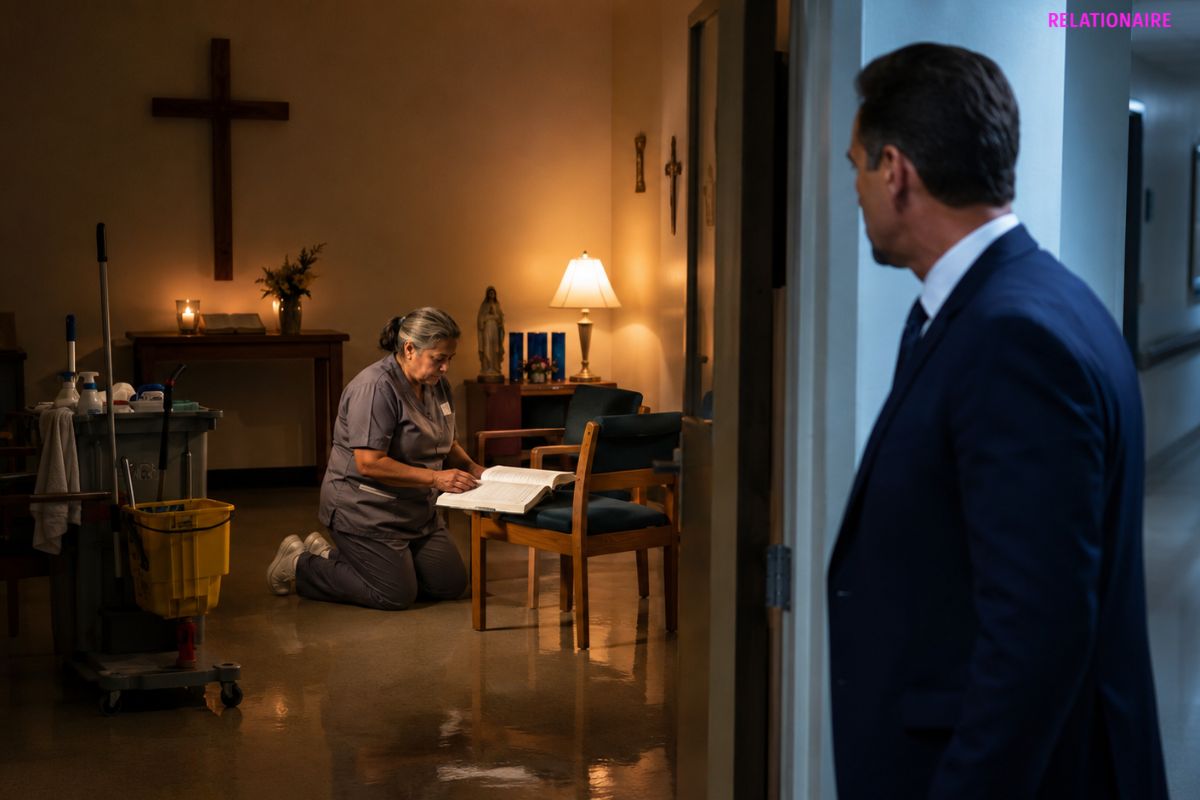
The first time Daniel Mercer saw the cleaner kneeling in the hospital chapel, he thought she was hiding.
It was 9:47 p.m., the end of another long day of meetings, budget reviews, patient satisfaction reports, and quiet complaints that somehow always found his desk.
The chapel was supposed to be empty after nine.
The cleaning schedule said so.
Daniel noticed things like that.
He had built his career noticing what other people missed: a late signature, a misplaced supply order, a nurse clocking out fourteen minutes past approved overtime. He was polished, careful, and always composed. Even his shoes seemed too shiny for a hospital.
That night, he had been walking past the small chapel on the first floor when he saw the door cracked open.
A slice of yellow light fell across the hallway tiles.
Inside, a woman in a gray cleaning uniform knelt near the first row of chairs. Her mop bucket sat behind her. A rag was folded neatly on the floor beside her knee.
She wasn’t mopping.
She wasn’t dusting.
She was bent over something in her hands, whispering.
Daniel stopped.
The hospital chapel was barely bigger than a storage room. Twelve chairs. One wooden cross. A box of tissues. A small table with prayer cards. A visitor log where people wrote names and requests in shaky handwriting.
Families came there when they needed a place to fall apart quietly.
Staff came there when they needed to breathe before walking back into rooms where other people were falling apart loudly.
Daniel rarely went in.
Not since his mother.
He adjusted his tie even though no one was watching.
The cleaner turned a page.
Her lips moved again.
Daniel looked at his watch.
9:49.
Housekeeping shift began at 10.
He told himself it was none of his business.
Then he saw the chapel floor.
The entrance area was still wet from earlier rain. A faint trail of muddy footprints led from the hallway straight to the first row. A coffee spill had dried near the back wall. Someone had left crumpled tissues under a chair.
The cleaner was on the clock in eleven minutes, and the chapel looked exactly as tired as the people who used it.
Daniel stepped away before she could see him.
The next night, he saw her again.
Same time.
Same place.
Kneeling.
Whispering.
Her mop leaning against the wall like an afterthought.
On the third night, he asked the night supervisor.
“Who cleans the chapel after nine?”
The supervisor glanced up from her clipboard. “Usually Rosa.”
“Rosa who?”
“Rosa Alvarez. Environmental services.”
“Does she clock in early?”
“No. She clocks in at ten.”
Daniel looked down the hallway toward the chapel.
The supervisor followed his gaze. “Is something wrong?”
He almost said yes.
Instead, he said, “I’m just reviewing efficiency.”
That was the kind of sentence that made people stand straighter around him.
The next evening, he went back.
He told himself he was checking compliance. He told himself the hospital could not pay people to linger in quiet rooms while other areas needed attention. He told himself discipline mattered because order mattered.
Hospitals survived on order.
But when he reached the chapel, he did not go in.
He stood outside, half-hidden behind the wall, and watched through the narrow opening.
Rosa Alvarez was older than he had first realized. Maybe late fifties. Her dark hair was pulled into a low bun streaked with silver. Her uniform was clean but worn at the elbows. She wore white sneakers that squeaked softly whenever she shifted her weight.
A name badge hung from her pocket.
ROSA.
No title beneath it.
Just Rosa.
She held the chapel visitor log open in both hands.
Daniel leaned closer.
Her voice was low, almost too soft to hear.
“For Mr. Bell in 308,” she whispered. “May he not feel alone tonight.”
She ran one finger down the page.
“For Emily’s father in ICU.”
A pause.
“For the woman waiting for test results.”
Another pause.
“For Patricia.”
Daniel’s throat tightened before he understood why.
Patricia was a common name.
It meant nothing.
It should have meant nothing.
Rosa turned another page.
“For the son who couldn’t get here in time.”
Daniel stepped back so suddenly his shoulder hit the wall.
The sound made Rosa look toward the door.
He kept walking.
Fast.
Down the hallway, past the vending machines, past the framed donor plaques, past the nurses’ station where someone called, “Good night, Mr. Mercer,” and he gave his usual nod without seeing who said it.
By the time he reached his office, his hand was shaking.
He closed the door.
For a long minute, he stood in the dark beside his desk.
Then he opened the bottom drawer.
Inside was an envelope he had not touched in years.
His mother’s discharge papers were not really discharge papers. Everyone had used softer words at the time. He had kept them anyway, folded neatly beside her old hospital bracelet and a visitor badge with his own name on it.
DANIEL MERCER.
He had worn it the day after she passed.
Not the day of.
The day after.
Because when Patricia Mercer had been admitted seven years earlier, Daniel had been in Chicago presenting at a healthcare leadership conference. His sister had called three times.
He had silenced the phone twice.
The third time, he had stepped into the hallway and whispered, “I’ll get the first flight tomorrow.”
Tomorrow had been too late.
That was the sentence that had lived inside him ever since.
Tomorrow had been too late.
He sat down slowly.
The hospital had changed since then. New signage. New cafeteria tables. New patient portal system. New paint on the fifth-floor hallway.
But the chapel looked the same.
The same twelve chairs.
The same wooden cross.
The same visitor log.
He had never opened it.
He had never wanted to know whether his mother’s name was written there.
The next night, Daniel stayed late on purpose.
He watched Rosa clock in at exactly 10:00 p.m.
No theft of time.
No hiding.
No delay.
At 10:01, she tied on a pair of gloves and pushed her cleaning cart toward the east wing.
He followed from a distance.
She worked quickly. Quietly. Carefully.
She emptied trash without banging the bins. She wiped handrails that no one noticed touching. She picked up a fallen blanket outside room 214, folded it, and placed it on the chair instead of tossing it into laundry.
Outside room 226, she stopped.
An old man slept alone, his mouth open, one hand curled on top of the blanket. A plastic cup of water sat just out of reach.
Rosa looked left, then right.
She stepped in, moved the cup closer, and adjusted the call button near his fingers.
Not part of her job.
Daniel knew that immediately.
Then she moved on.
At 11:18, she entered the chapel.
This time, she did mop.
She started at the far corner, slow overlapping strokes, bending slightly as if the floor deserved tenderness too. She wiped the bottoms of the chair legs. She gathered tissues. She straightened the prayer cards.
Then she reached for the visitor log.
Daniel stood outside the door.
He meant to confront her.
That was the word he used in his mind.
Confront.
But Rosa opened the book, and the word slipped away.
Her fingers moved down the page until they stopped.
She whispered a name.
Daniel could not hear it.
Then she reached into her pocket and pulled out something small.
A folded piece of paper.
Old.
Soft at the creases.
She held it for several seconds before placing it gently inside the visitor log.
Daniel felt something cold move through him.
He stepped into the doorway.
“Rosa.”
She startled so badly the paper slid from her hand and landed open on the chapel floor.
Daniel looked down.
The handwriting was his mother’s.
PART 2
For a moment, neither of them moved.
The chapel was so quiet Daniel could hear the air conditioner hum above the ceiling tiles.
Rosa’s hand hovered over the paper, as if she wanted to pick it up before he saw too much.
But he had already seen enough.
The letters were uneven and familiar.
His mother had always pressed too hard when she wrote. Grocery lists. Birthday cards. Notes left on the kitchen counter.
Don’t forget your umbrella.
Soup is in the fridge.
Call me when you land.
Daniel bent down slowly and picked up the paper.
It had been folded into fourths. The edges were soft, almost cloth-like from being opened and closed too many times.
At the top was written:
Patricia Mercer — Room 412.
Below that, in his mother’s handwriting:
Please remember my son Daniel. He works too hard to be sad.
Daniel’s breath caught in his chest.
Not loudly.
Not dramatically.
Just enough to hurt.
Rosa stood up carefully, one hand on the back of the chair for balance.
“Mr. Mercer,” she said, her voice small. “I can explain.”
He wanted to ask how she had it.
He wanted to ask why she had it.
He wanted to ask why a woman he barely knew had been carrying his mother’s words in her pocket while he had kept his grief locked in a drawer like a file no one was allowed to open.
But the first thing he said was colder than he meant.
“You took this?”
Rosa flinched.
Daniel heard it then.
The accusation.
The old administrator in him. The man with polished shoes. The man who found errors before he found people.
“No,” she said softly. “She gave it to me.”
Daniel stared at her.
“My mother?”
Rosa nodded.
The chapel light made the silver in her hair shine.
“I was cleaning the fourth floor that week,” she said. “Mostly nights. Your mother came in here twice when she could still walk with assistance. The second time, she asked me if I knew where the visitor log was kept after the pages filled up.”
Daniel looked at the paper again.
His mother had been worried about visitor logs?
Rosa continued. “I told her the old books went to storage. She said some names should not disappear into storage.”
Daniel swallowed.
His mother had always been like that. Remembering birthdays of people who barely remembered hers. Keeping church bulletins because someone she knew was mentioned in them. Saving sympathy cards in a shoebox.
“She asked me to tear out the page?” Daniel asked.
“No.” Rosa shook her head quickly. “Never. She wrote this separately. She said she did not know if you would come in time.”
The words landed gently.
That made them worse.
Daniel sat down in the first row.
His knees had gone weak, and he hated that Rosa saw it.
He had spent years learning how to keep his face still. Hospital leaders were supposed to be steady. Calm. Unshakeable. He could speak at memorials without trembling. He could tour families through new wings. He could stand beside plaques with donor names and say the right words about compassion.
But this small piece of paper broke through every practiced version of him.
“She knew I was trying to get back,” he said.
Rosa did not answer too quickly.
That kindness was almost unbearable.
“She knew you loved her,” Rosa said at last.
Daniel closed his eyes.
He remembered the airport.
The delayed flight.
The stale coffee.
His phone buzzing while he stood in line to rebook.
His sister’s voice when he finally answered.
Daniel, she’s gone.
He remembered sitting down on the floor near Gate B12 because there had been no chair close enough.
He remembered people stepping around him with rolling suitcases.
He remembered thinking, absurdly, that his mother would hate him sitting on a dirty airport floor in a good suit.
“What did she say?” he asked.
Rosa folded her hands in front of her.
“She said you were the kind of boy who thought being useful was the same as being present.”
Daniel looked at her sharply.
Rosa’s eyes filled, but she did not look away.
“She said that with love,” Rosa added. “Not anger.”
That was exactly how his mother would have said it.
With love.
Not anger.
Daniel pressed the note between both hands.
“Why did you keep it?”
Rosa looked toward the visitor log.
“Because sometimes people leave pieces of themselves in this room,” she said. “And nobody knows what to do with them.”
He waited.
She touched the back of a chair, almost absentmindedly.
“When my husband was here, years before I worked nights, I wrote his name in that book every evening. I wrote the same thing every time. Please don’t let him be scared.”
Daniel had heard of Rosa’s husband only in the way administrators heard of employees’ lives. Briefly. Indirectly. A bereavement leave request. A return-to-work date. A note in a file.
Not a man.
Not a voice.
Not someone afraid.
“I sat right there,” she said, pointing to the third chair from the back. “Every night. Sometimes family came. Sometimes friends. But near the end, people got tired. Not because they didn’t love him. Because hospitals make time strange. People have jobs. Children. Buses to catch. Bills. Fear.”
Her mouth tightened.
“One night, I came in and found someone had written his name under mine.”
Daniel looked at the open log.
“Who?”
Rosa smiled faintly.
“I never knew. Just a note. ‘For Luis, so he is remembered tonight.’”
She wiped at one eye with the back of her wrist.
“It helped more than it should have.”
Daniel did not speak.
“So after he died, when I came to work here, I started reading the names. Not every name every night. I can’t. But as many as I can. People write them and leave. They think no one sees. I see.”
She looked embarrassed now, as if compassion were a rule she had broken.
“I clean the room first,” she said quickly. “Always. Then I read. Before my shift if I arrive early, or on my break, or after I finish. I never skip work.”
Daniel looked down at his mother’s note.
He thought about every time he had walked past Rosa without seeing her.
Every budget meeting where environmental services had been reduced to numbers.
Every staff satisfaction survey that said night workers felt invisible.
Every sign in the hospital that said compassion, while people like Rosa practiced it without a sign at all.
“Why my mother’s note?” he asked.
Rosa’s face changed.
There it was.
The part she had not said.
“She asked me for one thing,” Rosa whispered. “She asked that if you ever came back to the chapel, I should give it to you.”
Daniel felt the room tilt.
“I did come back,” he said.
Rosa nodded.
“The day after.”
He looked up.
“You saw me?”
“You sat in the last row for eleven minutes,” she said. “You did not cry. You held your visitor badge so tight it bent.”
Daniel looked away.
He remembered that badge.
He remembered gripping it until the plastic cracked.
“Why didn’t you give it to me then?”
Rosa’s eyes lowered.
“Because your sister came to the door and said, ‘Not now. He cannot carry one more thing.’”
Daniel’s lips parted.
His sister had never told him that.
“She said to wait,” Rosa said. “So I waited.”
“For seven years?”
Rosa folded and unfolded her hands.
“I kept thinking there would be a right moment.”
Daniel almost laughed, but it came out broken.
A right moment.
There had been seven birthdays.
Seven Mother’s Days.
Seven anniversaries of the call from the airport.
There had been promotions, ribbon cuttings, a new parking garage, three flu seasons, two hospital award ceremonies, and countless nights when Daniel sat alone in his office because going home meant there was no more work to hide inside.
And through all of it, a cleaner had carried his mother’s last concern in her pocket.
Please remember my son Daniel.
He works too hard to be sad.
Daniel stood.
He could not stay seated with all of that inside him.
“I need to talk to my sister,” he said.
Rosa nodded.
But as he turned toward the door, she spoke again.
“Mr. Mercer?”
He stopped.
“There is one more thing.”
Daniel gripped the note.
Rosa walked to the visitor log and turned back several pages. Her fingers trembled as she searched.
Then she found what she was looking for.
She did not tear the page out. She only turned the book toward him.
At first, Daniel saw his mother’s name.
Patricia Mercer.
Then he saw the line written beneath it in handwriting he did not know.
For Patricia’s son, who is trying to come home.
Daniel stared at the words.
Rosa’s voice was barely above a whisper.
“That was the night she died.”
PART 3
Daniel did not go to his office.
He went outside.
The night air felt cool after the hospital’s recycled warmth. He stood near the ambulance bay, beside a row of shrubs trimmed too neatly, and called his sister.
It was almost midnight.
She answered on the fourth ring, her voice thick with sleep.
“Daniel? Is everything okay?”
For seven years, he had wanted to ask her one question and had been too afraid of the answer.
Now he asked it before courage could leave him.
“Why didn’t you tell me about Mom’s note?”
There was silence.
Then a soft breath.
“Oh, Danny.”
No one called him that anymore.
Only his mother had.
“I thought Rosa had given it to you years ago,” his sister said.
Daniel closed his eyes.
“She tried. You told her not now.”
“I did.” Her voice cracked. “Because you were standing there like glass. I thought if anyone touched you, you’d break.”
He leaned against the brick wall.
“I already had.”
“I know,” she whispered. “But you wouldn’t let anyone see.”
An ambulance pulled in without sirens. Two paramedics stepped out calmly, talking in low voices. Somewhere above him, a patient room light glowed blue-white against the dark.
Daniel rubbed his forehead.
“I wasn’t there.”
His sister did not rush to comfort him.
That was mercy too.
“No,” she said gently. “You weren’t.”
The honesty hurt.
Then she added, “But she knew you were trying.”
“I silenced your calls.”
“You were working.”
“That doesn’t excuse it.”
“No,” she said again. “It doesn’t. But guilt isn’t proof that you didn’t love her.”
Daniel pressed the phone harder to his ear.
“She said I thought being useful was the same as being present.”
His sister gave a sad little laugh.
“She said that to all of us, in different ways.”
That surprised him.
“She said I kept bringing casseroles instead of sitting down,” his sister said. “She said Aunt May talked too much because silence scared her. She said you made work your armor.”
Daniel looked through the glass doors into the hospital lobby.
A security guard was helping an elderly woman find the right elevator. A young father sat on a bench with a sleeping child against his chest. A nurse walked past with a paper cup of coffee and eyes that looked older than her face.
Work your armor.
His mother had seen him clearly.
Even at the end.
Especially then.
When Daniel returned to the chapel, Rosa was gone.
The floor was clean.
The chairs were straight.
The visitor log sat open on the small wooden table.
His mother’s note lay beside it, folded carefully.
Daniel picked it up and sat in the last row.
The same place Rosa had remembered.
For the first time since Patricia Mercer died, he allowed himself to stay.
Not as an administrator.
Not as the man who signed forms and approved schedules.
Just as a son.
At 1:12 a.m., Rosa came back with her cart.
She stopped when she saw him.
“I’m sorry,” she said automatically.
Daniel shook his head.
“No. Please.”
She hesitated, then entered.
The wheels of her cart squeaked once and settled.
Daniel looked at the visitor log.
“Will you read them tonight?”
Rosa seemed unsure.
“You don’t have to stay.”
“I’d like to.”
So she stood beside the table, opened the book to the newest page, and read softly.
“For Anna in recovery, whose daughter is driving through the rain.”
She paused.
“For Mr. Kamal, who asked for music.”
Another pause.
“For the baby in room 219, and for her tired mother.”
Daniel stared at the floor as each name entered the room.
Not loudly.
Not officially.
No policy captured it.
No plaque would ever be made for it.
But something holy happened there, in a hospital chapel with vinyl floors and a half-empty tissue box.
People who thought they had been forgotten were remembered by a woman holding a mop.
When Rosa finished, Daniel said, “Who wrote the line under my mother’s name?”
Rosa turned the page back carefully.
For Patricia’s son, who is trying to come home.
“I did,” she said.
Daniel looked at her.
“She worried about you,” Rosa said. “Not because you were bad. Because you were alone in a way busy people are alone. She asked if I thought sons could forgive themselves.”
Daniel felt his eyes burn.
“What did you tell her?”
“I told her mothers usually forgive first.”
He covered his face with one hand.
Rosa did not move toward him.
She did not pat his shoulder or say it was okay.
She simply stayed.
That was what made him cry.
The next morning, Daniel cancelled his first meeting.
Then his second.
By noon, the hospital was whispering.
Mr. Mercer cancelled finance review.
Mr. Mercer rescheduled donor lunch.
Mr. Mercer was seen on the night shift floor.
He found Rosa in the housekeeping supply room, restocking disinfectant wipes.
She straightened when he entered.
“Did I do something wrong?”
Daniel hated that her first thought was fear.
“No,” he said. “You did something right for a long time without anyone noticing.”
Her brow furrowed.
He handed her an envelope.
Inside was a formal letter, but not a warning. Not a reprimand.
A commendation.
More than that, a proposal.
A small volunteer program, led by spiritual care but supported by environmental services, nursing, and family liaison staff. A way for names left in the chapel log to be read each night by someone willing. No medical details. No privacy violations. Just first names when appropriate. Just remembrance. Just a small promise that written names would not sit alone on paper.
Rosa read it slowly.
“I don’t need an award,” she said.
“I know.”
“I don’t want people looking at me.”
“I know.”
She looked up.
“Then why?”
Daniel took a breath.
“Because no one should have to hide tenderness in a pocket.”
Rosa looked down at the envelope again.
For a second, he saw her as his mother must have seen her. Not a cleaner. Not background. Not a line item in a staffing report.
A witness.
A keeper of names.
A woman who understood that hospitals were not only places where bodies were treated, but places where love came frightened and tired and sometimes too late.
The program began quietly.
No press release.
No big banner.
Just a small card placed beside the chapel visitor log:
If you write a name here, someone will hold it in thought tonight.
Staff started signing up.
A respiratory therapist who had lost her father.
A cafeteria worker who remembered every patient who liked extra peaches.
A security guard who said he wasn’t good with words but could read names just fine.
Even Daniel signed up for Thursdays.
The first time he read aloud, his voice shook.
“For Elena, waiting for morning.”
“For James, who misses his dog.”
“For Patricia.”
He stopped.
Rosa stood near the back, hands folded.
Daniel looked at the page.
There was no new Patricia in the book that night.
He had written the name himself.
Not to reopen the wound.
To finally stop pretending it wasn’t there.
Months later, on the anniversary of his mother’s passing, Daniel arrived before dawn.
The chapel smelled faintly of lemon cleaner and old wood.
On the table sat a folded note.
His name was written on the outside.
Danny.
His sister’s handwriting.
He opened it with trembling hands.
Inside was a copy of a photo he had not seen in years. His mother in her garden, laughing at something outside the frame, one hand lifted to block the sun. On the back, his sister had written:
She knew you loved her. Come home for dinner Sunday.
Daniel sat down in the first row.
Not the last.
When Rosa came in, she found him smiling through tears.
“You’re early,” she said.
“So are you,” he answered.
She shrugged. “Floors don’t mop themselves.”
He laughed softly.
Then, together, they opened the visitor log.
The hospital was waking around them. Elevators chimed. Wheels rolled over tile. Someone coughed in the hallway. Somewhere, a family was getting news. Somewhere, a nurse was taking a breath before entering a room.
And in the little chapel, two people read the names.
Not because it fixed everything.
It didn’t.
Not because remembering erased regret.
It couldn’t.
But because sometimes love arrives late and still deserves a chair.
Sometimes forgiveness begins in a place you avoided for years.
And sometimes the person holding your heart together is someone you walked past every night, carrying a mop, whispering names into the quiet.