If you’ve already read part 1 of this story on Facebook, go here for Part 2!
PART 1
The first time I saw Mara cry, she was holding a paper cup of soup like it was something sacred.
Not spilling it.
Not serving it.
Just holding it with both hands, standing behind the hospital cafeteria counter while everyone rushed past her like she was part of the wall.
I was three months into my internship then, which meant I was tired enough to forget my own name but still proud enough to think exhaustion made me important.
Every morning, I walked into Mercy General with my white coat wrinkled, my badge flipped backward, and a cold coffee already dying in my hand.
And every morning, before I could even speak, Mara would slide a toasted bagel toward me.
“Plain. Burnt edges. No cream cheese,” she’d say.
I never told her that order.
I never asked how she knew.
I just tapped my card, grabbed the paper bag, and kept walking.
That was the kind of person I was becoming.
Fast.
Hungry.
Useful.
Too busy to notice kindness unless it came with my name printed on a chart.
Mara noticed everyone.
She knew Dr. Patel took black coffee only when he had bad news to deliver.
She knew Nurse Lena wanted two bananas on night shift because one was always for the elderly man in room 412 who refused breakfast but would eat fruit if she peeled it first.
She knew Mr. Alvarez in the ICU waiting room liked his oatmeal thin because his hands shook too much when it was thick.
She knew which residents lied about eating.
She knew which mothers had stopped sleeping.
She knew which fathers cried in the stairwell and came back pretending they had allergies.
To most of us, she was just the cafeteria lady.
Late fifties, maybe.
Soft gray hair tucked into a hairnet.
Blue apron.
Reading glasses hanging on a chain.
Hands always moving.
A woman with a calm voice in a place where everything beeped, rang, and broke.
I barely looked at her.
Until the day the rumor started.
It was a Tuesday, because bad things in hospitals always seemed to happen on ordinary days.
The cafeteria was packed by noon. Rain streaked the windows. People stood in line holding trays, phones, crumpled visitor badges, and the kind of silence that comes from waiting for answers nobody wants.
I was halfway through paying for coffee when I heard two nurses whisper behind me.
“They’re saying it was a medication mistake.”
“On pediatrics?”
“That’s what I heard.”
My stomach tightened.
Everyone’s did.
Hospital rumors move differently. They don’t run. They seep. Through hallways. Around nurse stations. Under closed doors.
By one o’clock, the whole building seemed to know something had happened on the pediatric floor.
No one knew the full truth.
That didn’t stop anyone from filling in the blanks.
A little boy in 5B had taken a turn.
A chart had been misread.
A dose had been wrong.
A nurse was crying in the medication room.
A doctor had been called into administration.
A family was threatening to sue.
Rumor after rumor.
And in the middle of it all, Mara kept serving food.
“Turkey sandwich, no tomato,” she said gently to a surgeon who didn’t answer.
“Hot tea, two sugars,” she said to a woman whose visitor badge was bent in half.
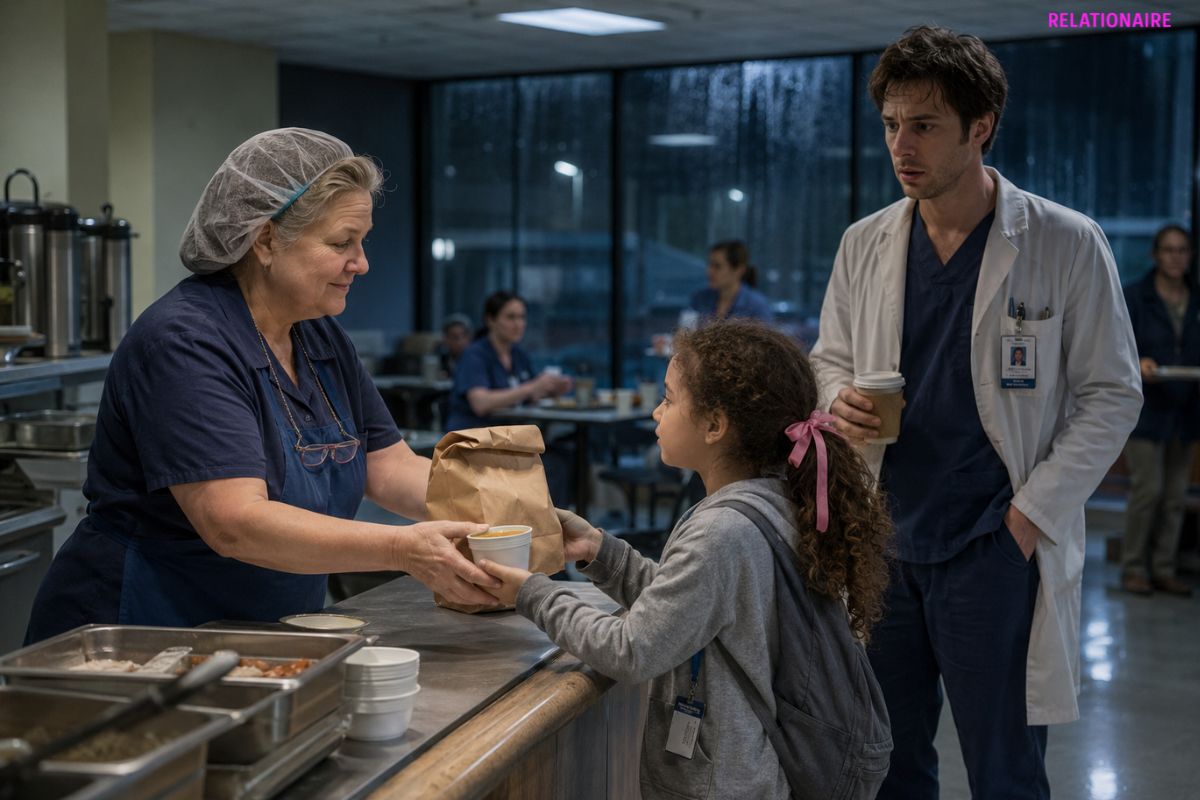
“Chicken broth,” she said, placing a bowl on a tray. “Careful, sweetheart. It’s hot.”
That last one made me look up.
A little girl stood at the side of the counter.
She couldn’t have been more than seven.
She had tight curls tied with a pink ribbon, light-up sneakers, and a hospital bracelet loose around one wrist. Not a patient bracelet. A visitor one. It was worn and wrinkled like she’d been wearing it too long.
She reached for the soup with both hands.
Mara covered the girl’s fingers with her own.
“Where’s your mama, Tilly?”
“Sleeping.”
“Beside Noah?”
The girl nodded.
“Did she eat today?”
Tilly looked down.
That was answer enough.
Mara’s face changed.
Not dramatically.
Just a small tightening around the eyes.
Then she turned, packed two wrapped sandwiches, a banana, and a carton of milk into a brown paper bag.
“Mara,” I said before I could stop myself.
She looked at me.
There was a line forming behind the girl.
People waiting.
People watching.
I don’t know why I spoke. Maybe because I was tired. Maybe because the rumor had put everyone on edge. Maybe because I saw food going into a bag and no card being tapped, no cash placed down.
Maybe because I had spent three months being trained to catch mistakes, and suddenly every ordinary kindness looked like a rule being broken.
“Did she pay for that?” I asked.
The cafeteria went quiet in that sharp, ugly way that makes you hear the refrigerator humming.
Tilly froze.
Mara’s hand stayed on the bag.
For a second, nobody moved.
Then Mara said softly, “Go on, baby. Take it to your mama.”
The girl hugged the bag to her chest and slipped away.
I felt heat rise under my collar.
I wanted Mara to defend herself. To say it was allowed. To say someone had approved it.
Instead, she turned back to the register.
“That’ll be two dollars for the coffee, Doctor.”
I wasn’t a doctor yet.
I hated that she called me that right then.
Behind me, someone cleared their throat.
I tapped my card and walked away with my coffee, feeling like I had done the responsible thing and the wrong thing at the same time.
The rest of the day got worse.
Pediatrics stayed tense. Supervisors moved in and out of closed rooms. Families whispered. Staff avoided eye contact.
And the rumor grew teeth.
By evening, everyone had a version.
The little boy’s name was Noah.
His mother had been sleeping in a chair for weeks.
His sister, Tilly, practically lived in the unit.
And someone, people said, had made a mistake.
At 8:40 that night, I went back to the cafeteria because I had not eaten since morning.
The place was nearly empty.
Chairs stacked on tables.
Fluorescent lights buzzing.
A mop bucket near the drink machine.
Mara stood alone behind the counter, wiping the same clean spot over and over.
For the first time all day, she looked tired.
Not cafeteria tired.
Hospital tired.
The kind that gets into the bones.
I almost turned around.
Then I saw Tilly sitting at a corner table with her pink ribbon undone, pushing a cracker back and forth across a napkin.
Mara stood beside her, one hand resting gently on the back of the chair.
The girl was whispering something.
I couldn’t hear all of it.
Only one sentence.
“My mama says Noah didn’t get worse because of medicine.”
Mara bent down.
Tilly kept talking.
“She says he got worse because she couldn’t keep being awake enough to notice.”
My chest tightened.
Mara closed her eyes.
Then Tilly looked straight at me.
Not past me.
At me.
“You’re the doctor who was mean about the food.”
I stopped.
Mara turned around, and there was no anger in her face.
That somehow made it worse.
“I’m sorry,” I said, but it came out too small.
Tilly slid off the chair and reached into the pocket of her little hoodie.
She pulled out a folded receipt.
It had cafeteria grease on one corner and a child’s drawing on the back.
A man with glasses.
A bowl of soup.
A heart.
She held it toward me.
“Mara said I shouldn’t tell,” Tilly whispered. “But she feeds your dad too.”
My whole body went still.
“My dad?”
Tilly nodded.
“He sits by the window when he comes from upstairs. He says not to call you because you’re busy saving everybody else.”
Mara’s face went pale.
The cafeteria lights hummed above us.
I looked at the folded receipt in Tilly’s hand, then at Mara, then back at the little drawing of a man I suddenly knew too well.
And all I could say was, “What upstairs?”
PART 2
Mara took the receipt from Tilly very gently, like the paper might bruise.
“Tilly,” she said, “why don’t you go sit with your mama for a minute?”
The little girl looked between us.
Children in hospitals learn adult silence too early. They know when a room has changed. They know when words have weight.
“Is he mad?” she asked.
“No,” Mara said.
But she didn’t look sure.
Tilly walked away with her crackers cupped in both hands.
I stood there in the empty cafeteria with my white coat hanging open, suddenly feeling less like a doctor and more like a son who had missed something obvious.
“What upstairs?” I asked again.
Mara folded the receipt once.
Then again.
“Oncology clinic,” she said.
The word landed quietly.
That made it worse.
There was no dramatic sound. No crash. No gasp. Just a cafeteria at closing time. A mop bucket. A coffee machine clicking as it cooled. My whole life shifting under fluorescent lights.
“My father doesn’t come here,” I said.
But even as I said it, I remembered things.
My dad canceling dinner twice.
His voice sounding thin on the phone.
The way he had said, “Don’t worry about me, Minh. You’ve got enough sick people.”
The loose watch on his wrist last month.
The unopened soup containers in his fridge when I stopped by late and found him “not hungry.”
Mara watched me remember.
I hated that.
Not because she had done anything wrong.
Because she had seen my father more clearly than I had.
“How long?” I asked.
She pressed her lips together.
“I don’t know everything.”
“But you know enough.”
Mara looked down at her hands.
They were clean, but the work lived in them. Small burns. Dry knuckles. A faint tremor when she was tired.
“He started coming in about six weeks ago,” she said. “At first, he bought coffee. Then broth. Then nothing. He would sit by the window and pretend to read old magazines.”
I swallowed.
“He never told me.”
“He said you were on pediatrics. He said you were carrying enough.”
That sounded like my father.
Kind in a way that could hurt you.
“He shouldn’t have told you,” I said, too sharply.
Mara nodded once.
“No. Maybe not.”
Something in her voice stopped me.
She didn’t defend herself.
That was Mara’s way, I would learn.
She never stepped into the center of a story, even when she had been holding the whole thing up from the edge.
“Why were you feeding him?” I asked.
“Because he was hungry.”
I looked away.
Such a simple answer.
Such a devastating one.
The rumor about Noah still moved through the hospital that night. It was everywhere. In whispers near elevators. In half-finished sentences at computers. In the way people lowered their voices when his mother passed.
I should have gone upstairs to find my father.
Instead, I stood in that cafeteria because I could not move.
Mara took off her apron and hung it on a hook behind the counter.
There was a faded photo taped inside her locker.
A young man in a graduation gown.
A boy, really.
Smiling so hard his eyes disappeared.
Beside the photo was a prayer card, its edges softened by years of touch.
I noticed it.
She noticed me noticing.
“My son,” she said.
I didn’t ask.
But she told me anyway.
Not all at once.
Not like a confession.
More like someone setting down groceries one item at a time.
His name was Daniel.
He had worked as a transport aide at Mercy General years before. He was the kind of young man who knew which patients liked to face the window and which ones were afraid of elevators.
“He used to bring me stories,” Mara said. “Never names. Just stories. ‘Mama, I wheeled a man downstairs today who kept asking whether his wife had eaten.’ Or, ‘Mama, a little girl gave me a sticker because I pushed her slow.’”
She smiled, but it didn’t reach her eyes.
“He said hospitals don’t run on medicine alone.”
I thought of the way I had snapped at her about food.
Mara kept her hands busy, stacking napkins that did not need stacking.
“Daniel got sick before he turned twenty-four. He spent his last months here. Different floor. Different staff. Same cafeteria soup.”
She paused.
“I kept trying to make him eat.”
The refrigerator hummed.
“And one night, a cafeteria worker I barely knew brought him mashed potatoes with extra gravy. He hadn’t asked. She just remembered he liked them. He ate three bites.”
Mara looked at me then.
“Three bites can feel like a miracle when you love someone.”
I had no answer.
The hospital around us seemed suddenly full of unseen miracles.
Bananas peeled by tired nurses.
Blankets warmed before anyone asked.
Coffee placed beside shaking hands.
Sandwiches slipped into paper bags.
Small things.
The kind of things important people walk past.
Mara closed her locker.
“I started working here after he passed,” she said. “Part-time at first. Then I stayed.”
“Because of him?”
“Because someone had remembered what he liked.”
I felt my face burn.
Not with shame exactly.
Something deeper.
I had spent months telling myself I was too busy to call my father back. Too busy to visit. Too busy to notice the pauses between his words.
But Mara had noticed.
Mara, who didn’t share his blood.
Mara, who knew his soup order.
Before I could speak, a sound came from the hallway.
A woman crying.
Not loudly.
That soft, embarrassed crying people do when they are trying not to take up space.
Tilly’s mother stood near the cafeteria entrance, one hand covering her mouth. Her visitor badge hung from a blue lanyard, twisted and worn. Her sweatshirt had a small stain near the sleeve. Her eyes were swollen from weeks of pretending she could keep going.
“Mara,” she said.
Mara went to her immediately.
The woman looked at me, then away.
“I heard what people are saying,” she whispered.
Mara touched her arm.
“You don’t have to explain anything tonight.”
“Yes, I do.”
The woman stepped inside. Her name, I later learned, was Elise.
She looked like someone who had been awake so long that rest had become a language she no longer understood.
“Noah didn’t get worse because someone hurt him,” Elise said. “He got worse because bodies get tired. Because illness is cruel. Because I was so exhausted I blamed myself before anyone else could.”
Her voice cracked.
“And then people started saying mistake, mistake, mistake. Like there had to be someone to punish so we didn’t have to admit how helpless this feels.”
I stood very still.
I had heard the rumor.
I had believed parts of it.
Not because I knew anything.
Because judgment gives fear somewhere to sit.
Elise looked at Mara.
“This woman fed my daughter when I forgot she was hungry,” she said. “She brought me tea when I forgot I was cold. She noticed I was disappearing before I did.”
Mara shook her head slightly, as if attention embarrassed her.
But Elise wasn’t finished.
“She also told me to sleep,” Elise said. “And I got angry. I told her she didn’t know what it was like to love someone in a hospital bed.”
Mara’s eyes filled.
Elise reached into her pocket and pulled out a folded paper.
Not a receipt this time.
A note.
“I wrote this for her,” Elise said. “But I think maybe it’s for all of you.”
She handed it to me.
My fingers hesitated around it.
I was not ready for another truth.
But the paper was already in my hand.
And at the bottom, beneath Elise’s shaky handwriting, was my father’s name.
Not printed.
Signed.
As if he had written something too.
PART 3
I opened the note in the hallway outside the cafeteria because I could not breathe inside it.
The paper was warm from Elise’s pocket.
Three different handwritings filled the page.
Elise’s came first.
Thank you for feeding my daughter when I could not leave my son.
Then Tilly’s, large and uneven.
Thank you for soup. I like the crackers too.
Then, at the bottom, my father’s handwriting.
Small.
Careful.
Familiar enough to hurt.
Mara, thank you for not letting me be alone while my son is busy becoming the kind of doctor this place needs.
I read the line three times.
Not because I didn’t understand it.
Because I did.
My father had always written like that. With more grace than accusation. With a gentleness that made you feel forgiven before you had apologized.
I found him twenty minutes later.
He was not in a hospital bed.
That was the first mercy.
He was in the oncology clinic waiting area, sitting by the window under a wall clock that had stopped ticking loudly years ago but still made everyone look up.
He wore his brown cardigan.
The one with the loose button he refused to let me replace.
There was a paper cup of broth beside him and a magazine open on his lap that he was not reading.
For a second, I stood behind the doorway and watched him.
My father looked smaller than I remembered.
Not weak.
Just tired in a way he had hidden from me because hiding had always been his love language.
He turned his head and saw me.
His face changed.
Guilt first.
Then tenderness.
Then the smallest smile.
“Minh,” he said. “You’re supposed to be working.”
I walked toward him slowly.
“I was.”
He looked at the note in my hand.
His eyes lowered.
“Mara told you?”
“Tilly did.”
He let out a soft breath, almost a laugh.
“Children are terrible secret keepers.”
I sat beside him.
For a moment, neither of us spoke.
Hospitals teach you how to speak to strangers about pain. They do not teach you how to sit beside your own father and admit you have missed his.
“How long have you known?” I asked.
“A while.”
“That’s not an answer.”
“No,” he said. “It is not.”
His hands rested on the magazine. His wedding ring looked loose.
“I didn’t want your first year here to be about me.”
I stared at him.
“You’re my father.”
“And you are my son,” he said softly. “That is exactly why.”
I wanted to be angry.
Anger would have been easier.
It would have given me something sharp to hold.
But then I looked at the broth Mara had brought him. The plastic spoon. The napkin folded neatly beneath it. The care placed around him by someone who did not owe us anything.
“You should have told me,” I said.
“I know.”
“I would have come.”
“I know.”
“Then why didn’t you let me?”
He looked out the window.
Rain still moved down the glass in thin lines.
“Because after your mother died, I watched you become serious overnight,” he said. “You were fifteen. You stopped asking for things. You stopped crying where I could see. You made yourself easy to raise.”
My throat tightened.
“I thought I was helping.”
“You were a child.”
He turned back to me.
“And I was so grateful for your strength that sometimes I forgot it cost you something.”
No monitor beeped.
No alarm rang.
No emergency pulled me away.
Just my father, sitting beside a cooling cup of soup, telling me the truth years late.
“I didn’t want to take more from you,” he said.
I looked down at my hands.
They were shaking.
“You didn’t take anything.”
He smiled sadly.
“That is what children say when parents have already taken too much.”
The door opened down the hall.
Mara appeared with a tray she pretended not to carry for us.
Two cups of tea.
One packet of crackers.
A banana.
She saw us and stopped.
“I can come back,” she said.
“No,” my father said. “Please.”
She set the tray down between us.
Not fussing.
Not intruding.
Just placing kindness within reach.
“I’m sorry,” I told her.
Mara looked at me.
“For the food,” I said. “For assuming. For not seeing what you were doing.”
She adjusted the napkin under the tea.
“You saw what you were trained to see.”
“That’s not an excuse.”
“No,” she said. “But it is a beginning.”
My father took the tea with both hands.
“Mara says doctors need feeding too,” he said.
“She’s right,” I said.
For the first time in weeks, maybe months, he looked relieved.
Not cured.
Not magically fixed.
Just relieved that the hiding was over.
The next morning, the rumor about Noah finally quieted.
The official explanation never spread as quickly as the false one had. Truth rarely moves as fast as fear.
But something changed.
Elise wrote a note to the pediatric staff.
She thanked the nurses.
She thanked the doctors.
She thanked the cleaning crew who kept the room safe.
She thanked the cafeteria worker who remembered that her daughter liked crackers more than bread.
The note was copied and pinned near the staff elevator.
People stopped to read it.
Some wiped their eyes and pretended not to.
Noah improved slowly. Not in a movie way. In a hospital way. A little less oxygen. A little more color. A smile one afternoon when Tilly drew a crooked dinosaur on the whiteboard.
Elise slept for four straight hours in the family room while Mara sat with Tilly in the cafeteria and taught her how to count back change at the register.
My father started letting me come to appointments.
Not all of them.
He was still my father.
But some.
On those days, I met him afterward in the cafeteria.
Mara always had broth ready.
Sometimes he ate half a sandwich.
Sometimes only three bites.
I learned not to measure hope by full plates.
I learned that three bites could be enough to thank the morning for coming.
Weeks later, the hospital held a small appreciation breakfast for support staff.
There were balloons near the cafeteria entrance and a sheet cake with blue icing. Someone from administration gave a speech about teamwork. It was kind. It was polished. It missed the point.
Then Tilly stepped forward.
Her mother stood behind her, one hand on her shoulder.
Tilly held a folded paper, her pink ribbon back in her curls.
She looked at Mara.
“You know everybody’s order,” she read carefully. “But you also know when people are sad and pretending they aren’t.”
The cafeteria went silent.
Mara pressed a hand to her mouth.
Tilly kept reading.
“You gave my mama tea. You gave me soup. You gave Mr. Minh’s dad broth. You gave everybody something so they didn’t feel forgotten.”
She looked up.
“That is not just food.”
No one moved for a second.
Then applause rose quietly.
Not loud at first.
Hospitals are careful with noise.
But it grew.
Nurses clapped with tired hands.
Doctors clapped with coffee cups tucked under their arms.
Cleaning staff clapped from the doorway.
Families clapped too, some still wearing visitor badges, some still waiting for news.
Mara cried then.
Not the kind of crying that asks for attention.
The kind that happens when someone finally says out loud what your heart has been doing in silence for years.
My father stood beside me, clapping slowly.
His eyes were wet.
“She fed me before you knew I was hungry,” he said.
I nodded.
“And then she fed you too.”
He was right.
Because that was the thing about Mara.
She had not only fed the frightened girl, or the exhausted mother, or the old man by the window.
She had fed the part of us that hospitals can starve if we are not careful.
The part that notices.
The part that softens.
The part that remembers a person is more than a chart, a badge, a rumor, a mistake, a job title, or a tired face in line.
Months later, whenever I walked into the cafeteria, Mara still had my bagel ready.
Plain.
Burnt edges.
No cream cheese.
But I stopped grabbing it without looking.
I stopped treating kindness like background noise.
I learned to say, “Good morning, Mara.”
And I learned to wait for her answer.
Because sometimes the person everyone overlooks is the one holding the whole place together.
Not with grand gestures.
Not with speeches.
Just with soup, tea, crackers, and the quiet courage to notice who is hungry before they ask.