If you’ve already read part 1 of this story on Facebook, go here for Part 2!
PART 1
My mother was being discharged from the hospital, and I was throwing away everything that smelled like sickness.
The paper cups.
The half-used lotion.
The unopened crackers from the tray.
The little plastic basin no one wanted to name.
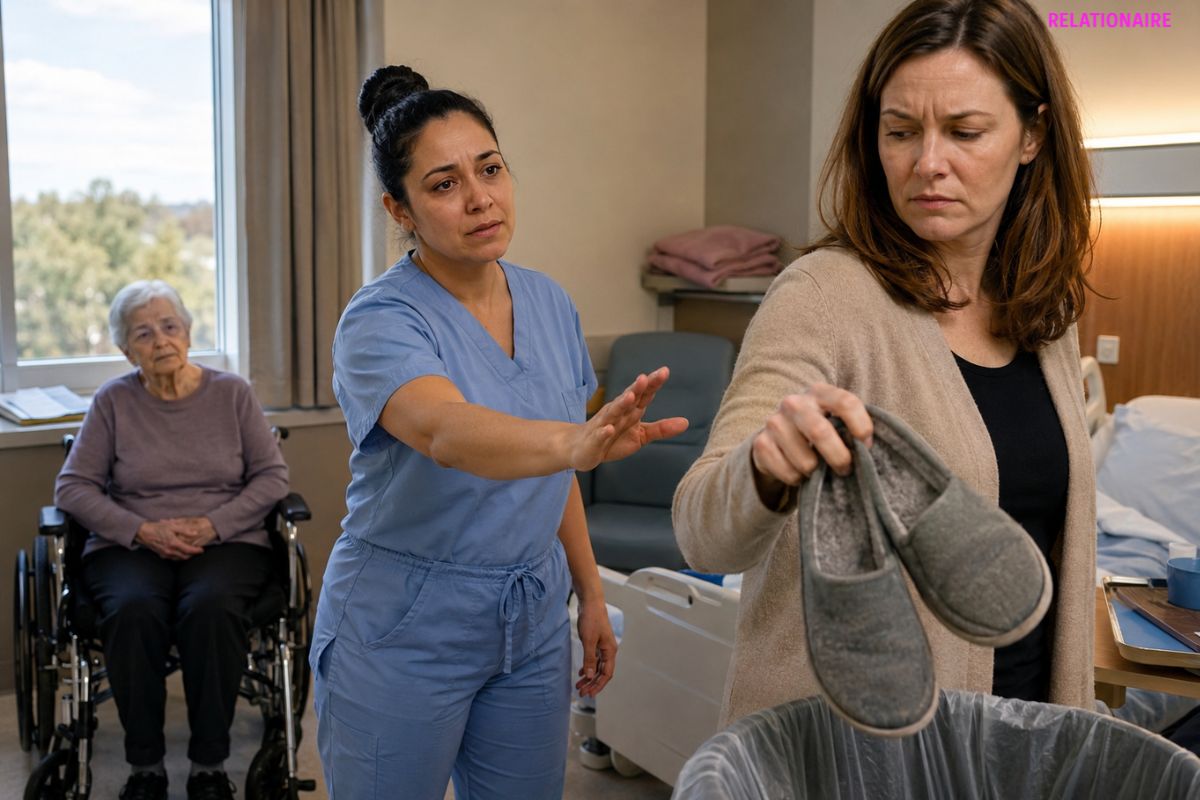
And then I picked up the slippers.
They were gray once, maybe. Now they were the color of old dishwater. The backs were flattened from too many tired steps. One toe had a loose thread hanging from it, and the rubber sole had worn thin near the heel.
I held them between two fingers and turned toward the trash can.
That was when Nurse Elena said, very softly, “Please don’t throw those away.”
I stopped.
She stood near the doorway with my mother’s discharge papers tucked under her arm. Her scrubs were pale blue and wrinkled at the knees. Her hair was pulled into a bun so tight it made her face look sterner than it probably was.
I had seen her every morning that week.
Always calm.
Always quiet.
Always moving like she was saving her strength for something no one else could see.
But that day, I was tired.
Tired from sleeping in a chair that folded my spine in half. Tired from fighting with insurance over the phone. Tired from pretending I was not scared every time my mother forgot what day it was.
My mother had survived the worst of it. She was going home.
So I wanted the room clean.
Empty.
Proof that we were leaving all of this behind.
“They’re falling apart,” I said.
“I know,” Elena replied.
“They’re not even hers.”
My voice came out sharper than I meant.
My mother, sitting in the wheelchair by the window, looked down at her lap. She had a hospital blanket folded over her knees even though she was wearing her own clothes again. A soft purple sweater. Black pants. Her wedding ring loose on her finger.
“She wore them all week,” Elena said.
“Because someone left them here,” I said. “And nobody gave her proper ones.”
Elena’s eyes flicked toward my mother.
Not long.
Just enough for me to notice.
“I washed them,” she said. “Before your mother used them.”
That irritated me more.
The gentleness.
The way she stood there guarding two ugly slippers like they were something holy.
I had spent six nights watching strangers come in and out of my mother’s room. Doctors with tablets. Aides checking blood pressure. Food service workers carrying trays she barely touched. Housekeepers emptying bins. Nurses changing shifts with tired smiles and coffee breath.
Everyone had been kind enough.
But I was still angry.
Not at one person.
At the whole place.
At the fluorescent lights that never softened.
At the beeping machines.
At the way my mother looked smaller in a hospital bed.
At myself for not noticing sooner that she had gotten weaker.
So I said, “Nurse, we’re trying to leave. I don’t need a conversation about garbage.”
The room went still.
My mother closed her eyes.
Elena did not look offended.
That made it worse.
She only walked closer, slowly, like she was approaching someone frightened. She set the discharge papers on the windowsill and reached out one hand.
“May I?” she asked.
I almost laughed.
May I.
For trash.
But something in her voice stopped me.
Not authority.
Not judgment.
A kind of ache.
I handed her the slippers.
She took them with both hands.
Both.
Like they could break.
“They’re clean,” she said again.
“I’m not worried about germs,” I said. “I’m worried about my mother going home with someone else’s junk.”
My mother whispered, “Mara.”
Just my name.
Small and tired.
I turned to her. “Mom, you don’t need these. I bought you new ones. The memory foam kind. They’re in the bag.”
She looked at the shopping bag by the chair, then at the slippers in Elena’s hands.
Her mouth trembled, but she smiled like she was trying to keep peace.
“They helped,” she said.
“They’re slippers.”
My mother looked away.
That should have been my first clue.
But I missed it.
I missed a lot that week.
I missed how Elena always brought my mother tea in a paper cup with two lids so it stayed warm longer.
I missed how she placed the call button in my mother’s right hand, not the left, because the left hand shook.
I missed how the cleaning woman once paused outside the room and asked, “Is Miss Rose sleeping?” like my mother was not just a room number.
I missed the folded blue cardigan on the chair that did not belong to us.
The crossword book on the tray.
The soft blanket at the foot of the bed.
I only saw clutter.
I only saw things I wanted gone.
Elena held the slippers against her chest.
“Your mother asked to keep them for one more night,” she said.
“Fine,” I said. “She kept them. Now we’re leaving.”
My mother’s eyes filled.
I hated that too.
Not because I was cruel.
Because if she cried, I would cry. And if I started, I didn’t know if I would stop.
So I reached for the slippers again.
Elena stepped back.
Just one step.
It was small.
But it changed the room.
My hand stayed in the air.
“Why are you doing this?” I asked.
Elena looked at me then.
Really looked.
Her eyes were tired in a way sleep would not fix.
“Because the last time I let someone throw away a pair of slippers,” she said, “I promised myself I would never do it again.”
I stared at her.
My mother covered her mouth.
“Elena,” she whispered.
The nurse swallowed.
And for the first time all week, her calm cracked.
She looked down at those worn gray slippers and said, “They belonged to a woman who died with no one coming to claim her things.”
Then she reached into the pocket of her scrubs and pulled out a small folded note.
My name was written on it.
In my mother’s handwriting.
PART 2
The note was folded twice.
Not neatly.
My mother’s hands had not been steady enough for neatness that week.
I took it from Elena, and for a moment I forgot every impatient thing I had just said. The room was too bright. Too quiet. Outside the open door, someone laughed at the nurse station, then lowered their voice.
My mother looked out the window.
“Elena,” I said carefully, “what is this?”
The nurse did not answer right away.
She placed the slippers on the bed beside my mother’s folded blanket. Then she stepped back, giving me space I suddenly did not deserve.
“Your mother asked me to give it to you before you left,” she said.
My throat tightened.
“Mom?”
My mother touched her wedding ring with her thumb.
It was something she did when she was nervous. She had done it at my father’s funeral. At my college graduation. In the grocery store the day she admitted she could no longer read the small print on labels.
“Open it,” she said.
So I did.
Inside, the words were uneven and cramped.
Mara, please don’t throw everything away.
That was the first line.
I looked at her.
Her eyes stayed on the window.
I kept reading.
Some things here are not mine because I needed them. Some things are mine because somebody else did.
My hand lowered.
I saw the room differently then.
The purple sweater she was wearing.
The blue cardigan on the chair.
The crossword book.
The blanket.
The slippers.
All week, I had thought the hospital had misplaced things or gathered random donations into my mother’s room. I had complained twice to the front desk. I had told my husband on the phone, “It’s like nobody knows what belongs to anyone here.”
Now shame moved through me slowly, like cold water.
“What does this mean?” I asked.
My mother finally turned.
She looked older than she had that morning.
Not sick.
Just honest.
“The cardigan belonged to me,” she said. “It’s for Mr. Alvarez in 412. He gets cold during dialysis. He told Elena the hospital blankets itch.”
I blinked.
“The crossword book?”
“For Denise. She waits for her husband every afternoon and pretends not to cry. She likes the easy puzzles because she says hard ones make her feel stupid.”
My mother smiled sadly.
“She is not stupid.”
Elena stood near the door, quiet as a shadow.
“And the blanket?” I asked.
My mother looked at the blanket at the foot of the bed.
“For the little girl across the hall. The one with the yellow socks. Her grandmother sleeps in the chair. She never brings a coat.”
I sat down hard on the edge of the visitor chair.
The chair squeaked under me.
I remembered that grandmother now.
A woman with gray braids and a canvas tote bag. I had seen her in the hallway at 2 a.m., trying to drink coffee from a vending machine cup with trembling hands.
I had walked past her.
My mother had not.
“You were giving your things away?” I asked.
“I was lending dignity,” she said.
It sounded like something my father would have said.
My mother had always been practical. Coupons in a kitchen drawer. Soup in reused jars. Birthday cards saved because “someone’s hand touched this.” When I was a child, she kept an envelope marked for someone who needs it in the glove compartment. Bus fare. Grocery money. A stamp.
But I had forgotten that version of her.
Illness had made me see only what she had lost.
Her strength.
Her memory on bad days.
Her fast walk.
Her full laugh.
I had not noticed what remained.
Elena spoke then.
“Your mother asked who on the ward had no one bringing things from home.”
My eyes went to her.
“You told her?”
“She asked gently,” Elena said.
There was no defense in her voice. “I didn’t give private details. Just little needs. A sweater. A book. A blanket. Socks.”
“And slippers,” I said.
Elena’s face changed.
The slippers.
That was where the room turned tender and painful again.
My mother reached for them. Elena picked them up and placed them in her lap.
“These are not mine to give,” my mother said.
The sentence confused me.
Elena’s mouth pressed into a line.
“They belonged to a patient named June,” my mother continued. “Elena told me.”
The nurse looked down.
I waited.
Elena took a breath so small I almost missed it.
“June was here three years ago,” she said. “She was eighty-one. No children listed. No emergency contact who answered. She corrected everyone who called her Mrs. Palmer because she said she had been divorced since 1979 and earned the right to her own name.”
My mother smiled faintly.
“She sounds wonderful.”
“She was difficult,” Elena said.
But the way she said it meant the opposite.
“She complained about oatmeal. She hated daytime television. She told the interns they looked twelve. She asked me every night if anyone had called for her.”
Elena folded her hands in front of her.
“No one had.”
The hallway outside seemed to fade.
“I was new then,” Elena said. “Still trying to be efficient. Still trying not to feel everything. When June passed, her belongings sat in a clear plastic bag at the bottom of the closet.”
No graphic words.
No drama.
Just a bag.
That made it worse.
“A volunteer asked if we should discard them,” Elena said. “I said yes.”
She looked at the slippers.
“These were in the bag.”
My mother’s thumb moved over the flattened heel.
“Elena found them later,” she said softly.
“In the trash room,” the nurse whispered. “On top of a stack of meal trays.”
Her voice broke on the last word.
I looked at her then and finally saw what I had mistaken for coldness.
It was not coldness.
It was containment.
A woman holding back years of names and rooms and unanswered phone calls.
“I took them out,” Elena said. “I washed them. I put them in my locker. I don’t know why. They were cheap. They were ugly. But they were the last thing that looked like she had chosen it herself.”
She gave a small, embarrassed laugh that held no humor.
“Every time I meant to throw them away, I heard her asking, ‘Did anyone call?’”
My mother reached for Elena’s hand.
The nurse let her.
And suddenly I understood why Elena had stepped back when I reached for the slippers.
She was not protecting junk.
She was protecting a promise.
I looked at the note again.
There was one more line.
I had not read it yet.
My mother’s handwriting dipped toward the edge of the paper.
If I ever become only a bag of things to someone, please find the person who still needs what I had.
I covered my mouth.
“Mom,” I whispered.
She looked at me with tired eyes.
“I am going home, Mara,” she said. “But not everyone does.”
The room blurred.
I thought of all the things I had nearly tossed because they made me uncomfortable. Not useless things. Not clutter.
Comfort waiting for a body.
Warmth waiting for shoulders.
A book waiting for trembling hands.
And those slippers.
A lonely woman’s last small trace.
Elena wiped beneath one eye quickly, like she was ashamed of needing to.
Then my mother lifted the slippers toward her.
“Maybe,” she said, “it’s time they go to someone who is still walking.”
Elena shook her head.
“I don’t know if I can.”
My mother squeezed her hand.
“That’s why I asked Mara to help.”
I looked between them.
For the first time all week, neither of them was asking me to pack, sign, arrange, or fix.
They were asking me to understand.
And that was harder.
PART 3
We did not leave right away.
The wheelchair waited by the door.
The discharge papers sat unsigned on the windowsill.
My mother’s new memory foam slippers stayed in the shopping bag, untouched.
For ten minutes, no one said much.
Elena stood beside the bed holding June’s old slippers. My mother sat beneath the thin hospital blanket, looking tired but peaceful. I sat in the visitor chair with the note in my hand, reading the same line over and over.
Please find the person who still needs what I had.
Finally, Elena said, “There’s a man down the hall.”
My mother looked up.
“Which room?”
“418,” Elena said. “Mr. Harlan. He was admitted last night. His son is driving in from two states away, but he won’t make it until tomorrow. Mr. Harlan keeps trying to walk to the bathroom in socks.”
Her voice became nurse-like again. Practical. Careful.
“He says slippers are for old men.”
My mother smiled.
“He sounds like he needs them.”
Elena looked at the gray slippers.
“They’re women’s slippers.”
“They’re warm,” my mother said.
That settled it.
Elena laughed softly through her nose.
It was the first time I had heard her laugh.
I stood.
“I’ll take them,” I said.
Both women looked at me.
Maybe they expected me to hesitate.
I had earned that.
“I’ll ask him,” I added. “If that’s allowed.”
Elena studied my face, not suspiciously, but gently. As if she were checking whether my change of heart was real or only guilt wearing a nicer coat.
Then she nodded.
“I’ll come with you.”
My mother reached into the shopping bag and pulled out the new slippers I had bought her. Soft navy ones with thick soles and a little tag still attached.
“These are too nice for me to wear around the house alone,” she said.
“Mom.”
“They are,” she said.
She held them out to me.
“For the grandmother across the hall.”
I almost said no.
Out of habit.
Out of daughterly panic.
Out of the need to keep something for her because I had already been scared of losing too much.
But then I saw her face.
Not weak.
Not confused.
Herself.
So I took the slippers.
Elena led me down the hall.
It was late afternoon, and the ward had that strange hospital stillness between shifts. Wheels squeaked. A monitor chimed softly. Someone’s lunch tray sat untouched outside a door. A child’s drawing of a crooked sun was taped to the wall near the nurses’ station.
I had walked this hallway all week like it was a tunnel.
Now it felt like a neighborhood.
Room 418 had the door half open.
Mr. Harlan was sitting on the edge of his bed, scowling at a pair of yellow grip socks. He was thin, with silver hair combed straight back and a blanket over one shoulder like a cape he had not agreed to wear.
Elena knocked.
“Mr. Harlan? This is Mara.”
He squinted at me.
“I don’t need another lecture.”
“I’m not here to lecture,” I said.
I held up the slippers.
“I’m here to negotiate.”
His eyes dropped to them.
“Those are ugly.”
“Yes,” I said.
Elena pressed her lips together.
“They are also warm,” I added.
Mr. Harlan looked at the slippers for a long moment.
Then he looked away toward the window.
“My wife had a pair like that,” he said.
No one moved.
“She wore them in the kitchen,” he continued. “Could hear her coming from the little slap-slap on the floor. Drove me crazy.”
His voice thinned.
“House has been too quiet since.”
I lowered the slippers.
I had expected resistance.
A small joke.
Maybe irritation.
I had not expected a doorway opening into someone’s empty kitchen.
Elena stepped forward.
“Would you like to try them?” she asked.
Mr. Harlan cleared his throat.
“Only so you stop worrying.”
We helped him slip them on.
They were a little loose.
He stared at his feet.
Then he pressed one heel down, flattening the back even more.
“Just like hers,” he whispered.
Elena turned away first.
I understood why.
Some moments are too tender to be stared at.
Before we left, Mr. Harlan said, “Tell whoever gave these that they’re not ugly on the right feet.”
When I returned to my mother’s room, she was waiting.
I told her what he said.
She closed her eyes.
For a second, her face softened into something younger.
“Good,” she whispered.
Then she looked toward the hall.
“And the navy pair?”
I found the grandmother across the hall sitting exactly where I remembered her, in a chair too hard for sleeping. The little girl with yellow socks was coloring quietly on the bed tray.
I introduced myself badly.
I stumbled over the words.
“My mother is being discharged today,” I said. “She wanted someone to have these.”
The grandmother looked at the slippers in my hands.
Brand new.
Soft.
Warm.
Her eyes filled so quickly I looked down to give her privacy.
“I can’t pay,” she said.
“They’re not for sale.”
The little girl looked up.
“Grandma, your feet won’t be cold.”
That was all it took.
The grandmother held the slippers against her chest with both hands.
Both.
Like Elena had held June’s.
By the time I got back, my mother had signed her discharge papers.
Elena was taping a small note inside the closet door.
I frowned.
“What’s that?”
She stepped aside.
It was written on hospital stationery.
If something is left behind, ask who might still need it.
Underneath, my mother had added, in shaky handwriting:
People are not gone just because we stop noticing them.
I read it twice.
Elena looked embarrassed.
“I’ll take it down if management says something.”
“Don’t,” I said.
My mother reached for her coat.
I helped her stand, slowly. Carefully. She leaned on me in a way she never used to. But this time, I did not feel only fear.
I felt the weight of her.
The gift of still having her arm through mine.
At the doorway, my mother stopped.
“Elena,” she said.
The nurse turned.
My mother held out her hand.
Not for a handshake.
For a promise.
Elena took it.
“You kept June,” my mother said.
Elena’s eyes filled again.
“No,” she whispered. “I kept her slippers.”
My mother smiled.
“Sometimes that’s enough until someone remembers the rest.”
We rolled toward the elevator with one less bag than we had packed and more than we had brought.
At home that night, I found things I had never noticed.
A basket of clean scarves by my mother’s front door.
Extra cans of soup in the pantry marked with dates.
A drawer full of greeting cards she bought on sale, waiting for people who might need to be remembered.
My mother had been leaving pieces of kindness everywhere for years.
I had mistaken them for clutter.
A week later, Elena called.
Not from her personal phone. From the nurses’ station.
She said Mr. Harlan’s son had arrived and cried when he saw the slippers. He asked where they came from.
Elena told him, “From someone who knew they still mattered.”
Then she told me the grandmother wore the navy pair every night and had started bringing an extra blanket for another family.
Small things had begun moving down the hallway.
A cardigan.
A puzzle book.
A pair of socks.
A paper cup of tea with two lids.
Not charity.
Not pity.
Just proof that someone had looked closely enough to see a need.
My mother recovered slowly.
Some days were frustrating. Some days were funny. Some days she forgot where she put her glasses while wearing them on her head, then laughed until she had to sit down.
But every month, we went back to the hospital with a small bag.
Nothing grand.
Slippers with good soles.
Sweaters without holes.
Puzzle books.
Soft blankets.
Once, a red scarf my mother said looked too cheerful to stay in a closet.
We always stopped by the note inside the room if it was empty.
Sometimes it was still there.
Sometimes a new one had been added beneath it.
Room 406 needs a phone charger.
Room 411 likes peppermint tea.
The man by the window misses baseball.
The hallway had become a place where people left traces on purpose.
And I learned something I wish I had known before I stood there holding those gray slippers over a trash can.
Sometimes dignity looks ordinary.
A blanket.
A book.
A nurse who remembers.
A daughter who finally pays attention.
A pair of ugly old slippers finding the right feet.
And sometimes love does not announce itself loudly.
It waits beside a hospital bed, worn thin at the heel, hoping someone will understand before it is thrown away.