If you’ve already read part 1 of this story on Facebook, go here for Part 2!
PART 1
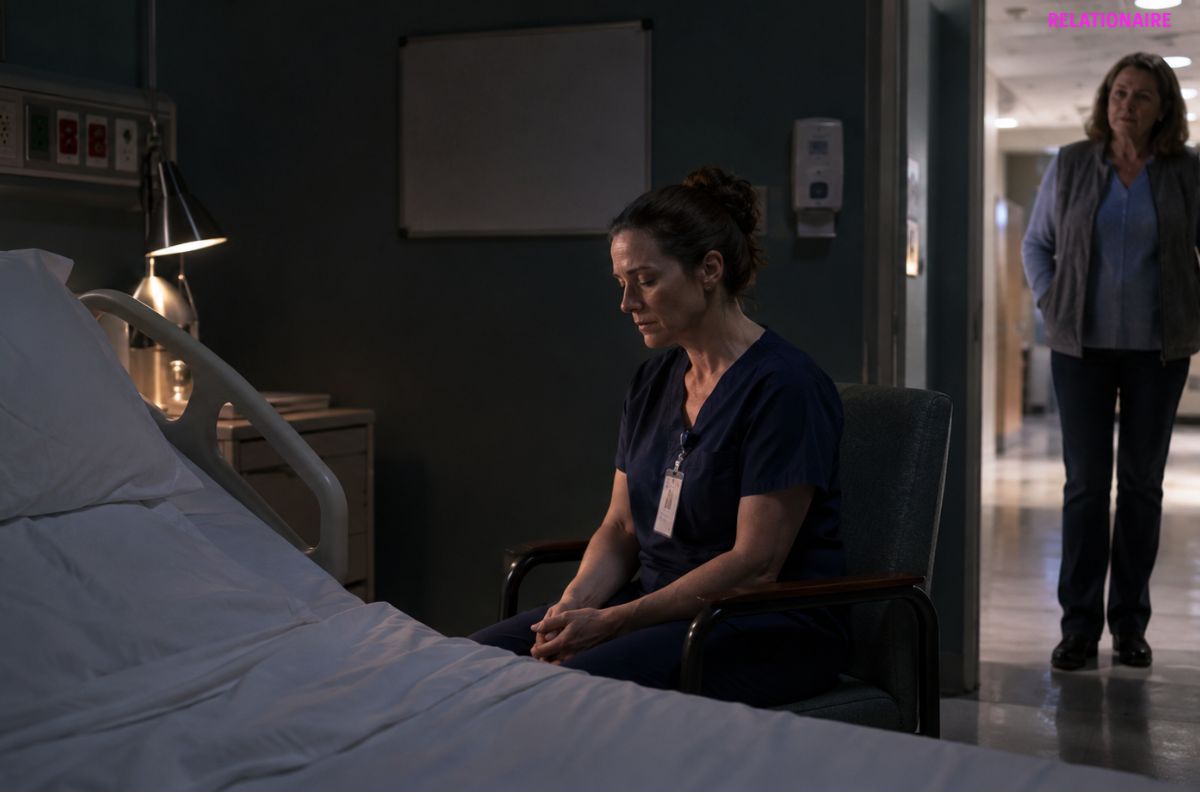
Every night after her shift, Nurse Elena Walsh disappeared into Room 417 and turned off the lights.
Not dimmed them.
Not lowered them.
Off.
The first time I saw her do it, I was carrying a stack of warmed blankets from the volunteer cart, trying not to spill the paper cup of ice chips balanced on top.
It was 9:12 p.m. on the medical floor.
The hall had gone quiet in that tired hospital way, when the day visitors had left and the overnight people began speaking softer, as if the walls themselves were trying to sleep.
I noticed Elena because she was still in her navy scrubs, still wearing her badge, still had her hair pinned in the same tight bun she had started with twelve hours earlier.
She stood outside Room 417 with one hand on the doorframe.
Then she stepped inside.
The room was empty.
The bed had been stripped.
The whiteboard was wiped clean.
No flowers. No family photos. No slippers under the chair.
Just a bare hospital room waiting for the next person who would be wheeled into it and asked their date of birth.
Elena pulled the door nearly closed behind her.
And the room went dark.
I stood there longer than I should have.
My name is Mara, and at the time I had only been volunteering at St. Agnes for three weeks. I was forty-eight, newly divorced, and trying to fill my evenings with something other than microwaved soup and the sound of my own house settling.
The volunteer coordinator told me I had “a calming presence.”
Really, I just knew how to be quiet.
So I pushed blankets. Refilled water pitchers. Walked confused visitors to elevators. Sat with people while they waited for updates they were scared to receive.
And after a while, I began to notice things.
The surgeon who always washed his hands twice before calling a family.
The cafeteria woman who gave an extra pudding cup to anyone crying into their napkin.
The janitor who cleaned the chapel last because he knew people stayed there late.
And Elena Walsh, the best nurse on the floor, sitting alone in the dark.
At first, I thought she was praying.
Then I thought she was hiding.
By the fourth time, I wondered if she was breaking.
Everyone loved Elena in that careful, respectful way people love someone who rarely asks for anything.
She remembered which patient hated orange juice.
She warmed blankets before they were requested.
She called grown men “sweetheart” only when they were scared enough to need it.
She never rushed families.
She never raised her voice.
But she also never laughed.
Not really.
Sometimes, at the nurse station, someone would say, “Elena, you going home?”
And she would answer, “In a minute.”
Always the same.
In a minute.
Then she would walk down the hall to Room 417.
One Thursday night, I saw her sitting inside.
The door had not clicked shut all the way.
A thin slice of hallway light fell across the floor, just enough for me to see her silhouette in the visitor chair beside the empty bed.
She was not crying.
That almost made it worse.
She sat perfectly still, hands folded in her lap, head slightly bowed, as if listening to someone I couldn’t hear.
The call buttons chimed at the nurse station.
A machine beeped somewhere down the hall.
Someone’s shoes squeaked past me.
But Elena did not move.
I told myself it was none of my business.
Hospital people carried things volunteers like me were not trained to hold.
Still, the image stayed with me.
That dark room.
That empty bed.
That nurse sitting beside nothing.
A week later, I found her in the break room pouring coffee she clearly did not want.
The clock above the microwave said 8:57 p.m.
Her shift had ended at 7:30.
“Elena,” I said gently, “are you all right?”
She looked at me like she had forgotten other people could see her.
Then she smiled.
It was small. Professional. The kind of smile nurses give when they are the ones being asked if they are okay.
“I’m fine, Mara.”
I wanted to leave it there.
I really did.
But loneliness had made me braver than I used to be.
“I see you go into Room 417 after work sometimes.”
Her hand tightened around the paper cup.
Only for a second.
Then she looked down at the coffee.
“I didn’t mean to pry,” I said quickly. “I just wondered if maybe you needed someone to sit with you.”
That was the first time I saw her face change.
Not crumble.
Not exactly.
It was more like a curtain moved.
Behind it was a tiredness I had no name for.
She set the cup down.
“That room gets quiet too fast,” she said.
I waited.
She looked toward the hall, where Room 417 sat just out of sight.
“Sometimes patients pass with no one there,” she said. “No family. No old friend. No one holding their hand because their people live too far away, or got the call too late, or there just… isn’t anyone.”
Her voice stayed steady.
That made my throat ache.
“When the room is cleaned,” she continued, “everyone has to move on. We have to. Another patient needs the bed. Another family needs answers. Another call light goes off.”
She rubbed her thumb along the seam of the paper cup.
“But I started sitting there for one minute after my shift. Just one. So they’re not left alone too fast.”
I didn’t know what to say.
There are some kindnesses so quiet they almost embarrass you when you discover them.
I had thought she was hiding from the living.
But she had been keeping company with the gone.
“Elena,” I whispered.
She shook her head, not unkindly.
“It’s not sad the way you think,” she said. “It’s just… unfinished. Some people leave a room and there’s no one to notice the shape they had in it.”
We stood there with the refrigerator humming between us.
Then she gave a small shrug, as if she had said too much.
“I keep their bracelets,” she added.
I looked at her.
“Bracelets?”
“Only the ones no family asks for. Not medical records. Just the empty bands after everything is cleared. I write their first name on a card and keep them for a month. Then I say goodbye.”
She opened the break room drawer beneath the coffee stirrers.
Inside was a small gray box.
Not hidden.
Not displayed.
Just there, like something waiting patiently.
She lifted the lid.
There were folded index cards, a few prayer cards, and several hospital bracelets curled like pale little circles.
My chest tightened.
It should have felt strange.
It didn’t.
It felt unbearably tender.
Elena touched the top bracelet.
“Walter,” she said softly. “No visitors. Loved but unreachable, maybe. We don’t always know.”
The name hit me before my mind understood it.
Walter.
My grandfather’s name had been Walter.
I leaned closer.
The bracelet had a date of birth printed on it.
Month. Day. Year.
My breath caught so sharply Elena looked up.
Because the date on that bracelet was my grandfather’s birthday.
And the last name printed beside it was mine.
PART 2
For a moment, the break room became too bright.
The buzzing light over the vending machine.
The silver sink with a ring of coffee stains.
The bulletin board full of flu shot reminders and faded birthday announcements.
Everything looked ordinary.
Nothing felt ordinary.
“Elena,” I said, and my voice came out smaller than I meant it to. “Where did you get that?”
She followed my eyes to the bracelet.
Her face changed again, but this time it was not tiredness.
It was alarm.
“Mara,” she said carefully, “do you know him?”
I reached for the counter because my knees did not feel trustworthy.
“Walter Hayes was my grandfather.”
The words came out flat.
Like someone else had said them.
Elena’s hand hovered over the box, then drew back, as if even touching it might hurt me.
“I’m sorry,” she whispered.
I stared at the bracelet.
Walter Hayes.
Room 417.
No visitors.
No family.
That last part landed hardest.
No family.
My grandfather had family.
He had me.
He had a daughter in Oregon who sent Christmas cards two weeks late but always sent them.
He had a son in Denver who called every Father’s Day.
He had a granddaughter who used to sit on his porch steps eating canned peaches out of a bowl while he told stories about fixing radios in the army.
He had not been alone.
Not really.
But apparently, at the end, he had been.
“When was this?” I asked.
Elena looked pained.
“Almost seven months ago.”
Seven months.
I remembered that week with cruel clarity.
Rain for four straight days.
Divorce papers on my kitchen table.
A voicemail from an unknown hospital number I deleted by accident because I was crying and trying to silence everything at once.
My mother had told me Grandpa Walter had “gone peacefully.”
She said it gently, over the phone.
I had assumed that meant family had been there.
People always say that phrase when they want you to picture something soft.
A hand held.
A prayer whispered.
A room full of love.
I had let myself picture it because I needed to.
“Was anyone with him?” I asked.
Elena lowered her eyes.
Her silence answered first.
Then she said, “I was.”
Those two words should have comforted me.
Instead, they cracked something open.
I sat down hard in one of the plastic chairs.
The chair legs squealed against the floor.
“Elena, I didn’t know.”
“I know.”
“No, I mean—” I pressed a hand to my chest. “I should have known. Someone should have called me.”
“They did,” she said softly.
I looked up.
She did not say it accusingly.
That made it worse.
“There was a number listed,” she continued. “We called several times. There was no answer. We left messages. Your grandfather couldn’t tell us much by then, but he kept saying one name.”
My mouth went dry.
“What name?”
She hesitated.
“Mara.”
I covered my mouth.
The break room door opened, and a young resident stepped in, saw us, froze, and stepped right back out without a word.
“Elena,” I said behind my hand, “please don’t.”
“I’m sorry.”
“No, please. Tell me.”
Her eyes shone now, though no tears fell.
“He wasn’t scared,” she said. “Confused sometimes. But not scared. He had a photo in his wallet. A little girl on a porch with two missing front teeth.”
I closed my eyes.
The canned peaches.
The porch steps.
The summer I was seven.
“I lost that photo,” I whispered.
“He didn’t.”
My chest ached so deeply I had to lean forward.
For years, guilt had been a quiet room inside me.
I did not go to my grandfather enough near the end.
That was the truth.
Not because I did not love him.
Because life had become loud and messy, and I kept thinking there would be more time.
A weekend after the divorce settled.
A Sunday when work slowed down.
A day when I felt less broken and could visit without bringing all my sadness into his small apartment.
There is a kind of neglect that does not look cruel from the outside.
It looks busy.
It looks overwhelmed.
It looks like “soon.”
But soon is not a promise.
Soon is a risk.
“What did he say?” I asked.
Elena was quiet for a long moment.
“He asked if the porch light was on.”
A sound came out of me then.
Not a sob exactly.
More like my body trying to make room for the pain.
His porch light.
Every time I stayed late as a child, he would turn on the porch light before driving me home.
“So you know where to come back to,” he used to say.
I had not thought of that in years.
Elena reached for a napkin and slid it across the table.
I took it because my hands needed something to hold.
“I sat with him,” she said. “I told him the light was on.”
The room blurred.
“He believed you?”
She nodded.
“I think he needed someone to say it.”
For the first time since I met her, Elena looked unsure.
“I kept his bracelet longer than usual,” she admitted. “I don’t really know why.”
I knew why before she said more.
Because he had said my name.
Because he had waited.
Because maybe, in that last quiet hour, Nurse Elena Walsh had become the granddaughter who did not answer the phone.
I wanted to thank her.
I wanted to apologize.
I wanted to go back seven months and pick up every call I had ever ignored.
Instead, I said the one thing that rose from the deepest part of me.
“Was he kind to you?”
Elena smiled then, and it was the first real smile I had seen on her face.
“Yes,” she said. “He told me I looked tired.”
A laugh broke through my tears.
That was him.
Even at the end, noticing someone else.
“He said nurses should sit down more,” Elena added.
Then the smile faded.
“He told me his wife used to make lemon cookies. He asked if you still wore red shoes.”
I looked down at my sneakers.
Plain gray.
Volunteer approved.
But when I was little, I had a pair of red plastic sandals I refused to take off. Grandpa Walter called them my dancing shoes, even though I was clumsy and shy and mostly stomped around his kitchen.
“I forgot he remembered that,” I whispered.
Elena closed the box gently.
“I didn’t tell you this to hurt you.”
“I know.”
“I didn’t know you were his Mara.”
“I know.”
But something had changed between us.
Not blame.
Not exactly.
Something more complicated.
A hallway had opened inside the story I thought I knew.
And standing at the end of it was my grandfather in Room 417, asking for me while I was somewhere else, drowning in a life that suddenly seemed much less important than one phone call.
That night, I did not finish my volunteer shift.
I walked to Room 417.
It had a new patient now, an elderly woman sleeping with the TV on mute and a folded blue sweater on the chair beside her.
I stood outside the doorway and gripped my visitor badge until it bent.
Elena came up beside me.
“I can request the archived belongings record,” she said softly. “Sometimes there are notes. Small things logged before family pickup.”
“My mother picked up his things,” I said.
“Maybe not everything.”
I looked at her.
She took a breath.
“There was an envelope,” she said. “He asked me to put your name on it. I gave it to the unit clerk to file with his personal belongings.”
The floor seemed to tilt.
“My name?”
Elena nodded.
“Mara.”
For seven months, somewhere in that hospital, there might have been an envelope from my grandfather.
A last message.
A porch light left on.
And I had not known.
PART 3
The envelope was in a basement office that smelled like dust, toner, and old cardboard.
It took two days to find it.
Two days of Elena making calls during breaks she did not really have.
Two days of me volunteering with my stomach tight and my eyes always drifting toward Room 417.
Two days of wondering what kind of goodbye could survive in a file box under fluorescent lights.
On the third morning, the unit clerk, Denise, came upstairs carrying a manila envelope between both hands.
She was a brisk woman with silver glasses and a voice that could stop a confused visitor from entering the wrong ward. But when she saw me standing at the nurse station, her face softened.
“This should have been forwarded,” she said.
I looked at the envelope.
My name was written on the front in shaky blue ink.
Mara.
Not my full name.
Not formal.
Just Mara.
Like a call from the porch.
Elena stood beside me, still in her coat, though her shift had ended twenty minutes before.
“You don’t have to open it here,” she said.
But I did.
Not because I was brave.
Because if I carried it home, I knew I might set it on the kitchen table and stare at it for a week.
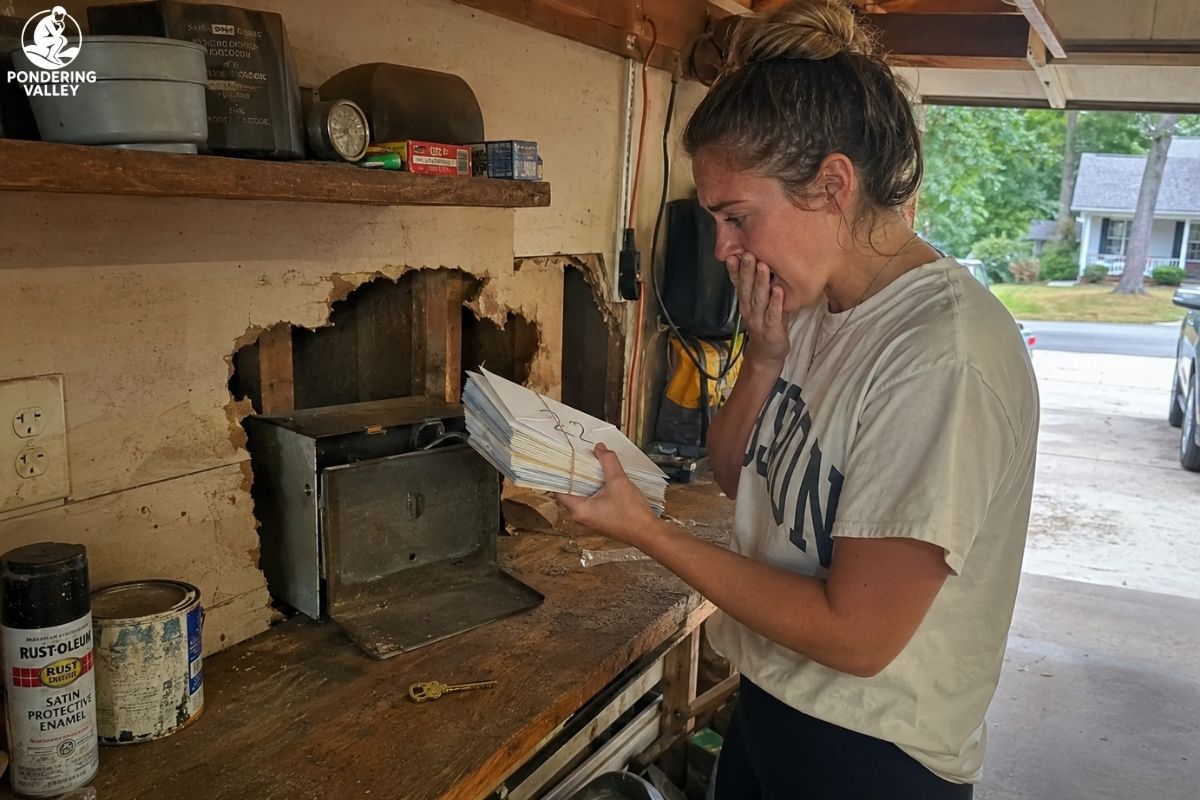
My hands trembled as I opened the flap.
Inside was a folded piece of hospital stationery, a small photograph, and something wrapped in tissue.
The photograph fell into my palm first.
A little girl on porch steps.
Two missing front teeth.
Red sandals.
A bowl of canned peaches balanced on her knees.
I pressed it to my chest before I could help myself.
Then I unfolded the paper.
The handwriting was uneven, but it was his.
My sweet Mara,
If this gets to you late, don’t let late become forever.
I know you have been hurting. Your mother told me some. Not all. Enough.
I wanted to tell you that you do not have to come back cheerful. You never did.
You could have come back angry, quiet, divorced, tired, empty-handed. I would have made coffee. Bad coffee, maybe. But coffee.
I was never waiting for the best version of you.
I was only waiting for you.
The letters blurred.
I stopped reading because my breath had become uneven.
Elena turned slightly away, giving me privacy without leaving.
That small mercy undid me almost as much as the letter.
I wiped my eyes and kept going.
A nurse named Elena is here. She has kind hands and does not think I notice when she is tired. Tell her to sit down sometimes.
I laughed through tears.
She looked at me.
“What?” she asked softly.
“He wrote about you.”
Elena blinked.
I handed her the letter.
She read the line once.
Then again.
Her mouth tightened, the way people do when emotion reaches them before permission does.
“He shouldn’t have been worrying about me,” she whispered.
“That was Grandpa.”
I unwrapped the tissue.
Inside was a small brass key.
For a second, I did not understand.
Then I did.
His apartment.
The spare key he used to keep on a hook by the back door, tied with a faded yellow ribbon so I could find it when I came in from the porch.
Below the key, the letter continued.
The porch light key is yours. Your mother may not remember. I want you to have it.
Not because of the apartment.
Because everybody needs somewhere they are allowed to return unfinished.
I had to sit down.
Denise quietly slid a chair behind me.
Hospitals are full of people who know when knees are about to give.
“I thought he was alone,” I said.
My voice broke on the last word.
Elena handed the letter back.
“He wasn’t.”
“I wasn’t there.”
“No,” she said gently. “You weren’t.”
There was no pretending in her voice.
No sweet lie.
Just mercy with the truth still inside it.
“But he was loved,” she said. “And he knew it. People can miss each other and still know.”
That was when I understood something I had not let myself understand.
Elena did not sit in those empty rooms because she believed one minute could fix the unfairness of who arrived too late.
She sat because a minute could still matter.
A hand could still matter.
A sentence could still matter.
The light could be turned on in someone’s mind, even if the room was dark.
That evening, I stayed after my volunteer shift.
The hall settled into its nighttime hush.
A man in Room 412 asked for ginger ale.
A daughter outside the elevators cried quietly into the sleeve of her coat.
The cleaning cart rolled by with its soft rattling wheels.
At 9:08, Elena came out of the nurse station with her bag on her shoulder.
She paused when she saw me.
“You don’t have to do this,” she said.
“I know.”
Room 417 was empty again.
The bed had been stripped.
The whiteboard was clean.
A thin smell of disinfectant hung in the air.
Elena reached for the light switch.
Then stopped.
“Do you want it dark?” she asked.
I thought of my grandfather asking whether the porch light was on.
“No,” I said. “Not tonight.”
So she left one small lamp glowing beside the bed.
We sat in the two visitor chairs.
For one minute, neither of us spoke.
It was not dramatic.
No music swelled.
No miracle happened.
The hospital kept being a hospital.
Call lights chimed.
Someone laughed softly at the nurse station.
A door clicked shut down the hall.
But in that small pool of lamplight, I felt my grandfather closer than I had in years.
Not as a final hour I had missed.
As a porch.
As a bowl of peaches.
As bad coffee waiting for the version of me that never felt ready.
When the minute passed, Elena touched the edge of the chair as if to stand.
“Could we sit a little longer?” I asked.
She looked at me, and for once, she did not say she was fine.
She sat back down.
“Yes,” she said.
After that night, I came every Thursday.
Not to punish myself.
Not to replace what I had missed.
To honor what had been given.
Sometimes Elena and I sat in silence.
Sometimes we said the first names from the cards in her gray box.
Walter.
June.
Anthony.
Ruth.
Samuel.
People who had occupied rooms, worn bracelets, asked for water, worried about somebody, loved somebody, been somebody.
A month later, I brought lemon cookies.
They were too hard at the edges.
Elena ate two anyway.
“You made these?” she asked.
“With effort, not skill.”
“My favorite kind.”
She finally laughed.
A real laugh.
Small, tired, beautiful.
The next week, I brought a small battery candle for the drawer.
Not religious. Not decorative.
Just a light.
Elena placed it beside the cards and bracelets.
At the end of her shift, she opened the drawer, turned it on, and stood very still.
“I used to think I was doing this for them,” she said.
I looked at her.
“Maybe I needed it too.”
I thought of all the people who hold rooms together and never get named in the story.
The nurse who stays one minute longer.
The clerk who keeps the envelope safe.
The cleaner who makes the room ready without erasing what happened there.
The volunteer who thinks she is there to help strangers and finds her own grief waiting in a drawer.
Some love arrives loudly.
Some love arrives late.
And some love sits quietly in a dim hospital room for one more minute, just so nobody has to leave the world feeling forgotten.