If you’ve already read part 1 of this story on Facebook, go here for Part 2!
PART 1
The man in the gray cashmere coat snapped his fingers at the front desk like the woman behind it was a waiter who had forgotten his table.
“I’ve been waiting forty minutes,” he said.
The older receptionist looked up from the computer screen.
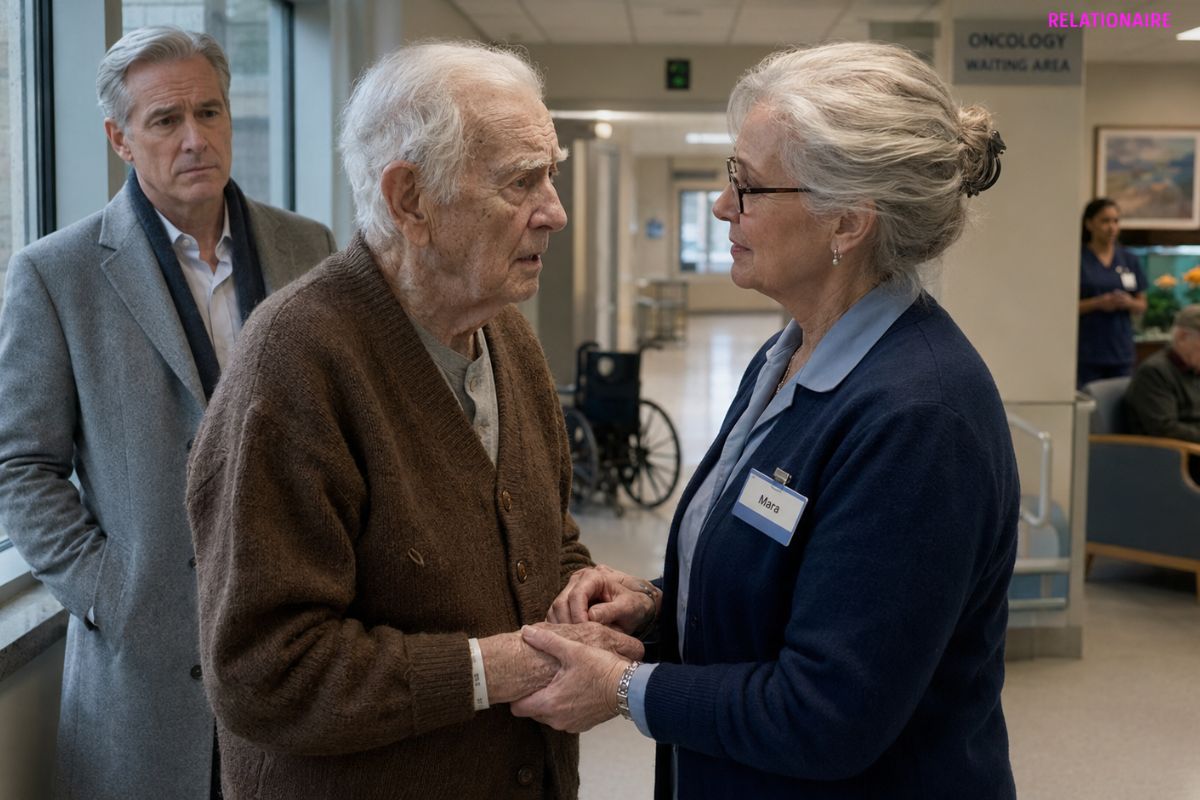
Her name tag said Mara.
Her hair was silver and pinned neatly at the back of her head. A pair of reading glasses sat low on her nose. There was a paper cup of tea beside her keyboard, untouched and gone cold.
“I’m sorry, Mr. Whitmore,” she said gently. “The lab is still processing your results. As soon as they release them, the doctor will call you back.”
He leaned one hand on the counter.
“I don’t need a speech. I need an answer.”
The waiting room went quiet in the way waiting rooms do when everyone wants to look, but nobody wants to be seen looking.
A young mother held her toddler closer.
An elderly woman in a blue cardigan lowered her magazine.
A man with a hospital bracelet rubbed his thumb over the plastic band like it was a worry stone.
Mara did not flinch.
She had worked the oncology clinic front desk for nineteen years. She had been yelled at by frightened husbands, silent daughters, exhausted sons, and people who thought money should make fear move faster.
She had learned that people were rarely angry at the front desk.
They were angry at the clock.
At the unknown.
At the door that had not opened yet.
Still, Mr. Whitmore’s voice had a sharpness that landed.
“I have meetings,” he said. “I cleared my entire morning for this. Do you have any idea what my time is worth?”
Mara looked at him for a moment.
Then she slid a box of tissues closer to a woman crying softly two chairs away, without making a scene of it.
“Yes, sir,” she said. “I know waiting is hard.”
He gave a short laugh.
“You know waiting is hard?”
His eyes moved over her desk. The sticky notes. The old appointment book she still kept beside the computer. The little ceramic bird near the phone. The sweater folded over the back of her chair.
He saw all of it and understood none of it.
“Mara,” he said, reading her name tag as if the name itself annoyed him, “could you please find someone who actually knows what’s happening?”
Behind him, the automatic doors opened.
Cold air slipped into the waiting room.
A nurse hurried through with a chart tucked to her chest. Somewhere down the hall, a machine beeped three times and stopped.
Mara’s fingers paused above the keyboard.
Not because of Mr. Whitmore.
Because she had noticed the empty wheelchair near the fish tank.
It had not been empty two minutes ago.
She stood.
“Mrs. Alvarez,” Mara called softly to the elderly woman in the blue cardigan, “was Mr. Bell sitting there?”
The woman looked toward the wheelchair.
“Oh,” she said. “He was just there. I thought he went with a nurse.”
Mara’s face changed.
Not dramatically. Not enough for Mr. Whitmore to notice at first.
But the softness left her eyes, replaced by something alert and steady.
She stepped around the counter.
“Excuse me,” Mr. Whitmore said. “Where are you going?”
Mara did not answer him.
She moved faster than anyone expected a woman her age to move, past the row of chairs, past the water cooler, past the table of outdated magazines.
At the hallway entrance, she stopped and looked both ways.
“Daniel?” she called.
No answer.
A nurse at the station looked up.
“Mara?”
“Mr. Bell is missing from the waiting room.”
The nurse’s face tightened.
“He’s confused today?”
“His daughter said mornings are worse.”
The nurse put down the chart.
“I’ll check infusion.”
“I’ll check the south corridor,” Mara said.
Mr. Whitmore followed three steps behind, irritated.
“Is no one going to handle my appointment?”
Mara turned just enough to look at him.
For the first time, her voice lost its softness.
“Sir, please sit down.”
Something in the way she said it made him stop.
Not because it was loud.
Because it was certain.
Then she went down the hall.
The clinic hallway smelled faintly of disinfectant and coffee. Fluorescent lights hummed overhead. Staff moved around her in practiced urgency, but Mara seemed to know every corner by memory.
She checked the restroom.
The small consultation room.
The alcove near the vending machines.
“Daniel?” she called again. “Danny?”
At that name, Mr. Whitmore, who had followed despite himself, frowned.
The missing man was in his eighties, thin and stooped, with careful white hair and a brown cardigan buttoned wrong. He had come in with his daughter that morning. Mr. Whitmore remembered him only because the old man had smiled at the fish tank for nearly ten minutes.
He had seemed harmless.
Forgettable.
Now he was gone.
Mara turned the corner toward the older wing of the hospital, where the flooring changed from polished gray to dull beige.
At the far end, near a closed chapel door, a figure stood trembling beside a window.
Daniel Bell.
He was staring outside at the ambulance bay, both hands pressed to the glass.
His hospital bracelet hung loose around his wrist.
A nurse started toward him.
Mara lifted a hand.
“Wait.”
The nurse stopped.
Mara approached slowly, each step careful.
“Mr. Bell,” she said.
The old man did not turn.
His shoulders shook.
“I can’t find her,” he whispered.
Mara’s face softened in a way that made the hallway feel smaller.
“I know,” she said.
He touched the glass with two fingers.
“She said she’d wait by the garden.”
Mr. Whitmore looked from the old man to Mara.
The nurse looked down.
There was no garden on that side of the hospital. Only concrete, parked ambulances, and rainwater shining on the ground.
Mara moved beside him, not too close.
“She always liked the garden,” she said.
Daniel turned his head just slightly.
His eyes were cloudy with fear.
“Have you seen my Rosie?”
Mara swallowed.
For a second, she looked much older than she had at the desk.
Then she smiled through something that was not quite a smile.
“Oh, Danny Boy,” she said softly, “Rosie would be so mad if she knew you walked off without your scarf.”
The old man froze.
His mouth parted.
Mr. Whitmore felt the air change.
Not because of what Mara said.
Because of the name.
Danny Boy.
The old man’s trembling hand slid from the glass.
Only one person, it seemed, could have called him that.
His late wife.
Mara held out her hand.
And Daniel Bell, who had ignored nurses, forgotten where he was, and wandered half the hospital in confusion, placed his hand in hers like a child coming home.
Mr. Whitmore stared at the receptionist.
The slow woman.
The unimportant woman.
The woman he had snapped at.
Daniel’s voice broke.
“Rosie?”
Mara closed her eyes for half a second.
Then she opened them and said something so quietly that Mr. Whitmore almost missed it.
“No, Danny Boy,” she whispered. “But I promised her I’d remember.”
Mr. Whitmore’s chest tightened.
Mara began leading Daniel back toward the clinic, one careful step at a time.
And as they passed the chapel door, a folded yellow envelope slipped from Daniel’s cardigan pocket and fell to the floor.
Mr. Whitmore bent to pick it up.
On the front, in faded handwriting, were two words:
For Mara.
PART 2
Mr. Whitmore stood in the hospital corridor with the yellow envelope in his hand and felt, for the first time that morning, completely out of place.
The envelope was old.
Not dirty. Not neglected.
Old in the way cherished things become old.
The edges were soft from being handled. The flap had been sealed once, opened carefully, then tucked closed again. There was a small pressed flower taped to the corner, flattened almost transparent with time.
For Mara.
The nurse walking beside Daniel saw it and stopped.
“Mara,” she said.
Mara turned.
For a moment, all the steadiness drained from her face.
Then she looked at the envelope in Mr. Whitmore’s hand, and her eyes filled so quickly she had to look away.
“Where did you get that?” she asked.
“It fell from his pocket,” Mr. Whitmore said.
His voice was quieter now.
Daniel looked back at the envelope.
His expression was lost again, then suddenly bright with recognition.
“Rosie wrote that,” he said. “For the lady with the bird.”
Mara’s hand tightened gently around his.
“Yes,” she said. “She did.”
Mr. Whitmore glanced toward her desk down the hall, where the small ceramic bird sat beside the phone.
He had noticed it earlier and judged it as clutter.
Now it felt like evidence.
The nurse touched Mara’s shoulder.
“I can take him back.”
“No,” Daniel said quickly, gripping Mara’s hand. “No, she knows.”
Mara nodded.
“I’ll bring him.”
They walked back slowly.
The entire waiting room watched them return.
Nobody spoke.
Mara guided Daniel into his wheelchair near the fish tank. She adjusted the blanket over his knees and tucked one corner under his hand like she had done it many times before.
His daughter, a tired woman in her fifties with a wrinkled visitor badge clipped to her sweater, came rushing from the hallway with a nurse behind her.
“Dad,” she breathed. “Oh, Dad.”
Daniel looked at her with confusion first, then tenderness.
“Annie?”
She knelt in front of him, taking both his hands.
“You scared me.”
“I was looking for your mother.”
Annie’s face changed.
It was not surprise. It was the practiced pain of hearing the same impossible sentence again and again.
“I know,” she whispered. “I know you were.”
Mara stood back, but Daniel reached for her.
“Don’t go.”
“I’m right here,” she said.
Annie looked up at Mara, then at the envelope still in Mr. Whitmore’s hand.
Her face went pale.
“You found it?”
Mr. Whitmore held it out awkwardly.
“I’m sorry. I didn’t mean to—”
“It’s okay,” Annie said. “He carries it sometimes. We’ve never opened it.”
Mara’s eyes flicked to her.
“Never?”
Annie shook her head.
“Mom said it belonged to you.”
The waiting room was still silent.
Even the toddler had stopped fussing.
Mr. Whitmore should have gone back to complaining. His test results still had not come. His meeting had been missed. His phone had buzzed three times in his coat pocket.
But he could not look away.
Mara took the envelope with both hands.
She held it carefully, as if the paper itself could bruise.
“I haven’t seen this in seven years,” she said.
Annie rose slowly.
“You knew my parents before this clinic?”
Mara let out a soft breath.
“Yes.”
Daniel stared at the fish tank.
“The lady with the bird,” he murmured.
Mara smiled at him.
“That’s me.”
Annie looked confused.
“I don’t understand. Dad has been coming here only since last spring.”
Mara did not answer right away.
She looked toward the front desk, where the phone was ringing. Another patient had stepped up. A delivery person waited with a clipboard. The world kept asking things of her.
It always had.
She turned to the younger receptionist who had just arrived for the late shift.
“Jenna, can you cover for ten minutes?”
Jenna nodded immediately.
“Of course.”
Mara looked at Annie.
“There’s a family room around the corner.”
Then she glanced at Mr. Whitmore, and for one strange second he thought she might ask him to leave.
Instead, Daniel pointed at him.
“He has Rosie’s letter.”
“No, Dad,” Annie said gently. “Mara has it now.”
Daniel frowned.
“He should hear. He looks lonely.”
Mr. Whitmore stiffened.
The words landed too close.
He had a house with seven bedrooms, an assistant who managed his calendar, a driver downstairs, and a phone full of people who answered him quickly.
Lonely was not a word anyone would dare use for him.
But the old man had said it without judgment.
Like a diagnosis made from the heart.
Mara looked at Mr. Whitmore.
“You don’t have to come.”
He almost said, “I wasn’t planning to.”
Instead, he heard himself say, “I can wait.”
Mara led them into the small family room.
It had a round table, four chairs, a box of tissues, and a framed print of a beach nobody had ever visited. There was a water stain on one ceiling tile. A clock ticked too loudly above the door.
Daniel sat closest to Mara.
Annie sat beside him.
Mr. Whitmore stood at first, then lowered himself into a chair near the wall.
Mara placed the envelope on the table.
For a while, nobody touched it.
Then Annie said, “How did you know my mother called him Danny Boy?”
Mara folded her hands.
“Because I heard it every morning for almost five months.”
Annie blinked.
“At the hospital?”
“At St. Bridget’s Rehab,” Mara said. “Before I came here full time. I worked evenings at the front desk there after my husband got sick.”
Her voice was even, but Mr. Whitmore noticed the way her thumb rubbed the base of her wedding ring.
It was old. Thin. Worn almost smooth.
“Your mother had fallen and needed help walking again,” Mara continued. “Your father came every day at four o’clock. Same blue cap. Same paper bag with two oatmeal cookies inside. One for her, one he pretended was for himself.”
Daniel smiled faintly.
“Rosie liked cookies.”
“She did,” Mara said. “But she liked sharing yours more.”
Annie pressed a hand to her mouth.
“I was living in Portland then,” she whispered. “I came weekends. I didn’t know.”
Mara nodded.
“You were doing what you could. Your mother knew that.”
Annie’s eyes filled.
Mara looked down at the envelope.
“They used to sit in the lobby because your mother said the room smelled too much like medicine. They would hold hands and watch people come in. Some days they talked. Some days they just sat.”
Daniel’s gaze drifted toward the wall.
“Rosie had red shoes.”
“Yes,” Mara said. “Bright red. She said if she had to learn to walk again, she might as well look beautiful doing it.”
Annie laughed once through tears.
“That sounds like her.”
Mara’s smile faded.
“One evening, your mother asked me to keep a list.”
“A list?”
“Names,” Mara said.
The room seemed to still.
“She said people in places like this are always being called by room numbers, appointment times, conditions, last names. She hated that. She said, ‘Mara, when people are scared, their own name can feel like a blanket.’”
Mr. Whitmore looked down.
His own name had been said all morning.
Mr. Whitmore.
Sir.
Not once had he noticed that Mara remembered everyone else’s too.
Mrs. Alvarez.
Mr. Bell.
Jenna.
Daniel.
Danny Boy.
Mara continued.
“So I started writing names down. Not just patient names. Daughters. Grandsons. Favorite drinks. Who needed the door held open. Who got nervous if the waiting room was too crowded.”
She nodded toward the front desk.
“That old appointment book you saw? It isn’t appointments anymore.”
Mr. Whitmore knew, instantly, that she was talking to him.
His face warmed.
Mara did not shame him. That made it worse.
She turned back to Annie.
“When your mother left rehab, she gave me this envelope. She said I wasn’t allowed to open it unless there came a day when remembering names hurt too much.”
Annie looked at the envelope.
“And you never opened it?”
Mara shook her head.
“I was afraid if I did, it meant I was done.”
The honesty of it sat heavily in the small room.
Daniel reached out and touched the pressed flower on the corner.
“Rosie said Mara keeps people.”
Mara’s eyes closed.
Annie whispered, “What does that mean?”
Mara picked up the envelope.
Her fingers trembled now.
“She said some people fix bodies. Some people run tests. Some people give medicine.” She swallowed. “And some people stand at the door and keep people from disappearing.”
Nobody moved.
Not Annie.
Not Mr. Whitmore.
Not even Daniel.
Mara looked down at the envelope addressed to her in Rosie Bell’s faded hand.
Then she slid one finger beneath the flap and said, “Maybe it’s time.”
PART 3
Inside the envelope was a single sheet of stationery folded into thirds.
The paper was cream-colored, with a tiny blue bird printed at the top.
Mara stared at it so long that Annie reached across the table and touched her wrist.
“You don’t have to read it out loud.”
Mara nodded.
“I know.”
But she unfolded it anyway.
Her eyes moved across the first line.
Her mouth trembled.
Then she began.
“Dear Mara,” she read softly, “if you are opening this, then you have probably forgotten something important.”
She stopped and pressed the paper to her chest.
Daniel looked at her with gentle confusion.
“Rosie had pretty writing,” he said.
“Yes,” Mara whispered. “She did.”
She took a breath and continued.
“You remember everyone else. You remember who takes sugar, who hates wheelchairs, who cries in the bathroom but smiles at the desk. You remember that my Danny Boy gets scared when hallways look the same. You remember that I like my blanket folded at my feet, not under my chin.”
Annie covered her face.
Mara’s voice shook, but she kept going.
“But I am writing this because I want you to remember you too.”
The room blurred around Mr. Whitmore.
He had spent his life being obeyed quickly. He knew how to read contracts, pressure rooms, move people, close deals. He knew how to make others feel the cost of wasting his time.
But he did not know what to do with a sentence like that.
Remember you too.
Mara wiped her cheek with the back of one finger.
“My husband is gone now,” she said quietly, not reading for a moment. “He died the winter after Rosie left rehab. I kept working because the house was too quiet. Then I kept working because people needed me. After a while, I forgot there was a difference.”
Annie reached for Daniel’s hand.
Mara continued reading.
“Do not let the tired ones make you hard. Do not let the rude ones make you small. Most of them are just frightened in expensive shoes.”
Mr. Whitmore looked away.
There was no cruelty in the line.
That was why it hurt.
Mara read the last paragraph slowly.
“One day Danny may not know my name. He may ask for me while I am gone. If that day comes, and if you are near him, please call him Danny Boy. Not because you are pretending to be me. Because love should not vanish just because memory does.”
Mara could not finish for a moment.
Annie was crying openly now, but quietly, with one hand over her mouth like she did not want to disturb anyone.
Daniel looked around the little room.
“Why is everyone sad?”
Mara folded the letter with care.
“Because your Rosie loved you very much.”
His face softened.
“My Rosie?”
“Yes.”
“She coming?”
Mara looked at Annie.
Then she turned back to Daniel, and her voice became the gentlest thing in the room.
“Not today, Danny Boy.”
He nodded slowly, accepting this in the way his heart could manage.
“Then we wait nice.”
Mara laughed once through tears.
“Yes,” she said. “We wait nice.”
A knock came at the door.
Jenna leaned in, hesitant.
“Mara, I’m sorry. Mr. Whitmore’s results are ready. Dr. Patel can see him now.”
Everyone turned toward him.
For a moment, Mr. Whitmore did not stand.
The thing he had demanded all morning had arrived, and somehow it seemed smaller now. Still important. Still frightening. But smaller beside the letter on the table.
Mara began to rise.
Old habit.
Even with her hands shaking, even after opening a piece of her own heart in front of strangers, she was getting up to help him.
“No,” Mr. Whitmore said quickly.
She paused.
“I mean… please don’t get up.”
The room went quiet again.
He stood, but not with the impatient stiffness from before.
He looked at Mara.
Really looked.
At the tired lines around her eyes.
At the worn ring.
At the name tag.
At the woman who had been holding people together from behind a counter while the world mistook her for furniture.
“I owe you an apology,” he said.
Mara’s expression softened, but she did not rescue him from the discomfort.
So he stayed in it.
“I was rude,” he said. “Not because you were slow. Because I was scared. And I made that your problem.”
His voice caught on the last word.
“I’m sorry, Mara.”
It was the first time he said her name like it belonged to a person.
Not a service.
Not a delay.
A person.
Mara nodded once.
“Thank you, Mr. Whitmore.”
“My name is Charles,” he said.
Daniel looked up.
“Charlie?”
Mr. Whitmore almost corrected him.
Then he smiled a little.
“Yes,” he said. “Charlie is fine.”
Daniel seemed satisfied.
“Charlie looks less lonely now.”
Annie laughed through her tears.
Even Mara smiled.
Dr. Patel appeared at the doorway, patient and kind.
“Mr. Whitmore?”
Charles turned, then looked back at Mara.
“Will you be here when I come out?”
The question surprised everyone, including him.
Mara studied him.
Then she said, “Yes, Charlie. I’ll be at the desk.”
He nodded.
Not because she owed him that.
Because somehow, in a hallway full of strangers, he needed to know somebody would remember he had gone in.
The appointment did not take long.
The results were not the worst news.
They were not easy news either.
There would be more tests. More waiting. More mornings where fear sat beside him in a chair.
When Charles stepped back into the waiting room, the first thing he saw was Mara at the front desk.
Daniel was asleep near the fish tank, his blanket tucked around him. Annie sat beside him, holding the yellow letter in both hands. Mrs. Alvarez was back to her magazine. The toddler had spilled crackers on the floor.
Life had resumed its small, ordinary shape.
Mara looked up.
Charles tried to speak, but his throat tightened.
She understood.
Of course she did.
She slid a paper cup of water toward him.
No speech.
No pity.
Just water.
Just his name written carefully on a follow-up card.
Charles Whitmore — Thursday, 9:30 a.m.
Under it, in smaller writing, she had added:
Likes water, no ice. Gets quiet when scared.
He stared at the card.
Then he laughed softly, and the laugh broke into something close to tears.
“You wrote me in the book?”
Mara picked up her pen.
“You’re in pencil,” she said. “We’ll see how you behave.”
For the first time all day, Charles smiled like a man instead of a title.
In the months that followed, he came back often.
At first for tests.
Then treatments.
Then follow-ups.
He stopped snapping at people. He learned Jenna’s name. He brought oatmeal cookies once, two in a paper bag, and left them beside Daniel when Annie wasn’t looking.
He donated new chairs to the waiting room but asked that nobody put a plaque on them.
Mara said, “Good. People don’t need to sit on your name.”
He laughed harder than anyone expected.
On Mara’s last day before retiring, the clinic filled with people who had once been frightened in that room.
Former patients.
Grown children.
Widows.
Nurses.
Doctors.
A man who used to cry by the vending machine.
A woman whose husband had loved ginger tea.
Annie came with Daniel, who no longer remembered the clinic but smiled when Mara touched his shoulder.
Charles stood near the back holding a small wrapped box.
When it was his turn, he handed it to her.
Inside was a ceramic bird.
Not new-looking or expensive.
Just small, blue, and simple.
The note beneath it said:
For the woman who kept people from disappearing.
Mara read it and pressed her lips together.
Then she looked around the room at all the faces she had remembered.
Some names came easily.
Some took a second.
A few were gone now, carried by the people who loved them.
But they were not lost.
Not completely.
Because someone had said their names at the desk.
Someone had noticed how they took their tea.
Someone had remembered the nickname only a wife used when her husband was scared.
And sometimes, that is the kindest thing a person can do in a place full of fear.
Not fix everything.
Not promise the pain will pass.
Just stand at the door, look someone in the eyes, and remind them they are still here.