
At my own wedding reception, my new mother-in-law took the microphone and called me baggage because I was a single mom—then my eight-year-old daughter read the letter my husband had written for that exact moment.
“My son deserves better.”
That was how she started.
Not with a blessing.
Not with a toast.
Not with one soft word about the vows we had just said or the family we had just promised to build.
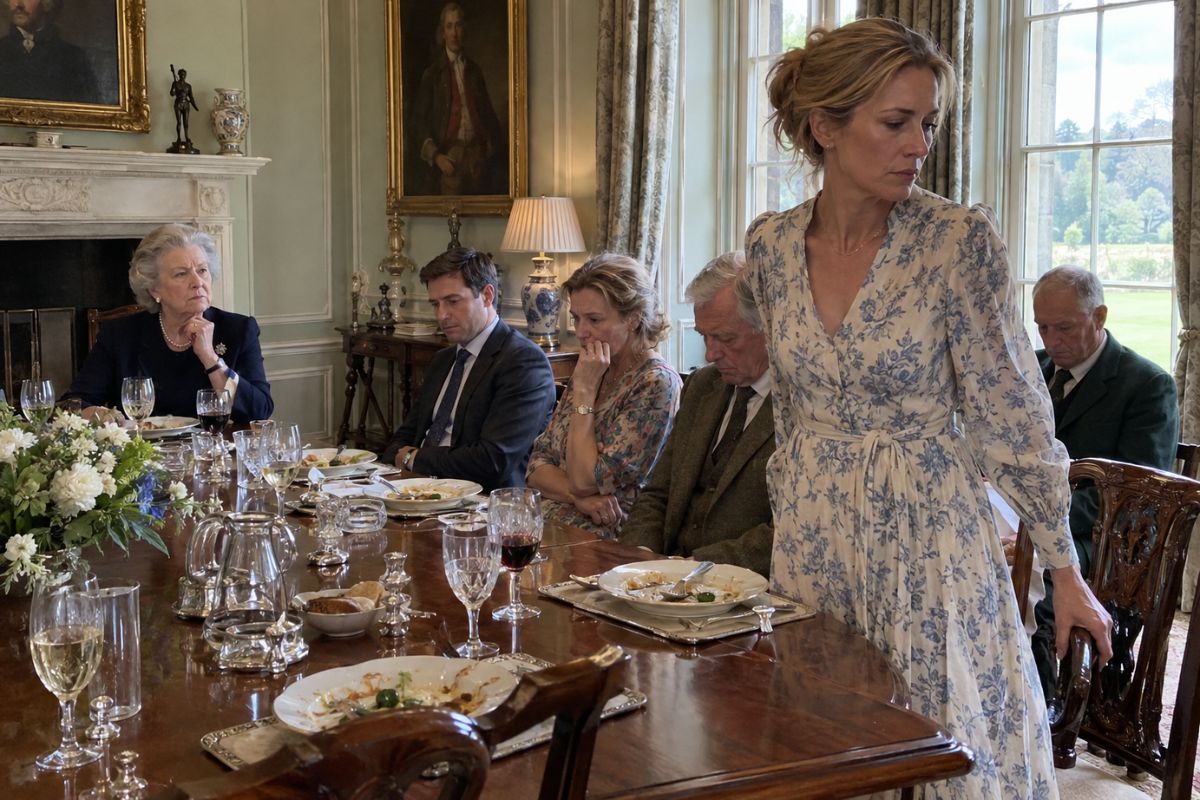
She stood at the front of the room in a black dress that looked more suited for a grudge than a celebration, one hand wrapped around the microphone, a smile pinned on so tightly it looked painful.
Around us, two hundred guests went quiet all at once.
The silverware stopped clinking.
The laughter died in little broken pieces.
Even the kids at the side table seemed to feel that something had shifted.
I was still sitting at the head table in my wedding dress, one hand resting near my plate, the other around a glass of water I suddenly could not lift.
Marcus, my husband for less than three hours, went still beside me.
I knew that stillness.
It meant he was furious.
But he was trying not to turn fury into something bigger.
“My son,” Dolores said again, “has always had a heart that was too generous for his own good.”
Some people gave the kind of polite half-smile guests wear when they think an older relative is about to tell an embarrassing childhood story.
A few even leaned in, expecting something harmless.
They did not know her the way I knew her.
They did not know the way she sharpened words before she used them.
They did not know how she could sound sugary while taking a chunk out of your dignity.
She lifted her chin and looked directly at me.
Then she looked at Ivy.
My daughter had been coloring on the back of a folded kids’ menu with a set of wedding crayons one of my cousins had brought for the children’s table.
She looked up slowly, confused, her freckled face open and unguarded.
Dolores smiled at the room.
“Marcus deserves a woman who can give him a real beginning,” she said. “A clean beginning. A woman who can build a life around him, instead of bringing another man’s history into the marriage.”
I heard someone gasp.
Not loudly.
But in a room gone that silent, it carried.
My face burned so hard I thought the heat might show through my makeup.
I couldn’t move.
I couldn’t speak.
I knew humiliation had a physical feeling, but I had never known it could feel this complete.
Like every bone in your body forgets what it was made for.
Like your chest turns hollow and heavy at the same time.
Then she said the part I still hear when I wake up some nights.
“A single mother,” she said, “will always put her child first. My son should not have to come second in his own marriage.”
The room froze.
Two hundred people.
Frozen.
My maid of honor, Tessa, shoved her chair back so fast it scraped the floor.
Marcus stood halfway.
Dean, Marcus’s older brother, covered his mouth like he had been hit by the truth of who his mother really was in front of witnesses he could not explain her away to.
But before anybody got to her, before Marcus could cross the room, before Tessa could march up there and tear the microphone out of Dolores’s hand, my little girl stood up.
She set down her crayon.
Carefully.
Like she did not want to break the moment, only step into it.
She picked up her little white beaded purse.
The one that matched her flower girl dress.
Then she walked toward the front of the room.
For a second, I forgot how to breathe.
I thought she was just confused.
I thought she was going to ask for me.
I thought she was too young to understand what had just happened.
I did not know yet that Marcus had seen this coming.
I did not know he had made a plan for the exact kind of cruelty his mother loved most.
And I definitely did not know he had trusted my eight-year-old with that plan because he believed in her that much.
Ivy walked straight up to Dolores.
She looked tiny in that big room, in her pale pink dress, her curls slipping loose from the little pins the stylist had tucked in that morning.
But she did not look afraid.
She looked calm.
Calmer than I was.
She looked up and said, in the clearest little voice I had ever heard, “Excuse me, Grandma Dolores. May I please have the microphone?”
Dolores blinked at her.
Then at Marcus.
Then back at Ivy.
“My new daddy told me if anybody said something mean about my mom, I should read his letter.”
You could feel the shock move through the room.
It was like a wave.
Not loud.
But real.
A shift.
A current.
Something turning.
Dolores’s hand trembled.
Just once.
It was small, but I saw it.
Because I was staring at her like my life depended on understanding what was happening.
Ivy held out her hand.
And my new mother-in-law, who had just tried to make me feel small in front of everybody I loved, handed the microphone to my daughter.
That was the moment the whole night changed.
That was the moment the room stopped belonging to cruelty.
That was the moment truth walked up in dress shoes and a flower girl bracelet.
Ivy took the microphone with both hands.
Then she opened her purse.
And pulled out a sealed envelope.
I had never seen it before.
It had her name written across the front in Marcus’s careful block letters.
Her small fingers opened it with solemn concentration.
The room stayed so quiet I could hear the crackle of the paper.
Then Ivy lifted the page.
She cleared her throat the way she had seen adults do.
And she began.
“Hi, everybody. My name is Ivy, and I’m the flower girl. My new daddy wrote this for me in case anyone said mean things about my mom.”
A few people already had tears in their eyes.
Marcus sat down again beside me, but he reached for my hand under the table.
His palm was warm.
Steady.
He squeezed once.
Like he was saying, I’ve got you.
Like he had been saying it from the day we met.
“Dear family and friends,” Ivy read, slow and clear, “if you’re hearing this letter, it means someone at our wedding has questioned whether Serena deserves to be my wife, or whether the family we are building is somehow less worthy than the family they imagined for me.”
People leaned forward.
Not one person looked away.
“Let me be clear,” she read. “I did not settle when I married Serena. I was blessed.”
The first line landed like a bell.
Not loud.
But clean.
True.
Powerful because it did not strain to be.
Marcus’s letter did not sound angry.
It sounded certain.
That made it hurt more.
That made it matter.
“Serena is not baggage,” Ivy read. “She is not someone else’s leftovers. She is not a complication in my life. She is one of the strongest, kindest, most devoted women I have ever known.”
I pressed both hands over my mouth.
The tears came so fast I could not stop them.
I heard Tessa sob somewhere to my left.
Not pretty crying.
Real crying.
The kind where your whole chest gets involved.
My daughter kept reading.
“She worked long shifts caring for sick children while raising Ivy with grace, patience, and more courage than most people ever have to find in themselves. She built a safe home with tired hands and a full heart. She did not wait for someone to rescue her. She rescued her child every single day by showing up.”
A woman at table seven reached for her husband’s hand.
Dean dropped his head.
One of Marcus’s friends from the firehouse wiped at his eyes and pretended he wasn’t.
Ivy’s voice grew steadier with every line.
Like she could feel the truth taking root in the room.
“When I met Serena,” she read, “I did not see a woman asking for someone to carry her life. I saw a woman who had already carried more than most people ever see, and still stayed tender. I saw a mother who put her daughter first, and that was not something I wanted changed. That was one of the reasons I fell in love with her.”
Dolores no longer looked shocked.
She looked cornered.
Not by yelling.
Not by revenge.
By honesty.
Simple honesty delivered by the exact little girl she had tried to dismiss as a burden.
“Ivy is not another man’s baggage,” my daughter read. “She is a joyful, funny, smart, loving child who made my world bigger the day she let me into it. I am not taking on someone else’s child. I am being trusted with a place in her life, and that is an honor.”
I thought my heart might break right there.
Not from pain.
From relief.
From being seen so fully in front of people after having been reduced to one ugly label.
I looked at Marcus.
He was watching Ivy, tears in his eyes, pride written all over his face.
And suddenly all the pieces I had not noticed before began to line up in my head.
The way he had seemed extra thoughtful the week before the wedding.
The quiet Sunday afternoon when I came home and found him and Ivy sitting on the couch in serious conversation.
The little look they had shared.
The envelope.
He had known.
He had known his mother so well that he prepared for the exact wound she would try to inflict.
And instead of preparing to defend me after the damage, he had prepared to shield me before it landed.
Ivy turned the page.
Then she read the line that finished the room.
“To anyone who believes Serena’s love for her daughter means there will be less left for me, you do not understand love the way I do. I love Serena in part because she loves Ivy that fiercely. I do not want a woman who abandons what matters to make a man feel bigger. I want a woman whose heart knows how to stay true.”
A man near the back whispered, “Wow.”
Nobody shushed him.
Nobody needed to.
The room was breathing with the letter.
Every line of it.
“Serena does not make me second,” Ivy read. “She shows me what first-rate love looks like. The kind that is patient. Loyal. Protective. The kind that builds a home people can rest inside.”
My daughter paused.
Not because she forgot the words.
Because she understood them.
Then she read the last part.
“If you came here tonight to celebrate us, then know this: I married Serena with a full heart, clear eyes, and gratitude beyond what I can say in vows alone. I am proud to become Ivy’s father in every way that matters. And I will spend the rest of my life making sure they never doubt their place with me again.”
Silence.
Deep silence.
Then Ivy lowered the page and added, in her own voice, “Also, my mom makes the best Saturday pancakes in the whole world, so Daddy Marcus is very lucky.”
The room broke.
Laughter through tears.
Applause.
People standing up.
Hands clapping over chairs and plates and centerpieces and half-finished drinks.
Tessa shouted, “That’s right!” through tears and mascara.
Someone in the back whooped like they were at a football game.
Marcus stood.
I stood with him.
And Ivy ran back to us.
She climbed onto my lap, careful with my dress, still holding the letter in one hand and the microphone in the other like she had just completed a job she had been given and wanted to return the equipment.
I took the microphone from her and set it on the table.
Then I buried my face in her hair and cried.
I cried the way you cry when you’ve been bracing for humiliation and instead are handed dignity.
When you’ve spent months being quietly chipped away at and then suddenly somebody restores the missing pieces in front of witnesses.
When your daughter becomes a mirror that shows the room who you really are.
Marcus wrapped both of us in his arms.
And for a second, despite the guests and the band and the candles and the barn lights and the woman who had just tried to break the night, it felt like there were only three people in the world.
The family we had chosen.
The family we were making.
The family nobody would ever get to name for us again.
That was the night everyone remembers.
But the story did not begin there.
It started two years earlier, on a Thursday morning when I was late, exhausted, and carrying more than I wanted anybody to notice.
At that point, I was thirty-two.
A pediatric nurse.
A single mother.
And if you had asked me then whether I believed in second chances, I would have smiled politely and changed the subject.
Not because I had become bitter.
Because I had become practical.
There is a difference.
Practical women do not sit around waiting for grand romance.
Practical women pack lunches at six in the morning, fold tiny socks at midnight, and learn how to answer questions like “Why doesn’t my dad live here anymore?” without making their child carry the adult pain hidden inside the truth.
I had Ivy young.
I had loved hard.
I had believed somebody when he told me forever in a voice that sounded certain.
Then life did what life sometimes does.
It exposed the difference between what a person likes the sound of and what they can actually stay for.
By the time Ivy was three, her father was out of the picture.
Not a dramatic exit.
Not one explosive fight.
Just a slow backing away from responsibility until the distance hardened into the truth I had to build around.
And I did build.
Not beautifully.
Not easily.
But honestly.
I built around hospital schedules and school pickup lines and grocery store math done in my head.
I built around cheap mac and cheese on payday eve and little rewards when I could afford them, like one new book from the used bookstore and a chocolate milk from the diner by the hardware store.
I built around exhaustion.
I built around love.
That was enough.
Most days.
Some days it felt like enough because I made myself believe it was.
Ivy was six when Marcus came to her elementary school with the fire department for a safety demonstration.
I remember that day so clearly because I had worked the night before and overslept after promising her I would be there.
I drove to the school still in my scrubs, hair half up, coffee in a travel mug I kept forgetting to drink from.
I rushed into the gym already apologizing under my breath.
And there she was.
Cross-legged on the polished floor.
Looking up at a firefighter like he was telling the greatest story ever told.
Marcus was standing in front of the kids in his uniform, showing them how to crawl low under smoke.
He was tall.
Broad shoulders.
Warm voice.
Not loud.
Not theatrical.
Just steady in a way that made children listen.
Some people hold attention by taking up space.
Marcus held attention by making space feel safe.
That was the first thing I noticed.
The second was his smile when Ivy asked a question.
Not the polite adult smile you give a child because you’re supposed to.
A real smile.
Interested.
Delighted.
Like he thought her curiosity was the best part of his morning.
After the presentation, Ivy ran to me.
“Mom, did you hear me?” she asked. “I asked the smartest question.”
“You probably did,” I said, because that was almost always true.
Then he walked over.
He introduced himself.
Shook my hand.
Complimented Ivy on paying such close attention.
Then instead of talking to me like she wasn’t there, he crouched down and asked what her favorite subject in school was.
“Reading,” she said immediately.
“Good answer,” he told her. “Readers notice things other people miss.”
She lit up.
I noticed that too.
He told her he had a children’s book at the station about firefighters and rescue dogs and that if her teacher was okay with it, he’d bring it by next time.
I remember standing there in wrinkled scrubs, looking like a woman who had not slept and probably smelled faintly like hospital hand soap, and feeling something I had not felt in a long time.
Not butterflies.
Not fantasy.
Something steadier.
Something quieter.
Hope, maybe.
Or safety.
The kind that does not make promises.
The kind that simply stands there and lets you exhale.
He asked if I wanted to grab coffee sometime.
Then he glanced at Ivy and said, “Actually, would it be okay if the first outing was something kid-friendly? If I’m getting to know you, I’d like to get to know the most important person in your life too.”
That one line did more for me than any polished compliment ever could have.
Because men had dated me before.
Some with decent intentions.
Some without.
But a lot of them treated motherhood like a hurdle I had to apologize for.
A scheduling problem.
A complication.
A reminder that I came with real life attached.
Marcus did not act like that.
He acted like Ivy’s existence told him something good about me.
Our first date was a Saturday at the science museum.
I almost canceled three times.
Once because I was nervous.
Once because Ivy spilled orange juice on her shirt twenty minutes before we had to leave.
And once because it felt easier not to risk disappointment.
But we went.
And from the moment Marcus met us by the front entrance with museum tickets in one hand and an extra juice box in the other “just in case,” I could feel the day tilting toward something different.
He did not try too hard.
He did not put on a show.
He just paid attention.
To me.
To Ivy.
To the shape of the day.
He let her lead us to the dinosaur exhibit first.
He listened like each breathless fact she shared mattered.
He knelt beside her at the hands-on engineering station and helped her build a crooked little bridge out of foam blocks like it was a major project with lives depending on it.
At lunch, when ketchup landed on her cheek, he handed her a napkin without making it a thing.
At the gift shop, he quietly steered her away from the expensive toys and helped her pick a ten-dollar glow-in-the-dark bookmark instead.
On the drive home, Ivy fell asleep in the backseat holding the bookmark against her chest.
Marcus looked over at me while we sat parked in front of my little rental house.
“She’s wonderful,” he said.
Not “cute.”
Not “a lot.”
Wonderful.
And I had to look away for a second because my throat tightened so fast I could not answer.
That was how it started.
Not with fireworks.
With steadiness.
Week by week, he became part of the shape of our lives.
Not by pushing.
By showing up.
He came to Ivy’s school play and laughed exactly where the script wanted the audience to laugh, even though the whole thing lasted forty minutes and half the kids forgot their lines.
He let Ivy paint his fingernails at the kitchen table one Sunday because she said firefighters looked too serious and needed “at least one fun hand.”
He learned how to braid from internet videos after she announced that mine were “fine, but Daddy-practice braids might be better.”
That was months before he had any official title in her life.
He still treated the practice like it mattered.
He helped her with spelling words.
He fixed the loose hinge on my bathroom cabinet without acting like he deserved praise for it.
When I got called in unexpectedly for a night shift, he came over with pancake mix, board games, and the children’s chapter book he had promised her on the day we met.
He read aloud in character voices so dramatic Ivy slid off the couch laughing.
Every time he left, the house felt fuller, not emptier.
Like he had not taken anything with him.
Like he had added something that stayed behind.
He was a firefighter with the county department.
The job fit him.
Not because he liked being seen as brave.
Because he was calm when people were scared.
Because he knew how to move toward trouble without performing it.
Because his first instinct, always, was to protect.
He never made a big speech about loving us.
He loved in verbs.
He loved in groceries.
In school pickups.
In checking my gas tank and replacing dead batteries in remote controls and noticing when Ivy’s shoes were getting tight before I had said anything.
He loved in listening.
In really listening.
That mattered more to me than almost anything else.
I had spent too much of my adult life being half-heard.
Then came the school carnival.
The proposal.
Which I still cannot think about without smiling.
I thought we were just there for funnel cake and ring toss and face paint.
I had no idea Marcus had spoken to Ivy’s teacher and the PTA weeks ahead of time.
There was a “Make a Wish” booth that had been set up with little slips of paper and paper stars for the kids.
Ivy dragged me there because she wanted to show me something.
Instead of paper stars, there was Marcus.
On one knee.
Looking nervous in the sweetest way.
Ivy stood beside him holding a candy ring pop in one hand and grinning so hard she was practically glowing.
Marcus held the real ring.
Then he looked at Ivy first.
“Can I ask your mom something important?” he said.
“Yes,” she whispered, though she was bouncing.
Then he looked at me.
“I love you,” he said. “I love the life you’ve built. I love the way you mother. I love the way you keep going when you’re tired. I love your laugh. I love your temper when somebody hurts someone smaller than them. And if you’ll let me, I want to spend the rest of my life loving both of you.”
I cried before he finished.
Ivy cried because I cried.
Then she shoved the ring pop at me and said, “You have to say yes because we already practiced being a family.”
I said yes.
Of course I said yes.
And for a little while, it felt like everything might simply be allowed to be joyful.
Then there was Dolores.
Marcus had warned me before I met his family.
Not dramatically.
Not in a way that made me dread it.
He just said, “My mom has a hard time accepting change, and she can be… pointed.”
I remember laughing and saying, “Pointed? What is she, a cactus?”
He smiled, but it did not reach his eyes.
That should have told me something.
The first time I met Dolores was at Sunday dinner at her house.
A house so polished it looked like nobody actually lived in it.
Not a blanket out of place.
Not a single family photo on a crooked angle.
Everything lined up.
Everything controlled.
She opened the door, looked me up and down, then looked at Ivy.
Her smile arrived late.
“So,” she said, before hello, “you were married before.”
Not a question.
A filing system.
I said yes.
She nodded once.
“Well,” she said, “that explains some things.”
I still remember the silence after that.
The way Marcus stiffened.
The way Dean disappeared into the kitchen pretending to check on dinner.
The way Ivy tugged my hand, unaware of the insult but alert to the tension.
That was dinner number one.
Dinner number two, Dolores asked how hard it must be for Marcus to adjust to a life with “so many existing priorities.”
Dinner number three, she said, smiling over mashed potatoes, “Not everybody gets to start fresh, I suppose.”
Dinner number four, she asked whether it might be better for us to wait a few years before marrying “until Ivy is older and less dependent.”
She said everything like she was being practical.
Concerned.
Thoughtful.
That was her specialty.
She rarely said anything openly cruel when there were just enough people around to make direct confrontation look messy.
She preferred polished harm.
Harm with napkins.
Harm with casserole.
Harm that left you wondering if you were overreacting because technically the words could be defended.
Marcus never let it slide.
Not once.
If she said I had “a lot on my plate,” he said, “That’s one of the reasons I admire her.”
If she suggested he was taking on too much, he said, “I am gaining, not taking on.”
If she implied Ivy would keep us from having the marriage he deserved, he said, “The marriage I deserve includes the child I love.”
He shut her down every time.
But shutting someone down does not erase the fact that they wanted to say it.
And the closer we got to the wedding, the more I could feel her resentment hardening.
It moved beneath the surface at first.
A look.
A sigh.
A pointed silence whenever somebody praised Ivy.
Then it started slipping into the open.
At a family barbecue, she said, “Some women are lucky enough to become the center of a man’s world. Others already come with a center that can’t be moved.”
At my bridal shower, she gave me a gift basket filled with bath towels and kitchen items, then said in front of three older aunts, “Every bride should have a few fresh things for her fresh start. Or at least as fresh as possible.”
Tessa nearly choked on lemonade.
Later in my kitchen, she said, “You want me to handle her?”
I laughed even though I was close to tears.
“How would you handle her?”
“I don’t know yet,” Tessa said. “But I’d enjoy finding out.”
Tessa had been my best friend since nursing school.
She was the kind of woman who loved loudly and defended without hesitation.
She had watched me survive years of strain without asking for rescue.
So when Marcus came along and loved me cleanly, without games or conditions, she loved him for it too.
But she never trusted Dolores.
“Women like that don’t give up gracefully,” she told me during my final dress fitting.
I looked at myself in the mirror, white fabric pinned at the waist, my hair clipped back, and tried to ignore the knot in my stomach.
“What if she does something at the wedding?” I asked.
Tessa met my eyes in the mirror.
“Then she embarrasses herself.”
“You know that’s not how it works.”
I wasn’t worried about gossip.
I wasn’t worried about some ruined centerpiece or one awkward family moment.
I was worried about what it would feel like to stand at the center of the happiest day of my life and have somebody force my old shame back onto me in public.
Because no matter how healed you are, certain fears do not vanish.
They just get quieter until somebody says exactly the thing that wakes them.
I had spent years fighting the voice that said I was harder to love because I came with history.
Because I came with a child.
Because I was no longer untouched by disappointment.
Marcus made that voice quieter.
Dolores always seemed to know how to make it louder.
The morning of the wedding, that fear sat under my ribs like a stone.
I was in the bridal suite with Tessa and my cousin June and the hair stylist, watching my reflection become softer and more formal by degrees, and all I could think was: please let her behave.
That felt like too little to ask on my own wedding day.
And still it felt uncertain.
Marcus sent me a note through the photographer before the ceremony.
It said: Whatever happens today, remember this—I am choosing you with my whole heart.
At the time, I thought it was romantic.
I did not know it was also tactical.
The ceremony itself was beautiful.
Truly beautiful.
We got married in a restored white barn on the edge of a small town outside Nashville, with string lights crisscrossing the rafters and late summer flowers spilling out of old wooden barrels near the aisle.
My uncle walked me halfway.
Then Ivy took my hand and walked the rest beside me.
She was so serious.
So proud.
Marcus started crying before I even reached him.
Not a dramatic movie tear.
A real one.
He laughed at himself through it.
Everybody laughed softly with him.
And for those twenty minutes, all my fear loosened.
Our vows were simple.
Not because our love was simple.
Because real vows should sound like things you can live.
Marcus promised to protect the peace of our home.
I promised to keep telling the truth even when it was hard.
He promised Ivy, during his vows, that he would never treat her like an afterthought.
She cried so hard the officiant had to pause.
Half the guests cried with her.
Even Dolores smiled through most of the ceremony.
Though when I looked at her closely, I could see the tension in it.
She wore black.
Not charcoal.
Not navy.
Black.
At the time I told myself not to care.
Now I know she had been announcing her position all day.
The reception began well enough that I actually started believing I had misjudged the risk.
The barn glowed golden after sunset.
The band played old love songs and easy country standards that had people of every age on the dance floor.
The food was good.
The kids chased each other outside on the lawn with glow sticks.
Ivy danced with everyone.
With Marcus.
With me.
With Dean.
With my father, who rarely danced but would have done anything for her.
At one point she twirled in front of the photographer and declared that this was “the fanciest day in family history.”
Marcus whispered in my ear during our first dance, “See? We made it.”
I leaned into him and almost believed it.
During dinner, the speeches started.
Dean went first.
He talked about how Marcus had always been loyal, but how meeting me had turned loyalty into purpose.
He said, “My brother used to be good at helping. Serena and Ivy gave him somewhere to belong with that help.”
It was such a kind thing to say.
Then Tessa stood and made half the room laugh and half the room cry.
She told the story of meeting me when we were both student nurses and how I had once traded my own lunch break to sit with the parent of a child who had just gotten difficult news.
“She has always loved people in full,” Tessa said. “The only difference now is that someone finally loves her back that way.”
People clapped.
Glasses lifted.
I relaxed enough to eat three bites of chicken and roasted potatoes.
Then Dolores pushed back her chair.
It is strange how quickly the body knows danger.
Before she took a single step toward the front of the room, my stomach dropped.
Marcus felt it too.
I saw it in his face.
He looked less surprised than resigned.
Like part of him had been waiting all night.
Dolores moved with purpose.
Asked the DJ for the microphone.
Thanked everyone for coming.
Praised Marcus’s generosity.
And then she did exactly what she had always done.
She took my deepest old fear.
Polished it.
And held it up like truth.
Except this time she did it in front of everybody.
And this time she forgot something.
She forgot Marcus knew her.
She forgot he had grown up studying the weather system of her moods.
She forgot he had been listening not just as a son, but as a man building a home she could no longer control.
Two weeks before the wedding, while I was buried in seating charts and linen colors and whether my aunt would start something with my cousin’s ex if they ended up at neighboring tables, Marcus had been planning.
I only learned the full story later.
It was a Sunday afternoon.
I had picked up an extra shift because one of the newer nurses on our floor had a family emergency.
When I got home, the house smelled like microwave popcorn and cinnamon toaster waffles.
Ivy and Marcus were sitting on the couch together.
No cartoon on.
No game out.
Just sitting.
Serious.
I remember setting down my bag and asking, “Everything okay?”
Marcus looked up and smiled.
“Yep.”
Ivy nodded too fast.
Which should have told me something.
I sat beside them.
Ivy was holding her little beaded purse.
Not because she needed it.
Because she liked practicing fancy things after we bought her flower girl outfit.
Marcus rubbed the back of her head and said, “We were just talking about weddings.”
“What about weddings?”
Ivy answered before he could.
“That sometimes grown-ups get weird.”
I laughed.
“That is very true.”
Then Marcus said, “And sometimes when people feel scared about change, they say things that aren’t kind.”
He said it lightly.
Gently.
The way he always explained hard things to her without giving them unnecessary weight.
I remember kissing the top of Ivy’s head and telling her, “That’s why the nice grown-ups try extra hard to act right.”
She nodded like she was filing this away for future use.
Then Marcus changed the subject.
Or seemed to.
I did not know then that after I left for work that morning, he had sat her down at the kitchen table with apple slices and told her the truth in the careful, age-appropriate way only he could.
He had told her that weddings make some people emotional.
That sometimes when families change shape, people say hurtful things because they are afraid.
That Grandma Dolores loved her son, but love can get twisted when it is mixed up with control and fear.
He had told her none of that would ever change her place.
Not with him.
Not in our home.
Not in the family he was building.
Then he had handed her the envelope.
He told me later exactly what he said.
“If anybody says something at the wedding that makes your mom feel small, or makes you feel like you don’t belong, I want you to read this. Not because you need to fight. Just because truth should get a turn.”
That line still undoes me.
Truth should get a turn.
He and Ivy practiced.
Twice.
He showed her how to hold the microphone close.
How to pause at commas.
How to ask politely.
How to stand still when people reacted so she would not get nervous and rush.
He told her she was not responsible for fixing adults.
Only for reading what he had written if the moment came.
Then he put the letter in the envelope and wrote her name on the front.
Tessa knew about it.
Marcus asked her to discreetly check before the ceremony that Ivy had the purse with her.
Dean did not know.
I did not know.
Nobody else knew.
It was not a trick.
It was preparation.
A husband making sure cruelty would not get the last word.
Back at the reception, after Ivy finished reading, people surrounded us in waves.
The night did not collapse the way I had feared.
It opened.
That is the only word for it.
Opened.
Like people had been given permission to tell the truth about their own families too.
Marcus’s battalion chief came first.
A broad man with silver at his temples and eyes that got shiny when he talked about anything emotional.
He shook Marcus’s hand and said, “Son, that was leadership.”
Then he turned to me.
“And you,” he said, “don’t let anybody ever make you forget who you are.”
A woman from my hospital, one of the older nurses from pediatrics, hugged me so tightly she nearly bent my veil.
She whispered, “I was a stepchild. A good man chose me once too. It changes everything.”
A couple from Marcus’s crew told us about blending their family after both had previous marriages.
An aunt I barely knew confessed that she had married at nineteen, divorced at twenty-four, and spent years letting people act like that made her damaged until she met the man who became her real home.
Even some of Dolores’s longtime friends came over looking shaken.
One of them took my hand and said, “I’m sorry. That should never have happened.”
I think what surprised me most was how many older guests came to Ivy.
Not to pity her.
To praise her.
To kneel down and tell her she was brave.
To say her reading made them cry.
To ask if she would mind if they gave her a hug.
She handled all of it with the solemn delight of a child who knows she did something important but is not quite sure why grown-ups are making such a big deal about it.
At one point Marcus picked her up and spun her once, slow and careful because of his dress shoes.
She giggled into his shoulder.
I heard him whisper, “You did exactly right.”
She whispered back, loudly enough for half of us to hear, “I know.”
That broke the tension in the best way.
People laughed again.
The band started up.
The air changed.
Dolores disappeared during all this.
One minute she was standing by the speaker table looking like the floor had become unreliable.
The next minute she was gone.
No dramatic exit.
No slammed door.
Just vanished.
I did not go looking for her.
Not because I was cruel.
Because for the first time since I had met her, I understood something clearly.
Her opinion did not hold the final authority over my worth.
Not in that room.
Not in my marriage.
Not anymore.
Dean found us maybe an hour later near the dessert table.
He looked wrecked.
Not angry.
Ashamed.
He took a long breath before he spoke.
“I am so sorry.”
Marcus put a hand on his shoulder.
Dean shook his head.
“No. Don’t do that. Don’t make this easier for me. She was wrong, and I should have confronted the pattern harder a long time ago.”
There was so much pain in his face that my anger softened around the edges.
Because there is a particular kind of grief in seeing the parent you spent your life trying to excuse finally reveal themselves in front of people who cannot unsee it.
He apologized again.
To me.
To Ivy.
Ivy said, “It’s okay, Uncle Dean. Daddy had a plan.”
Dean laughed through tears.
“Yeah,” he said. “Apparently he did.”
The rest of the reception became something sweeter than I would have dared imagine.
People danced harder because tension had broken.
The older ladies started a line dance.
My cousins dragged me back onto the floor after I thought I was too wrung out to move.
The photographer got pictures of Marcus kneeling beside Ivy while she showed him where she had folded the letter back up and tucked it into her purse “for safekeeping.”
Tessa insisted on a photo of the three of us with the envelope visible.
“Historical evidence,” she said.
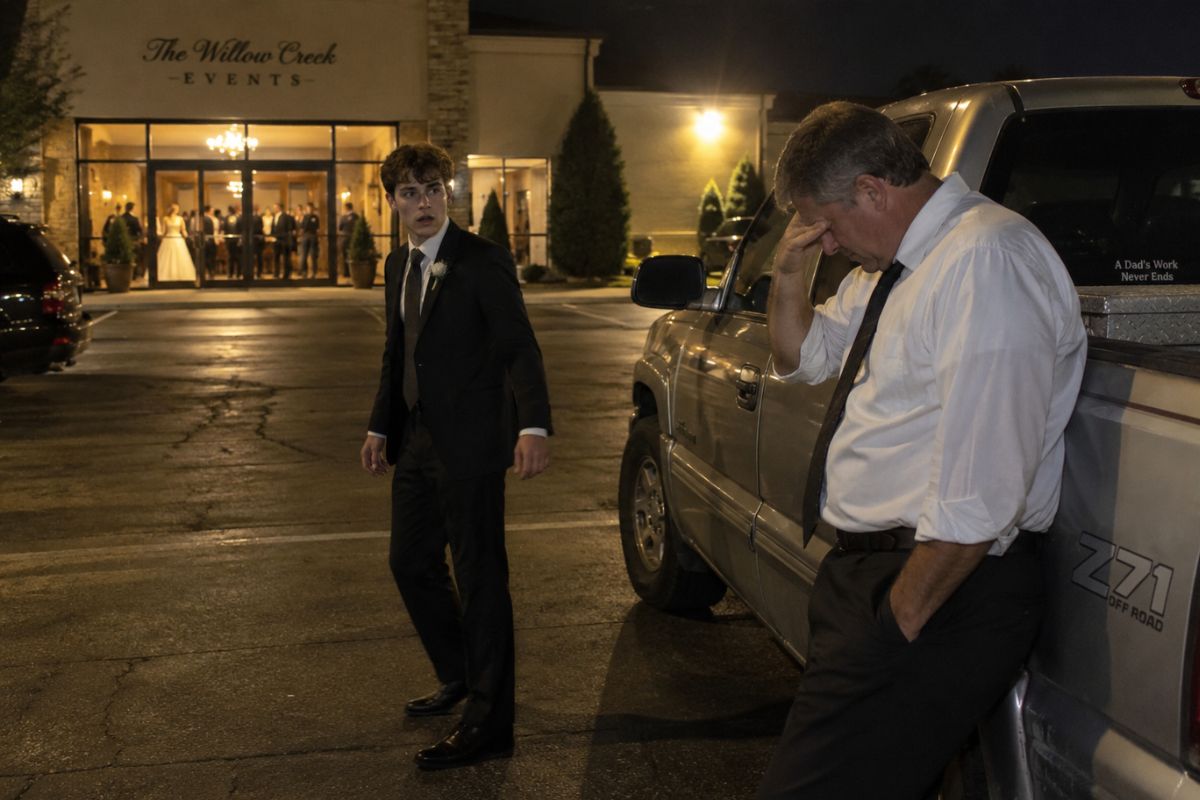
At the end of the night, when the last guests were gathering their coats and the sparklers were set up outside for the send-off, I stood in the emptying barn and looked around at the flowers, the wrinkled tablecloths, the half-burned candles, the scattered napkins, and I thought: she did not ruin this.
She really did not.
She tried.
But love had been better prepared than bitterness.
That was the part I kept coming back to.
Not that Marcus defended me.
Though he did.
Not that Ivy was brave.
Though she was.
It was that love had not shown up naive.
It had shown up alert.
Tender and alert.
Openhearted and ready.
That mattered to me in ways I did not even have language for yet.
For about eight weeks after the wedding, Dolores said nothing.
No call.
No card.
No “misunderstanding.”
No half apology dressed as offense.
Nothing.
Marcus was relieved.
Honestly, so was I.
We moved into a bigger house thirty minutes away.
Nothing fancy.
Just a warm place with a front porch swing, a small backyard, and a room Ivy immediately declared “perfect for becoming a serious older sister someday,” though at the time there was no baby on the way and she was operating entirely on optimism.
Life settled.
We learned the ordinary rhythm of marriage.
Not the movie version.
The real one.
Who takes out the trash.
Who loads the dishwasher in the way the other person claims is chaos.
How to hold each other after long workdays without making every hard moment a dramatic conversation.
Marcus hung the wedding letter in a simple frame in the living room.
At first I thought that would make the memory feel too sharp.
But somehow it did the opposite.
Framed, it looked less like a weapon turned around and more like a declaration of what our home would stand on.
Sometimes I would catch Ivy reading it from the couch.
Not because she had forgotten.
Because she liked hearing, in her own head, what had been said about us.
Kids know the value of repetition when something helps them feel safe.
One evening I asked Marcus, “When did you decide to write it?”
He was standing at the stove making grilled cheese and tomato soup because that was his comfort-food specialty.
He didn’t turn around right away.
“Rehearsal dinner,” he said.
“What happened?”
He sighed.
“Mom cornered Tessa near the restroom and said it was ‘sad’ that I was locking myself into a complicated life.”
I closed my eyes.
Of course she did.
“She asked Dean that week if there was still time to ‘talk sense into me,’” he added. “And the thing is, I know her. I knew if she was going to do something, she’d do it when everyone was watching.”
I stood in the kitchen doorway and just looked at him.
“Why didn’t you tell me?”
He finally turned.
Because he knew what I was really asking.
Not about logistics.
About burden.
About whether he had been carrying this alone because he thought I had enough already.
“Because I didn’t want you spending your wedding week braced for impact,” he said. “And because protecting your peace isn’t the same as keeping secrets from you forever. I planned to tell you after the honeymoon if nothing happened.”
I stepped closer.
“You trusted Ivy with something that big.”
He smiled.
“I trust her because I love her. And because she takes important things seriously. Also because she worships a microphone.”
I laughed.
Then I cried a little.
Because that was my life with him.
Even the heavy truths ended with some tenderness I had not been expecting.
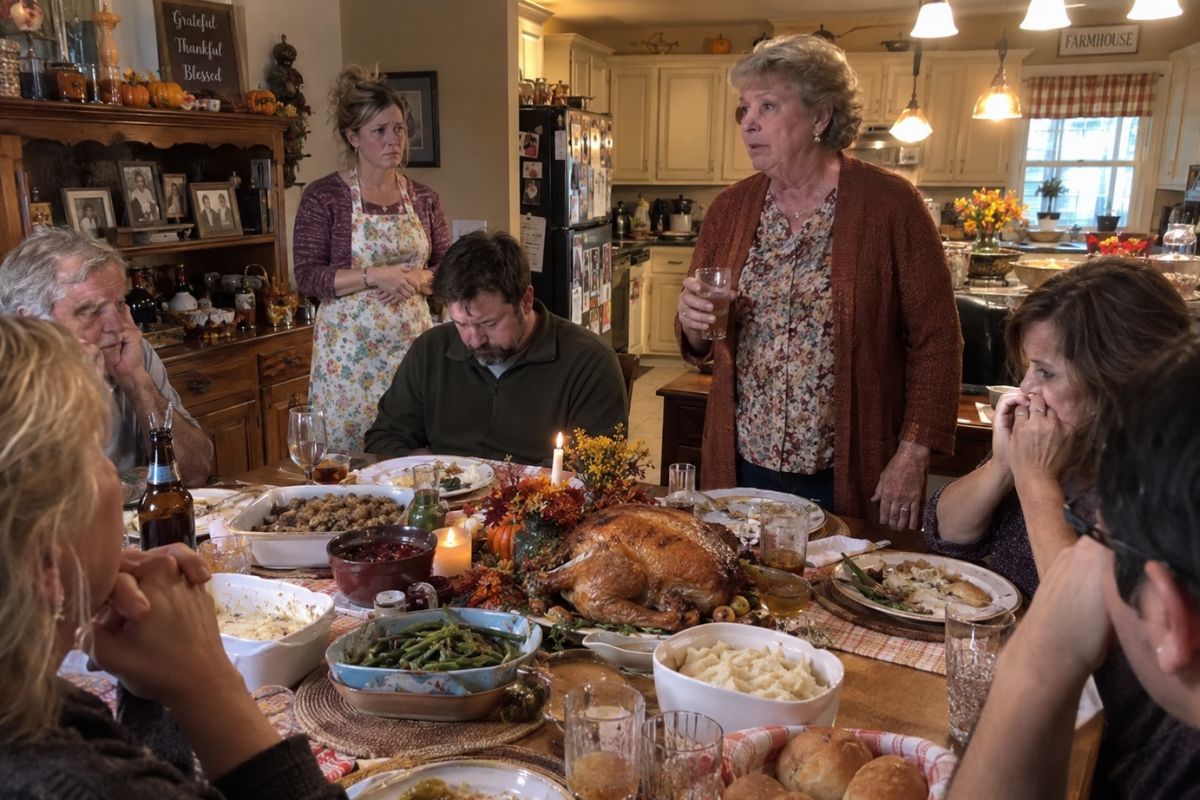
Thanksgiving came.
Then two days before, Dolores called.
Marcus answered in the living room while I was peeling sweet potatoes in the kitchen.
I could hear only his side.
Long pauses.
A few clipped responses.
Then one sentence that made me stop peeling.
“You want to come here?”
When he hung up, he looked tired.
Not angry.
Tired.
“She wants to apologize.”
I stared at him.
“To who?”
“All three of us.”
Part of me wanted to say no immediately.
Not because I wanted revenge.
Because I had finally gotten used to the quiet.
I had finally started to understand what it felt like not to be under observation by her.
But another part of me thought about Ivy.
About what kind of family story we wanted to write going forward.
Not the one where harm is erased.
The one where accountability matters if it is real.
So I said yes.
She came the Sunday before Thanksgiving.
No black dress this time.
No polished armor.
Just slacks, a cardigan, and a face that looked older than I remembered.
Fear can age a person.
So can shame.
She sat on our couch and twisted her wedding ring around her finger for almost a full minute before she spoke.
“I was wrong,” she said.
Not, “I’m sorry you were upset.”
Not, “Things got out of hand.”
Not, “I was emotional.”
“I was wrong.”
Then she looked at me.
And for the first time since I had known her, she looked directly at me without competing.
“I thought if Marcus married you, I would lose him,” she said. “I told myself I was protecting him, but I wasn’t. I was protecting my own place. Or trying to.”
Her voice cracked on the last words.
She hated that.
I could tell.
She was a woman used to control.
Emotion made her look almost startled by herself.
“I convinced myself,” she went on, “that if he gave his heart to you and Ivy, there would be less left for me. And instead of admitting that fear, I turned it into judgment.”
Marcus sat beside me.
Quiet.
Letting her finish.
She turned to him.
“I have said unkind things for months. You warned me. You asked me to stop. I told myself I was being practical.”
Marcus did not rescue her from the truth.
He just nodded once.
Then she looked at Ivy.
This was the part that mattered to me most.
More than anything she said to Marcus.
More than anything she said to me.
Because adults can apologize to adults all day long and still skip the child who absorbed the damage.
Dolores did not skip her.
She got off the couch.
Slowly.
Knelt on the rug in front of Ivy, who was sitting cross-legged with colored pencils and a half-finished turkey drawing.
“I said mean things about your mama,” she said. “And I said mean things that were about you too. That was wrong. You are not baggage. You are not something in the way. You are a little girl who loves very big, and I was wrong to talk like you were anything else.”
Ivy watched her.
Quiet.
Serious.
The same way she had watched the room at the wedding.
Then Dolores said, very softly, “Would you let me try again? At being your grandma?”
It would be nice if I could tell you that the room instantly filled with healing music and everybody cried and all damage disappeared.
That is not how real repair works.
Repair is smaller than that.
More ordinary.
More careful.
It depends on what happens after the apology, not just how moving the apology sounds.
But in that moment, Ivy did what children with generous hearts often do.
She said, “Okay. But you have to be nice for real.”
Dolores let out a shaky laugh.
“Yes,” she said. “For real.”
That was the beginning.
Not of instant closeness.
Of possibility.
Since then, it has been slow.
She comes to Ivy’s school concerts now.
She asks about spelling tests and art projects and actually listens to the answers.
The first time she showed up to one of Ivy’s soccer games with a folding chair and orange slices, I nearly cried into my coat sleeve.
Not because I forgot the wedding.
Because I hadn’t.
But because change, when it is real, can look humble.
Can look like a woman who once saw a child as competition now clapping when that child misses the ball but keeps trying.
Dolores still slips sometimes.
Control does not vanish from a person because they cried once in your living room.
But Marcus stops it the minute it shows.
And now she listens.
That is the biggest difference.
Now she listens.
Six months after the wedding, I found out I was pregnant.
I took the test alone at six in the morning because I did not want to get ahead of myself.
I had been tired, but then again, I was always tired.
Still, there it was.
Positive.
Clear as anything.
I sat on the bathroom floor in my pajamas and laughed and cried at the same time.
Then I carried the test to the kitchen where Marcus was packing Ivy’s lunch.
He looked at my face and said, “What?”
I held it up.
He stared.
Then he looked at me again.
Then back at the test.
Then he laughed in this stunned, beautiful way that made me laugh harder too.
He walked around the counter and hugged me so carefully you would have thought I was already made of glass.
“We’re having a baby?” he whispered.
“We’re having a baby,” I whispered back.
When we told Ivy, she screamed so loudly the dog next door started barking.
She ran in circles through the living room chanting, “I knew it, I knew it, I knew this room was for something.”
Then she stopped and asked if big sisters got extra dessert for responsibility.
Marcus said that sounded official enough to him.
When we told Dolores, she cried again.
But this time it was not because she feared losing her son.
It was because she understood, finally, that love had not been divided.
It had grown.
She asked Ivy, half laughing through tears, “What kind of grandmother do you want me to be when the baby comes?”
Ivy did not hesitate.
“The helpful kind,” she said. “Not the bossy kind.”
Dolores nodded like she had received instructions from a very small and very legitimate authority.
“The helpful kind,” she repeated.
That is where we are now.
Not in a perfect family.
I do not believe in those.
Not in a family without scars.
Not in a family that never said the wrong thing, feared the wrong thing, or had to learn how not to let old insecurity become new damage.
We are a real family.
Which, to me, means something better.
A family that was tested.
A family that told the truth.
A family that chose repair without pretending harm never happened.
The framed letter still hangs in our living room.
Visitors always ask about it.
Sometimes I tell the short version.
Sometimes the long one.
Sometimes I just smile and say, “It’s the reason our family learned to say the important parts out loud.”
Because that is what changed me most.
Not the humiliation.
Though I remember it.
Not even the applause after.
Though I will never forget that sound either.
It was the clarity.
The clarity of hearing, in front of everyone, the man I loved refuse the lie that my motherhood made me less.
The clarity of watching my daughter stand steady in a room full of adults and read a truth she had been trusted to carry.
The clarity of understanding that the right kind of love does not merely tolerate your past.
It honors the life you built before it arrived.
For years, I had quietly carried this idea that the best I could hope for was to be loved despite the hard parts.
Despite the divorce.
Despite the struggle.
Despite the child.
Despite the history.
Marcus loved me because of the ways those things shaped me.
Because I had learned endurance.
Because I had.
Because I had learned tenderness with boundaries.
Because I had built a home out of leftovers and faith and very little sleep and still made it feel warm.
Because my daughter existed.
That part matters.
He did not love Ivy as a concession.
He loved her as part of the whole truth of me.
That changed something deep in me.
It replaced shame with pride.
Not all at once.
But for good.
And if there is one thing I know now, it is this:
Love is not made smaller by what came before it.
Real love is made more honest.
A man who needs you untouched by life is not looking for a partner.
He is looking for a mirror.
A man who can look at the whole of your life and say, “Yes. This too. I choose this too”—that is a man who understands devotion.
And as for children?
Children know more than we think.
They know who shows up.
They know who sees them.
They know who is threatened by them and who is grateful for them.
Ivy knew, long before the wedding, that Marcus loved her.
That is why she could carry his words without fear.
Because she had already read the letter in his daily actions for two years.
In pancakes.
In school drop-offs.
In braids.
In chapter books.
In being told, over and over, that she belonged.
The microphone moment was just the public version of a private truth he had been building all along.
Sometimes people ask me if I’m glad Dolores spoke that night.
That is a hard question.
No part of me is glad I was humiliated.
No part of me is glad my daughter had to hear those words.
No part of me romanticizes harm because something beautiful came after it.
But I will say this:
I am glad the truth came into the open.
I am glad the room saw who we were.
I am glad Marcus’s love was not something I only knew in private.
I am glad Ivy saw, at eight years old, that when someone tries to define your family with cruelty, you do not have to scream to answer them.
Sometimes you answer by standing steady and telling the truth so clearly that everybody else recognizes it too.
And I am glad that the woman who tried to wound us had to live long enough in the quiet afterward to understand what she had done.
Because sometimes consequences are not loud.
Sometimes they are a roomful of people seeing through you all at once.
Sometimes they are an eight-year-old holding a microphone with more grace than you brought to the whole evening.
Sometimes they are the slow work of becoming the kind of person a child will agree to trust again.
When I think back to that night now, I do not see Dolores first.
I used to.
For months, I did.
I replayed her face.
Her tone.
That sentence about baggage.
But memory has softened around a different center.
Now I see Ivy walking forward in her flower girl dress.
I see Marcus turning to me, calm in the middle of the storm he had predicted.
I see the envelope.
The paper opening.
The room listening.
I see two hundred people learning, in real time, that family is not defined by sequence.
Not by who arrived first.
Not by who shares blood.
Not by who thinks they are owed the center chair.
Family is defined by who loves with honor.
Who protects the vulnerable.
Who tells the truth when a lie would be easier.
Who makes room.
Who stays.
That is our story.
Not the story of a cruel wedding speech.
The story of what happened after it.
The story of a husband who prepared love like armor.
The story of a little girl who read a room full of adults back into decency.
The story of a woman who finally understood that her hardest years did not make her unworthy of deep love.
They made her ready to recognize it.
And every Saturday morning now, when Marcus flips pancakes and Ivy critiques his syrup distribution like a seasoned restaurant inspector, and I sit at the kitchen table with one hand on my coffee and one on the small life growing inside me, I look at them and think the same thing every time.
This was never baggage.
This was always the blessing.
Thank you so much for reading this story!
I’d really love to hear your comments and thoughts about this story — your feedback is truly valuable and helps us a lot.
Please leave a comment and share this Facebook post to support the author. Every reaction and review makes a big difference!
This story is a work of fiction created for entertainment and inspirational purposes. While it may draw on real-world themes, all characters, names, and events are imagined. Any resemblance to actual people or situations is purely coincidenta