If you’ve already read part 1 of this story on Facebook, go here for Part 2!
Mr. Luis almost missed it because it looked like trash.
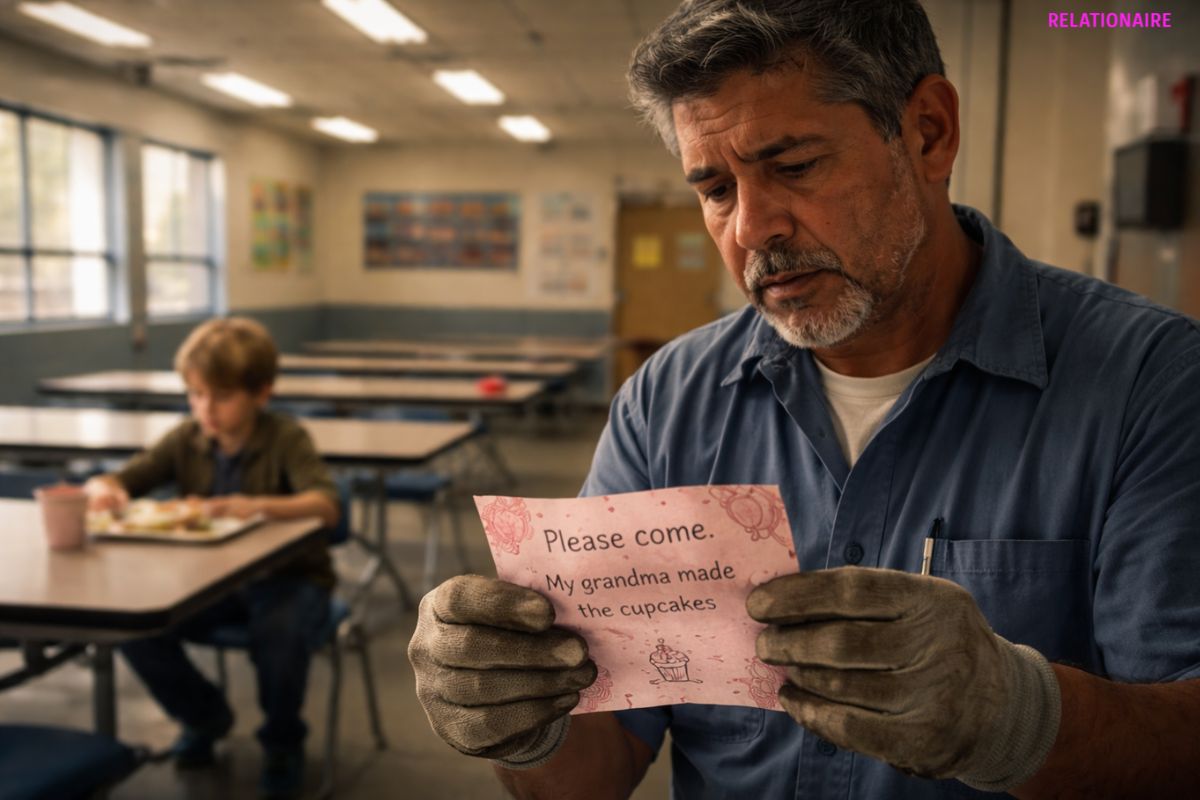
A damp paper ball, half-buried under apple cores, milk cartons, and a sticky napkin in the cafeteria garbage.
He was changing liners between lunch waves, moving fast before the fifth graders came in loud and hungry, when something white caught on the edge of his glove.
He pulled it loose.
Pink paper. Bent in the middle. Smeared with chocolate pudding.
On the front, in crooked purple marker, were the words:
Please come. My grandma made the cupcakes.
He almost smiled.
Kids threw away stranger things than invitations. Homework. Valentine cards. Permission slips. Once, a whole shoe.
He flattened the paper against the side of the trash can and read the rest.
You are invited to my birthday on Friday at 4:30.
Room 214, Magnolia Care Center.
Please come because it’s my last party with her.
At first he thought he’d read it wrong.
He looked again.
The marker had bled a little, but the words were still there.
Please come because it’s my last party with her.
He stood very still while the cafeteria noise rolled around him like weather.
Someone at the far table laughed too hard. A tray clattered. One of the lunch ladies called for ketchup packets. But in his hand was a child’s invitation, written carefully enough to hurt.
“Mr. Luis?”
He looked up. Mrs. Hanley, one of the teachers, stood by the door with a stack of folders pressed against her chest.
“You okay?”
He folded the paper once. “Yeah. Just cleaning.”
She nodded and moved on.
He put the invitation in his shirt pocket and finished the trash.
By the next day, he’d nearly forgotten about it.
That was how life worked when you were the school janitor. Everything needed something. A bathroom sink clogged. A classroom chair broke. A second grader threw up blue sports drink in the hallway. One of the teachers needed salt for the icy patch near the side entrance, even though spring had already started pushing through the cold.
But then, during first lunch, he saw the boy.
Skinny shoulders. Red sweatshirt with one stretched cuff. A paper carton of milk untouched. A lunch tray with carrot sticks pushed into a neat line like he was trying to make them behave.
The boy sat alone at the end of the table while two empty seats beside him stayed empty.
Kids weren’t always cruel in loud ways. Sometimes they were cruel by drifting elsewhere.
Mr. Luis recognized him after a second.
Owen Mercer. Third grade. Quiet kid. Big eyes. Drew rockets in the margins of worksheets when teachers left papers on their desks.
Mr. Luis had fixed the zipper on Owen’s backpack once with a twist tie.
Now the boy was staring at the cafeteria doors every time they swung open.
Like he was waiting for someone.
Friday party, Mr. Luis thought.
The invitation in his pocket suddenly felt heavier than a piece of paper ought to.
By Wednesday, Owen was still eating alone.
By Thursday, he was still glancing up every time someone came in.
And on Thursday afternoon, while Mr. Luis was sweeping the hallway near the office, he saw Owen crouched by the lost-and-found bin.
Not digging for a coat.
Just standing there too long, like he was trying to make himself small.
“Everything all right, buddy?” Mr. Luis asked.
Owen jerked a little, then nodded too fast.
His cheeks flushed pink. “I was just looking.”
“For what?”
Owen shrugged.
Mr. Luis leaned the broom against the wall. “Maybe I can help.”
The boy looked at the floor. His sneakers were worn through at the white edges. One lace was tied in a hard knot.
Then he said, barely above a whisper, “Do you think people throw stuff away if they don’t want it?”
Mr. Luis didn’t answer right away.
Kids asked questions sideways when they were afraid of the real one.
“Sometimes,” he said carefully. “Sometimes they throw stuff away because they don’t know what it means.”
Owen nodded like that mattered. Like he was storing it somewhere.
Then the office door opened and a woman stepped out carrying a cardboard box of construction paper and juice pouches.
Carly Bennett.
Mr. Luis knew her by sight. Parent volunteer. PTA type, some people said, with that tone people used when they meant too cheerful. She was always showing up for class parties in crisp sweaters and clean white sneakers that somehow stayed white. Today she wore a denim jacket and a ponytail and looked like she’d come straight from somewhere busier than this school.
She stopped when she saw Owen’s face.
“You okay, sweetie?”
Owen stepped back so fast he bumped the lost-and-found bin. “I’m fine.”
Then he walked away with his head down, one hand gripping the strap of his backpack.
Carly watched him go. “That didn’t sound fine.”
“No,” Mr. Luis said.
She looked at him. “You know what’s going on?”
He hesitated.
It wasn’t really his business. A crumpled invitation from a trash can wasn’t the kind of thing adults were supposed to build stories around.
But then again, neither was a little boy eating lunch alone for four days.
Mr. Luis reached into his pocket and handed her the folded pink paper.
She read it once.
Then again, slower.
Her face changed.
Not dramatically. Just enough for him to see the moment the words landed.
“Oh,” she said.
A long second passed in the empty hallway.
Then Carly looked up. “This was in the trash?”
He nodded.
“Did he give these out?”
“I don’t know.”
She pressed her lips together. “Kids can be awful.”
“Kids can also be eight,” Mr. Luis said. “Sometimes they don’t understand what they’re looking at.”
She gave a tired little laugh, the kind that wasn’t really laughter. “That’s true.”
He took the invitation back, but she didn’t move.
“What’s Magnolia Care Center?” she asked.
“Hospice wing’s attached to the nursing home on Maple.”
Her eyes flicked to the card again. “So his grandmother…”
“Probably.”
Carly looked down the hallway where Owen had disappeared.
“I signed up to bring napkins for the spring picnic,” she said softly, almost to herself. “And that little boy is inviting people to a birthday party in hospice.”
Mr. Luis said nothing.
A few parents passed the front office windows outside, laughing about soccer practice and pick-up schedules and whether Friday would rain out field day. The ordinary noise of ordinary lives.
Inside the hallway, the invitation seemed to hum.
Carly turned back to him. “What if nobody comes?”
He thought of the untouched milk carton. The cafeteria doors. The way Owen had asked about things people throw away.
He didn’t answer because they both already knew.
Carly exhaled slowly. “We could go.”
Mr. Luis blinked. “What?”
“We could go,” she repeated. “Not as a big thing. Not to embarrass him. Just… show up.”
“That’s probably not appropriate.”
“Why?”
“We weren’t invited.”
She looked at him like that was the most ridiculous thing she’d heard all day, then lifted the pink card between two fingers.
“I think maybe we were.”
He almost smiled in spite of himself.
Then Principal Merritt stepped into the hallway, spotted them, and frowned at the invitation in Carly’s hand.
“What is that?”
Carly answered before Mr. Luis could. “A birthday invitation.”
The principal’s eyes moved from one of them to the other. Suspicion settled in quick and sharp.
“For which student?”
Mr. Luis felt the air change.
There were some looks adults wore that said they’d already decided what kind of story they were in.
“Why?” Principal Merritt asked.
No warmth in it. No curiosity. Just that clipped tone that made ordinary people sound guilty.
Carly straightened. “Because we’re thinking about going.”
The principal stared at them.
Then she held out her hand. “Let me see that.”
Mr. Luis passed her the invitation.
She read it.
And for the first time since stepping into the hallway, her expression cracked.
Not with anger.
With something worse.
Recognition.
She looked up at Owen’s empty classroom door, then back at them, and said quietly:
“You don’t understand. This isn’t just a birthday party.”
Part 2
The hallway felt colder after Principal Merritt said it.
Carly was the first to speak.
“Then what is it?”
Principal Merritt looked down at the invitation again, smoothing the bent corner with her thumb like she was trying to soften what the words meant.
“It’s his mother’s room number,” she said. “Not his grandmother’s.”
Mr. Luis stared at her.
“But it says—”
“I know what it says.”
Her voice gentled, and that was somehow harder to hear.
She handed the card back carefully.
“Owen’s grandmother made the cupcakes,” she said. “His mother is the one at Magnolia.”
Carly pressed a hand to her mouth.
For a second nobody moved. The fluorescent lights buzzed overhead. Somewhere in the office, the copier started grinding out pages.
Mr. Luis heard himself ask, “How old is she?”
“Thirty-two.”
That hit him in the chest in a strange, blunt way.
Thirty-two was too young to be in a hospice room while her son passed out birthday invitations at school.
“Cancer,” Principal Merritt said, answering the question before either of them asked. “It spread fast.”
Carly’s eyes had gone wet, but her voice stayed steady. “Does Owen know?”
Principal Merritt looked exhausted. “He knows enough.”
Enough.
Mr. Luis hated that word.
Enough meant a child had learned words no child should need. Enough meant there were parts of the truth adults were trying to hold back with their bare hands while time kept slipping through anyway.
“He brought the invitations on Monday,” the principal said. “His teacher told me some kids got nervous when they saw ‘care center’ and ‘last party with her.’ A few thought it would be scary. A few parents weren’t comfortable.”
Carly laughed once, in disbelief. “Uncomfortable?”
The principal didn’t defend it. “Some never made it home. Most were found in desks. A few were thrown out.”
Mr. Luis looked at the pink paper and felt heat rise up the back of his neck.
He pictured Owen writing them one by one.
Maybe sounding out names. Maybe making sure the letters were neat. Maybe asking his grandmother if blue icing would stain teeth. Maybe believing that if he handed enough invitations to enough people, his mother’s room could feel less like a place people were leaving.
“When is his birthday?” he asked.
“Tomorrow.”
“And no one’s going?”
Principal Merritt didn’t answer.
She didn’t need to.
Carly squared her shoulders. “Then we’re going.”
The principal looked at her for a long moment.
Then she looked at Mr. Luis.
He expected resistance. A speech about boundaries. Liability. Optics. School policy.
Instead she said quietly, “Bring paper plates. Magnolia always runs out.”
That was how it began.
Not with a plan grand enough for a movie.
Just three adults standing in a school hallway with a crumpled invitation and the shared understanding that a child should not have to watch a door all week for people who were never coming.
By the end of the day, Carly had texted two other parent volunteers. One said yes right away. One left her on read.
Mr. Luis stopped by the dollar store after work and bought balloons that said HAPPY BIRTHDAY in bright block letters, though the “P” was missing from one package and the tape barely stuck.
He stood in line behind a woman buying cough syrup and cat litter, holding balloons in one hand and a plastic pack of dinosaur plates in the other, and felt ridiculous.
Then he imagined Owen in a hospice room pretending not to notice an empty doorway.
He bought two packs.
That night, Carly called him.
He almost didn’t answer because he didn’t know people like Carly Bennett called people like him after dinner. But he picked up on the fourth ring.
“I talked to Owen’s teacher,” she said without preamble. “Off the record.”
Mr. Luis leaned against his kitchen counter. “Yeah?”
“He hasn’t stopped talking about tomorrow.”
Something in her voice made him close his eyes.
“He keeps telling kids it’s okay if they can’t stay long,” she said. “He told one girl they only need to eat one cupcake if they don’t like chocolate.”
Mr. Luis swallowed hard.
Carly was quiet for a moment. Then: “His mom wanted to throw him a real party this year. Backyard, water balloons, those cheap plastic tablecloths. She got sick before she could.”
His small apartment suddenly felt too still.
“What time are you going?” he asked.
“Four. I’m bringing a present.”
“You didn’t have to.”
“I know.”
That was the thing that made him trust her.
She wasn’t doing it because she had to.
Friday moved like it was afraid of what waited at the end of it.
At school, Owen wore a paper crown all day. It was slightly crooked, and he kept touching it like he wasn’t sure it was supposed to be his.
Kids said happy birthday in passing. Some were sincere. Some were prompted by teachers. Some didn’t say anything at all.
At lunch, he still sat alone.
But this time, Mr. Luis noticed something new.
Owen had three napkins folded beside his tray.
Not one.
Three.
Like he was already saving places.
At 3:40, after the buses left and the halls emptied into that strange silence schools had after children were gone, Mr. Luis found Owen in the front office with his grandmother.
She was a small woman in a tan coat with silver hair pinned back loosely and tired eyes that kept trying to brighten themselves for the boy’s sake. She held a bakery box against her chest with both hands.
Cupcakes, Mr. Luis thought.
Homemade, just like the invitation said.
Owen saw him and smiled in a way that made his whole face look younger.
“Mr. Luis,” he said. “You fixed my backpack.”
“I remember.”
The boy nodded proudly toward the box. “My grandma made twelve cupcakes because maybe more people will come than we think.”
His grandmother’s fingers tightened around the cardboard.
Carly arrived two minutes later, balancing a gift bag, a bouquet of grocery store daisies, and a helium balloon that kept drifting sideways and hitting her in the cheek.
She looked almost breathless when she walked in.
Owen stared at her.
Then at Mr. Luis.
Then back at Carly.
Understanding flickered across his face so slowly it hurt to watch.
“You came?” he asked.
Carly knelt in front of him. “Of course we did.”
The grandmother made a sound then, a small broken sound she tried to hide by clearing her throat.
Principal Merritt appeared from her office with a stack of paper plates and napkins under one arm.
“I had a meeting nearby,” she said, though nobody believed her. “Thought you might need these.”
Owen looked at all of them like he didn’t know where to put that much relief.
Then he smiled.
Not a loud, jumping-up-and-down smile.
A careful one.
A smile from a child who had spent all week preparing not to be disappointed, and had just realized he might not have to be.
The drive to Magnolia Care Center took eleven minutes.
Carly followed in her SUV. Mr. Luis rode with Principal Merritt because she said she knew where to park. Owen and his grandmother drove ahead in an old Buick with one brake light dimmer than the other.
When they pulled into the lot, the sun was already lowering, casting the building in soft gold that made it look gentler than it probably was inside.
Magnolia was clean, quiet, and smelled faintly of lemon polish and something medicinal underneath.
The receptionist smiled at Owen like she knew him.
“Birthday boy,” she said.
He grinned and adjusted his paper crown.
They took the elevator up.
Second floor.
Hospice wing.
Carly’s eyes met Mr. Luis’s just for a second as the doors opened.
The hallway was hushed, carpeted, lined with framed watercolor prints that tried their best.
At Room 214, Owen stopped.
He took a breath.
Then another.
His grandmother shifted the cupcake box to one arm and reached for the handle, but Owen touched the door first.
Like he needed to be the one to open it.
He looked back at the adults behind him.
There were only four of them.
Not a crowd. Not a rescue. Just four people with paper plates, a balloon, flowers, and the sudden terrible understanding that this little party might be carrying more weight than any of them had guessed.
Owen smiled, nervous and bright and breakable.
“She’s been sleeping a lot,” he whispered. “So if she looks different, don’t act weird.”
Then he opened the door.
And from inside the room, a woman’s weak voice said:
“Owen? Did your friends come?”
Part 3
The room was smaller than Mr. Luis expected.
Hospice rooms always were.
He had no idea why people imagined sorrow took up more space.
A narrow bed stood near the window. A blue recliner sat in the corner with a folded blanket over one arm. On the windowsill there was a paper sun cut from yellow construction paper, a plastic cup holding three bent straws, and a framed photo of Owen missing his front teeth beside a woman with dark hair and a laugh caught mid-burst.
The woman in the bed was the same woman.
Only thinner now.
So thin it startled him.
Her hair was wrapped in a soft knit cap. Her skin had that fragile, almost see-through look illness gives people when it has taken more than weight. But her eyes were open, and when she saw the small cluster behind her son, they filled so fast it seemed like the body could still remember joy even when it was losing everything else.
“Owen,” she whispered again.
He went to her bed at once.
“Mom, they came.”
That was all.
Not names first. Not explanations.
Just the miracle.
They came.
Carly turned away for a second and pressed her fingers to the corner of one eye.
Mr. Luis stood near the door, suddenly awkward in his work boots and clean flannel, holding a bag of dinosaur plates like he’d arrived at the wrong place in the world.
But Owen’s mother looked at each of them as if they belonged there.
“You must be the famous Mr. Luis,” she said, her voice papery but warm.
He blinked. “Famous?”
“Owen says you can fix anything.”
Something in the room loosened. Just enough for people to breathe.
Carly stepped forward with the flowers. “I’m Carly. I volunteer at school.”
“And she brought you daisies,” Owen said, beaming, as though this were proof that the evening was already a success.
Principal Merritt set down the napkins and plates on the tray table and introduced herself softly. Owen’s grandmother moved around the room with the automatic competence of someone who had been holding too much together for too long. She found space for the cupcakes. She asked where the lighter was. She adjusted the blanket at her daughter’s feet without being asked.
The candle was a number nine.
When Owen saw it, he grinned. “I told Grandma I’m not ready for double digits.”
His mother laughed.
A real laugh.
Thin, yes. Brief, yes. But real enough that everyone in the room smiled as if they’d been handed something rare and breakable.
The cupcakes were chocolate with vanilla frosting that swirled unevenly on top. Hand-piped. A little messy. Perfect.
They sang quietly because this was hospice and there were other rooms, other families, other endings happening down the hall.
Even so, the sound filled the little room completely.
Owen shut his eyes tight when it was time to make a wish.
He held them closed longer than most children do.
Long enough that Carly looked down.
Long enough that his grandmother’s hand covered her mouth.
Long enough that his mother looked at him with a love so naked it felt private to witness.
Then he blew out the candle in one breath.
Everyone clapped softly.
And for ten whole minutes, it almost felt ordinary.
Cake.
Napkins.
Frosting on the edge of Owen’s thumb.
Carly giving him the gift bag, which turned out to hold a sketchbook, colored pencils, and a small pack of glow-in-the-dark star stickers.
Owen gasped when he saw them.
“You remembered I like space.”
Carly looked startled. “I guessed.”
“Well,” he said seriously, “it was an excellent guess.”
Even Principal Merritt smiled at that.
Then Owen’s mother asked if she could have a minute alone with him.
The adults understood at once.
They moved into the hallway, the door left cracked open.
Mr. Luis leaned against the wall and stared at the watercolor print opposite the room without seeing it. Carly stood beside him, hands wrapped around each other. Principal Merritt spoke quietly with the grandmother near the nurses’ station.
From inside came the low murmur of a mother talking to her son on his ninth birthday.
No one tried to listen.
After a few minutes, the grandmother came back with red eyes and said softly, “She wants to speak to you. Both of you.”
“Us?” Carly asked.
She nodded toward Mr. Luis.
Inside, Owen had moved to the recliner with his new sketchbook on his lap. He was drawing already, head bent, giving the adults a privacy children sometimes offer without being asked.
His mother looked more tired now, but peaceful too. As if she had spent a piece of strength and chosen exactly where to spend it.
“I know about the invitations,” she said.
Mr. Luis felt heat crawl up his neck. “I’m sorry. I found one in the trash.”
She shook her head. “Don’t be.”
Her eyes shifted to Carly, then back to him.
“I asked him not to hand them out at school.”
Carly frowned. “Why?”
“Because children shouldn’t have to come here if they don’t want to.” She paused, catching her breath. “And because I thought maybe… maybe if nobody came, it would be easier on him to think I’d decided it should just be family.”
Mr. Luis glanced at Owen, drawing stars in careful rows.
“But he handed them out anyway,” she said, smiling faintly. “He said birthdays are supposed to have guests.”
No one knew what to say to that.
She looked at the balloon drifting against the ceiling.
“I heard him asking all week if kids had RSVP’d.” Her voice thinned. “I knew what the answer probably was.”
Carly sat on the edge of the recliner opposite the bed. “I’m glad we came.”
“So am I.”
Owen’s mother reached slowly toward the bedside drawer. Her hand trembled with the effort. Mr. Luis stepped forward to help, but she shook her head once, wanting to do it herself.
From the drawer, she took out a small white envelope.
It had Owen’s name written across the front.
“I was going to wait until after,” she said. “After everything. I thought maybe my mom could give it to him later.”
She looked at the envelope for a long second before continuing.
“But I need someone to make sure he gets more than just the letter.”
Her eyes lifted to Mr. Luis.
“When he was in first grade, he came home talking about the janitor who fixed his lunchbox latch with a paper clip and told him the moon looked close enough to climb that night.”
Mr. Luis blinked hard. He barely remembered saying it.
“He decided that meant you were the kind of grown-up who stays,” she said.
Then she looked at Carly.
“And I’ve seen you in the hallway with kids who aren’t yours. The way you kneel down when you talk to them. The way you don’t rush.”
Carly’s face crumpled.
Owen’s mother drew a shallow breath.
“I’m not asking for miracles,” she said. “My mother will raise him. He has family. But grief is strange on children. It shows up at school. At lunch tables. In the quiet.”
She held out the envelope.
“Will you help watch for the quiet?”
Mr. Luis took it with both hands.
Carly covered her mouth again and nodded before she could even speak.
“Yes,” she whispered. “Yes, of course.”
Owen looked up from his sketchbook. “What’s happening?”
His mother smiled at him with so much gentleness it hurt to look at.
“Just making sure my good guess about people was right.”
He seemed satisfied with that.
Later, after hugs and dishes and the careful awkwardness of saying goodbye in a room where goodbye meant too many things, they left Magnolia under a sky washed lavender and gray.
In the parking lot, Owen ran back to Mr. Luis before getting into his grandmother’s car.
“Hey,” he said, slightly out of breath. “Thanks for coming uninvited.”
Mr. Luis laughed through the thickness in his throat. “Anytime.”
“That’s not what uninvited means,” Owen said very seriously.
“No?”
“It means you came because you wanted to. Not because you had to.”
Then he hugged him.
A quick, fierce squeeze around the middle.
When the Buick pulled away, Carly stood in the lot with her arms folded tight.
“I don’t think I’ll ever be the same after that,” she said.
Mr. Luis looked down at the envelope in his hand.
Neither would he.
Owen’s mother died nine days later.
The school learned in pieces, the way schools learn hard things. A counselor came. Teachers spoke softly. Children asked blunt questions. Some cried because they understood. Some cried because everyone else did. Some just sharpened pencils and stared at the wall because grief enters a room even when you don’t know its name.
At lunch that week, Owen did not sit alone.
Not because every child suddenly understood loss.
But because one sat down, then another.
Because Carly started volunteering on Wednesdays, not just party days.
Because Principal Merritt quietly began a birthday board in the front hallway so no child’s day passed unseen.
Because Mr. Luis started carrying granola bars and extra napkins and bits of string and tape and all the small things that keep lives from unraveling completely in public.
And because when Owen went still and watchful near the cafeteria doors, there was always at least one grown-up who noticed.
Near the end of the school year, after dismissal, Owen found Mr. Luis mopping the hallway outside Room 8.
He held up a folded drawing.
It was a picture of a hospice room with a bed, a balloon, a tray of cupcakes, and five people standing close together. Over their heads he’d drawn stars.
“My mom said parties are really just people making a small space feel full,” Owen said.
Mr. Luis took the picture carefully.
At the bottom, in crooked block letters, Owen had written:
They came.
Mr. Luis taped it inside his supply closet door.
He kept it there beside spare keys and work orders and the kind of ordinary things that fill a life.
Some days, when the building was noisy and children ran past with untied shoes and missing homework and all their loud unfinished futures, he looked at that drawing and thought about how close some heartbreaks come to being invisible.
A paper in the trash.
A boy at the end of a lunch table.
A door someone almost lets stay closed.
And how sometimes what saves a person is not a grand rescue.
Just someone who sees the small, breakable thing in front of them and decides it matters enough to show up.