If you’ve already read part 1 of this story on Facebook, go here for Part 2!
“Don’t put your hand in there, Hank.”
The kennel tech said it low, but sharp enough to stop him halfway.
“She’s snapped at three people,” she added. “Won’t eat. Won’t drink unless we leave the bowl and back off. Animal control found her wrapped in that old blanket out by Miller Road.”
Hank Lawson kept his hand on the chain-link gate and looked past his own reflection in the scratched glass.
The dog stood in the far corner, pressed so tight against the cinder block wall she looked like she wanted to disappear into it.
Long-eared hound. Brown and white once, maybe. Now just dull coat, ribs, mud, and fear.
Her legs were trembling.
Every sound in the county shelter made her flinch. A bark from the next run. The clang of a metal bowl. The squeak of rubber soles on concrete.
The place smelled like bleach, wet fur, old canvas, and burnt coffee from the front desk.
Hank had been coming there every Tuesday and Thursday for almost four years. Rain or shine. Cold morning air or August heat. Didn’t matter.
He always picked the same kind.
The ones nobody wanted.
The dogs too old, too scarred, too skittish, too plain.
He walked them slow around the back gravel path. Sat with them if walking was too much. Talked to them like they were people and never once asked anything back.
People in town had opinions about that.
At the diner, over coffee and bacon grease, they’d watch him through the front window if he pulled into the shelter lot.
Old Hank Lawson, feeding his heart to lost dogs.
Some said it was kind.
Some said it was sad.
A few said it wasn’t natural for a man his age to care more about strays than folks.
Hank never answered any of them.
He’d just take his cap off at the counter, nod to the waitress, and stir his coffee until the spoon stopped clinking.
Now he stood outside kennel 14, looking at a dog everybody else had already given up on.
The tech folded her arms.
“We’re calling her Junie for the paperwork, but she doesn’t answer to anything.”
Hank said nothing.
“Honestly,” she went on, “if she keeps declining food, the vet thinks—”
“I heard you,” Hank said.
His voice wasn’t mean. Just worn.
Like old leather left in the weather and still holding together.
The tech sighed. “You want me to open it?”
“No.”
He crouched instead.
Slowly. Careful on one knee.
The dog’s eyes locked on him, wide and glassy.
He could see the panic in them. Not anger. Not meanness. Panic.
That mattered.
He rested one hand on the concrete outside the gate. Didn’t reach in. Didn’t whistle. Didn’t click his tongue.
Just sat there.
The shelter got loud around them. A child crying in the lobby because his mother said no. Somebody dropping a leash. Two shepherds setting each other off down the row.
The hound never moved.
Then Hank saw it.
Not the dog.
The blanket.
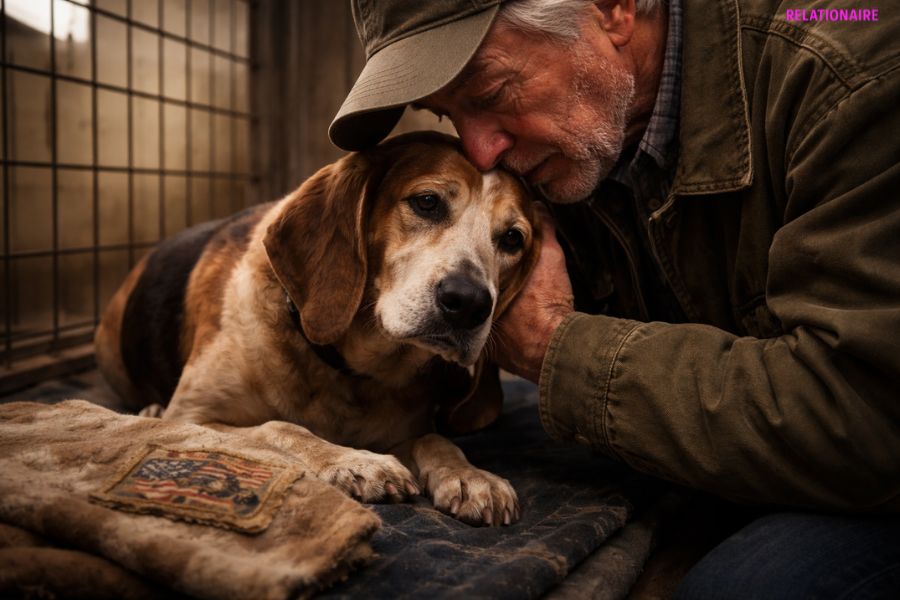
It was bunched under her front paws. Thin as a rag now. Smoke-stained. Gray with age and dirt. One corner folded over.
Sewn into that corner was a faded patch.
Hank leaned closer.
At first he thought it was just an old scrap somebody had stitched there to mend a tear.
Then the dog shifted, and the patch showed full.
Blue thread.
A half-peeled gold border.
The shape of a little house under a pair of wings.
Hank stopped breathing.
The tech said something behind him, but it went thin and far away.
He knew that patch.
Not because he’d seen one like it.
Because he’d held that one.
Years ago. On a winter evening so cold the windows in base housing had frosted white at the corners.
His wife Sarah had laughed at him for trying to sew it straight.
“You were a mechanic, Hank,” she’d said, standing by the kitchen table. “Not a tailor.”
He’d told her, “A patch is a patch.”
She’d kissed his cheek anyway.
He remembered the smell of coffee on her sweater. The screen door creaking when the wind pushed against it. The old yellow porch light outside their unit on base.
And at their feet, a young hound mix circling once before dropping down onto that same blanket.
Rosie.
Sarah’s service dog.
Smart eyes. Soft ears. Always half an inch from Sarah’s leg.
Always watching her.
Always there.
Hank stood up too fast.
The tech stepped back. “You okay?”
He didn’t answer.
He was staring at the patch like it might vanish if he blinked.
That fire had taken the whole row of duplexes in under twenty minutes.
It had taken photo albums, Sarah’s cedar chest, the folded letters tied with twine in the top drawer, his dress blues from the closet, and every small thing that made a life feel real.
Rosie had gotten out.
That was what everybody said.
One neighbor swore he’d seen the dog run into the dark behind the units while smoke rolled over the roofs.
They looked for her for two days.
Then the snow came.
Then the officials took statements.
Then people said the words they always say when they want grief to move along and behave itself.
At least Sarah made it out.
At least you still have each other.
At least it wasn’t worse.
But Sarah had never really believed Rosie was dead.
Even in the hospital, with burns on one arm and her lungs raw from smoke, she’d asked once a day, “Did anybody find her?”
Hank had always said no.
Then Sarah died the next spring from a stroke nobody saw coming, and after that, there wasn’t much left to say.
The tech touched his elbow gently.
“Hank?”
He cleared his throat. “Open the gate.”
She blinked. “She’ll bite.”
“Open it.”
Something in his face must have settled it.
The tech unlatched the kennel and stepped away.
Hank went down on one knee again, slower this time.
The hound flattened herself against the wall, shaking so hard her tags rattled against the bowl. Cheap county tag. No name.
He kept his hands open.
“Easy,” he said.
His voice cracked on the word.
The dog’s nose twitched.
Hank swallowed.
“Rosie?”
The tech frowned behind him. “What?”
The dog didn’t come.
Didn’t wag.
Didn’t bark.
But one ear lifted.
Just a little.
Hank felt the air leave his lungs.
His hand trembled where it rested on the floor.
He tried again, quieter. “Rosie girl.”
The hound took one step.
Then stopped.
Her eyes stayed fixed on him, searching his face the way old memories search a room.
Hank didn’t move.
A minute passed. Maybe two.
Then the dog crept forward, inch by inch, her body low, every muscle ready to bolt.
When she reached the edge of the blanket, she stretched her neck, sniffed the cuff of his coat—
and pressed her nose against his wrist.
Hank shut his eyes.
The tech drew in a breath.
The dog gave one broken sound, almost too small to hear.
Not a growl.
Not a bark.
A whine.
The kind a dog makes when it has found something it thought was gone.
Hank’s shoulders bent like somebody had set a weight across them.
He reached with two fingers and touched behind her ear.
The hound didn’t flinch.
She leaned.
Just slightly.
Like she remembered.
Behind them, somebody in the lobby laughed too loud. A phone rang. A man complained about adoption fees.
Life kept moving.
But inside kennel 14, Hank Lawson was staring at a smoke-stained blanket from a fire that had taken his whole life apart—
and a dog he had buried in his mind beside his wife.
The tech whispered, “How do you know that dog?”
Hank looked down at the patch again.
Then at the hound.
Then at the scar he hadn’t noticed before, half hidden under one ear.
His mouth went dry.
Because suddenly there was something worse than finding her alive.
Something that made no sense at all.
Sarah had sewn one more thing into that blanket.
Something only Hank and Sarah knew was there.
And if this was truly Rosie—
then the blanket should still be carrying it.
His fingers slid toward the folded corner.
The dog went still.
Hank carefully lifted the edge.
And what he saw stitched inside made his face lose all color.
Whoever had kept this dog all these years had known exactly where Rosie came from.
And maybe exactly who she belonged to.
What kind of person keeps a lost dog hidden for that long?
And why send her back now?
PART 2
Hank held the blanket corner between his fingers like it might burn him.
Inside the fold, worked in tiny thread Sarah had stitched by hand, were the initials she used on everything she loved enough to keep.
S.L.L.
Sarah Lynn Lawson.
The letters were faded, but they were there.
Not maybe.
Not close.
There.
The kennel tech stepped closer. “What is it?”
Hank looked at her, but for a second it was like he didn’t know where he was.
Then he got his voice under control.
“It’s hers,” he said.
“Whose?”
“My wife’s.”
The tech went quiet.
Rosie—because now he could not call her anything else—stood pressed against his knee, still trembling, but no longer trying to vanish.
Hank slid one hand beneath her jaw.
The old hound tipped her head into his palm.
That did it.
Not the patch.
Not the initials.
That.
The trust.
Sarah had trained Rosie with patience and repetition and a voice softer than rain on a porch roof. Hand signals. Pressure cues. Quiet commands for the bad days when crowds got too loud and memories came too fast.
After the fire, after the weeks in the hospital, Sarah could barely sleep unless Rosie’s body was against the side of the bed.
When they couldn’t find the dog, something in Sarah had gone hollow.
Hank had watched it happen.
Slowly. Quietly. The way a room goes dim when a lamp is dying but nobody notices until evening.
The tech asked, “Do you want me to call the director?”
Hank nodded once.
Then he looked down at Rosie again.
Her muzzle had gone white with age. There were rough calluses on both elbows. A notch in one ear. An old healed scar near her shoulder.
She had not lived an easy life.
That was plain.
But the blanket had been washed.
Mended twice.
The patch still sewn in place.
Whoever had kept her had not thrown her away.
That made it stranger.
They moved Hank and the dog into the intake office.
Small room. Metal desk. Folding chair. Smell of copier heat and stale coffee.
Rosie stayed close to his boot, too tired now to tremble much.
The shelter director, a square-shouldered woman named Denise, came in with a file and reading glasses low on her nose.
“You’re certain?” she asked.
Hank touched the initials again. “As certain as I’ve been of anything in a long time.”
Denise opened the intake form. “Animal control picked her up two nights ago on Miller Road, about fifteen miles east. A caller said an older man’s truck was pulled off near the ditch. By the time deputies got there, truck was gone. They found the dog wrapped in that blanket.”
“Any plate?”
“No.”
“Any cameras?”
She shook her head. “County road.”
Hank stared at the file.
“What kind of man leaves an old dog in a ditch?”
Denise didn’t answer.
Maybe because there wasn’t one good enough.
By afternoon, word had started moving.
In towns like theirs, it always did.
By supper, folks at the diner were already turning it over between bites of pie and ham.
Old Hank found some shelter mutt and decided it belonged to his dead wife.
Grief will do that to a man.
He’s lonely.
He’s making it into something bigger than it is.
One man at the counter even said, “Next thing you know, he’ll tell us the dog came back from the grave.”
Hank heard it all because he walked in right then.
The waitress, Donna, stiffened and wiped the same clean spot with her rag three times.
The man looked down into his coffee.
Hank did not stop.
He went to his usual booth under the faded high school football photo and sat with Rosie’s blanket folded beside him.
Donna poured without asking.
“You all right?” she said.
“No.”
She nodded. “Need pie?”
He almost smiled.
“No.”
She left the pot anyway.
From the booth behind him, two women whispered.
“Is that the fire dog?”
“That’s what I heard.”
“Why would someone keep it?”
“Maybe they stole it.”
Hank stared out the window at the darkening street.
Maybe they did.
He thought about Sarah saying Rosie’s name from the hospital bed.
He thought about the months after, when he’d wake reaching his arm across the mattress before remembering who was gone.
He thought about every Tuesday and Thursday at the shelter, every dog nobody chose, every leash he clipped on because somebody had to.
Maybe people thought he was saving them.
Truth was, half the time, they were saving him.
He took one sip of coffee, then set the cup down.
“Donna,” he said.
She turned from the register.
“Anybody around Miller Road been sick? Died? Lost a place recently?”
Donna frowned. “Why?”
He looked at the blanket.
“Because somebody let go of that dog on purpose. I don’t think it was random.”
Donna knew better than to pry.
She just nodded slow and said, “You might talk to Walter Boone.”
Walter Boone lived east of town and seemed to know every roof leak, fence line, and family trouble within twenty miles.
By dusk, Hank was pulling up to Walter’s place.
Old farmhouse. Flag on the porch. Screen door hanging a little crooked. Smell of wood smoke in the yard.
Walter came out in socks and boots, carrying a flashlight though the yard light still worked.
“You look like hell,” Walter said.
“Good to see you too.”
Walter listened from the porch swing while Hank told him about the blanket, the initials, the dog.
He didn’t interrupt.
Didn’t call it crazy.
Just rubbed his jaw and looked toward the road.
Finally he said, “There was a man out past Miller. Renting the old Pritchard place.”
“Who?”
“Name of Ellis. Marvin Ellis, I think. Kept to himself.”
Hank waited.
Walter shifted in the swing.
“Died last week.”
Hank’s chest tightened. “You knew him?”
“Not well. Saw him at the gas station now and then. Bought feed. Canned soup. Dog food.”
“Had other dogs?”
Walter shook his head. “Just the one hound. Mean-looking if you didn’t know better. Always stayed close.”
Hank went still.
“Anybody family?”
“A daughter came down from Ohio to clear out the place. Folks said she loaded most of it into a trailer yesterday.”
“Did she mention the dog?”
Walter’s mouth flattened. “She asked Earl at the station if the county put old animals down quick.”
The cold seemed to sharpen all at once.
Not weather cold.
The kind that starts in your stomach.
Hank stood up.
Walter said, “Hank.”
He turned.
“There’s something else,” Walter said. “A few years back, Marvin got drunk at the VFW fish fry. Started talking too much. Said he once pulled a dog out of a fire on base. Said nobody thanked him for it either.”
Hank felt his hand close around the porch rail.
Walter watched his face.
“I didn’t know your story then,” he said. “Not all of it.”
Hank swallowed hard.
“So he found Rosie.”
“Maybe.”
“And kept her.”
Walter nodded once.
Hank looked out into the dark yard, hearing the screen door tap in the wind.
A man had pulled Sarah’s dog from the fire.
A man had saved her.
And then kept her for himself while Sarah waited, hoped, asked, and finally died without knowing.
That was the part that hit hardest.
Not clean cruelty.
Something worse.
A selfish kindness.
The kind that tells itself a good story.
Maybe Marvin had loved the dog.
Maybe he’d told himself the Lawsons would never find her anyway. Maybe he’d meant to call and then waited too long. Maybe shame had hardened into silence year by year until it felt impossible.
Maybe he fed Rosie, kept her warm, patched her blanket, gave her a place by his stove.
Maybe he cared.
Hank hated him for that most of all.
Because monsters are easy.
A lonely man who does one decent thing and one unforgivable one—
that’s harder to carry.
The next morning Hank drove to the Pritchard place.
The house sat low behind bare trees, porch sagging, truck tracks cut deep into the mud. A dumpster out front. A woman in a quilted vest dragging black trash bags to the curb.
She looked up when he stopped.
“You Marvin’s daughter?”
She straightened. “Who’s asking?”
“Hank Lawson.”
No change in her face.
Then he held up the blanket.
Everything in her stilled.
She looked at it like she knew every thread.
“Oh,” she said.
Just that.
Oh.
Hank stepped closer.
“That dog was my wife’s.”
The woman closed her eyes a second.
When she opened them, there was water in them already.
“I know,” she whispered.
And in that moment, before she said another word, Hank understood the truth had been sitting in that house for years.
Waiting.
Ashamed.
Too late to stay hidden.
Too late to undo anything.
And that’s when everything changed.
PART 3
Marvin Ellis’s daughter sat down on the porch step like her legs had given out.
Her name was Rachel.
She said it without looking at him.
Hank stayed standing in the yard with the blanket in both hands and the cold biting through his coat.
The place smelled like wet leaves, old lumber, and diesel from the dumpster truck parked half a mile off.
Rachel wiped her face with the heel of her hand.
“He told me not to contact you unless…” She swallowed. “Unless he died first.”
Hank didn’t move.
She let out a shaky breath.
“There’s a box inside,” she said. “He said if the dog ever made it back to you, it had to go too.”
Hank followed her into the house.
It was smaller than he expected.
Neater too.
Not nice. Not warm. But not careless.
A recliner by the stove.
Dog bed beside it.
Two stainless bowls.
A hook by the door with a worn leash hanging from it.
On the end table sat a framed photo of Marvin with Rosie, both older, both looking straight into the sun.
Hank stopped at that.
For one ugly second, anger rose so fast it surprised him.
Not because the man had loved the dog.
Because the dog had loved him back.
Rachel saw where he was looking.
“She was all he had,” she said.
Hank’s jaw tightened. “She was all my wife had too.”
Rachel nodded like she deserved that.
Maybe she did.
She brought him the box from a kitchen cabinet.
Plain cardboard. Twine around it.
Inside was a stack of envelopes, a veterinary record, Sarah’s old brass dog tag stamped ROSIE, and one letter in a hand Hank recognized from the intake forms and hospital bills all those years ago.
Not Sarah’s.
His own.
Because Marvin had copied down the Lawsons’ name and address from Rosie’s collar tag.
The first envelope had never been mailed.
Hank unfolded the letter carefully.
Mr. and Mrs. Lawson,
I pulled your dog from the housing fire tonight. She was under the back steps choking on smoke. I meant to bring her to the station after, but she wouldn’t leave my truck and I had nowhere to put her till morning. I know that sounds foolish. Truth is I ain’t had much good in my house in a long while, and when that dog laid her head on my leg, I told myself one night wouldn’t hurt.
By morning I still didn’t bring her back.
That is a shameful thing to write, but it is the truth.
Hank had to stop.
His fingers pressed into the page hard enough to wrinkle it.
Rachel stood by the sink, crying quietly and not asking for mercy.
He read on.
I heard your wife was hurt. Heard folks were looking. Every day I meant to do right, and every day it got uglier. Then it had been a week. Then a month. Then too long to explain.
I kept the blanket because her patch was sewn to it and because she slept on nothing else without shaking.
I know what kind of man this makes me.
The next lines were shakier.
When I heard your wife died, I tried twice to drive to your house. Sat at the end of the road and turned around both times. Cowardice can settle in a man so deep it starts to feel like bone.
Rosie was never mistreated here. That don’t excuse a thing, but you should know it. She slept by my stove, rode in my truck, and put her head on my knee every evening till my hands stopped shaking.
Hank lowered the page.
Rachel said softly, “He was in Vietnam. He never came home right. That’s not an excuse either. He knew it.”
Hank looked up at her.
“I’m not asking you to forgive him,” she said. “He wrote these letters over the years and never sent them. When the doctor told him he didn’t have long, he made me promise the dog would go back to the county if she outlived him, with the blanket. He said if you still lived here, maybe you’d find her. Maybe she’d find you.”
Hank stared at the box.
There were more letters.
Some only a page. Some half written. All apologies that had come too late to do anybody any good.
Except maybe now.
Except maybe for truth.
He found the vet record next.
Rosie had been treated for arthritis. Ear infections. A torn pad once. Vaccines on time for years.
The dog had been cared for.
Fed.
Sheltered.
Loved.
And stolen.
All of it true at once.
That sat heavy.
He looked around the kitchen.
No pictures on the wall except one of Marvin in uniform, black-and-white, barely older than a boy.
A flag folded in a triangle on the shelf above it.
Private worth in a house the whole town probably called shabby.
Public indifference written into every warped board.
Hank thought of all the men he’d known who carried their damage quiet because nobody wanted to hear it unless it came polished and heroic.
He thought of Sarah, who would have hated what Marvin did and still somehow found room to pity the broken part of him.
That was who she was.
His hand trembled once, then steadied.
“Where is he buried?” Hank asked.
Rachel blinked. “County cemetery. Back row.”
That afternoon the wind cut hard across the hill.
County cemetery. Bare trees. Old flags tied to flower cones. Brown grass flattened by late winter.
Rachel stood off to one side, hugging her coat closed.
Hank stood at Marvin Ellis’s grave with Rosie’s leash in one hand and the blanket under his arm.
The dog leaned against his leg, stiff but calm.
There wasn’t much to say.
Nothing that could balance it.
Nothing that could hand Sarah those lost years back.
Nothing that could make a wrong clean.
Hank reached into his coat and took out Rosie’s brass tag.
He set it on the headstone for a moment, then picked it back up.
“No,” he murmured.
That belonged with family.
Rachel watched him, crying again.
Hank finally spoke, not loud.
“You should’ve brought her home.”
The wind took the words and thinned them.
Rosie sniffed the cold air.
Then Hank raised his hand to his forehead.
A slow, steady salute.
Not because Marvin deserved easy absolution.
Not because what he did was small.
Because he had once run into smoke for a dog that wasn’t his.
Because he had failed afterward.
Because he had known it.
Because broken men still answer to God the same as anyone else.
Because dignity sometimes looks like refusing to become smaller than the wound.
When Hank dropped his hand, Rachel covered her mouth.
“I’m sorry,” she said. “For all of it.”
He nodded once.
“I know.”
A week later, the shelter held its Saturday adoption event in the parking lot.
Kids ran between folding tables. Crockpots plugged into extension cords. Coffee in foam cups. Somebody grilling hot dogs by the fence.
Hank came with Rosie in the passenger seat and the blanket folded neat on the dash.
People noticed.
Of course they did.
Old Hank Lawson, the man with the unwanted dogs.
But when he stepped out and Rosie climbed slowly down beside him, there was a hush that moved through the lot in pieces.
Donna from the diner wiped her eyes with a napkin.
Walter took off his cap.
Even the man who’d made the joke at the counter last week looked ashamed enough to study his boots.
Denise from the shelter walked over with adoption papers on a clipboard.
Hank looked at them and almost laughed.
“Think I’ll keep her,” he said.
Denise smiled through tears. “I was hoping you might.”
He signed with a hand that shook only a little.
Then he bent, with care, and spread the blanket on the ground under the weak spring sun.
Rosie stepped onto it, turned once, and lay down with a sigh so deep folks standing closest could hear it.
Home.
That simple.
That hard.
A little girl nearby asked her mother, “Why’s everybody crying?”
The mother answered in the plain voice country people use when they don’t want to ruin a true thing by dressing it up.
“Because sometimes,” she said, “something lost finds its way back.”
Hank knelt beside Rosie and rested his palm over the faded patch Sarah had sewn all those years ago.
For the first time in a long while, the ache in his chest did not feel like an empty house.
It felt like a room with one lamp lit.
Enough to sit in.
Enough to breathe.
Enough to stay.
That evening, when the light went gold across his porch and the screen door gave its old familiar creak, Hank set Sarah’s photo back on the table by the window.
Rosie curled on her blanket at his feet.
He stood there a long moment with one hand on the chair Sarah used to claim first.
Then he said, soft as prayer, “She made it home, honey.”
Rosie thumped her tail once.
And that was all.
Sometimes the heart does not heal by forgetting.
Sometimes it heals by being handed back one small, living piece of what it thought was gone forever.
What would you have done in Hank’s place—held on to the anger, or made room for mercy too?