If you’ve already read part 1 of this story on Facebook, go here for Part 2!
Every Friday, a filthy stray crawled under the same diner booth, until the old veteran didn’t show up, and the dog made everyone realize they’d judged the wrong soul
“Either that dog goes, or I do.”
The man at the counter shoved his coffee away like it had offended him.
Mabel didn’t even look up from the register at first. She kept her pencil moving across the breakfast tickets, jaw tight, gray hair pinned back so hard it made her face look stern even when it wasn’t.
Then she looked.
The dog was already there.
Curled tight under booth seven.
Mud-caked ribs. One torn ear. Dirty tan coat gone dark with grease and rainwater. He had slipped in sometime between the screen door’s familiar creak and the second wave of farmers coming in from the cold morning air.
Sarah stood near the pie case with a coffee pot in one hand and a stack of saucers in the other.
She was the first one who’d seen him that morning.
Same as last Friday.
Same as the Friday before.
“He ain’t bothering anybody,” she said quietly.
The man at the counter snorted. “He stinks.”
He did.
The smell drifted up under the table legs—wet fur, old canvas, road dust. It mixed with coffee and bacon grease and the fried potatoes Walter had just dropped onto the flat top in the back.
Mabel wiped her hands on a towel.
“This is a diner, not a shelter.”
The dog didn’t growl.
Didn’t beg.
Didn’t even look at the plates being carried past him.
He just kept his body tucked under booth seven like he belonged to the dark space beneath it.
Sarah glanced at the booth.
Empty.
For now.
“He only stays under that one,” she said.
Mabel gave her a look. “You saying that like it means something.”
Sarah didn’t answer.
Because the truth was, she thought it did.
The bell over the door gave a sharp little jingle.
Cold air rolled in.
And right on time, old Hank Delaney stepped inside.
He came every Friday at 7:15.
Always alone.
Always in the same brown coat that had gone shiny at the elbows. Always with those worn boots that looked like they’d seen too much weather and too many years. He had a veteran’s cap on, dark blue, brim bent soft from use. His shoulders were still broad under the coat, but age had bent him forward just enough to show life had taken its share.
He paused when he saw the diner.
Saw the faces.
Saw Mabel standing stiff behind the register.
Then he saw the dog under booth seven.
The old man’s mouth tightened, just once.
“Morning,” Hank said.
“Morning,” Sarah answered.
He crossed the floor slowly, leather soles clicking softly on the worn tile.
The dog lifted his head.
That was the part Sarah couldn’t stop thinking about.
The dog never did that for anybody else.
Not for the men dropping quarters into the cigarette machine by the door.
Not for Mabel.
Not for Walter in the kitchen.
Only Hank.
The dog didn’t wag.
Didn’t whine.
Just raised his head and watched the old man sit down.
Like he’d been waiting.
Hank lowered himself into booth seven with the careful stiffness of a man whose body remembered old damage even when his face refused to show it.
“Usual?” Sarah asked.
He nodded.
“Eggs over easy. Rye toast. Bacon crisp.”
She smiled a little. “I know.”
For a second, something softer crossed his face.
Then his eyes dropped below the table.
The dog had laid his muzzle across Hank’s boot.
Not pushing.
Not begging.
Just resting there.
Hank didn’t move him.
Didn’t touch him, either.
Just sat still.
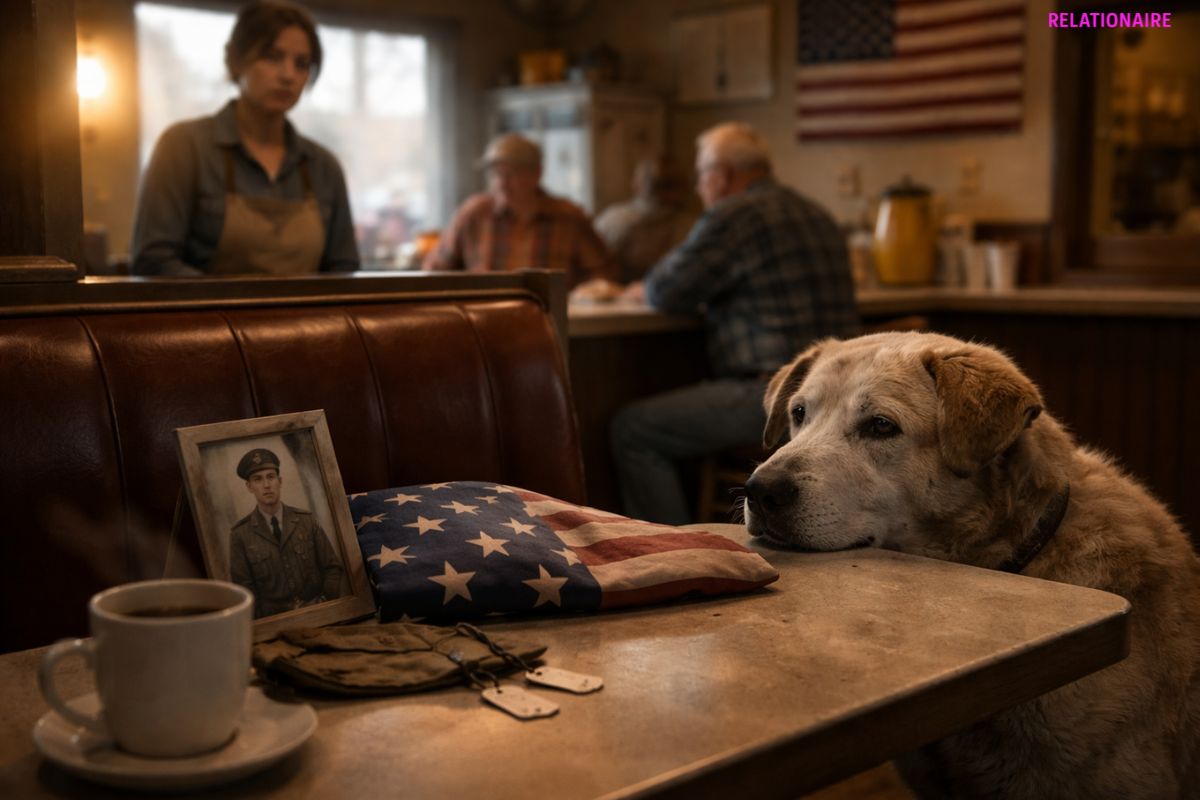
Sarah brought the coffee first. The steam rose between them. Hank wrapped both hands around the mug before he drank, letting the heat get into his fingers.
On the table beside the sugar caddy lay the little leather key ring he always carried.
It had an old set of dog tags attached.
Scratched up.
Worn smooth at the edges.
He kept them there every Friday while he ate, as careful with them as some folks were with wedding bands.
Sarah had noticed that, too.
Mabel came over with her mouth set in a line.
“Hank,” she said, “I got customers complaining.”
Hank looked up.
Mabel nodded toward the dog.
“He can’t keep coming in here.”
The dog didn’t even flinch.
Hank studied Mabel for a second, then reached for his coffee.
“He’s warm under there,” he said.
“That’s not the point.”
“He ain’t hurting anybody.”
“He’s a stray.”
At that, Hank’s hand paused around the mug.
Sarah saw it.
Just a pause.
But it carried something.
A weight.
“He doesn’t look mean,” Sarah said.
Mabel snapped, “That’s how trouble starts.”
The man at the counter chimed in again. “Call animal control.”
A few heads nodded.
Some people did it because they meant it.
Some because they were bored and wanted something to be against before 8 a.m.
The dog stayed still through all of it.
Private worth. Public annoyance.
Sarah felt heat rise in her neck.
“He only comes on Fridays,” she said.
Nobody answered.
So she kept going.
“He comes in, goes under that booth, and waits. That’s it.”
Mabel folded her arms. “And how many Fridays we supposed to play this game?”
Hank finally looked down at the dog again.
His face gave nothing away.
But his thumb had started rubbing slowly over the edge of one of the tags on the table.
“I’ll be done soon,” he said.
Mabel exhaled hard through her nose. “Fine. But this is the last time.”
She walked away.
The room went back to forks clinking against plates and the low hum of country music from the radio near the kitchen pass-through.
But it wasn’t really normal again.
Too many people kept glancing at the booth.
Sarah brought Hank his breakfast.
Eggs trembling at the edges, bacon crisp, rye toast buttered.
He thanked her like he always did.
The dog never once looked at the food.
That bothered her more than if he had begged.
Hungry dogs begged.
This one waited.
Like breakfast wasn’t the reason he came.
When the rush slowed, Sarah topped off Hank’s coffee.
He was looking at the tags again.
Not staring, exactly.
Just holding them in his palm.
“Those your service tags?” she asked gently.
He turned them over once and closed his hand.
“No,” he said.
That was all.
Sarah could have let it go.
Probably should have.
But there was something in his voice that felt like an old bruise.
Before she could say another word, the dog shifted under the table and nudged Hank’s ankle.
Hank froze.
Then, slowly, he bent down and touched the dog’s head.
Just once.
It wasn’t a pat.
More like proof.
The dog shut his eyes.
Sarah looked away because something about that one quiet touch felt too private to witness.
When Hank paid, he left exact change and one folded dollar under the plate for tip money.
Same as always.
He stood with effort.
The dog came out from under the booth and followed him to the door.
Several customers stiffened.
The dog ignored them all.
At the door, Hank stopped.
So did the dog.
For one long second, man and animal looked at each other in the gray light coming through the glass.
Then Hank stepped outside into the cold.
The dog stayed inside.
The screen door creaked shut between them.
Hank never looked back.
But the dog stood there for a long time after he was gone.
The next Friday, the booth sat empty.
7:15 came and went.
No Hank.
At 7:20, the dog came in anyway.
He was wetter this time. Shivering. One paw bleeding. His eyes moved straight to booth seven.
Then to the door.
Then back to the booth.
He circled once and curled up beneath it.
Waiting.
At 7:45, Mabel grabbed the phone.
“That’s enough,” she said. “I’m calling.”
Sarah stepped forward. “Mabel, wait.”
“For what?”
Sarah looked at the empty booth.
At the dog tags Hank had forgotten the week before—still tucked into the crack between the wall and window ledge where Sarah had found them after closing. She had put them in an envelope, meaning to hand them back.
They were in her apron pocket now.
Heavy for their size.
Folded-flag heavy.
Memory heavy.
The dog let out one low sound.
Not a bark.
Not a growl.
Just a broken, aching whine toward the door.
And for the first time since Sarah had known him, the filthy stray refused to hide.
He crawled halfway out from under the booth, laid his chin on Hank’s empty side of the seat, and stared at the entrance like he still believed the man would come through.
Mabel’s fingers stopped over the phone.
Nobody in the diner said a word.
Then the screen door opened.
And two men in dress uniforms stepped inside.
Sarah’s hand closed around the envelope in her apron.
One of the men looked straight at booth seven.
Then at the dog.
Then at Sarah.
And suddenly she knew this had never been about a stray looking for scraps.
She just didn’t know how much worse the truth was going to hurt.
PART 2
The taller man in uniform took off his hat the minute he stepped inside.
That alone told Sarah enough to make her stomach turn.
The whole diner seemed to go still around him.
Even the spatula scraping the flat top in the kitchen stopped.
Mabel lowered the phone slowly.
The dog rose from under booth seven.
His tail stayed low, but his whole body had gone tight, eyes moving from one uniform to the other, then to the empty seat, then back again.
“Morning,” the taller man said, though there wasn’t anything morning about his voice.
He looked to Sarah first.
Maybe because she was closest.
Maybe because she had that look on her face people get when they already know the next sentence is going to hurt.
“You folks know Henry Delaney?”
“Hank,” Sarah said.
The man nodded once. “Yes, ma’am. Hank.”
He glanced at his partner, then back at her.
“There was an incident Tuesday evening out on County Route 8. His truck left the road.”
Sarah gripped the coffee pot so hard her hand hurt.
“Is he—”
The man answered gently. “He passed before the deputy arrived.”
Nobody moved.
At the counter, the man who’d wanted animal control called stared down into his cup like he might drown in it.
Mabel put one hand against the register to steady herself.
Under booth seven, the dog began to pant.
Not from heat.
From fear.
Sarah swallowed hard. “Did he have family?”
The second uniformed man stepped forward this time. He was older, heavyset, with a face that looked built for bad news.
“He had a son,” he said.
Had.
That word hit the room almost as hard as the first.
The older man continued. “Sergeant Michael Delaney. Army.”
Sarah felt the envelope in her apron like a live thing.
The dog tags.
Not Hank’s.
Mike’s.
The first man pulled a folded paper from his coat pocket.
“We’re trying to locate next of kin records and some personal belongings. Mr. Delaney kept limited contacts. The VFW gave us this address as a place he came regularly.”
Mabel found her voice. “Every Friday.”
The taller man looked at her. “Friday?”
Sarah nodded. “Same booth. Same breakfast.”
She looked down.
The dog had moved closer now, head low, eyes fixed on the men’s hands.
On the paper.
On the hats.
Like he knew uniforms, too.
The older officer followed her gaze. “That his dog?”
Mabel answered too fast. “No. Just some stray.”
Sarah said, at the same time, “I don’t know.”
The dog flinched at the sound of their voices and backed halfway under the table again.
The older man crouched slowly, careful not to crowd him.
The dog watched him, muscles shaking under the dirt-matted coat.
“What’s his name, buddy?” the man asked softly.
The dog’s ears twitched.
No one answered because no one knew.
Sarah reached into her apron and pulled out the envelope.
“I found these after he left last week.”
She handed it over.
The taller officer opened it.
Inside were the dog tags.
He read them once, then his whole expression changed.
He passed them to his partner.
The older man let out a breath through his nose.
“Well,” he said quietly, “that explains part of it.”
Sarah felt the room lean toward him.
He stood and held the tags carefully in his palm.
“These belong to Sergeant Mike Delaney. Killed eight years ago.”
Hank had been carrying them every Friday.
Not his own.
His son’s.
The diner stayed silent.
The officer looked toward booth seven, toward the dog, and then back to Sarah.
“You said this animal only comes on Fridays?”
“Yes.”
“And only sits here?”
“Yes.”
The men exchanged one of those quick looks people share when pieces are sliding into place and they don’t like where they’re landing.
“Mr. Delaney had any pictures with him?” the taller man asked.
Sarah thought.
Then nodded toward the far wall, where a small community board hung beside the pie specials.
Hank had pinned one there in winter.
Not for show, exactly.
More like he wanted it near him, but not on him.
A young soldier in desert uniform, smiling against a backdrop of tan dust and sunlight.
Beside him sat a lean tan dog with a black muzzle and alert ears.
Walter had joked once that the mutt looked better fed than half the boys overseas.
Hank hadn’t laughed.
Sarah crossed the room and unpinned the photo with shaky fingers.
The corners were worn white.
She brought it back.
The older officer stared at it and went still.
“Well, I’ll be damned,” he murmured.
The dog had crawled forward again.
When Sarah lowered the photo a little, he lifted his nose toward it.
Then he made that same low, aching sound.
Not loud.
Just broken.
The kind of sound that comes from somewhere deep and old.
“That dog isn’t a stray,” the officer said.
Sarah looked up. “What?”
He pointed gently to the photo.
“That’s the same animal.”
Mabel blinked. “No. That can’t be.”
The officer didn’t argue. He just looked at the dog again.
“Mike Delaney’s unit had a stateside transfer after deployment. There was an animal involved. I remember because Hank came through our post trying to track it down after his son died.”
Sarah’s heart started pounding.
“Track it down?”
“He said the dog had belonged to Mike,” the officer said. “Not officially military. Just his. Picked him up overseas, got attached at the hip. Dog came back through a chain of handlers, then got lost during transport to another state. Van accident, records messed up, animal disappeared.”
The whole diner seemed to shrink around that sentence.
Lost in another state.
Gone for years.
Sarah looked at the dog again.
Mud-streaked.
Too thin.
Scar at the shoulder she hadn’t noticed before beneath the dirt.
“You’re saying this dog found him?” she whispered.
The older man nodded slowly.
“Could be. Dogs have crossed farther for less. And if Hank kept coming here on the same day, same time, same smell…” He looked down at the booth. “Looks like the animal finished the trail.”
No one had anything to say to that.
The man at the counter covered his mouth with his hand.
Mabel sat down hard in the nearest chair.
Sarah thought of every Friday.
The waiting.
The stillness.
The dog never asking for food.
Never wanting attention.
He had not come for scraps.
He had come for Hank.
For Mike’s father.
For the last piece of his old life he could still find.
And now Hank was gone.
The dog stood and placed his front paws against the booth seat, nose pressed where Hank used to sit.
A private kind of grief happened right there in front of all of them.
No sound except that rough breathing.
No performance.
No asking.
Just loss.
Sarah had to bite the inside of her cheek to keep herself steady.
The taller officer cleared his throat. “We can have county animal services take him in and check for a chip. If there’s any traceable record—”
“No.”
The word came out of Sarah before she could think.
Everyone looked at her.
The dog turned, too.
She took one step toward booth seven.
Then another.
The dog didn’t back away this time.
“He’s not going to a cage after all that,” she said.
Mabel opened her mouth, probably to remind her whose diner this was.
But she closed it again when she saw the dog tags in the officer’s hand.
Saw the photo.
Saw the animal’s head still resting on Hank’s side of the booth like he was standing watch over somebody he had already lost twice.
The older officer spoke gently. “Ma’am, there’s procedure.”
Sarah nodded, tears hot behind her eyes. “I know.”
She crouched.
The dog smelled like rain and road and survival.
Slowly, she held out her hand.
He looked at it.
Then at her face.
Then, with the care of something that had learned not to trust too easily, he touched his nose to her fingers.
Worn leather collar.
That was when she saw it.
Hidden beneath the fur.
Cracked and filthy, but still there.
A collar.
Not a stray.
Never was.
Sarah’s hand trembled as she turned the tag hanging from it.
The metal was scratched nearly smooth, but one word could still be read.
Ranger.
The older officer shut his eyes briefly.
“Mike’s dog,” he said.
And in one breath, the whole story changed.
The nuisance.
The complaints.
The muddy animal under the table.
He had not been freeloading.
He had been reporting in.
Every Friday.
Waiting beside a grieving father who never once told anybody who the dog was.
Maybe because saying it aloud would have made Mike gone all over again.
Maybe because some griefs are too sacred for conversation over eggs and toast.
Sarah slid her hand under Ranger’s neck.
He leaned into it just enough to break her heart.
“What happens now?” she asked.
Nobody answered right away.
Then the screen door creaked open again.
A gust of cold came in.
And with it came Pastor Jim from the chapel down the road, hat in hand, face pale.
He looked at the uniforms.
At Sarah.
At Hank’s empty booth.
Then he said the words that changed everything again.
“They found a letter in Hank’s truck,” he said. “Addressed to this diner.”
He looked down at the dog.
“And I think he knew this day was coming.”
And that’s when everything changed…
PART 3
Pastor Jim held the envelope like it might tear if anyone breathed wrong.
It was plain white.
Sarah’s name written across the front in careful block letters that looked older than the paper itself.
She stared at it a second before taking it.
Her fingertips shook.
Ranger sat pressed against her leg now, leaning there like he had made a choice.
The uniforms stayed by the door.
Nobody in the diner touched their coffee.
The radio in the kitchen had gone to static.
Mabel reached over and switched it off.
All that was left was the hum of the cooler and the faint rattle of the front window when the wind hit it.
“Read it,” Mabel said softly.
Sarah looked at her.
The older woman’s face had gone loose around the edges, all the hardness dropping away.
Sarah opened the envelope carefully.
Inside was one folded sheet and a smaller photograph.
She unfolded the letter first.
The handwriting was steady, though pressed hard enough in places to mark the page.
“Sarah,” she read, voice thin at first. Then stronger.
“If this letter reaches you, it means I didn’t make it back in on a Friday.”
The whole diner leaned in without moving.
“You once asked me whose tags those were. I didn’t answer because some names are hard to carry out loud. They belong to my son Mike. He was the best man I ever knew.”
Sarah had to stop for a second.
Not because she couldn’t read.
Because Hank’s voice had come into the room so clearly through those words that it felt like he was sitting right there with his coffee between his hands.
She went on.
“The dog, if he comes back, is Ranger. He belonged to Mike. After my boy was killed, I tried to bring that dog home. Somewhere along the line he got lost. Folks told me to let it go. I never did.”
Sarah glanced at Ranger.
His ears had lifted at the sound of his name.
Just a little.
The simple, ruined miracle of that nearly broke her.
She kept reading.
“Then a few weeks ago, I walked into the diner and found him under my booth like he had simply been delayed, not gone.”
One man at the counter bowed his head.
Sarah swallowed and read the next line.
“I knew him before he knew me. Age does that. It changes a face, a voice, the way a man moves. But grief knows grief, and he kept coming.”
Ranger laid his head on Sarah’s knee.
“The reason I said nothing is because I was selfish. Friday breakfast was the one hour a week I still got to sit across from something that loved my son.”
No one in the room was pretending not to cry anymore.
Even Mabel had a hand over her mouth.
Sarah unfolded the second item in the envelope.
A photo.
Mike in uniform again.
Hank beside him, younger, broader, both men squinting in the sun.
Between them sat Ranger, still lean and proud, tongue lolling, one paw on Mike’s boot.
There it was.
The resemblance.
Not just in the dog.
In the set of the jaw.
The eyes.
Sarah had never seen it because she’d never had the right picture.
The delayed recognition hit like a blow.
Hank had been sitting under those lights every Friday with his son’s dog and his son’s tags, carrying both of them in silence while the room judged what it did not understand.
She looked back down at the letter.
“If Ranger stays, please feed him bacon when Mabel isn’t looking.”
That did it.
A broken laugh went through the diner, wet with tears.
Mabel let out a sound halfway between a sob and a scoff.
“Old fool,” she whispered.
Sarah kept reading.
“If he won’t stay, let him choose. He has earned that much. If by some mercy he does stay, bury my son’s tags with me, but not the dog’s collar. That belongs with Ranger.”
Sarah’s voice faltered on the final lines.
“Men like me don’t always say what should be said in time. So say this for me if you can: Mike was brave. Ranger was faithful. And I was proud to be their man.”
At the bottom, after the signature, there was one last line squeezed in.
“Please don’t let anybody call him stray again.”
Sarah lowered the paper.
No one spoke.
Then the man at the counter—the same one who had wanted animal control—stood up slowly. He took off his cap and held it against his chest.
“I was wrong,” he said.
It wasn’t loud.
It didn’t need to be.
That one sentence changed the room.
Walter came out from the kitchen still wearing his apron.
Mabel walked to the stove, grabbed a plate, and laid two strips of bacon on it with hands that weren’t steady.
She carried it over and set it on the floor beside Ranger without a word.
Ranger looked at it.
Then at booth seven.
Then at Sarah.
Only after she touched his neck did he eat.
Slowly.
Like a gentleman.
The older officer cleared his throat. “Hank’s service is tomorrow. Small graveside. Military honors. We can make sure there’s room.”
“There better be,” Mabel said, sharper than usual because that was the only way she knew to hide feeling.
The next morning came raw and cold.
The cemetery sat on a little rise outside town, flags snapping hard in the wind. The grass was winter-pale, and frost still clung in the shadow of the stones.
Sarah came in her dark coat.
Mabel wore black gloves and sensible shoes.
Walter stood with his cap in both hands.
Half the diner came.
So did men from the VFW hall.
So did folks who had never once spoken to Hank beyond “Morning,” but now felt the weight of what they had missed.
Ranger came too.
On a borrowed leash at first.
Worn leather in Sarah’s hand.
But when they reached the graveside and the honor guard lifted the folded flag, Ranger sat on his own beside the casket and did not move.
The bugle call carried thin and clean across the cold air.
Several men saluted.
One of them trembled while he did it.
When the shots were fired, Ranger flinched but held his place.
Sarah thought he might run.
He didn’t.
He just stared at the folded flag in the chaplain’s hands.
When the soldier stepped forward to present it, there was no widow.
No daughter.
No son left to receive it.
Just a silence that cut right through everybody there.
Then Pastor Jim looked at Sarah.
Sarah looked at Mabel.
Mabel looked at Ranger.
And the old woman straightened her back.
“You give it here,” she said, voice unsteady.
She took the flag in both hands and then, after one long breath, bent down and laid it gently against Ranger’s side for a moment.
Not as a joke.
Not as a trick.
As witness.
As belonging.
Ranger lowered his head to it.
A sound passed through the people standing there. Not a gasp. Not exactly.
Just the kind of grief that escapes when pride and sorrow meet in the same place.
Sarah knelt and unclipped the leash.
Ranger stayed.
He rose only when Pastor Jim began the final prayer.
At the end, Sarah took Mike’s tags from the officer and placed them on the casket as Hank had asked.
Her hand trembled so badly the metal clicked against the wood.
Ranger stepped forward then.
He pressed his nose once to the edge of the casket.
Then he sat back and looked up, standing watch.
No command.
No training word.
Just loyalty.
Quiet and complete.
After the service, folks came one by one.
Men who had judged.
Women who had complained.
A teenager from the gas station down the road.
The man from the diner counter.
Each one knelt, or bent, or reached a careful hand toward Ranger and then stopped short, as if understanding they were in the presence of something they had not earned but had been allowed to witness.
Mabel finally broke first.
She crouched in the dirt and took Ranger’s face in both hands.
“I won’t say it again,” she whispered. “Not ever.”
Ranger licked once at the air near her wrist.
That was all.
It was enough.
A week later, booth seven had a framed photograph on the wall above it.
Hank.
Mike.
Ranger.
Below it hung a small brass plaque Walter had ordered with money collected in a jar by the register.
It read:
Reserved for Loyalty.
Every Friday morning, Sarah set down one plate with two strips of bacon near the booth before the first customer came in.
Ranger took his place beneath the table, not hidden now, just settled.
Belonging.
And every single time the screen door creaked open, somebody looked over, half-expecting an old man in a worn coat to step in from the cold and take his seat.
In a way, he still did.
Because some people don’t leave a place.
They leave their honor there.
They leave their love there.
They leave proof that quiet men can carry whole worlds without ever asking to be seen.
How many good hearts have we judged too quickly just because their pain came in wearing dirt, silence, or old clothes?