If you’ve already read part 1 of this story on Facebook, go here for Part 2!
The first time I saw her, I thought she was lost.
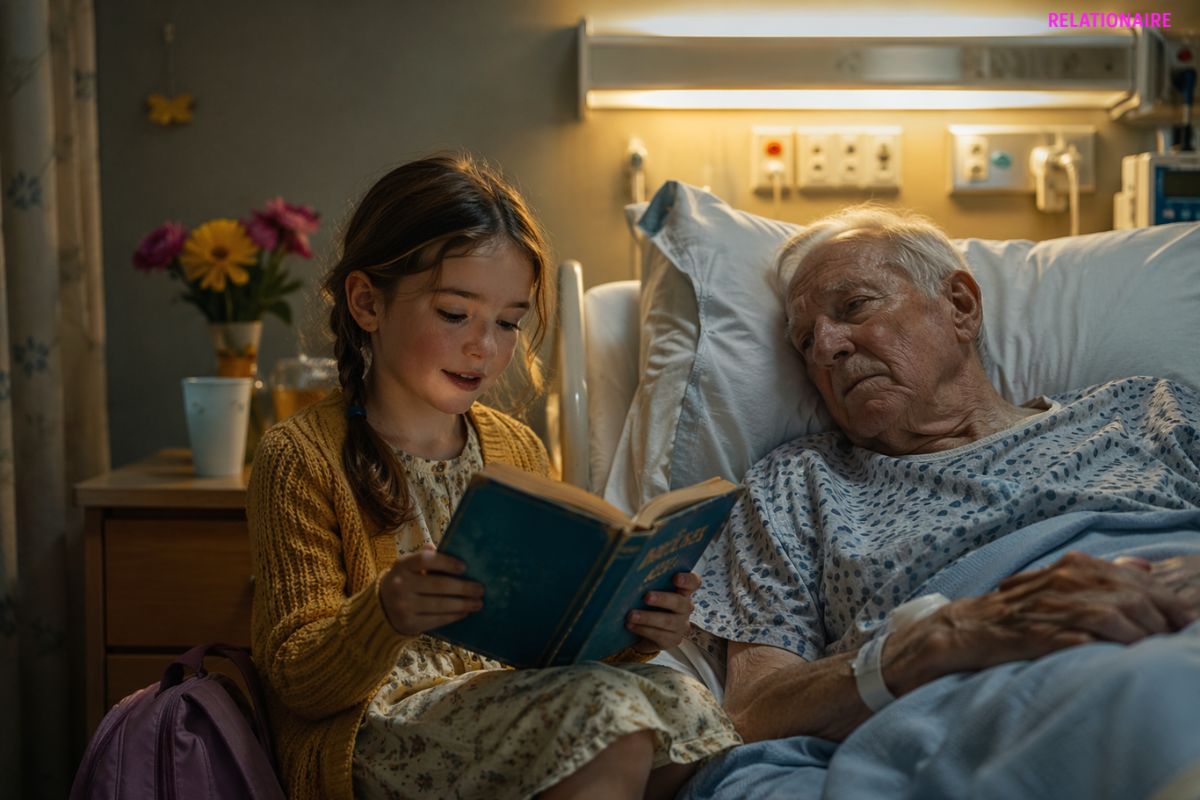
She was sitting cross-legged on the hospital floor in the east wing, right outside Room 214, reading out loud like the hallway belonged to her.
Not loudly. Not in a way that begged for attention.
Just softly. Steadily. Like she had somewhere important to be.
It was a Thursday, close to the end of my shift, and the pediatric floor had already wrung me dry. One toddler with a fever that wouldn’t break. A teenage boy pretending his arm didn’t hurt after surgery because his little brother was scared. A mother crying in the linen closet because she didn’t want her son to see.
By four-thirty, my scrubs smelled like hand sanitizer and stale coffee. My feet ached. My charting wasn’t done. I had exactly enough kindness left in me to get through the next hour if nobody made me chase them.
Then I turned the corner and saw a child alone on the floor with a book in her lap.
She looked about eight.
Maybe nine.
Skinny legs folded neatly beneath her. Brown curls tied back with a yellow elastic that had started slipping. A backpack almost as big as her leaned against the wall. Her sneakers were wet at the toes, like she’d stepped in a puddle outside. Her jacket was draped beside her in a careful square, not tossed like most kids would toss it.
She didn’t look frightened.
That would have made more sense.
She looked settled.
“…and the spider did not answer,” she was reading, one finger under the line. “She was very busy spinning her web.”
Her voice was clear and serious, with the small, stubborn concentration kids use when they want to get every word right.
I glanced at the room number.
Mr. Joseph Bell.
Eighty-seven years old. Congestive heart failure. Failing kidneys. A body quietly letting go in pieces. No visitors on file except a niece in Arizona who’d called twice in ten days and apologized each time for not being able to come.
He had been with us long enough that the staff had developed that particular kind of tenderness reserved for patients nobody claimed in person. The kind that tries not to look like pity.
I walked toward her.
She kept reading.
“Sweet and delicious. Everybody liked her.”
“Hey there,” I said, keeping my voice light. “Where’s your grown-up?”
She looked up at me, slid a bookmark into the book, and answered like I had interrupted a meeting.
“In the parking lot.”
I blinked. “You’re here alone?”
“No.” She pointed vaguely toward the elevators. “My aunt drops me off after library hour, and then she goes to sit in the car and do work stuff. She comes back when I’m done.”
That answer hit every alarm bell a hospital nurse has.
I crouched down so I wasn’t towering over her. “Honey, you can’t just sit in a hospital hallway by yourself. What room are you supposed to be in?”
“This one,” she said.
And then, with complete calm, she turned the book so I could see the cover.
Charlotte’s Web.
Dog-eared corners. Library sticker half peeled. A water stain that had wrinkled the back cover.
“I’m reading to him.”
I glanced through the glass panel in the door.
Mr. Bell was asleep. Or looked asleep. His chest rose shallowly under the blanket. The afternoon light from the window fell across his face, making him look even thinner than he had that morning.
I looked back at her.
“To your grandfather?”
She shook her head.
“You know him?”
Another shake.
I stood up slowly, already irritated in the way tired people get irritated when something doesn’t fit into a neat box.
“Okay. What’s your name?”
“Maya.”
“And how long have you been sitting here, Maya?”
“Twenty-three minutes.” She checked a plastic watch with a cracked pink band. “I usually read for an hour.”
Usually.
That word landed wrong.
“Usually?”
She nodded. “On Thursdays.”
I stared at her for a second.
My brain tried on explanations and rejected all of them.
Maybe she belonged to a volunteer program nobody told us about. Maybe somebody from chaplaincy arranged it. Maybe she was somebody’s granddaughter and just had a strange way of explaining things.
But even then, there were rules. Paperwork. Permission. Adults. Badges.
I picked up the phone at the nurses’ station and called security first, then the front desk, then social work. Nobody knew anything about an eight-year-old named Maya who came here on Thursdays to read to an elderly man she wasn’t related to.
When I hung up, she was back in the same position, as if bureaucracy had nothing to do with her.
Reading.
“Wilbur didn’t want food,” she said softly. “He wanted love.”
Something in me tightened.
I walked over and took the book from her before I thought too hard about it.
“Okay,” I said. “We’re going to pause this until I figure out where you’re supposed to be.”
Her face changed then.
Not into panic.
That would have been easier.
It changed into something worse — hurt held very still.
“You can’t take it,” she said.
“I’m just holding it for a minute.”
“He likes Chapter Four.”
The way she said it made me sound cruel even to myself.
“Who told you that?”
“No one.” She swallowed. “I just think he does.”
I was too tired for riddles and too responsible to ignore a child camped outside a dying man’s room.
So I did what adults do when they’re convinced they’re being the reasonable one.
I got firmer.
“Maya, you cannot be here without permission. Do your parents know you’re in this wing?”
“My mom died,” she said.
Just like that.
No tremble. No dramatic pause. Just a fact placed carefully on the floor between us.
I exhaled through my nose. “Then your dad.”
“He works.”
“And your aunt leaves you here every week?”
“She knows.”
That somehow made it worse.
A volunteer coordinator would have been easier. A confused grandchild, easier. Neglect I knew how to report. Grief I knew how to chart around.
But this child was giving me small, solid answers in a voice that did not sound confused at all.
I softened my tone again. “Why this room?”
She looked through the glass at Mr. Bell.
The hallway buzzed around us — a cart rattling by, the faint overhead page for respiratory, somebody laughing too loudly near the elevators, because hospitals are rude that way. They let ordinary sounds keep happening even when somebody’s whole life is narrowing to a room number.
Maya folded her hands in her lap.
“Because no one comes.”
I didn’t answer.
She looked down at the floor tile between her shoes.
“The first time, I was waiting for Aunt Tessa to bring the car around because it was raining, and I heard two doctors talking.” Her thumb traced the edge of the bookmark. “One of them said hearing is sometimes the last thing to go. And familiar voices help people feel safe.”
I felt the air shift in my chest.
She kept going, still not looking at me.
“I didn’t know if it had to be familiar already.”
The words were so simple they almost slipped past me.
Then they hit.
I looked through the glass again.
Mr. Bell. Alone. No framed cards. No flowers. No coat over the chair from a loved one who’d stepped out for coffee. Just the pale blanket, the untouched pudding cup from lunch, the Bible one of the volunteers had left three days ago, and the silence.
Behind me, security finally turned the corner.
A tall man named Dennis, kind eyes, heavy shoes. “Everything okay?”
I should have said yes.
I should have handed the situation off, followed procedure, called the aunt inside, documented the incident, and moved on with the rest of my shift.
Instead I heard myself ask, “Maya, how many times have you been here?”
She hesitated.
That was the first time she looked like a child again.
Not because she was scared.
Because she knew the truth might end it.
Dennis stopped beside me. “Kiddo?”
Maya’s fingers tightened around the hem of her sweater.
Then she whispered, “Since January.”
January.
It was October.
I stared at her. At the book. At the room. At the little backpack leaning against the wall like it knew the routine better than I did.
I had been Mr. Bell’s nurse on and off for weeks.
Other nurses had cared for him for months.
And somehow an eight-year-old girl had been slipping into our hospital every Thursday to read to a man no one visited.
Dennis and I looked at each other.
Then Maya reached into her backpack and pulled out a folded stack of papers tied with blue yarn.
Construction paper.
Drawings.
Crayon hearts.
Bookmarks.
Notes.
All with the same shaky, careful name written across the top.
For Mr. Bell.
My mouth went dry.
“What is that?” I asked.
Maya held the stack against her chest and looked up at me with wide, guarded eyes.
“It’s what he was holding last week,” she said. “Before your doctor came in and said something about calling family.”
Then she took a breath that seemed too big for her little body.
“And there’s a letter in there,” she said, “that I think you need to read before you make me leave.”
Part 2
Dennis stepped back first.
Not physically. Just in that subtle way people do when they realize something in front of them is no longer simple.
The hallway felt quieter, though I knew it wasn’t. A machine kept beeping somewhere down the hall. Wheels squeaked. Someone called for fresh linens. But all I could hear was the paper in Maya’s hands making a tiny crackling sound as she held it tighter.
“A letter from who?” I asked.
She swallowed. “From him.”
That made no sense.
Mr. Bell was too weak to write more than a shaky signature. Most days, he barely managed three full sentences without needing to stop and catch his breath. I knew because I had helped him hold cups, lift spoons, turn onto his side, and sit up when the fluid in his lungs made him feel like he was drowning in bed.
But Maya was already undoing the blue yarn.
Inside the stack were folded drawings and index cards. A picture of a spider with eight wildly uneven legs. A red paper heart with glitter glued on one side. A bookmark colored in purple marker. A note that said, in a child’s careful handwriting:
I am reading Chapter 7 next week if you are still here.
Love, Maya
My throat tightened.
Dennis looked at me, waiting for direction.
I barely knew what direction was anymore.
Maya slid a white envelope from between the papers. Not sealed. My name wasn’t on it. No name was.
The writing on the front was thin and shaky.
For the nurse with tired eyes, if the little reader comes when I’m sleeping.
I stared at it so long Maya had to hold it closer.
“He asked me what your name was last week,” she said quietly. “I told him I didn’t know. He said that was all right. He said everybody knows who the nurse with tired eyes is.”
Dennis made a soft sound in his throat, almost a laugh, almost not.
I took the envelope.
My fingers felt clumsy.
Inside was one sheet of hospital stationery, folded twice. The handwriting wandered downhill across the page.
If the girl comes and I’m too far gone to speak, don’t send her away.
She thinks she’s helping me, but the truth is she saved my Thursdays.
At my age, people stop speaking to you like you’re still fully here. They speak around you. Over you. Kindly, but not to you.
Then this child sat in my doorway and read about a pig and a spider like it was the most natural thing in the world.
First week, I thought she belonged to someone else and was waiting.
Second week, I thought I’d imagined her.
Third week, I stayed awake for her.
She told me her mother used to read to her when storms made her scared.
She said no one should have to be scared alone if a voice can help it.
If I don’t wake up one Thursday, please tell her I knew her voice by then.
Tell her it counted as familiar.
I had to stop reading.
The paper blurred.
I blinked hard and tried again.
Please also tell her the blue bookmark is in the drawer. I meant to give it back after I finished the chapter she marked.
And if my niece asks, don’t let her think I was alone every week. That would hurt her more than the truth.
I folded the paper once, then again, like smaller might hurt less.
Dennis looked at me with that helpless expression men in hospital hallways wear when grief arrives and they don’t know where to put their hands.
Maya waited.
Not impatiently.
Just patiently enough to make me feel ashamed.
I handed the letter back too carefully. “How long was he awake for you?”
“Some days only a little,” she said. “Some days more.”
“And no one saw this?”
She gave me a look so honest it stung. “People saw me.”
That sat between my ribs.
Of course people saw her. An old wing gets filled with familiar strangers. Delivery men. Volunteers. Maintenance workers. Kids walking too close to where they’re not supposed to be. A child with a book becomes part of the wallpaper fast if everyone assumes she belongs to someone else.
“We need to call your aunt,” I said, softer now.
Maya nodded.
No argument. No flinch.
Like she had known from the beginning this day would come.
Dennis went to make the call while I stood there holding my own guilt like a tray I couldn’t set down. I had almost sent her away. I had taken the book out of her hands because procedure mattered and I was tired and it felt safer to be suspicious than wrong.
I looked at Room 214.
“Did you ever go inside?” I asked.
“Only when he asked me to.”
I pushed the door open.
The room smelled faintly of antiseptic and the lemon swabs dietary used with meal trays. Afternoon light stretched thin across the blanket. Mr. Bell’s mouth was slightly open. His skin had that waxy stillness I had started recognizing too well after twelve years in nursing.
On the rolling bedside table sat the pudding cup, untouched.
In the top drawer, exactly where the note said, was a blue bookmark made from cardboard cut from a cereal box, covered in pressed clover under clear tape.
On the back, in shaky pencil, he had written:
For Maya, because every good story deserves someone who comes back.
I had to grip the drawer handle.
Behind me, Maya stood in the doorway, not entering until I looked at her and nodded.
She came in on quiet feet.
For the first time, she seemed unsure.
Hospitals do that. A hallway can feel public. A room feels sacred.
She walked to the chair by the bed and rested her hand on the blanket near his wrist, not touching skin, just close enough.
“Hi, Mr. Bell,” she said. “It’s Thursday.”
Her voice changed when she spoke to him. Gentler. Less careful about getting every word right.
Like this was the one place she didn’t need to perform being grown-up.
“I brought Chapter Nine,” she said. “And I made a new bookmark, but I guess you already had one.”
Her smile wobbled and disappeared.
I checked the monitor though I already knew what I would see: weak numbers, thinner than yesterday. The kind of decline families pray not to witness and then ache forever for not witnessing.
“Has he always been alone?” Maya asked.
I should have given the adult answer.
Complicated family. Distance. Timing. Work. Money. Estrangement. All the true things people hide inside when they can’t get to a bedside.
Instead I said, “Mostly.”
She nodded like she understood more than I wanted her to.
“My mom was alone when she died,” she said.
The words were quiet. Matter-of-fact. Not offered for pity.
I turned to her too fast. “Maya—”
“It’s okay.” She rubbed the corner of the book with her thumb. “I only know because my aunt told me by accident when she was crying to my grandma. She thought I was asleep.”
There are moments in nursing when your training leaves the room and all that remains is the human being inside the scrubs.
This was one of them.
I sat in the chair on the other side of the bed because standing suddenly felt wrong.
“My mom was in a hospital too,” she said. “A different one. And Aunt Tessa said the nurse held her hand when she went. So I know she wasn’t totally alone. But I kept thinking…” She looked at Mr. Bell. “What if someone doesn’t have even that?”
The room held still around her.
There it was.
Not sainthood. Not magic. Just a child building mercy out of the one unbearable thought she couldn’t live with.
What if someone doesn’t have even that?
A knock came at the door.
A woman in office clothes stood there, car keys in one hand, laptop bag on her shoulder, rain-specked glasses slipping down her nose. She looked exhausted and braced for judgment before anyone had spoken.
“Tessa?” I asked.
She nodded, eyes already going to Maya, then to the bed, then back to me.
“I know how this looks,” she said quickly. “Please don’t be angry at her. It was supposed to be one time.”
Maya lowered her eyes.
Tessa came in, voice shaking now. “My sister died in County Memorial eighteen months ago. Maya heard enough to understand she was scared at the end. Since then she… notices people. Especially older people alone. We volunteer at the library on Thursdays, and one day we were leaving and she saw this man through the door and asked me if he had anybody.”
Tessa pressed the heel of her hand under her eye.
“I said I didn’t know. Later, in the parking lot, she told me she wanted to come back with a book.” Tessa looked at me, raw and embarrassed. “I said no. Then she cried so hard she threw up in the bushes. Not because she wanted her way. Because she said, ‘What if he thinks everybody forgot him?’”
I closed my eyes for one second.
One second was all I could afford.
“So I brought her back,” Tessa whispered. “I asked at the desk the first two times if children could visit with an adult. No one stopped us. After that, I’d walk her up and wait downstairs because she asked me not to make it feel official.”
Maya stared at the floor.
“I’m sorry,” Tessa said. “I know it was probably against policy. I just… after what that child has lost, I couldn’t find a good reason to tell her no.”
Before I could answer, Mr. Bell made a sound.
A rough, scraping inhale.
Then his eyes opened.
Not wide.
Not clear.
But open.
Maya moved to the bed so fast her chair tipped backward.
He looked at her, and in a voice so thin I had to lean in to hear, he whispered, “Chapter Nine?”
Maya’s mouth fell open.
And then the monitor changed.
Not dramatically.
Just enough.
Enough to make me grab the call button and step closer.
Enough to make the room gather itself around whatever was about to happen next.
Part 3
I have seen miracles in a hospital, but they never look the way people want them to.
No music.
No sudden light.
No speech returning in a perfect flood.
Usually just a hand squeezing back when everyone thought it couldn’t. A number on a monitor steadying for a little while. A person waiting, somehow, for one more voice.
Mr. Bell’s eyes stayed open for less than a minute.
But it was a full minute.
Full enough to matter.
“Maya,” I said gently, “you can read.”
She nodded too fast, pulled the chair upright, and sat down with Charlotte’s Web trembling in her hands.
She found the page by feel, opened to a chapter she’d probably read three times already, and began.
There was no performance in her voice now.
No hallway bravery.
No trying to sound older.
Just a little girl reading to a tired man as if this were the most ordinary promise in the world.
Outside the room, Dennis kept the door half closed and quietly redirected traffic. Tessa stood against the wall, one hand over her mouth, crying without sound. I adjusted oxygen tubing. I watched the monitor. I checked the IV line though it did not need checking. I did all the useful small things nurses do when there is one huge thing we cannot control.
Maya kept reading.
About Wilbur.
About Charlotte.
About how love can be practical and plain and still save a life for a while.
At one point, Mr. Bell’s fingers moved weakly over the blanket.
Maya saw it before I did.
She put her hand near his again, leaving him room to choose.
After a few seconds, his hand shifted until two fingertips rested against the side of hers.
That was all.
Just two fingertips.
But Tessa made a broken sound in the doorway, and I had to look down at the medication cup in my hand to keep from crying with her.
He drifted in and out after that. Once, when Maya stopped to turn a page, he opened his eyes again and looked toward her voice.
“Not alone,” he whispered.
It took me a second to understand he wasn’t asking.
He was telling us.
Telling her.
Telling the room.
Maya nodded, though tears were standing in her eyes now. “No, sir.”
He slept again.
This time deeper.
The kind of sleep that makes everyone in the room more careful with their breathing.
I stepped into the hallway with Tessa while Maya read on softly.
“You should have told someone,” I said.
Tessa nodded immediately. “I know.”
I almost let that be the whole truth. It would have been easier. Cleaner. The adult version.
But I had spent too much of my life watching people punish themselves for imperfect mercy.
“We should have noticed sooner,” I said instead.
Tessa looked at me, startled.
Through the crack in the door we could hear Maya reading, voice rising and falling like a small steady lamp.
“Does she do this often?” I asked.
Tessa gave a wet laugh. “You mean rescue strangers without permission?”
I smiled despite myself.
“She notices everything now,” Tessa said. “Which cashier looks tired. Which neighbor hasn’t brought in their mail. Which dog in the park limps. She acts like loss turned her into a little lighthouse and now she can’t stop looking for people drifting in the dark.”
That sentence stayed with me.
A little lighthouse.
Inside the room, Maya reached the end of the chapter and closed the book.
She sat quietly for a moment, then reached into her backpack and pulled out a folded drawing.
I watched from the doorway as she laid it on the tray table beside the untouched pudding cup.
It was a picture of a pig, a spider, and an old man in a bed listening while a girl read from a yellow book. Above them, in careful block letters, she had written:
SOME VOICES STILL STAY
I stepped inside. “That’s beautiful.”
She shrugged, embarrassed now that the urgent part had passed. “The spider looks weird.”
“The spider looks perfect.”
Mr. Bell died just after nine that night.
Peacefully, as much as that word can be true.
Not while Maya was in the room — I would never have let that weight fall on her shoulders. By six, Tessa had taken her home with the blue bookmark in her pocket and Mr. Bell’s whispered “thank you” tucked into her chest where children store things they will not fully understand until they are older.
But he did not die alone.
I was there.
Dennis stood in the hall.
Our night nurse, Claire, came in and stroked his shoulder after I told her about the girl.
And on the bedside table, within reach of his hand, sat Maya’s drawing and the dog-eared library book he had asked for by chapter number.
The next morning, his niece arrived from Arizona.
Her name was Linda. Fifty-something. Ash-blonde hair gone silver at the roots. Airport clothes still wrinkled. Eyes swollen from crying before she even got to the room.
The kind of grief that arrives already apologizing.
“I tried,” she said to me before anything else. “I called. I sent groceries. I paid for the aide when he would allow it. I just…” She looked around the room helplessly. “My husband’s in chemo. I thought I had more time.”
People think nurses get numb to this.
We don’t.
We just learn how to stand steady inside other people’s regret.
“He knew you loved him,” I said.
Her face crumpled with relief so sharp it hurt to witness.
Then I told her about Maya.
Not all at once. Gently. The Thursdays. The reading. The note he left. The bookmark. The way he had waited awake for her.
Linda cried into both hands. Then she laughed through it.
“He always loved being read to,” she said. “His wife used to read the newspaper out loud every morning after he lost most of his vision in one eye. Even when he could still read it himself. He said he liked the sound of her choosing the important parts.”
That got me.
Not the sadness. The detail.
That tiny domestic thing. Newspaper. Coffee. A voice deciding what mattered.
Familiar.
Before she left, Linda asked if she could take Maya’s drawing.
Then she hesitated.
“Actually,” she said, “would it be strange if I made copies?”
A week later, she came back with three.
One for herself.
One for the room staff.
And one laminated copy she asked us to hang in the hallway outside 214 for a little while, until the room was reassigned.
Under it, she taped a typed card:
Mr. Joseph Bell was loved at the end of his life by family, by nurses, and by one small reader who refused to let him be forgotten.
The hospital administration did eventually hear about the Thursdays.
There were meetings.
Policy reviews.
Tight smiles from people in offices.
But there was something awkward in the room every time anyone tried to talk about the situation as a breach before acknowledging it as grace.
In the end, they built an actual program out of it.
Not for children alone. Not informally. Not unsafely.
A volunteer reading hour for long-term patients without regular visitors.
Retired teachers came. College students came. Church ladies with canvas totes came. One mechanic with hands like wrenches came every Tuesday to read Louis L’Amour to a former rancher who never once said thank you but always stayed awake through every chapter.
And on the sign-up sheet in the volunteer office, in bubbly handwriting with backward tails on some of the y’s, was a name too young to officially participate but impossible to keep off the list.
Maya.
She came with Tessa.
She wore a hospital visitor sticker that always peeled at one corner by the end of the hour.
Sometimes she read.
Sometimes she drew pictures and left them behind.
Sometimes she just sat with people and asked them what their favorite story was before they got sick.
Months later, on a Thursday, I found her again on the floor.
Same cross-legged posture. Different room.
This time I sat down beside her.
“What are you reading today?” I asked.
She showed me the cover. Because of Winn-Dixie.
“Good one,” I said.
She nodded.
Then, after a minute, she leaned closer and whispered, “Do you think people can feel when someone stays?”
It was such a child question.
Plain. Unpolished. Bigger than it sounded.
I looked through the small window in the door. At the sleeping woman inside. At the blanket pulled high. At the wilted carnations. At the chair no one had filled all week.
“Yes,” I said.
Maya considered that.
Then she opened the book.
I listened to her begin.
And for the first time in a long time, the hospital did not feel only like a place where bodies failed. It felt, briefly and stubbornly, like a place where people kept each other company at the edge of things.
Maybe that is smaller than saving a life.
Maybe not.
Because there are kinds of rescue that do not change the ending.
They change the loneliness inside it.
And sometimes that is the holiest thing a person can do for another.