
He hadn’t set foot in the garden since the day they lowered Pearl into the ground.
Then came the beagle. Shaking. Quiet. And far too familiar.
By Sunday night, the dog had dug up more than just dirt.
She was gone—but her rhythm, her scent, her secrets?
Somehow, they’d come back on four legs.
Part 1 – The Beagle at the Back Door
Wilmington, North Carolina — Late October
Lester Briggs had never liked dogs.
Not really. He liked the idea of dogs—their loyalty, their purpose—but in practice, they were noisy, hairy, and they died too damn soon. Pearl, though, had loved them. Always had. She used to tell him, “A home without a dog is a waiting room for loneliness.” He never argued, just grunted and kept sanding whatever piece of driftwood he was turning into art that week.
That was before the silence took her place.
Now the house was too clean. Too still. The kind of stillness that didn’t settle—it pressed.
He was halfway through reheating a can of beef stew when the doorbell rang.
No one rang the bell anymore. Not since the funeral.
He opened the door and squinted into the dying light. The streetlamp flickered overhead. His grandson stood there, hoodie pulled tight around his neck, holding a leash that looked like it had seen a few too many battles.
At the other end: a beagle. Shaking. Silent. Watching him like it knew something he didn’t.
“Just for the weekend,” said Josh. “Foster situation fell through. You’ll barely notice her.”
Lester opened his mouth to say hell no. He really did.
But something in the dog’s eyes—a stillness that wasn’t fear, a calm that wasn’t submission—touched the edge of something he’d buried.
He stepped aside.
“Food’s in the bag,” Josh said, already backing down the steps. “Thanks, Grandpa.”
The door clicked shut. The stew burned.
—
The dog didn’t bark. Didn’t whimper. Didn’t make a sound as it padded through the house, nose low, pausing every few feet.
It stopped in front of Pearl’s chair.
The one no one had sat in since February 12.
Then it did something that stole the breath from Lester’s throat: it placed one paw on the edge of the cushion. Just one. Gently. Reverently.
Like it remembered.
He turned away.
That night, he didn’t sleep.
Not from nightmares or restlessness, but from listening. The sound of dog nails against old wood floors, soft breathing near the heater, the occasional shift on the carpet. Not disruptive—but there. Alive.
The way the house used to be.
—
The next morning, Lester did something he hadn’t done in eight months.
He made toast for two.
Laid it on a small saucer, same as Pearl used to. With just a touch of butter and strawberry jam. The dog sat, eyes expectant, tail motionless.
“You don’t belong here,” he said.
But he placed the saucer on the floor anyway.
The dog took a single bite, then walked to the back door and sat.
Lester blinked. “You want out?”
A soft whine. Not desperate—just… steady.
The yard had gone to seed. Weeds where lilies used to be. The swing Pearl loved now sagged from one chain. The garden bench was half-swallowed by creeping fig.
He hadn’t been out there since the funeral. The ground was still uneven where they’d lowered her ashes into the soil beneath the old magnolia.
But the dog trotted out like it had a map of the place.
It circled the birdbath. Sniffed the stone planter shaped like a goose.
Then it stopped—dead still—at the edge of the garden. Nose to the dirt.
Lester’s chest tightened. “Hey,” he called. “Leave that.”
But the dog didn’t move.
Not until Lester stepped off the porch and followed.
It was Pearl’s spot. Her favorite patch. Tomatoes in spring, mums in fall.
He hadn’t touched it since.
Now, a faint line had been scratched into the soil. A perfect crescent. Deliberate. Like something had been moved.
Or was waiting to be uncovered.
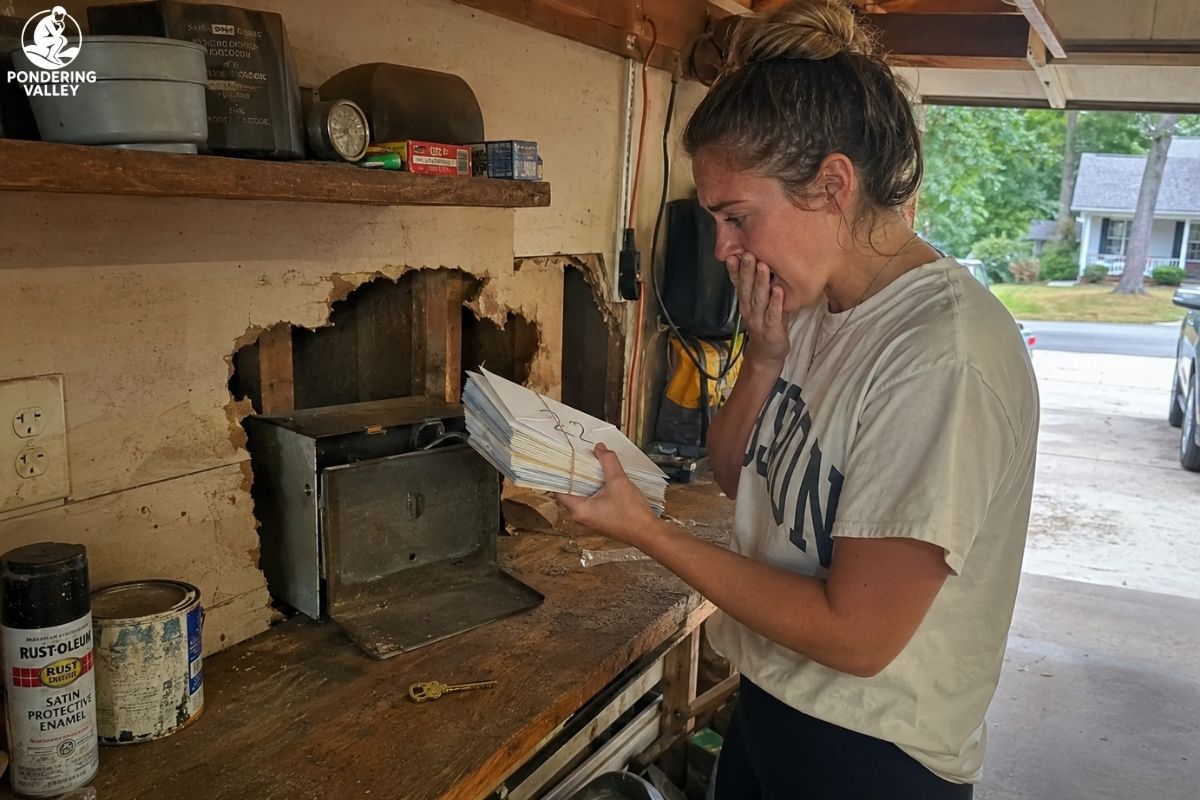
He dropped to one knee. The ground was soft. Damp. A small mound shifted beneath his fingers. He brushed away the dirt, slower than necessary, his breath hitching.
Then he saw it.
A tin box. Rusted at the corners. Wrapped in faded green ribbon—the kind Pearl used for Christmas gifts and homemade jam.
His hand shook.
The beagle sat beside him, eyes steady. Like it had brought him back on purpose.
Lester didn’t open the box. Not yet.
He just sat there, knees in the dirt, the dog beside him.
The wind moved through the magnolia, and somewhere in the distance, a train wailed across the Cape Fear River.
He hadn’t cried at the funeral.
He did now.
And the dog stayed. Silent. Watching the sun dip low. Its last bark still waiting.
Part 2 – The Ribbon and the Recipe
Lester didn’t open the box right away.
He sat with it in his lap as the sun vanished behind the trees, the dog curled at his side like it had always belonged there. The ribbon was soft but fraying, tied in the exact way Pearl used to seal her preserves—two loops, pulled tight with a tuck. That was her style. Everything had a place, a rhythm. She never rushed.
He brushed his thumb over the bow.
Then he took a breath and pulled.
The ribbon fell away.
Inside the tin was a folded paper, yellowed around the edges. A scent rose from it—faint lilac and old cedar, like the inside of her dresser drawers. Beneath the paper was something wrapped in cloth. But first, the letter.
He unfolded it with both hands, careful not to tear the fragile creases.
And froze.
It wasn’t addressed to him.
It read:
“To the girl who always said yes, even when she was scared.”
It wasn’t Pearl’s handwriting to him—not the casual, scribbled notes she left on the fridge, not the loving grocery lists or birthday cards. This was older. Formal. A different voice altogether. As if she’d been writing to a version of herself she didn’t show to anyone else.
His mouth went dry.
The letter continued.
August 11, 1968
Coshocton, Ohio
If you’re reading this, you found what I couldn’t bury.
You remember the tomato patch. How I used to go out before the sun got mean and tuck the vines back up with string. I told you it was for the birds—but it wasn’t. It was for the quiet.
Back then, the world inside me was loud. Louder than I ever let on. You thought I was brave, marrying a soldier, moving down south. But there were things I never told you—things that lived in the stillness.
That’s why I started writing to you, girl. So you wouldn’t forget. So I wouldn’t forget who I was before the brave face.
This box is for the day I finally stop pretending I’m not afraid of goodbyes.
Lester stopped reading.
He could hear the blood in his ears.
The date. The name of the town. That was the summer he met her—two weeks before she agreed to come to Wilmington with him. He’d thought he’d won her over with his stories, his driftwood carvings, his half-healed war wounds.
But there had been someone before him.
Or something inside her he’d never asked about.
He looked at the beagle, who now sat on the garden bench—her bench—staring at him with those tired, searching eyes.
“Who the hell are you?” Lester whispered, not expecting an answer.
But the dog stood.
Hopped down.
Walked back toward the porch.
Then paused. Looked over its shoulder. Waited.
Like it was saying: Come on. There’s more.
Inside the house, Lester laid the tin box on the kitchen table.
He unwrapped the second item—a square of muslin cloth tied with twine. Inside: an index card with a recipe written in Pearl’s bold, looping script.
“For the storm days.”
Below that, her biscuit recipe. The one he’d never quite managed to replicate. She always added something—he assumed it was buttermilk or luck.
But now, scribbled along the edge of the card, almost as an afterthought, were these words:
“Use the blue tin, not the yellow. You’ll know when.”
He closed his eyes. That damn woman always did love riddles.
The beagle scratched softly at the kitchen cabinet. Not barking. Just drawing attention.
He opened it.
And there, on the bottom shelf behind a stack of unused trays, sat two tins: one yellow, one blue.
His fingers hovered over the yellow one—familiar, dented, the one Pearl always used for cookies when the grandkids came. But the blue one?
He didn’t remember ever seeing it.
He pulled it out. It was lighter than expected. Inside—nothing but a single brass key.
And under the key: another note.
“For the shed.”
His heart kicked hard against his ribs.
The shed hadn’t been opened in three years. Not since Pearl stopped painting.
Not since she said, “Let it go, Lester. Some things are better locked away.”
He looked at the beagle.
It was already sitting by the back door.
The shed groaned when he pulled the door open.
Dust motes scattered in the flashlight beam. The old easel stood in the far corner, draped in a white sheet. The smell of turpentine and mildew flooded his nose, thick with time. A paint-stained apron hung from a rusty hook. It still had her initials stitched into the collar: P.J.B.
Pearl Jean Briggs.
The dog sniffed once and padded toward the covered easel.
Lester followed.
He pulled the sheet off.
And stared.
It was a painting. Unfinished, but vivid—Pearl had been halfway through it. The scene was the garden, viewed from the porch, just as it looked at sundown. The magnolia glowed. The swing cast a long shadow. But it was the figure in the lower corner that stopped his breath.
A dog.
This dog.
Same markings. Same tilt of the head. Same quiet, watchful pose.
She’d painted it before she died. Before she could have ever seen this particular dog.
Before Josh ever brought it to his door.
His knees buckled slightly, and he reached out to steady himself on the easel.
Then he saw it—another folded paper, taped to the back of the canvas.
It read:
“Lester—if the dog finds this, listen to it.”
He turned around, the flashlight trembling.
The dog was gone.
Just the faint creak of the garden swing moving in the wind.
Or maybe not the wind.
Part 3 – The Painting She Never Finished
The swing was moving.
Just slightly. Back and forth. Back and forth.
Lester stood frozen in the doorway of the shed, one hand still on the easel, the other gripping the flashlight like a weapon. But there was no wind. Not tonight. The air was heavy, like the moment before a thunderclap.
Then the beagle stepped back into the beam of light.
Its head tilted. Not in confusion—no, it was more like expectation.
“Where’d you go?” Lester asked, voice too brittle for his own ears.
The dog blinked. Then turned and trotted away from the swing, across the garden path, through the narrow gap between the rose bushes and the broken fence.
Somewhere he hadn’t looked in years.
Lester followed.
His joints ached. His back was screaming. But the flashlight held steady.
At the end of the narrow path, behind a curtain of ivy, was the old potting bench. The wood had rotted through on one side. Pearl had loved that spot. She kept gardening gloves there. Seed packets. Once, she found a bird skull and kept it in a jar like it was some kind of treasure.
The beagle pawed once at the base.
Just enough to scatter a little dirt.
There—barely sticking out—was a photograph.
Lester knelt.
It was face-down. He turned it over.
The edges were curled from moisture, but the image was still clear: a black-and-white snapshot. Two women standing in front of a brick schoolhouse, arms around each other. Smiling. One of them was Pearl—barely twenty, her hair pinned up like she used to in the ’60s. The other woman was unfamiliar. Tall. Broad-shouldered. With a dimple in her cheek and her hand resting on Pearl’s hip in a way that didn’t feel quite… casual.
On the back, in Pearl’s handwriting:
“M.G. — September ‘66. Still my calm in the storm.”
That phrase again. Storm.
Just like the recipe card. Just like the letter buried in the garden.
He stared at the photo, feeling like a trespasser in his own memory.
Who was M.G.?
Back inside, Lester spread everything out on the kitchen table.
The tin box. The letter. The painting key. The recipe. And now the photo.
The beagle curled up beneath the table, silent but alert.
Lester poured a glass of bourbon. Sat down. And stared at Pearl’s young face.
She looked… happy.
But not the kind of happy he remembered.
This was freer. Almost unrecognizable. Like a version of herself she never let him meet.
He didn’t sleep that night.
The pieces were piling up. Letters written to herself. A hidden key. A painting of a dog she shouldn’t have known. And now this photograph—carefully hidden, intentionally preserved.
Why?
Why hadn’t she told him?
The beagle stirred just before dawn. Walked to the hall closet and scratched.
Lester watched, heart thudding.
That closet hadn’t been opened in over a year.
He stood. Walked over. Slowly turned the knob.
It smelled like old wool and cedar. His hands moved across the coats, hats, scarves. And then—
His fingers touched something hard behind the lining.
A small wooden box.
Inside: dog tags. Not his. Not from his unit. These were older. Different name. Female.
Margaret Grace Fielding.
Army Nurse Corps. Vietnam.
He sat down hard on the entry bench.
M.G.
She wasn’t just a friend.
Pearl had loved her.
And he’d never known.
Later that morning, Lester called Josh.
“I need you to come by,” he said. “Bring that old photo scanner of yours.”
“You okay, Grandpa?”
“No,” Lester said quietly. “But I’m starting to be.”
Josh came by after lunch. Sat at the kitchen table, eyes flicking over the items like he’d stepped into a movie.
“Where’d all this come from?” he asked.
“The garden,” Lester said.
Josh blinked. “The garden?”
“And the shed. And the beagle,” Lester added, motioning to the dog, who now rested with its chin on Pearl’s slipper like it had always belonged there.
Josh looked between the photo and the tags.
“Who’s Margaret Grace Fielding?” he asked.
Lester swallowed.
“The woman your grandma loved before me,” he said.
Josh sat back, stunned.
“I didn’t know she—”
“I didn’t either.”
They scanned the photograph. Lester uploaded it to the old family genealogy site Pearl had once obsessed over. Just in case someone was looking for her. Or remembered her.
That night, Lester sat on the porch with the beagle beside him. The swing creaked softly. The stars were scattered like salt across black velvet.
He thought about the letter again.
About what it meant to live half your life in silence.
And how the dog—this dog—had brought all of it back. Piece by piece.
Pearl hadn’t forgotten. She’d just waited until he was ready to know.
And maybe… until the dog was ready to show him.
He leaned back in the chair.
Closed his eyes.
The last line of the letter echoed in his mind:
“Some things don’t die, Lester. They wait. They wait for the right one to listen.”
Part 4 – The Girl from Coshocton
Lester didn’t know what he was looking for.
Only that the dog knew more than he did—and that Pearl had never once mentioned a place called Coshocton.
The photograph stayed on the table. The dog tags too. And that name—Margaret Grace Fielding—kept repeating in his head like a stuck record.
M.G. Still my calm in the storm.
It was the same phrasing Pearl used in her recipe. In the letter. Always tied to storms. He thought back to the night they met, 1968, a summer thunderstorm rolling in off the Atlantic. She’d shown up in that yellow dress with holes in both sleeves, said she didn’t mind the rain. He believed her.
Now he wondered if the storm had followed her from somewhere else.
By Wednesday morning, the dog had developed a pattern.
Wake up. Eat exactly half of what Lester gave it. Walk the perimeter of the backyard. Then sit in front of Pearl’s old bedroom door and wait.
It never went inside.
Just sat.
Staring.
And each time, Lester could feel something tugging at him—like the past had lodged itself just out of sight and was daring him to look closer.
That afternoon, he finally opened the door.
The room still smelled like her.
Lilac. Dryer sheets. And that faint trace of turpentine from when she used to paint in the afternoons.
Her dresser was covered in dust. Her Bible lay untouched on the nightstand. The closet doors, long shut, creaked when he pulled them open.
Rows of cardigans. Worn shoes. One shoebox on the top shelf labeled “Ohio.”
Lester stared.
Ohio.
He pulled it down.
Inside were papers, folded and yellowed. A letter on aged stationery, never sent. The envelope was addressed to:
Margaret Grace Fielding
c/o St. Luke’s Hospice
Coshocton, OH 43812
No stamp. No return address.
Pearl had written it. But she never mailed it.
May 3, 1987
Dear Maggie,
I heard from someone in Coshocton that you were sick. That the cancer came back. That you don’t ask for visitors anymore. I understand why. I do.
But I have to tell you something, and it won’t sit right inside me if I don’t put it down somewhere. Lester never knew about us. I didn’t hide it to hurt him—I just couldn’t find the words once he started healing, and then life carried on, and I let myself pretend I’d folded it all away for good.
But the truth is, I still think of the summer by the river. The sound of the crickets. That stupid dock that always smelled like catfish.
You taught me what it meant to stand still without being afraid.
I wish I had told you that in person. I wish a lot of things. I’m sorry I let silence carry so much of our story.
I’ll always be grateful for the storm.
Love,
Pearl
Lester folded the letter slowly. His hands shook.
He sat on the bed and let it wash over him.
She had loved someone before him. Maybe even alongside him, at first. And then buried it so deep inside herself, he only found it when it was too late to ask questions.
But she hadn’t destroyed the letter. She hadn’t burned the photo.
She’d kept them.
Maybe part of her had always wanted him to find them.
That night, the dog scratched at the bedroom door again.
Lester let it in.
It didn’t sniff or explore. It walked straight to the far wall—the one opposite the window—and sat down. Staring at it like there was something there.
Lester followed its gaze.
The wallpaper was faded. The corners curled. But there—just above the baseboard—was a seam.
He pressed it.
A small panel gave way.
Behind it: a narrow compartment no bigger than a shoebox.
Inside: one object.
A small, carved wooden beagle.
Pearl hadn’t been a sculptor. That was Lester’s thing.
But this piece… it wasn’t his.
She must’ve bought it. Or maybe it was a gift. The grain was smooth. The details perfect. The dog’s eyes were painted—one green, one brown.
Exactly like the real beagle now sitting beneath the window.
Lester knelt beside it.
The dog lifted its head, as if to say: Now you see it too.
He sat in the room for hours.
Holding the carved dog. Re-reading the unsent letter. Thinking about the weight people carry when no one’s looking.
He wasn’t angry.
Surprised, yes. Wounded in some small, bone-deep way. But not angry.
Because the dog—this dog—had brought him here. Not just to Pearl’s secrets, but to something deeper.
Her truth.
And maybe, in some way he couldn’t name, to her peace.
The next morning, Lester called the hospice listed on the envelope.
A kind voice answered.
“I’m looking for someone named Margaret Grace Fielding,” he said. “She might’ve stayed there. Long time ago.”
A pause.
“I’m sorry, sir. Miss Fielding passed in ’87. Liver cancer. She didn’t have family listed, but she left a note for someone named Pearl. Said she’d never stop waiting by the river.”
Lester closed his eyes.
“Thank you,” he whispered. “That’s all I needed.”
He hung up the phone.
Walked outside.
And sat with the beagle in the garden as the sun dipped low again.
He didn’t speak.
Didn’t need to.
The wind moved softly through the magnolia branches, and the dog rested its chin on his knee.
Some stories didn’t end. They circled back. Waited for a sign.
And now, finally, Pearl’s storm had cleared.
Part 5 – The Collar and the Clock
The beagle had begun sleeping by the nightstand.
Every night, same spot. Chin on paws, eyes half-lidded, as if waiting for something to wake up.
Lester noticed it on Friday morning—just as the sun cut a soft line across Pearl’s quilt.
The dog hadn’t eaten.
Hadn’t barked.
Hadn’t moved.
Just lay there beside the nightstand like it was standing guard.
Lester stepped into the room. Slowly. Cautiously. His eyes flicked to the drawer.
He hadn’t opened that one since Pearl passed.
Inside: hair ties, a bottle of perfume with the label worn off, a dog-eared copy of To Kill a Mockingbird, and tucked beneath all of it—a small leather pouch, faded and cracked, the kind she used to keep her sewing needles in.
He picked it up.
The dog stood.
Tail stiff.
Watching.
Lester opened the pouch.
Inside was a broken wristwatch—his own, a Timex from his Army days. The crystal was cracked. The hands frozen at 4:12.
Looped through the leather band was something that hadn’t been there when he lost it all those decades ago.
A small, rusted dog tag.
His name.
His blood type.
And one word etched faintly along the bottom, worn nearly to nothing:
“Return.”
He sat down on the bed, breath stuck in his chest.
He remembered the watch.
It had gone missing during a storm training exercise in 1972. He’d been thrown from the jeep, knocked out cold. He thought the river had taken it. He never found it again.
And yet—here it was.
In Pearl’s drawer.
No explanation. No note. Just tucked away, like a secret waiting to be remembered.
The beagle stepped forward and nudged his leg.
Then turned its eyes to the pouch again.
Lester stared at the tag.
“Return…”
To what?
Later that day, he pulled out an old cigar box from the closet. Inside were pieces of his past he rarely touched: medals, letters from his unit, a faded Polaroid of him and Pearl in front of the barbecue at Wrightsville Beach.
He placed the watch inside, next to everything else.
But the dog didn’t leave the nightstand.
Not even when Lester called.
It only turned in a slow circle and lay back down, eyes trained on the drawer like it still held something else.
That night, Lester dreamed of the jeep.
He hadn’t in years.
The rain was heavy. Trees were down. Mud rising fast. And then—impact. Screech. Cold water.
But in the dream, there was a voice.
Not his commanding officer. Not Pearl.
A woman’s voice, soft and even:
“You left more than the watch.”
When he woke, the dog was sitting at the foot of the bed.
Waiting.
He opened the drawer again.
This time, he checked beneath the fabric lining.
Something shifted.
A folded paper, brittle and brown at the edges.
A Red Cross telegram.
March 6, 1972
Sgt. Lester W. Briggs injured. Non-life threatening. Recovery expected. Location: Camp Eagle, Thừa Thiên Province.
It was addressed not to his parents. Not to Pearl.
But to Margaret G. Fielding.
Lester sat back like he’d been punched.
Pearl had never told him.
She must’ve found the telegram after Margaret passed. Or maybe Margaret left it for her, and Pearl kept it without saying a word.
All this time, he’d thought his story and Pearl’s began with that beach barbecue.
But Pearl had been living alongside his scars long before he ever gave them a name.
She hadn’t told him because it wasn’t just his story to carry.
He went outside at dusk.
The beagle followed.
They walked down to the edge of the garden, where the tomatoes had once grown and the paint-chipped bench still leaned left.
He held the watch in one hand. The telegram in the other.
The beagle sat quietly, tail resting in the grass.
“You knew,” Lester said. “Didn’t you?”
The dog blinked. One green eye. One brown.
“You’re not just any mutt,” he whispered. “You came here for her.”
The beagle stood.
Walked to the edge of the flower bed.
And began to dig.
Beneath two inches of soil: a small, cloth-bound journal.
Faded blue cover. Spine frayed.
The first page was dated August 1967. Coshocton.
It was Pearl’s handwriting.
And on the inside flap, one sentence written in pencil:
For whoever still listens when the wind moves the swing.
Lester looked up.
The swing, barely touched, rocked back and forth behind him.
The sun dropped below the horizon.
And somewhere in the distance, a dog barked—just once.
Not the beagle beside him.
But a sound from long ago.
Or maybe just waiting to be heard.
Part 6 – Pages from the Past
Lester didn’t sleep.
Not because of pain, not even because of grief.
Because of the blue journal.
Because every time he closed his eyes, he could still feel its weight in his hands—soft, frayed, and full of words Pearl never meant anyone to read.
Or maybe she did, eventually. Just not too soon.
He waited until the light came through the kitchen window before he opened it.
The beagle sat across from him on the linoleum, eyes steady.
Like it had been through this part before.
August 9, 1967 – Coshocton, Ohio
The river is too loud at night. Maggie says it’s peaceful, but to me it just sounds like something trying not to break. Still—I sleep better with her hand on my back. She always knows when I’m drifting too far.
She reads letters from the VA out loud like they’re bedtime stories. I think she’s the only person who’s ever looked me in the eye when I cry.
I told her I can’t stay in Coshocton forever. She didn’t ask me to. Just said, “When the time comes, I’ll help you pack.”
Lester read the first five pages in silence.
They weren’t love letters, not in the usual sense.
They were observations.
A woman peeling herself open line by line—not for him, not for the world, but for herself.
Maggie was everywhere in those pages. In the margins. In the rhythms. In the gaps between what Pearl said and what she couldn’t say.
But what struck Lester most wasn’t jealousy.
It was grief.
Grief for a version of Pearl he’d never met. One who laughed too loud in diners and learned to bait hooks because someone had called her “soft.”
One who wrote poems in the margins of gardening books.
One who carried the weight of love like it might disappear if she didn’t.
He paused on a page halfway through.
November 14, 1967
I found the beagle again today. The same one from last month—brown and white with that single green eye. Maggie says it’s a stray, but it follows me like it knows where I’m going before I do.
It waits by the garden gate every morning. I’ve started calling it “Echo.”
Lester blinked.
His stomach flipped.
He looked across the room.
The beagle stretched out on the floor, paws crossed.
One green eye.
One brown.
“Echo,” he whispered.
The dog’s ears twitched.
Then slowly, it raised its head.
There was no reaction in its eyes. No sudden bark or wag.
Just… recognition.
As if it had been waiting years to hear that name spoken aloud again.
Lester’s hands trembled.
He turned the page.
April 2, 1968
I’m leaving tomorrow. Maggie kissed me behind the post office and said it wouldn’t change anything. She’s wrong, of course. Everything will change.
I don’t want to lose her. But I also can’t stay. I keep dreaming of the ocean. Of Carolina wind.
The beagle followed me all the way to the bus stop. Sat on the curb until the driver closed the door. Then turned around like it already knew I’d be back someday.
I don’t know why I’m writing this down, except maybe I want to remember what it felt like to have my name spoken gently.
Maggie always did that—like she knew the whole map of me, even the bruised parts.
Lester closed the book.
His eyes burned.
His fingers rested on the worn cloth of the cover.
Pearl hadn’t just left a past behind.
She’d carved it into memory. Tucked it between tomato vines and sewing pouches and buried corners of the house she shared with him for forty-seven years.
And Echo—the beagle—somehow, impossibly, was part of it all.
A thread that had followed her.
Now followed him.
That afternoon, Lester made a decision.
He packed the journal, the photograph, the broken watch, the letter to Maggie—all of it—into a canvas tote.
He clipped a leash onto the dog’s collar.
“Come on, girl,” he said. “We’ve got one more place to see.”
They drove west.
Out of Wilmington. Past Fayetteville. Past Asheville. Through winding hills, maple trees lit with the fading fire of early November.
Lester drove slower than he used to. He stopped often. Let the dog stretch. Ate crackers from gas stations. Watched the miles melt into memory.
He didn’t speak much.
But he didn’t need to.
The dog never barked. Never whined. Just looked out the passenger window like it remembered this road, too.
On the third day, they reached Coshocton, Ohio.
A small town with brick storefronts and wide sidewalks.
Pearl had always called it “dusty, but kind.”
Lester found the old church first.
Then the hospice center.
Then, tucked behind a row of trees and a rusting chain-link fence, the river.
And there, just like Pearl wrote:
A broken dock that smelled like catfish.
Lester stood at the edge.
The dog sat beside him.
He took the journal from the tote and placed it gently on the wood, near the end of the dock.
Then the letter.
Then the photograph.
He didn’t drop them into the water.
Just left them there.
For her.
For Maggie.
For whoever might still walk these paths in memory.
The beagle whined softly. The first sound she’d made all trip.
Then she stood.
Took a step forward.
And nudged Lester’s hand with her nose.
Lester smiled.
“Thank you, girl,” he whispered. “For bringing me here.”
He turned back toward the car.
Behind him, the pages fluttered in the breeze.
And in the distance, a swing moved.
Though there was no wind at all.
Part 7 – Where the Wind Had Waited
The next morning, the air in Coshocton was cold in a way that didn’t bite—it settled. It had that stillness Lester recognized from cemeteries and empty train stations. A hush that asked you to listen before you moved.
Echo—because there was no point pretending that wasn’t her name now—paced near the motel door. Not frantic. Intentional. Focused.
Like she had one more place to lead him.
And Lester had learned enough by now to follow.
They drove north out of town, past cornfields glazed with frost, until Echo let out a low, single whine.
Lester turned off the main road onto a gravel path that looked like it hadn’t been used in a decade.
At the end of it stood a white clapboard house, roof slightly caved on one side. The mailbox was rusted, the door unhinged, but still bore the name:
F. FIELDING.
His breath caught.
Fielding.
Maggie’s people.
He parked beneath a dying elm. The house didn’t look abandoned. Just paused.
Echo walked ahead without hesitation. She sniffed the porch, the door, then circled once before lying down and resting her head on the step like she’d been here before.
Lester climbed the creaking stairs and knocked.
No answer.
But through the screen, he could hear the faint scrape of slippers on hardwood. Then the door opened.
A woman, maybe in her late seventies. Strong jaw. Silver hair pulled back in a bun. Eyes like iron that had known fire.
She looked at Echo first.
Then at Lester.
“You’re him, aren’t you?” she said.
He blinked. “Ma’am?”
She pushed the door open wider. “Come on in. Been waitin’ since August.”
The woman’s name was Franny Fielding—Maggie’s niece.
She poured black coffee without asking, slid a plate of saltines across the table, and sat down across from him like they’d known each other for decades.
“Maggie always told me there’d be a man one day. Might show up with a dog. Might not even know what he’s looking for. But he’d have her eyes in his hands.”
She nodded to the tote in Lester’s lap.
“You got something of hers, don’t you?”
Lester unzipped the bag and placed the photo on the table.
Franny’s hand trembled as she touched the edge of it.
“That’s the last summer before Pearl left,” she said softly. “They never said goodbye. Not properly.”
Lester cleared his throat.
“She left Maggie a letter… never mailed it.”
Franny nodded. “And Maggie left one too. For Pearl. But she was too far gone by then. Asked me to keep it safe. Just in case.”
She reached into the drawer beside her and pulled out a small, folded envelope.
Lester recognized Pearl’s name in a shaky, dying script.
For Pearl Jean Briggs. If he ever comes, give it to him instead.
Franny passed it across the table.
Lester stared at it.
His hands didn’t move.
“You want me to read it?” she asked gently.
He shook his head. “No… I need to.”
He unfolded the letter.
June 10, 1987
Pearl,
I hope you found what you were looking for. Not just a quiet porch or a good man—though I bet you did. I hope you found a life that let you breathe.
I don’t regret letting you go. I regret not telling you it was okay to stay.
That beagle of yours—Echo—she stayed longer than you. Watched over me like a ghost that never barked. Left the day I got the diagnosis. Haven’t seen her since.
If you get this, know that I loved you with every soft part of me. Even the parts I didn’t know were mine until you touched them.
Tell him thank you. For making room for the woman I couldn’t hold.
Love,
Maggie
Lester folded the letter with reverence.
His chest ached—not from betrayal, not from anger.
But from the sheer gravity of it all.
These two women had held each other’s truths like glass.
And then let them go.
And somehow… Echo had held it all together. Across time. Across miles. Across silence.
“She really loved her,” Lester whispered.
Franny nodded. “With everything she had.”
He looked down at Echo, who now lay curled beneath the table.
Silent. Still.
“I think she still does.”
Franny smiled.
“She brought you here, didn’t she?”
Lester nodded. “Piece by piece.”
Franny stood and walked to the window.
“She always said grief wasn’t something to fix. It was something to carry. Like water in your hands—you lose some along the way, but what you keep… that’s what shapes you.”
That night, Lester stayed in Maggie’s old room.
Franny said it was fine—said it was meant.
The wallpaper was faded. The air smelled faintly of cedar and mothballs. But in the corner sat an old cedar chest.
Inside, wrapped in flannel, was another carved dog.
Not a beagle this time—but a hound. Three-legged. Same as the one Pearl once sketched in her gardening notebook.
He held it in his lap.
Echo rested her chin on his foot.
Outside, the wind stirred the trees.
But inside, nothing moved.
Nothing needed to.
Part 8 – Ashes and Apples
Lester drove home with the windows cracked just enough to let in the leaf-smoke scent of October.
Echo lay curled in the back seat, head resting on a flannel blanket Franny had tucked in for her. She hadn’t eaten much that morning. Slept more than usual during the drive. But her eyes still tracked the road like she knew they were heading somewhere important.
They passed the state line into North Carolina just after noon. Lester turned off the radio. No need for noise.
He had Maggie’s letter in the glovebox. Pearl’s journal in the passenger seat. The carved dogs in a shoebox beside his tools.
But more than anything, he carried a silence that felt earned now.
Not empty.
Just quiet.
Wilmington had changed in small ways. More traffic lights. A new gas station near the bypass. But the house on Ormond Street looked the same.
Faded blue siding. Magnolia tree half-bent from last year’s storm. The porch swing still hanging, still crooked.
Echo hesitated at the bottom of the steps.
Lester waited.
Then said softly, “It’s okay. We’re home.”
She came.
Slowly.
One paw, then the next.
Inside, he unpacked everything onto the kitchen table. Just as before. But this time, the weight didn’t come from confusion.
It came from knowing.
He didn’t need to ask why Pearl kept the letters or why Maggie never wrote again. He understood now: Some stories weren’t meant to be finished. Just carried.
He reached down to pet Echo.
She didn’t lift her head.
Just leaned into his touch.
And for the first time, Lester felt it:
She was getting ready to leave.
The next morning, he walked into the backyard and stood beneath the old apple tree.
It hadn’t borne fruit in years. Pearl always blamed the squirrels. But Lester knew the truth—after she got sick, the garden faded with her.
Still, something about this tree felt… waiting.
He walked the circle around its base. The soil was dry, packed from years of neglect. Then, just beneath a gnarled root, he noticed it: a small square of stone. Covered in moss.
He knelt.
Brushed it clean.
A flat rock, no larger than a dinner plate. Carved with one word:
“Return.”
The same word etched into the old dog tag on his lost watch.
He looked up at the tree.
At the swing.
At Echo, who now sat just a few feet away, watching him—not urgently. Just present.
Lester closed his eyes.
And remembered.
February 14, 1972.
Two weeks before his Jeep flipped in the storm outside Camp Eagle.
Pearl had written him a letter that began:
If you don’t come back, I’ll plant a tree. I’ll bury the promise. And I’ll wait until it blooms again.
He’d forgotten it.
Or thought he had.
But she hadn’t.
She’d planted the tree.
And here, beneath it, she’d buried the word.
Return.
Not just to her.
But to the part of himself he thought the war had taken.
He reached into his coat pocket.
Pulled out the tin box from the garden—the one with the recipe, the key, and the green ribbon.
He opened it.
Removed the last item inside.
A sealed envelope.
Still unopened.
Still bearing his name.
“To Lester, if the dog finds you.”
He walked back to the porch. Sat on the swing.
Echo lay beside his boots.
He opened the envelope.
March 1, 2023
Lester,
If you’re reading this, then she found you. I don’t know when, or how, or whether you’ll believe any of it. But the truth is, I never stopped writing to you. I just changed the way I did it.
Through Echo. Through the soil. Through things I couldn’t say out loud because I didn’t have the courage.
You gave me a quiet life, and I filled it with stories I didn’t know how to share. Not because I didn’t trust you—because I loved you enough not to ask you to carry what wasn’t yours.
But now, maybe it is.
Echo was with Maggie until the end. She stayed with me after. And now she’s with you.
When she’s ready to leave, you’ll know. Bury her under the apple tree. Where the word waits. Where the wind moves through even when nothing else does.
And remember: love doesn’t end. It returns. In footsteps. In fur. In the last bark at sundown.
All my love,
Pearl
Lester folded the letter.
Pressed it to his chest.
The sun had begun to set.
Echo stood.
Walked slowly to the apple tree.
Then lay down beneath it.
And didn’t move.
He didn’t cry right away.
He sat beside her.
Ran his hand through her fur.
Waited until the sky turned to ash.
Then, as the first star blinked into view, he heard it:
One soft bark.
Not from her.
But through her.
A sound the earth made when it was done keeping secrets.
Part 9 – The Garden She Left Behind
The next morning, the garden was still.
No birdsong. No wind. Just that hushed, reverent quiet Lester had come to recognize as sacred.
He knelt by the apple tree with a small spade in one hand and a wool blanket in the other—wrapped carefully around Echo’s body. She looked at peace. Her eyes closed. That one green and one brown eye forever gone soft.
He didn’t say anything at first.
Didn’t pray.
Didn’t speak.
Just dug.
Slow, deliberate, like she deserved every careful inch.
He laid her down beneath the root that bent toward the bench.
Tucked the blanket around her as if she might get cold.
Then he sat.
And waited.
For the sun to clear the magnolia.
For his breath to come back steady.
Then he noticed something strange.
Where the soil had been turned—the same place Echo had laid for days before—there was a small, cloth-wrapped bundle deeper in the earth.
Lester hesitated.
Then reached down.
Unwrapped it.
Inside: a paper envelope, yellowed but sealed.
And a handful of seeds—carefully dried, tied in cheesecloth, labeled in Pearl’s looping handwriting:
“For when she goes. Plant here.”
He sat on the edge of the garden bed, tears already warming the corners of his eyes.
The envelope wasn’t addressed. Just sealed with wax and pressed with the imprint of a tiny paw.
He opened it.
Inside was a single note:
You never liked dogs.
But this one, I think, changed that.These are zinnia seeds. I chose them because they bloom where things refuse to grow. And because they come back, year after year, even if you forget to tend them.
Plant them here. Let her rest beneath the riot of color. Let the birds come. Let the bees dance.
She carried my silence. Now let her bloom with yours.
I love you. I always did.
– Pearl
He didn’t move for a long time.
Just held the note. Felt the paper tremble in his hands.
Then, slowly, he scooped the first mound of soil back over Echo’s blanket. Patted it gently. Smoothed it with his palm like he was tucking her in.
Then he reached into the cheesecloth and scattered the seeds.
Not in a neat row. Not with a measuring stick or garden trowel.
Just freely.
Like she would have.
Then he whispered, “I’ll tend them, Pearl. Every spring.”
And meant it.
The next few days passed quiet.
But not empty.
The house felt different now. Warmer. As if Echo’s presence had shifted something that couldn’t be undone.
Lester began to move through old corners again. He vacuumed Pearl’s reading chair. Repaired the swing chain. Sharpened the blades on the garden shears.
One afternoon, he made her biscuit recipe from memory—and this time, it didn’t taste like failure.
He left one on a saucer near the back door.
Just in case.
The zinnias sprouted faster than expected.
By the second week, little green fingers had broken through the soil.
By the third, tiny buds like teardrops peeked out beneath the apple’s shade.
And every evening, Lester sat on the bench near the grave and read aloud—passages from Pearl’s journal, letters he never mailed, sometimes just grocery lists written like poetry.
“I miss her,” he’d say to the wind.
And sometimes, he swore it whispered back.
I know. I do too.
One morning, while pruning the honeysuckle, Lester spotted something odd at the base of the garden wall: a shallow hollow in the brick, stuffed with newspaper clippings and a ribbon-tied notebook.
Pearl’s handwriting marked the spine:
“Echo’s Garden – Notes and Drawings”
Inside were pages of dog sketches—some from decades ago. Some clearly of this Echo, though Pearl never would’ve seen her in person.
At least not in a way that made sense.
Lester flipped to the back.
One last page.
A sketched design for a garden sign:
“The Garden She Left Behind
In memory of all things that loved us without words.”
Underneath, in soft pencil:
Maybe you’ll carve it for her. I’d like that.
Lester looked at the page.
Then walked to the shed.
Pulled out his old tools—chisels, gloves, the sandpaper Pearl used to steal when she worked on her picture frames.
He found a flat slab of driftwood tucked behind an old rake.
And he began.
It took him four days.
Not because it was hard.
Because he wanted to do it right.
On the fifth day, he staked it into the earth just beside the apple tree, where the zinnias had begun to bloom like fire.
The carving read:
The Garden She Left Behind
For Pearl. For Echo. For everything that returned.
And beneath it, in smaller letters, just one word:
“Stay.”
That night, he dreamed of the swing.
Of Pearl sitting on it, one leg tucked under, dog at her feet.
She didn’t speak.
But she smiled.
And that was enough.
Part 10 – The Last Bark at Sundown
Lester began the letter on a Thursday morning, before the sun cleared the roofline.
The zinnias were blooming now—wild, messy, radiant. Red, orange, pink. The kind of color Pearl would’ve said didn’t need permission.
He sat at the kitchen table with a black-ink pen and one sheet of paper.
No laptop. No grammar checks.
Just truth.
The kind that lived in soil and scars and soft, quiet dogs who didn’t bark until it mattered.
To Whoever Finds This,
There used to be a dog here.
She wasn’t mine, not really. She belonged to someone before me. Maybe to no one at all. Maybe to two women who loved each other in silence. Maybe to the world itself. I don’t know. I just know she showed up after my wife died, and she never left until she knew I was ready to stop being angry about it.
She never barked. Except once.
At sundown.
And that was enough.
Lester paused. Took a sip of lukewarm coffee. Glanced out the window at the bench beneath the apple tree. The zinnia petals trembled in a breeze that didn’t move the branches.
He continued.
My wife’s name was Pearl. She was kind, strong, and a little too good at hiding the deepest parts of herself. I think she loved me with all she had—but I know now there were pieces of her life she carried alone, because she didn’t want them to break me. She had someone before me. A woman named Maggie. And I think that love never stopped breathing in her chest, even when she was saying my name in the dark.
It used to hurt. Then it didn’t.
Because now I understand: love doesn’t run out. It returns. In pages, in letters, in footsteps, in paws.
In barks at sundown.
He stopped again. Rubbed his eyes.
He wasn’t young anymore. The shovel hurt more than it used to. His knuckles ached when the weather turned. But somehow, the garden—this garden—made him feel twenty again.
Not because it erased his age.
Because it mattered again.
The tree out back? That’s where she buried it all. The promise, the story, the silence.
The dog? She found it again.
Me? I dug it up. And I buried something new: the weight I didn’t know I’d been carrying.
He folded the letter. Slipped it into a mason jar. Sealed the lid with beeswax. Then walked barefoot into the yard, the dew wet between his toes like a memory.
At the foot of the apple tree, beside the grave and the garden sign, he knelt and pressed the jar into the dirt.
Not deep.
Just enough.
For someone else to find.
Someday.
The days that followed were slow. Sweet.
He carved small driftwood signs for each flower bed. One read “For Maggie.” Another, “For Silence.” A third, “For Pearl’s Joy.”
And every evening, he sat on the porch swing.
Watched the zinnias turn toward the last light.
Listened.
Not for thunder. Not for footsteps.
Just for her.
And some nights—when the wind came in low from the east, when the light bent just right across the fence post—he heard it:
One bark.
Soft. Distant. Familiar.
Not a sound made by an old man’s memory.
But something else.
Something returned.
One night, his grandson Josh visited. Saw the garden. The sign. The bench.
Asked, “Is this all for Grandma?”
Lester smiled.
“It’s for everything she never said,” he replied.
Josh nodded.
And that was enough.
The last entry in Pearl’s journal—one Lester had never read until weeks later—was dated just a few months before her passing.
It read:
There’s a part of me that believes in return.
In gardens reblooming.
In a dog finding the same door twice.
In love that doesn’t need to be rewritten to be true again.I hope when I go, the silence isn’t empty.
I hope it sounds like one last bark at sundown.
And it did.
It really did.
[The End]
If you’ve ever lost someone and found them again in a sound, a scent, or a quiet companion curled at your feet—this story is for you. Share it. Pass it on. Let it return to someone who needs it
Because some barks never stop echoing.
Not really.
Not at sundown.