If you’ve already read part 1 of this story on Facebook, go here for Part 2!
By three-thirty every afternoon, the boy in the gray hoodie was always there.
Same corner of the public library. Same chair near the radiator that clicked and hissed like it had a tired heart. Same cracked phone plugged into the outlet behind the atlas shelf. Same backpack at his feet, zipped all the way shut, one strap mended with black electrical tape.
Most people never looked at him twice.
The ones who did usually decided what he was in seconds.
Too old to be skipping school, too young to look that worn out. Homeless, probably. Killing time. Using the heat. Maybe waiting to steal something. Maybe one of those kids who learned how to disappear in plain sight.
The front desk staff had a name for him, though never to his face.
Radiator Boy.
Nina heard it the first week she started covering Thursdays at circulation.
“He doesn’t cause trouble,” one of the pages told her in a whisper, stamping due dates. “But he never checks anything out. Just sits there pretending to read and charging that phone. Mr. Talley says not to engage unless he breaks a rule.”
Pretending to read.
Nina looked over.
The boy had a thick hardcover open in his lap, but he wasn’t turning pages. He was staring at the same paragraph so hard it looked like he was trying to enter it. His face was thin in the way hunger makes a face look older and younger at the same time. There was a bruise-yellow shadow beneath one eye. His sneakers were damp around the seams.
He looked cold clear through.
Nina had retired eight years earlier after thirty-six years as a school librarian. She was seventy-two, small-boned, silver-haired, and still incapable of watching a child be misread without feeling it somewhere in her chest.
Even now, she could spot the difference between boredom and exhaustion from across a room.
Every afternoon that week, he came in at three-thirty-one. Every afternoon at five-fifty, he unplugged his phone, shouldered the backpack, and left before the security guard made his rounds.
Always with a book.
Always a different one.
Always returned, never borrowed.
And always, before he left, he would walk the book back himself and slide it onto the shelf with a care so deliberate it almost looked ceremonial. One hand under the spine. One finger straightening the edge until it lined up perfectly with the books beside it.
Not absentminded.
Respectful.
Like he knew what it meant for something to be kept safe.
On Friday, rain came down hard enough to turn the library windows into gray water.
The boy arrived soaked through.
His hoodie clung to his shoulders. His jeans were dark with rain to the knee. He went straight to the radiator corner and held both hands over the metal vent for a second before catching himself, glancing around, and pretending he had only been adjusting his sleeves.
Nina watched him choose a book from the cart of recent returns.
It was a book of poems.
That made her look up.
Most people choosing a disguise pick something impressive. History. Philosophy. Big books make people assume seriousness. But a dog-eared poetry collection was not a performance choice. It was personal, or desperate, or both.
At four-ten, a man in a tan windbreaker sat down two tables away from him and muttered loud enough for everyone nearby to hear, “Place is turning into a shelter.”
The boy’s shoulders went still.
Nina felt the old flash of anger she used to feel when adults said ugly things near children and assumed children could not hear them if they kept their eyes down.
She left the desk before she gave herself time to reconsider.
She walked to the corner with two paper cups from the vending machine. One held library coffee that tasted like burned cardboard. The other held hot water with a tea bag.
She set the tea down by the boy’s elbow.
“For the rain,” she said.
He looked up fast, defensive first. His hand shot toward the phone as if he thought she might take it.
“I’m not sleeping,” he said.
Nina blinked. “I didn’t say you were.”
His face changed. Not softened. Just tightened in a different place, like he hated that those were the first words out of his mouth.
“I’m sorry,” he said quietly. “I’m not causing anything.”
“I know.”
He glanced at the tea but did not touch it. “I can’t pay for that.”
“It came from a machine that should be ashamed of itself. I promise you’re not in debt.”
For a second, she thought he might smile.
He didn’t.
But he wrapped both hands around the cup like it was medicine.
“What’s your name?” she asked.
His eyes dropped back to the book. “I’m fine.”
“That’s not a name. I taught seventh graders for years. I know a dodge when I hear one.”
That did it. A tiny almost-smile, gone so quickly she could have imagined it.
“Eli,” he said.
“Nina.”
He nodded once.
She waited.
Most people fill silence because they fear it. Librarians know silence is where the truth often gets brave enough to sit down.
After a minute she said, “You take good care of the books.”
His fingers tightened around the cup.
“I just put them back.”
“You put them back like they matter.”
He stared at the poem book for a long moment.
Then he said, so low she almost missed it, “Books are one of the only things that still stay where you leave them.”
Nina felt that line land.
Not like poetry.
Like testimony.
Before she could answer, Mr. Talley from administration came striding down the aisle. He had the brisk, humorless walk of a man who believed rules were kindness because rules kept unpleasantness tidy.
“Ma’am,” he said to Nina, though he was looking at Eli. “We’ve had complaints. No loitering, no device charging unless you’re actively using library materials.”
Eli straightened immediately, one hand already moving for the phone cord.
“I am using one,” he said, too quick.
Talley’s eyes flicked to the book. “Then read it.”
Something in the aisle changed.
Not loud. Not dramatic. Just humiliating in that careful public way humiliation often is.
A mother near the picture books looked over.
The man in the tan windbreaker gave a little shrug, as if to say See?
Eli unplugged the phone. He moved with the speed of someone practiced at leaving before he could be fully thrown out.
Nina heard herself say, “Stop.”
Both men looked at her.
She stood a little straighter. “He is reading. And even if he weren’t, libraries have always served more than one kind of need.”
Talley’s mouth flattened. “Nina, policies—”
“I know policies,” she said. “I also know the difference between a disruption and a boy trying to get warm.”
That last word changed the room.
Boy.
Not drifter. Not problem. Not case.
Boy.
Talley lowered his voice. “You don’t know anything about him.”
“No,” Nina said. “Neither do you.”
Eli had gone pale. Not because of Talley. Because of her. Because adults defending you in public can feel too close to being seen.
“I’ll go,” he muttered.
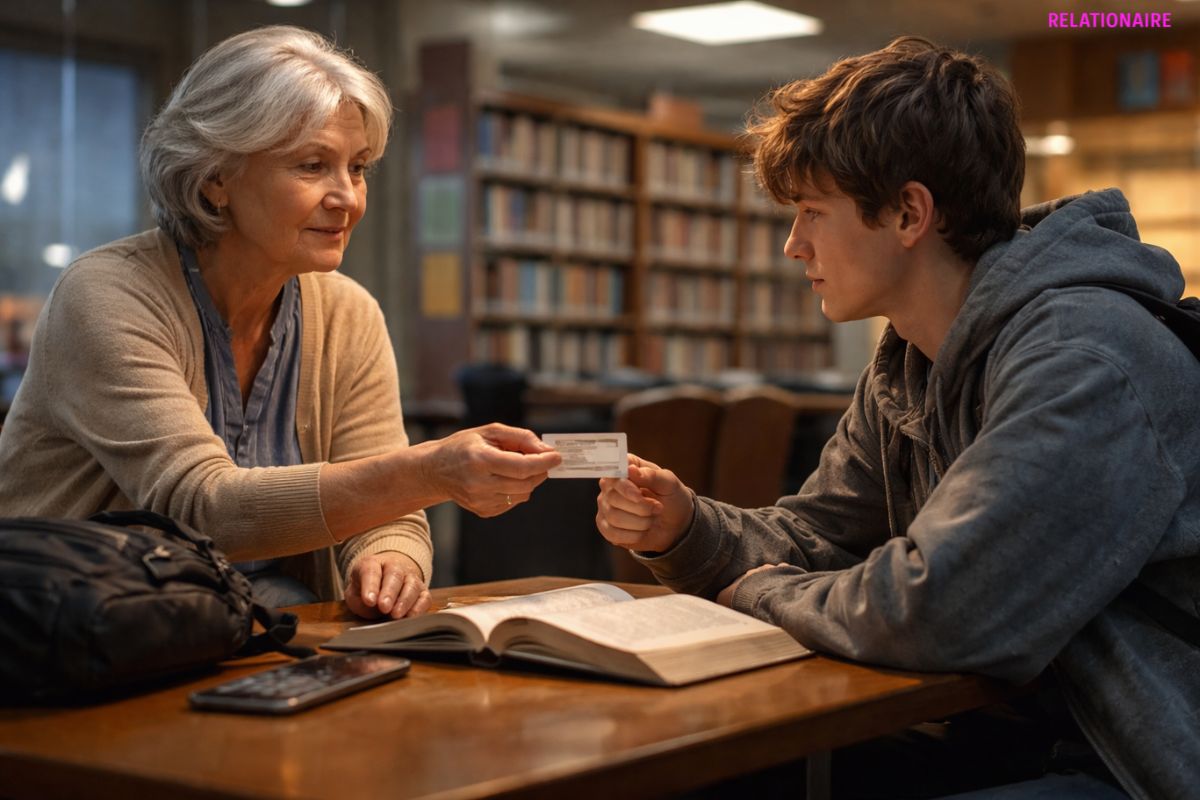
Nina turned to him. “Do you have a library card?”
He looked almost offended by the question. Then embarrassed.
“No.”
“Why not?”
He gave a short laugh with no humor in it. “Need an address.”
Talley said, “Which is exactly why we can’t—”
Nina ignored him. “Do you want one?”
Eli looked at her as if she had asked whether he wanted to borrow the moon.
“You can’t get one without proof,” he said.
“Sometimes,” Nina replied, “proof is a problem adults made.”
Talley folded his arms. “Nina.”
But she was already thinking.
Not loosely. Not sentimentally.
Practically.
She had spent decades helping children whose forms were missing signatures, whose field trip slips never came back, whose records got lost between schools and shelters and relatives’ couches. She knew how systems erased people. She also knew systems had seams.
“Come to the desk,” she said.
Eli didn’t move. “Why?”
“Because I want to try something.”
Talley’s voice sharpened. “This is not how registration works.”
Nina met his stare. “Then it’s a good thing I remember exactly how exceptions are processed for temporary residency and municipal outreach referrals.”
For the first time, Talley looked unsure.
Eli looked between them like a person standing at the edge of a bridge he had already decided was too fragile to hold him.
“I don’t have papers,” he said.
“Do you have your name?” Nina asked gently.
He swallowed. “Yeah.”
“Then start there.”
The rain beat harder against the windows.
At the desk, Nina pulled out forms no one had touched in years. Temporary residency verification. Outreach exception. Minor identification affidavit. Most staff forgot they existed because most staff had never had to help someone who belonged nowhere official.
Eli stood rigid while she asked the questions quietly.
Full name.
Elias Warren.
Date of birth.
He answered without hesitation.
Emergency contact.
Silence.
Nina skipped it.
Last school attended.
That took longer. “North Mercer High,” he said finally.
Talley hovered two feet away, disapproving and curious in equal measure.
“And current residence?” Nina asked.
Eli gave a bleak little shrug. “Shelter when there’s room.”
Nina lifted one of the forms.
“There’s a branch option,” she said.
He frowned. “What?”
“For patrons without fixed housing who receive services through city shelters or outreach programs. The mailing address can be held in care of the library branch pending confirmation.”
Talley said immediately, “It still requires supporting documentation.”
Nina nodded. “Yes. Which I can request.”
From the pocket of her cardigan, she took out her phone and dialed a number from memory.
It rang twice.
A woman answered, winded and busy.
“Mercy House Youth Shelter.”
“Nora, it’s Nina Bell. Former Eastside Middle. I need a favor.”
Eli’s whole head lifted.
He knew that shelter name.
Nina listened, nodded, then said, “I have a young man here named Elias Warren. I’m trying to establish temporary documentation for a library card.”
Eli stared at her.
Nora said something on the other end that made Nina’s expression shift.
Not surprise.
Something heavier.
She looked at Eli then. Really looked.
When she spoke again, her voice had changed.
“Are you certain?” she asked softly.
Eli’s hand slid off the counter.
“Nora,” Nina said, very quiet now, “how long?”
The library seemed to go still around them.
Eli’s face lost what little color it had left.
Nina lowered the phone, eyes fixed on him, and whispered the sentence that made the whole room tilt.
“Oh, honey,” she said, “you think your mother is still coming back for you.”
PART 2
For one terrible second, Eli looked like she had struck him.
Not because she was loud.
Because she wasn’t.
Because she had said it the way people say the truth when they wish with everything in them that it weren’t true.
Talley cleared his throat, suddenly uncomfortable in his own skin. The mother by picture books turned away. Even the man in the windbreaker found a magazine he urgently needed to study.
Public humiliation had changed shape.
Now it belonged to everyone who had watched the boy and seen only inconvenience.
Eli stepped back from the desk.
“You don’t know anything,” he said.
Nina covered the phone with her hand. “Eli—”
“You don’t know her.”
His voice cracked on the last word and that, more than anything, told the truth.
Nora was still on the line. Nina lifted the phone again.
“I’ll call you back,” she said quietly.
She ended it and set the phone down.
Eli was already pulling the cord from his charger with shaking hands. Not plugging in. Packing up. Fleeing.
That old reflex.
Leave before pity arrives.
Leave before anyone sees too much.
“Don’t,” Nina said.
He shoved the phone into his pocket. “I’m leaving.”
“I know.”
“Then move.”
She did not.
He looked so young then that it hurt. Not sixteen-young, which he likely was. Younger than that. Nine, maybe. The age children are when they still believe every adult promise with their whole body.
“I didn’t say she’s dead,” he snapped.
“No,” Nina said. “You didn’t.”
He swung the backpack over one shoulder. “She told me to wait for her.”
There it was.
Not a backstory, not yet.
Just the one sentence he had built his whole life around.
She told me to wait for her.
Nina had heard versions of it before. I’ll be right back. Stay here. Don’t move. Watch your brother. Be good. Wait for me.
Adults say those things every day and forget how sacred they sound to a child.
“When?” Nina asked.
His eyes flashed. “Why do you care?”
“Because no one waits this hard unless they were loved hard first.”
That stopped him.
Talley stepped away at last, muttering something about checking on a delivery. He was not cruel enough to stay and not kind enough to help. The man in the windbreaker left without meeting anyone’s eyes.
The room breathed again.
Nina said, “Come sit.”
“I’m not a kid.”
“No,” she said. “You’re a boy who’s had to be older than that for too long. Sit anyway.”
He stood there another moment, jaw locked.
Then, because exhaustion wins where trust cannot, he sat.
Not at the desk. At one of the small tables off to the side, near the local history shelves where fewer people passed by.
Nina brought the tea. It had gone lukewarm.
He drank it anyway.
She sat across from him and waited until his breathing loosened.
Finally, he said, “She dropped me at Mercy House six months ago.”
His gaze stayed on the table.
“Said she had to fix something.”
He swallowed.
“Said two nights, maybe three. She left me her phone charger and fifty dollars and said if she wasn’t back by Sunday, I should keep waiting where staff could find me.”
Nina listened without interrupting.
“At first I thought maybe she got arrested. Or hurt. Or something happened to the bus.” He rubbed the heel of his hand hard against one eye. “Then every week it got dumber to still think that, so I stopped saying it out loud.”
There are kinds of pain that humiliate people simply because they have lasted too long.
“I’m sorry,” Nina said.
He gave a brittle laugh. “Everybody says that when they want you to stop talking.”
“I say it when I wish I could change what happened.”
That landed differently.
He looked at her then, suspicious but listening.
Nina said, “Nora told me your mother never came back to the shelter. She also said they’ve been trying to help you get ID, but you keep disappearing before appointments.”
“I don’t disappear.”
“You leave.”
His face hardened.
She nodded. “All right. You leave.”
“I can’t stay there all day. They kick us out in the morning.”
“I know.”
“I come here because it’s warm.”
“I know.”
“And because I can charge my phone.”
“I know.”
He looked down.
“And because if she calls, I need it on.”
That was the real answer.
Not warmth. Not internet. Not even shelter from rain.
A charged phone was a lifeline to a mother-shaped maybe.
Nina looked at the cracked screen sticking out of his sweatshirt pocket.
“Does she ever call?”
His mouth flattened. “Not yet.”
Not no.
Not never.
Not yet.
It was so hopeful it made her ache.
She had worked long enough with children to know that hope could keep a person alive and ruin them at the same time.
“What about school?” she asked.
He stared at the wood grain of the table. “I was going.”
“Past tense.”
“I missed too much.”
“Why?”
He almost looked offended again, as if she were asking why someone with a broken leg limped.
“Because everything got stupid.”
That answer was so deeply teenage and so deeply broken that Nina might have smiled in another life.
“What happened before Mercy House?” she asked.
He took a long breath, then let it out slowly.
His mother cleaned motel rooms off Highway 9. Sometimes diner shifts too, when someone called out sick. They moved three times in one year. Then twice in four months. Then into one room at the Brookside Inn where the manager let them stay because his mother changed sheets and unclogged sinks when the maintenance man didn’t show.
She kept an envelope of cash in the Bible in the nightstand. She called it “the door money.” Enough for one more week somewhere if everything fell apart.
Everything fell apart anyway.
The motel got sold.
The new owner wanted paying guests, not arrangements.
His mother started missing shifts. Then she started acting strange. Phone clutched all the time. Jumping at knocks. Looking out the curtain. Crying in the bathroom with the faucet running.
“Did someone hurt her?” Nina asked gently.
“I don’t know.”
“Did she hurt you?”
His answer came fast. “No.”
Nina believed him.
“Then one night,” Eli said, “she packed a bag and said we were going somewhere safe. But we only got as far as the shelter.”
He stopped there.
Because sometimes the end of a story is simply where someone left you.
Nina did not push harder. Not yet.
Instead she said, “Why the books?”
He looked confused.
“The way you put them back.”
That question softened something.
“My mom used to take me to the library when I was little. Before stuff got bad.” His voice thinned around that memory. “She said if you borrow a book, you bring it back nicer than you found it if you can. Like saying thank you.”
Nina blinked against sudden heat in her eyes.
“That poem book,” she said. “Do you like poems?”
He shrugged. “Sometimes.”
“Which ones?”
“The short ones.”
“That narrows it down to several thousand.”
His mouth twitched.
Then he said, almost embarrassed, “The ones that sound like someone thought they were the only person who ever felt that way, and then found out they weren’t.”
Nina sat back.
There it was again. Not pretending to read.
Finding shelter in language because language stayed where you left it.
By six o’clock the lights had shifted to evening gold. Rain streaked the windows. The building was beginning to empty.
Nina knew if she let him leave with only sympathy, the moment would collapse into one more adult conversation that changed nothing.
And the danger wasn’t only homelessness.
It was erasure.
No address. No active school. No current ID. No official paper with his name and present tense attached to it.
A boy can vanish that way while still sitting in front of you.
She rose and went back behind the desk.
Talley returned, cautious now.
“This is becoming a social services matter,” he said.
“It has always been one,” Nina replied. “You just preferred not to notice.”
He sighed. “What exactly are you trying to do?”
“Give him a card.”
He rubbed his forehead. “That is not going to fix his life.”
“No,” Nina said. “But it might give him one place in town that records he belongs.”
Talley looked at Eli, who was pretending not to listen and failing.
Nina lowered her voice. “He needs documentation. A mailing point. An institutional reference. A number in a system. Something official with his name on it that doesn’t disappear when someone tells him to move along.”
Talley hesitated.
There are moments when rules and conscience stand in front of each other and wait to see which one will blink first.
Finally he said, “If Nora at Mercy House confirms temporary placement, and if he signs the limited-use form, and if we use branch-hold for correspondence… then technically it can be processed.”
Nina didn’t smile. “Thank you.”
He pointed a finger. “Technically.”
“Of course.”
When she returned to the table with the forms, Eli looked at them like they were joke props.
“What’s that?”
“A chance,” she said.
“I told you I don’t have an address.”
“You may not need one.”
He stared.
She explained the branch-hold system, the shelter verification, the temporary residency exception, the way mail could be routed to the library until something more permanent existed.
His face changed with each sentence.
Not belief.
Not yet.
Something more fragile.
The fear of wanting it.
“What would I even use it for?” he asked, but there was no edge in it now.
Nina could have listed the obvious things. Books. Computer time. Online applications. School records. Job searches.
Instead she told the truth.
“For proof,” she said. “That when someone asks where your life is being kept right now, there is an answer.”
He looked at the blank card application.
Name.
Date of birth.
Residence type.
Signature.
The line for signature undid him.
Nina saw it happen.
A tiny stillness. A breath that wouldn’t come right. His hand hovering above the pen like it belonged to someone else.
“What is it?” she asked softly.
He didn’t answer.
Then, without looking up, he said, “No one’s asked me to sign anything in a long time.”
The room went very quiet again.
Nina slid the pen closer.
“Then let this be the first thing.”
He picked it up.
His hand was shaking so hard the metal clicked against the table.
He wrote slowly, as if each letter had weight.
Elias Warren.
When he finished, he stared at the signature for a long time.
Nina took the form before he could change his mind.
“I’ll call Nora back,” she said. “Stay here.”
This time, he did.
She reached for the phone.
And just as she hit the first number, Eli’s cracked screen lit up on the table between them with an incoming call.
No name.
Just a number he clearly knew.
He went white.
Then he whispered, with all the fear and hope of a child left waiting too long in one breath:
“That’s her.”
PART 3
For a second, neither of them moved.
The phone buzzed against the table, rattling like a trapped thing.
Nina saw Eli’s eyes lock on the screen the way drowning people lock on shore. Hope made him look younger than grief ever had.
The call was almost over by the time he snatched it up.
He fumbled, nearly dropped it, then answered.
“Mom?”
His whole body leaned into the word.
Nina turned away on instinct, giving him privacy that the open room could not really give. But privacy has less to do with walls than with where another person puts their eyes.
She stared at the returns cart and listened to the silence on his end stretch too long.
Then his shoulders changed.
Not collapsed.
Braced.
“Yeah,” he said after a moment, voice flat now. “I’m here.”
Another pause.
“No. I didn’t.”
His fingers dug so hard into the phone his knuckles whitened.
“I waited.”
Nina closed her eyes.
Around them, the evening staff moved softly, all pretending not to hear.
Then Eli said, “You could have called.”
Whatever answer came through the speaker did not comfort him.
His jaw locked.
“Where are you?”
He listened.
And then, so quietly Nina barely heard it, he said, “I don’t have money to send you.”
Silence.
Then something worse than anger entered his face.
Recognition.
Not of her voice.
Of the truth.
He pulled the phone away and looked at the number again, as if maybe the screen would change out of mercy.
When he brought it back to his ear, the hope was gone.
“No,” he said. “Don’t do that.”
His throat worked.
“I’m not your backup plan.”
He ended the call with a shaking thumb.
For a moment he just sat there staring at the dead screen.
Nina waited.
Finally he laughed once, short and broken.
“She remembered me because she needs bus money.”
The words were so stripped of self-protection they barely sounded spoken.
Nina sat back down across from him.
“She’s in Dayton,” he said, before she could ask. “Or says she is. She said she’s sorry. She said things got complicated. She said she thought I’d be safer at Mercy House than with her. She said if I could send just enough for a ticket, she could come get me.”
He looked up then, and what was in his face was not only heartbreak.
It was shame for still wanting to believe her.
“That’s stupid, right?” he asked. “It’s obviously stupid.”
“No,” Nina said. “It’s human.”
He pressed the heels of his hands into his eyes.
“I hate that I picked up.”
“Of course you picked up.”
“I hate that part of me still—”
He stopped.
Nina finished the sentence in her head.
Still runs toward her.
Still needs her.
Still wants one version of the world where mothers come back because they said they would.
He dropped his hands.
“I knew,” he said. “I think I knew before she called. I just didn’t know what to do if I stopped waiting.”
That was the real wound.
Not just being left.
Being left with a job no child should have: deciding when hope had become self-harm.
Nina reached across the table, not touching him yet, just placing her hand where he could choose the distance.
“You do not have to decide your entire life tonight,” she said. “Only the next right thing.”
He swallowed. “What’s that?”
“Finish the form.”
He looked at her like that answer had come from another planet.
“The form?”
“Yes.”
“She just called me for money and you want me to finish a library form?”
“I want you,” Nina said gently, “to do the one thing in front of you that belongs to your future and not your fear.”
His mouth parted, then shut again.
It was such a small thing on paper.
A card.
A laminated square.
But grief is often shifted not by grand speeches, but by one practical instruction that returns a person to themselves.
He picked up the pen again.
Nina called Nora back while he completed the rest.
This time she stepped a few feet away but kept him in sight.
Nora confirmed his placement history, his date of intake, the repeated attempts to connect him with school services and ID assistance, the fact that he was still eligible for support if he would come back consistently.
“He’s a good kid,” Nora said tiredly. “He just keeps living like he might have to run in ten minutes.”
Nina looked over at him.
“Yes,” she said softly. “I can see that.”
When she hung up, Talley processed the exception in the system himself. He did it with the expression of a man still deciding whether he believed in mercy if it required paperwork. But he did it.
Name entered.
Temporary branch-hold address logged.
Shelter confirmation noted.
Limited-use account created.
The printer made a small whirring sound.
Then, with absurd ordinary finality, a fresh plastic card slid into the tray.
Nina picked it up first.
The card was pale blue, the branch name stamped across the top. Under it, in clean black letters, was his name.
ELIAS WARREN.
No one could mistake it for charity. It looked like what it was.
Belonging, entered into a system.
She carried it to him.
His eyes dropped to the card, then widened a little, like he had expected the moment to feel bigger, louder, more cinematic.
But life-changing things are often quiet enough to miss if you are waiting for trumpets.
“I can use it?” he asked.
“Yes.”
“For real?”
“For real.”
He took it carefully.
The same way he returned books.
With reverence.
He turned it over, thumb rubbing the edge.
Nina saw his mouth tighten.
“He asked for my address once,” Eli said suddenly.
“Who?”
“The guy at a job fair table. I wanted to apply to stock shelves at a grocery store. He said write your address here and I just stood there.” He looked at the card again. “I didn’t know how to explain I was nowhere.”
Nina felt something in her chest break cleanly open.
“You were always somewhere,” she said. “The problem was that no one had written it down yet.”
That did it.
Not sobbing.
Not dramatic collapse.
Just one tear, then another, slipping down the face of a boy who had gone out of his way not to need anything from anyone.
He wiped them fast, angry at them.
Nina pretended not to notice in the way adults do when they are trying to protect the last scraps of someone’s dignity.
Talley cleared his throat from behind the desk.
“There are… additional resources,” he said stiffly. “Database access. Homework help. Resume software.”
Nina looked at him, surprised.
He added, to Eli but not quite looking at him, “And the branch receives mail for general delivery accounts. Official mail, if needed. School records. Forms.”
Eli stared.
It was not an apology.
But it was the first decent thing Talley had offered him.
“Thank you,” Eli said.
Talley nodded once and retreated.
The next hour unfolded in practical miracles.
Nina showed Eli how to log into a library computer with his new account number.
They requested a copy of his birth certificate application checklist.
They pulled up the school district re-enrollment page.
They found a youth employment program that accepted branch-held mailing addresses.
They printed everything.
Nina paid the ten-cent page fees before he could protest.
At closing time, she walked him to the doors.
The rain had stopped. The sidewalks were slick and dark. The air smelled like wet pavement and leaves.
He stood under the awning, backpack on, papers sealed inside a library envelope so they would not bend.
The blue card was in his front pocket.
Safe.
“You going back to Mercy House?” she asked.
He nodded.
“Good.”
He looked out at the street. “What if she calls again?”
Nina considered that.
“Then you answer if you want to,” she said. “Or you don’t. But either way, you don’t have to disappear while you wait to decide.”
He took that in.
Then he said, almost shyly, “Can I come back tomorrow?”
Nina smiled. “That is quite literally how libraries work.”
A tiny laugh escaped him.
Real this time.
He turned to go, then stopped.
“The book,” he said.
“What book?”
“The poem one. I never finished it.”
Nina opened the door behind her and held it.
“Then come check it out.”
He hesitated. “Can I?”
She lifted an eyebrow. “Elias Warren, are you asking me if a person with a valid library card may borrow a library book?”
He gave her a look that was almost offended, and for the first time he looked exactly his age.
They went back inside together.
He borrowed the poetry collection and one grammar workbook and, after a long internal debate, a novel about a boy surviving winter alone in the woods.
At the scanner, the machine beeped each item into his account.
Three small sounds.
Three undeniable records.
When they stepped outside again, he held the books against his chest under the library envelope.
Not hiding.
Carrying.
“What if I bring them back late?” he asked.
“Then we’ll deal with that when it happens.”
He nodded.
Then, after a silence that felt full and careful, he said, “Nobody’s ever given me something official before.”
Nina looked at the card peeking from his pocket.
“Yes,” she said. “They should have.”
He walked away down the wet sidewalk toward the shelter, taller somehow than he had seemed at three-thirty that afternoon.
Not because his life was fixed.
It wasn’t.
Tomorrow would still have forms, waiting lists, hard phone calls, grief that came back in waves, and a mother-shaped ache that a plastic card could not cure.
But now there was a place in town where his name lived in the present tense.
A place where someone would notice if he didn’t come back.
A place where the books would wait where he left them.
Nina stood under the awning until he disappeared at the corner.
Then she went inside, turned off the desk lamp, and touched the stack of returned books with her fingertips.
All those years, people had called libraries quiet.
But they were never really quiet.
They were full of small sounds that meant a life was still going on.
A page turning.
A printer waking up.
A card being made.
Sometimes that was all hope looked like at first.
And sometimes, if someone noticed in time, it was enough.