If you’ve already read part 1 of this story on Facebook, go here for Part 2!
The first time I saw Emma put the cereal back, I thought she was just being picky.
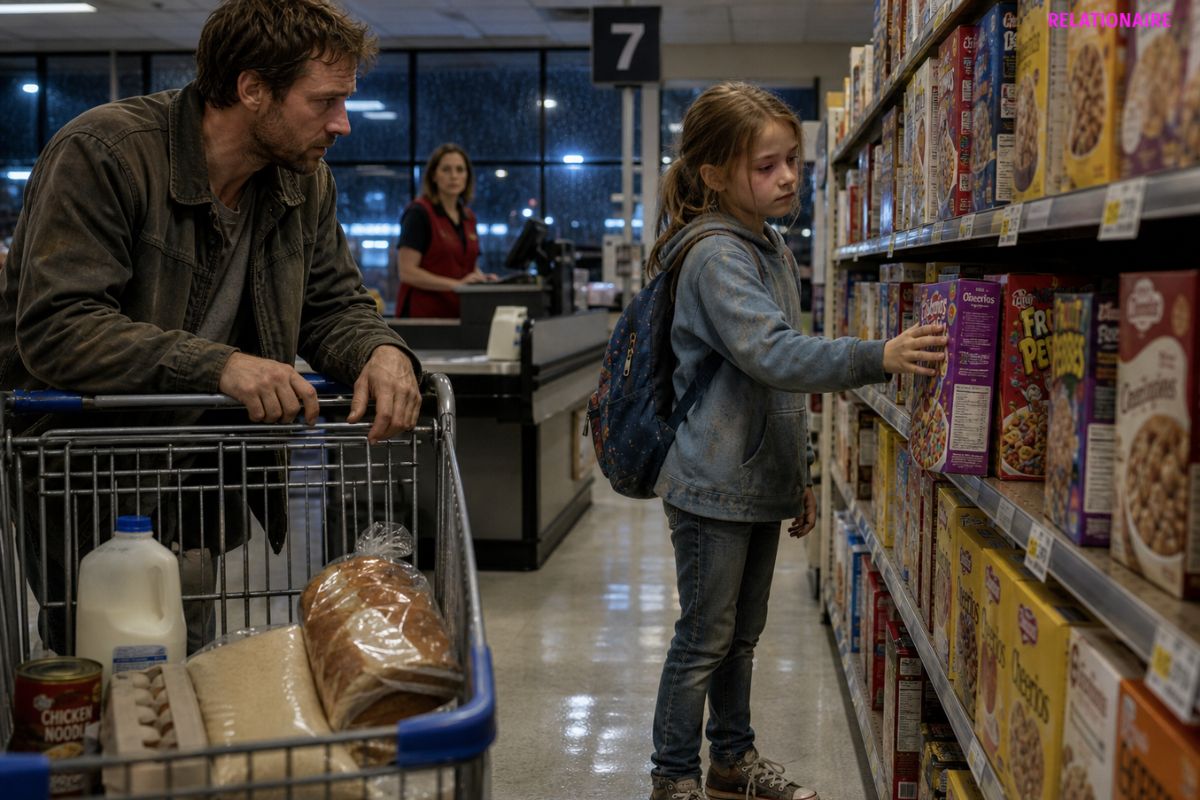
She stood in aisle seven with both hands wrapped around a bright purple box, the kind with cartoon marshmallows and a toy prize printed on the front. Her little sneakers were untied. Her backpack hung open, one broken zipper tooth catching on the fabric.
Her father stood beside the cart, staring at the price tag like it had personally hurt him.
“Not today, baby,” he said softly.
Emma did not argue.
She did not pout.
She did not even ask why.
She just nodded once, held the cereal against her chest for one extra second, then reached up and slid it back onto the shelf.
That was what made me notice her.
Children usually fought for things in grocery stores. Candy bars. Cookies. Juice boxes. Tiny toys near checkout that no parent wanted to buy.
But Emma never fought.
Every Tuesday evening, a little after six, she and her father came into the supermarket where I worked after school.
By day, I was Miss Palmer from Room 14, third grade, dry erase marker dust on my sleeves, cafeteria duty on Fridays, a tote bag full of ungraded spelling tests digging into my shoulder.
By night, I wore a red vest and scanned coupons under fluorescent lights.
Most people thought teachers went home at three.
I wished.
Rent had gone up. My car needed brakes. The district froze stipends again. So three nights a week, I stood behind register four and smiled at people who barely looked up.
But Emma looked up.
She was one of my students.
Quiet child. Careful handwriting. Always first to return the glue stick caps. Always last to take off her coat, even when the classroom was warm.
She never caused trouble.
That was the trouble.
Children who are fine usually make noise.
Emma moved through the world like she was trying not to take up too much space.
Her father, Daniel, looked the same.
He was maybe thirty-five, but exhaustion had folded him forward. He wore the same faded work jacket every week, the cuffs dark from use. His phone screen was cracked in a spiderweb across the corner. There was always a grocery list folded in his hand, written on the back of something else.
A school lunch debt notice once.
A medical bill another time.
An old permission slip for the zoo trip I knew Emma had never turned in.
At school, I had judged him before I meant to.
Not cruelly.
Just in the quiet way tired adults judge each other when there are forms missing and emails unanswered.
Emergency contact form incomplete.
Reading log unsigned.
Parent-teacher conference missed.
Field trip money never sent.
I had written, “Please contact me when you can,” on three different notes tucked into Emma’s folder.
No answer.
Then on Tuesday nights, I watched him count apples one by one.
I watched him choose the smaller loaf.
I watched Emma place things in the cart, then remove them before he asked.
Strawberry yogurt.
A box of crayons.
Chicken nuggets shaped like stars.
A small pack of batteries.
Always back on the shelf.
Always with that same calm little nod.
“Not today, baby.”
And every time, something inside me tightened.
One Tuesday in early May, Emma came into class with her jacket zipped all the way to her chin.
It was warm enough outside that the playground blacktop shimmered in the afternoon sun.
“You can hang that up, sweetheart,” I said.
“I’m okay.”
During math, she kept one hand inside her pocket and wrote with the other.
During lunch, she picked the cheese off her sandwich and wrapped half the bread in a napkin.
I saw it.
Teachers see more than children think.
We see the trembling fingers.
The shoes getting too small.
The way a child flinches when the office calls their name.
The way they stop asking for help because help costs somebody something.
That afternoon, while the class packed up, a Mother’s Day craft sat half-finished on Emma’s desk.
A paper flower pot with the words, “My mom is special because…”
Most children had written things like, “She makes pancakes,” or, “She hugs me,” or, “She lets me watch movies.”
Emma’s paper was blank.
Her pencil had rolled onto the floor.
I walked over gently.
“You can make yours for anyone you love,” I said. “Grandma, auntie, dad, whoever takes care of you.”
She looked at me then.
Not angry.
Not sad.
Just tired in a way no eight-year-old should know.
“My mom liked yellow,” she whispered.
I did not move.
There are moments in a classroom when the whole world keeps going around one child’s pain. Backpacks thump. Chairs scrape. Someone asks for a Band-Aid. Someone loses a lunchbox.
And there you are, holding a sentence too heavy for the room.
“I didn’t know,” I said.
She shrugged one shoulder.
“She died in January.”
January.
Four months.
Four months of unsigned forms. Missed emails. Unpaid lunch notices. A child with half a sandwich in her pocket.
I looked at her empty paper flower pot and felt ashamed.
That evening, I saw them at the store again.
Daniel’s face looked worse than usual. His eyes were red, his work jacket damp from rain. Emma walked beside him with both hands tucked into the sleeves of her hoodie.
Their cart was nearly empty.
Milk.
Eggs.
Bread.
A bag of rice.
One can of soup.
They moved slowly, like every aisle asked a question they did not want to answer.
At the end of aisle seven, Emma stopped in front of the seasonal display.
Mother’s Day cards.
Pink envelopes. Glittery flowers. Gold letters that said things like, “For the Best Mom Ever.”
Daniel looked at the display and froze.
For a second, I thought he might turn the cart around.
Instead, he reached for Emma’s shoulder.
“Come on, baby,” he said, his voice breaking just enough that I heard it from the register.
Emma nodded.
But she did not follow right away.
She waited until her father bent over the cart to check the list.
Then her small hand reached out.
She took one Mother’s Day card from the bottom row.
Not a big one.
Not fancy.
Just a yellow card with tiny daisies on the front.
She slipped it under the bread in the cart.
My stomach sank.
I told myself not to assume.
Maybe it was for an aunt.
Maybe a grandmother.
Maybe children grieve in ways adults do not understand.
But when they reached my register, Daniel placed the groceries on the belt with the careful shame of someone who already knew the total might be too high.
I scanned slowly.
Milk.
Eggs.
Bread.
Rice.
Soup.
Then I reached under the loaf and touched the yellow envelope.
Daniel saw it.
His whole face changed.
“Emma,” he said quietly.
She stared at the floor.
He picked up the card like it was burning his hand.
“Baby,” he whispered, “we can’t…”
The line behind them went silent.
Emma’s chin began to tremble, but she did not cry.
Daniel closed his eyes.
“I can’t buy this,” he said.
And then Emma looked up at him and said something so soft I almost missed it.
“It’s not for Mommy.”
PART 2
Daniel did not speak.
The card stayed in his hand, yellow and small against his rough fingers.
The woman behind them in line shifted her basket from one arm to the other. Somewhere near the freezer section, a child laughed too loudly. The scanner light blinked red across the counter.
But register four felt like a chapel.
Emma’s face was pale.
Daniel bent down a little, trying to keep his voice steady.
“Then who is it for?”
Emma pressed both hands into the sleeves of her hoodie.
“You.”
Daniel stared at her.
I felt every assumption I had made about that family rise in my throat like something bitter.
The missing forms.
The unpaid lunch balance.
The unanswered emails.
The parent who did not show up.
I had seen the evidence.
I had not seen the wound.
Daniel looked down at the card again.
“For me?” he asked, like he did not understand the words.
Emma nodded.
“I heard you,” she whispered.
His face changed again, not suddenly, but slowly. Like a door opening to a room he had kept locked.
“Heard me when?”
“In the kitchen.”
Daniel’s mouth tightened.
Emma looked at the card instead of him.
“When you were crying. You said you didn’t know how to be both.”
The woman behind them quietly stepped out of line and pretended to look at gum.
Daniel put one hand on the counter.
I had seen fathers embarrassed before. Angry. Defensive. Ashamed.
But this was different.
This was a man trying not to fall apart in front of his child because he thought falling apart would scare her more.
“Emma,” he said, but nothing came after it.
She reached toward the card.
“I wanted to tell you happy Mother’s Day,” she said. “Because you pack my lunch wrong, but you try. And you don’t know how to braid, but you watch videos. And you burned the pancakes but you still made them like Mommy did.”
Daniel covered his mouth.
The supermarket hummed around us.
A machine beeped.
Plastic bags rustled.
Rain tapped the front windows.
I looked at the total on the screen.
$21.38.
The card was $4.99.
It might as well have been $400.
I reached for my employee discount card before I could think too hard.
Daniel saw me.
“No,” he said quickly. “Please don’t.”
There was pride in his voice, but not the ugly kind.
The bruised kind.
The kind people carry when life has already taken so much that even kindness feels like one more thing they cannot afford.
“I was just—”
“I know,” he said. “Thank you. But no.”
Emma’s shoulders folded inward.
Daniel looked at her and then at the card.
His hands shook when he put it back on the counter.
“I’m sorry, baby.”
Emma nodded.
That nod again.
The one that said she had practiced wanting less.
I rang up the groceries without the card.
Daniel paid with cash. Mostly ones. A few coins.
When they left, Emma turned back once.
Not at me.
At the yellow card sitting beside the register.
After my shift, I bought it.
I told myself I would not cross a line.
Teachers have lines everywhere.
Professional lines. Privacy lines. Don’t-get-too-involved lines.
But by then, Emma was not just a student in my gradebook.
She was a little girl who had made a Mother’s Day card for a father who cried in the kitchen.
The next morning, I found her sitting alone by the lost-and-found bins before the bell.
Around her, the school was already alive.
Sneakers squeaking on scuffed floors.
Announcements crackling over the intercom.
A first grader crying because he forgot his library book.
The secretary calling bus numbers in a voice that could cut through thunder.
Emma sat with her backpack in her lap, picking at a frayed strap.
“Good morning,” I said.
“Morning, Miss Palmer.”
I wanted to hand her the card right there.
I wanted to say, “Give this to him.”
I wanted to fix one small thing in a world that kept asking children to be brave before breakfast.
Instead, I sat beside her on the bench.
“Did you eat?”
She looked away.
“Yes.”
A lie.
A small one.
A survival one.
I reached into my tote bag and pulled out the granola bar I had packed for myself.
“I accidentally brought two.”
She looked at it.
Then at me.
Children know when adults lie kindly.
She took it anyway.
That day, I watched her more closely than I had before.
During reading, she stared at a paragraph for seven minutes without turning the page.
During recess, she sat on the edge of the blacktop and watched other girls practice cartwheels.
During art, when Mrs. Cline asked the class to draw “someone who takes care of you,” Emma drew two stick figures at a kitchen table.
One small.
One tall.
Between them, she drew a frying pan with smoke coming out of it.
At dismissal, Daniel arrived late.
Not very late.
Seven minutes.
But late enough for the front office to call down twice.
He came through the doors still wearing his work boots, his hair damp with sweat, breathing hard like he had run from the parking lot.
“I’m sorry,” he said to the secretary. “I’m sorry. They changed my shift.”
Emma stood from the bench.
“It’s okay, Daddy.”
He flinched at the kindness.
That was when I understood something I should have known long before.
Sometimes children comfort their parents because nobody else does.
I followed them outside with the yellow card hidden inside Emma’s homework folder.
“Mr. Reyes,” I called.
He turned.
The pickup line was loud behind him. Cars idled. A bus hissed at the curb. A parent shouted for a missing water bottle.
Daniel looked tired enough to disappear.
“Can we talk for a minute?” I asked.
His face tightened.
I recognized that look too.
Parents expect schools to call when something is wrong.
Missing homework.
Unpaid balances.
Behavior reports.
Forms.
Always forms.
He looked at Emma, then back at me.
“Did she do something?”
“No,” I said. “She didn’t do anything.”
But that was not true.
She had done everything.
She had noticed grief.
She had carried silence.
She had tried to buy mercy with a five-dollar card.
Daniel nodded slowly and followed me toward the side of the building, near the teacher parking lot where my old car sat with one bad brake light.
Emma stayed close to his leg.
I opened my tote bag, pulled out her homework folder, and held it toward him.
“I put something inside,” I said.
Daniel did not take it.
“What is it?”
I looked at Emma.
Her eyes were wide.
I had meant to help.
But suddenly I saw the fear on her face.
Not fear of me.
Fear that I had told him.
Fear that her private love had been dragged into the daylight.
Daniel saw it too.
He knelt down in front of her.
“Emma,” he said carefully. “What’s in the folder?”
She shook her head.
“Baby.”
Her eyes filled.
“I’m sorry,” she whispered.
“For what?”
“For hearing you cry.”
Daniel looked like the sentence had struck him.
He reached for the folder then.
Slowly.
Carefully.
Like whatever was inside might break all three of us.
And just before he opened it, Emma grabbed his wrist and said, “Please don’t be sad that I know.”
PART 3
Daniel sat down on the curb.
Not because he wanted to.
Because his knees seemed to give out under the weight of his daughter’s sentence.
The pickup line kept moving behind us.
Cars honked softly.
Children shouted goodbye.
A teacher waved traffic forward with a laminated sign.
Life did what life always does around heartbreak.
It kept going.
Daniel held Emma’s wrist, gentle as breath.
“I’m not sad that you know,” he said.
But his voice said he was sad about everything.
Emma stood in front of him with her backpack slipping off one shoulder. Her little face was trying so hard to be brave that it made her look younger.
“I didn’t want you to think you were doing bad,” she whispered.
Daniel closed his eyes.
“Oh, baby.”
I should have walked away.
Maybe that would have been the professional thing.
But I stayed.
Not as a cashier.
Not even as a teacher.
Just as another tired adult standing near a child who needed someone to witness the truth kindly.
Daniel opened the folder.
The yellow card sat on top of her wrinkled spelling test.
A daisy card.
Five dollars’ worth of paper and every bit of love an eight-year-old could fit inside it.
He slid it out with both hands.
On the front, in my handwriting, there was nothing.
I had not signed it.
I had not written a note.
I had only placed it there.
The inside belonged to Emma.
She must have written it during morning work when I thought she was finishing vocabulary.
Her letters were uneven.
Some words leaned uphill.
Dear Daddy,
I know Mother’s Day is for moms.
But you are doing mom things too.
You wake me up soft.
You cut the crusts even when you forget one side.
You learned the pink hair tie is for Tuesdays.
You smell Mommy’s sweater when you think I am asleep.
I miss her too.
You do not have to be both.
You can just be Daddy.
I love you more than pancakes, even burned ones.
Love, Emma
Daniel read it once.
Then again.
By the third time, the paper was shaking.
Emma watched his face like she was waiting to find out whether love had hurt him.
Then Daniel reached for her.
She went into his arms so fast her backpack slid to the sidewalk.
He held her with one hand on the back of her head and the other pressed against the card.
“I’m sorry,” he whispered.
Emma’s voice was muffled against his jacket.
“You say sorry too much.”
A laugh broke out of him then.
Small.
Wet.
Half pain, half mercy.
“I know.”
“You’re doing good,” she said.
He pulled back enough to look at her.
“No, baby. I’m messing up a lot.”
She shook her head.
“You still come back.”
That was the line that stayed with me.
Not because it was polished.
Not because it belonged on a poster in the hallway.
Because it was what children know best.
Who comes back.
Who shows up tired.
Who packs the wrong lunch but packs it anyway.
Who signs the form late but signs it.
Who burns the pancakes but stands at the stove.
Who cries in the kitchen and still wakes them up softly.
Daniel wiped his face with his sleeve.
Then he looked at me.
“I don’t know how to thank you.”
I shook my head.
“You don’t have to.”
“I missed your emails,” he said. “I saw them. I just…” He looked down at the card. “After my wife died, every message felt like another place I was failing.”
“I’m sorry,” I said.
He nodded once.
“So am I.”
For a minute, none of us said anything.
Then I did what teachers do when the moment is too big and the world still needs practical things.
I asked if Emma could join the breakfast program.
I asked if he wanted help filling out the lunch assistance form.
I asked if the school counselor could check in with Emma once a week, not because she was broken, but because grief should not have to sit alone at a third-grade desk.
Daniel looked embarrassed at first.
Then tired.
Then relieved in a way that looked almost painful.
“Yes,” he said. “Please.”
That one word felt like a door opening.
The next few weeks did not become magical.
That is not how real life works.
Daniel still arrived late sometimes.
Emma still had quiet days.
The lunch debt did not vanish overnight.
The grief did not leave their apartment just because a yellow card had named it.
But things changed.
Small things.
The kind schools are built on.
Emma started eating breakfast in the cafeteria with two other girls from class. She always saved her orange juice for last.
Her homework folder came back more often, the corners still bent, but signed.
Daniel came to the spring conference with paint on his jeans and dark circles under his eyes. He sat in the tiny chair across from my desk and listened like every word mattered.
When I told him Emma was reading above grade level, he looked stunned.
“She reads to her mom’s picture,” he said quietly. “Every night.”
Then he covered his mouth and smiled through it.
At the end of May, our class held a character assembly in the gym.
The floor smelled like dust and rubber soles. Folding chairs scraped. Parents stood along the walls holding phones. Students wore laminated name tags and whispered too loudly.
The principal handed out awards for kindness, courage, responsibility, perseverance.
Emma sat in the second row, twisting the hem of her yellow dress.
I had not told her.
When her name was called for the Courage Award, she looked behind her like there must be another Emma.
The gym clapped.
Daniel stood near the back in his work jacket, still dusty from his shift. His hands came together slowly at first, then harder.
Emma walked to the front with her eyes on the floor.
The principal smiled and read from the paper.
“Emma Reyes shows courage by caring deeply, trying again on hard days, and reminding the people around her that love can be quiet and still be strong.”
Emma took the certificate.
Then she looked at the back of the gym.
At her father.
He pressed the yellow Mother’s Day card against his chest.
I do not think most people saw it.
They saw a little girl with a certificate.
They saw a tired man in a work jacket.
They saw a teacher wiping her eyes near the bleachers and probably thought I was just emotional at assemblies.
But I saw the whole thing.
A supermarket aisle.
A card hidden under bread.
A father who thought he was failing.
A child who had been trying to tell him he was enough.
After the assembly, Emma ran to him.
He lifted her with one arm even though she was getting too big for it.
Her certificate bent between them.
“Did I do good?” she asked.
Daniel kissed the side of her head.
“You did beautiful.”
Then he looked over her shoulder at me and nodded.
Not a thank-you exactly.
Something quieter.
Something between two adults who understood that caring for children is never just one person’s job.
Some lessons are written on whiteboards.
Some are tucked into homework folders.
Some stand in grocery lines with five dollars missing.
And some children teach the grown-ups what school was supposed to teach all along:
That being good is not the same as being perfect.
That love does not always know what to do.
But it comes back.
And sometimes, that is the lesson that saves a family.