
She never knew her father’s dog had a name—until the day a stranger knocked at her door.
“I think this belongs to your father’s dog,” he said, holding up a faded blanket, embroidered with initials she didn’t recognize.
The man’s story began in Vietnam and ended on her front porch, a tale buried deep in the past.
A dog, a blanket, and a secret that changed her father’s life… and may help her heal her own.
Sometimes, the past won’t let go.
Part 1: The Blanket
Lena Mitchell stood in the doorway of the old tool shed, staring at the piles of rusted tools and forgotten things. The scent of aged wood and earth filled her lungs. She was 62, but today, she felt the weight of a lifetime—her father’s life, to be precise—pressing on her chest. It was time to sort through the remnants of the man who had lived here, in this modest house on the outskirts of Granby, Colorado. Time to clear away the clutter.
The shed smelled of sweat, metal, and something else—a faint hint of tobacco. She closed her eyes for a moment, trying to summon her father’s presence. He had been a quiet man, a man of few words, but those words had been measured, heavy with things he refused to say. He died six months ago, his heart giving out in the middle of the night, as if tired from carrying too much. Lena had never known much about his past, the years he spent before her birth. All she had were whispers and fragments, some of which came from her mother, who had left when Lena was young.
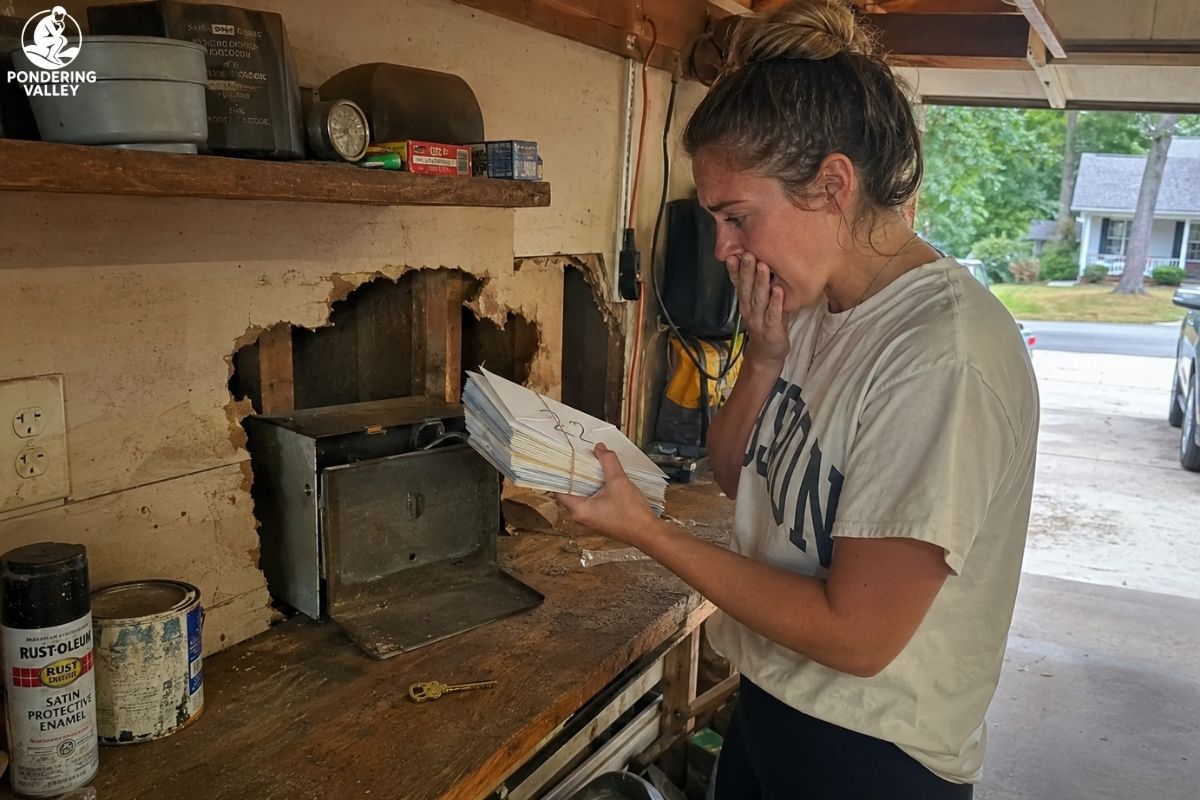
Bending down, she dug through the clutter of tools and old cans, not knowing what she was searching for, only knowing it had to be done. She found a leather-bound notebook first, its edges frayed and the pages yellowed with time. She set it aside. Then, underneath a dusty tarp, she discovered a dog blanket. It was faded, its once-deep maroon color now pale and threadbare. The edges were frayed, and in one corner, embroidered in delicate blue thread, were two initials: “M.H.”
She froze.
Lena had never seen this blanket before. Her father never spoke of a dog. He had been a solitary man, working hard every day, and never seemed to have much interest in animals. Yet here was this blanket, as if it had been carefully kept for decades.
Her hands trembled as she ran her fingers over the initials. They weren’t hers. They weren’t her father’s. The blanket felt heavier now, as if it carried a secret buried deep beneath its fabric.
Later that evening, after dinner, Lena sat on the porch of her father’s house, the same porch where she had sat countless times growing up, listening to the crickets and the wind rustling through the trees. The air was cool with the promise of an early fall, the kind of chill that hinted at the first frost.
She held the blanket in her hands, examining it carefully. The embroidered initials burned in her mind. “M.H.” But who could it be? Her father had never mentioned a dog, let alone one with initials.
Her thoughts were interrupted by the sound of a car engine. At first, she thought it was a neighbor passing by, but the car pulled into the driveway. Lena stood up, the blanket still clutched tightly in her hands.
A man got out of the car. He was tall, with graying hair and a hard face, one that had been weathered by years, but still held an air of quiet strength. He wore a faded military jacket, the kind that looked like it had seen the world. As he approached, he tipped his hat, a gesture of politeness, but there was something in his eyes that made Lena’s stomach tighten.
“Good evening, ma’am,” he said, his voice gruff, but polite. “I hope I’m not disturbing you.”
Lena narrowed her eyes, suddenly alert. “Can I help you?”
The man’s gaze dropped to the blanket in her hands. A brief flicker of recognition passed through his eyes. “I think this belongs to your father’s dog,” he said, his voice steady.
Lena’s heart skipped a beat. “My father didn’t have a dog,” she said, the words coming out sharper than she intended.
The man nodded, as though he had expected this response. “I didn’t think so. But I’m afraid I’m the one who had him. His name was Major.”
Lena’s mouth went dry. “Major?”
The man took a step closer, his hands resting on the worn edges of the blanket. “Yes, ma’am. Major was a dog that saved my life in Vietnam. He and I were inseparable. After the war, I tried to bring him back home with me. But things didn’t turn out the way we hoped.”
The man paused, as if the weight of his words had just caught up to him. Lena’s mind raced, but she stayed silent, unsure what to say.
The man continued, his voice softening. “I left him with your father when I had to go back to Vietnam for one last mission. After that, well, we lost contact, and I didn’t know what happened to him. I thought about him all these years. I kept his blanket, hoping that one day I could return it to the right person.”
Lena stood frozen, the blanket in her hands now feeling like a relic from another time. She could feel the weight of the man’s words settling into her chest, a knot of confusion, loss, and something else she couldn’t name.
“Why now?” she asked, her voice hoarse.
The man looked at her, his eyes filled with regret and something deeper, something she couldn’t place. “Because it’s time,” he said, his voice trembling ever so slightly. “Time to return what was never really mine to keep.”
The man stayed for a while, telling her about Major, about the bond they had shared during the war, and the pain of losing him. Lena listened quietly, her thoughts whirling. Who was this man, and how did he know her father? And why had her father never mentioned a dog?
As the man left, he pressed the blanket into Lena’s hands one last time. “If you ever want to know more, I’ll be around,” he said, tipping his hat once more.
Lena stood on the porch long after he had gone, the blanket still in her hands, her heart heavy with questions she didn’t know how to ask. The past was coming back to life, and she wasn’t sure if she was ready to face it.
But one thing was certain—she couldn’t let this mystery go. The man had given her a piece of the past, a piece of her father’s past, and now it was up to her to uncover the rest of the story.
And so, as the night deepened and the stars shone brightly above her, Lena Mitchell made a decision. She would find out what happened to Major. She would find out what secrets her father had kept—and maybe, just maybe, she would find a way to heal the old wounds that had never quite closed.
Part 2: The Letter
Lena woke early the next morning, long before the sun stretched over the horizon. She hadn’t slept well, not with the man’s words still echoing in her mind. Major. Vietnam. Her father’s secret life. Each fragment of information gnawed at her, each unanswered question like an ache she couldn’t shake.
The blanket was still draped across the chair by the front door, the initials “M.H.” still staring at her with quiet insistence. It felt wrong to just leave it there, a piece of a story untold, so close, yet so distant.
She wrapped herself in her father’s old flannel robe, the faded fabric like a thread connecting her to him. She made her way to the kitchen, where the first light of dawn cast long shadows across the floor. The room was filled with the smell of coffee, the same smell she remembered from when she was a child, when her father would sit at the table early in the morning, drinking his coffee in silence before the workday began.
As she poured herself a cup, she glanced at the stack of old boxes near the back door—boxes she had pulled from the attic the day before. There was something inside them that might hold the answers, something her father had kept hidden for years. She had no idea what it might be, but now, with the man’s visit fresh in her mind, it felt like it was time to search through them.
She sifted through the boxes one by one, until her hands landed on a small leather-bound folder. It was thin, fragile with age, and had no markings—just the soft feel of well-worn leather. When she opened it, a single letter fell out, yellowed with time, its edges crinkled. She recognized the handwriting immediately—it was her father’s.
Her breath caught in her throat. What could this be?
The letter, dated August 13, 1973, began simply:
Dear Major,
I’m not sure how to write this, or if I even should, but I owe you this much at least. You saved my life in a way no one else could. You kept me grounded when the world around me was falling apart. You stayed with me through the worst days and the darkest nights.
I don’t know if I’ll make it back, but if I do, I promise you’ll be with me again. You were always there, even when no one else was, and I will never forget that. But if you never see me again, I hope you find a home with someone who understands.
I’ll never be the same, Major, but I owe you everything.
Yours,
Harold Mitchell
Lena’s hands trembled as she read the letter again. Her father had written this to the dog. To Major. A promise to return. But it was the last part that left her heart heavy: If you never see me again, I hope you find a home with someone who understands.
What did that mean?
She read the letter a third time, feeling the weight of the words settle deep within her. She had known her father as a man who kept things close, who never spoke about his time in the war. But this—this letter—spoke volumes.
There was more to her father’s story, more than she had ever known, and it had been buried beneath years of silence. It wasn’t just about a dog. It was about loyalty, survival, and the wounds that never fully healed.
Lena sat down at the kitchen table, her fingers still gripping the letter. The day had barely begun, but she already knew what she had to do. She had to find out more about Major, about the man who had come to her porch the day before, and about the life her father had lived before she was born.
She knew one thing for certain—her father had carried a burden he’d never spoken of. And now, it was time to bring that burden into the light.
Later that afternoon, Lena drove to the local library, the small, brick building that had been the heart of Granby for decades. She had lived in this town her entire life, and yet it had never occurred to her to look for answers in its dusty archives. But now, with the letter in hand and the blanket still in the back seat, she felt like she was chasing a ghost.
The librarian, an older woman with thick glasses, greeted her warmly. “Afternoon, Lena. How can I help you today?”
Lena hesitated for a moment before speaking. “I’m looking for anything about my father—Harold Mitchell—and his time in Vietnam. Anything related to a dog named Major.”
The librarian raised an eyebrow. “A dog, you say? That’s an unusual request. Let me check the archives. You might find something.”
Lena watched as the librarian disappeared into the back room, the sound of her footsteps fading away. The library was quiet, the only noise the occasional rustle of paper and the hum of the fluorescent lights overhead.
When the librarian returned, she held a stack of old newspaper clippings. “There’s not much here, but I found a few articles about your father. And some mentions of the war. I’ll go through them with you.”
Lena skimmed through the papers, her heart racing. There were mentions of her father’s name—Harold Mitchell—but nothing directly related to Major. One clipping caught her eye, though. It was from a local paper, dated June 1974, just a few months after the war ended.
Local Veteran Returns Home: Harold Mitchell Joins the Community After Serving in Vietnam
Harold Mitchell, a local veteran, has returned to Granby after serving in Vietnam. Known for his quiet demeanor, Mitchell has made no secret of his difficulties adjusting to life back home. “The war takes a lot out of you,” Mitchell said in a brief statement. “But I’m here now. I’ll keep moving forward, one day at a time.”
Neighbors have described Mitchell as a “good man,” though many remain puzzled by his reticence regarding his service. “He’s just not the same man he was before,” said longtime friend, James McAlister. “But he’s trying. That’s all we can ask.”
Lena paused, her finger resting on the paper. This article, so plain and factual, didn’t mention the dog—didn’t mention Major. But it confirmed the distance her father had kept from his past. The war had changed him, in ways that no one had ever truly understood.
The librarian noticed her pause. “Anything else I can help with, Lena?”
Lena took a deep breath. “I think I need to talk to someone who knew my father during the war. Maybe someone who could tell me about Major.”
The librarian gave her a sympathetic look. “I’ll give you a name—James McAlister. He’s still around, and he was close with your father back then. You should give him a call.”
The rest of the day passed in a blur, Lena’s mind consumed by what she had learned. The letter, the article, the strange man at her door—they were all connected in ways she was only beginning to understand. But as the sun dipped below the horizon, she knew one thing for certain: she couldn’t stop now. She had to find James McAlister.
Tomorrow, she would make the call.
Tomorrow, she would learn the truth.
Part 3: The Man Who Knew
The phone call with James McAlister wasn’t as straightforward as Lena had hoped. When she finally dialed the number the next morning, she was met with a long, drawn-out ring that made her stomach tighten with anticipation.
“Hello?” The voice that answered was gravelly, worn by years, but unmistakably kind.
Lena took a steadying breath. “Mr. McAlister? This is Lena Mitchell. I’m… I’m looking for information about my father—Harold Mitchell. I was hoping you could help me.”
There was a pause on the other end, a shift in the air that felt like recognition. “Lena, huh? You’re his daughter. I remember your dad well. What is it you’re after, girl?”
Lena hesitated. She had been rehearsing this moment in her mind, but now that it was here, the words felt too heavy to say all at once. “I found something—a letter, and a dog blanket. I… I think it’s from Vietnam. My dad—he never talked about his time there. Not once. But now, there’s this dog. A dog named Major. And I don’t understand. What happened, Mr. McAlister?”
The silence that followed was thick, a quiet as deep as the past itself. Then McAlister spoke again, his voice softer now, as though it had taken a toll just to remember.
“I can’t tell you everything, Lena. Your father… he kept a lot locked up. But if you’re looking for answers about Major, well, you’ve come to the right place.”
Lena sat forward, clutching the edge of the table. “What happened to him? To Major? And why didn’t he ever talk about it?”
“Well,” McAlister started, a sigh threading through his words, “I guess we should start at the beginning.”
The story, as McAlister told it, began in 1968, in the dense jungles of Vietnam. He and Harold Mitchell had been assigned to the same infantry unit, two young soldiers thrust into the chaos of a war they didn’t fully understand. Major had been a military working dog, trained for search and rescue, detection, and combat support. He wasn’t a dog you’d find lounging on someone’s porch, but rather, a creature honed by war, with instincts as sharp as the men who worked beside him.
McAlister’s voice faltered as he recalled the first time he’d seen the dog. Major had been a German Shepherd, with deep brown eyes that seemed to understand more than any human could. He had saved McAlister’s life twice, and saved Harold’s once. They were a team—soldiers and dogs, bound together by necessity and a silent bond forged in fire.
“We all depended on Major,” McAlister continued, his voice now distant, as though the years hadn’t softened the memories. “He was more than just a dog. He was… he was family.”
Lena could hardly breathe as she listened, the room closing in around her. She had no idea that her father had been so deeply entwined with something—or someone—during that time.
“Harold and Major were close,” McAlister went on, his words slow and deliberate. “Closer than most men and their dogs, I’d say. They’d been through hell together, and when the war ended, Harold promised Major he’d come back for him. But things didn’t go the way Harold had hoped.”
“What do you mean?” Lena asked, her voice barely a whisper.
“There was a… a situation,” McAlister said, his words heavy with hesitation. “The mission went sideways, and they got separated. Harold was sent back to the States before Major could be brought home. By the time Harold had the chance to get back to Vietnam, Major had already been reassigned. Harold tried to track him down, but by that point, it was too late. Major had been… lost in the system.”
Lena felt a lump in her throat. “So he just… disappeared?”
McAlister’s voice tightened. “Not exactly. Harold did what he could. But the military wasn’t going to let one dog slip through the cracks, not after everything they’d been through. They made sure Major was placed with a new handler… someone who wouldn’t ask too many questions.”
Lena closed her eyes. Her father had never spoken about any of this. Not once.
“And the blanket?” she asked, her voice hoarse.
“That blanket,” McAlister said, a note of nostalgia creeping into his voice, “was the last thing Harold had of Major. He took it with him when he came home, a reminder of the dog who saved his life. But after Major was reassigned… Harold never really talked about it again. It broke him, in a way. I think he carried it with him for years, but it wasn’t just the dog he lost. It was a piece of himself.”
Lena sat in silence, trying to piece together the man she had known and the man McAlister was describing. Her father had kept this secret buried, a weight that had only grown heavier with the years. But now, in the quiet of her own home, it was beginning to unravel.
“Mr. McAlister,” she asked, her voice trembling, “where is Major now? Do you know?”
“I don’t,” McAlister replied softly. “But I think I know someone who might.”
Lena’s heart skipped a beat. “Who?”
“The man who took him in,” McAlister said. “I lost touch with him after the war, but he’s still out there. His name’s Sam Taylor. He’s the one who ended up with Major after the military took him away. I don’t know where he is now, but he’s the last person who might know what happened to that dog.”
Lena didn’t hesitate. “Where can I find him?”
The next day, after some digging, Lena found Sam Taylor’s address. He lived on the outskirts of Pueblo, a small town south of Granby, in a weathered ranch house with a worn American flag hanging in the yard. The sun was beginning to set as she arrived, casting long shadows over the dirt road that led to his doorstep.
She knocked once, her heart in her throat.
The man who answered the door was older than McAlister, his skin weathered and his eyes sharp despite the years. His graying beard framed a jaw that looked like it had been carved from stone.
“You must be Lena,” he said before she could introduce herself. “McAlister told me you’d be coming. You’re here for Major, aren’t you?”
Lena nodded, unsure of what to say next. She was standing on the doorstep of a man who might hold the final piece of the puzzle.
Sam stepped aside, opening the door wider. “Come on in, then. Let me show you something.”
Lena followed him into the house, her mind racing. The house smelled faintly of tobacco and wood, the kind of earthy scent that reminded her of home. Sam led her down a narrow hallway to a small room at the back, where a dusty old trunk sat against the wall.
He opened it slowly, revealing a collection of mementos, old photos, and keepsakes. Among them was a faded dog blanket, embroidered with the same initials Lena had seen before: “M.H.”
Lena’s breath caught in her throat. This was it. This was Major’s blanket.
“Harold never let go,” Sam said quietly. “Neither of us ever did.”
Part 4: The Final Promise
Lena stood frozen, staring at the dog blanket spread out on the trunk. The faded maroon fabric seemed to pulse with life, as if the years of neglect had only heightened its importance. Her father’s initials were still stitched in delicate blue thread, just as they had been when she first found it in the shed. But now, here, it felt like a bridge between two lives—her father’s and Major’s.
Sam Taylor stood beside her, his weathered face unreadable, but there was a heaviness in his eyes, the same weight Lena had seen in McAlister’s. “That blanket was Major’s,” Sam said, his voice thick with emotion. “It was the last piece of Harold’s heart that Major left behind.”
Lena swallowed hard, her throat tight with unspoken questions. “Why didn’t my father ever tell me? Why didn’t he ever talk about Major, or the war? I don’t understand.” Her voice trembled, the truth cutting through her like a jagged knife.
Sam sat down on a nearby chair, the leather squeaking as he lowered himself with a deep sigh. “Harold was a proud man. But when he came back from the war, he was broken. There are things you can’t talk about, not because you don’t want to, but because you can’t. Your father never wanted you to carry the same pain he did. He thought… well, he thought Major was the last thing he could hold on to.”
Lena’s mind raced. The mystery of her father, the man she had always known as distant, even cold, was unraveling before her eyes. Her father had lost so much more than a dog. He had lost himself. And yet, he had never let go of this blanket, this symbol of a bond formed in the horrors of war.
“Where did Major go?” Lena asked, the question escaping before she could stop it. “After the war… what happened to him?”
Sam’s face tightened, his gaze dropping to the floor. “Major was lost in the system after your father left him. I tried to find him. McAlister tried too. But the military had different plans. By the time we got back, Major was already gone. All we had was the blanket, and the memory.”
The room felt smaller now, the weight of the past pressing in on Lena’s chest. “What happened to him? Where is he now?”
Sam shook his head, his voice soft with regret. “I don’t know. After the war, things got messy. People moved on. The Army wouldn’t give us any information. But what I do know is that Major never gave up. He always knew how to find the right people, even when they didn’t know they were lost. I think he found someone who understood him, just like your father promised.”
Lena felt the sting of tears, but she fought them back, her mind clinging to a shred of hope. “But what about my father’s promise? What about the man who returned the blanket?”
Sam’s eyes softened, the lines of his face deepening as he leaned forward. “Your father’s promise wasn’t just about a dog, Lena. It was about surviving. About finding a piece of himself in the aftermath of everything he lost. Major was his anchor, the one thing that kept him going when everything else felt like it was slipping away.”
Lena blinked, the realization hitting her with the force of a wave. “And now… now I have the blanket. The promise is mine to keep, isn’t it?”
Sam nodded slowly. “It’s not just a blanket. It’s a legacy. Your father’s way of holding on to what he loved most. And now, it’s up to you to decide what to do with it.”
Lena’s hands shook as she reached out and touched the fabric. The weight of the past, of the untold stories and forgotten promises, was suddenly hers to bear. It was overwhelming, but in a strange way, it also felt like a calling. She had spent years trying to understand her father, trying to make sense of his silence. But now, in the presence of this simple object, she felt as though she was beginning to see him clearly, for the first time.
“Do you think Major is still out there?” she asked quietly, her voice barely above a whisper.
Sam stood up, his hand resting gently on her shoulder. “I don’t know. But I think he’s somewhere, with someone who understands. And if you really want to know, Lena… maybe you should keep searching. Maybe it’s time for you to find your father’s peace—and your own.”
Lena spent the next few days in a haze of thoughts and emotions, trying to reconcile everything she had learned about her father’s past. The more she thought about it, the more she realized that the answer to the mystery didn’t lie in finding Major or uncovering every detail of her father’s time in Vietnam. The answer, she realized, was about letting go—letting go of the hurt, the silence, the distance. It was about healing, for both her father and herself.
She couldn’t find Major—at least, not in the way she had hoped. But she had found something else: the courage to face the past, to acknowledge the wounds that had shaped her father’s life. And in doing so, she had found a path forward. A way to heal the rift that had always existed between them.
As she sat on the porch of her father’s house, the blanket now folded neatly beside her, Lena felt a shift inside her. The memories of her father, of the man who had loved her in his quiet, distant way, seemed to settle around her like the evening air. It was as if his presence was still there, not in the form of the man who had lived in this house, but in the legacy he had left behind. The stories that had never been told, the promises that had never been fulfilled—they were now hers to carry.
She picked up the blanket, her fingers tracing the initials once more. “I’ll never forget you, Major,” she whispered, her voice carrying the weight of the years. “And I won’t forget my father, either.”
As the sun set behind the mountains, Lena felt the first true sense of peace she had known in years. It wasn’t the kind of peace that came with answers, but rather the kind that came with understanding. With forgiveness. And with the hope that, perhaps, the past didn’t have to define her future.
Part 5: The New Beginning
The following weeks passed in a blur, a mix of quiet reflection and moments of sudden clarity. Lena found herself returning to the porch, where the evening light would paint the house in soft golds and oranges. There, she sat with her father’s dog blanket—folded neatly beside her—fingers occasionally brushing the faded fabric as if touching it would somehow allow her to reach across time and connect with him.
The town of Granby, with its sleepy streets and small-town charm, seemed to continue on as it always had. But for Lena, everything had changed. She had uncovered pieces of her father’s past that she had never known existed, and it had stirred something deep inside her, a need to understand who he had been beyond the man who raised her. She had always felt that her father’s silence was a void, a space that left her wondering who he had truly been.
Now, sitting with Major’s blanket in her hands, Lena felt closer to him than she ever had before. It wasn’t the answers she had hoped for—finding Major, piecing together the final fragments of her father’s time in Vietnam—that had given her peace. It was the realization that some things could remain a mystery. Not every question had to be answered, and not every story had to be fully told.
There was freedom in that. And, strangely, there was healing.
One day, as Lena walked through the town square, she saw a familiar face—James McAlister, the man who had started her search in the first place. He was sitting at a bench near the old diner, sipping a cup of coffee. The sight of him, with his weathered features and slow, thoughtful movements, made her smile. He had been a quiet guide through the entire process, a man who seemed to know just enough to point her in the right direction but never pushed too hard for answers.
“Mind if I join you?” Lena asked, approaching the bench.
McAlister looked up and gave her a small, knowing smile. “Of course, Lena. Didn’t expect to see you here. You’ve been quiet lately.”
Lena sat down beside him, her eyes scanning the street. It was a lazy afternoon, the kind of day when everything seemed to move in slow motion, and the world felt just a little bit too peaceful for the chaos that had just been unfolding in her life.
“I’ve been thinking,” Lena said after a moment, her voice soft. “About Major. About my father. And the blanket.”
McAlister nodded slowly. “I figured you would. It’s not easy, figuring out all that. Sometimes it feels like the more you know, the less you understand.”
Lena smiled faintly, her eyes fixed on the empty street ahead. “That’s exactly it. I thought I needed to know everything—every detail, every last piece of the puzzle. But now, I’m not so sure. Maybe it’s okay to leave some things unanswered.”
McAlister chuckled softly. “You’re getting wiser, Lena. Your father would’ve been proud of you. He had that same way of dealing with things, didn’t he? Silent strength, carrying the weight without letting anyone see it. You’re carrying that now.”
“I don’t know if I can carry it like he did,” Lena admitted, glancing down at her hands. “I’ve spent so much of my life resenting him for being distant, for not talking to me about what mattered. But now… now I think I understand him more than I ever did. He wasn’t just cold. He was trying to protect me. From the parts of him he thought I didn’t need to know.”
“That’s the thing about war, Lena,” McAlister said, his tone turning serious. “It doesn’t just break the person who’s been to the battlefield. It breaks everyone they come back to. Your father carried a lot of pain. I don’t think he ever wanted to burden you with it. Not because he didn’t love you, but because he thought you’d be better off without it.”
Lena felt a pang in her chest. She had always wished her father had been more open with her, more willing to share himself. But now, with the clarity of understanding, she realized he had loved her in the only way he knew how—by keeping the darkness away from her, even if it meant keeping parts of himself hidden.
“I’ve been thinking about what you said,” Lena began, her voice steady now. “About letting go of the search for Major. I think I’ve been chasing shadows. The past is important, but it doesn’t always hold the answers we think we need.”
McAlister studied her with his piercing blue eyes, as though assessing her, then nodded. “It’s a hard lesson, but it’s the right one. Sometimes, the only way to move forward is to accept that not everything can be fixed. But that doesn’t mean we can’t heal from it.”
Lena’s gaze shifted to the mountains in the distance, their peaks bathed in the soft afternoon light. A weight lifted from her shoulders, and for the first time in a long while, she felt lightness settle in her chest. She didn’t have to know everything. She didn’t have to piece together every fragmented part of the story. Some stories would remain untold, and some answers would remain hidden. But that didn’t mean she couldn’t live with the questions.
“I think I’m ready to move forward,” she said, her voice filled with quiet resolution. “I’m not going to keep searching for Major. But I am going to make peace with what’s been left behind. I’m going to honor my father’s memory. Not by digging up every detail, but by living a life that reflects the man he was.”
McAlister smiled at her, a proud, almost fatherly smile. “I think Harold would’ve been proud, too.”
The next few days were filled with small, everyday tasks—cleaning the house, sorting through her father’s things, and reflecting on the life he had led. Lena didn’t rush. She didn’t try to uncover more secrets or chase any more ghosts. She simply allowed herself to be present, to honor the quiet strength her father had shown, and to move forward with a sense of peace that had eluded her for so long.
One afternoon, as the sun dipped below the horizon, Lena stood on the porch once more. She held the blanket in her hands, its fabric now soft and worn from years of use. The initials “M.H.” were still there, a reminder of the bond between her father and Major, and the promise he had made long ago.
Lena smiled to herself, the weight of the past no longer a burden but a quiet presence beside her. She didn’t need to search for Major. She had found something far more important—a connection to her father, a quiet understanding, and the knowledge that healing wasn’t about uncovering every detail, but about letting go and moving forward.
With the blanket draped over her arm, Lena took a deep breath, feeling the cool evening air fill her lungs. She was ready to start anew, to embrace the future with the same quiet strength that her father had carried through his life.
And in that moment, Lena knew that the promise her father had made—to survive, to heal, and to carry on—was now hers to fulfill.
Part 6: The Unspoken Truth
Lena’s days became a delicate balance of sorting through the remains of her father’s life and tending to the small, quiet rituals that kept her grounded. Granby was still the same town it had always been—slow, peaceful, with the distant hum of life ticking away as if it could never be interrupted. But inside Lena, everything felt different. The past had shifted, settled, and she had come to understand things she never could have imagined.
Though she had made peace with the unresolved questions about Major, something inside her still longed for closure. The blanket, folded neatly on the armchair in the living room, was a constant reminder of the man her father had been, the promises he made, and the life he had tried to protect her from. Yet, even with the sense of peace that had started to take root, she knew there was one thing she hadn’t yet done.
She hadn’t truly said goodbye.
And so, one morning, after a long silence from the world outside, Lena made the decision. It was time to visit the place where everything had begun—the small, isolated cemetery on the edge of Granby, where her father was buried.
The cemetery had always seemed like a place of quiet reflection, a place where the living could come to pay their respects, but where the dead could remain undisturbed. She had visited it only once since her father’s funeral, her grief too raw to bear it again. But today was different. She was not just visiting a grave. She was revisiting the pieces of her father’s life that had once been so obscured, and maybe—just maybe—she could finally make peace with the man she had never fully known.
The drive was brief, the air crisp and clear as she pulled up to the cemetery’s small iron gates. She had always found solace in the stillness of the place—the way the gravestones, worn by time and weather, seemed to fade into the earth. She parked near her father’s resting place, the simple stone marker that bore his name—Harold Mitchell—and sat in silence for a long while.
The wind rustled through the trees, and for the first time in a long time, Lena felt the weight of her father’s absence settle in. But there was also something else—something lighter. It was as if, by simply sitting here in this quiet space, surrounded by memories, she could feel him in the air. Not the harsh, silent figure she had grown up with, but a man who had loved her in his own quiet way, a man who had given everything and asked for nothing in return.
She stood, her fingers brushing the stone marker, her mind filled with a thousand thoughts. And then, her gaze shifted to the small area beside her father’s grave—the place where his military plaque had been placed. The plaque, made of polished brass, bore the insignia of the Vietnam War, a stark reminder of the years her father had spent as a soldier. Her heart tightened as she looked at it, remembering the stories McAlister had shared with her.
She reached into the car and grabbed the blanket, the one she had found in the shed, and carried it over to the grave. Kneeling down, she unfolded it carefully, laying it over the grass beside the stone. The wind caught the fabric, making it ripple like a flag in the breeze.
“Dad,” Lena whispered softly, her voice almost lost in the wind. “I’m here.”
Her eyes burned with unshed tears, but she didn’t cry. Instead, she allowed herself to simply be. For the first time, she let the grief wash over her, not as a burden, but as a release. There was no more searching, no more trying to piece together the fragments of a life she had never fully understood. She didn’t need answers anymore. She didn’t need to find Major, or fix what was broken.
She just needed to remember. To let go.
For a long while, Lena sat there, in the quiet space between the living and the dead, the dog blanket resting beside her father’s grave like a bridge between the past and the present.
She had come here to say goodbye, to make peace with the mystery that had surrounded her father’s life. And in this sacred place, Lena understood something that she had never truly grasped before: her father had always been trying to protect her. Not just from the war, but from the pain of things that could never be undone. And in that effort, he had given her something more valuable than any story or memory.
He had given her the space to live her own life, free from the burdens of the past.
Lena left the cemetery that day feeling lighter than she had in years, the cool autumn air crisp against her cheeks as she drove back into town. The blanket was still with her, but it no longer felt like a symbol of loss. It had become something else entirely—a piece of her father’s life, yes, but also a reminder of how far she had come, of the healing she had embraced.
She had found closure, not by answering every question, but by accepting the gaps, the silences, and the stories that had never been told. She no longer needed to search for Major. He was gone, and the past was behind her. But in her heart, she had found something just as valuable—a deep, quiet understanding of the man her father had been, and the love he had carried for her all these years, even in the silence.
As the weeks passed, Lena continued to live her life, no longer burdened by the mystery of the past. She focused on the future, on the people she loved, and on the new family she was building—one that would never be defined by the secrets or the distance her father had carried.
And though the dog blanket remained folded neatly in her living room, a reminder of what had once been, it no longer held the same weight. It was a piece of history, yes, but it was also a symbol of healing. The healing that came from understanding, from letting go, and from finding peace with what had once seemed impossible to accept.
Part 7: The Road Forward
Lena’s life, now brimming with quiet resolution, began to unfold with an ease that had eluded her for so many years. There were moments, still, when she would pause, the weight of the past lingering at the edges of her thoughts. But they no longer defined her. The memories of her father, the mystery of Major, the silence that had shaped her childhood—they were no longer chains that held her back. Instead, they had become the foundation for something new.
It had been several months since Lena visited the cemetery with her father’s dog blanket. The weather had turned colder, the first signs of winter starting to creep in with its crisp winds and early sunsets. But in the quiet of her home, surrounded by the things that had once belonged to her father, Lena felt a sense of calm. She was no longer searching for answers that couldn’t be found. She had come to understand that some things were simply meant to remain mysteries.
One afternoon, as Lena was sifting through old family photos—sorting through what to keep and what to give away—she came across something unexpected. It was a photograph, one she had never seen before. It was small, worn at the edges, and faded from age. The picture showed her father, Harold Mitchell, as a young man, smiling beside a dog she recognized immediately. Major.
Her heart caught in her chest. She stared at the image, her father’s face beaming with a joy she had never seen. In the background, the jungle of Vietnam loomed, a stark contrast to the warmth radiating from their faces. Major stood beside him, tail wagging, the bond between them clear even in a photograph taken so many years ago.
Lena ran her fingers over the photograph, and for the first time in years, she allowed herself to feel what she had always longed for—a connection with the man her father had been before he became the quiet, distant figure she had known.
The phone call came later that evening, just as Lena was preparing dinner. She had been thinking about Major, about her father, when the ring interrupted her thoughts. She picked up the receiver, curious but calm.
“Lena?” The voice on the other end was familiar. It was McAlister.
“James,” Lena said, a smile tugging at her lips despite herself. “It’s good to hear from you. What’s going on?”
“I just wanted to check in on you,” he said. “And I’ve got something you might be interested in.”
Lena raised an eyebrow. “What is it?”
“It’s about Major,” McAlister continued, his voice low, as if he were carefully weighing his words. “I’ve been looking into things, and I think I’ve found someone who might know what happened to him. It’s not much, but it’s something.”
Lena’s heart skipped a beat. She hadn’t expected this. “Who?”
“A man named Sam Rodriguez,” McAlister explained. “He was the last one to see Major before he was reassigned. He’s living in Denver now. I don’t know if he can tell you anything new, but it might be worth checking out.”
Lena sat down at the kitchen table, the phone pressed to her ear. She hadn’t been actively looking for Major anymore, but a part of her—the part that still held on to the mystery of the dog, the promise her father had made—wanted to know.
“Okay,” she said, her voice steady. “I’ll give him a call.”
The next day, Lena made the drive to Denver, the city’s skyline stretching ahead as she approached. It had been a while since she’d been in the city, and as the streets passed by in a blur, she couldn’t help but feel a sense of anticipation.
The address McAlister had given her was tucked away in a quiet neighborhood, a far cry from the bustle of downtown. Lena knocked on the door of a modest home, and when it opened, she was greeted by a man who looked to be in his late sixties. His face was weathered, much like McAlister’s, and his eyes, though tired, held a spark of recognition.
“You must be Lena,” he said, his voice rough but kind. “I’ve been expecting you.”
Lena nodded. “You’re Sam Rodriguez?”
“Yeah,” he replied, stepping aside to let her in. “I was in the same unit as your father, and Major. Come on in. We’ve got a lot to talk about.”
Sam led her into his living room, where old military memorabilia lined the walls. Photographs, medals, and items that seemed to carry a lifetime of history. He motioned for Lena to sit, and she did, her hands folding in her lap.
“I was just telling James McAlister the other day that I never thought I’d be talking about Major again,” Sam began, his eyes distant for a moment. “But you’ve got the right to know. Your father kept that dog close, Lena. Major was more than just a companion. He was a lifeline for your father. After everything went wrong over there, Major kept him going.”
Lena’s throat tightened. “But you didn’t bring him back, did you? After the war?”
Sam shook his head slowly, his eyes dark with regret. “No. I tried. I really did. But when your father left Vietnam, Major got lost in the shuffle. He was sent to another handler, and by the time we found out where he was, the military had already reassigned him.”
Lena blinked, her heart sinking. “So Major… he never came back?”
Sam paused, his gaze turning far away, as though he were seeing the past play out before him. “Major didn’t come back to your father. But I’ll tell you something, Lena. I think Major knew that your father had tried. I think he knew that your dad was doing the best he could.”
The silence between them stretched long, and Lena could feel the weight of her father’s absence—still so heavy, even now.
“But you said he’s out there somewhere?” Lena asked, her voice barely a whisper.
“I think so,” Sam said, his voice cracking with emotion. “The thing is, I’ve always believed Major found his own way. He wasn’t meant to be lost forever. Maybe he’s out there still, somewhere, waiting for someone to remember.”
Lena’s mind whirled, but she took a deep breath, her hands resting on her lap. She had come here seeking answers, but she realized something in that moment: it was not the answers that mattered. It was the fact that Major, like her father, had been a part of something much bigger—a story of survival, loss, and the quiet bonds that connected them all.
“Thank you,” Lena said softly, standing up from her seat. “I think I understand now. Maybe it’s not about finding Major after all. Maybe it’s about letting go of the past and living in the present.”
Sam gave her a long, searching look before nodding slowly. “That’s a good lesson, Lena. Your father would be proud.”
As Lena left Sam Rodriguez’s house and made her way back to Granby, she felt a quiet peace settle in her heart. She had come seeking closure, but in a way, she had found something even more valuable: an understanding of the bond between her father and Major, and the lesson that sometimes, the road to healing was found not in the past, but in the act of moving forward.
Part 8: Letting Go
Lena returned to Granby with a sense of finality she hadn’t anticipated. The drive back had been long, her mind still processing the words Sam Rodriguez had shared with her. She’d been looking for answers, and while she hadn’t found the definitive closure she had imagined, she had found something far more powerful—a deeper understanding of her father and the life he had lived before she was born.
It wasn’t about Major. It wasn’t even about the secrets her father had kept buried. It was about forgiveness—about accepting the parts of the past that could never be fully healed and learning how to live with them. She had spent so much of her life trying to uncover the mysteries of her father’s silence, of his broken promises. But now, she realized that some things were meant to remain unanswered. Not because they were unimportant, but because the act of letting go was just as powerful as knowing the truth.
As the days passed, the weight that had once been heavy on Lena’s shoulders seemed to lift. The blanket, which she had carried with such reverence, was now folded neatly in a box at the foot of her bed. It no longer felt like a symbol of loss, but rather a piece of history—a piece of her father’s life that she had honored by understanding it, and now, by letting it go.
One evening, as she sat in her living room with a cup of tea, the setting sun casting long shadows through the windows, Lena felt a sudden urge. She grabbed her coat and left the house, the air cool against her skin. It had been weeks since she had visited the cemetery, and although she knew her journey with her father’s past had come to an end, something inside her still felt like there was one last step to take.
The cemetery was peaceful in the twilight hour, the shadows of the trees stretching across the ground. Lena made her way to her father’s grave, the familiar sense of quiet washing over her. She stood there for a long moment, the wind gently rustling the leaves around her, and allowed herself to simply be present.
This time, there were no questions. No regrets. No searching for answers that couldn’t be found. Lena simply stood, her eyes closed, and let the peace of the moment surround her. She had made her peace with the past, with her father, with the years of silence and mystery. The weight she had carried for so long was gone.
Finally, she knelt by the grave, placing the blanket on the ground beside it. She unfolded it carefully, letting the fabric spill out across the grass.
“I’m not holding on anymore, Dad,” Lena whispered, her voice soft but steady. “I’m letting go.”
The blanket, once a symbol of unresolved pain, now felt like an offering—a tribute to the man who had loved her in his own way, despite the distance between them. It was a final act of understanding, a way to honor her father’s memory without holding onto the past.
As the wind picked up, the blanket fluttered lightly, and Lena stood, watching the fabric dance in the fading light. She felt something shift within her, a final release, as though the blanket itself had become a part of the wind, a part of the earth. It no longer held the weight of grief or loss. It was simply a piece of history, as it should be.
Later that evening, as Lena returned to her home, she felt lighter. The weight of her father’s unspoken words no longer bore down on her. She had reconciled with the silence, with the gaps in his story, and with the understanding that some things—some people—could not be changed, no matter how hard we tried to uncover them.
In the days that followed, Lena began to embrace the present in ways she had never before. She reconnected with old friends, took long walks through Granby, and even began taking on new projects—things that her father would have never understood, but that filled her with a sense of purpose and joy. She felt the future unfolding before her, untethered from the past, free to create her own path.
A few months later, Lena received a letter in the mail, a simple envelope with her name written in familiar handwriting. She opened it carefully, recognizing the sender’s address from Denver. Inside was a letter from Sam Rodriguez.
Lena,
I wanted to reach out to you one last time to share something I’ve been holding onto. A few weeks ago, I made a call to an old friend who used to be part of our unit. I was trying to see if I could uncover more about Major. And, in a strange twist of fate, I found something.
Your father, Harold Mitchell, had sent a letter to Major, just a few months before he passed away. He never spoke about it, but I’ve kept it all these years. It’s been buried in the bottom of a box in my attic, but I think it’s time you read it.
It’s not much, but I believe it’s the last thing your father wrote about Major, and I think you deserve to see it.
Take care,
Sam Rodriguez.
Lena sat down at the kitchen table, her heart pounding in her chest. She opened the letter, her hands trembling, and began to read. It was a simple note, written with care, and yet, it felt like a final piece of the puzzle—a letter that carried with it the quiet love her father had for Major, for the bond they had shared, and for the memories that had stayed with him until the end.
Major,
I know this is strange, writing to you after all this time. I’ve never been good at saying goodbye, and maybe this is just one more way for me to do that. You were more than just a dog, you were my partner, my friend. And I should’ve told you that when I had the chance.
I can’t undo what happened, and I can’t change the past. But I can promise you this: I will never forget you. The bond we shared, the way you kept me going when the world seemed too much to bear, that will stay with me, always.
I hope you’re in a place where you’re loved. You deserve that. You always did.
Thank you, Major. For everything.
Harold Mitchell.
Lena placed the letter down slowly, her heart heavy but full. She had found the last piece, the final part of her father’s story, and with it, she realized something important. It wasn’t about knowing every detail, or finding the answers to every question. It was about understanding that love, even in its quietest forms, could transcend time, distance, and silence.
As the days passed, Lena began to let go in ways she had never expected. She no longer sought closure from the past. Instead, she lived in the present, honoring the memory of her father and the bond they had, even if it had been unspoken for so long.
And in that peace, she finally felt whole.
Part 9: The Legacy of Silence
Lena woke early that morning, the golden light of the rising sun spilling through the curtains. It was a new day, one like so many before it, yet it felt different. There was a quiet sense of finality in the air, a peace that had settled into her bones. It had been nearly a year since she had found the photograph of her father with Major, since she had stood by his grave, and since she had let go of the past she had spent her life trying to uncover.
The letter from Sam Rodriguez had been the final piece, a quiet gift that had allowed Lena to understand her father in a way she had never thought possible. But it was more than just the letter. It was the knowledge that her father had tried, in his own way, to reach out. The man who had kept his silence for so many years had, in the end, found a way to speak through his actions, his love for Major, and the final note he had left behind.
Lena stood at the window for a long time, her mind drifting to thoughts of the future. The future, she realized, was no longer something distant and uncertain. It was here, in the quiet moments she had learned to cherish. It was in the friendships she had nurtured, the peace she had found in her own heart, and the small, everyday moments that had once seemed insignificant.
She felt her father’s presence, not as a shadow of the past, but as a part of her—his quiet strength, his silent love, his unspoken sacrifices. They were woven into the fabric of her life now, not as a burden, but as a legacy.
The phone rang, interrupting her thoughts. Lena picked it up, her heart still warm from the peaceful thoughts that had filled her morning.
“Lena? It’s McAlister,” James McAlister’s voice crackled over the line. “I hope I’m not catching you at a bad time.”
“Not at all,” Lena said, smiling as she sat down at the kitchen table. “What’s going on, James?”
“I wanted to share something with you,” he said, his tone serious. “It’s not much, but it might be important. I was talking to Sam Rodriguez the other day, and he mentioned that he had something else he wanted to give you. It’s a piece of your father’s history, something he’s kept for years.”
Lena’s heart skipped a beat. She had thought that the letter had been the last piece, the final offering. But now, James’s words felt like the echo of an unfinished story.
“What is it?” she asked, curiosity piqued.
“A photograph,” McAlister replied. “Your father took it before he left Vietnam. He didn’t talk about it much, but it’s of him and Major, right before they were separated. Sam says it’s the last picture he has of them together. It’s been in his possession all this time. He wants you to have it.”
Lena felt her breath catch in her throat. The last photograph. She hadn’t expected anything more. And yet, here it was—another piece of her father’s life, another piece of the mystery she had spent so long trying to understand.
“I’ll go see Sam,” Lena said softly, her voice steady despite the rush of emotions that stirred within her.
“I’ll let him know you’re coming,” McAlister replied. “Take your time. It’s not a hurry, but when you’re ready, the photo will be there.”
Lena made the drive to Sam’s house the next day, her hands gripping the steering wheel as memories of the past few months danced through her mind. The last photograph. It felt like the final key, the last door waiting to be opened. She had come so far, let go of so much, and yet, there was something about this image that felt like it would complete the puzzle.
When she arrived at Sam’s house, the familiar warmth of the place greeted her, the same as it had when she first visited. Sam greeted her at the door, his weathered face lighting up with recognition.
“Lena,” he said, his voice full of quiet emotion. “It’s good to see you again.”
“Thank you for everything, Sam,” Lena said as she followed him inside. “You’ve been more help than I can express.”
Sam nodded, leading her to the same room she had been in before. The walls, lined with military memorabilia, seemed to carry the weight of decades of history. Sam walked over to an old wooden cabinet and pulled out a small, framed photograph.
“I’ve kept this all these years,” Sam said, his voice quieter now. “Your father… he never wanted anyone to see it. But I think you deserve to have it.”
He handed her the photograph. It was slightly worn at the edges, the colors faded by time, but the image was clear. In it, her father, a young Harold Mitchell, stood beside Major. They were in the jungle, both of them looking out at the camera, but there was something else in the photo—the bond between them. Major’s ears were perked up, his tail just beginning to wag, while her father’s face, despite the hardship they both had endured, showed a rare moment of peace. They were more than just soldier and dog. They were partners, comrades, and friends.
Lena held the photograph in her hands, feeling the weight of it. She could almost hear the sounds of the jungle, the faint rustling of leaves, the stillness between them. It was as if time had paused in that moment, holding onto them both, suspended between the past and the future.
“I never knew how much this meant to him,” Lena said, her voice thick with emotion.
Sam looked at her with a knowing gaze. “He never talked about it much. But you know, that picture… it’s more than just a photo. It’s a reminder of who he was, before the war took everything from him. He wasn’t always silent, Lena. There was a time when he believed in something greater than himself. And Major was part of that.”
Lena felt the tears welling up, but she didn’t let them fall. She had spent so many years chasing after her father’s past, trying to understand him. But in this moment, she realized that she had found the most important part of the journey: acceptance.
“Thank you, Sam,” she said, her voice steady. “For everything. I think I’m finally ready to let go.”
Sam smiled softly. “It’s not about letting go, Lena. It’s about carrying them with you. Your father, Major—they’re always going to be a part of you. And that’s something you’ll never have to let go of.”
As Lena drove back home that day, the photograph of her father and Major carefully placed on the passenger seat, she realized something profound. The journey she had taken, the questions she had sought to answer, had never been about finding every piece of the past. It had always been about understanding the legacy her father had left behind, the quiet love that had been hidden beneath years of silence.
In the weeks that followed, Lena found herself embracing her future with more joy than she ever thought possible. She didn’t need to chase the past anymore. The pieces of her father’s life, the story of Major, and the love they had shared had all been laid out before her. She no longer needed answers. She simply needed to live.
And so, with each passing day, Lena carried them forward with her. Her father, Major, and the quiet legacy of love they had left behind.
Part 10: The Peace of the Present
Lena woke up early that morning, the sunlight filtering gently through the curtains, casting soft golden light across the room. It was the kind of morning that felt full of promise. The kind of morning when everything felt right, even though there was no particular reason why.
For the first time in a long time, Lena felt completely at peace.
The months had passed, and she had settled into a new rhythm, one that no longer carried the weight of past questions or unresolved stories. She had come to understand her father in a way she never could have imagined. His silence, his distance, the absence of certain parts of his life—they were no longer things that defined her. They were simply parts of his story, and her story, too.
She looked across the room at the photograph of her father and Major, now framed and resting on the mantel. The picture had become more than just an image. It was a reminder of the journey they had both taken, a journey of healing, letting go, and understanding. It had also become a symbol of how far Lena had come.
She had finally made peace with her father’s past. She had learned to let go of the need for every answer, every explanation. The love they shared, though quiet and unspoken, had always been there, and now, Lena understood that it was enough.
Lena spent the day doing what she had come to love—working in her garden, walking through the town, visiting with old friends, and enjoying the small, simple things in life. It wasn’t always easy, but it was real. She had stopped chasing after the past and had started embracing the present. The past was always there, of course. But it no longer haunted her.
As the evening approached, Lena took a walk through Granby, her feet tracing familiar paths. The town felt unchanged, yet everything felt different. There was a quiet joy in the air, as though the weight of the world had been lifted.
She passed the cemetery, and without thinking, she found herself walking toward her father’s grave. It had been some time since she last visited, but today, she felt compelled to come. It was almost as though her father were calling her, inviting her to see the peace she had found, to see the life she had made for herself.
Lena knelt beside the grave, the quiet wind rustling the leaves around her. The blanket she had placed there all those months ago was still there, now weathered by the seasons, but still present. It was no longer the symbol of a lost past, but the symbol of a journey—one that had led her to this moment of understanding, of acceptance.
“I’m okay, Dad,” Lena whispered, her voice soft but steady. “I’ve let go. And I think you can, too.”
As she sat there, the weight of years of unanswered questions seemed to dissipate. She had come to realize that sometimes, letting go wasn’t about forgetting or abandoning the past. It was about acknowledging it for what it was—its beauty, its pain, and its lessons—and then choosing to live, to move forward, carrying those lessons with her.
The weeks that followed were full of quiet changes. Lena had begun to write down the stories of her father she had once tried to uncover. Not to solve the mysteries or to find closure, but to honor the parts of him that had shaped her. She wrote not just about Major, but about her father’s life before the war, the man he had been before he became silent and distant. She began to understand that his silence had been a shield, a way to protect her from the things he couldn’t bear to share.
In the evenings, she would sit by the fire and read the letters she had received from Sam Rodriguez and James McAlister. They had all become a part of her journey, and though their words were few, they carried with them a depth of understanding that Lena had never expected to find.
And as the seasons changed once again, Lena realized that she was no longer just living in the shadows of the past. She was living in the present, grounded in the understanding that the people she loved—her father, Major, and even herself—had all been part of a larger story. A story that didn’t need to be fixed, but simply accepted and carried forward.
One quiet afternoon, as Lena walked through the town square, she noticed something that had changed since her childhood. The trees had grown taller, the buildings had been painted in fresh colors, and the town felt brighter. But what stood out the most was the people. The faces she saw weren’t just familiar; they were connected. Neighbors waved at one another, shared brief conversations, and stopped to smile.
Lena stopped in front of the small café, where a group of people sat outside, laughing and chatting. It was a simple moment, but for Lena, it was everything. It was the peace she had sought for so long—being present, being connected, and understanding that life was more than just the search for answers.
She smiled to herself and continued on her walk, feeling the weight of the past no longer holding her down. It was no longer about searching for Major or uncovering every detail of her father’s life. It was about living in the moments that mattered, creating new memories, and carrying the lessons from the past with her—not as a burden, but as part of who she was.
As she walked through the streets of Granby, Lena felt her heart lightened, her spirit free. The legacy her father had left behind was not a heavy thing to carry, but a gift—a reminder of love, loss, and the quiet bonds that shaped them both.
And so, with each passing day, Lena lived, free of the need for closure, free of the weight of silence. She lived fully, in the present, surrounded by the people and the world she had come to love, knowing that in the end, love was the answer to every question she had ever asked.
End of Part 10 – and the final chapter of The Man Who Returned the Blanket.