
If you’ve already read part 1 of this story on Facebook, go here for Part 2!
PART 1
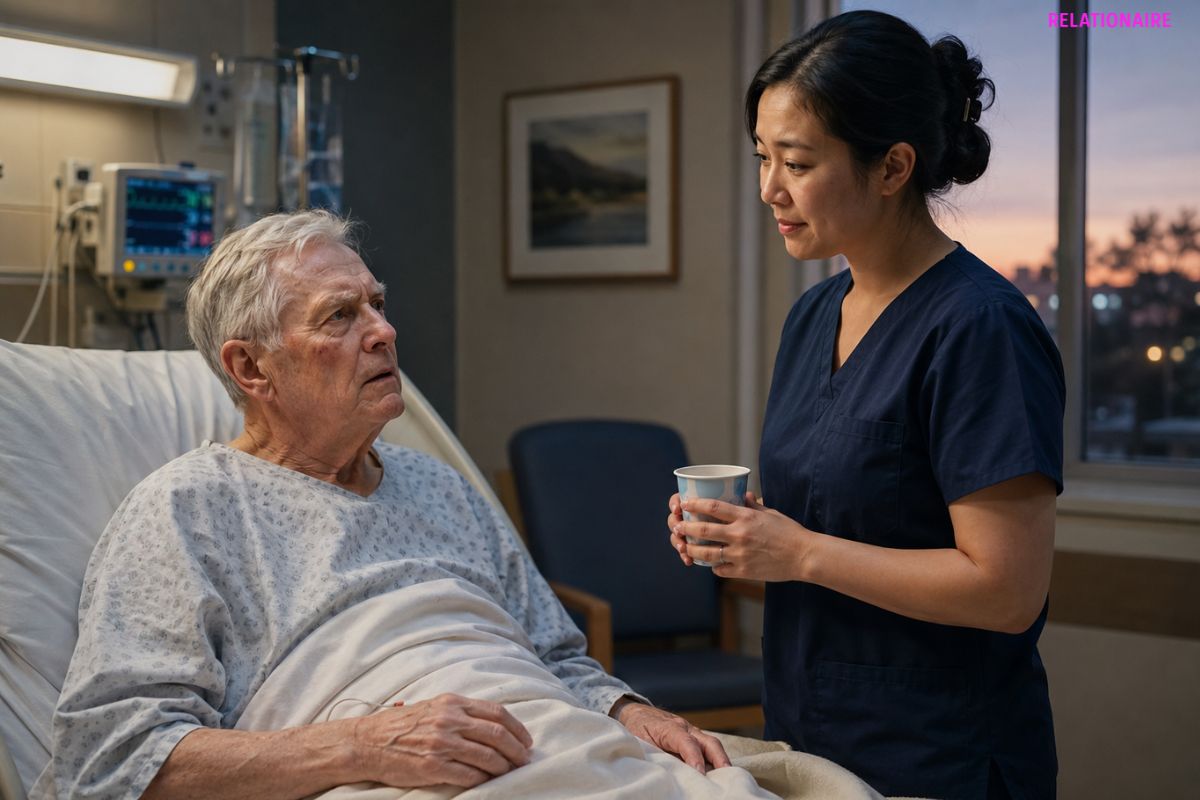
The first time Nurse Lena called him “Professor,” Mr. Alden Pryce looked at her like she had placed the wrong name on his hospital bracelet.
He was eighty-one, sharp-eyed, thin as a folded umbrella, and angry enough to make the beeping monitor seem nervous.
“I am not a professor,” he said.
Lena stood beside his bed with a paper cup of water in one hand and his evening pills in the other.
“I know,” she said softly. “But it suits you.”
That made him dislike her immediately.
He had fallen on the front steps of his townhouse three nights earlier while carrying in a bag of groceries he refused to let the delivery man bring inside. The neighbor found him sitting upright in the rain, one hand gripping a torn paper bag, the other pressed to his hip.
Now he was in Room 412 of St. Mercy Hospital with a bruised side, a stubborn limp, and no patience for anyone who spoke to him like he was fragile.
Especially her.
Lena was young enough to irritate him, though not as young as the interns who whispered outside his door and thought he could not hear them.
She had tired eyes, neat dark hair pinned low, and a habit of checking the room before she checked him. Window. Water cup. Call button. Blanket. Tray table. Visitor chair.
It annoyed him that she noticed everything.
It annoyed him more that she smiled anyway.
“Good morning, Professor,” she said the next day, sliding open the blinds.
He winced as daylight filled the room.
“I told you not to call me that.”
“I remember.”
“Then why do you keep doing it?”
She adjusted the blanket over his knees. “Because some names are earned.”
He stared at her.
“That is nonsense.”
She did not argue. She only picked up his untouched breakfast tray and looked at the oatmeal with a small frown.
“You need to eat.”
“I need to go home.”
“You need to stand without trying to fight the floor first.”
His mouth tightened.
Lena’s eyes softened, but her voice did not. “Your physical therapist will be here at ten.”
“I was a school principal for thirty-eight years. I know how schedules work.”
“Yes, Professor.”
He slammed his palm lightly against the mattress.
“There it is again.”
Outside his door, a food cart rattled past. A patient down the hall laughed at something on the television. Somewhere, shoes squeaked over clean tile.
Lena paused with the breakfast tray in her hands.
For a second, something passed over her face.
Not amusement.
Not mockery.
Something quieter.
Then she turned and left.
By the third day, Mr. Pryce had built a whole theory about her.
She was one of those sentimental nurses. The kind who thought every old man needed a nickname and a pep talk. The kind who softened everything with sweetness until it became unbearable.
He had no use for it.
He had lived alone for twelve years since his wife, Margaret, passed. He liked his tea unsweetened, his shirts pressed, and his mornings quiet. He had spent a lifetime making children stand straight, speak clearly, and think before they answered.
People called him strict.
He preferred necessary.
That afternoon, Lena came in carrying a fresh gown and a stack of towels.
“Time to get washed up, Professor.”
His face burned.
“I can wash myself.”
“I know you can. I’m just here in case your hip disagrees.”
“My hip is not a person.”
“It has opinions.”
Despite himself, he almost laughed.
Almost.
Then he caught the nickname again.
Professor.
It scraped at him.
Because he had never been one.
He had been a principal in a public middle school with flickering lights, broken lockers, and a staff room coffeemaker that sounded like it was begging for retirement. He had not lectured in grand halls. He had not written books. He had not worn tweed jackets or inspired applause.
He had signed detention slips.
He had called parents.
He had reminded boys to remove their caps and girls to stop hiding behind their hair.
Professor.
It sounded like a joke dressed as respect.
That evening, his only visitor came.
His daughter, Claire, arrived after work, still wearing her office badge and carrying the guilty energy of someone who had been answering emails at red lights.
“Dad,” she said, kissing his forehead. “How are they treating you?”
“Like a museum piece.”
She smiled tiredly. “That means carefully.”
He pointed toward the hallway. “That nurse keeps calling me Professor.”
Claire glanced at the whiteboard near his bed.
Lena Tran, RN.
“She probably means it kindly.”
“She means it carelessly.”
“Dad.”
He looked away.
Claire set a small paper bag on his tray table. Inside was a blueberry muffin from the bakery he used to like. He did not tell her his appetite had disappeared. He did not tell her he had been waking in the middle of the night reaching for Margaret’s side of the bed in a room where Margaret had never slept.
He only said, “I don’t need pet names.”
Claire sat down, smoothing her skirt over her knees.
“You know,” she said gently, “not everyone is trying to insult you.”
That stung more than it should have.
Because he was not sure anymore.
The hospital had a way of shrinking a man. One day, you were carrying groceries. The next, strangers were asking if you needed help walking to the bathroom.
By evening, rain tapped softly against the window.
Claire had gone home to her children.
The room dimmed.
Mr. Pryce sat upright, refusing sleep.
At 9:15, Lena came in with a small cup of pills.
“Last round, Professor.”
Something in him broke loose.
“Stop calling me that.”
Lena froze.
His voice grew harder.
“I don’t know what game you’re playing, but I am not one of your confused patients. I know what I was. I know what I wasn’t. I was never a professor. I was a principal. A tired, underpaid, disliked principal. So stop dressing me up as something grander than I am.”
The room went painfully still.
Lena lowered the medicine cup.
For the first time since he had met her, her face lost its calm.
She looked younger suddenly.
Not like a nurse.
Like a girl standing in front of someone powerful, trying not to cry.
“You really don’t remember me,” she said.
Mr. Pryce blinked.
Her voice was barely above a whisper.
“Room 214. Eighth grade. November 17. You walked in while everyone was laughing.”
His chest tightened.
Lena reached into the pocket of her scrub top and pulled out a small folded piece of paper, worn soft at the edges, the kind of paper someone had opened and closed too many times to count.
She held it between them.
“You wrote this sentence on my discipline form,” she said. “And it changed my whole life.”
Mr. Pryce stared at the folded paper in her hand.
He did not remember her.
He did not remember the room.
He did not remember the sentence.
But Lena’s hand was trembling.
PART 2
Mr. Pryce stared at the folded paper as if it might accuse him.
The rain tapped the window.
The monitor blinked beside him.
Lena did not hand it over yet. She held it against her palm, thumb pressed to one corner, guarding it with the carefulness people usually saved for photographs of the dead.
“I don’t understand,” he said.
“I know.”
The softness in her voice made him feel worse.
He wanted to say something sharp. Something that would return the room to its proper order. Nurse and patient. Medicine and chart. Old man and young woman.
But she had said a date.
November 17.
She had said Room 214.
He remembered Room 214.
Not the day. Not the girl.
But the room, yes.
A second-floor classroom with bad heating and windows that rattled when buses pulled up. The kind of room where chalk dust lived in the corners and the ceiling tiles sagged after every spring storm.
He had walked into that room hundreds of times.
He had changed hundreds of lives badly, probably.
Maybe a few well.
Lena opened the paper.
“It was after lunch,” she said. “I had been sent to your office because I refused to read out loud.”
Mr. Pryce frowned.
Many students refused to read out loud.
“Mrs. Hanley said I was being defiant,” Lena continued. “She said I rolled my eyes. I didn’t. I was trying not to cry.”
She looked toward the window, not at him.
“I had transferred that year. My parents ran the laundromat on Bexley Street. I spoke English, but not like the other kids. Not fast. Not clean. When I read, I got stuck on words. They laughed before I even opened the book.”
Mr. Pryce swallowed.
A memory stirred, but it was loose and shapeless.
A classroom.
A girl near the back.
Hair hiding her face.
A teacher’s voice, impatient.
He closed his eyes briefly.
Nothing came clear.
Lena unfolded the paper all the way.
“It was supposed to be a discipline referral,” she said. “But you crossed out the word ‘defiant.’”
His hand tightened around the sheet.
“And you wrote something else.”
She placed the paper on his blanket.
The hospital room seemed too bright then, even in the dim evening.
The paper was old, yellowed at the fold lines.
At the top, in block letters, was his former school’s name.
BEXLEY MIDDLE SCHOOL DISCIPLINE REPORT.
Student: LENA TRAN.
Infraction: Refused to participate in reading activity.
Teacher comment: Disruptive. Defiant. Uncooperative.
Below it, in blue ink, was his handwriting.
Not defiant. Terrified. Give her time. She has something worth hearing.
Mr. Pryce read the sentence once.
Then again.
His eyes stung.
He hated that.
Lena let him sit with it.
“You said it in front of the class too,” she whispered. “Not exactly those words. You stood by my desk and told everyone, ‘A quiet student is not an empty one.’”
Mr. Pryce looked up.
“I said that?”
She smiled, but it shook.
“You said it like you were angry at the whole room.”
That sounded like him.
He could almost see it now.
Not fully.
A flash of desks. A few boys snickering. A girl gripping a paperback so hard the cover bent.
He remembered being angry often. But not always at the person everyone thought he was angry with.
Sometimes he had been angry at cruelty.
Sometimes at laziness.
Sometimes at the way adults mistook embarrassment for disrespect because it was easier.
Lena sat in the visitor chair.
“I kept waiting for you to remember me,” she said. “Every time I called you Professor, I thought maybe you’d look at me and say, ‘Room 214.’”
“I’m sorry.”
It came out small.
He had apologized before in his life. To his wife when he forgot their anniversary. To Claire when he missed a school play because a student had disappeared after dismissal. To teachers when budgets failed them.
But this apology felt different.
It was for the ache of not remembering someone who had built a whole life around one moment he had forgotten by dinner.
Lena shook her head.
“You don’t need to be sorry for that.”
“Yes,” he said. “I do.”
She looked at him then.
“Mr. Pryce, you had hundreds of students.”
“That is not an excuse.”
“It’s the reason.”
Her words landed gently, but firmly.
He looked down at the paper again.
Give her time. She has something worth hearing.
“How did this make you a nurse?” he asked.
Lena breathed in slowly.
“It didn’t. Not by itself.”
She leaned back, fingers clasped in her lap.
“But after that day, Mrs. Hanley stopped calling on me to embarrass me. She gave me the reading ahead of time. One girl started sitting with me at lunch. I joined the library club because you told the librarian I needed books where girls like me got to be brave.”
Mr. Pryce blinked.
“I did?”
“You did.”
A faint smile crossed her face.
“Later, when my father got sick, I translated at appointments. Nurses were always rushing. Doctors used big words. My mother nodded even when she didn’t understand. I remembered what it felt like to be scared and have everyone think you were difficult.”
She touched the paper lightly.
“So I became the person who stands beside the quiet one.”
Mr. Pryce had no defense against that.
For most of his life, he had believed results were visible. Graduations. Report cards. Attendance. College letters. Job titles.
But here was a result sitting beside him in wrinkled scrubs, with tired eyes and steady hands.
A life had taken shape around a sentence he barely remembered writing.
The next morning, Claire came in carrying clean socks and a phone charger.
She found her father sitting silently with the old discipline form on his lap.
Lena was changing the water pitcher.
“What’s that?” Claire asked.
Mr. Pryce opened his mouth.
No sound came.
So Lena answered.
“Something your father gave me a long time ago.”
Claire looked between them.
Her father’s eyes were wet.
That frightened her more than his fall had.
“Dad?”
He folded the paper carefully, but his fingers were clumsy.
“I don’t remember being good,” he said.
The sentence startled both women.
Claire moved closer. “What?”
He stared at the blanket.
“I remember every parent who yelled. Every child I suspended. Every teacher who quit. Every mistake. I remember the boy I should have checked on sooner. The girl whose bruises I didn’t understand until too late. I remember being stern because I thought it was the only thing holding the place together.”
His jaw trembled.
“I don’t remember this.”
Lena stood very still.
Claire sat on the edge of the bed.
For years, she had known her father as a man made of rules. A man who ironed napkins. A man who corrected grammar on birthday cards. A man who loved deeply, but often through repairs, payments, and reminders to check tire pressure.
She had not known he carried names.
So many names.
Mr. Pryce looked at Lena.
“Why keep calling me Professor?”
Lena’s eyes filled, but she did not let the tears fall.
“Because after that day, I told my father you were smarter than every professor on TV.”
A soft laugh escaped her.
“He said, ‘Then listen to him.’ So I did.”
The room held the words.
Then Mr. Pryce did something he had refused to do since admission.
He reached for the walker.
“I want to stand.”
Lena stepped forward. “Not without help.”
He looked at her.
This time, there was no irritation in his face.
“All right,” he said. “Teach me.”
And for a moment, Nurse Lena Tran looked like she might break.
Not from sadness.
From being seen.
PART 3
Standing took less than one minute.
It cost him almost everything.
Mr. Pryce gripped the walker until his knuckles turned pale. Lena stood at his side, one hand near his elbow, not touching unless he needed her.
Claire hovered at the foot of the bed with both hands pressed to her mouth.
“Small steps,” Lena said.
Mr. Pryce breathed through his nose.
“I know how to walk.”
“Yes,” Lena said. “And today you’re learning how to accept help while doing it.”
He gave her a look.
She smiled.
“Lesson one, Professor.”
This time, he did not correct her.
He took one slow step.
Then another.
The hospital floor shone beneath him. His socks had blue grips on the bottom. His gown hung loose at his shoulders. He hated all of it.
But Lena kept her hand near him like a promise.
Not pity.
Not control.
Just presence.
At the doorway, he stopped.
Across the hall, an older woman sat in a wheelchair holding a paper cup of tea. A young man slept folded over in a visitor chair. A cleaner pushed a cart slowly past, nodding to Lena as if they belonged to the same quiet night world.
Mr. Pryce looked at all of them differently.
People doing small things.
People surviving small humiliations.
People holding one another together without applause.
When he sat back down, he was sweating.
Claire wiped his forehead with a tissue.
“You did it, Dad.”
He closed his eyes.
“No,” he said. “We did.”
Later that afternoon, Lena came by on her break.
She had changed out of her gloves and carried two vending machine coffees, one black, one with too much creamer.
“I brought the terrible kind,” she said.
“I’m familiar with cafeteria punishment.”
She handed him the black coffee.
For a while, they sat without speaking.
Then Mr. Pryce said, “Tell me about your father.”
Lena looked down at her cup.
“He passed when I was in nursing school.”
“I’m sorry.”
“He got to see me in my first white shoes,” she said. “He told everyone at the laundromat I was a doctor.”
Mr. Pryce smiled gently.
“Parents are allowed to exaggerate.”
“He kept your note in the cash drawer for years,” she said. “When customers were rude about his English, he would tap the drawer and say, ‘Quiet does not mean empty.’”
Mr. Pryce turned toward the window.
He did not want her to see his face.
But she did.
Nurses always saw.
The discharge papers came two days later.
Mr. Pryce tried to pretend he was relieved.
Claire fussed with his bag. The therapist reviewed exercises. A case manager talked about safety rails, follow-up appointments, and home health visits.
Lena came in near the end of it, carrying a small envelope.
No pills.
No chart.
Just an envelope.
“I made a copy,” she said.
Mr. Pryce looked at it.
“Of the discipline form?”
She nodded. “The original stays with me.”
“As it should.”
She handed him the envelope.
“I thought maybe you should have proof too.”
He held it carefully.
Proof.
Not that he had been perfect.
Not that he had saved everyone.
Just proof that one good sentence can outlive a bad day.
Claire stepped out to pull the car around.
The room emptied of noise.
Mr. Pryce looked at Lena.
“I don’t know how to thank you for remembering me better than I remember myself.”
Lena’s eyes softened.
“You remembered me first.”
He shook his head.
“I wish I remembered your face.”
“I don’t need that.”
“What do you need?”
She glanced toward the hallway, where call lights blinked and someone laughed softly near the nurse station.
“I need you to go home,” she said. “Do your exercises. Let your daughter help. Stop pretending needing people makes you smaller.”
He huffed.
“Anything else?”
“Yes.”
She smiled.
“Be kind to the home nurse.”
He almost laughed.
Then his face changed.
“Lena.”
She looked at him.
He held the envelope against his chest.
“A quiet student is not an empty one,” he said slowly, as if returning something borrowed. “And a tired nurse is not a cold one.”
The words found the place in her she had been protecting.
Her mouth trembled.
For one second, she was not the steady person in the room.
She was the girl in Room 214 again.
The girl everyone thought was refusing.
The girl who was only afraid.
And he was an old man in a hospital gown, finally understanding that dignity was not something he had handed down from a desk.
It was something people carried for each other when one of them could not.
Lena stepped forward and hugged him carefully, mindful of his bruised side.
He froze at first.
Then he lifted one thin hand and patted her shoulder.
It was awkward.
It was enough.
Three weeks later, a letter arrived at St. Mercy Hospital.
It was addressed in careful handwriting to Nurse Lena Tran.
Inside was a photograph of Mr. Pryce standing on his front steps with one hand on the railing and the other holding up his walker like an earned certificate. Claire stood beside him, laughing.
Behind the photo was a note.
Dear Nurse Tran,
I did the exercises.
I allowed the safety rail.
I was kind to the home nurse, though she has strong opinions about rugs.
I have spent many years believing a life is measured by what a person remembers. I am beginning to think it may also be measured by what others remember because of them.
Thank you for returning one of my better pieces to me.
Yours sincerely,
Alden Pryce
P.S. My daughter says I am not allowed to climb ladders. Please advise.
Lena read it twice at the nurse station.
Then she folded it and placed it in her locker beside the old discipline form.
Not replacing it.
Beside it.
Because some people become part of your life twice.
Once when they save you without knowing.
Again when they let you save them back.
That night, in Room 412, a new patient complained about the blanket, the lights, the food, and the fact that everyone kept asking if he needed help.
Lena checked the window.
The water cup.
The call button.
The tray table.
Then she smiled.
“Good evening,” she said gently.
And because she knew better than anyone that every person is more than the mood they arrive in, she waited before deciding who he was.
Sometimes grace begins there.
Not in grand speeches.
Not in perfect memory.
Just in giving someone enough time to become known.