If you’ve already read part 1 of this story on Facebook, go here for Part 2!
PART 1
They caught him at 12:47 a.m. with a screwdriver in one hand and a stuffed rabbit in the other.
That was the part everyone remembered later.
Not the way his shoulders froze.
Not the way the hallway lights made his gray hair look almost white.
Not the way he whispered, “Please don’t wake the children,” before anyone had even accused him of anything.
His name was Walter Bell.
Most people on the pediatric floor just called him “maintenance.”
He was the man who changed lightbulbs above nurses’ stations, tightened loose bed rails, unclogged sinks in family bathrooms, and appeared silently whenever something beeped, leaked, squeaked, or stopped working.
He wore the same navy work shirt every night, with his name stitched over the pocket in faded white thread.
WALTER.
A name most people read without really seeing.
I was three months into my pediatric residency then, young enough to believe exhaustion made me wise, and tired enough to be wrong about almost everyone.
That night, I had been sitting at the nurse station with a cup of cold coffee and a stack of charts I was pretending to understand. The floor was quiet in the way hospitals get quiet after midnight.
Not peaceful.
Just softer.
Machines hummed behind half-closed doors. Parents slept folded into vinyl chairs. A little boy in room 412 had finally stopped crying after his mother sang the same song six times. Down the hall, someone’s cartoon blanket had slipped to the floor.
Then the security radio cracked.
“Possible theft on pediatrics. Playroom.”
Nurse Gloria looked up first.
She had worked nights for twenty-two years and could hear trouble before it turned a corner.
“Theft?” she said, under her breath. “From children?”
I stood too quickly, knocking my pen onto the floor.
By the time I reached the playroom, two security guards were standing in the doorway. Their bodies blocked the soft glow of the fish tank nightlight inside.
Walter stood between the little plastic kitchen set and the shelves of donated board games.
His toolbox was open at his feet.
A yellow toy truck lay upside down on a table.
A doll stroller had one wheel removed.
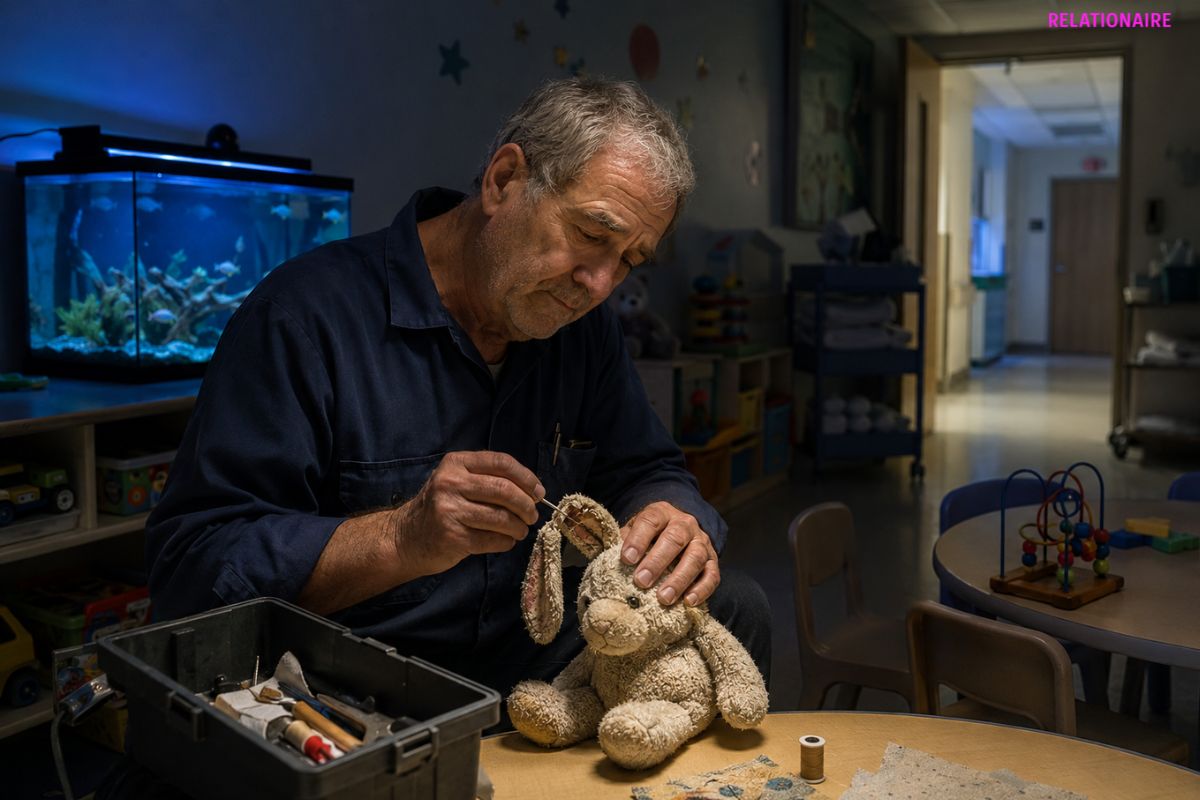
And in Walter’s left hand was a stuffed rabbit with one ear hanging by a thread.
It looked bad.
There is no gentle way to say that.
It looked like a grown man had sneaked into a children’s playroom after midnight and was taking things apart.
“Sir,” one guard said, not unkindly, but firmly, “you need to step away from the items.”
Walter did not move.
His fingers tightened around the rabbit.
“It’s not what you think,” he said.
That sentence almost never helps.
The second guard shined his flashlight over the toolbox.
Tiny screws.
Fabric patches.
A spool of white thread.
A small bottle of glue.
Batteries.
Needle-nose pliers.
A child’s plastic dinosaur with its jaw missing.
“Why are you in here after hours?” the guard asked.
Walter looked toward the hallway, where the patient rooms were dark.
“Because they’re asleep,” he said.
The guard glanced at me.
I wish I could say I understood immediately.
I didn’t.
I saw an older man alone in a locked playroom. I saw broken toys, tools, and a stuffed animal clutched too close. I saw hospital property. Donated property. Children’s property.
I saw something suspicious.
That is the uncomfortable truth.
“Walter,” I said carefully, “do you have permission to be in here?”
He looked at me then.
His eyes were tired, but not frightened. That made it worse somehow. He looked like a man who had already been judged many times and no longer had the energy to argue with it.
“No, doctor,” he said.
The guard sighed.
“Then we need to write this up.”
At the word “write,” Walter’s face changed.
Not anger.
Not panic.
Something smaller.
Shame, maybe.
He set the rabbit down slowly on the table, as if it could feel embarrassment too.
From behind us, Nurse Gloria arrived in her cardigan with the frayed cuffs.
“What’s going on?”
“Maintenance worker entered the playroom after hours,” the first guard said. “Found with tools and toys.”
Gloria looked at Walter.
Then at the toolbox.
Then at the little rabbit.
Her mouth opened, but Walter gave the smallest shake of his head.
A warning.
Or a plea.
She closed her mouth.
That was the first moment I wondered whether we were missing something.
The playroom was one of the few places on the floor that didn’t feel like a hospital. There were murals of clouds on the walls, a shelf of picture books, a tiny table with mismatched chairs, and a blue rug with roads printed on it. Children drove toy cars across that rug while IV poles rolled beside them like strange metal trees.
Every morning, the playroom looked cheerful.
Every night, after the children went back to their rooms, it looked abandoned.
I had never thought about what happened to the broken things.
The trucks missing wheels.
The puzzles missing knobs.
The stuffed animals with seams split open from too much hugging.
The battery toys that went silent.
I had assumed someone threw them away.
I had assumed many things.
“Open the toolbox,” the second guard said.
Walter’s jaw tightened.
“It’s already open.”
“All the way.”
He hesitated.
The guard took one step forward.
Walter stepped back, but his hand moved toward the rabbit again.
That small movement made the guard’s voice sharpen.
“Sir. Don’t touch anything.”
Walter froze.
And suddenly the whole room felt wrong.
Not dangerous.
Just cruel in that accidental way institutions can become cruel when nobody stops to ask one more question.
I looked at the rabbit.
One ear hanging loose. One black button eye scratched. Fur worn thin at the belly. It didn’t look new enough to be hospital property. It looked loved.
Too loved.
“Walter,” I said more softly, “whose rabbit is that?”
He didn’t answer.
Nurse Gloria looked down.
The guard repeated, “Whose is it?”
Walter swallowed.
The sound was small, but I heard it.
Then from the hallway came a child’s sleepy voice.
“Mr. Walter?”
Everyone turned.
A little girl stood outside room 409 in pink socks, holding onto her IV pole with one hand. Her father was behind her, half awake, visitor badge stuck crooked on his sweatshirt.
Her name was Mia. Six years old. Round cheeks. Brave in the daytime. Scared at night.
She stared past the guards into the playroom.
At the rabbit.
“My bunny,” she whispered.
Walter closed his eyes.
Mia’s father stepped forward, suddenly alert.
“What is he doing with her bunny?”
The security guard turned toward him.
“We’re sorting that out, sir.”
But Mia was already crying.
Not loudly.
Just with that stunned, silent heartbreak children have when something they trust is in the wrong hands.
Walter looked like the sound went straight through him.
“I was fixing her ear,” he said.
Mia’s father’s face hardened.
“At one in the morning?”
Walter nodded once.
“So she wouldn’t wake up and find it broken.”
The room went quiet.
Even the fish tank seemed to stop bubbling.
Mia’s father looked from Walter to the toolbox and back again. His anger wavered, but it didn’t disappear.
“Why didn’t you ask us?”
Walter opened his mouth.
Nothing came out.
Then Nurse Gloria stepped between them, gentle but firm.
“Dr. Patel,” she said to me, “you should see his locker.”
Walter turned sharply.
“No.”
Gloria looked at him with the kind of sadness that comes from knowing someone’s secret too long.
“It’s time, Walt.”
“No,” he said again, but this time it broke.
The first guard frowned. “What’s in the locker?”
Walter reached for the rabbit with trembling hands, then stopped himself.
He looked at me.
Not at security.
Not at Gloria.
At me, the young doctor who had already judged him.
And he said one sentence that made every person in that playroom go still.
“That rabbit was my daughter’s before it was hers.”
PART 2
Nobody moved after Walter said it.
Not the guards.
Not Mia’s father.
Not Nurse Gloria.
Not even Mia, who stood in the hallway with her pink socks planted on the polished floor, looking too small for the silence around her.
“That rabbit was my daughter’s before it was hers.”
The words did not explain everything.
They made everything heavier.
Walter stared at the rabbit on the table like he wished he could take the sentence back and place it gently somewhere no one would step on it.
Mia’s father pulled his daughter closer.
“What does that mean?” he asked.
His voice was quieter now, but still guarded.
Walter looked at the floor.
“It means I’m sorry,” he said.
That was all.
Security still needed answers. Hospital policy did not bend just because a man’s voice sounded broken. The guards asked Walter to come with them. Gloria argued in a low voice. I stood there, useless in my white coat, feeling younger than I had five minutes earlier.
Mia kept staring at the rabbit.
“Is Bunny in trouble?” she asked.
Her father kissed the top of her head.
“No, sweetheart.”
But she looked at Walter.
“Is Mr. Walter in trouble?”
Walter tried to smile.
It was painful to watch.
“No, honey,” he said. “You go back to sleep.”
Children know when adults are lying kindly.
Mia did not move.
So I did something that felt small, but it was the first right thing I had done that night.
“I’ll walk with Walter,” I told security. “And I’ll document what we find.”
The first guard nodded.
Walter didn’t thank me.
He just picked up his toolbox with both hands, slowly, like he was carrying something fragile inside it.
His locker was in the basement maintenance corridor, two floors below pediatrics.
I had never been down there.
Residents lived in the bright panic of patient floors, the places with monitors and families and urgent voices. We rarely thought about the hidden rooms beneath us where the hospital kept its extra beds, old signs, mop buckets, paint cans, holiday decorations, and the people who made everything keep working.
The basement smelled like dust, coffee, and warm pipes.
Walter’s locker was the third one from the end.
Gray metal.
Dented near the bottom.
A small sticker of a cartoon moon was stuck near the handle, faded almost transparent.
He stood in front of it for a long moment.
Gloria had come with us. She leaned against the wall, arms folded, eyes wet but steady.
“Walt,” she said softly.
He took a key from a ring clipped to his belt.
His hands shook so badly it took him three tries.
Inside the locker was not stolen hospital property.
It was a tiny repair shop.
There were jars filled with buttons, wheels, doll shoes, puzzle knobs, toy screws, tiny batteries, ribbon, thread, felt, and plastic parts sorted by color. A roll of clear tape. A chipped mug full of paintbrushes. A stack of thank-you drawings from children, taped carefully to the inside of the door.
There was a photo, too.
An old one.
A little girl with dark curls sat in a hospital bed, smiling with one front tooth missing. She held the same stuffed rabbit against her chest.
On the back of the photo, in faded blue ink, someone had written:
LUCY, AGE 7.
Walter reached up and touched the edge of the picture with one finger.
Not the girl’s face.
Just the corner.
As if even after all these years, he was afraid of smudging her.
“My daughter stayed on four east,” he said.
His voice was plain. Almost too plain.
“That was before the new playroom. Before the fish tank. The walls were beige then. There was one shelf of toys, and half of them didn’t work.”
Gloria looked away.
I realized she knew this story.
Maybe not all of it.
But enough.
Walter continued.
“Lucy had that rabbit from the time she was two. Took it everywhere. Grocery store. Bath time. Dentist. Hospital.”
He gave a soft breath that was almost a laugh.
“She called him Captain Bun because she thought every brave thing needed a title.”
The guard lowered his flashlight.
Walter kept looking at the photo.
“One night, his ear tore. She cried like the whole world had come apart. I told her I’d fix him by morning.”
He stopped.
His thumb rubbed the key in his hand.
“I couldn’t find a needle. Couldn’t find thread. Nurses were busy. I didn’t want to bother anyone. So I told her we’d do it the next day.”
No one spoke.
“That night got hard for her,” he said, carefully. “Not loud. Not dramatic. Just hard.”
His face did not twist. He did not make a scene. He did not ask us to imagine it.
That restraint made it worse.
“She kept asking for Captain Bun’s ear. Said he needed to be brave too. And I kept saying tomorrow.”
His eyes finally lifted to mine.
“There wasn’t a tomorrow for her.”
The basement pipes clicked somewhere above us.
A long, ordinary sound.
The kind of sound that keeps happening no matter whose life has split open.
Walter looked back into the locker.
“My wife left the hospital with a bag of clothes and that rabbit. We didn’t speak much after. Grief does that sometimes. Makes two people lonely in the same room.”
He swallowed.
“She died twelve years later. Heart gave out. Mine just kept being stubborn.”
Gloria wiped her cheek quickly.
Walter reached into the locker and took down a small sewing tin. It was blue with painted flowers on top.
“After Lucy, I couldn’t go near children’s rooms for years. Then one night, a toy fire truck broke in the old playroom. Little boy cried because it was the only thing that made him stop thinking about his IV.”
His mouth tightened.
“I fixed it.”
He shrugged, but it was not casual.
“It took eight minutes.”
Eight minutes.
Such a small amount of time to carry for twenty years.
“After that,” he said, “I started checking the playroom after midnight. Not every night. Just when I could. Wheels. batteries. seams. cracked handles. Anything I could make whole before morning.”
The security guard looked embarrassed now.
“So why hide it?”
Walter closed the locker door halfway, not fully.
“Because rules are rules,” he said. “And I didn’t want anyone making a thing of it.”
Gloria let out a small, sad laugh.
“You mean you didn’t want anyone pitying you.”
Walter did not deny it.
Back upstairs, Mia had refused to sleep until she saw the rabbit.
Her father stood outside the playroom with his arms crossed, his face pulled tight with guilt and confusion.
Walter placed the rabbit on the little table and sat down slowly. His knees cracked. Under the bright overhead light, he looked older than he had in the hallway.
He threaded the needle.
Mia watched from the doorway.
“Can you fix Bunny?” she asked.
Walter nodded.
“I can fix the ear.”
“Can you make him not scared?”
Walter’s hand paused.
Her father closed his eyes.
Walter looked at the rabbit, then at Mia.
“No,” he said gently. “But I can make sure he’s not scared by himself.”
Mia seemed to accept this.
Walter stitched the ear back with careful, tiny movements. The guards stood back. Gloria stood beside me. Mia’s father kept looking at Walter like he wanted to say something and didn’t know where to begin.
When it was done, Walter tied the thread and clipped it.
He held the rabbit out.
Mia walked forward, took it, and pressed it to her face.
Then she did something no one expected.
She stepped closer and wrapped one arm around Walter’s neck.
He froze.
His hands hovered in the air, uncertain, like he had forgotten what a child’s hug felt like.
Then his face folded inward.
Not loudly.
Not dramatically.
Just enough.
Mia whispered, “Thank you for fixing him.”
Walter nodded once.
“You’re welcome, sweetheart.”
Her father finally spoke.
“Mr. Bell,” he said, voice rough. “I’m sorry.”
Walter stood slowly.
“No need.”
“There is,” Mia’s father said. “I thought…”
He did not finish.
We all knew what he thought.
Walter gave him the kind of mercy people rarely give themselves.
“You were protecting your daughter,” he said. “That’s what fathers do.”
The words landed between them.
And for a moment, Mia’s father and Walter were not a worried parent and a maintenance worker.
They were just two men standing on opposite sides of love.
The next morning, I expected the story to end quietly.
It did not.
By 9 a.m., hospital administration had heard about the after-hours playroom visits.
By 10 a.m., Walter had been called into a meeting.
By noon, the pediatric floor knew.
And by 2 p.m., Nurse Gloria found me outside room 412 and said, “They’re suspending him pending review.”
I stared at her.
“For fixing toys?”
“For entering restricted areas without authorization,” she said.
Her voice was flat, but her eyes were not.
Down the hall, children were waking from naps. A toy truck rolled across the blue rug in the playroom, smooth on all four wheels.
And in the basement, Walter’s locker stood closed.
For the first time in years, no one would check the broken shelf after midnight.
PART 3
The pediatric floor felt different without Walter.
Not at first in any dramatic way.
The lights still turned on. The call buttons still worked. The fish tank still glowed blue at night.
But small things began to stay broken.
A toy piano lost three keys and went silent.
The red truck’s wheel came loose again.
A dollhouse door hung crooked.
A stuffed bear sat on the top shelf with one eye missing, turned gently toward the wall by some parent who did not want a child to notice.
Nobody complained.
That was the saddest part.
Children in hospitals learn early not to ask for too much.
Parents learn even faster.
They accept the cold coffee, the thin blankets, the squeaky chairs, the little disappointments that seem too small to mention beside bigger worries.
But I started seeing those small disappointments everywhere.
A boy shook a plastic flashlight that no longer lit up, then placed it back without a word.
A little girl tried to push a stroller with a broken wheel and said, “It’s okay,” before anyone apologized.
Mia carried Bunny everywhere.
His repaired ear stuck out slightly crooked, with a neat white seam visible if you looked closely. She told everyone Mr. Walter had given Bunny “hospital stitches.”
Her father corrected her gently once.
“Toy stitches, sweetheart.”
Mia shook her head.
“No. Hospital stitches. They made him brave.”
On Walter’s third day away, I went to administration.
I was not brave about it.
My voice shook. My hands sweated around the folder I had put together after my shift.
Inside were photos of repaired toys, notes from nurses, and copies of child life inventory logs showing how many broken toys had quietly returned to usable condition over the years.
Gloria had added a stack of drawings from Walter’s locker.
One showed a smiling man in a blue shirt fixing a dinosaur.
One said, “Thank you Mr. Watr.”
One had only a heart and a rabbit.
The administrator, Ms. Kline, listened.
She was not cruel. That mattered.
She was a woman with a tired face, a tidy bun, and the impossible job of keeping a hospital safe, funded, legal, and humane all at once.
“I understand the emotion here,” she said.
I hated that sentence before she finished it.
“But we can’t have employees entering patient areas off-task without documentation. Especially pediatrics.”
“He wasn’t stealing.”
“No,” she said. “But security protocols exist for reasons.”
Gloria leaned forward.
“Then make a protocol for kindness.”
Ms. Kline blinked.
Gloria did not blink back.
“Put him on a list. Give him a badge code. Let child life approve the repairs. Call it a program. Call it whatever makes the paperwork happy.”
Ms. Kline looked down at the drawings.
Her thumb paused on one of them.
A child had drawn Walter standing beside a bed, holding a yellow star.
Above him, in uneven letters, it said:
HE FIXES SAD THINGS.
Ms. Kline’s face changed.
Just slightly.
Sometimes that is how grace enters a room.
Not like thunder.
Like a locked door beginning to give.
“We would need consent,” she said.
Gloria sat back.
I almost laughed.
Because in hospital language, that was not a no.
The next two days became something I had never seen before.
Nurses collected stories between medication rounds.
Parents wrote notes on cafeteria napkins and discharge folders.
Child life brought records of donated toys Walter had saved from the trash.
The front desk found an old photo from a holiday party where Walter stood in the back, half hidden behind a fake Christmas tree, while children crowded around a repaired train set.
Even security wrote a statement.
The guard who had stopped him that night added one sentence at the bottom:
“I misread the situation.”
That sentence may not sound like much.
But in a place where everyone is tired, afraid of blame, and trained to protect themselves first, it felt like someone opening a window.
Walter did not come to the hearing.
He was allowed to.
He chose not to.
Gloria said he was embarrassed.
I thought of his locker. The faded moon sticker. The photo of Lucy. The sewing tin.
Some grief does not like fluorescent lights.
So we went without him.
Mia’s father came too.
He wore the same worn hoodie from that night, visitor badge clipped to the pocket. Mia was being discharged the next morning, and she insisted on sending Bunny with him “as proof.”
When Ms. Kline asked if anyone else wanted to speak, Mia’s father stood.
He held the stuffed rabbit in both hands.
“I judged him,” he said.
The room went quiet.
“I saw a man with my daughter’s toy after midnight, and I thought the worst. Maybe any father would. But I was wrong.”
He looked down at Bunny’s ear.
“My daughter has been scared every night since we got here. I couldn’t fix that. Her doctors couldn’t fix that. Her nurses helped. Everyone helped. But when she woke up and saw this ear repaired, she smiled for the first time before breakfast.”
His voice caught, but he kept going.
“I don’t know hospital policy. I know my daughter slept better because one man stayed after his shift and cared about something everyone else thought was too small.”
Then he placed the rabbit on the table.
“He wasn’t stealing from children,” he said. “He was giving something back.”
Nobody spoke for a long moment.
At the end of the meeting, Ms. Kline approved a trial program.
Officially, it was called the Pediatric Toy Safety and Repair Initiative.
Nobody called it that.
The nurses called it Walter’s Workshop.
It would happen twice a week, after child life checked the toys and parents gave permission. Walter would be paid for the hours. He would not have to sneak. He would not have to hide. A small room beside the playroom, once used for extra chairs and dusty holiday bins, would be cleaned out and fitted with shelves.
Walter returned the following Monday.
He came in quietly, as if he hoped no one would notice.
Everyone noticed.
Gloria had put a paper sign on the door of the storage room.
WALTER’S WORKSHOP
Underneath it, Mia had taped a drawing before discharge.
It showed a rabbit, a man in a blue shirt, and a girl with wings standing beside them.
None of us knew how Mia knew about Lucy.
Maybe Gloria told her.
Maybe children understand more than adults think.
Walter stood in front of the sign for a long time.
His toolbox hung at his side.
His name patch looked newly washed.
He reached up and touched the drawing.
Again, not the face.
Just the corner.
That night, I found him in the workshop repairing the toy piano.
The room smelled like wood polish, coffee, and clean cardboard. On one shelf sat labeled jars of buttons and wheels. On another, a row of stuffed animals waited patiently, as if they knew their turn would come.
Walter sat beneath a warm desk lamp.
For once, he did not look like a man caught doing something wrong.
He looked like a father at a kitchen table after bedtime, fixing what the day had broken.
I leaned in the doorway.
“Do you ever get tired of it?” I asked.
He looked up.
“Fixing toys?”
I nodded.
He considered this.
Then he picked up a tiny plastic piano key and eased it back into place.
“I got tired of having nowhere to put the love,” he said.
The words were quiet.
Plain.
They stayed with me longer than anything I learned in residency.
Years later, I still think about Walter when I see people doing small things nobody applauds.
The aide who brushes a patient’s hair before family arrives.
The cafeteria worker who remembers which child hates peas.
The cleaner who mops around a sleeping parent’s shoes without waking them.
The nurse who tucks a blanket over someone and never mentions it.
The world keeps asking for big miracles.
But most days, the mercy we get is smaller.
A repaired rabbit.
A wheel that turns again.
A light left on.
A broken thing placed gently back into a child’s hands.
And sometimes, love does not disappear when the person is gone.
Sometimes it stays behind, looking for somewhere useful to go.