If you’ve already read part 1 of this story on Facebook, go here for Part 2!
On the Monday before school pictures, Mrs. Alvarez stood at the front of her third-grade classroom holding a stack of white envelopes.
They were thin, cheap things. Glossy on one side. Order form on the other. The kind parents crumpled into kitchen junk drawers or signed while stirring spaghetti.
“Picture day is Thursday,” she said, walking row by row between the desks. “If you want to order photos, bring your envelope back with the money inside.”
Most of the kids barely looked up.
A few groaned because they hated combs and scratchy collars.
A few got excited because their mothers had already laid out sweaters on beds.
One boy took the envelope like it might tear if he held it too hard.
Eli Mercer.
Eight years old. Small for his age. Brown hair that never stayed flat. Serious eyes that made him look like he was always listening for bad news.
He slid the envelope into the front pocket of his backpack and zipped it shut all the way.
Mrs. Alvarez noticed because Eli never zipped anything all the way. Not his coat. Not his pencil pouch. Not his lunchbox, with the broken red tab she kept meaning to tape.
By Tuesday morning, three kids had already lost their envelopes.
By Wednesday, half the class was reminding each other to smile with teeth.
On Thursday, the photographer arrived with his lights and blue-gray backdrop and the smell of hot cords and printer paper trailing behind him.
The whole school changed shape on picture day.
Girls came in with ribbons and freshly brushed curls.
Boys showed up in button-down shirts they tugged at like they belonged to older brothers.
Teachers carried coffee and clipboards and tried to keep everyone from wiping syrup on their sleeves before their turn.
Mrs. Alvarez stood by the classroom door that morning and greeted each child as they came in.
Then Eli walked through.
He wore a pale blue collared shirt under a too-big navy sweater. The sweater cuffs swallowed half his hands. One of the buttons on the shirt had been sewn back on with thick white thread that didn’t match.
But his hair was damp, neatly combed, and for once, his sneakers looked clean.
He stopped in the doorway and glanced at her face before stepping inside.
That was when she knew.
He hadn’t brought the envelope.
Again.
She checked the basket on her desk anyway. No white envelope with Eli Mercer written across the front in careful block letters.
He moved to his desk, took out a pencil, and sat straighter than usual.
When the class lined up for pictures just before lunch, Mrs. Alvarez gathered the envelopes one last time.
“Last call,” she said. “If you have your money, bring it now.”
Kids ran forward waving them.
Bills folded in half. Checks clipped inside. One envelope sticky with jelly.
Eli stayed in line.
He stared at the floor tiles.
Mrs. Alvarez walked over quietly.
“Eli,” she said, keeping her voice soft, “did your envelope get left at home?”
He shrugged without looking up.
“It’s okay if it did. Sometimes grown-ups forget. I can send another one.”
“I forgot,” he muttered.
She waited.
He lifted one shoulder again. “It doesn’t matter.”
There was no anger in it. No whining. Just something flat and practiced.
Mrs. Alvarez had heard that tone before from children trying to get ahead of disappointment.
Still, she nodded.
“All right.”
He gave a quick, grateful look, the kind children gave when adults let a subject die.
That should have been the end of it.
Kids without money got their picture taken sometimes, but the printed packets didn’t go home unless someone paid later. Every school handled it a little differently. Usually, there were awkward calls. Sometimes, quiet exceptions.
Mrs. Alvarez had learned not to make a public thing out of private lack.
So she let him stay in line.
In the hallway, the children buzzed with nervous energy.
“Do I look weird?”
“Don’t smile too big.”
“My mom said not to blink.”
Eli said nothing.
But when they reached the library where the backdrop was set up, Mrs. Alvarez saw him do something that made her chest tighten.
He lifted both hands to his collar.
And very carefully, almost tenderly, he smoothed it flat.
Not once.
Three times.
Then he tugged the sweater down at the shoulders and licked his thumb to wipe a tiny stain off the cuff.
It was the smallest thing in the world.
A child fussing with his shirt.
But it was so precise. So hopeful. So completely at odds with I don’t care that Mrs. Alvarez felt a little ashamed for believing him.
She watched him from across the room while the volunteer list was checked in the front office doorway.
That morning’s office helper was a woman she had seen only twice before. Maybe late fifties. Short silver hair. Plain tan coat. Canvas tote bag with a public library logo faded across the side.
She sat behind the folding table near the library doors, helping pass classes through in order.
Mrs. Alvarez didn’t know her name.
The woman was the sort of person people forgot five seconds after looking away. Calm face. Soft shoes. No perfume. Nothing bright.
But now and then her eyes lifted from the paperwork and landed on the children with a kind of quiet attention that felt almost maternal.
When Eli’s turn came, the photographer adjusted the stool.
“Chin up, buddy.”
Eli climbed on without a word.
The camera flash popped.
Mrs. Alvarez thought the moment had passed.
Then the photographer frowned at his list and looked toward the office table.
“Order envelope?”
Mrs. Alvarez stepped forward. “He doesn’t have one today.”
The photographer gave the brisk nod of someone moving an assembly line.
“Basic pose only, then.”
Eli had already climbed down.
He heard it.
Of course he heard it.
His whole face changed for half a second. Not enough for another child to catch. But enough for an adult watching.
Hope folding itself up.
Mrs. Alvarez bent toward him. “You still did great.”
He nodded.
Too fast.
Then he went to stand by the wall with the others, hands tucked into sweater sleeves.
At lunch, he barely touched his food.
At recess, he stayed near the fence, rubbing the broken zipper tab on his backpack between two fingers.
That afternoon, while the class worked on spelling sentences, Mrs. Alvarez found herself glancing at him over and over.
She thought about calling home.
She thought about slipping the money in herself.
She thought about all the lines teachers walked every day between kindness and intrusion, help and humiliation.
When the dismissal bell rang, Eli packed slowly.
The rest of the room erupted in scraping chairs and shouted goodbyes.
He waited until almost everyone else had gone before slinging his backpack on.
Mrs. Alvarez crouched beside his desk.
“Eli,” she said gently, “you know it’s okay to tell me if something’s wrong.”
He kept his eyes on the floor.
“Nothing’s wrong.”
Then, after a pause that seemed to hurt him, he added, “I just needed it to happen.”
Mrs. Alvarez blinked. “What do you mean?”
He swallowed. His throat moved.
But before he could answer, the front office volunteer appeared in the doorway, holding a sealed picture envelope.
“Mrs. Alvarez?” the woman said. “I think this belongs with your class paperwork.”
Mrs. Alvarez stood and took it automatically.
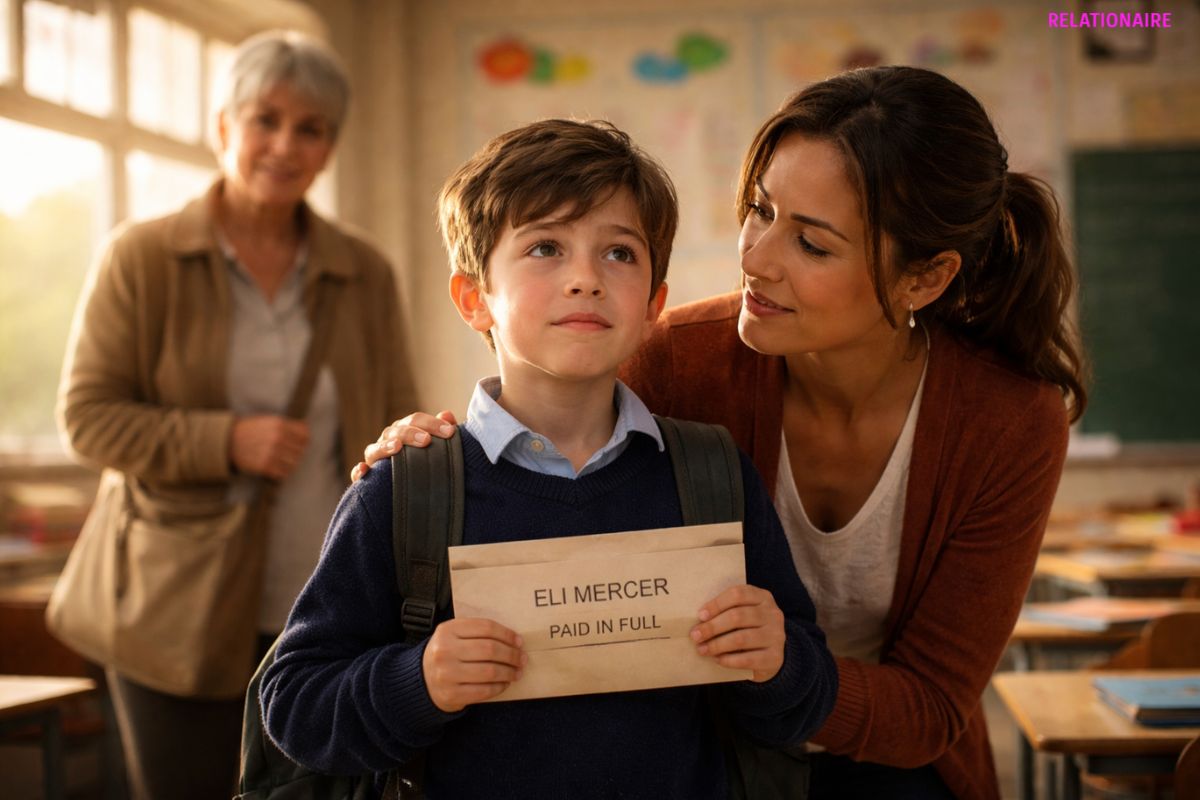
On the front, in neat blue ink, someone had written:
ELI MERCER — PAID IN FULL
She looked up.
The volunteer gave a small shrug, like it was nothing at all.
But Eli had gone perfectly still.
His face drained.
His fingers tightened around the strap of his backpack.
And then, in a voice so thin Mrs. Alvarez almost didn’t hear it, he whispered:
“No.”
The room seemed to tilt.
Mrs. Alvarez looked from the envelope to Eli.
“It’s okay,” she said. “Someone just wanted to help.”
But Eli took one step back like the paper might burn him.
His eyes filled so fast it was startling.
“No,” he said again, shaking his head now. “No, she wasn’t supposed to.”
Mrs. Alvarez’s hand closed around the envelope.
The volunteer in the doorway stopped smiling.
And Eli looked at them both with the terrified face of a child who had just realized a secret prayer had been answered by the wrong person.
Part 2
Mrs. Alvarez had spent eight years teaching third grade, and she knew the difference between ordinary tears and panic.
This was panic.
Not loud. Not dramatic.
Worse.
Eli stood there with his backpack hanging off one shoulder, breathing like the room had gotten too small. He didn’t look embarrassed. He looked caught.
The office volunteer took a cautious step back into the hallway.
“I’m sorry,” she said softly. “I didn’t mean to upset him.”
Mrs. Alvarez set the envelope down on her desk and knelt again so she was level with Eli.
“No one’s upset with you,” she said. “Can you tell me what’s wrong?”
He rubbed his sleeve hard across one eye.
“You weren’t supposed to pay it.”
The words came out broken.
“Why not?”
His chin trembled. He pressed his lips together.
Mrs. Alvarez waited.
Children told the truth in the silence after kindness, not usually during questions.
Finally he whispered, “Because my dad was.”
For a second, all she heard was the whine of the hallway lights.
“Your dad?” she repeated.
Eli nodded once.
And suddenly she remembered the registration forms from August. Emergency contact: mother only. No father listed. When she had asked casually at conference night if anyone else needed school updates, his mother had smiled too quickly and said, “It’s just me.”
Mrs. Alvarez had not pushed.
Teachers learned there were a hundred reasons for an absent parent. Most of them not theirs to ask about.
But now Eli’s face was crumpling.
“He said,” Eli whispered, “he said if I got my picture taken this year, he’d come get one. My grandma told him the date.”
Mrs. Alvarez felt the floor drop out beneath her.
The volunteer in the doorway made the smallest sound, like air leaving her lungs.
Eli kept going, not because he wanted to, but because children sometimes start telling the truth and can’t stop once the seam splits.
“He doesn’t know where we live now,” Eli said. “Mama said he can’t know. But Grandma sees him sometimes and she said maybe if I did school pictures, she could give him one. Just one. So he could see I’m bigger.”
His voice cracked on the last word.
Bigger.
Not better. Not okay. Not happy.
Just bigger.
Mrs. Alvarez put a hand over her mouth.
It took effort to keep her own voice steady. “Eli… where is your dad?”
The answer was almost soundless.
“In prison.”
The library volunteer closed her eyes.
Mrs. Alvarez had imagined a dozen things.
Money trouble.
A missed deadline.
A child too proud to admit he wanted what other kids got without thinking.
She had not imagined this eight-year-old boy spending weeks pretending not to care because caring would have revealed hope. Because hope, in some homes, was dangerous.
“He writes me letters,” Eli said, staring at the carpet. “Not a lot. Grandma sneaks them. Mama throws them away if she finds them.”
That told Mrs. Alvarez enough to understand the shape of the wound without touching its edges.
A father who had done something serious enough to disappear behind locked doors.
A mother trying to build safety out of silence.
A child living between those two facts, loving with one hand what the other had been taught to fear.
“He said he missed second grade picture day because they moved him,” Eli went on. “He wrote it in the letter. He said not to miss third grade because he wanted to see my face.”
Mrs. Alvarez looked at the envelope on her desk.
Paid in full.
A kindness. Yes.
But not a simple one.
Because Eli had not been praying for pictures.
He had been praying for proof.
Proof that somewhere beyond whatever his father had broken, beyond whatever his mother could not forgive, he was still being waited for.
“Eli,” Mrs. Alvarez said carefully, “the picture still happened.”
He shook his head violently.
“You don’t understand.”
And then he said the thing that made it all make sense.
“If somebody else paid, then it means it’s charity.”
The word landed hard in the room.
The volunteer’s hand rose to her chest.
Eli looked sick with shame.
“He said he was sending the money,” he whispered. “Grandma promised. She said it was coming in time. I kept waiting. I kept checking the mailbox with her when Mama was at work. But it never came.”
He dragged in a breath.
“If he didn’t send it… then maybe he forgot.”
There it was.
The real terror.
Not that the stranger had paid.
That the payment might prove his father hadn’t.
Mrs. Alvarez understood now why Eli had said he needed it to happen. Not because he wanted glossy portraits. Because he needed to know whether the man writing letters on prison paper still meant what he said.
And a stranger’s kindness had just blurred the only answer he thought he might get.
The volunteer in the doorway stepped forward at last.
Her voice was gentle and unadorned.
“Eli,” she said, “I can fix this.”
He looked up, confused and blotchy-faced.
She came inside fully then, setting her tote bag on the nearest chair. Up close, Mrs. Alvarez could see her hands were rough and pink around the knuckles, like someone who washed them often.
“I shouldn’t have assumed,” the woman said. “I saw your teacher’s face when the photographer said basic pose only, and I thought I was helping. But I can tell this wasn’t just about the money.”
Eli said nothing.
The woman looked at Mrs. Alvarez before continuing, asking permission without words.
Mrs. Alvarez gave a tiny nod.
“What’s your dad’s name?” the woman asked.
Eli hesitated.
Then he said it.
“Daniel Mercer.”
The woman went still.
Not the startled stillness of recognition exactly.
Something stranger.
Like she had stepped on a stair she thought wasn’t there.
Mrs. Alvarez noticed it at once.
“So you do know him,” she said before she could stop herself.
The woman’s face changed.
Not into guilt.
Into grief.
A very old grief.
She took a breath that shook only at the end. “No,” she said. “Not him. But I knew the place.”
Neither of them understood.
Eli wiped his eyes with both fists.
The woman pulled out the chair near the desk but did not sit yet.
“My name is June,” she said. “I volunteer in the office on Thursdays because I’m retired and because if I stay home too much, I talk to the walls.” A faint, broken smile touched her mouth and disappeared. “My son was at Green Hollow Correctional for four years.”
Mrs. Alvarez felt her own spine straighten.
June went on quietly.
“He got out three years ago. He died nine months later.”
No one moved.
The classroom still smelled like crayons and pencil shavings and the peanut butter crackers someone had dropped under the radiator at lunch.
June looked at Eli with the kind of care people only have when pain has made them fluent.
“When I saw you standing there in that shirt,” she said, “I thought of my grandson. My son missed one school picture while he was inside, and he kept that boy’s old kindergarten photo folded in his wallet until the corners turned white.”
Eli stared at her.
So did Mrs. Alvarez.
June glanced at the envelope on the desk.
“I can call the photographer,” she said. “I can tell them not to process the payment yet. Or I can leave it and you can wait and see if money comes from your grandmother. But either way, sweetheart, that picture is yours. Not because you need charity. Because a child should not lose his face over adult mistakes.”
Eli’s mouth opened, then closed.
Mrs. Alvarez thought the hardest part was over.
She was wrong.
Because June reached into her tote bag and pulled out an old, much-folded photograph.
A school picture.
First grade, maybe.
A little boy in a striped polo, smiling with one front tooth missing.
She laid it gently on the desk.
“My grandson,” she said.
Then she looked at Eli, and her eyes shone wet and clear.
“And there’s one more thing you need to know before you decide what to do with that envelope.”
She lowered herself slowly into the chair.
“When your grandmother called Green Hollow last week asking how to send money for school pictures…”
June’s fingers pressed flat against the desk.
“I was the one who answered.”
Part 3
For a moment, nobody in the room breathed.
Eli stared at June like she had opened a door in the wall.
Mrs. Alvarez sank into the chair behind her desk because her knees felt unreliable.
June folded her hands together, as if holding them still took effort.
“I work part-time there,” she said. “Not in the units. In administration. Phones, records, family calls. Nothing dramatic. Just paperwork and voices.” She looked at Eli. “Your grandmother called because she didn’t understand the money order rules. She was worried it wouldn’t reach your father in time.”
Eli’s lips parted.
June’s voice stayed soft. Careful. Like she knew one careless sentence could break what was left of the moment.
“I remember her because she sounded so tired. And because she kept saying, ‘He made a promise to that boy. I just need to help him keep it.’”
Mrs. Alvarez closed her eyes briefly.
A grandmother stretching herself across the distance between a prison and a child, trying to keep one small bridge from collapsing.
“I checked the account after we hung up,” June said. “Your father had already submitted a request to send what little was in it. But there was a delay. A lockdown. Staffing shortage. Paperwork piled up. By the time I realized the money wouldn’t make it before picture day…” She glanced at the envelope. “I thought maybe I could fix it without making it worse.”
Eli’s face twisted.
“So he did send it?”
June nodded.
“Yes.”
He made a sound that was almost a sob and almost a laugh. The kind that comes out of children when relief hurts as much as fear.
Mrs. Alvarez pressed her fist to her mouth.
All day she had carried the image of Eli smoothing his collar, careful and hopeful. Now that image shifted. It wasn’t vanity. It wasn’t even just longing.
It was preparation.
For being seen.
For being kept.
Eli took one shaky step toward the desk.
“Did he say anything?” he asked.
June swallowed.
“He asked if the money could go faster because, and I’m quoting him here, ‘My boy’s growing while I’m sitting still.’”
That did it.
Eli crumpled.
Not to the floor, not dramatically. He just folded inward the way children do when they’ve used all their strength pretending they’re fine.
Mrs. Alvarez was beside him in two seconds, her arms around his narrow shoulders. He cried into the too-big navy sweater, quiet at first, then with the raw broken sound of someone much older.
“I thought he forgot,” he gasped.
“I know,” she whispered.
“I thought maybe he didn’t want it anymore.”
“I know.”
June looked down at the desk until she trusted herself to speak.
“He wanted it,” she said. “Very much.”
After a while, Eli sat in the chair June had pulled out. His eyes were swollen. His hair had fallen forward again. He looked more like eight.
Mrs. Alvarez got him water in a paper cup from the teachers’ lounge sink.
June smoothed the old photo of her grandson once, then tucked it back into her tote.
“What happens now?” Eli asked.
Children ask practical questions after emotional earthquakes. It is how they find the edges of the world again.
Mrs. Alvarez thought before answering.
“Now,” she said, “we do this right.”
She looked at June. “Can the photographer hold the order until the money transfer posts?”
June nodded. “I can call before I leave. If it arrives tomorrow, the payment can be attached to Eli’s order. No problem.”
“And if it doesn’t?”
June smiled gently. “Then I’ll cover it until it does, and no one has to tell the difference but us.”
Eli looked uncertain. “Is that still charity?”
June shook her head.
“No, honey. That’s a bridge.”
He sat with that.
It seemed to settle somewhere inside him.
Mrs. Alvarez glanced at the clock. The buses would be gone. The office secretary would be locking up soon. Eli’s mother would be worried.
There were still real life things to navigate. Permission slips. Pickup calls. The difficult possibility of talking to a parent about a father she clearly did not want brought into school.
But for one suspended moment, the room held something steadier than logistics.
A teacher who had almost missed the truth.
A volunteer who had stepped in for the wrong reason and ended up carrying the right one.
A boy learning that being helped did not erase being loved.
Mrs. Alvarez called Eli’s mother and kept it simple. “He had a hard day. He’s okay. We’re just wrapping up.” No mention of prison. No mention of letters. Some truths belonged first to the child carrying them.
That evening, after Eli was picked up, Mrs. Alvarez stayed late.
She straightened desks that didn’t need straightening.
She erased the board.
She thought about all the children who learned, far too young, how to act like they wanted less than they did.
The next day, June was waiting in the office when she arrived.
The money had posted.
Daniel Mercer’s funds, delayed but real.
June had already called the photography company and attached the payment to Eli’s order.
“No special note,” she said. “Just processed normally.”
Mrs. Alvarez exhaled.
A week later, the picture packets came in a cardboard box with classroom labels.
Kids tore into them at their desks, squealing over their own smiles, laughing at closed eyes and crooked cowlicks.
Mrs. Alvarez placed Eli’s envelope quietly on the corner of his desk.
He stared at it for a long second.
Then he touched it with both hands, almost reverently.
He did not open it right away.
Instead, he slipped one hand into his backpack and pulled out a folded sheet of lined paper. It was worn soft at the creases.
He looked at Mrs. Alvarez, asking without asking.
She nodded once.
He slid the school picture into the fold of the letter.
Careful. Exact. Like something sacred.
Later, during recess, he came back to her desk while the room was empty.
“There’s two small ones in there,” he said.
“I know.”
He held one out.
“For the office.”
Mrs. Alvarez blinked. “For the office?”
“For June,” he said. “In case she sees him.”
She understood immediately.
Not Daniel. The father.
A picture small enough to travel through official hands and fluorescent hallways and rules and delays.
A picture that said: Here. He’s bigger.
June cried when Mrs. Alvarez gave it to her in the front office.
Not loudly.
Just one hand over her mouth, the other holding the tiny photo by its edges.
Weeks passed.
Spring tipped closer.
One Friday afternoon, a plain white envelope arrived at school with no return address, only Eli’s name written in block letters that pressed hard into the paper.
Mrs. Alvarez handed it to him at dismissal.
He opened it right there by the cubbies.
Inside was a single sheet of prison stationery.
And tucked inside that, a photograph.
Not of Eli.
Of a man standing in a visitation room, older than thirty should look, one hand flat over his heart, holding Eli’s school picture to his chest.
On the back, in careful print, were seven words:
I missed years. I won’t miss you.
Eli read it three times.
Then he folded it up with a kind of tenderness that made Mrs. Alvarez look away.
Because some moments are too private even when they happen in front of you.
By June, Eli smiled more easily.
He still wore sweaters a little too big. Still spoke softly. Still kept his treasures zipped deep in his backpack.
But he no longer said I don’t care when he did.
And Mrs. Alvarez stopped believing children when they said that in the flat, practiced voice of the disappointed.
Sometimes they meant it.
Often they were just trying to get there first.
Years later, she would remember the whole thing when school pictures came around again.
The white envelopes.
The damp comb marks.
The way an unknown kindness can enter a room wearing the wrong shape at first.
And how sometimes what saves a person is not money, or even the thing money buys.
Sometimes it is the small, trembling proof that they were not forgotten after all.