If you’ve already read part 1 of this story on Facebook, go here for Part 2!
Every Morning the Old Veteran Ordered Two Coffees at 6:15—Until the Day a Stranger Sat Down, Lifted the Untouched Cup, and Changed Everything
“Don’t touch that one.”
The waitress said it softly, but the young man had already wrapped his hand around the second cup.
The diner went still in that small-town way, where nobody speaks but everybody notices.
The screen door had just slapped shut behind him, letting in a ribbon of cold morning air. It carried the smell of wet pavement and diesel from the highway. Inside, the room was warm with bacon grease, coffee, and old habits.
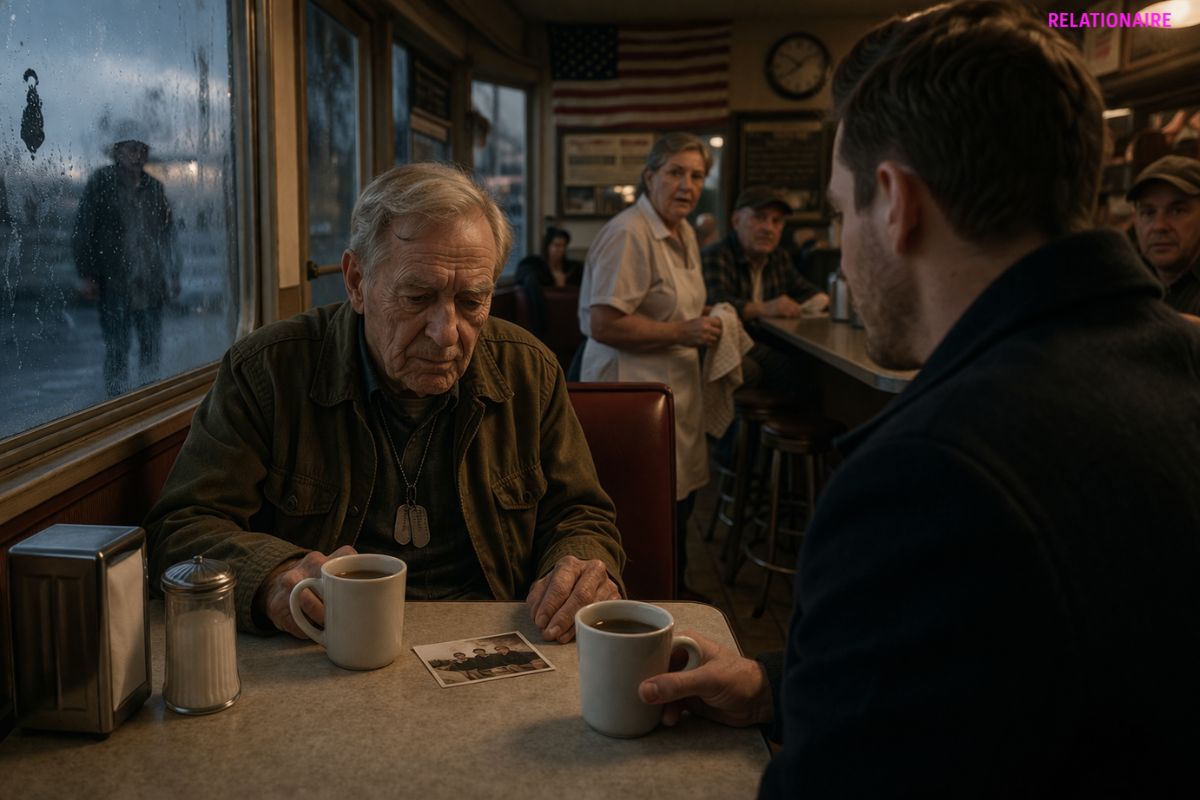
At the corner booth by the window, the old man sat straight-backed in a faded field jacket, one hand flat on the table.
He wasn’t a big man. Age had pared him down. But something in the set of his jaw made people keep their voices low around him.
Every morning at 6:15, he came in alone.
Every morning, he ordered two coffees.
One for himself.
One for nobody, as far as most folks could tell.
The young man looked around, half smiling, like he’d missed the joke.
“It’s coffee,” he said. “Didn’t know it was reserved.”
Nobody laughed.
Mabel, who had worked the Sunrise Diner longer than most marriages lasted, tightened the towel in her hand.
“It is.”
The old man finally looked up.
His eyes were pale and steady. Not angry. Worse than angry.
Tired.
“If you’re thirsty,” he said, “I’ll buy you one of your own.”
The young man leaned back a little. He had the look of somebody passing through. Clean boots. Nice watch. City haircut. Maybe early thirties. He glanced at the untouched cup, then back at the old man.
“There’s nobody here drinking it.”
“That doesn’t mean it’s yours.”
A couple at the counter stopped eating.
Old Walter, who spent every Thursday at the far stool with his newspaper folded under one elbow, lowered his glasses and watched over the top of them.
The young man let go of the cup, but only for a second.
Then he picked it up again.
This time he took a sip.
It wasn’t loud. Just a swallow.
But it landed in the room like a plate hitting the floor.
Mabel sucked in a breath.
Walter muttered, “Lord help him.”
The old man didn’t move right away.
He just stared at the cup in the stranger’s hand.
Then he reached into the inside pocket of his jacket and pulled something out. A photograph. Worn soft at the corners. Folded and unfolded so many times it looked like cloth more than paper.
He set it beside the sugar jar.
It showed two young men in uniform standing in front of a canvas tent, squinting in some hard light far from home. One was broad-shouldered and grinning. The other stood a little stiffer, like smiling didn’t come easy.
The old man tapped the grinning one with one bent finger.
“That cup,” he said, “belongs to Hank.”
The young man looked down at the photo.
“Hank your brother?”
The old man’s hand stayed on the table. Large knuckles. A scar across one finger. The kind of hand that had held tools, rifles, steering wheels, casket edges.
“No.”
“Your friend?”
The old man gave the smallest nod.
“Then I’m sorry,” the young man said, but there was impatience in it. “I didn’t know. But if he’s gone…”
He stopped there.
Because something changed in the old man’s face.
Not rage.
Not grief exactly.
Something flatter.
Something older.
Outside, a truck rattled past the front window. The flag over the gas station across the road snapped once in the wind.
The old man picked up his own cup, took one slow drink, then set it down.
“If you’ve never waited for somebody,” he said, “it’s hard to explain.”
The young man frowned.
“You do this every day?”
“Every day I can.”
“For how long?”
Mabel answered before the old man could.
“Thirty-two years.”
That hit the room harder than the first sip.
The young man looked from her to the old man and back again, like he was deciding whether the whole town had lost its mind.
“You mean to tell me,” he said, “for thirty-two years you’ve been ordering coffee for a dead man?”
Walter folded his paper.
“That’s what he means.”
The young man shook his head and gave a short laugh, but there was no humor in it.
“With all due respect, sir, that’s not honor. That’s being stuck.”
The old man turned his gaze to the window.
The sun hadn’t fully cleared the grain elevator yet. Pale light touched the parked trucks. Frost still clung to the edges of the glass.
He said nothing.
And somehow that silence made the young man push harder.
“My dad served,” he said. “He used to say the worst thing a man can do is live in the past so long he forgets the living.”
At that, the old man’s jaw tightened.
Just once.
Mabel stepped forward. “That’s enough.”
But the young man was already in it now, embarrassed by the room, by the silence, by the sense that he had stumbled into something deeper than he understood and didn’t know how to back out.
“So what?” he said. “Everybody just comes in here and watches this every morning like it’s normal? Nobody tells him to let go?”
The old man stood up.
Slowly.
His booth gave a tired creak under him. He wasn’t tall, but standing made him seem larger somehow. The jacket fell open just enough for the room to catch sight of what hung from his neck under his shirt.
Dog tags.
Old ones.
The metal flashed dull in the light.
He reached for the second cup.
The young man’s fingers were still around it.
For one breath, neither let go.
Then the old man took the cup back, careful as if it held something living, and set it in front of the empty seat again.
“He didn’t get to let go,” he said.
The diner stayed quiet.
The young man glanced at the tags, then at the photograph, then at the empty booth seat across from the old man.
Something in his face shifted. Not understanding. Not yet.
But maybe the beginning of it.
He looked back down at the photo.
“There’s something written on the back,” he said.
The old man’s eyes sharpened.
The picture had shifted when he set it down. A corner had turned just enough to show faded ink bleeding through the paper.
The young man reached for it, then stopped.
“Can I?”
The old man hesitated.
Then he slid the photo across.
The stranger turned it over.
Mabel’s hand rose to her mouth.
Walter stood up so fast his stool scraped.
Because written there, in shaky blue ink worn nearly to nothing, were six words:
If he comes home, buy him mine.
The young man stared at it.
His throat worked once.
Then, without another word, he reached into the inside pocket of his coat.
And pulled out an old folded letter with the same faded blue handwriting on the front.
The old man went white.
Not pale.
White.
His hand trembled against the edge of the table.
The young man looked at the name written on the envelope. Then at the man in front of him.
And when he finally spoke, his voice was no longer sharp.
It was unsteady.
“Are you Jim?”
The old veteran didn’t answer.
He couldn’t.
Because for the first time in thirty-two years, somebody was standing in that diner holding Hank’s handwriting in his hands.
And the second cup was still warm.
What would you do if a stranger touched the one thing you’d been holding onto for decades—only to reveal he may be the reason you held onto it at all?
PART 2
Jim didn’t sit back down.
He just stared at the letter like it might vanish if he blinked.
The diner had gone so quiet you could hear the coffeemaker clicking behind the counter. Somewhere in the kitchen, a spatula hit the grill. Nobody turned toward it.
The young man swallowed.
“My name’s Mike,” he said. “Mike Bennett.”
The name seemed to pass through Jim without landing.
It was the envelope that held him. That old paper. Those blue-ink letters. The way the top corner had been creased twice, same as soldiers used to fold things they meant to keep dry.
Mabel moved first.
“Jim,” she said gently. “Sit down before you fall down.”
He didn’t look at her.
Mike stepped closer to the booth, slower now, like he was coming up on something wounded.
“I found this in my father’s things after he passed,” he said. “Locked in an old tackle box with some Army patches, a lighter, and a photo of two men standing in front of a tent.”
Jim’s eyes flicked to the photograph on the table.
Then back to the letter.
Mike set it down next to the untouched cup.
“I didn’t know what it meant,” he said. “Not for years.”
Walter took off his glasses and rubbed them with his napkin, though they didn’t need it.
Mabel quietly topped off Jim’s coffee even though it was still half full.
Nobody told Mike to leave now.
Jim’s hand moved toward the letter, then stopped inches above it.
“Hank Bennett?” he asked.
Mike nodded.
“My father.”
The word sat there between them.
Father.
Jim closed his eyes once.
When he opened them again, they were wet but steady.
“Hank had a son?”
Mike gave a crooked little shake of the head.
“He didn’t know it yet.”
That landed hard.
Mabel leaned against the counter.
Walter lowered himself slowly back onto his stool.
Jim finally sat.
Not because he wanted to.
Because his knees gave him no choice.
Mike slid into the booth across from him, but not all the way. He left space between himself and the second cup.
A respectful space.
“My mother’s name was Sarah,” Mike said. “They were engaged before he shipped out. She found out she was pregnant after he was gone.”
Jim’s eyes dropped to the letter.
“She never told him?”
“She tried.”
Mike looked down at his hands. Big hands. Younger version of another man’s.
“She mailed letters. A lot of them, I think. Some came back. Some didn’t. Then the telegram came before anything else did.”
At the word telegram, Jim looked like he’d been struck.
The cold morning light had climbed higher now, laying itself across the table, catching the steam from both cups.
Jim reached at last for the envelope.
His fingers shook so badly he had to use both hands.
Inside was a letter on thin paper, folded small.
He opened it carefully.
The handwriting was Hank’s all right. Jim knew it before he read a word. Knew it in the slant of the H. The pressure in the downstrokes. The way Hank always crossed his t’s too high.
Jim read silently.
His mouth moved once, but no sound came out.
Mike waited.
The diner waited with him.
Then Jim set the letter down and looked straight through the window as if the highway beyond it had been replaced by another road in another country.
“He wrote this the night before.”
Mike didn’t speak.
Jim’s voice came low.
“We were running supply through a bad stretch. Mud roads, low fog, too quiet. The kind of morning where even the birds know better.”
He touched the edge of the cup in front of Hank’s empty seat.
“Our truck took fire first. Then the one behind us.”
The room seemed to shrink around his words.
“Hank was in the passenger seat. I was driving. We got hit again. Everything went sideways.”
He paused there.
Not for effect.
For breath.
“I woke up outside the truck. Couldn’t hear right. Couldn’t see right. Thought I was dead until I tasted dirt.”
Mike didn’t move.
Jim pressed two fingers against the table to steady them.
“Hank dragged me out.”
Nobody in the diner looked away.
Jim’s eyes had gone far off now.
“Truck was burning. Ammo cooking off. He should’ve kept going. Should’ve saved himself. Instead he came back for me.”
He swallowed.
“Got me clear. Threw me into a ditch. Then he turned around because he said my tags were still in the cab.”
Mike shut his eyes.
Jim gave one hollow laugh that wasn’t laughter at all.
“That was Hank. Man would run into fire for something that mattered to somebody else.”
Mabel turned her face toward the coffee machine and pretended to straighten cups.
Jim looked at Mike again.
“He never made it back out.”
The words were plain.
That made them worse.
Mike’s jaw tightened.
Jim nodded once toward the letter.
“That was written before the convoy moved out. He handed it to another boy and said if anything happened, it was for Sarah.” He looked down. “Must not have gotten there in time.”
Mike’s face had changed now. The arrogance from before was gone so completely it seemed impossible it had ever been there.
“My mother got one thing from him,” he said. “A wallet photo. That’s all. She kept it in her Bible until the day she died.”
Jim stared.
“She didn’t remarry?”
Mike shook his head.
“She raised me alone in a base town three states over. Worked at a school cafeteria. Hemmed pants at night.”
He gave a small, embarrassed smile.
“She used to tell me my father was the kind of man who’d leave his last dry pair of socks for somebody else.”
That pulled the first real expression from Jim. Not quite a smile.
“That sounds like him.”
Mike looked at the untouched cup.
“I thought this was foolish when I walked in. I’m ashamed to say it, but I did.”
Jim said nothing.
“I saw an old man holding onto a ghost. That’s all I saw.”
He reached into his coat and pulled out something else.
A set of dog tags on a worn chain.
Not Army issue. Smaller. Homemade, almost. One tag stamped with a name.
HANK BENNETT
The other with a date.
Mike laid them beside the cup.
“My mother had these made from his photo and the information in the telegram. She said if I ever found the man named Jim, I should know one thing.”
Jim’s hand trembled again.
Mike drew in a breath.
“She said, ‘Tell him Hank didn’t die alone. He died doing what he would’ve chosen.’”
Jim bowed his head.
For a second, nobody in the diner moved.
Then his shoulders gave one small, hard shudder.
Just one.
The kind a man spends a lifetime learning to hide.
Mike kept going because some truths, once opened, have to be carried all the way across.
“There’s more.”
Jim lifted his head slowly.
Mike touched the letter.
“My father didn’t just ask for this to be delivered to Sarah. He wrote something else.”
Jim frowned. “I read it.”
“You read the front page.”
Mike turned the sheet over.
There, faint as breath, was more writing on the back.
Jim stared like he was looking at a door in a house he’d lived in for years and never noticed.
Mike’s voice caught.
“He wrote, ‘If the baby’s a boy, name him after the man who comes home.’”
Jim went utterly still.
Not confused.
Struck.
Mike nodded once, tears standing in his eyes now.
“My full name,” he said, “is Michael James Bennett.”
Jim’s lips parted, but no words came.
He looked from the letter to Mike and back again, like the years between them had been pulled tight in a single breath.
And that was when the whole room understood what the second cup had really been waiting for.
Not just memory.
Not just grief.
But an answer.
Jim reached across the table.
His hand stopped halfway, uncertain.
Mike met it.
Their hands closed hard.
Old scarred knuckles against younger ones built from the same loss.
And then Mike said the thing that changed the morning for good.
“My mother didn’t just send me here to find you,” he said. “She told me to bring you home.”
How do you live with a debt you can never repay—when the only man left to honor it suddenly calls you family?
PART 3
Jim had not been to the cemetery in six months.
Not because he forgot.
Because some mornings the walk from memory to stone took more strength than a man had left.
But by noon, he was standing there in his old dress coat with the brass buttons gone dull at the seams, the cold air pressing red into his cheeks.
Mike stood beside him.
So did Mabel.
Walter too, hat in both hands, though he grumbled all the way from the diner parking lot like a man embarrassed to be caught doing something kind.
The cemetery sat on a rise just outside town where the wind never seemed to stop. Rows of markers lifted out of the grass in clean lines. A flag snapped near the gate. Somewhere down the hill, a train gave a long low call.
Jim carried the second coffee in both hands.
Fresh.
Black.
Still steaming.
They walked in silence past the names of men who had become dates to most of the world and never stopped being sons to somebody.
Mike had offered to carry the cup.
Jim had said no.
Not sharp.
Just no.
At Hank’s stone, Jim stopped.
The marker wasn’t large. White government issue. Name. Rank. Dates. Nothing on it that could hold a laugh, or a voice, or the memory of a man diving back into fire because his friend’s tags were still inside.
Jim stared at it a long time.
Then he crouched, slow and stiff, and set the coffee at the base of the stone.
His hand lingered on the lid.
“There,” he said quietly. “You waited long enough.”
Mike looked at him.
Jim took a folded photograph from his coat pocket and laid it beside the cup. The same photo from the diner, but this time Mike could see there had been tape on the back once. Jim had carried it everywhere.
“I should’ve gone to Sarah,” Jim said.
The words surprised even him.
They came out rough, dragged over years that had sat like gravel in his chest.
“I should’ve found her. Should’ve made sure she knew how he went. Should’ve told her he wasn’t afraid. That he was joking even then.” His mouth twitched. “Said if we got home, he wanted bacon, eggs, and coffee that didn’t taste like burnt socks.”
Walter let out a broken chuckle and wiped his nose like the cold had gotten to him.
Jim kept his eyes on the stone.
“I told myself there were reasons. Young man trying to stay upright. Too many funerals. Too many miles. Then the years got heavy and shame does what rust does. It spreads.”
Mike stood very still.
“My mother knew all that,” he said.
Jim looked up.
Mike reached into his inside pocket and took out one last envelope. Cleaner than the others. Newer. Bent at the corners from being handled.
“She wrote this before she died. Told me not to open it unless I found you.”
He held it out.
Jim took it like it might burn him.
For a moment he only stared at Sarah Bennett’s handwriting.
Then he opened it.
The paper moved in the wind.
His eyes tracked line by line.
Mabel looked away first.
Walter cleared his throat and looked at the trees.
Mike watched Jim’s face change.
Not all at once.
A tightening around the eyes.
A tremor in the mouth.
Then something loosening. Something that had been held shut too long.
Jim lowered the letter.
“What does it say?” Mabel asked softly.
Jim swallowed.
“She says…” His voice failed. He tried again. “She says she used to be angry at the man who came home.”
Mike shut his eyes.
Jim nodded, staring at the page.
“She says for years she thought if she ever met me, she would ask why it wasn’t Hank.”
The wind moved the flag hard enough to make it crack.
Jim read on.
“Then she says age teaches you the questions that wound the wrong person.”
His hand shook so badly the page rattled.
“She says, ‘You were not the thief of my future. You were the witness to his courage.’”
Mike turned away and pressed his fist to his mouth.
Jim’s voice dropped lower.
“She says, ‘I named my son after you because I wanted one part of the man Hank saved to keep living under my roof.’”
No one spoke.
Not for several breaths.
Then Jim folded the letter with painful care and tucked it inside his coat over his heart.
He stood straighter.
Not younger.
Not healed.
But less bent.
Mike stepped closer to the stone.
“I didn’t come just to bring a letter,” he said. “I came because my mother made me promise something.”
Jim looked at him.
Mike glanced back toward the road, where a pickup and three more cars had pulled up at the cemetery gate.
Folks from town.
A couple of men from the VFW hall.
Two high school boys in football jackets.
The pastor.
Even the gas station owner from across the road, still in his work coat.
Jim frowned. “What is this?”
Mike gave a small smile.
“Private worth getting a little public daylight.”
The people came slowly up the hill, carrying folding chairs, a bugle case, and a new metal marker wrapped in a blanket.
Jim stared as they gathered around Hank’s grave.
Walter stepped forward first, awkward as ever.
“Town council approved it yesterday,” he muttered. “Didn’t want to tell you till it was set.”
The blanket came off.
It was a bronze memorial plaque on a stand beside the stone.
Not grand.
Just honest.
It bore Hank’s name and one line beneath it:
He gave his life bringing another soldier home.
Jim’s hand rose to his mouth.
Then higher.
Until his fingers touched his forehead in a salute.
That was when they all saw it clearly.
The tremble in his hand.
The effort it took.
The dignity in it anyway.
Mike stood beside him and saluted too.
The bugler lifted the instrument.
The notes were thin in the cold air, and that made them truer somehow.
When it was done, Jim lowered his hand and looked at Mike.
For the first time that day, he really looked.
At the jaw that echoed Hank’s.
At the eyes Sarah must have kissed when he was little.
At the man who had walked into a diner like a stranger and turned out to be the living answer to a thirty-two-year ritual.
“You said she told you to bring me home,” Jim said.
Mike nodded.
“She did.”
Jim looked down at the cup, then at the plaque, then across the graves.
“I don’t know if I got much left to bring.”
Mike’s eyes shone.
“That’s not what she meant.”
Jim stared at him.
Mike smiled through it.
“She meant there’s a porch with a flag in Missouri, an empty room with your name already on it, and a grandson who ought to know why he’s called James.”
Jim broke then.
Not loud.
Not collapsing.
Just a slow loss of the last wall.
His chin dropped. His shoulders shook once, twice. Mike stepped in and put an arm around him, and Jim let him.
A man who had carried guilt longer than some people carried life finally let somebody share the weight.
After a while, Jim bent, picked up the second cup, and held it out toward the stone one last time.
“Permission to miss you less every morning,” he said.
Then he took a drink from it himself.
Mabel cried openly then.
Walter took off his cap.
And in that cold bright cemetery, with the wind moving through the flags and the smell of coffee still rising between them, the empty seat at the diner no longer felt empty.
Some people think remembrance is about refusing to move on.
Sometimes it’s the opposite.
Sometimes it’s carrying love long enough that, one day, it finally leads you back to the living.
What’s one quiet act of loyalty you believe should never be forgotten?