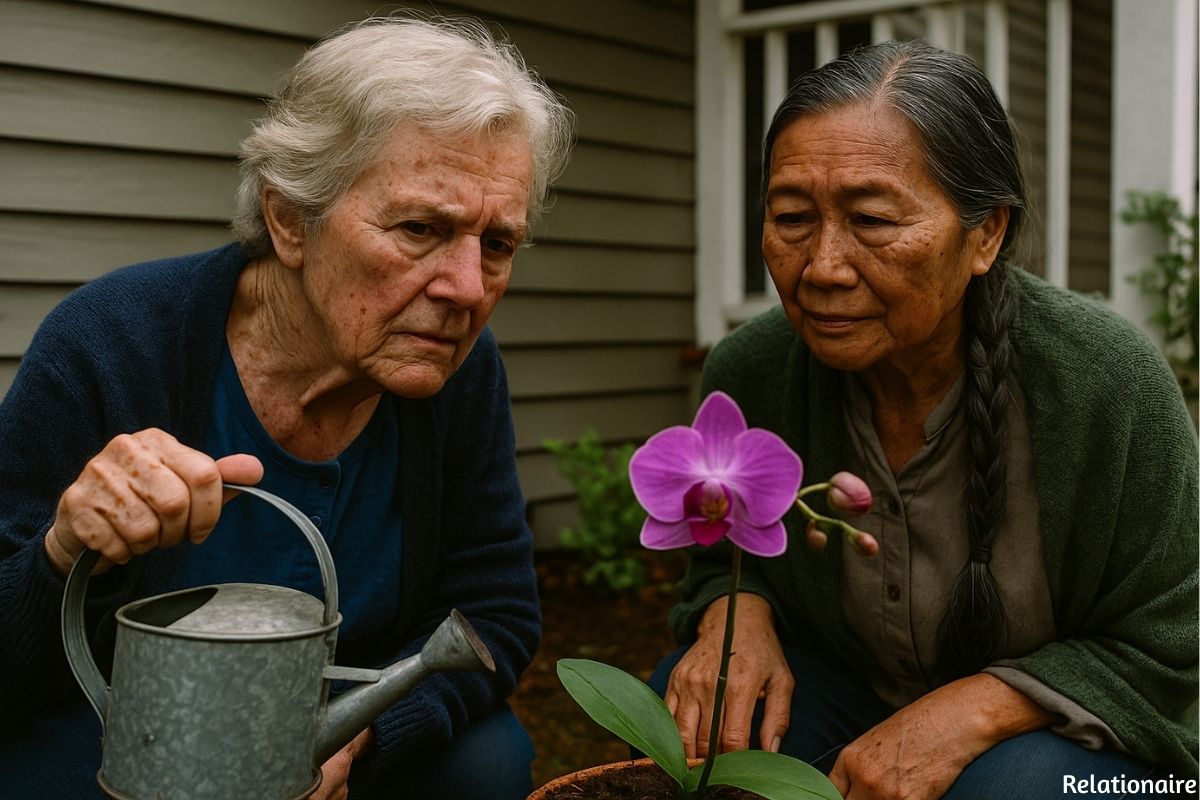
She never asked about the flower.
It bloomed once a year—then wilted in his hands.
Every Thursday, he watered it like clockwork.
Now he was gone, and all she had was dirt, petals…
And a photo of a girl her husband never mentioned.
Part 1 – “A Thursday Without Him”
Eleanor Myers had been waking up at 5:47 AM for fifty-two years.
Not because of any alarm. Not because of the arthritis, though it played its part.
It was just the way things had settled, like dust in corners you forgot to sweep. And now, at 5:47, she sat on the edge of the bed with the blanket still folded on his side.
Riverside, Oregon was quiet in June. The kind of quiet you can only hear when the birds are still sleeping and the wind hasn’t picked up. Their cottage—blue paint faded like an old postcard—stood at the end of a gravel road, hidden behind a picket fence and two untrimmed apple trees.
She could still hear his slippers scraping the floor. Still picture the dent he made in the left side of the couch. But most of all, Eleanor remembered the way he tended to that orchid.
One pot. One flower.
Always on the windowsill.
Watered every Thursday at 9 AM, just before lunch.
Its petals were thin and pale, almost translucent, the kind of beauty you could miss if you weren’t looking directly at it. Unlike the bright sunflowers or tulips she loved, this orchid felt… secretive. Fragile. Out of place.
It hadn’t bloomed since the funeral.
Today was Thursday.
She stood in the kitchen, clutching a chipped mug that read World’s Okayest Golfer—a gift from their grandson, Lucas, back when he was in braces and couldn’t say his R’s.
The coffee was weak. Her grip, a little weaker.
Eleanor crossed the room and stood by the window. The orchid sat where it always had, but it looked different now—drier, a little defeated. She reached out to touch the stem. That’s when she noticed it.
The pot wobbled.
She tilted it carefully, heart thudding as if she were about to find a rat or mold beneath it. Instead, there was a photograph.
Old. Faded. Curled at the corners from years of being hidden.
It showed a girl. Young—maybe twelve?—wearing a thin white shirt, barefoot, standing in front of a hut with a thatched roof. She was holding something in both hands: an orchid. The exact kind.
Eleanor sat down, hard, on the kitchen chair. Her fingers trembled.
There was handwriting on the back.
For W. Myers – Thank you. 1970. Da Nang.
She read it twice. Then again. She had never been to Da Nang. Walter had. But he never spoke of it. Not really.
“Spent some time in the jungle,” he’d say, scratching the back of his neck. “Hot as hell. Full of bugs. Left my left knee there.”
That was it. Forty-five years of marriage. That knee was all she ever really knew of Vietnam.
Until now.
Eleanor set the photograph down and stared at the orchid. She could almost see him again—how careful he was, how his hand lingered on the soil as if it could speak back.
Her lip quivered. A tear slid down one cheek, then the other.
She never asked. She never thought she needed to.
The phone rang, jolting her from the silence. It was Lucas.
“Hey, Grandma. Just checking in—how are you today?”
She opened her mouth, but the words caught.
“Grandma?”
“I… I found something, Lucas. Something I think your grandpa wanted to tell us.”
He paused. “What kind of something?”
“A photo. A girl. And an orchid. From Vietnam.”
Lucas said nothing for a moment. She could hear the hum of his fan in the background. Then: “Want me to come by after work?”
Eleanor looked out the window. The orchid sat still. Waiting.
“Yes, sweetheart,” she said. “I think I need your help.”
And just like that, Thursday changed.
Part 2 — “The Girl in the White Shirt”
Lucas Myers always brought two things when he visited his grandmother: donuts and a notebook.
The donuts were tradition—maple bars, her favorite. The notebook was new. Ever since Walter died, he’d been writing things down. Not just facts, but how things felt. He was twenty-six, a software developer in Portland, trying to remember what mattered.
Today, he arrived just past six. The sun hung low over the apple trees, the porch sagged a little more than last week, and Eleanor stood waiting in the doorway like she used to when he came home from camp.
“You didn’t have to drive down,” she said, though her voice betrayed the relief.
Lucas held up the pink bakery box. “I brought peace offerings.”
She stepped aside, and he followed her into the house. The living room was quiet, tidy. The couch still had Walter’s indentation. The orchid sat by the window like it always had.
Eleanor didn’t waste time.
She led him to the kitchen table, where the photo lay beneath a glass coaster.
Lucas leaned in. “That’s… definitely Vietnam.”
“You think it’s real?”
“Looks it. The roof style, the dirt path, even the way the girl’s dressed—rural, probably central Vietnam. Early ’70s, judging by the color fade. And she’s holding—”
“The same orchid,” Eleanor finished.
Lucas picked it up gently. “For W. Myers… 1970… Da Nang. You said he never mentioned anything about her?”
“Never mentioned anyone. Just that his knee got wrecked over there and he didn’t want to talk about it.”
Lucas squinted. “Did Grandpa keep any war stuff? Medals, journals, letters?”
“Just a box in the attic,” she said slowly. “He told me to toss it once, years ago. I didn’t.”
He smiled. “You’re kind of a badass, Grandma.”
She didn’t laugh, but her lips curled a little. “Let’s go.”
The attic was hot, dry, and filled with the scent of mothballs and cedar. Eleanor climbed slowly. Lucas followed with a flashlight, brushing aside cobwebs and old Christmas wreaths.
The box wasn’t hard to find. Plain. Wooden. Marked W. MYERS – 1970 in black paint. Its latch was rusted shut, but Lucas pried it open with a screwdriver from the junk drawer.
Inside:
A military-issue canteen.
A bundle of faded maps.
A rusted Zippo with “If I Die, Bury Me Face Down” etched crudely on the side.
And an envelope, yellowed with age.
Lucas opened it. Inside were three things:
- A field hospital discharge paper with Walter’s name.
- A napkin with what looked like a child’s handwriting in Vietnamese.
- And a pressed orchid, flat and fragile, like it had been placed there yesterday.
Eleanor sat down on the floor. “He carried that all these years?”
Lucas read the discharge slip. “Gunshot wound. Left thigh. ‘Patient reported being sheltered by local civilian for 3 days before recovery by unit.’ No name listed.”
“She hid him,” Eleanor whispered. “That girl.”
Lucas turned the napkin over. “This is Vietnamese. I can’t read it, but I know someone who might.”
“Who?”
“My old roommate’s mom. She was born in Da Nang. I’ll text her a photo of it.”
He snapped a picture of the writing and sent it. Then turned to Eleanor.
“Grandpa was shot. Alone. That girl found him. Hid him. And he—what? Took this flower to remember her?”
Eleanor’s eyes welled up. “And he watered it every Thursday. Every Thursday, for forty-five years. Like it was sacred.”
Lucas looked down at the pressed orchid, barely holding together in the paper.
“Maybe it was,” he said.
Later that night, while Eleanor made tea, Lucas’s phone buzzed.
Message from Linh’s Mom:
“It says: You are safe now. Please don’t come back. I will remember you forever.”
He showed it to Eleanor. She covered her mouth, then reached for the back of a chair.
“I didn’t know,” she whispered. “I never asked him. I thought I knew him.”
“You did,” Lucas said gently. “Just not all of him.”
The silence between them filled with old grief and new questions.
Eleanor glanced toward the orchid. “Do you think she’s still alive?”
Lucas looked at the photo again. At the slight smile on the girl’s face. At the hands cradling the flower like something holy.
“I think she survived,” he said. “And I think she changed him.”
Part 3 — “The Napkin Promise”
The next morning, Eleanor sat with her palms flat on the kitchen table.
She hadn’t slept much. Every time she closed her eyes, she saw the girl’s face. That tiny, solemn smile. The orchid cradled like a prayer. The image felt alive now, lodged in her chest beside the ache of missing Walter.
Lucas came downstairs barefoot, already texting.
“She responded again,” he said. “Linh’s mom.”
Eleanor looked up, still in her bathrobe.
“She says the message on the napkin sounds like something written by a child trying to be brave. ‘Please don’t come back’—that part stuck with her. Like maybe the girl was scared he’d be killed if he returned.”
Eleanor exhaled, long and slow. “And she was twelve.”
“Probably younger. Might’ve lost her whole family, Grandma. That war didn’t care how old you were.”
Eleanor rubbed her hands together. “Do you think he ever tried to find her?”
Lucas hesitated. “I think he didn’t, on purpose. Sometimes people keep their promises too well.”
That landed hard.
She turned toward the orchid on the windowsill. Its leaves drooped, soil dry.
“I want to find her,” Eleanor said. “I want to know who she was. I want to know what she meant to him.”
Lucas nodded. “Then we start with someone who might’ve known Grandpa over there.”
Eleanor looked surprised. “He never talked to anyone about Vietnam.”
“There’s one guy I remember,” Lucas said. “From the funeral. Tall, wore that stiff military jacket, with all the pins. Called himself ‘Mac.’”
“Mac…” Eleanor frowned. “That was Corporal McClendon. He visited every few years. Walter never let me in the room when they talked.”
“Think he’s still alive?”
“If he is, he’s in Coos Bay. I have his address somewhere. Wait here.”
She shuffled to the bedroom, returned ten minutes later with a worn Christmas card from 2016. The envelope said Cliff McClendon, Coos Bay, OR.
Lucas raised an eyebrow. “Road trip?”
The drive took four hours. Forests faded into low coastal fog. Eleanor dozed with her chin to her chest, fingers curled around the photograph like it might disappear if she let go.
They pulled into Coos Bay just after lunch.
The house was small and gray, with peeling paint and a front yard littered with broken fishing buoys. An American flag hung limp on a splintered pole.
Lucas rang the bell.
It took two full minutes before the door creaked open.
Cliff McClendon hadn’t changed much since the funeral—just more bent, more faded. His eyes, sharp and suspicious, studied them from beneath bushy white eyebrows.
“Eleanor Myers,” he said at last. “Ain’t seen you since Walt passed. That boy with you?”
“Lucas,” she said. “Our grandson.”
McClendon stepped aside without a word.
Inside, the living room smelled like pipe smoke and wintergreen liniment. War memorabilia lined the shelves—model helicopters, faded medals, a photo of four soldiers in the mud.
Lucas scanned the room while Eleanor got straight to it.
“Cliff,” she said. “I found something. A photo. From Vietnam.”
She handed it to him.
He stared at it longer than she expected. Then gave the smallest nod.
“I figured this’d come out someday,” he muttered.
“You know who she is?”
“I never met her. But I know the story. Walt told me. Once.”
Eleanor’s breath caught.
McClendon sank into his recliner. “We were doing recon near Da Nang in ‘70. Walt got separated during a firefight—shrapnel took out his knee, knocked him off the trail. Whole platoon thought he was dead.”
He reached for a tin of chewing tobacco but thought better of it.
“Three days later, a chopper spots him crawling out of the jungle. Half-dead. He wouldn’t say where he’d been. Just that someone hid him. Fed him. Kept him breathing.”
He tapped the photo.
“That girl. He told me she lived in a burned village. Her parents were gone—maybe VC, maybe napalm, who knows. She saw him bleeding, and instead of turning him in or leaving him, she dragged him into a root cellar.”
Eleanor’s voice cracked. “Why didn’t he tell anyone?”
“Because he promised her he wouldn’t. Said she was terrified he’d bring soldiers back, or worse, the NVA. Said she made him swear to forget.”
Lucas sat down. “But he didn’t forget. He kept that flower alive for 45 years.”
McClendon’s eyes gleamed. “He never did forget. He never tried to find her. Said she was a ghost, and some ghosts deserve peace.”
Eleanor was silent a long time.
Finally: “Do you know her name?”
“No.” He leaned forward, stiff and slow. “But I know someone who might.”
He opened an old file drawer and pulled out a brittle address book.
“Guy named Lieutenant Roger Talbert. Intelligence. After Walt got back, he filed a redacted report—had to explain where he’d been. Swore me to silence, but maybe Talbert kept something. He lives in Sacramento now.”
Eleanor and Lucas exchanged a look.
Sacramento was another day’s drive. Another door. Another ghost.
But Eleanor stood up anyway.
“Write down the address,” she said.
Part 4 — “The Intelligence Officer”
Sacramento heat settled on the car like a second skin.
The old Corolla wheezed as it crawled up the quiet street in East Sacramento. Elm trees leaned low. Lawn sprinklers ticked like old clocks. Everything felt too peaceful for what Eleanor was about to do.
Lucas parked at the curb. “You sure you’re up for this?”
Eleanor adjusted her blouse, smoothing the wrinkles that wouldn’t go away. “Your grandfather watered a flower for forty-five years. I’m just knocking on a door.”
The house was simple. Pale yellow with green shutters. A wind chime swayed from the porch beam. The name TALBERT was etched on the mailbox in brass.
Lucas rang the bell.
No answer.
Then the curtain shifted. A few seconds later, the door opened.
The man behind it was tall, stooped, and impossibly neat. Crisp button-down. Creased slacks. Clean-shaven, even at his age. Eyes like glass marbles—too alert for someone retired.
“Yes?”
“Mr. Talbert?” Eleanor asked. “We’re looking for Roger Talbert. My name is Eleanor Myers. My husband was Walter Myers.”
The change was instant. His spine stiffened. His eyes narrowed.
“I remember Walter,” he said. “Come in.”
The living room was sparse. Not much dust. Just enough silence to be awkward.
“I remember the day he came back,” Talbert said, settling into a high-backed chair. “Dragged out of the jungle like he’d been swallowed and spit back out. He wouldn’t talk to anyone but me. Not even the medics.”
He folded his hands. The nails were clean. No wedding ring.
“He told me about the girl. The root cellar. The three days she kept him alive. I asked if he got her name. He said she only gave one: Linh.”
Eleanor blinked. “Linh?”
“Spelled it out for him on a napkin. Said she didn’t speak English, but she knew how to write. Probably learned in school before the war came.”
Lucas pulled out the napkin from the envelope. “This one?”
Talbert looked at it. His breath caught.
“That’s it,” he whispered. “He never showed that to anyone else. Said it was all he had, and it wasn’t his to share.”
“Why didn’t you report it?” Lucas asked.
Talbert looked at him like he’d asked why water was wet. “Because the military doesn’t care about little girls. Or orchids. Or promises made in cellars. They care about objectives. And surviving. Walter gave me a cleaned-up version. Said he evaded capture. That was enough.”
Eleanor studied him. “But you kept something, didn’t you?”
Talbert hesitated. Then rose and walked to a locked cabinet in the hallway.
He returned with a folder. Yellowed. Thin. Marked MYERS, W. – 1970.
“I shouldn’t have,” he said, setting it on the table. “But I couldn’t forget her either. Not after the way he described her.”
Lucas opened the folder carefully. Inside were copies of Walter’s statement, a few field reports, and a rough sketch—done in pencil—of a girl holding a flower.
Eleanor stared.
“That’s her,” she said. “He drew her.”
“He told me once,” Talbert said quietly, “that when he closed his eyes at night, it wasn’t the war he saw. It was her standing in that doorway with that flower.”
Lucas flipped through the last page. It was a typed list. Vietnamese villages destroyed between March and May 1970. One name was circled.
Thuan Phuoc.
Lucas tapped the name. “Is this her village?”
Talbert nodded. “Burned down three days after he was rescued. Bombing raid. That’s why she told him not to come back.”
Eleanor’s throat tightened. “Then she didn’t make it.”
Talbert looked at her gently. “No one knows. Some villagers fled. Some didn’t. If she lived… she’s out there somewhere. But it’s been fifty-five years.”
Eleanor stared down at the sketch. “I need to try.”
Talbert looked between them. “Then you’ll want this.”
He pulled a slip of paper from his wallet. A name. A number.
“Nguyen Bao Chau. Retired interpreter. Lives in Garden Grove now. If anyone can help you trace Linh, it’s him.”
Eleanor stood up slowly. Her knees ached, but her chest felt lighter.
“Thank you,” she said.
Talbert nodded. “Walter was a good man. But some things are too heavy to carry out loud. He carried her the only way he could.”
As they left, the wind chime rang behind them. High and hollow.
In the car, Lucas stared at the slip of paper.
“Garden Grove. That’s seven hours.”
Eleanor leaned back in her seat, the photo on her lap, the napkin tucked in her pocket.
“Then we leave in the morning.”
Lucas glanced at her. “You’re really doing this.”
She nodded. “I kept his secret for forty-five years without knowing it. Now I need to know who he was keeping it for.”
The sun dipped low as they pulled away, casting long shadows across Sacramento streets.
Part 5 — “Chasing Linh”
The freeway south was long and humming.
Garden Grove shimmered in the late afternoon heat—Vietnamese signs, pho shops, incense curling from corner stores. Eleanor hadn’t realized how many lives from that war had made new roots here. It was like the story had kept going without her.
Lucas drove in silence.
She watched the palm trees flicker past and thought of Walter—not young, not wounded, not even as the man who fixed the porch railing every spring. She thought of him as a boy bleeding into foreign dirt, holding onto life because a child told him not to die.
When they reached the house, it was tucked behind a jade bush and a tiny shrine. The name on the gate read Nguyen Bao Chau.
Lucas rang the bell. The door opened halfway.
“Yes?” A man in his seventies stood behind it. He was slight, neat, with deep smile lines and eyes like still water.
Lucas held up the napkin. “We were told you might be able to help us find someone. Her name was Linh. She lived in Thuan Phuoc in 1970. She helped our grandfather during the war.”
Nguyen’s eyes dropped to the napkin.
“Who told you to come?”
“Roger Talbert,” Eleanor said. “He said you might remember. Or know someone who does.”
Nguyen looked at them long and hard. Then opened the door wider.
“Come in.”
The home smelled like star anise and books.
Old photographs lined the hallway—black-and-white family portraits, a wedding, children in school uniforms. Lucas kept scanning them, looking for a face that matched the one in the photo.
They sat at a low table. Nguyen poured tea without asking.
“I was twelve when I left Thuan Phuoc,” he said. “My uncle smuggled us out after the raids. I’ve spent the last thirty years helping others find family—some lost to the jungle, some lost to memory.”
Eleanor slid the photograph across the table. “Do you know her?”
Nguyen picked it up. His hand trembled slightly.
“This girl… I don’t know her name. But I know this flower.”
He pointed to the orchid.
“This type—Lan hồ điệp—was rare where we lived. Most grew in the highlands. If a family had one, it meant something. A gift, a legacy, sometimes even a grave marker.”
Lucas leaned in. “Do you think she made it out?”
Nguyen was quiet.
Then: “I’ve seen her face before. Or one like it. Wait.”
He rose and disappeared into the back room.
Eleanor’s hands clenched tight in her lap.
A full five minutes passed before he returned—holding a plastic binder of laminated pages. He opened to a newspaper clipping from 1998.
A woman stood beside a community garden plot in Westminster. Dark eyes. A little older. But the same lips. The same gentle way of holding something small—a sprig of basil in the photo, but it could have been an orchid.
Lucas’s jaw dropped. “That’s her.”
Nguyen nodded. “She came here in ’78. Her name wasn’t Linh anymore. She used ‘Anna.’ Most of us changed our names.”
“Do you know where she is now?” Eleanor’s voice cracked.
“I did,” Nguyen said softly. “But she left Garden Grove ten years ago. Moved up north—to somewhere quiet. A place called Florence.”
“Florence?” Lucas asked. “Oregon?”
Nguyen nodded. “Said the fog reminded her of home.”
Eleanor pressed her hand to her chest. “That’s where we live. Just two hours from us. She’s been that close?”
“She ran a flower stall for years. Orchids, mostly.”
Lucas swallowed. “Do you have an address?”
Nguyen pulled out a faded business card from between the pages.
It read: Anna Tran – Orchid & Moss, Florence Farmers Market
A phone number. A hand-drawn orchid beside the name.
“She hasn’t answered that number in years,” Nguyen warned. “She’s private. Careful. She may not remember you.”
Eleanor stared at the card. “It’s not about me remembering. It’s about remembering him.”
They drove through the night.
No hotel stop. No conversation. Just highway and the sound of Eleanor’s heartbeat in her ears.
She clutched the photograph in one hand, the napkin in the other. Both paper. Both fragile. But both had outlived Walter.
The next morning, they rolled into Florence as the marine layer burned off the hills.
The Farmers Market was setting up—sun tents, tables, people in fleece jackets hauling crates of vegetables.
Lucas parked. Eleanor stepped out, legs stiff but certain.
They walked together, past jars of honey and hand-knit scarves, past children selling lemonade and retirees with jam samples.
Then they saw the stall.
Simple. Clean. Two rows of orchids in recycled vases. Handwritten price tags. No sign.
Behind the table stood a woman in her late sixties. Short gray hair, braided back. Wrinkles carved deep at the corners of her mouth. And her hands—still cradling the petals like something sacred.
She looked up.
Eleanor’s mouth opened. But nothing came.
Lucas stepped forward, holding the photo like a passport. “Is your name Anna?”
The woman froze. Her eyes landed on the image.
She didn’t speak. She didn’t move.
But a tear slid down her cheek.
Eleanor stepped closer, voice barely above a whisper. “He never forgot you.”
The woman reached out, her fingers trembling, and touched the edge of the photo.
“I thought he died,” she said.
Eleanor took her hand. “He didn’t. You saved him.”
Anna closed her eyes.
Then opened them.
“Come,” she said. “You should hear the rest.”
Part 6 — “The Story She Never Told”
The back of the flower stall was a folding chair and a thermos.
Anna Tran—once Linh—sat with both hands wrapped around a chipped mug of jasmine tea. Her eyes, once stormy, had turned glassy with memory.
Eleanor sat beside her. Lucas stood off to the side, watching the quietest moment unfold like a funeral prayer.
Anna spoke slowly, her English careful but soft.
“It was March,” she said. “I was maybe ten. The soldiers came two nights before. They burned the huts. My father was taken. My mother told me to hide. So I did. Under the pig shed.”
She sipped her tea. “When it was quiet again, I crept out. I found him there. Your husband. He was under the banyan tree, bleeding into the earth.”
Eleanor’s hands tightened around the napkin.
“He didn’t look like the other soldiers. He looked… lost. So I dragged him. I don’t know how I did it. But I pulled him to the root cellar. My mother used it to store rice. It was cool and dark. He screamed the first night. He thought I was Viet Cong.”
Her voice wavered.
“But when I brought water, he drank it. I gave him sweet potato, chewed it so he could swallow. He cried, but he never told me to stop.”
Eleanor’s eyes filled. “He said you were brave.”
Anna looked at her. “I was scared. But he was kind. He gave me his jacket. Touched my head like a father would.”
Lucas stepped forward, quietly. “He said you told him not to come back.”
Anna nodded. “I knew the soldiers would return. I told him, if he lived, to forget me. I didn’t want him dead because of me.”
She reached down and pulled something from her basket: a worn patch of fabric. Faded camouflage, frayed along the edges.
“I kept this. From his sleeve. I tore it when I moved him. I sewed it into my mother’s apron. When we left for the refugee camp, I cut it out and kept it.”
Eleanor took it gently, heart pounding. “He kept your flower. You kept his sleeve.”
Anna smiled, small and aching. “I didn’t know if he lived. I told myself, if I ever saw that flower again, I’d know.”
Lucas looked between them. “He watered it every Thursday. For decades. He never missed a week.”
Anna turned away. Her breath shook. “He lived… and remembered.”
They sat in silence for a while.
People bustled past in the market. Laughter and clinking jars. The smell of kettle corn.
But under the tent, it was just them—two women bound by a ghost of war, by a kindness that crossed oceans.
Finally, Eleanor reached into her purse.
She unfolded the napkin, now soft from time.
“He kept this,” she whispered. “Your message.”
Anna stared at it like a window had opened in her chest.
“He never showed it to anyone,” Eleanor said. “Not even me.”
Anna touched it with reverence. “I wrote that in darkness. With a stub of charcoal. I didn’t think it would last.”
Lucas crouched beside them. “Would you… would you want to visit his grave?”
Anna looked at Eleanor.
“I would,” she said. “If that’s okay.”
Eleanor nodded, tearfully. “It would mean everything.”
That night, they sat in Eleanor’s kitchen.
The orchid sat on the windowsill, just as it had for decades.
Anna bent over it gently. She touched the base of the stem, the faded leaves.
“This flower…” she said, “is not meant to live this long without replanting. He must have changed the soil, cut back the roots. Kept it alive through effort, not accident.”
Eleanor laughed softly. “He wasn’t good with any other plant. Just this one.”
Anna smiled. “Because it wasn’t a plant. It was a memory.”
Lucas watched the two women fall into easy silence.
And then, something happened.
A small bud, pale and tight, sat nestled under the largest leaf. Eleanor leaned in.
“It’s… blooming.”
Anna’s eyes widened.
“It hasn’t bloomed since he passed,” Eleanor whispered. “Not once.”
The three of them stared at it.
A silent answer to a question that had never been asked out loud.
Eleanor reached for Anna’s hand.
“Stay with us a while.”
Anna nodded.
“I think I will.”
Part 7 — “The Bloom”
The cemetery sat on a hillside outside Florence. Quiet, wind-brushed, always a little damp from the Pacific air.
Walter’s headstone was simple:
Walter James Myers
1946–2021
“He came home.”
Eleanor had chosen the words herself. They were all she could bear to carve into stone.
Now she stood beside it again—this time, not alone.
Anna wore a linen jacket, her silver braid tucked beneath her scarf. In her hands was a small, clay pot. Inside: a young orchid, not yet bloomed. Not yet anything, really—just green tendrils curling up from the soil, like hope.
Lucas stood back a few paces, hands in his pockets.
Eleanor watched as Anna knelt and placed the pot gently at the foot of the grave.
“He saved me too,” she said softly. “Not just those three days. After I left my village… I carried guilt. I thought maybe I cursed him. That maybe he died because of me.”
Her voice trembled.
“I tried to forget. I became someone else. Changed my name. Stopped planting orchids. But something always brought me back. And when I saw the photo again, I knew.”
Eleanor crouched beside her, knees aching but steady.
“He never blamed you,” she whispered. “He thanked you. Every week, with that flower. That was his way.”
Anna reached out and touched the stone.
“I never knew his full name,” she said. “Only Walter.”
Eleanor smiled gently. “He used to hum a song when he watered the orchid. Said he didn’t know the lyrics, just the tune. Do you remember that?”
Anna nodded. “It was a lullaby. My mother used to sing it.”
They sat like that for a while. Silent. Still. Not praying. Not crying. Just remembering.
Then Anna reached into her coat pocket and pulled out a piece of paper, folded into quarters. She placed it beneath the clay pot, where the wind wouldn’t reach it.
Lucas stepped forward. “What’s that?”
Anna stood, brushing dirt from her hands. “His napkin. The message. I rewrote it today, in Vietnamese and English. This time, I wanted the words to stay with him.”
Eleanor blinked away tears.
Lucas cleared his throat. “I, uh… I’d like to take a photo. If that’s okay.”
Neither woman moved.
He stepped back, raised his phone, and captured it:
Two women, side by side, framed by wildflowers and sea wind.
An old grave.
A new orchid.
And a memory neither of them had to carry alone anymore.
Back at the cottage, Eleanor made tea while Anna wandered the living room, taking it all in.
She paused by the photo shelf. Snapshots of birthdays, fishing trips, and one blurry image of Walter kneeling beside the orchid, water can in hand.
Anna stared at it a long time.
“You know,” she said softly, “I once thought the war had swallowed me. That there was no story left but surviving.”
Eleanor poured the tea. “Me too.”
Anna turned to her. “But this—this was love, wasn’t it? Not the loud kind. The kind that grows in silence.”
Eleanor nodded. “It was.”
Lucas entered, holding a folded newspaper.
“Found something,” he said. “I reached out to a veterans’ history project yesterday. They had a transcript from a 2003 oral interview. Grandpa did one and never told us.”
He unfolded the page and read:
“There was a little girl in Vietnam. She hid me after I was shot. I don’t know if she lived. I hope she did. I didn’t keep her name, but I kept her flower. I guess sometimes, a man carries more than his own story.”
Anna closed her eyes.
Eleanor took her hand.
Lucas placed the paper between them, like an offering.
That night, as dusk fell over the coast, the orchid on the windowsill unfurled another petal.
Eleanor saw it first.
Anna joined her by the glass.
“It’s blooming,” Eleanor whispered.
“Not for him,” Anna said.
“For us.”
Part 8 — “The Second Thursday”
Thursday came with salt in the air and dew on the windowpanes.
It had been exactly one week since Anna placed the new orchid on Walter’s grave. Since the photo had been taken. Since the silence had started to feel less like grief and more like memory settling into place.
In the kitchen, Eleanor poured two cups of coffee—hers black, Anna’s with a touch of condensed milk, just like her mother used to make.
They sat together at the table without speaking, the way old friends do when there’s no need to fill the air.
Then, at precisely 9:00 a.m., Eleanor stood up.
Anna smiled. “Is it time?”
“It is.”
They walked to the windowsill.
The old orchid—Walter’s orchid—had opened three full blooms since Anna arrived. It was the first time it had blossomed more than once in nearly a decade.
Eleanor picked up the small watering can. Anna lifted the curtain slightly, letting the light pour in.
“Would you like to do the honors?” Eleanor asked.
Anna reached for the can. Her hand shook—just a little—but she steadied it.
She poured the water slowly, letting it soak into the dark soil.
“Why Thursday?” she asked.
Eleanor shrugged. “He never said. But he never missed it. Not once. Not through surgeries. Not through birthdays. Not even when he could barely walk.”
Anna nodded.
“Then we won’t miss it either.”
Later that day, Lucas stopped by with a USB drive and a manila envelope.
“I scanned the whole oral history interview,” he said. “Thought you might want a copy. Also—there’s something else.”
He handed Eleanor the envelope.
Inside: a letter. Typewritten. On VA stationery.
To the Family of Walter J. Myers
Date: March 12, 2004
Re: Unclaimed Personal Effects (Da Nang, 1970)
We recently completed an internal archival restoration effort and identified a small collection of recovered belongings associated with PFC Walter J. Myers, 3rd Recon Battalion. Due to the informal nature of the incident and lack of official record from local civilians, these items were never processed through traditional channels.
Among them is a fabric pouch containing:
– One children’s drawing in charcoal
– A pressed orchid (partial fragment)
– A makeshift wooden bead necklace
If you would like to claim these items, please contact the Veterans Legacy Program…
Eleanor looked up. “He never told me.”
Lucas shrugged. “Maybe he didn’t know. Maybe he didn’t want to.”
Anna sat very still. Her eyes wide.
“A necklace,” she whispered. “My mother made one from cooking twine and beads. I gave it to him.”
Eleanor folded the letter carefully. “Then maybe it’s time we claim it.”
The next week, they drove to the VA facility in Portland.
An old man at the front desk looked confused, then concerned, then finally handed over a small box with trembling hands.
Inside were the items exactly as described—except older now. Fragile with time.
The drawing was faint but recognizable: a soldier and a girl, hand in hand beneath a tree. The orchid had disintegrated into three curled edges of pale brown. And the necklace—tiny, uneven wooden beads on a crumbling string—still smelled faintly of smoke and dirt.
Anna touched the necklace like it might break if she breathed too hard.
“It was the only thing I had left of my mother,” she whispered.
Eleanor placed a hand on hers.
“He kept it safe.”
That Thursday, they added a new ritual.
After watering the orchid, Anna removed the necklace from its case and placed it on the windowsill beside the pot.
Eleanor placed the drawing beside it.
Lucas, when he joined, would bring a fresh flower—never the same twice.
“I don’t think Grandpa believed in big endings,” he said once, adjusting a daffodil in a small vase. “He believed in routine. Quiet rituals. The stuff no one notices.”
Anna nodded. “That’s how you survive war. One ritual at a time.”
It was around then that neighbors started to notice.
The old widow on the corner wasn’t alone anymore.
There was another woman now—gentle, with kind eyes, always at the market with a tray of small orchids.
Sometimes the two of them could be seen walking along the coastal trail in the early morning, side by side, not talking, not hurrying.
Just walking.
The way people do when the past has finally been laid down.
Part 9 — “What Was Left Behind”
It had rained the night before, soft and steady, leaving the morning air thick with earth and salt.
Eleanor hadn’t visited the attic in years.
She stood now at the base of the narrow stairs, hand gripping the rail. Anna waited beside her, patient but ready.
“I don’t know what’s still up there,” Eleanor said.
“That’s okay,” Anna replied. “Sometimes it’s not about finding something new. Just making peace with what’s there.”
Lucas had offered to climb it for her. But she’d declined.
Some doors had to be opened with your own hand.
The wood creaked under her steps. Dust rose in pale clouds. At the top, a single bulb cast a cone of yellow over a pile of boxes, one covered with an old towel.
She peeled it back.
Inside was Walter’s army footlocker. Still locked.
Anna stepped forward and touched the rusted latch.
“May I?”
Eleanor nodded.
Anna tugged gently—and it gave.
Inside:
A pair of worn boots.
A wrinkled map of central Vietnam.
A pocketknife with a missing screw.
And one small book wrapped in butcher paper.
Lucas had never seen it. Eleanor hadn’t known it existed.
Anna reached for the book and unwrapped it slowly.
A journal.
Walter’s name was on the inside cover, written in tidy block letters. Beneath it, one line:
If I don’t come back, remember the orchid.
They stared in silence.
Eleanor opened to the first page.
March 11, 1970
She found me. I don’t know her name. My leg’s on fire, and I can’t feel my toes, but she keeps coming back. I think she’s ten. Maybe younger. She gave me water today. Said one word: “Lan.” Orchid.
The entries continued—brief, uneven. A boy bleeding into dirt, writing to stay awake. A girl who never spoke, but sat by his side through the dark.
On March 14, the writing ended.
She told me not to come back. Said I’d bring trouble. Said she’d remember me. That I should forget her. I said I wouldn’t. I lied, I guess. Because I won’t.
Eleanor closed the book and held it to her chest.
“He was already loving you,” she said, voice trembling. “Even then.”
Anna wiped her cheek. “And I was already missing him.”
The next day, they drove back to the coast.
This time, it was Anna’s turn to lead.
She took them not to the market, but to a quiet cove north of town—one Eleanor had never visited, despite living nearby for decades.
“There was a woman I met in the refugee camp,” Anna said as they walked. “She came from a village not far from mine. We weren’t related, but she called me ‘em gái’—little sister.”
The waves broke gently on the sand.
“She was the one who brought me here, years ago. When I first moved to Oregon. She said it looked like the riverbanks near Huế. I didn’t believe her… until I saw it.”
Anna knelt and touched the cold sand with her fingertips.
“I buried the necklace here once. Years ago. But I couldn’t leave it. I dug it up the next morning.”
Eleanor sat beside her. “You’re allowed to keep what saved you.”
Anna looked at her, soft-eyed. “And you?”
Eleanor considered. “I think I was always afraid that if I asked him about the war, I’d break something. Some thread that held him together. So I let him keep it to himself.”
Lucas stood back, camera hanging at his side.
“But I was wrong,” she continued. “It didn’t need to be protected. It needed to be shared.”
Anna smiled. “And now it has been.”
That night, the three of them sat on the porch, wrapped in blankets.
Lucas had made tea this time. He was getting good at it.
The orchid on the windowsill glowed in the lamplight—four full blooms now, soft and open, the colors deeper than before.
Eleanor turned to Anna.
“Do you think he would’ve wanted us to meet?”
Anna didn’t hesitate. “I think he watered that flower every week hoping we would.”
Eleanor laughed softly. “Maybe he left us the pieces, knowing we’d be the ones to put them together.”
Lucas raised his cup. “To Walter.”
They clinked cups gently.
“To Walter.”
And to everything he left behind—not in a will or a bank account, but in small acts, old rituals, and a flower that wouldn’t die.
Part 10 — “The Third Bloom”
It was the third Thursday since Anna had come.
Rain tapped gently on the roof. The air smelled like moss and black coffee. The house was quiet except for the sound of Anna humming in the kitchen—low and familiar, a lullaby Eleanor had never known the words to, but now recognized.
Lucas arrived just before 9:00, his arms full of tulips.
“I thought we could plant something outside,” he said, setting the bundle on the counter. “Next to the porch. Something permanent.”
Eleanor smiled. “You want to give the orchid some company?”
He grinned. “Seems rude to leave it alone after all this.”
They moved together to the windowsill.
The orchid Walter had tended for 45 years was now in full bloom—five perfect petals curved like a held breath, the color somewhere between ivory and memory.
Eleanor picked up the watering can.
Anna placed the beaded necklace beside the pot, as she did every Thursday now. The charcoal drawing stayed pinned on the wall nearby. It had faded slightly but somehow looked clearer every day.
Lucas stepped forward and laid one tulip stem across the windowsill.
“Do you think he knew we’d all end up here?” he asked.
“No,” Eleanor said. “I don’t think he planned it.”
Anna nodded. “But I think he hoped.”
That afternoon, they drove to the Florence Library.
Lucas had arranged for something special.
In the quiet reading room, beside the military history shelf, a small glass case now stood on display. Inside: Walter’s journal, the napkin, the faded photo of young Linh, the necklace, and a replica of the orchid he kept alive.
A plaque read:
The Quiet Promise: A Soldier, a Stranger, and a Flower That Never Died
In honor of Walter James Myers (1946–2021), who carried a secret kindness for half a century—and the girl who carried him through the jungle.
Sometimes the greatest heroism is the kind no one ever sees.
Eleanor stood back, arms folded, eyes misted.
Anna touched the glass gently, then turned away.
“I didn’t think I wanted people to know,” she whispered. “But now I do.”
Eleanor took her hand. “It’s not just his story anymore.”
Anna nodded.
“It’s ours.”
Back at the cottage, the sun dipped low. The porch glowed with gold.
Lucas had dug a small patch of earth near the front steps. The tulips were in the ground now, their green leaves reaching up like they already understood.
Anna bent and pressed something into the soil—one orchid bulb from her stall, small and stubborn, wrapped in dark moss.
“Will it grow?” Lucas asked.
“Maybe,” Anna said. “But I planted it anyway.”
Eleanor smiled. “That’s what Walter did.”
Later, after the dishes were put away and the porch lights clicked on, Eleanor stepped outside.
The wind had stilled. The stars blinked between the trees.
She looked down the road where Walter used to walk their old retriever, Henry. Where he’d tip his cap at neighbors and mutter something about the clouds.
She closed her eyes and spoke into the dark.
“I found her,” she said. “She found me, too.”
Behind her, the screen door creaked open.
Anna stepped onto the porch, pulling her shawl tighter.
“He would’ve liked this,” she said.
Eleanor nodded. “He would’ve hated the fuss. But he’d have liked this.”
They sat side by side in the quiet.
Two women who might never have met if not for a single act of kindness. A flower. A hiding place. A promise whispered between strangers in the dark.
One Month Later
The orchid bloomed again.
Not Walter’s.
The one Anna planted by the porch.
It was smaller. Pale purple. A little wild.
But it bloomed.
Lucas snapped a photo. The three of them in the foreground—Anna holding a watering can, Eleanor with a book in her lap, Lucas crouched beside the flower.
He posted it to a veterans’ archive forum, along with the caption:
She saved him in 1970. He saved her in silence.
And now the flower grows in both their names.
#QuietHeroism #VietnamWarMemory #TheVietnameseOrchid
The post spread quietly.
Not viral. Not loud.
Just like Walter.
THE END
Thank you for reading.