They Wrote Off My 11-Year-Old as the “Divorce Kid” and Walked Past Her Science Project Like She Was Invisible—Then One Stranger Stopped at Her Table, Looked Closer, and Changed the Entire Room
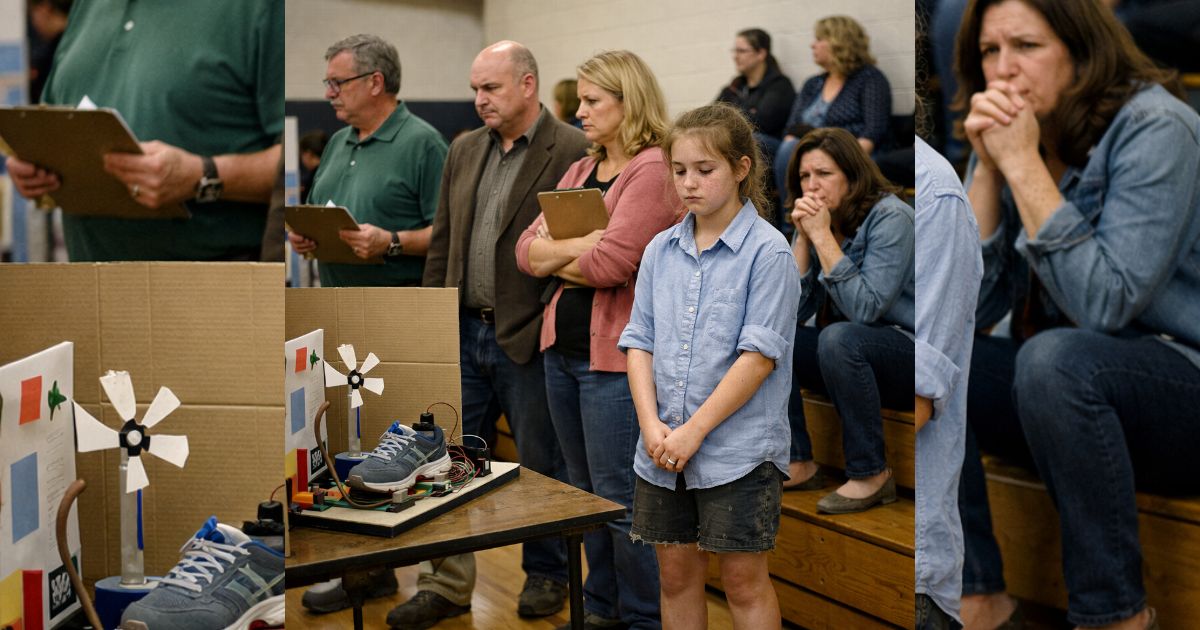
The judges barely slowed down at my daughter’s table.
One of them glanced at her poster board, tilted his clipboard, and kept walking like he was checking off something annoying on a grocery list.
Another gave her sneaker one quick look and said, “Oh.”
That was it.
Just “Oh.”
My daughter stood there in a button-down shirt with sleeves rolled to her elbows, hands trembling at her sides, waiting for a real question that never came.
Then I heard it.
Not from the judges.
From somewhere behind me.
“That’s her.”
A whisper.
“The divorce kid.”
A second voice, low and smug.
“The one everyone says is always in her own world.”
I turned so fast I almost dropped my coffee.
Two parents near the bleachers looked away at once, suddenly fascinated by the gym floor.
Across the room, a girl at another table leaned toward her friend and covered her mouth with her hand, but she was smiling when she did it.
Lena heard it too.
I knew because her shoulders changed.
Only a little.
Most people would have missed it.
But when you’ve raised a child mostly alone for five years, you learn the difference between your kid being nervous and your kid quietly getting hurt.
Nervous still has life in it.
Hurt goes still.
And my Lena went still.
She didn’t cry.
That almost would have been easier.
She just looked down at the cardboard display she had painted by hand at our kitchen table and folded her hands together so nobody would see them shake.
I was sitting on the lowest row of bleachers with my stomach in knots, trying not to march over there and pull her out of that gym before another careless adult or another smug little whisper took one more bite out of her.
But she had worked too hard for that.
Too hard.
My name is Kayla Monroe, and for the past five years, it has been me and my daughter against the world in a little town outside Pittsburgh where everyone knows your business, half of them get it wrong, and the wrong version is usually the one that sticks.
Around here, people don’t always say cruel things to your face.
That would require courage.
They do it with tilted heads.
With polite smiles.
With casseroles dropped off after a hard season, followed by rumors at the gas station.
With phrases like “bless her heart” and “that poor child” and “you know how those situations are.”
By the time my ex-husband left, half the town had already decided who I was.
Young mom.
Bad judgment.
Too stubborn.
Works too much.
Can’t keep a marriage together.
The kind of woman people act sympathetic toward while making sure their daughters don’t grow up like her.
Tom left on a Tuesday.
I remember that because Tuesdays were always my late shift at the diner.
Lena was six.
I had left a note on the fridge reminding him there were chicken nuggets in the freezer and her reading folder needed to be signed.
When I got home, the note was still there.
His duffel bag was gone.
Half his clothes were gone.
The coffee mug his mother had given us at our wedding was gone.
And my phone had one text.
I can’t do this life anymore.
No fight.
No explanation.
No discussion.
Just a sentence.
Like we were a subscription he had canceled.
Lena was asleep on the couch with her socks half off and a colored pencil still in her hand.
I stood in the kitchen reading that message over and over until the words stopped looking like English.
The next morning I still had to wake her up, make toast, sign her school form, and tell her something that a six-year-old should never have to hear in words that simple.
Daddy’s not here right now.
Then later:
Daddy’s staying somewhere else for a while.
Then later still:
No, honey, I don’t know when he’s coming back.
He never really did.
A birthday card here.
A vague promise there.
Two canceled weekends.
One phone call full of too much cheerfulness and not enough substance.
After a while, Lena stopped asking when he’d visit and started asking if batteries could explode if you put them in backward.
That was her way.
When life got too painful in one direction, her mind ran toward another.
Toward gears.
Toward wires.
Toward questions.
Toward anything that made sense.
She was never the loud kid.
Never the kid doing cartwheels for attention.
She was the one crouched in the corner with a broken toy, trying to understand why one wheel turned smoother than the other.
When she was seven, she took apart a flashlight with a butter knife and lined up every tiny piece on a dish towel like she was preparing for surgery.
When she was eight, she asked the librarian if there were books on “how things move when nobody’s touching them anymore.”
When she was nine, I found three remote controls in different stages of disassembly under her bed.
She didn’t do it to destroy things.
She did it because the hidden part mattered to her.
She needed to know what made something work.
Maybe that’s why people underestimated her.
She wasn’t shiny.
She wasn’t rehearsed.
She wasn’t good at making adults comfortable.
If you asked Lena what her favorite subject was, she wouldn’t smile and say “science” the way some kids do when they’re trying to sound impressive.
She’d say, “Depends.”
Then she’d stare at the floor for a second and add, “If I get to build something, then science. If I have to copy definitions, then maybe not.”
There was something about that honesty people didn’t know what to do with.
Teachers called her bright but withdrawn.
Other kids called her weird when they thought she couldn’t hear them.
Parents called her intense.
I called her mine.
And I knew exactly how much strength it took for a child like that to stand in a school gym and let strangers judge something she had made with her own hands.
The idea for the shoe came on a Thursday night in October.
I remember because I was dead tired and we were out of milk.
I had just come home from the diner and the local hardware store where I stocked shelves three nights a week, and my feet were throbbing so badly I sat down at the kitchen table before I even took off my jacket.
Lena had cereal in front of her, dry because we had no milk, and three pages torn from a notebook spread beside her.
She looked up and said, very seriously, “Do you think energy gets wasted because nobody cares about small amounts?”
I blinked at her.
I was thirty-two years old, my ponytail smelled like fryer grease, and my daughter was asking me a question that sounded like it belonged in a college classroom.
“I don’t know,” I said.
She pushed the notebook toward me.
There were little drawings.
Shoes.
Arrows.
Springs.
A tiny light bulb.
“If people walk anyway,” she said, “couldn’t each step do something?”
I sat a little straighter.
“Do something how?”
“Make something.”
“What kind of something?”
She shrugged like that part was obvious.
“Power.”
Then she launched into an explanation so fast I had to stop her twice.
She had been watching free science videos online at the library after school.
She had read about motion energy and pressure and materials that could transfer force.
She had taken notes.
Actual notes.
In pencil.
With page numbers.
The more she talked, the more awake I got.
Not because I understood all of it.
I didn’t.
But because she did.
Not perfectly.
Not in a polished, adult way.
But in that raw, hungry way people understand something when they’ve chased it on their own.
“I think if a shoe pressed something inside the sole,” she said, tapping the page, “it could make a tiny bit of energy. Not a lot. But if you made it better, maybe enough for lights. Or chargers. Or places where there isn’t much.”
“Where did you get that from?” I asked.
She looked almost embarrassed.
“I just kept thinking about people who walk a lot because they have to.”
That was Lena.
Eleven years old, and her brain wasn’t on ribbons or grades.
It was on people.
On use.
On whether something could matter.
A week later, she came home with a science fair flyer folded in half inside her backpack.
I found it while digging for a permission slip.
District Innovation Fair, it said in cheerful letters.
All grades welcome.
Students encouraged to present original ideas.
I almost tossed it on the counter and forgot about it.
Not because I didn’t believe in her.
Because I knew what these things cost.
Not always in money, though there was that too.
Display boards.
Supplies.
Transportation.
Time.
But also in exposure.
The kind that stings when you don’t have the right clothes or the right last name or the right parent standing behind you with color printouts and a professional smile.
That night Lena stood in the kitchen doorway while I washed dishes and asked, so softly I almost missed it, “Do you think I could do it?”
I kept my hands in the sink a second longer than I needed to.
There are moments as a parent when you know your answer is going to shape more than the next week.
This was one of them.
Because I could have said what poor people say when they’re tired and scared and trying to protect their child from disappointment.
Maybe next year.
Maybe when things settle down.
Maybe after we save a little.
Maybe something smaller.
Instead I turned off the water, dried my hands, and asked, “If we find a way, are you really going to do the work?”
Her face changed right in front of me.
Not into a grin.
Lena was never a grinner.
Into focus.
The kind you see in people stepping onto a bridge they’ve been staring at for a long time.
“Yes,” she said.
That was enough for me.
I picked up two extra breakfast shifts at the diner.
I traded one Sunday off for a double on Monday.
My brother Sean started helping with rides when I got stuck at work.
The woman who lived downstairs saved appliance boxes for us.
The maintenance guy at the hardware store gave me a bag of discarded wire ends and old connectors that were headed for the trash.
I asked permission before taking anything.
I was not about to let this town attach one more ugly story to my daughter’s name.
Every little thing we brought home, Lena treated like treasure.
A cracked flashlight.
An old phone charger with frayed ends.
A pair of used sneakers from a church donation bin.
Copper scraps.
Springs.
A dead toy keyboard she only wanted because of the little metal contacts inside.
Our kitchen table turned into a workshop.
Then our living room.
Then her bedroom.
There were diagrams taped to the wall near her bed.
A notebook full of numbers.
A ruler with black marks where she kept measuring the same piece again and again.
If I woke up at midnight to use the bathroom, I would see light under her door and hear the tiniest clicking sounds.
Not chaos.
Work.
Careful work.
I should have made her stop and sleep more.
A better parent probably would have.
But there was something holy about watching a child become more herself right in front of you.
And I had spent too many years watching people try to make her smaller for their own comfort.
So I’d tap on the door and say, “Ten more minutes.”
And half the time I’d come back twenty minutes later with a peanut butter sandwich and set it beside her elbow while she tested some new connection and frowned at a bulb that wouldn’t light.
There were failures.
A lot of them.
The first sole cracked.
The first wiring layout shorted out.
At one point she accidentally glued part of the pressure mechanism crooked and sat on the floor staring at it like it had betrayed her personally.
I thought she was going to cry.
Instead she pulled her notebook closer and wrote, in giant capital letters, DOES NOT RETURN EVENLY.
Then she underlined it twice.
I laughed.
She looked offended.
“What?”
“You sound like an engineer,” I said.
She shrugged and went back to work.
Somewhere in the middle of those weeks, word got around town that Lena Monroe was entering the science fair.
I don’t even know how information spreads that fast in a small town.
It just does.
Maybe it starts in a school office.
Maybe in a grocery checkout line.
Maybe because women who mean well don’t always understand the weight of their own voices.
I’d hear things at the diner.
“Your girl’s doing that science thing, huh?”
“You must be busy.”
“That takes a lot of support.”
The words were ordinary.
The tone wasn’t.
Once, near the coffee station, I heard a woman say to another, “Well, bless her heart. I guess it’s good to keep kids occupied when things are unstable at home.”
I kept pouring coffee.
My hand shook so hard some spilled onto the saucer.
Neither woman apologized.
Another time, at school pickup, one father standing beside a brand-new SUV looked at Lena’s box of supplies and said, “Looks ambitious.”
Then, after a pause long enough to be cruel, he added, “Hope she doesn’t get discouraged.”
I smiled with my mouth closed.
“She’s tougher than she looks,” I said.
He laughed like I had made a joke.
But I wasn’t joking.
That was the thing nobody understood about my daughter.
They saw quiet and mistook it for fragility.
They saw shyness and assumed weakness.
But Lena had the kind of endurance that doesn’t need noise.
She could fail ten times in a row, write down what went wrong, and try again with her jaw set.
No grand speeches.
No theatrics.
Just try again.
The week before the fair, she finally got the light to turn on consistently.
It was tiny.
Just a small LED wired to a homemade setup tucked inside the sneaker.
But when she stepped down and that little bulb blinked alive, we both froze.
Then she stepped again.
And it lit again.
A sharper little flash this time.
Her mouth opened.
I put my hand over mine.
She stepped a third time and the bulb glowed long enough for us both to really see it.
In our kitchen.
Under the cheap overhead light.
With dishes in the sink and coupons on the counter and a stack of overdue library books by the door.
There it was.
Proof.
Not perfect.
Not polished.
But real.
“Oh my gosh,” I said, before I could stop myself.
Lena backed up like she didn’t trust what she was seeing.
Then she stepped again.
The bulb lit.
She looked at me.
And in a voice so small I almost cried on the spot, she said, “It worked.”
I didn’t even try to act composed.
I grabbed her face in both hands and kissed the top of her head.
“It worked,” I said.
“It really worked.”
She laughed then.
One quick burst.
The kind that seemed to surprise her as much as it surprised me.
That night she named the project.
Power in Your Step.
She painted the words by hand on a trifold display we made from saved cardboard and reinforced with tape on the back so it would stand straight.
She added drawings.
A simple explanation.
A section called Why It Matters.
Another called Future Improvements.
And because she was Lena, she included a chart.
Not because anyone had told her to.
Because she wanted to show her test results over time.
The night before the fair, she laid everything out on the couch in neat rows.
Notebook.
Backup wire.
Extra bulb.
Tape.
Batteries.
The sneaker prototype.
Her display board.
She even packed a little hand towel to wipe the table if it was dusty.
Then she ironed one of Sean’s old button-down shirts and held it up in front of herself.
“It kind of looks like a lab shirt,” she said.
I had to turn away for a second.
Not because it was funny.
Because it was not.
It was heartbreaking.
That effort.
That hope.
That fierce little attempt to look the part in a world that had already decided she didn’t.
The morning of the fair, she was dressed before I came out of the bedroom.
Hair brushed flat.
Shirt buttoned wrong once, then fixed.
Project checklist in hand.
I poured coffee I never really drank.
She ate half a piece of toast and pushed the rest around the plate.
We loaded everything into my old sedan in careful silence.
Outside, the air had that cold Pennsylvania bite that wakes you up all at once.
The drive to the school was quiet.
Not heavy.
Just full.
She kept looking out the window and then down at her notebook.
At one red light, she said, “Do you think people will understand it if I explain it simply?”
“Yes,” I said.
“What if they don’t?”
“Then they should have listened better.”
That earned me the tiniest smile.
We pulled into the school parking lot and immediately saw the difference between us and everybody else.
Kids in matching shirts.
Professionally printed boards.
Tripod displays with logos.
Parents unloading containers like they were setting up trade shows.
One project had a polished wood base.
Another had shiny laminated charts.
A boy walked past carrying something with a real solar panel attached to it.
Lena saw all of it.
I knew she did because she went still again.
Not crushed.
Assessing.
That’s how she handles fear.
She takes inventory.
“You okay?” I asked.
She nodded too quickly.
“It’s fine,” she said. “Mine doesn’t have to look fancy.”
“No,” I said.
“It doesn’t.”
But we both knew the world often listens first to presentation, then to substance.
And my daughter had brought substance in a pair of scuffed sneakers and a hand-painted sign.
The gym had been transformed overnight.
Rows of folding tables.
Extension cords.
Poster boards.
The squeak of sneakers on varnished floor.
Teachers with clipboards.
Parents carrying coffee cups like credentials.
Kids rehearsing speeches under their breath.
I found Lena’s assigned table in the back corner near the exit doors.
Of course.
Not center aisle.
Not visible row.
Back corner.
She didn’t say anything when she saw it.
She just set down her boxes and started unpacking.
That somehow made it worse.
If she had complained, I could have fought something.
Instead she straightened her board, set down her notebook, connected her wires, hid the pressure setup inside the sneaker, and tested the light.
It worked.
One clean blink.
For a second, pride washed over her face so openly I wished I could freeze time and protect her inside that exact moment.
Then the room caught up.
A girl two tables over looked at Lena’s setup and whispered something to her friend.
The friend looked back at Lena, then at me.
They both did that tight little smile people do when they want to be mean without being obvious.
A teacher passed and said, “Good luck, sweetheart,” to another student, then kept walking past Lena like her table was part of the wall.
A PTA mother with pearls and perfect hair glanced at my baseball cap, my thrift-store coat, Lena’s cardboard board, and gave me the kind of smile women reserve for situations they consider unfortunate but predictable.
I wanted to disappear.
Not because I was ashamed of my daughter.
Because I knew how eagerly some people use a child’s moment to measure her mother.
There she is.
The waitress.
The one with the husband who left.
The daughter’s nice enough, but you know.
That family has had a rough time.
As if pain is contagious.
As if struggle stains everything it touches.
Then the judges came.
Three of them.
Two men, one woman.
All wearing school volunteer badges and expressions that said they were already tired.
At the table before Lena’s, they spent nearly five minutes asking questions about a polished weather project with printed graphs and a dad standing just close enough to “not help.”
At Lena’s, maybe fifteen seconds.
The first judge read her title out loud.
“Power in Your Step.”
A pause.
“What is this supposed to be?”
Lena stood straighter.
“It’s a motion-powered energy prototype,” she said. “I used pressure from walking to generate a small amount of electricity that lights an LED. I built it using recycled—”
“Mm-hmm,” he said, already writing something down.
The woman judge leaned forward, peered at the sneaker, and said, “That’s cute.”
Cute.
She called it cute.
Not smart.
Not promising.
Not creative.
Cute.
As if my daughter had glued glitter to a shoebox for fun.
Lena nodded once and sat back down.
That was what broke me.
Not tears.
Not drama.
That nod.
Like she had just learned, in real time, exactly how little effort some adults will spend before deciding what a child is worth.
I sat on the bleachers with both fists pressed into my thighs and tried to breathe through the heat rising in my chest.
All around the room, kids demonstrated erupting foam, motorized models, elaborate displays.
Parents filmed.
Teachers clapped.
There was cheering at one table.
Laughter at another.
Lena’s corner stayed quiet.
People passed by and slowed just enough to see the cardboard, the thrifted shoe, the quiet girl behind it.
Then they moved on.
I heard a boy say, “It’s just a shoe.”
I heard another say, “I think that’s the girl whose dad left.”
And then came the sentence that made my vision blur for a second.
“Isn’t she the dumb kid from that divorce?”
The speaker was a child.
Maybe eleven.
Maybe twelve.
Too young to understand the shape of what he had just done.
Old enough to know he was doing it.
I looked at Lena.
Her face had gone unreadable.
Not blank.
Locked.
That was her emergency setting.
Everything important sealed behind her eyes.
I stood up.
I really did.
My whole body had made the decision before my mind caught up.
I was going to walk over there, pack her things, and take her home.
Not because she was weak.
Because sometimes the world does not deserve access to your child.
Sometimes there is dignity in leaving.
I took three steps.
Then I saw her talking to a little boy from another row.
He had wandered over with a juice box and a curious expression.
Lena was showing him the pressure pad.
Not for the judges.
Not for the room.
For one kid who had asked a real question.
Her voice was soft, but steady.
“This part compresses when you step,” she said. “And then it sends energy through here.”
The boy stepped lightly.
The bulb lit.
His face changed.
He looked delighted.
Lena’s shoulders lowered a fraction.
She was still in it.
Still trying.
I stopped walking.
That was the moment I understood something I should have known already.
My job was not to rescue her from every ugly room.
My job was to be the person who never let the room decide who she was.
So I crouched beside her table.
Put my hand gently on her knee.
And said the truest thing I could think of.
“I’m proud of you.”
She looked at me.
Really looked.
I kept going.
“I don’t care what they say today. I don’t care who walks past. What you made matters. You matter. And nobody in this gym gets to tell you otherwise.”
Her eyes filled, but she blinked it back.
Then she nodded once.
That was all.
But it was enough.
I went back to the bleachers and sat down again, this time with my hands open instead of clenched.
Ten minutes passed.
Maybe fifteen.
The crowd shifted.
Some kids started talking about awards.
One teacher rolled a cart across the floor.
The judges gathered near the front to compare notes.
No one returned to Lena’s table.
Still she stayed.
That stubborn child of mine stood behind her project like it was worth defending even if nobody else thought so.
Then he walked in.
At first I barely noticed him.
He wasn’t loud.
Wasn’t important-looking in the flashy way some people are.
He wore a navy blazer over an open-collar shirt and moved with the calm attention of someone who had nowhere else to be.
Not a parent, I thought.
Too old to have a middle-schooler here.
Not a judge either.
No badge.
No clipboard.
He stopped at a robotics display near the center, asked one question, listened, nodded, and kept moving.
Then he reached Lena’s table.
He didn’t glance and move on.
He stopped.
Really stopped.
He looked at the project board.
At the shoe.
At the notebook.
Then he said something I couldn’t hear.
Lena answered.
He leaned in.
She demonstrated the pressure pad.
The bulb lit.
He asked another question.
She turned the notebook toward him.
He flipped through pages slowly.
Not performing interest.
Actually reading.
A strange hush seemed to settle around that corner of the room, though maybe that was just my body suddenly listening with every nerve I had.
He pointed to one of her diagrams.
She explained something with both hands.
He asked another question.
She answered without looking at me once.
That mattered.
Because it meant she wasn’t shrinking anymore.
She was thinking.
The man straightened, looked at her project again, and then did something that seemed to stop the air in the room.
He turned slightly so his voice carried.
And he said, clear as a bell, “This is not a craft project. This idea should be protected.”
Not loud.
Not theatrical.
Certain.
Then, after another glance at Lena’s notes, he added, “This kind of work deserves serious attention.”
The gym changed.
I don’t know how else to say it.
It changed.
Heads turned.
The judges at the front looked over.
The woman who had called it cute took three steps back toward us before she seemed to realize what she was doing.
The boy who had mocked Lena stared openly now.
Parents who had spent all morning orbiting bigger, flashier displays drifted toward the back corner like gravity had moved.
Lena stood frozen.
I don’t mean scared.
I mean caught in that strange, overwhelming second when the thing you hoped for arrives so suddenly you can’t yet trust it.
One of the judges came back first.
The same man who had all but shrugged at her earlier.
He cleared his throat.
“Would you mind walking me through this again?” he asked.
Again.
As if there had been a first time worth naming.
Lena looked at me.
I gave her one nod.
She turned back to him and started from the beginning.
And this time they listened.
Not halfway.
Not politely.
Fully.
She explained how pressure transferred through the sole.
How she had built a basic conversion mechanism from salvaged parts.
How each step created a small current.
How the current was enough to light the LED.
How the design could be improved for durability and better output.
How people in places with unreliable access to power might benefit from low-cost motion-based systems.
She said it simply.
Clearly.
No showing off.
No trying to sound older than she was.
Just truth.
Then she opened her notebook.
Voltage readings.
Sketches.
Failed versions.
Corrections.
Tiny handwritten observations in the margins.
NOT ENOUGH SPRING TENSION.
BULB BRIGHTER AFTER SHORTER WIRE.
HEEL PRESSURE MORE CONSISTENT THAN TOE.
The judge’s whole face changed.
“You recorded all of this yourself?”
“Yes,” she said.
“Who helped you?”
“My mom helped me find parts,” Lena said. “But I built it.”
That hit me in the chest so hard I had to look down for a second.
The woman judge came closer.
This time she asked real questions.
“How many versions did you test?”
“Did you consider the wear on the sole?”
“What would you change first if you had better materials?”
Parents started asking too.
“How did you learn this?”
“Did she take a class?”
“Is there a club for this?”
The irony nearly made me laugh.
These were the same kinds of adults who had looked right past her thirty minutes earlier because her project was homemade and her mother didn’t look polished enough to be standing in the room.
Now suddenly her curiosity was impressive.
Now suddenly her quietness looked like focus instead of awkwardness.
Now suddenly the back-corner table mattered.
I walked over because my knees would not let me stay on the bleachers anymore.
Up close, the man in the blazer gave me a kind smile.
“Are you her mother?”
“Yes,” I said, then heard the wobble in my own voice and hated it. “I’m Kayla.”
He shook my hand.
“Richard Hale,” he said. “I teach engineering at a university in Boston. I’m visiting family nearby and stopped in this morning because my niece is here.”
That explained the listening.
The way he had looked at the notebook.
The way he had known, instantly, that what everyone else had dismissed was more than decoration.
He turned back to Lena.
“How old are you?”
“Eleven.”
He nodded slowly.
“Well, Lena, eleven is awfully young to be thinking this way.”
She looked down.
Not out of shame.
Out of uncertainty.
He smiled.
“I mean that as a compliment.”
Then he looked at me again.
“She has instinct. That’s harder to teach than formulas.”
I thought I might cry right there in the gym.
Not because someone important had praised her.
Because someone saw her accurately.
Do you know how rare that is?
To have your child described in a way that matches the secret truth you’ve been carrying alone for years?
He asked if he could keep a photo of one of her diagrams on his phone.
He asked if she would mind if he shared her idea with a nonprofit that mentored young inventors from under-resourced communities.
He asked if we had email access at home.
I nearly laughed at that.
We had one ancient laptop that wheezed like an old man climbing stairs and internet that worked best if you stood near the front room window.
But yes.
We had email.
He handed me a card with his name, his university title, and a handwritten note on the back.
Please follow up. She deserves encouragement, he had written.
Not opportunity.
Not exposure.
Encouragement.
That choice of word still gets me.
Because he understood that before awards, before programs, before any bigger door opens, what a child like Lena needs most is someone to interrupt the story the world has been telling about her.
The awards ceremony happened twenty minutes later.
I don’t know if the judges changed anything because of Richard Hale, or because guilt hit them all at once, or because adults hate being caught underestimating a child in public.
Maybe all three.
Lena did not get first place.
That went to a polished project with a polished display and a polished father who looked relieved in a way I found deeply annoying.
But they did create a special award they hadn’t mentioned before.
Innovation in Applied Design.
A blue ribbon.
Probably assembled in a hurry.
Maybe even invented on the spot.
I would have resented that, except Lena didn’t.
When they called her name, the room clapped.
Not thunderous.
Not movie-style.
But enough.
Enough for her to walk to the front with her back straight.
Enough for the girl who had whispered earlier to stare at the floor.
Enough for the teachers to smile in that warm, surprised way people do when they’re trying to hide that they missed something obvious.
When Lena came back with the ribbon in her hand, she didn’t beam.
She didn’t wave it around.
She set it gently beside her notebook and immediately began wrapping her wires so they wouldn’t get tangled.
That was my daughter.
The recognition mattered.
But the work still mattered more.
On the way home, she held the ribbon in her lap and looked out the window.
I expected her to talk about the award.
Or the man from Boston.
Or the questions people had asked.
Instead she said, “I think the pressure plate needs to be flatter.”
I laughed so hard I had to wipe my eyes at a red light.
“You just won a special award.”
“I know.”
“And an engineer from a major university said your idea deserves real attention.”
“I know.”
“And you’re thinking about the pressure plate?”
She turned to me with complete seriousness.
“It could be better.”
There are people who spend their whole lives waiting to be told they are enough before they begin.
Then there are kids like Lena, who begin in the middle of not being enough for anyone, and build anyway.
Back home, she taped the ribbon to the refrigerator with one piece of clear tape.
Not centered.
Just attached.
Then she took the sneaker apart on the kitchen table and started sketching improvements before dinner.
I stood in the doorway watching her for a full minute without speaking.
Something in me had shifted too.
For years I had been carrying guilt like it was a second spine.
Guilt that Tom left.
Guilt that I didn’t choose better.
Guilt that Lena had to hear whispers because adults in small towns love simple stories and complicated people make them uncomfortable.
Guilt that I worked too much.
Guilt that I couldn’t give her the nice board, the polished clothes, the calm, two-parent house with fruit platters at PTA meetings and color-coded school binders.
I thought maybe if I carried enough guilt, it would count as protection.
But guilt does not protect your child.
It just makes you easier to bend.
What protects your child, I realized that night, is seeing them clearly enough that the world’s blurry version never becomes the one you hand back to them.
Richard emailed two days later.
Not an assistant.
Him.
He wrote three paragraphs.
Said he had shared Lena’s concept with a youth innovation program that supported young builders and problem-solvers from underserved communities.
Said one of their coordinators wanted to meet us virtually.
Said he would be happy to join the first call if that made Lena more comfortable.
At the bottom, he added one sentence.
Please tell her not to stop building.
I read that line three times.
Then I printed the email at the library because some things deserve paper.
The first virtual meeting happened three weeks later.
We cleaned the living room like royalty was coming.
I made Lena wear the same button-down shirt, though she complained it was itchy.
We balanced the laptop on two cookbooks so the camera angle wouldn’t look up our noses.
I apologized for our connection before the call even started.
The coordinator, a warm woman named Denise, smiled and told us not to worry about a thing.
There were two engineers on the call.
A program director.
And another woman named Amara, a software designer from rural Kentucky who had grown up in a single-parent home and now mentored girls in STEM.
That mattered too.
Because sometimes being understood begins before anyone says a word.
They spoke to Lena like she belonged there.
Not like she was a charming little novelty.
Not like she was the “surprising” child of a struggling mom.
Like she belonged.
They asked what problem she was trying to solve.
They asked what had been hardest about her design.
They asked what she would improve with more time and better parts.
Lena’s voice shook for the first two minutes.
Then it steadied.
Then it deepened.
Then it became the voice I hear at midnight when she’s alone with an idea and nobody is asking her to be charming.
She talked about efficiency.
About durability.
About scaling motion-generated energy in a realistic way.
She talked about places where portable, low-cost systems could make a difference in everyday life.
She talked about walking not as exercise or leisure, but as constant labor in some parts of the world.
At one point, one of the engineers smiled and said, “That’s a very thoughtful framework.”
Framework.
Nobody in town had ever used a word like that about my daughter.
After the call ended, Lena shut the laptop and just sat there.
I couldn’t tell what she was feeling.
“Are you okay?” I asked.
She nodded.
Then, after a second, she said, “They listened the whole time.”
That was her summary.
Not They liked it.
Not They said I was smart.
They listened the whole time.
Once you know how often someone has been dismissed, you understand how enormous that sentence is.
The program sent her a basic parts kit two weeks later.
Nothing fancy.
Just clean components, safer tools, a small testing board, proper wire, and a notebook with graph paper.
Lena opened the box like some kids open birthday gifts.
Not wild.
Reverent.
She touched each item before taking it out.
Then she lined everything up on the table.
“Do you think they really trust me with this?” she asked.
“Yes,” I said.
“I do.”
Her mentor, Amara, started meeting with her every Saturday morning over video.
Sometimes they talked about design.
Sometimes they talked about school.
Sometimes they just talked about what it feels like to be a girl who thinks differently in a place that prefers girls be easy to understand.
I’d make coffee and pretend not to listen from the kitchen.
But I heard enough.
I heard Amara say, “You do not have to become louder to be taken seriously.”
I heard her say, “There are more girls like you than people realize.”
I heard her say, “Curiosity is not something to apologize for.”
And one morning I heard my daughter, in a voice almost too quiet to catch, say, “I thought maybe something was wrong with me because I don’t act like the other girls in my class.”
My heart clenched so hard I had to set the coffee pot down.
Amara answered immediately.
“There is nothing wrong with a girl whose brain lights up when she solves a problem.”
I carried that sentence around for days.
Maybe because I needed to hear it too.
School changed after the fair.
Not overnight.
Small towns do not repent dramatically.
They adjust in tiny, embarrassing increments and hope nobody points out the difference.
The science teacher who had once told Lena to “simplify her goals” started asking if she wanted extra lab time after school.
The principal invited her to share her project with the elementary grades during STEM week.
Kids who used to ignore her started hovering near her locker asking if she was “famous now.”
She hated that question.
“Absolutely not,” she told me after the third time.
“Good,” I said.
Because fame is cheap.
What she had wanted was respect.
Not attention.
And slowly, awkwardly, the world around her began offering some version of it.
The local weekly paper ran a story.
Not flashy.
Just a small feature with a photo of Lena holding the sneaker prototype in our living room.
They called her “a promising young inventor from Mill Creek.”
I clipped it and put it in a drawer with the science fair ribbon and Richard Hale’s card.
Lena didn’t want it framed.
She said it would make the room feel weird.
So I let it live in the drawer like a private victory.
Then Tom called.
Of course he did.
Because life has a sense of timing that would be funny if it didn’t hurt so much.
He hadn’t spoken to Lena in almost four months.
Not really spoken.
A quick holiday text did not count.
Neither did a birthday card with money folded inside and no return address.
But the week after the paper story ran, my phone rang at 8:12 p.m., and there he was.
Sounding bright.
Interested.
Curious.
Like he had been waiting for the right opening to resume fatherhood without having to account for the missing parts.
“I saw something online,” he said. “About Lena. She built some kind of invention?”
I remember gripping the counter so hard my fingertips went white.
“She built a prototype,” I said.
“That’s amazing,” he said.
“As if you just found that out.”
He sighed the way men sigh when they want to skip to forgiveness without touching accountability.
“Kayla, I’m trying here.”
“No,” I said. “You’re arriving at the applause.”
Silence.
Then the familiar pivot.
“I want to talk to her.”
I looked toward the living room where Lena sat cross-legged on the rug, measuring something with her head bent low in concentration.
For years I had twisted myself in knots over these moments.
Should I protect her?
Should I encourage contact?
Would keeping distance make me bitter?
Would allowing it make me weak?
That night, for the first time, I did not answer from guilt.
I answered from clarity.
“She can choose that,” I said.
“I’m not making the decision for her anymore.”
When I asked Lena if she wanted to talk to him, she was quiet for a long time.
Then she said, “Not tonight.”
So that was the answer.
Not cruel.
Not dramatic.
Just boundary.
A child who had spent too much time learning how not to hope too hard.
Weeks later she agreed to one short call.
I stayed in the kitchen and let her have privacy, but I could hear pieces.
Yes.
School is fine.
Yes, I’m still working on it.
No, it’s not done.
At one point I heard Tom say something louder than the rest, something meant to sound proud.
And Lena, with more gentleness than he deserved, said, “You didn’t see the beginning part.”
I had to sit down.
Because she was right.
He hadn’t seen the beginning part.
He hadn’t seen the notebook pages scattered across our table.
He hadn’t seen her soldering under a lamp while ramen cooled beside her.
He hadn’t heard the whispers in the gym.
He hadn’t watched her be called cute by adults who should have known better.
He hadn’t seen her stand there anyway.
People love the revealed genius.
They love the newspaper photo.
The award.
The outsider who recognizes the spark.
What they do not love nearly enough is the long, invisible season before that.
The season where a child keeps building in a room that does not clap.
The season where a parent keeps believing without evidence anyone else ever will.
That is the part I wish more people understood.
Because that is where most lives are lived.
Not in breakthrough moments.
In hidden work.
By the time spring came, Lena had been accepted into a weekend junior innovators group at the county library.
Every Saturday morning I drove her there with a travel mug of coffee and a granola bar she rarely finished.
The room was nothing special.
Fluorescent lights.
Folding chairs.
Whiteboards with old marker stains.
But inside it were other kids who looked at circuits and models and design problems the way Lena did.
For the first few weeks she barely spoke to any of them.
Then one day, on the ride home, she said, “There’s this girl named Priya who’s building a water filter from camping materials.”
I tried not to sound too eager.
“Oh yeah?”
“She’s nice.”
That was Lena’s version of a parade.
A month later she was texting Priya photos of alternate sole designs.
A month after that they were sitting side by side at our table comparing notes and eating microwave popcorn.
I stood in the doorway pretending to wipe the counter just so I could watch my daughter experience something every child deserves at least once.
Peer recognition without performance.
Belonging without translation.
Meanwhile, Richard Hale kept checking in.
Not often.
Just enough.
A short email asking how the revisions were going.
A link to a youth design challenge.
A note reminding Lena to keep documenting every change.
He never acted like a savior.
Never inserted himself into our story as if he owned the turning point.
That made me trust him more.
He understood that his role had been simple and enormous at the same time.
He had looked.
That was all.
He had looked when others did not.
And once one person truly looks, sometimes a whole room is forced to reexamine itself.
One evening in early summer, I came home from the diner and found Lena sitting at the kitchen table in the dark except for one lamp.
Not sad.
Thinking.
Her notebook was open.
The first science fair ribbon sat beside it, edges slightly curled.
I dropped my purse and asked, “Everything okay?”
She nodded.
Then she asked a question that told me she was still carrying the gym inside her.
“Did people really think I was stupid?”
I sat down slowly.
You can prepare for bills.
For car trouble.
For exhaustion.
You cannot really prepare for the moment your child asks whether the world’s cruelty was accurate.
I chose my words carefully.
“Some people thought they understood you without taking time to know you.”
“That’s not what I asked.”
No.
It wasn’t.
I reached across the table.
“No,” I said. “They did not think correctly. Some of them thought carelessly. Some of them judged fast. Some of them saw our life and made a story out of it because that was easier than being honest about their own assumptions. But no, Lena. The problem was never that you were not enough.”
She looked at the ribbon.
“Then why did it feel like that?”
Because children feel contempt before they can name it.
Because rooms have temperatures.
Because a person can be reduced without anyone saying it plainly.
But I answered in the simplest truth I had.
“Because people can be wrong in ways that hurt.”
She absorbed that.
Then nodded.
Then said, “I’m glad I stayed.”
I smiled.
“Me too.”
She tapped the notebook with her pencil.
“I almost wanted to leave when they called it cute.”
I let out a breath I didn’t know I was holding.
Because there it was.
The near miss.
The line we almost stepped over.
All it would have taken was one more humiliation, one more dismissive adult, and maybe the story would have gone another way.
Maybe she would have packed up her project and decided invention was for kids with nicer shoes and louder parents.
Maybe she would have begun shrinking around her own mind.
Maybe I would have helped her do it because I thought I was protecting her.
“I know,” I said.
She looked up.
“But you didn’t.”
“No.”
“No,” I repeated. “You stayed.”
A lot of people like clean endings.
The cruel room learns its lesson.
The overlooked child gets the grand prize.
The whole town apologizes.
The father returns transformed.
Life rarely does that.
What happened instead was more ordinary and, I think, more honest.
Some people changed.
Some didn’t.
Some pretended they had always believed in her.
Some could not bear to mention the science fair again.
Some teachers got better.
Some parents remained exactly who they had always been, just quieter about it.
Tom did not become a different man.
But Lena became less available to disappointment.
That was its own kind of healing.
And I became less available to shame.
That was mine.
I stopped apologizing for working.
Stopped tucking my diner uniform under a coat at pickup.
Stopped acting grateful for invitations that came dipped in pity.
When people asked about Lena now, I answered plainly.
“She’s building something new.”
If they looked surprised, I let them.
That fall, almost a year after the fair, the district invited past participants to display projects at a community education night.
When the email came, I stared at it a long time.
Then I forwarded it to Lena.
She read it twice.
“Do I have to?”
“No.”
“Do you think I should?”
That was harder.
Because I would have happily protected her from that gym for the rest of my life.
But I had learned something too.
Not every place that hurts you once deserves permanent power over you.
So I said, “Only if you want to go back as yourself. Not to prove anything.”
She thought about it for two days.
Then she said yes.
We returned on a Thursday evening under bright cafeteria lights and a row of handmade welcome signs.
Same building.
Same polished floor.
Same smell of coffee and school wax.
Different Lena.
Not transformed into someone loud.
Not suddenly extroverted.
Just rooted.
She wore jeans, sneakers, and a navy cardigan with pockets deep enough for folded notes.
Her display was cleaner now.
Her updated prototype was stronger.
She had a small rechargeable pack attached and a better pressure system inside the sole.
No glitter.
No flashy slogan.
Just clear work.
At one point I stepped away to get water.
When I came back, I saw something that will stay with me the rest of my life.
A small girl.
Maybe eight.
Standing at Lena’s table with huge eyes.
And Lena, bent slightly so they were eye level, saying, “It’s okay if your first version doesn’t work. Mine didn’t either. You just write down why and keep going.”
The little girl nodded like she had just been handed a secret.
That was the moment I realized the story was never only about my daughter being seen.
It was also about who she would become once she was.
A bridge.
A mirror.
Proof for some other quiet child that brilliance does not always arrive in bright packaging.
Later that night, as we loaded her display back into the car, she said, “It was different this time.”
“How?”
“No one looked at me like I was a problem.”
I closed the trunk and leaned against it for a second.
The parking lot was mostly empty.
Yellow lights.
Cold air.
Her face half lit by the lamppost.
“Good,” I said.
Then, because the truth had become easier to say out loud, I added, “You never were.”
She rolled her eyes a little.
Not because she disagreed.
Because she was eleven, almost twelve, and certain kinds of tenderness embarrass her.
But she didn’t reject it.
She just got into the car and buckled her seatbelt.
On the way home she talked the whole drive about improving energy storage and whether shoe design alone was the best use of the concept.
I smiled into the dark and listened.
Sometimes people ask me what changed everything.
They expect me to say it was the award.
Or the article.
Or the mentor.
Or the engineer from Boston.
And yes, all of that mattered.
But the deepest change happened in a quieter place.
It happened when my daughter learned that being overlooked and being ordinary are not the same thing.
It happened when I learned that I could not raise her on fear of other people’s opinions.
It happened when one attentive adult interrupted a lazy narrative before it could harden into fact.
Most kids are not crushed by one terrible event.
They are worn down by accumulation.
By shrug after shrug.
Laugh after laugh.
The grown-up who says cute when they mean not worth my time.
The kid who repeats a rumor he heard at home.
The room that decides who matters before a word is spoken.
That is how children disappear in plain sight.
Not all at once.
A little at a time.
And sometimes all it takes to reverse that is one person willing to look long enough to be corrected.
Tonight, as I write this, Lena is at our kitchen table again.
Longer legs now.
Hair twisted up with a pencil.
Three notebooks open.
There is a revised sole design sketched in the margin of a grocery receipt because inspiration does not care where there is room.
Her first ribbon is still in the drawer.
Richard Hale’s card is there too.
So is the newspaper clipping.
I keep them not because we worship the moment she was finally recognized, but because I never want to forget how close the world came to missing her.
She presses her thumb against a small switch.
A test light glows on the table between us.
Warm.
Steady.
Simple.
She looks up and says, “I think this version wastes less.”
I smile.
“Show me.”
And she does.
Because that is what she was always trying to do.
Not impress.
Not perform.
Not beg.
Show.
Show the world what she could see before anyone else cared to.
Show that quiet is not empty.
Show that a child from a broken story can still build something whole.
Show that a girl in a secondhand shirt with a handmade board and a mother who comes home smelling like coffee and fryer oil can still change the shape of a room.
Back in that gym, they almost made my daughter feel small enough to disappear.
They almost let her believe that cardboard meant less than glossy print, that soft voices meant weak minds, that children from hard homes should be grateful just to participate.
They were wrong.
They were wrong the moment she first drew a shoe and a light bulb on notebook paper.
They were wrong every time they mistook hardship for lack.
They were wrong when they passed her table.
And they would have stayed wrong if one man had not stopped walking.
That part still stays with me.
He stopped.
He listened.
He looked.
Sometimes that is the whole difference between a child shutting down and a child stepping forward.
So now, when I think about that day, I do not remember the cruel whisper first.
I do not remember the judge saying cute.
I do not even remember the ribbon first.
I remember my daughter staying.
I remember her hands steadying over the sneaker.
I remember the little bulb flickering on under gym lights while the rest of the room still had no idea what it was seeing.
And I remember knowing, before anyone else finally caught up, what I had known all along.
My daughter was never the kid people made up stories about.
She was never the cautionary tale they attached to our last name.
She was never the child to pity.
She was a builder.
A thinker.
A quiet force.
A girl with power in her step.
And now, finally, she knows it too.
Thank you so much for reading this story!
I’d really love to hear your comments and thoughts about this story — your feedback is truly valuable and helps us a lot.
Please leave a comment and share this Facebook post to support the author. Every reaction and review makes a big difference!
This story is a work of fiction created for entertainment and inspirational purposes. While it may draw on real-world themes, all characters, names, and events are imagined. Any resemblance to actual people or situations is purely coincidenta