My Mother Raised a Glass to Celebrate Her “Real Daughter” in Front of Me at Family Dinner—Then a Waiter Handed Me a Sealed Envelope with My Name on It, and Everything I Thought I Knew About My Life Broke Open
I got the text on a Wednesday at 4:12 p.m.
Dinner at Bellamy House. 7:00 sharp. We have big news.
It came through the family group chat I was usually the last to hear from and the first to answer.
No smiley face.
No extra line.
No explanation.
Just that.
I stared at the words while standing at the nurses’ station, one hand still on a patient chart, the other holding my phone.
Big news.
The phrase sat wrong with me.
Not exciting wrong.
Careful wrong.
Like whoever typed it wanted me curious.
Wanted me there.
Wanted me to walk in on something already waiting.
I should have trusted that feeling.
Instead, I told myself what I always told myself.
They’re still your family.
Go.
Show up.
Maybe this time will be different.
By the time my shift ended, my feet hurt, my shoulders ached, and there was a faint pressure behind my eyes that usually meant I needed food, quiet, and about ten straight hours of sleep.
Instead, I changed my shoes in the hospital parking lot, smoothed my scrub top, put on lipstick using the rearview mirror, and drove across town.
I didn’t even have time to go home.
Part of me hated that.
Another part of me was still hopeful.
That was always the part that got me.
Bellamy House was one of those polished little places in our town that made people feel fancier than they were.
White brick outside.
Hanging lanterns near the entrance.
A host stand made of dark wood and fresh flowers that somehow always looked like they had been arranged for a magazine.
I parked under a streetlamp, killed the engine, and sat still for a second.
Inside, I could already see warm yellow light through the windows.
People talking.
Glasses lifting.
Someone laughing too loudly.
I took a breath and went in.
A hostess in black led me toward the private dining room without asking my name, which meant my family had either described me or forgotten to mention they were expecting me at all.
Neither possibility surprised me.
I rounded the corner.
And stopped.
My mother was seated near the center of the long table, her posture perfect, her blond hair curled and sprayed into place, a glass of white wine lifted halfway to her mouth.
My father sat beside her in a navy sport coat, nodding at something my sister was saying like every word out of her mouth deserved to be framed.
Tessa was glowing.
That was the first thing I thought.
Not because she looked beautiful, though she did in the careful, polished way she always looked beautiful.
It was because the whole room was pointed at her.
She had a new cream-colored dress on.
Her hair looked professionally blown out.
Even the light seemed to settle around her like it belonged there.
Several aunts were there.
Two cousins.
A family friend from church.
And at the far end of the table, quiet as a photograph, sat Grandpa Walter.
Then my eyes lifted to the back wall.
And everything inside me went still.
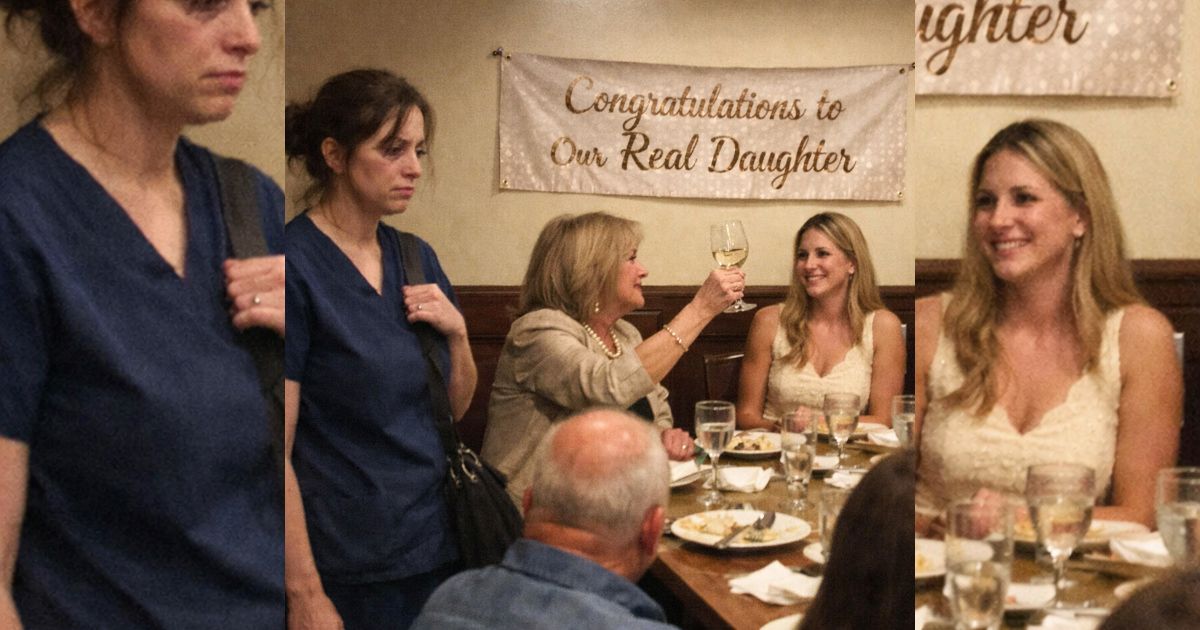
A wide white banner stretched across the room in glittering gold letters.
CONGRATULATIONS TO OUR REAL DAUGHTER
For one strange second, I thought maybe I had read it wrong.
Maybe my brain had skipped a word.
Maybe there was more to the sentence from where they were sitting.
Maybe it said something else entirely.
But it didn’t.
It said exactly what it said.
And no one in that room looked shocked that I was standing there reading it.
My mother noticed me first.
She gave me the kind of smile people use when the delivery driver finally arrives.
“Oh good,” she said. “You made it.”
That was all.
No apology.
No surprise.
No, Hannah, we should have explained.
No, Hannah, please sit down.
Just:
Oh good.
You made it.
Tessa’s eyes moved over me from head to toe and landed on my scrub top.
“Still in uniform?” she asked, smiling in a way that did not feel like a smile. “You really came straight from work.”
I swallowed.
“Shift ran late.”
My father gave a little nod, like that settled some administrative detail.
One of the waiters slid a spare chair toward the very end of the table.
No one shifted to make room.
No one reached for my arm.
No one said they had saved me a seat.
I sat where the chair was placed, which was half in the circle and half out of it, like an afterthought.
I kept staring at the banner.
I kept waiting for someone to laugh and say, “We know, it sounds dramatic, let us explain.”
But they didn’t.
My mother tapped her fork gently against her water glass.
The room quieted.
She stood.
And the expression on her face was one I had spent my whole life trying to earn.
Pride.
Warmth.
A shine in her eyes.
The problem was, none of it was for me.
“To Tessa,” she said, lifting her glass. “Our real daughter. Finally, something wonderful to celebrate.”
The room answered with a bright chorus of cheers and crystal clinking against crystal.
I didn’t move.
My hands were flat under the table.
My heart was beating slowly and heavily, like it had decided panic was too small a reaction for this.
Tessa laughed and pressed her fingertips to her chest like a pageant winner pretending to be surprised.
“Oh, Mom,” she said.
Then she looked straight at me.
“Okay,” she said. “Before Hannah faints, I’ll explain.”
A few people laughed.
I heard it.
Every single person at that table heard it.
Tessa leaned back in her chair and crossed one leg over the other.
“I sent off one of those DNA kits a couple months ago,” she said. “Mostly for fun. I wanted to see the ancestry breakdown and all that.”
She shrugged.
“But the results came back, and it turns out I’m fully Mom and Dad’s biological daughter. No donor mix-up, no outside match, no surprise branch on the tree. Just me. One hundred percent theirs.”
More laughter.
More applause.
One aunt actually dabbed at the corner of her eye.
My father smiled into his glass.
My mother looked like she had been handed proof of heaven.
I turned to her.
Then to him.
Then back to Tessa.
“What does that mean about me?” I asked.
My voice did not crack.
That almost made it worse.
For a second, there was a pause.
Not because they felt bad.
Because I had made them stop the party long enough to remember I existed.
My mother sat down slowly.
“Well,” she said, smoothing the edge of her napkin, “back then things were complicated.”
My father cleared his throat but did not add anything.
Tessa picked up the story again.
“Basically,” she said lightly, “Mom and Dad thought both embryos were from the same process. Turns out mine was theirs. Which means yours…” She lifted one shoulder. “Might not have been.”
Might not have been.
Like she was talking about a monogram mistake on a sweater.
Like my whole life had wandered into the wrong closet.
I looked at my parents.
My mother did not deny it.
My father did not deny it.
Neither of them rushed to soften the words.
Neither of them said, Hannah, sit down, we should have told you privately.
Instead my mother gave me a thin, practiced smile.
“It doesn’t change anything important,” she said. “You’re still family.”
Still family.
I had heard people use warmer language to talk about a neighbor’s cat.
One of my cousins leaned toward another and whispered something that made them both laugh behind their napkins.
Tessa took a sip of wine and said, “Honestly, it explains a lot.”
I turned to her.
She widened her eyes with fake innocence.
“You’ve always felt… different.”
Different.
That word had followed me through my entire childhood like a shadow with good posture.
Different because I had darker hair than anyone else in the family.
Different because I cried at school concerts and nobody else did.
Different because I loved books more than parties.
Different because I didn’t know how to sparkle on command.
Different because family photos always looked like somebody had arranged the people in order of importance and then set me just outside the frame.
My mother reached for the bread basket.
My father asked one of the waiters for more ice.
The room resumed movement around me like nothing sacred had just been broken open.
I stared at the white tablecloth.
The pattern in the fabric blurred.
I realized suddenly that I was cold.
Not the kind of cold that belongs to weather.
The kind that starts in your chest when something true has just been spoken in a room full of people who think the truth is entertaining.
That was when the waiter approached.
He came from the side, quiet and careful, carrying a single cream-colored envelope on a small tray.
He stopped beside my chair.
“For you,” he said softly.
I looked up.
He lowered his voice even more.
“The owner asked that I place this directly in your hand.”
The room noticed immediately.
Of course it did.
This was fresh material.
New drama.
Another twist for the party.
My mother frowned.
Tessa tilted her head.
My father looked annoyed, as if the evening’s program had been interrupted by an unapproved side event.
I took the envelope.
My name was written on the front in dark ink.
Just:
Hannah
No last name.
No flourish.
No stamp.
But the handwriting hit something in me like a distant bell.
It felt familiar.
Old.
Not recent.
Not casual.
Intentional.
I turned it over.
The seal was unbroken.
Tessa laughed lightly.
“Well,” she said, “now I’m curious.”
I slipped the envelope into my coat pocket.
“Imagine that,” I said.
That earned me a look from my mother.
The room shifted again.
Someone asked for dessert menus.
My aunt wanted a photo under the banner.
Tessa stood to pose with my parents, all three of them smiling under those glittering words.
Our real daughter.
I should have walked out right then.
Instead I stayed there another minute, maybe two.
Long enough to understand something I had always known but never allowed myself to say plainly.
That banner hadn’t been a joke.
It hadn’t been thoughtless.
It had been designed.
Printed.
Hung.
Approved.
Seen.
They had planned an entire evening around celebrating the fact that one daughter was real.
And had still expected the other one to attend.
That kind of cruelty doesn’t happen by accident.
That kind of cruelty wears lipstick and reservations and says big news in the group chat.
I rose quietly.
“I’m stepping outside,” I said.
No one asked if I was okay.
No one said they would come with me.
My mother just waved her fingers absently, already turned back toward Tessa.
I walked out of the dining room, down the hallway, through the front doors, and into the cold evening air.
Only then did I pull the envelope back out.
The lantern by the entrance cast a warm circle of light across the cream paper.
I could hear laughter through the walls.
The scrape of chair legs.
A fork tapping a plate.
If anyone had looked through the window, they would have seen a perfectly ordinary family dinner unfolding inside.
A celebration.
A memory in the making.
Outside, under the lantern, I stood shaking so hard I had to hold the envelope with both hands.
The paper was thick.
Expensive.
Not something bought in a last-minute rush at a drugstore.
I traced my thumb over my name.
And suddenly I knew why the handwriting felt familiar.
Grandpa Walter.
I had not seen his handwriting in years.
Not since I was little.
Back when he used to send me birthday cards with five-dollar bills tucked inside and notes written in a slanted script that somehow made even my name look protected.
My throat tightened.
I turned the envelope over and broke the seal.
Inside was one folded sheet.
Nothing else.
No official letterhead.
No photographs.
No documents.
Just paper.
I opened it carefully.
The first line blurred before I had finished reading it.
Hannah, if you’re reading this, then they finally told you something. Maybe not the truth. But something.
My knees nearly gave way.
I sat down hard on the stone bench near the entrance.
The night air smelled like dry leaves and car exhaust and rain that hadn’t arrived yet.
I kept reading.
I have waited years for this moment. Longer than I should have. Longer than you deserved. I was asked to stay quiet. I told myself silence was protecting you. I know now it mostly protected them.
I pressed one hand flat against my chest.
My heartbeat was strange.
Not fast.
Deep.
Like each beat had to travel through years to reach me.
Your mother was not Marlene.
I stopped.
I read that line again.
Then again.
Not because I didn’t understand it.
Because I did.
Perfectly.
And understanding it all at once felt like stepping onto a stair that wasn’t there.
I looked back through the restaurant window.
My mother was laughing at something near the cake.
Tessa was talking with both hands.
My father was smiling.
I dropped my eyes to the letter.
Your mother was a woman named Caroline Bennett. She was my daughter’s closest friend. The two of them were nearly inseparable from the age of fourteen. Caroline was bright, stubborn, musical, and full of more heart than most people know what to do with. When she had you, she said she had finally met the person she had been waiting for all her life.
The words shook in my hands.
Caroline.
My mother had a name.
My real mother had a name.
A name no one in my family had ever said aloud.
Not once.
Not in anger.
Not by mistake.
Not during one of those long childhood afternoons when kids ask where they got their eyes or their laugh or the shape of their hands.
Never.
I kept reading.
When you were still an infant, Caroline passed away unexpectedly. I cannot write those details here. They belong to her, and to you, and I want to tell you myself if you will let me. What matters now is this: after she was gone, Marlene offered to take you in. She said it would keep you safe, keep you close, keep you surrounded by people who knew your mother. I believed her. I wanted to believe her. She was my daughter.
A car passed in the lot.
Its headlights swept over the stone path and vanished.
I read the next lines with my whole body braced.
But over time I learned something painful. She did not want to raise Caroline’s child with tenderness. She wanted to rewrite the story in a way that made everything easier for herself. Cleaner. Simpler. More flattering. She took your past and put it in a drawer. Then she acted as though the drawer had never existed.
My vision blurred.
I wiped at my face and felt tears I had not noticed begin to fall.
Inside the restaurant, someone had started singing.
Probably for dessert.
Probably for Tessa.
I kept reading.
I tried to stay close to you. You may remember that. I came to birthdays when I was allowed. I sent letters until the letters stopped reaching you. I kept photos, journals, notes, hospital bracelets, and every piece of your mother I could preserve. I have them still. If you want them, they are yours. They were always yours.
I pressed the paper against my coat to steady it.
Something old and aching in me had started to wake up.
Not memory.
Recognition.
Those strange moments growing up when Grandpa Walter would kneel beside me at family picnics and say things like, “You have your own kind of strength,” or “Don’t let anyone teach you to disappear.”
The way he looked at me during school recitals.
The extra beat of softness in his face when everyone else clapped politely and then turned back toward Tessa.
The quiet certainty in him.
As if he had always known something I would one day need.
The final lines were shorter.
Shakier.
Come see me tonight if you can. The porch light will be on. I will tell you what should have been told years ago. Whatever you choose after that, I will respect it. But you deserved the truth long before this dinner.
With love,
Grandpa Walter
For a while, I just sat there.
The letter in my lap.
My hands cold.
The restaurant glowing behind me like another world.
I thought about walking back in.
About holding the paper up over the table.
About asking my mother, in front of everyone, whether Caroline Bennett’s name had ever once burned her tongue.
About asking my father how many times he had helped carry this lie from one year to the next.
About asking Tessa whether being the real daughter still felt as glamorous if everyone in the room knew the full cost of the role.
But the truth had already changed shape inside me.
Five minutes earlier, I had still been begging for a place at that table.
Now I knew that table had never been mine.
They were not about to hand me dignity.
They had spent years charging rent on belonging.
I was done paying.
I folded the letter carefully.
Slipped it back into the envelope.
Stood.
Then I walked straight to my car.
I did not go back inside.
I did not text anyone.
I did not explain.
I drove across town to Grandpa Walter’s house with the windows up, the heater low, and both hands locked around the steering wheel.
The whole drive felt unreal.
Every stoplight too bright.
Every storefront too ordinary.
There should have been thunder.
Or sirens.
Or some visible crack opening in the middle of Main Street.
Instead there were Christmas lights left up too long on one porch and a teenage boy crossing at the light with a pizza box under his arm and a woman filling her car at a gas station like this was just another Wednesday.
Maybe that was the strangest part.
The world had not changed at all.
And mine had.
Grandpa Walter lived in the same little white house he had lived in for as long as I could remember.
Deep porch.
Wind chime by the side window.
A wooden swing that creaked when anyone over the age of ten sat on it.
The porch light was on.
He was already outside.
He rose slowly when he saw my headlights.
He did not wave.
He did not call out.
He just stood there with both hands at his sides, waiting.
I parked and got out.
We looked at each other across the short front walk.
He seemed older than he had even a month before.
Smaller somehow.
But his eyes were steady.
Not guilty.
Not evasive.
Steady.
“I’m sorry,” he said before I reached the porch.
That was all it took.
I climbed the steps and fell into his arms like I was very young and very tired and had finally found the one place where I would not need to explain why I was crying.
He held me for a long time.
Longer than anyone had held me in years.
Maybe longer than anyone ever had.
When he finally let go, he kept one hand on my shoulder and looked into my face the way people do when they are making sure you are really there.
“I hated tonight,” he said quietly. “Every minute of it.”
I nodded because I could not speak.
He opened the front door and led me inside.
The house smelled like cedar and coffee and old books.
Nothing had changed.
Crocheted throw over the sofa.
Family Bible on the side table.
A lamp with a shade that leaned slightly left.
But the room felt different now.
Not smaller.
Not older.
Closer.
Like a place I had visited all my life had suddenly opened an inner door.
On the coffee table sat a wooden box.
Dark walnut.
Brass latch.
My eyes went straight to it.
He noticed.
“Yes,” he said. “Those are yours.”
I looked at him.
“All of it?”
He nodded.
“All the pieces I could save.”
He motioned for me to sit.
I lowered myself onto the couch, still wearing my work pants, still carrying the smell of antiseptic and hand soap and long hours.
He sat in the armchair across from me and rested both hands on his knees.
For a moment we just listened to the old wall clock in the hallway.
Tick.
Tick.
Tick.
I thought of all the years that clock had kept time while my own story sat boxed on a coffee table I had never been invited to open.
“I don’t know where to start,” I said.
“You don’t have to,” he answered. “I can.”
So he did.
He told me Caroline Bennett grew up on the south side of town in a little blue house with a wraparound porch and a piano that was almost always out of tune.
He told me she had laugh lines by the time she was twenty-four because she smiled with her whole face and did not know how to do anything halfway.
He told me she taught beginner music classes at the community arts center and sometimes came home with glitter on her shoes because the children she taught liked to decorate everything, including teachers.
He told me she was brave in quiet ways.
The kind that do not earn headlines.
The kind that show up as steadiness.
As work.
As showing up.
As choosing tenderness over spectacle.
I listened like a thirsty person.
Every fact mattered.
What songs she liked.
How she took her coffee.
That she wrote in journals.
That she cried at old movies and laughed at bad puns and kept a stack of blank cards in a kitchen drawer because she believed people should never wait too long to say something kind.
“She loved you before there was even a you to hold,” he said.
His voice trembled a little on that line.
“She talked to you all the time. Called you her little heartbeat.”
I covered my mouth.
No one had ever told me I had been loved like that.
Not in detail.
Not with shape and texture.
Loved, in my life, had mostly been presented as a duty.
A roof.
A ride to school.
A check signed for tuition.
A Christmas gift bag with tissue paper.
Loved had never been given to me as a living thing.
Something warm.
Something eager.
Something that woke up every day wanting me.
Grandpa Walter opened the box.
Inside were neat bundles tied with ribbon.
Letters.
Small photo envelopes.
A hospital bracelet in a tiny plastic sleeve.
A folded receiving blanket.
Two greeting cards.
And on top, a photograph.
He handed it to me first.
It showed a hospital room washed in afternoon light.
A woman with chestnut hair and soft, tired eyes sat propped against white pillows, holding a swaddled newborn close to her chest.
She was not posing.
That was what made it unbearable.
She was looking down at the baby in her arms with a private, open expression I had never seen directed at me in my life.
Joy.
Wonder.
Relief.
The kind of look that says there you are.
I stared at her face.
Then at the baby.
Then back at her.
I knew that face.
Not from memory.
From my own mirror.
The line of the nose.
The shape of the chin.
The eyebrows that turned slightly upward at the outer corners.
I looked like her.
I looked like someone.
Something inside me, something that had spent years standing alone in a dark room, finally found a light switch.
“That’s her,” I whispered.
“Yes,” he said.
I cried so hard then I had to bend forward.
Not because I was only sad.
It was larger than sadness.
It was grief mixed with relief mixed with fury mixed with the strange quiet joy of finally seeing proof that I had not imagined my own displacement.
I had always known, in ways I was ashamed to say out loud, that I did not fit.
Not emotionally.
Not physically.
Not even in the tiny unconscious ways families sometimes mirror each other.
The same smile.
The same walk.
The same way of using their hands while talking.
Around my family, I had always felt like I was performing daughterhood from observation.
Now, looking at Caroline’s face, I understood why.
I had not been difficult.
I had not been cold.
I had not failed to belong.
I had been looking for myself in the wrong room.
Grandpa Walter let me cry.
He did not rush me.
He did not tell me to breathe.
He did not use any of the phrases people say when they want emotions to tidy themselves quickly.
When I sat up again, he handed me a folded handkerchief from his pocket.
I smiled through tears.
“That is the most you thing I’ve ever seen,” I said.
He smiled too.
“She loved handkerchiefs,” he said. “Always said tissue made grief feel cheap.”
I laughed unexpectedly.
Then cried again because now I had inherited even the humor of a woman I had never met.
He handed me one of the bundles from the box.
“These are from during her pregnancy,” he said. “Letters she wrote to you.”
I untied the ribbon carefully.
The top page was dated in neat blue ink.
May 14
I began to read.
Little heartbeat,
Today I heard you for the first time, and I laughed right there in the office because you sounded so certain. Not loud. Certain. Like you were already announcing yourself to the world. I walked back to the car and sat there with both hands on my stomach and thought, well, there you are. I’ve been waiting for you.
The words blurred immediately.
I blinked them clear.
Read on.
I know I cannot promise you an easy life. I can promise you a loved one. I can promise you music in the kitchen, books by the bed, and somebody in the front row every time you do anything brave or silly or new. I can promise that home will be the place where you never need to audition.
I had to stop.
The room had gone very quiet.
Not outside quiet.
Inside quiet.
The kind that happens when an absence finally gets named.
Never need to audition.
That line found every year of my childhood at once.
Every time I waited in the school pickup line hoping my mother would remember it was my turn and not Tessa’s.
Every birthday where she got the bakery cake and I got whatever was left in the pantry and a distracted apology.
Every recital where my father checked his phone until Tessa went onstage and then suddenly sat up straight.
Every holiday photo where my mother adjusted Tessa’s collar three times and forgot mine was twisted.
Every adult in my life who praised me for being so mature, so independent, so low-maintenance, which was just a polished way of saying easy to neglect.
Never need to audition.
My real mother had wanted that for me.
A home where love did not have a scoreboard.
I read another letter.
Then another.
Some were funny.
Some practical.
One detailed her plan for a tiny yellow nursery with a moon lamp and a shelf full of thrifted children’s books.
Another talked about how she hoped I would love Sunday pancakes and rainy-day movie marathons.
One letter was written after I was born.
The paper was softer from folding.
You have a serious little face when you sleep, like you are solving something. Then you wake up and stretch one hand near your cheek and suddenly the whole room feels brighter. I keep looking at you and thinking I had no idea a person could arrive already feeling familiar.
I pressed the page to my lips.
My entire life I had been the serious one.
The reliable one.
The girl everyone described with words like sensible and calm and helpful, as if personality could be reduced to inconvenience avoided.
Here, in Caroline’s handwriting, even my seriousness had been loved.
Seen.
Welcomed.
Not tolerated.
Loved.
I don’t know how long we sat there.
Time did not behave normally that night.
It stretched and folded and circled back.
Grandpa Walter told me how Caroline had trusted Marlene at first because they had once been close.
How the arrangement after Caroline’s death had been spoken of as temporary in the beginning.
How temporary slowly hardened into permanent because everyone around the situation chose convenience over courage.
“Did she mean to tell me?” I asked. “Marlene.”
He took a long breath before answering.
“Yes,” he said. “Many times, I think. But meaning to and doing it are not the same thing. And then years pass. Shame grows roots. People get attached to the version of themselves that survives the lie. After that, truth feels expensive.”
I looked down at the letters in my lap.
“She had decades.”
“I know.”
“He had decades.”
“I know.”
“And Tessa?”
He hesitated.
“Tessa knew pieces,” he said carefully. “Not all of them. But enough to know tonight should never have happened.”
That hurt too.
Maybe not as deeply as my parents’ silence.
But sharply.
Because for all our distance, Tessa knew how hard I had spent my whole life trying.
She knew I was the one who drove our mother to her appointments when she forgot.
The one who picked up prescriptions.
The one who sent Father’s Day cards even after years of being answered with little more than a thumbs-up reaction.
She knew.
And still she stood under that banner.
Still she glowed.
Still she made my existence a punchline in a room full of witnesses.
Grandpa Walter reached into the box again and pulled out one final envelope.
This one was smaller.
Yellowed more at the edges.
My name was written on the front in different handwriting.
Rounder.
Younger.
This, I realized instantly, was Caroline’s.
“I was saving that for when you were ready,” he said.
“I wasn’t ready,” I whispered.
“No,” he said gently. “But maybe you are now.”
I opened it.
The paper inside smelled faintly old, like drawers and cedar and time.
My Hannah,
If you ever read this, it means life unfolded in a way I did not get to witness. That is hard for me to imagine, so I am going to write to you as though I am simply in another room and will be back soon.
I inhaled sharply.
I hope you know this first: you were wanted. Not in a general way. Not in a “someday maybe” way. You were hoped for specifically. I wanted you. I chose you before I knew your face.
Tears fell onto the paper and I wiped them away quickly.
If anyone ever makes you feel like an extra in your own life, please remember that they are speaking from their own smallness, not yours. You come from love. You come from music. You come from women who survived hard things and still kept something tender in reserve for the people they loved.
I laughed softly through my tears.
Women.
Plural.
She had left me a lineage even in one paragraph.
Please do not spend your years begging for crumbs where a table was never set for you. Build your own. Invite kind people. Serve warm food. Let there be laughter. Let there be truth. Let there be room for you exactly as you are.
My hand shook.
I could barely see the final lines.
You are not here to become acceptable. You are here to become yourself.
Love always,
Mom
Mom.
The word looked simple and impossible all at once.
I held the letter against my chest and closed my eyes.
There are moments in life when you realize the story you built yourself around was made of missing pieces.
And there are rarer moments when the missing pieces arrive not as punishment but as rescue.
That letter rescued me.
Not from pain.
Pain was there, and it would be there for a long time.
It rescued me from the lie hidden beneath the pain.
That I had been less wanted.
Less lovable.
Less real.
For the first time in my life, I knew with total clarity that none of those things had ever been true.
I was not the extra daughter.
I was not the stand-in.
I was not a mistake left over from someone else’s plan.
I was the daughter of a woman who wrote letters to me before I could breathe on my own and a man sitting across from me who had kept those letters safe through years of silence because he could not bear to let me lose every piece of her.
That was family too.
Maybe that was family in its truest form.
Not the people who performed it best.
The people who protected truth when truth was all they had left to give.
I stayed with Grandpa Walter that night.
He made tea around midnight even though neither of us really drank it.
He toasted bread and forgot the second slice in the toaster.
We laughed at that.
Then he showed me more photographs.
Caroline in a sunflower field.
Caroline at the piano.
Caroline holding me in a knitted yellow cap.
Caroline in a grocery store aisle, visibly pregnant, laughing at whoever had taken the picture.
“Who took these?” I asked.
“Me, some of them,” he said. “Some my daughter took. Before everything got complicated.”
I nodded.
That was the word everyone uses when they don’t want to say cruel.
Complicated.
As if betrayal were simply poor organization.
By two in the morning, I had learned more about myself than I had learned in the previous thirty-two years combined.
My middle name, which Marlene had always claimed she chose because it sounded elegant, was actually Caroline’s grandmother’s name.
The lullaby I had always found myself humming without knowing where I learned it was one Caroline used to sing while rocking me.
My love of old paper, quiet rooms, rainy windows, lemon tea, secondhand bookstores, and children who ask serious questions had not come out of nowhere.
They had roots.
I had roots.
Somewhere around 2:40 a.m., exhaustion caught up with me.
Grandpa Walter made up the guest room and left a glass of water on the nightstand.
As I stood in the doorway, I turned to him.
“Why tonight?” I asked. “Why now?”
He looked so tired then.
Tired in a way that had nothing to do with age.
“Because when I saw that banner,” he said, “I knew silence had become its own kind of cruelty. And I decided I was done helping it.”
I nodded.
There was nothing to add.
I slept in a room wallpapered with pale blue flowers and woke up just after sunrise to birds in the front yard and the smell of coffee drifting down the hall.
For a second, before memory returned, I felt light.
Then the entire previous night came flooding back.
The dinner.
The banner.
The letters.
Caroline.
I sat up in bed and expected to feel broken.
Instead I felt sore.
Tender.
Raw.
But not broken.
Something important had shifted.
The ache was still there, but underneath it was a kind of steadiness I had never known.
Truth does that.
Even painful truth.
It gives your pain a floor to stand on.
At breakfast, Grandpa Walter made eggs and overcooked them and apologized three times.
I ate every bite.
We sat at his tiny kitchen table while morning light pushed across the linoleum.
He asked what I wanted to do next.
Not what I should do.
Not what would be proper.
What I wanted.
The question startled me so much I had to set down my fork.
No one in my family had ever asked it like that.
People had asked about plans.
Schedules.
Availability.
But wanting was different.
Wanting assumed I had a self to consult.
“I don’t know yet,” I admitted.
“That’s all right,” he said. “You don’t have to know today.”
I looked down at my coffee.
Then out the window at his little backyard with the crooked bird feeder and the hydrangeas that never bloomed on schedule.
“I know one thing,” I said quietly. “I’m not going back there.”
He nodded once.
Not triumphant.
Not relieved.
Just certain.
“You don’t have to.”
That morning, while Grandpa Walter sorted through more boxes in the hall closet, my phone lit up again and again on the table beside me.
I ignored it for a while.
Eventually, I picked it up.
The family group chat had twenty-three new messages.
Photos from the dinner.
Tessa under the banner.
My mother calling the evening unforgettable.
An aunt posting heart emojis.
A cousin saying the truth always comes out.
Then a direct text from my mother.
You left abruptly. I wish you had handled that with more grace.
Another from my father.
Call your mother. She’s upset.
Then from Tessa.
I honestly didn’t think you’d take it so personally.
I stared at that one for a long time.
Take it so personally.
As if I had been informed the restaurant changed brands of sparkling water.
As if identity were a scheduling conflict.
I set the phone facedown.
Grandpa Walter returned with another small album in hand and took one look at me.
“You don’t owe immediate responses to people who were not gentle with you,” he said.
I looked at him.
“Have you always known exactly what to say?”
“No,” he answered. “But I have had a very long time to think.”
That day turned into the first honest day of my life.
Not the happiest.
Not the easiest.
Honest.
And honesty brought its own strange peace.
I called the hospital and asked if I could switch out of my next shift because of a family matter.
My charge nurse, who had seen me hold myself together through things most people would collapse under, heard something in my voice and said yes before I finished the sentence.
Then I drove to my apartment.
A small second-floor place over a hardware store.
Not glamorous.
But mine.
I stood in the middle of my living room and looked around as if seeing it for the first time.
The cheap couch I bought after picking up three extra holiday shifts.
The bookshelf I assembled alone with a butter knife because I had lost the screwdriver.
The little lamp by the chair where I drank coffee on Sundays.
Everything in that room had been built by me.
Paid for by me.
Chosen by me.
There was comfort in that.
I packed one overnight bag and then another.
Not because I planned to move in with Grandpa Walter permanently.
Because I needed distance.
Space.
A place where every object was not tangled up with people who had watched me disappear and called it family harmony.
By afternoon, my mother had moved from offended to strategic.
Her next text was softer.
I think things got emotional last night. We should discuss this calmly.
An hour later:
No matter what, we raised you.
Then:
You are creating a lot of unnecessary drama by staying away.
I did not respond.
My father sent only one more message.
This does not need to become a public family issue.
That one almost made me laugh.
Public family issue.
As though hanging a banner announcing one daughter real and the other not had been a private devotional act.
Tessa sent a voice message I never opened.
Instead, I sat on my apartment floor surrounded by old work shoes and laundry baskets and allowed myself to remember.
Memory changed shape quickly once truth entered it.
Suddenly childhood scenes I had once filed under oversensitive or awkward or maybe I imagined that now stood up straight and called themselves what they were.
I remembered being eight and asking my mother why my hair was dark when hers and Tessa’s were light.
She had smiled too brightly and said, “Families get all kinds.”
I remembered being ten and bringing home a certificate from school for reading more books than anyone in my grade.
My father glanced at it and said, “That’s nice.”
Three days later, Tessa got selected to wave from the homecoming parade float and the entire family came out to watch like a royal event.
I remembered my eleventh birthday cake.
A store-bought vanilla sheet cake with my cousin’s name still faintly visible under the frosting because my mother had scraped it off after someone canceled a party.
I remembered Tessa’s twelfth birthday one year later.
Custom bakery cake.
String quartet playlist.
Monogrammed favor boxes.
I remembered learning to keep my expectations small because small expectations hurt less when they were dropped.
I remembered being praised for being mature whenever I swallowed disappointment quickly.
I remembered every family dinner where I became useful the moment attention drifted away from me.
“Hannah, can you help clear?”
“Hannah, can you run out to the car?”
“Hannah, you’re so good at these things.”
These things.
All the invisible labor that keeps a household smooth while somebody else gets photographed in the center of it.
The pain of that day was real.
But beneath it was also a rising anger I had never fully allowed myself.
Not wild anger.
Clear anger.
The kind that does not shatter windows.
The kind that opens them.
By evening, I was back at Grandpa Walter’s with two bags, a stack of Caroline’s letters, and the sense that something final had ended even if no one else had agreed to call it final yet.
He did not make a speech.
He just took one of my bags and said, “Guest room closet’s got more space than you’d think.”
I smiled.
That small kindness nearly undid me all over again.
Over the next few weeks, my life split into before and after.
Before, I spent enormous amounts of energy trying to translate every cold glance from my family into something understandable.
After, I stopped translating.
I let things be what they were.
Cruel if cruel.
Selfish if selfish.
Careless if careless.
There is strange freedom in no longer decorating other people’s behavior with prettier language than it deserves.
I kept working.
Hospital life did not pause because my personal history had detonated.
Patients still needed medications.
Families still needed updates.
New nurses still needed help learning which supply closet held the good IV tape and which one always looked full but somehow never had anything useful in it.
But I was different at work too.
Lighter in some places.
More solid in others.
One afternoon, a student nurse burst into tears in the medication room after a rough interaction with a patient’s daughter.
Before, I might have offered practical reassurance and moved on.
That day I sat on the little stool beside her and said, “You do not need to become smaller so someone else can feel bigger.”
The words were for her.
They were also for me.
She looked at me through tears and nodded.
Later, I wrote the line down on a sticky note and tucked it inside one of Caroline’s letters.
At Grandpa Walter’s house, evenings settled into a rhythm.
Supper at the small kitchen table.
Stories after.
Sometimes about Caroline.
Sometimes about me.
Sometimes about nothing important at all.
The weather.
The bird feeder.
Whether canned peaches had gotten worse in quality or we were simply older and harder to impress.
He showed me a notebook where Caroline had written down song ideas.
He showed me the little silver rattle I had once held as a baby.
He showed me a recipe card in her handwriting for lemon pound cake and said, “She never made it the same way twice.”
I began to understand something I had never known how to name.
Belonging is not always loud.
Sometimes it is just being handed your own history without having to fight for every piece.
One Sunday afternoon, I drove to the county records office.
Not because anyone told me to.
Because I wanted to see my own paperwork with open eyes.
The woman at the desk was kind and efficient and did not ask intrusive questions.
I requested copies I had never before thought to request.
Birth records.
Guardianship documents.
Anything attached to my original file.
Some of it was bureaucratic and dry.
Some of it was incomplete.
Some of it revealed things in the bland language of systems that had no idea their forms were holding people’s lives.
My name at birth.
My mother’s signature on one line.
A note indicating temporary custodial transfer after her death.
Another form revised later.
Permanently.
Each document felt both devastating and clarifying.
Paper does not cry.
It does not apologize.
It just records.
And there, in clean black type, was proof that my life had once had another shape before Marlene and Gerald folded it into theirs and sealed the edges.
I took the folder back to Grandpa Walter’s house and placed it on the kitchen table.
He looked at it for a long time.
Then he looked at me.
“You don’t have to carry all of this at once,” he said.
“I know,” I answered. “But I want to stop carrying guesses.”
That was the week I decided to change my name.
Not impulsively.
Not dramatically.
Quietly.
Certain things, when they are right, do not arrive with fireworks.
They arrive with a settling.
A click.
A feeling like your ribs finally know how to hold what is inside them.
I stood in front of the bathroom mirror one morning and said it aloud.
“Hannah Bennett.”
Then again.
“Hannah Bennett.”
The sound of it moved through me like a key finding the right lock.
My current last name had always felt like wearing a coat that technically fit but belonged to someone else.
Bennett felt warm.
Specific.
Mine.
I filed the petition.
The clerk at the courthouse asked me to confirm the spelling.
I did.
She stamped the paperwork and slid it back toward me.
The sound of that stamp landed harder than I expected.
Official.
Ordinary.
Transforming.
When I walked back to my car, I sat behind the wheel and cried for several minutes.
Then I laughed.
Then I called Grandpa Walter.
“Well?” he said when he answered.
“I did it.”
There was a pause.
Then very softly, “Your mother would have loved that.”
Weeks passed.
I did not return my family’s calls.
At first they came often.
My mother cycled through indignation, woundedness, guilt, performance, and then something almost like bargaining.
We may not have handled things perfectly, but we gave you a good life.
You are forgetting all we did for you.
Families survive worse than this when people choose forgiveness.
Your grandfather has filled your head with one side of the story.
That line angered me most.
Not because it was new.
Because it was their oldest trick.
When truth arrives, call it one side.
When hurt names itself, call it dramatic.
When a person stops accepting scraps, call them ungrateful.
My father’s messages were fewer and colder.
Mostly logistical.
Your mother wants to know if you will attend Easter.
There are some family items at the house if you want them.
We would prefer this not be discussed with extended relatives.
Tessa texted late one night.
A long message.
I read it twice.
It said she had not known the whole story.
It said the banner had been my mother’s idea.
It said she got caught up in the moment.
It said I had always judged her too harshly.
It said none of this erased the fact that I had been lucky to grow up in a stable home.
That line told me everything.
Lucky.
That word people use when they want gratitude to cover a multitude of wounds.
I typed three replies and deleted all of them.
Then I locked my phone and went to bed.
Silence was not weakness this time.
It was selection.
I was choosing where my life could go and where it could not.
At work, a few people noticed the shift in me before I said anything.
My friend Jenna from pediatrics looked at me during lunch and said, “You seem… not happier exactly. But clearer.”
I smiled.
“That’s fair.”
I did not tell everyone the full story.
I told a few trusted people enough.
That my family had hidden major truths.
That I had found my biological family history through my grandfather.
That I was changing my name.
That I was stepping away from certain relationships for my own peace.
No one I trusted said, but they’re still your family.
That surprised me.
Maybe because healthy people do not confuse access with entitlement as often as unhealthy systems teach you they should.
One evening, after my court order came through and the name change was official, Grandpa Walter took me out to dinner.
Nothing fancy.
A small diner on the edge of town with red vinyl booths and pie in a rotating case.
We sat by the window.
He ordered meatloaf.
I ordered grilled cheese and tomato soup like I was twelve.
Halfway through the meal, he reached into his coat pocket and slid something across the table.
A key.
Old brass.
“This was Caroline’s piano bench key,” he said. “I kept it because I couldn’t bear to lose little things. Her old piano is in storage. Needs work. But if you want it someday, it’s yours.”
I held the key in my palm and thought about inheritance.
How my family had treated it like blood proof and banners and public approval.
How the things I was inheriting now were quieter.
A piano key.
Letters.
Recipes.
A name.
The knowledge that I had once been deeply wanted by someone who did not get to stay.
I closed my fingers over the key.
“Thank you,” I said.
He nodded.
Then, because he knew when to save a moment from becoming too heavy, he added, “Don’t thank me until we see if that piano still behaves itself.”
I laughed.
That spring, I moved fully into a small rental house three streets over from Grandpa Walter.
Tiny place.
Blue shutters.
Front porch wide enough for two chairs and a pot of geraniums.
Nothing about it was impressive.
Everything about it felt peaceful.
I unpacked slowly.
On the first shelf I placed Caroline’s photograph.
Not hidden.
Not dramatic.
Just present.
On the kitchen counter, I propped up the lemon pound cake recipe.
In the living room, I set out the old letters in a cedar box.
I bought a secondhand keyboard and started teaching myself the lullaby Caroline used to sing.
Some notes were wrong at first.
Then less wrong.
Then something close to whole.
Grandpa Walter came by often.
Sometimes with groceries I did not ask for.
Sometimes with stories he had forgotten until that moment.
Sometimes just to sit on the porch and complain about the way modern tomatoes had no real flavor.
For the first time in my life, home began to feel less like a place I had earned and more like a place I inhabited naturally.
No auditions.
Just presence.
Months after the dinner, my mother sent a letter.
Not a text.
A letter.
I almost laughed at the irony of it.
She had chosen paper now.
When it was too late.
I opened it at the kitchen table with Grandpa Walter nearby, shelling peas into a bowl.
The letter was polished.
Measured.
A masterpiece of partial accountability.
She said she regretted how the news had come out.
She said emotions had been high.
She said everyone had done what they thought best under impossible circumstances.
She said she had loved me “in her own way.”
I put the letter down after that sentence.
In her own way.
There it was.
The final confession disguised as defense.
Because some ways of loving are so consistently self-serving they stop being love and become management.
I folded the letter once.
Twice.
Then slid it into a drawer.
I never answered.
Not because I wanted revenge.
Because I was no longer interested in conversations where I had to reduce my pain into something easy enough for the person who caused it to digest.
By then, my life had already begun growing in better soil.
I started volunteering one Saturday a month at the community arts center where Caroline had once taught.
I did not choose music at first.
I signed up for whatever they needed.
Snack table.
Registration.
Helping little kids find their grown-ups after class.
Then one teacher called out sick and they asked if I could sit with the beginner keyboard group for an hour because, “You play, right?”
I almost said no.
Then I thought of Caroline in those classrooms, coming home with glitter on her shoes.
So I said yes.
The room was full of seven-year-olds pounding keys with more joy than technique.
By the end of the hour, one little girl with missing front teeth looked up at me and asked, “Do you teach here?”
I smiled.
“Not officially.”
“You should,” she said. “You’re patient.”
Patient.
It hit me strangely.
That had always been the quality people praised when they wanted to make my endurance feel noble.
But here, in that classroom, patience felt different.
Not like shrinking.
Like offering space.
I began covering classes occasionally.
Then regularly.
It was not a second career.
Not a dramatic reinvention.
Just another thread joining.
Nursing by day.
Music and community when I had time.
A life built rather than inherited.
On the first anniversary of the dinner, I did not hide.
I did not collapse either.
I took the day off.
In the morning, I went to the cemetery with Grandpa Walter and a small bunch of yellow flowers because Caroline had loved yellow.
We stood in the quiet and said the things people say when love has outlived time.
Not perfect speeches.
Just true ones.
“I found her,” Grandpa Walter said softly, meaning me.
And because grief and joy are often sisters, I smiled through tears.
Afterward we went back to my house.
I made grilled cheese.
He over-salted the soup.
We laughed.
Later that evening, I sat alone on my front porch with a blanket around my shoulders and thought about the woman I had been a year earlier.
Driving from the hospital to that restaurant.
Still hoping.
Still believing that maybe if I showed up enough times, smiled enough times, forgave enough little cuts, I would finally be pulled toward the center of the frame.
I felt tenderness for her.
More than embarrassment.
She had not been weak.
She had just been hungry for ordinary love.
There is nothing shameful about that.
What matters is that she eventually learned hunger is not proof that the table belongs to you.
Sometimes it is proof you need to leave and cook for yourself.
The next morning, a message came from an unknown number.
I nearly ignored it.
Instead, I opened it.
It was from one of my aunts on my father’s side.
A woman I had never been especially close to but who had been at the dinner that night.
I have thought about what happened for a long time. I should have stood up for you. I did not. That was wrong. I hope your life is gentler now.
I stared at the message.
Then at the yard.
Then back at the screen.
Not every apology changes the past.
But some of them restore a tiny piece of your faith in human beings.
I wrote back:
Thank you for saying that. My life is gentler now.
And it was.
Not perfect.
Gentler.
Which, after certain kinds of survival, is almost the same as beautiful.
If you had met me before all of this, you would have said I was steady.
Reliable.
Practical.
Good in a crisis.
And I was.
But underneath those respectable words was a woman exhausted from trying to prove she deserved softness.
Now, when I think about that dinner, I do not think first about the banner.
Or the wine glasses.
Or Tessa’s smile.
I think about the envelope.
That small cream-colored interruption.
The moment the script they had written for me cracked open.
Because that was the real turning point.
Not their cruelty.
Their cruelty had existed for years.
The turning point was truth finding me anyway.
That is what I carry now.
Not the humiliation.
The rescue.
The fact that somewhere inside a room built to erase me, truth still reached my hand.
And once I held it, everything changed.
I changed.
I stopped calling myself lucky for surviving on crumbs.
I stopped mistaking endurance for belonging.
I stopped measuring my worth against the comfort of people who had only ever valued the version of me that stayed quiet.
I became Hannah Bennett.
I became the woman Caroline imagined when she wrote letters to a child she hoped would grow up knowing she was loved.
I became the kind of nurse who listens with her whole face.
The kind of teacher who lets a nervous child start again on the same note six times if that is what it takes.
The kind of friend who no longer says “it’s fine” when it isn’t.
The kind of woman who sets the table wide and warm and leaves room for herself.
That might not sound dramatic enough for people who think family is proved by shared features and holiday cards and matching last names.
But I know better now.
Family is not who claims you when it flatters them.
It is who tells you the truth when lying would be easier.
It is who keeps the letters.
Who leaves the porch light on.
Who notices when you are hungry for kindness and offers you the first honest meal of your life.
I thought for years that I had been the outsider in my own story.
The stand-in.
The almost.
I was wrong.
I was someone’s little heartbeat.
Someone’s hoped-for child.
Someone’s daughter in every full and sacred sense of the word.
And the night my family raised a glass to their “real daughter,” I finally found my real life.
Thank you so much for reading this story!
I’d really love to hear your comments and thoughts about this story — your feedback is truly valuable and helps us a lot.
Please leave a comment and share this Facebook post to support the author. Every reaction and review makes a big difference!
This story is a work of fiction created for entertainment and inspirational purposes. While it may draw on real-world themes, all characters, names, and events are imagined. Any resemblance to actual people or situations is purely coincidenta