If you’ve already read part 1 of this story on Facebook, go here for Part 2!
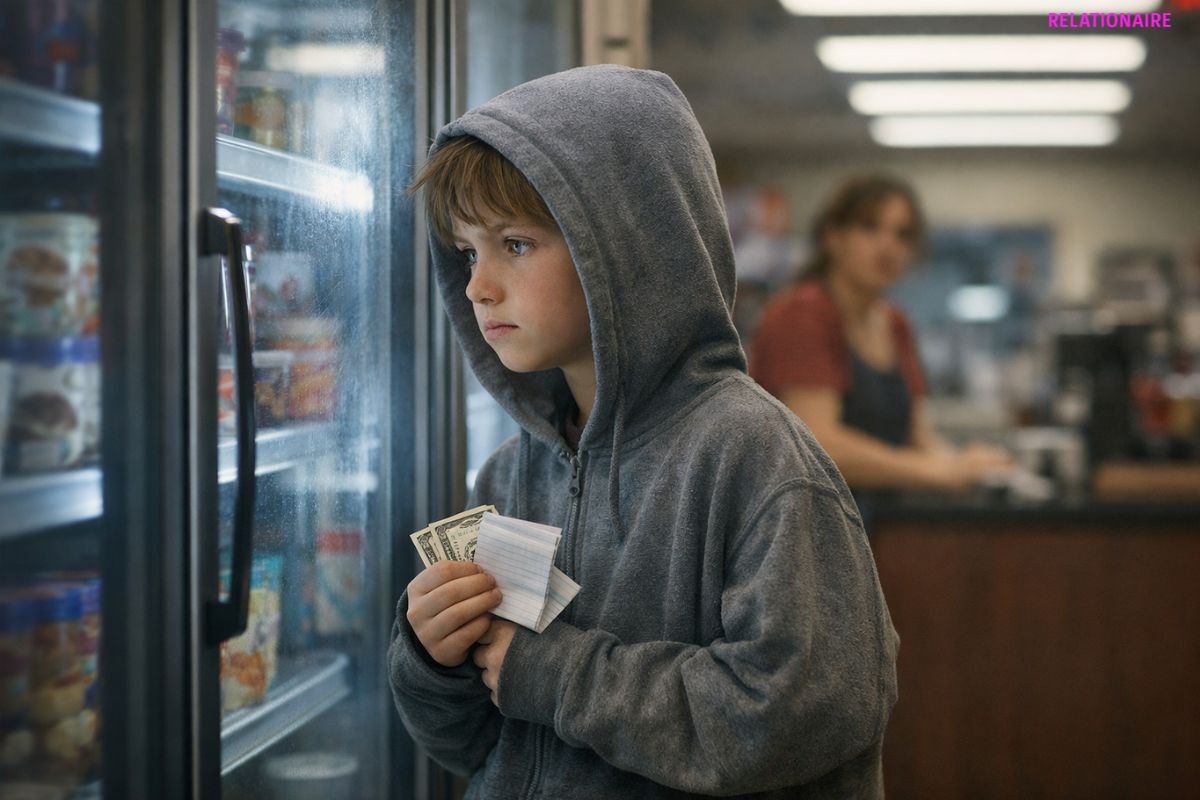
By the time I noticed the boy for the third time, he was still standing in front of the ice cream freezer with two crumpled dollar bills in his hand and the kind of face kids get when they are trying very hard not to get something wrong.
He couldn’t have been older than nine.
Maybe ten, if life had been unkind early.
It was almost nine at night, and the gas station felt like every tired gas station feels at that hour, buzzing fluorescent lights, coffee that had been sitting too long, a floor that never looked clean no matter how often you mopped it, and the little freezer door humming harder than it should have.
My feet hurt.
My back hurt.
I had been on shift since noon because Tanya’s babysitter canceled and she begged me to cover.
A man in a mud-streaked work jacket had just snapped at me because pump four froze mid-transaction. A teenager spilled blue slushie by the beef jerky rack and walked out pretending not to notice. My dinner was a stale honey bun I hadn’t had time to open.
So no, I was not feeling tender toward the world.
Especially not toward the skinny boy in the oversized gray hoodie who was planted in front of the ice cream freezer like it was a museum exhibit.
Every few minutes, someone had to angle around him.
He would step aside quickly, mumble, “Sorry,” then drift right back.
He kept opening the freezer door, staring in, shutting it, then opening it again.
Vanilla cups.
Chocolate bars.
Strawberry swirls.
Orange push-pops.
The cheap sandwiches of frozen sugar children always grab with the certainty adults lose somewhere around thirty.
But this boy looked wrecked by the decision.
I rang up a woman buying cigarettes and a gallon of milk. When I looked back, he was still there, lips moving a little like he was reading something to himself.
Then he took a folded piece of paper from his pocket.
He flattened it against the glass lid of the freezer and stared down at it.
I almost called out then, but another customer came up with windshield washer fluid and sunflower seeds.
When I looked again, the boy was rubbing one thumb over the edge of those two dollar bills until I thought the paper might tear.
My irritation sharpened.
It is ugly, the way irritation can make a person careless.
A trucker came in, broad shoulders, tired eyes. He headed straight for the freezer aisle, then stopped behind the boy.
“Excuse me, buddy.”
The boy jolted so hard he nearly dropped the money.
“Sorry,” he whispered, scooting sideways.
But once the trucker grabbed his drumstick cone and moved on, the boy stepped back in front of the glass.
He wasn’t choosing.
He was hovering.
Blocking.
Lingering.
Something in me, hunger, exhaustion, plain meanness, finally boiled over.
I came around the counter, wiping my hands on a paper towel.
“You planning to buy something,” I said, sharper than I needed to, “or just stand there all night?”
The boy turned so fast I saw the fear in his face before he could hide it.
It hit me in a quick, unpleasant flicker, but I was already in motion, already committed to sounding annoyed.
“You’re in the way,” I said. “Other people need to get in there.”
His ears went pink.
He glanced at the freezer. Then at the money in his hand. Then at me.
“I’m sorry,” he said.
He folded the paper so fast he nearly mangled it, stuffed it back into his hoodie pocket, and stepped away from the freezer completely.
The trucker avoided looking at either of us.
I went back behind the counter.
For a second I expected the boy to come up with an ice cream bar anyway. Kids usually do. Usually they beg change from a parent in the car or switch to candy or settle for the bright blue popsicles that stain their mouths.
But he just stood near the chip display, staring at the floor.
Then he walked over to the candy shelf and picked up a single roll of wintergreen mints.
He brought them to the register like they weighed something.
I scanned them.
“Anything else?”
He shook his head.
“$1.09.”
He laid the two dollar bills on the counter very carefully, smoothing them with the flat of his hand.
His fingernails were bitten down to nothing.
There was dirt under one thumb, like he’d been digging in a yard or playing beside a road. A frayed red backpack hung from one shoulder. One zipper was broken.
I handed him his change.
He scooped up the coins and the mints, then hesitated.
For a second I thought he might say something. Ask about the ice cream. Explain himself. Kids sometimes explain even when nobody asks them to, as if the world might soften if it understood.
But he only said, “Thank you, ma’am.”
It was the kind of politeness that makes you feel worse, not better.
Then he left.
I watched him through the front window as he crossed the dark parking lot.
Not to a car.
To the far edge of the lot, near the pay phone nobody used anymore and the broken ice machine with the OUT OF ORDER sign half hanging off.
A woman was sitting there on the curb in the yellow spill of light from the side wall.
Thin.
Wearing a knit cap even though it wasn’t cold enough for one.
She had one arm folded over her stomach and the other resting limp across her knees.
The boy went straight to her.
He sat down close, shoulder against shoulder.
Then he opened the roll of mints and tipped two into her palm.
She smiled at him.
Even from inside, even through the streaked glass, I could see how tired that smile was.
She said something.
He answered.
Then she leaned her head against the cinderblock wall and closed her eyes while he sat beside her, guarding her with his small body like that could do anything against whatever had worn her down.
I looked away.
People come through gas stations carrying whole private worlds. Sick parents. Court dates. Empty checking accounts. Late-night jobs. Secrets. Bad news. Good news nobody has anyone to tell. If you work a register long enough, you learn not to ask.
Still, something about them stayed with me.
Maybe because the woman looked too sick to be sitting on a curb eating wintergreen mints for dinner.
Maybe because the boy never once asked for anything.
Maybe because I knew I had embarrassed him, and there was no good reason for it except that I was tired and he was there.
They were gone by ten.
My shift dragged until midnight.
I wiped counters. Restocked the roller grill. Counted scratch-off tickets. Dumped burnt coffee and brewed a fresh pot nobody would finish. Around eleven-thirty I went to mop near the freezer aisle, and that was when I saw the paper.
Folded once.
Dropped beside the bottom shelf where the novelty bars were.
I recognized it immediately, the paper he had flattened on the freezer lid.
I picked it up with the wet mop still in one hand.
It was soft from being handled too much.
There were pencil marks pressing through from where he had written hard.
I don’t know why my chest tightened before I even opened it.
Maybe because I was already ashamed.
Maybe because some part of me had understood, too late, that he had not been wasting time.
I unfolded it carefully.
Crooked pencil writing.
A child’s writing.
Each line leaned in a different direction.
At the top it said:
Flavors Mom Might Like Again
Below that was a list.
Vanilla — plain, maybe safe
Strawberry — maybe if it tastes like real strawberries
Orange — she used to like orange pops in summer
Chocolate — probably no because last time she spit it out
And at the bottom, underlined three times so hard the paper had nearly torn, were the words that knocked all the air out of me:
after chemo everything tastes wrong now so i’m trying to remember for her
I stood there with the note in my hand and the mop water creeping toward my shoe, and for one long second all I could hear was his voice at the counter.
Thank you, ma’am.
Then the bell over the front door rang.
I looked up, still holding that note.
And there he was again, back inside, breathless, eyes wide, like he’d come for the one thing he could not afford to lose.
Part 2
For half a second neither of us moved.
The boy stood just inside the door, one hand still on the metal handle, chest rising hard under that too-big gray hoodie. His hair looked damp, flattened on one side, and his face had that pinched, panicked look children get when they are trying not to cry in front of strangers.
I was still holding his note.
He saw it immediately.
His whole body changed.
Not relaxed. Not exactly. But focused, like the world had narrowed to that one folded page in my hand.
“I came back for—” He stopped, swallowed, and tried again. “I think I dropped something.”
I set the mop against the cooler and walked toward the register.
“This?”
He nodded so fast it almost hurt to watch.
“Yes, ma’am.”
I handed it to him.
He took it with both hands.
Carefully. Like it mattered more than money.
“Thank you,” he said, quieter this time.
I should have stopped there. Hand him the note. Let him go. That would have been easiest. Least embarrassing for both of us.
But shame has a way of making silence feel heavier than speech.
“I’m sorry,” I said.
He looked up.
“For snapping at you earlier.”
His fingers tightened around the paper. He glanced toward the side window, toward the dark edge of the lot where his mother had been sitting.
“It’s okay.”
It wasn’t.
I could hear it in the way he said it. Children learn to say it when adults leave them no room for anything else.
I took a breath.
“No,” I said. “It’s not. I thought…” I stopped, because what had I thought? That he was indecisive? Annoying? In my way? “I thought the wrong thing.”
He studied me for a second with a seriousness that did not belong on a face that young.
Then he gave a small shrug.
“She takes a long time now too.”
Something in my chest pulled tight.
“With choosing?”
“With everything.” He looked down at the note. “Sometimes she says she isn’t hungry, but I think it’s because food tastes bad and she doesn’t want me to see.”
He said it plainly.
No performance in it. No self-pity.
Just information. Weather report from a child living in a storm.
I looked toward the window. “Is your mom still outside?”
He nodded.
“She got tired.”
There was an old rule in places like that: don’t get involved unless you absolutely have to. People were proud. People were private. People got offended. People were carrying things you might make worse by touching wrong.
But I was already involved.
I had been involved the moment I used my sharpest voice on a little boy trying to remember what his mother used to love.
“Wait here,” I said.
I went into the office, pulled my purse from the bottom shelf, and counted what cash I had. Twenty-three dollars in bills. I took out five, then ten, then stood there hating how clumsy charity could feel. As if money could fix what shame had already bruised.
When I came back out, he was standing exactly where I left him, turning the note over in his hands.
“What was your mom’s favorite before all this?” I asked.
He blinked. “Before?”
“Before food started tasting wrong.”
He thought for a long moment.
“Orange pops in summer,” he said. “And strawberry when it was real strawberries. She likes cold things now. Sometimes.”
I nodded toward the freezer. “Come on.”
His eyes widened.
“I have money.”
“I know.”
“I do.” He opened his hand to show me the coins. “Ninety-one cents.”
“I know,” I said again, gentler. “This one’s on me.”
He didn’t move.
The pride in that tiny pause nearly undid me.
Then he said, “Can I pick the cheapest?”
“No.”
He frowned, suspicious.
I almost laughed, but it caught in my throat.
“You can pick the best chance.”
Slowly, he followed me to the freezer.
Up close I noticed the knees of his jeans were whitened with wear. One sneaker lace had been tied in a knot because it had snapped and shortened. He smelled faintly of outside air and laundry detergent that had given up by the end of the day.
He unfolded the note again and pressed it to the freezer lid.
I stood beside him this time instead of behind him.
He pointed with one finger.
“She said chocolate was too thick.”
“We skip chocolate.”
He nodded.
“Vanilla might be okay, but plain stuff tastes like nothing.”
“Maybe that’s good if everything else tastes bad.”
“Maybe.”
He leaned closer to the glass.
“What about orange creamsicle?” I asked.
He considered that with great seriousness.
“She likes orange,” he said. “But not creamy milk stuff right now.”
“Strawberry shortcake bar?”
He squinted. “Maybe fake strawberry is worse than real strawberry.”
“Good point.”
We kept going.
One by one.
As if we were solving something delicate together.
Finally he chose two things: a simple orange fruit bar and a small cup of vanilla.
“One to try,” he said, almost to himself. “And one in case the first one’s bad.”
I added a bottle of water before he could protest.
When we got back to the register, he reached for his money again.
“Keep it,” I said.
He stood very still.
Kids know when adults are being casual, and they know when adults are making room for dignity. He was deciding which this was.
Then he asked, “Can I do something for it?”
I looked at him.
He glanced around the store. “I could wipe the windows on the cooler or pick up trash outside.”
My throat burned.
“No,” I said softly. “You can help your mom.”
He nodded once.
Not happy. Not exactly grateful in the showy way people expect. Just relieved that I had finally spoken to him like a person.
He took the bag and headed for the door, then stopped.
Turned back.
“She used to bring me here after Little League,” he said. “When she had payday.”
I waited.
“She always got me two napkins even if I only needed one, because she said ice cream drips faster when you’re happy.”
And then he left before I could answer.
I watched him through the side window.
His mother was still on the curb, head bent.
He knelt in front of her first, talking. Then he held up the orange bar like a prize.
Even from that distance I saw her smile start before she even took it.
She touched his face.
He opened the vanilla too and set it beside her like a backup plan.
For a few seconds they looked almost ordinary. A mother and son sharing something cold under bad lights on a warm night.
Then she tried the orange bar.
She took one bite, and her shoulders shook.
I thought she was getting sick.
The boy reached for her immediately.
But then she covered her mouth and laughed.
Not a strong laugh. Not a healthy laugh. More like a sound pulled through damage.
Still—laughter.
He said something, and she nodded, wiping at her eyes.
Then she took another bite.
I had to turn away.
The rest of my shift went strangely quiet inside me. Not outside—outside there were still customers and receipts and engines and change clattering into trays. But inside, something had shifted enough that all the ordinary noise felt far away.
A little after midnight, when I finally locked the front door and switched off the open sign, I saw them again.
Not outside this time.
Across the road, beneath the flickering motel sign.
The kind of motel people used when they had no better option and needed one night at a time.
The boy was carrying the leftover vanilla cup and the water bottle.
His mother walked slowly, one hand on his shoulder.
I stood there in the darkened store and watched them disappear into room twelve.
The next afternoon I came in for my shift and asked Darnell, who worked mornings, if he’d seen the woman and boy from the night before.
He looked at me while counting twenties from his till.
“The sick lady?”
I nodded.
“Yeah. Kid came in around seven. Bought saltines and ginger ale.”
“With what money?”
He shrugged. “Change, mostly.”
Something in me tightened again.
“Did they say where they were from?”
“Nope.”
He shoved the bills into the drawer and closed it with his hip.
“Though Mavis from the diner said she saw them at the laundromat two days ago. Said the boy was folding towels while his mom slept on a plastic chair.”
I pictured that.
His small hands smoothing out damp towels with the same concentration he’d brought to the freezer.
That night I made an extra turkey sandwich at home and packed two bruised peaches from the bowl on my counter. I told myself I was only bringing them in case I saw them.
By eight-thirty, I had checked the parking lot six times.
By nine, I was angry at myself for checking.
By nine-fifteen, the bell over the door rang.
It was the boy.
Alone.
He looked even smaller without his mother beside him.
He walked to the counter with a folded stack of bills in one hand and set them down in front of me.
“What’s this?” I asked.
“For the ice cream and water.”
I stared at him.
There was a five-dollar bill, four ones, and some quarters. More money than he’d had last night. Too much money for a child to be carrying around in that kind of place.
“You don’t owe me.”
“Yes, ma’am, I do.”
“Keep it.”
He shook his head. “I can’t.”
“Why not?”
His chin trembled once, then steadied.
“Because my mom said when people are kind to you, you don’t make them pay twice.”
The store went very still.
I opened my mouth, but before I could say anything else, he looked me straight in the eye and said:
“She asked me to come settle up because she had to go to the hospital, and she doesn’t think she’s coming back to the motel tonight.”
Part 3
For a moment I forgot where I was.
The register hummed.
The drink cooler kicked on behind me.
Somewhere outside, tires hissed over the highway.
But all I could hear was that one sentence, spoken in a child’s careful voice, as if he had rehearsed it enough times to keep it from breaking apart.
“She doesn’t think she’s coming back tonight.”
The words landed heavier the second time through my mind.
I looked at the money on the counter, then at him.
“Where is she now?”
“At County General.”
“Who took her?”
“An ambulance from the motel.”
He said it flatly, but his fingers had curled into the hem of his hoodie so hard his knuckles were pale.
“Are you here by yourself?”
He nodded.
Everything in me went cold.
“Where were you when the ambulance came?”
“In the room.”
“And they just…” I stopped, trying not to let my alarm spill onto him. “They let you stay behind?”
He looked down.
“I said I could.”
That told me enough.
Adults in chaos hear a calm child and mistake it for safety.
“What’s your name?” I asked.
“Eli.”
“I’m Maren.”
He nodded like he had known I should have had a name all along.
“Eli,” I said, keeping my voice steady, “do you have anybody I can call? Grandparents? An aunt? Your dad?”
He was quiet long enough to answer without answering.
Then he said, “No one close.”
The ache of that nearly doubled me.
I picked up the money and pushed it back toward him.
“This stays with you.”
He didn’t touch it.
“She said—”
“I know what she said.” My voice softened. “You settled up. We’re settled. This is for you now.”
He looked at the bills, then at me.
Not trusting. Not distrusting either.
Just measuring.
I reached for the store phone, then stopped and grabbed my cell instead. The station phone barely worked, and I did not want him hearing me ask questions like there was a problem to be solved standing right in front of him.
County General transferred me three times.
I stepped into the office but kept the door cracked so I could see him the whole time. He stood exactly where I left him, red backpack hanging off one shoulder, watching the counter as if he meant to stay upright by force.
By the time I reached a nurse on the oncology floor, my heart was pounding.
I explained too fast at first. Slowed down. Tried again.
A woman from the motel. Thin, knit cap, ambulance pickup maybe thirty minutes ago. She had a son, around nine. His name was Eli.
The nurse asked the mother’s name.
I looked out through the crack in the door.
“Eli,” I called gently, “your mom’s name?”
He stepped closer. “Jenna.”
I repeated it into the phone.
There was a pause while the nurse checked.
Then her voice changed.
Not dramatic. Just quieter.
“Yes,” she said. “She was admitted. We do have a Jenna Collins.”
Admitted. Not gone. Not yet.
My knees nearly loosened.
“Can you tell me if she’s okay?”
“I can tell you she’s being treated, but I can’t discuss details over the phone.”
Of course.
I glanced at Eli again.
“Her son is here with me,” I said. “He’s alone.”
That moved things faster.
Within minutes I was talking to a social worker who sounded tired but competent. Yes, the hospital needed the child brought in. Yes, they would help coordinate from there. Yes, someone should come with him.
I hung up and leaned both hands on the desk for one breath before going back out.
Eli looked at my face.
The bravest children always do that first. They study the adult, not the answer.
“She’s there,” I said. “She’s asking for you.”
I did not know that for certain.
But I knew enough.
Something in him loosened then, so briefly I almost missed it. Not relief exactly. More like permission to feel scared.
His eyes filled and then fought it back.
“Okay,” he whispered.
Darnell’s cousin ran the overnight shift sometimes and lived five minutes away. I called him, begged him to come early, and for once the world gave me something easy. He said yes.
While we waited, I made Eli sit on the stool behind the counter where employees usually counted lottery packs.
“Have you eaten?”
He shrugged.
That meant no.
I heated the last cheese pizza slice from the warmer even though it had no business being called pizza by then. I added crackers, a banana, and one of those small cartons of milk kids either love or hate.
He ate with the concentration of a child who had spent the day staying composed for someone else.
Halfway through, he stopped and looked up at me.
“Can I save some?”
“For later?”
“For my mom. In case hospital food tastes wrong too.”
I turned away under the pretense of straightening the coffee lids because my eyes had gone hot.
When I turned back, I found a small paper sack and packed the crackers, banana, and two mints.
He watched me do it and said nothing.
When my relief got there, I locked my till, grabbed my keys, and told Eli, “Come on.”
County General was fifteen minutes away.
He sat in the passenger seat with the paper sack in his lap and his backpack at his feet. The seatbelt crossed his chest at the wrong angle because he was too small and too old all at once.
Streetlights slid across his face.
After a while he said, “I thought you were mad at me.”
The honesty of it hurt.
“I was,” I said. “And I was wrong.”
He nodded slowly.
“My mom says tired people sometimes sound meaner than their heart.”
I let out a breath that almost became a laugh and almost became a cry.
“Your mom sounds smart.”
“She is.”
No hesitation.
No apology.
Just fact.
At the hospital, everything smelled like disinfectant and stale air-conditioning. The social worker met us in the lobby and crouched to Eli’s level. He answered her questions politely, one hand still gripping the paper sack.
When she learned there really was no one nearby and no father coming, she stood up with that careful professional face people wear when compassion has to move faster than surprise.
She thanked me.
I almost hated being thanked.
Because I could not stop thinking about how small the thing had been that first put me on the wrong side of this child’s story. A sharp tone. An impatient assumption. A tired woman with sore feet deciding a boy in her aisle was a problem before she imagined he might be carrying something heavier than she was.
They let Eli see his mother after a while.
I stood back near the doorway.
Jenna Collins looked even frailer in a hospital bed than she had on the curb outside the gas station. Her skin had that washed-out gray sickness gives some people. But when Eli walked in, her whole face changed.
That happens sometimes.
Love does not cure anything, but it can still light up a room where medicine has failed to make it warm.
“Hey, baby,” she said.
Her voice was thin, but it reached him.
He went straight to the bed and set the paper sack on her blanket like a treasure.
“I brought backup,” he said.
She smiled.
“What kind of backup?”
“Crackers, banana, and mints.”
He glanced at me once, then back at her.
“In case everything tastes wrong.”
Jenna closed her eyes for just a second.
When she opened them again, they were wet.
“Oh,” she said softly. “Thank you.”
He climbed carefully into the chair beside her and unfolded that note—the one with the crooked pencil writing and the flavor rankings—and laid it on the bed.
“I got orange right,” he told her.
“You did.”
“And vanilla second.”
“You did that too.”
Then, with no warning at all, he finally broke.
Not loudly.
That was the hard part.
He just put his forehead against the side of her mattress and cried the way children cry when they have been holding it together so long their bodies don’t know how to do it gently.
Jenna reached weak fingers into his hair.
“I’m here,” she whispered. “I’m still here.”
The social worker touched my arm and drew me out into the hall.
Over the next two days I learned more than I had expected to. Jenna had been fighting ovarian cancer for over a year. They had drifted from one temporary place to another after she got too sick to keep her job at a dry cleaner. Motels when they could manage. Shelters when they couldn’t. Her sister in Arkansas had lost touch months back after her own husband got laid off and moved the family. Hospital staff were trying to locate her again.
And Eli?
Eli had been keeping lists.
That’s what the social worker told me.
Lists of what his mother could still keep down. Lists of things that made her nauseous. Lists of TV shows that made her laugh. Lists of bus times, motel room numbers, medicines, nickels and dimes in his pocket, and foods that used to make her smile before chemo turned half the world bitter.
He was not trying to buy ice cream.
He was trying to remember her back into herself.
Three days later, I brought a small spiral notebook and a pack of sharpened pencils to the hospital.
Eli took them like they were exactly right.
“What kind of list will you make first?” I asked.
He thought about it.
Then he said, “Maybe things that still taste like themselves.”
Weeks passed.
Jenna stabilized enough to be moved into a care program that finally connected them with the sister in Arkansas. There were calls. Paperwork. Delays. One near setback. Then a church group helped with bus fare, and the social worker made sure no part of the handoff was left to luck.
The last time I saw them was at the station, early in the morning.
Their ride to the bus depot was running late, so they stopped in.
Jenna looked thinner still, but stronger somehow in the eyes. Eli wore the same gray hoodie, but it had been washed, and someone had fixed the backpack zipper with a piece of blue cord.
He came to the counter and laid something down in front of me.
A note.
Crooked pencil. Careful printing.
At the top it said:
Flavors That Still Work
Orange
Mint
Cold water
Sometimes vanilla
And underneath, in smaller letters:
Also people can taste like kindness even when they sounded mad first
I had to press my hand to my mouth.
When I looked up, Jenna was watching me.
“I told him that last part was too much,” she said, smiling.
“It’s true though,” Eli said.
I came around the counter before I could stop myself and hugged him.
Then I hugged her too, very gently.
After they left, I stood in the doorway and watched the bus depot shuttle pull away from the curb.
I thought about all the ways people stand in front of us every day holding things we cannot see.
Grief.
Fear.
Instructions to themselves written in crooked pencil.
Tiny plans to take care of somebody they love.
And I thought about a boy in front of a gas station freezer, doing the best he could to choose one sweet thing in a world that had gone wrong-tasting on him far too soon.
Some people will tell you kindness is in the big gestures.
But sometimes it begins when you realize you were wrong, and decide not to look away from that.
Sometimes it begins with a child who still remembers how to love somebody carefully, one flavor at a time.