My Mother-in-Law Told My Five-Year-Old Daughter to Stay Quiet at Christmas Dinner—Then My Eight-Year-Old Son Stood Up, Opened an Old Phone, and Exposed the Secret That Had Been Running Our Family for Years
“That will be enough, Penelope.”
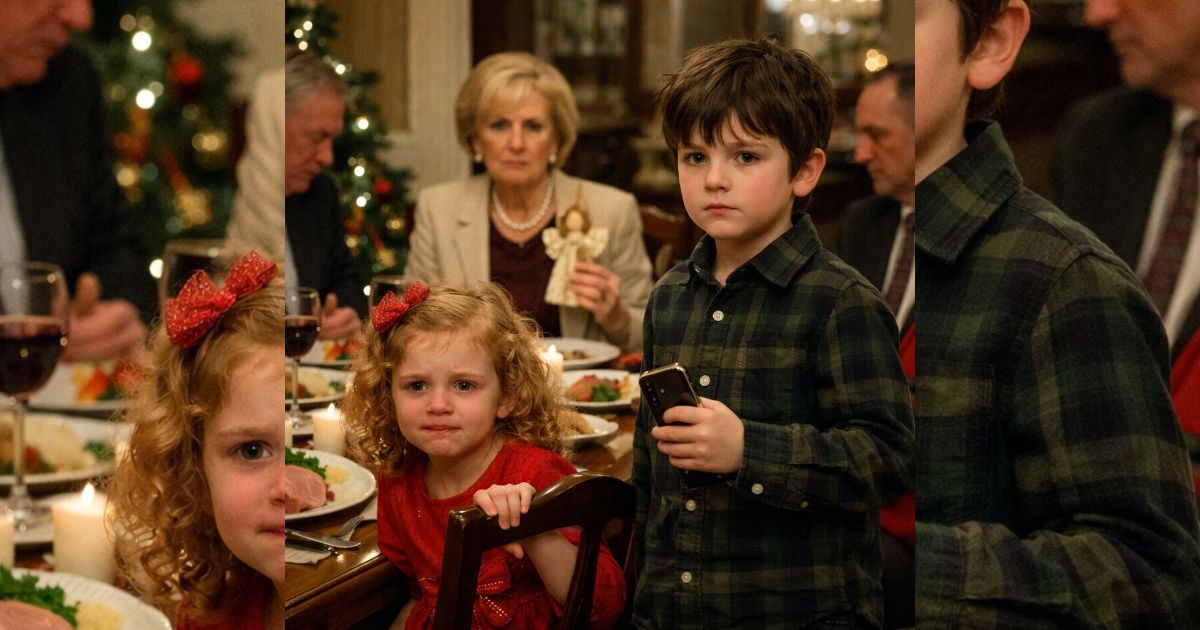
My mother-in-law’s voice floated down the long mahogany table like silk wrapped around a blade. She held my daughter’s handmade angel ornament between two fingers, studying it the way people study a stain they wish had not appeared in polite company.
Penny froze with her mouth still half open.
She had been in the middle of telling everyone about her school Christmas pageant. About the glitter wings. About how Miss Rodriguez said she spoke her lines clearly. About how she got to stand in the front row because she remembered every word.
She was five.
She was wearing the red dress she had picked out herself, the one with the sparkly bow at the waist and the little white cardigan because she said angels probably got cold in December. She had been glowing all day, full of that breathless excitement only little kids can hold for hours without getting tired.
Judith looked at the ornament again, then set it beside her wine glass instead of on the tree branch centerpiece where Penny had carefully placed it.
“Pretty girls don’t need to narrate every thought in their heads,” she said. “They’re much lovelier when they learn quiet.”
No one at that table spoke.
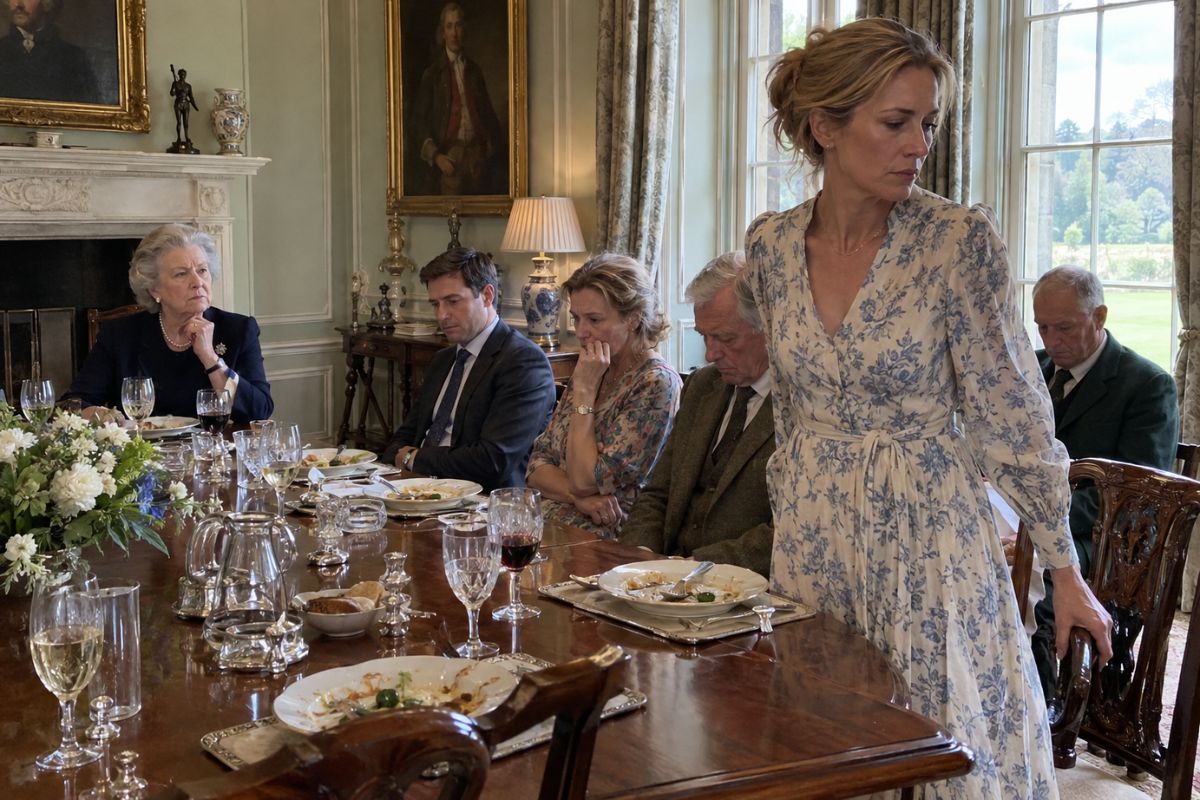
Twenty relatives sat beneath her chandelier with forks in their hands and glazed ham on their plates and expensive napkins folded in perfect triangles. My husband stared at his water glass. My sister-in-law smoothed the tablecloth. My brother-in-law cut another bite of sweet potatoes.
And my daughter’s smile went out right in front of all of them.
Penny looked at me first.
That was the worst part. Not the words. Not the silence after. It was the way she looked at me, like she was trying to figure out if she had just broken some invisible rule she had not known existed.
“I was just telling about my wings,” she whispered.
Judith gave a small, tired smile, the kind people use when they want to look patient while being cruel. “Exactly, dear. And now you’ve told enough.”
I pushed my chair back.
The scrape of wood on the floor was the first honest sound in that room all night.
“She’s five,” I said. “She’s excited. She made that ornament for you.”
Judith lifted one eyebrow.
“And excitement is not the same thing as self-control, Brooke.”
Across the table, Trevor finally glanced up. “Mom.”
Just that.
One soft syllable. Not a warning. Not a defense. Not protection. Just a weak little word dropped into the middle of the mess like it might somehow clean it up.
Judith didn’t even look at him.
She looked at Penny.
“If you’re going to sit with adults,” she said, “you need to learn how adults behave.”
Penny’s lower lip trembled.
My son Colton, sitting three seats down from me, didn’t move at all.
That should have scared me sooner than it did.
He was always the quiet one. The observer. The child who noticed the things other people missed. The one who could walk into a room, say almost nothing, and still somehow understand exactly where the tension was coming from. He had my green eyes and Trevor’s dark hair and a way of watching adults that made me feel, more than once, like he was the only truly honest person among us.
That night, he sat with his hands folded in his lap and looked at Judith with a calmness that did not belong on an eight-year-old boy’s face.
I reached for Penny’s hand.
“We’re done here,” I said.
Judith smiled then.
Not kindly. Never kindly. She smiled like a woman who had spent years making sure every room in her house bent around her will.
“Oh, don’t be dramatic,” she said. “Dessert hasn’t even been served.”
Something in me rose so fast I could feel it in my throat.
“You humiliated my daughter in front of this whole family.”
“I corrected her,” Judith said. “There is a difference, though I realize distinctions like that are unpopular in your world.”
My world.
There it was. The old cut. The old insult. The little reminder that I did not belong in hers.
I had been married to her son for seven years, and Judith Hawthorne still spoke to me as if I were a temporary inconvenience that had somehow lasted too long.
Penny slid off her chair and came to stand by me. She pressed her small hand into mine so hard it almost hurt.
Her eyes were shiny, but she wasn’t crying.
She had learned, far too young, that crying in Judith’s house only made things worse.
And before I tell you what happened next, you need to understand that Judith’s cruelty was almost never loud at first. That was how she kept it hidden. She did not shout in the beginning. She polished. She corrected. She refined. She smiled while she did it.
She made people feel small so elegantly they sometimes thanked her for it.
When I first met Trevor, I thought I had stumbled into a life I wasn’t sure I deserved. He was handsome, steady, successful, and came from one of those families people in my Pennsylvania town described with lowered voices and lifted brows. Good family. Good name. Beautiful house. Connections. Tradition.
Trevor worked in consulting. He wore tailored coats and remembered birthdays and opened doors and listened when I talked.
I was twenty-seven, a school nurse from a small town outside Scranton, and he made me feel chosen.
The first time he brought me to meet Judith, she stood in the foyer of her Westchester colonial in a cream sweater set and pearls and looked me over from boots to hairline in one slow sweep.
“So,” she said, smiling without warmth, “you’re Brooke.”
Not Brooke, lovely to meet you.
Not Trevor has told us so much.
Just those two words, like she was matching a shipment to an order and deciding whether it met specifications.
I held out my hand. “It’s nice to meet you.”
Her fingers touched mine for less than a second.
Trevor said, “Mom, Brooke works with children at the elementary school.”
Judith’s smile widened by exactly half an inch.
“How noble,” she said. “That kind of work takes such patience. And not everyone is meant for bigger rooms.”
I remember laughing politely because I did not yet know her language.
Trevor squeezed my hand later and told me not to take it personally. His mother could be formal. Protective. Slow to warm up. She meant well.
Trevor had spent his whole life translating Judith for other people.
He translated her contempt into concern.
He translated her control into tradition.
He translated her coldness into standards.
By the time I understood that, I was already married.
Our wedding should have told me everything.
Judith insisted on handling the guest list because my family “wouldn’t know how to navigate a proper reception.” She placed my parents near the back beside a decorative pillar and seated Trevor’s old college friends near the dance floor because they “photographed better.” During her toast, she spent far too long talking about Trevor’s future, Trevor’s upbringing, Trevor’s promise, Trevor’s former girlfriend Catherine, who was now a surgeon and had, in Judith’s words, “always understood the kind of life Trevor was born for.”
Then she lifted her glass to me.
“But life does surprise us,” she said brightly. “And sometimes love asks us to choose differently. Welcome to the family, Brooke.”
Everyone laughed.
I laughed too, because when you are being humiliated in a room full of people who have already decided the humiliator is charming, sometimes laughter is the easiest way to survive.
It got worse after Colton was born.
Suddenly Judith became interested in us.
Her first grandson. The boy who carried the Hawthorne name forward. She began visiting more often. Calling more often. Commenting on everything. The nursery paint. The stroller. The way I held him after feeding. The softness of his onesies. The fact that I sang to him while folding laundry instead of playing classical music in the background.
“In our family,” she once said, watching me button Colton’s sleeper, “boys are raised to be composed.”
He was three months old.
When Penny came three years later, Judith’s enthusiasm cooled so noticeably even Trevor had to notice it, though of course he pretended not to.
He said she was simply older now. More tired. Less hands-on.
But I saw the truth in small things.
In the way Judith sent lavish birthday gifts to Colton and delicate, decorative things to Penny. Dolls meant for display. Velvet shoes too stiff for actual play. Monogrammed sweaters in pale colors that Judith preferred, not the bright reds and blues Penny loved.
In the way she praised Colton for being “solid” and Penny for being “sweet” when she was in a good mood and “too much” when she was not.
In the way she introduced them at family gatherings.
“This is my grandson, Colton,” she’d say, her hand light on his shoulder. “So thoughtful. Such self-control.”
And then, without fail, “And this is little Penelope. She certainly keeps things lively.”
That word lively started sounding like an accusation.
Penny was sunshine in sneakers. She talked to everyone. Grocery cashiers. Mail carriers. Elderly ladies at church. Strangers with dogs. She noticed earrings and shoelaces and funny shaped clouds. She remembered stories and wanted to tell stories and believed, with the simple faith of a child who had not yet been taught otherwise, that the people who loved her would want to hear what she had to say.
Judith hated that about her.
Not openly. Never openly at first.
But in the little corrections.
“Inside voice, Penelope.”
“Not every silence needs filling.”
“Sit still.”
“Fold your hands.”
“Stop wriggling.”
“Pretty girls don’t interrupt.”
“Pretty girls don’t shout across rooms.”
“Pretty girls don’t ask so many questions at once.”
By the time Penny turned five, that phrase had become a whole private theology in Judith’s house.
Pretty girls do not.
Pretty girls do not.
Pretty girls do not.
Colton heard it all.
That is another thing you need to know.
People think the quiet child is the child who misses things. In my experience, it is usually the opposite. The quiet child is the one cataloging every glance, every tone shift, every contradiction. The quiet child is the one learning the architecture of a room.
Colton had been studying Judith’s house for years before I realized he was also studying Judith herself.
The mandatory Hawthorne gatherings followed the same pattern every time.
Arrive early enough for cocktails and smiling photographs in the front hallway.
Children complimented if neat. Corrected if not.
Adults separated into familiar clusters. Trevor near Judith. Darlene near whoever might admire her latest business success. Grant discussing markets or mortgages or school admissions with whichever uncle had shown up in a blazer.
The children were usually sent to the basement playroom until dinner, unless Judith wanted them displayed upstairs first.
And dinner always looked like a magazine spread. Candles. China. Crystal. Sprigs of cedar tied to place cards. A centerpiece so elaborate it made real conversation almost impossible.
What wasn’t visible in the photos was the seating chart.
Judith never seated Trevor and me together. Never.
At first I thought it was chance. Then I realized it happened every single holiday. He would be placed near her, where she could guide conversation and adjust his posture with a glance. I would end up at the far end near elderly relatives or children or anyone unlikely to challenge the flow of the evening.
She did not want us united.
She wanted him absorbable.
She wanted me isolated.
Trevor never questioned it.
That Christmas morning, I should have recognized how wrong things felt before we even got in the car.
Penny was thrilled from the moment she woke up. She twirled in her red dress in front of the mirror and asked me three separate times whether Grandma Judith would think she looked pretty. Each time I kissed her hair and told her she looked beautiful.
Colton was different.
He sat on the edge of his bed in his white button-down, redoing the same two buttons over and over with careful fingers.
“Buddy,” I said, “you already look great.”
He glanced up. “Grandma likes the collar flat.”
My stomach tightened.
“Since when?”
He shrugged. “Since always, I guess.”
Trevor appeared in the doorway knotting his tie. “Ten minutes,” he said. “Mom hates late arrivals.”
Your mother hates oxygen when it enters the room without her permission, I almost said.
Instead I asked, “Why is Colton nervous?”
Trevor frowned. “He’s not nervous.”
Colton’s hands were trembling.
Penny burst into the room before I could say anything else. “Mommy, should I bring the ornament now or wait till Grandma says?”
She held up the little angel she had made at school. It was lopsided and glittery and precious. The halo leaned to one side. One paper wing was slightly higher than the other. She had written Grandma in crooked silver marker across the center.
Trevor glanced at it and gave a distracted smile. “That’s nice, honey.”
Penny beamed.
Colton looked at the ornament and then at me, and for just a second something flashed across his face.
Not dislike.
Not embarrassment.
Worry.
The drive to Westchester took forty minutes.
Trevor spent most of it talking through harmless topics. His promotion track. Grant’s new kitchen. Darlene’s listing in Connecticut. Aunt Francine’s knee surgery. Things Judith considered acceptable table conversation. Things that kept attention away from the one subject he never wanted to address, which was the way his mother made our home feel smaller even when she wasn’t in it.
Penny sang along softly to the Christmas station until Trevor asked her to save her voice for later.
Colton stared out the window and held my old phone in his lap.
I had given it to him months earlier after upgrading mine. It no longer held a charge for long, but it worked on Wi-Fi and had a camera. Mostly he used it for puzzle games and taking blurry pictures of squirrels in the yard.
That day, he kept checking that it was in his blazer pocket.
I noticed.
I noticed, and I let it go.
To this day, that still sits in my chest like a stone.
When Judith opened the front door, she looked exactly as she always did at Christmas: silver hair smooth, lipstick perfect, cream silk blouse, emerald earrings, posture like a queen at court.
She kissed Trevor’s cheek.
“Finally.”
Then she looked at the children.
“Colton,” she said warmly. “Much better. You remembered the shirt.”
My heart lurched.
Then her eyes moved to Penny.
“That is certainly a festive dress.”
Penny smiled anyway. “Thank you! It has sparkles.”
Judith’s expression did not change. “Yes,” she said. “I can see that.”
We stepped into the house, and the smell hit me first. Cinnamon candles. Pine. Roast ham. The polished cold scent of a house cleaned for inspection rather than comfort.
Everything gleamed.
Everything always gleamed.
Relatives had already started arriving. Grant stood near the fireplace with Uncle Raymond, both holding drinks and talking about year-end numbers. Darlene was near the piano showing photos of some enormous listing to her cousin Meredith. Aunt Francine floated from cluster to cluster collecting details she would later turn into concern disguised as gossip.
Rosa, Judith’s longtime housekeeper, emerged from the dining room carrying a tray of little tart shells.
She was the only person in that house who ever looked at me like I was fully human.
“Merry Christmas,” she said softly.
“You too,” I answered.
Before I could say more, Judith clapped her hands once.
“Children downstairs,” she said. “Adults have enough to manage without underfoot excitement.”
Penny clutched her ornament. “Can I show Grandma first?”
“You just did,” Judith said.
Penny’s face fell. Colton took her hand immediately.
“I’ll take her,” he said.
The basement door closed behind them, and I felt that familiar tug of helplessness.
Cocktail hour in Judith’s house always felt like a pageant everyone but me had rehearsed.
Darlene air-kissed me and asked whether I was “still loving the school thing.”
Grant nodded at me with the bland politeness of a man who had long ago decided genuine curiosity was optional.
Meredith, to her credit, asked real questions about the kids and listened to the answers. But even she glanced toward Judith before speaking too warmly, as though affection in that house needed approval before it was allowed to settle.
At one point I slipped into the kitchen to help Rosa with the deviled eggs.
She lowered her voice without looking at me. “The boy was upset yesterday.”
I stopped.
“What do you mean?”
“Your husband brought them by to help set up. Señora Judith was… particular.”
My hands went cold. “About what?”
Rosa opened her mouth, then closed it.
Judith appeared in the doorway.
“Brooke,” she said, “we do employ Rosa to work, not to entertain.”
I looked at Rosa. She looked down at the tray.
The message was clear.
Whatever happened yesterday, I was not supposed to know.
A little later, I went downstairs on the excuse of checking whether Penny needed help with the bathroom.
The twins were on the floor lining up toy cars. Penny sat on the rug by herself, smoothing the hem of her dress. Colton stood near the bookshelves with his hands in his pockets.
The second he saw me, something in his face softened.
“Hey, babies,” I said. “You okay?”
Penny nodded too quickly. “I’m being quiet.”
The words were bright and wrong in her tiny mouth.
I knelt in front of her. “You don’t have to perform being quiet for me.”
She leaned forward and whispered, “Grandma said I could sit at the big table if I remembered not to tell too many stories.”
I looked up at Colton.
He was already looking at me.
“Who told you that?” I asked softly.
Penny glanced toward the ceiling, as if Judith might somehow hear through the floorboards.
“Grandma.”
Of course.
I stood and turned to Colton. “Honey, what happened yesterday?”
He shook his head.
“Nothing.”
It was too quick. Too careful.
“Colton.”
He swallowed. “Can I stay near you at dinner?”
Something deep in me answered before my mind caught up.
“Yes.”
Then Judith’s voice rang down the basement staircase.
“Five minutes!”
Penny flinched.
Not dramatically. Not enough for anyone else to notice, maybe.
But I saw it.
And once you see a child flinch at the sound of a voice, it becomes hard to unsee every other thing that voice has done to them.
Dinner began the way Hawthorne dinners always began.
With performance.
Judith stood at the head of the table and gave a blessing that had less to do with gratitude than status. She thanked God for family, for health, for legacy, for standards, for discipline, for the blessings that came to those who upheld them.
Then everyone sat.
As usual, Trevor was beside Judith.
As usual, I was at the far end.
Penny was placed midway down the table on Judith’s side, close enough to be observed. Colton sat near her, one chair over, unusually silent. He had insisted on sitting beside his sister, and Judith had allowed it after a brief pause that I didn’t understand then but understand now. She thought she still had him.
That was her first mistake of the night.
The second was underestimating what children remember.
Dinner moved through its courses with the same stiff rhythm as every other holiday meal. Compliments about the ham. Talk of schools. A cousin’s engagement. Grant’s mortgage rate predictions. Darlene’s year in real estate. Meredith’s volunteer committee. Trevor’s prospects.
Judith steered every subject like a conductor with a baton only she could see.
Penny stayed quiet longer than any five-year-old should have had to.
I could feel the effort coming off her.
She folded and refolded her napkin. She took tiny bites. She glanced at me every few minutes for reassurance. Once, when Rosa set down the green beans, Penny whispered thank you so softly I barely heard it from across the table.
Then dessert plates were set nearby, waiting for later, and someone mentioned children’s pageants.
That was it.
The door opened.
Penny lit up the way children do when the thing they’ve been carrying all day finally finds the smallest opening to come out.
“I was the angel in the front row,” she said, leaning forward. “And my halo kept slipping so Mommy put extra pins and Miss Rodriguez said—”
“That will be enough, Penelope.”
And there we were.
Back at the beginning.
Back at the moment that split our family open.
After Judith said her piece and the table went silent, Penny’s little face changed.
Excitement first.
Then confusion.
Then the awful effort to look as though she was fine.
No child should have to learn that expression at five years old.
I stood up because not standing up would have broken something inside me I am not sure could ever have been repaired.
Judith looked almost bored.
“Sit down, Brooke.”
“No.”
One simple word. It felt like the first honest one I had spoken in that house in years.
“You don’t get to shame her like that.”
Judith dabbed the corner of her mouth with her napkin. “If you insist on raising children without boundaries, that is your choice. I do not have to let your chaos overtake my table.”
“She was talking about a school pageant.”
“She was monopolizing a room.”
“She is five.”
“And already indulged far beyond what is healthy.”
Trevor cleared his throat. “Mom, maybe let it go.”
Judith turned to him with that expression she used when she wanted to remind her children that love from her had always come with terms.
“Trevor,” she said gently, “you know better than anyone that children need structure.”
That used to work.
I had seen it work for years. A slight shift in her voice, and Trevor would shrink without moving. A whole childhood compressed into one sentence. One look. One well-placed reminder that loyalty to her was the same thing as goodness.
But that night something in him only half responded.
Not enough.
But not nothing.
Penny got down from her chair and walked toward me with small careful steps, as if any sudden movement might make the room turn on her again.
I lifted her into my arms.
Her face pressed against my neck. I could feel the heat in her cheeks.
“Mommy,” she whispered, so low only I could hear, “did I ruin dinner?”
I wanted to break.
I wanted to scream.
Instead I held her tighter and said, “No, baby. You did nothing wrong.”
Judith let out one soft breath, almost a laugh.
And because cruelty alone is never enough for people like her, she added, “This is what comes of letting children believe every thought deserves an audience.”
I looked at Trevor.
“Get your coat. We’re leaving.”
He hesitated.
Just for a second.
That was all it took for Judith to step in.
“Oh, for heaven’s sake, Brooke. Stop acting like this is some tragedy. Penelope will survive being corrected.”
The room stayed frozen.
No one told her to stop.
No one said, She’s just a little girl.
No one said, That was unkind.
No one said, Judith, what is wrong with you?
The silence around cruel people is how they grow so large.
“You all sit here,” I said, looking down the table, “and let her do this every single holiday.”
Aunt Francine looked at her plate.
Grant adjusted his cuff.
Darlene stared at the centerpiece.
Meredith looked uncomfortable, which in that family often passed for bravery.
Judith’s smile thinned. “You always did have a gift for melodrama.”
“No,” I said. “I’m just finally tired of mistaking your meanness for sophistication.”
Her whole face sharpened.
Then came the line she always reached for when she sensed she was losing altitude.
“Where exactly will you go, Brooke? Back to your parents’ little house in Pennsylvania? Back to folding chairs and store-bought pies and whatever version of chaos passes for warmth there?”
My jaw tightened.
At another table, in another year, I might have swallowed it.
Not with my daughter shaking in my arms.
“My parents’ house,” I said, “has never once made my children feel small.”
Judith gave a thin smile. “Love is a lovely slogan, but it does not pay tuition, maintain standards, or open doors.”
Penny stiffened against me.
Because even at five, she knew that voice. She knew what it meant when love was being compared to usefulness.
Before I could answer, Colton stood up.
Not suddenly. Not dramatically.
Slowly.
He pushed back his chair, picked up my old phone from beside his napkin, and looked straight at Judith.
He was pale, but his hands were steady.
“Grandma,” he said, clear as church bells, “do you want me to show everyone the Christmas folder? Or the list you made me keep on Penny?”
The room stopped.
Not quieted.
Stopped.
Even the people who had spent years surviving Judith by pretending not to notice could not pretend their way past that sentence.
Judith’s face changed with terrifying speed.
First surprise.
Then calculation.
Then anger so cold it barely looked like anger at all.
“Sit down, Colton,” she said.
He didn’t move.
Trevor frowned. “What folder?”
Colton kept looking at Judith.
“The one from your study,” he said. “And the notes. The ones you said I should hide because Mom ‘wouldn’t understand the difference between standards and sentiment.’”
No one breathed.
Penny lifted her face from my shoulder and turned to stare at her brother.
I had never seen anything in my life more heartbreaking or more beautiful than that little boy standing at his grandmother’s table, choosing truth while every adult around him was still calculating cost.
Judith’s voice went sharp.
“You are confused.”
“No,” Colton said. “I’m not.”
Then he unlocked the phone.
The first photo filled the screen.
A sheet of cream stationery in Judith’s handwriting. Her handwriting was impossible to mistake. Slanted, elegant, expensive-looking even when the words themselves were ugly.
Good boys help keep a family respectable.
Do not let Penny chatter through dinner.
If your mother gets emotional, say you are tired and I will handle the rest.
At the bottom, a neat little check box.
Reward: extra gift after dessert.
Darlene gasped.
Grant leaned forward.
Trevor went still in a way I had never seen before. Not withdrawn. Not defensive. Still like a man whose mind had just lost track of which floor was underneath him.
Judith gave a short laugh. “That is a reminder. Hardly a scandal.”
Colton swiped again.
Another note.
This one older.
A proper boy reports what he sees.
Your mother speaks against this family because she does not understand it.
Girls who talk too much become women no one respects.
You must help your sister before it is too late.
Penny made a small sound in my arms. Not crying. More like the sound someone makes when a door shuts and they realize they’ve been standing in the draft the whole time.
I felt her bury herself against me again.
“Colton,” I said carefully, because I could barely hear my own voice over the pounding in my ears, “what is this?”
He looked at me then.
Just once.
And in that one glance I saw it all. The months of carrying this alone. The fear. The planning. The waiting for the right moment, because somehow my eight-year-old son had understood what the rest of the adults in that room did not: people like Judith only lose power when there are witnesses.
“She started giving me notes in October,” he said. “At first I thought it was because she trusted me. Then I realized they were all about you and Penny.”
Judith stood up so quickly her chair pushed back into the sideboard.
“This is unbelievable. He is a child. He’s turning routine family guidance into some kind of performance because his mother has taught him to be oversensitive.”
Colton swiped again.
This time it was not a note.
It was a picture of a page in a red leather binder.
Across the top, in Judith’s handwriting, were the words HOLIDAY STANDARDS.
Beneath them were names.
Trevor.
Brooke.
Colton.
Penelope.
Grant.
Meredith.
Darlene.
Harrison.
Frederick.
Each name had bullet points underneath.
Each bullet point was an assessment.
Each assessment was a strategy.
I watched Trevor’s face lose color.
Judith moved toward Colton. “Give me that phone.”
Trevor rose so fast his chair tipped backward.
“No.”
The word came out of him rough and strange, like it had torn on the way up. It may have been the first real no he had ever given his mother in his adult life.
Judith turned to him slowly.
“Trevor.”
“No,” he said again, stronger now. “You stay away from him.”
Nobody at the table moved.
Nobody knew how.
We had all spent years living under the assumption that Trevor would fold first. That was the order of things. Judith pressed. Trevor adjusted. The rest of the room exhaled and kept eating.
But not this time.
Colton held the phone tighter and kept going.
“I took pictures because Mom says if something feels wrong and people keep saying it’s normal, you write it down so you don’t start believing them.”
Every eye in the room swung toward me.
I remembered the conversation immediately. It had happened after a problem with another student at school, when I was explaining why teachers kept incident logs. Why truth mattered. Why patterns mattered. Why you wrote things down when your stomach told you something wasn’t right.
I had never imagined my son would use that lesson inside his own family.
The next image showed more of the binder.
Trevor — praise publicly, correct privately.
Still responsive to approval cues. Keep him near me at meals.
Never seat Brooke beside him. Her emotional influence increases when proximity is allowed.
I heard Darlene inhale sharply.
Colton swiped.
Brooke — provincial. Defensive. Better managed through exclusion than confrontation.
Do not engage on substance. Let the room diminish her for me.
Darlene made a sound like she’d been slapped by the sentence, though no hand had touched her.
Grant muttered, “Jesus.”
Then came the page for Penny.
Penelope — decorative if quiet. Risky if encouraged. Limit opportunities for open storytelling at formal meals. Correct early. Use Colton as a model in front of her.
My whole body went hot and cold at once.
Decorative if quiet.
Risky if encouraged.
My daughter.
My bright, singing, story-spilling little girl had been reduced to a line item in her grandmother’s control system.
Penny, from the shelter of my shoulder, whispered, “What does decorative mean?”
I kissed the top of her head because I could not answer without shattering.
Colton swiped again.
This one was for him.
Colton — promising. Sensitive, but eager to please. Can be trained into usefulness if rewarded early. Give him responsibility. Praise restraint. Position him as protector of family standards.
The room seemed to tilt.
Every holiday. Every compliment. Every special wink from Judith to Colton when he remembered to sit up straight or answer softly or fold a napkin neatly.
It had never been love.
It had been recruitment.
Judith found her voice first.
“That is not what any of this means,” she snapped. “Those are private notes. Organizational notes. Every matriarch keeps track of family dynamics.”
“Matriarch?” Meredith said, disbelief cracking through her usual careful tone. “You made a file on the children.”
“They are not files. They are observations.”
“On children,” Meredith repeated.
Grant stood and held out his hand to Colton.
“Let me see.”
Colton looked at me. I nodded.
He walked the phone down the side of the table and handed it over.
Grant scrolled. His face went gray. He passed it to Meredith, who covered her mouth with one hand. Darlene reached for it next. Then Francine. Then Uncle Raymond.
Nobody was eating anymore.
Good.
Judith looked around like a woman watching the walls of her house shift for the first time.
“You are all overreacting.”
That was when Colton reached into his blazer pocket and pulled out a folded piece of cream paper.
“I have tonight’s note too,” he said.
His little voice was steady.
“My hands were shaking so much when she gave it to me in the hallway I thought I might drop it.”
Trevor shut his eyes for one second. When he opened them, there was something in his face I had never seen before.
Not weakness.
Grief.
Colton unfolded the paper.
He did not hand it to anyone. He read it aloud.
If Penny starts one of her little performances, redirect.
If Brooke objects, stay calm and let her embarrass herself.
Family always reveals itself under pressure.
Then, lower on the page:
After dessert, come find me for your real present. You’ve earned it.
No one spoke.
Penny whispered into my shoulder, “Was I a performance?”
I held her so tightly my arms started shaking.
“No,” I said. “You were a child at Christmas.”
Judith finally lost the careful shape of herself.
“Oh, for heaven’s sake,” she snapped. “Must we all pretend children are beyond correction now? Is that the game? Is that what we are doing? Because the world is full of weak, noisy, indulgent people, and it begins right here, when mothers mistake structure for cruelty and turn every family rule into a moral emergency.”
She was looking at me.
Still trying to make me the problem.
Still betting the room would choose comfort over truth.
For a second, I saw the old reflex ripple through some of them. The temptation to soften. To say maybe she didn’t mean it that way. To say Judith could be harsh but she loved her family. To say perhaps this was all being blown out of proportion.
Then Darlene spoke.
And everything changed again.
“She has notes on me too, doesn’t she?”
No one answered.
Darlene laughed once, bitter and ugly. “Of course she does.”
She reached for the phone again, scrolled with frantic fingers, then stopped.
Her face drained.
On the screen was another binder page.
Darlene — still vain. Use praise about appearance to secure cooperation. Never discuss aging directly. Position Brooke as cautionary contrast; keeps Darlene aligned.
Darlene stared at it for a long time.
Then she whispered, “I am fifty years old.”
Judith snapped, “Do not be absurd. You know exactly what I mean.”
“Actually,” Darlene said, looking up, “I don’t think any of us do.”
Grant took the phone back and scrolled again.
His jaw clenched.
“Here’s mine.”
He read in a flat, stunned voice.
Grant — responds best to competition. Compare favorably to Trevor when motivation is needed. Keep Meredith busy with children; she notices too much when idle.
Meredith’s head turned so sharply toward Judith I thought for a second she might not even be able to speak.
Then she did.
“You wrote that about me?”
Judith looked genuinely offended now. “Those notes were never meant to be public.”
And there it was.
Not remorse.
Not shame.
Just outrage that the curtain had been pulled back.
Colton cleared his throat.
“There’s audio too.”
Judith actually took a step backward.
My heart climbed into my throat.
“What audio?”
He took the phone back and tapped the screen.
Judith’s voice filled the room.
Not loud. Not screaming. Somehow worse because of how calm it was.
“Good boys keep their families from becoming embarrassing. You understand that, don’t you, sweetheart?”
A pause.
Colton’s smaller voice, timid and uncertain. “I think so.”
Then Judith again.
“Your mother means well, but she was not raised for rooms like this. Penny is taking after her. If you love your sister, you will help me teach her before she turns into another Brooke.”
The date stamp at the top said November 28.
Thanksgiving.
My vision blurred for a second.
I remembered that day. I had been in the kitchen with Rosa and Meredith, rinsing serving platters and talking about school calendars while Judith had offered to “check on the children” in the den.
Trevor had been outside with Grant watching football highlights on someone’s phone.
And in those fifteen quiet minutes, Judith had been in the den grooming my son into helping her manage us.
“Play the next one,” Darlene said hoarsely.
Colton did.
Judith’s recorded voice again.
“If Penelope starts rambling at Christmas, give her this.”
There was a rustle of paper.
“Tell her Grandma says angels are silent.”
Penny started crying then.
Not loud. Just those small helpless tears that come when a child realizes the thing that hurt was real and bigger than she knew.
I carried her around the table and sat with her in my lap in the empty chair beside Colton.
He reached over without looking away from Judith and put one hand on her little sleeve.
That was the moment I understood the real scale of what he had been doing.
He had not been documenting because he loved proof.
He had been documenting because he knew Penny would be next.
Maybe she already had been.
Just not in ways adults in that family wanted to name.
Trevor sat back down very slowly.
His face had changed completely.
He looked older.
Not in years. In understanding.
Judith saw it too.
Her tone softened at once.
“Trevor,” she said, “you know how family works. You know what discipline requires. You know how easily children become impossible when mothers refuse structure.”
He looked at her like a stranger.
“That’s what this was to you?” he asked quietly. “Discipline?”
“It was guidance.”
“You turned my son into an informant.”
“He was helping.”
“You taught my daughter that her voice makes her less lovable.”
Judith’s jaw hardened. “I was preparing her for reality.”
Trevor laughed then.
One terrible hollow laugh I will never forget.
“No,” he said. “You were preparing her for you.”
I looked at him.
He had never spoken to her like that.
Not once in seven years. Not once in all the time I had known him.
Judith straightened.
“You are tired. Emotional. That woman has filled your house with sentiment and weakness, and now your children don’t know the difference between being loved and being indulged.”
Trevor stood again.
“My children know exactly what love is,” he said. “That’s why this feels wrong to them. I’m the one who didn’t.”
That silenced even Judith.
Grant put both hands on the table and leaned forward.
“How long has this been going on?”
Colton answered before anyone else could.
“Since at least October for me. Maybe longer. She said I was the only one mature enough to understand what was wrong with our family.”
He swallowed.
“She said if I helped her, Dad would finally see the truth about Mom. She said if I told anyone, we might lose school because strong families don’t waste money on children who can’t behave.”
Meredith looked stricken.
“Harrison,” she said sharply to one of the twins at the far end, “has Grandma ever said things like that to you?”
The older twin froze.
He looked at his brother. Then at his parents. Then at Judith.
Finally he nodded.
“She told us not to ask for seconds until important people were finished.”
A brittle little voice from the other twin added, “She said boys who talk during grace look cheap.”
Meredith closed her eyes.
Grant rubbed both hands over his face.
Aunt Francine began to cry.
Not dramatic sobbing. Just silent tears sliding down a woman who had probably known more than she ever wanted to admit.
And then, in the doorway, Rosa spoke.
“I told her to stop.”
Every head turned.
She stood there holding the dessert tray she had apparently forgotten to put down.
Her face was set in a way I had never seen before.
“Many times,” she said. “I told Señora Judith this was not love. She said love is not the point.”
Judith spun toward her. “Rosa, leave the room.”
Rosa didn’t move.
“She keeps copies,” Rosa said, looking at Trevor. “In the study. Bottom left drawer. The red binder is not the only one.”
Trevor stared at her.
“You knew?”
Rosa’s face folded with something like sorrow. “I knew enough to be afraid for them. Not enough to know how to stop her by myself.”
Judith took a step toward Rosa. “You are forgetting your place.”
Rosa set the dessert tray on the sideboard with deliberate care.
“No,” she said. “Tonight I am remembering mine.”
Nobody had ever spoken to Judith like that in her own house.
Not staff. Not siblings. Not children. Not Trevor. Not me.
Judith looked suddenly smaller, though she was still standing at the head of the table in her silk blouse and emerald earrings.
Power shrinks fast once witnesses decide to keep their eyes open.
Trevor turned and walked out of the dining room without a word.
For one terrifying second I thought he was leaving.
Then I heard the study door open down the hall.
Judith started after him. Grant blocked her path.
“Move,” she snapped.
“No.”
She looked at her middle son as if he were a waiter who had misunderstood a simple request.
“Grant.”
He did not move.
“Not this time.”
The house felt different then.
Not warmer. Not safer yet. But changed.
Like one of those winter mornings when the ice on a pond begins to crack under its own weight. You still know it’s dangerous. You still know someone could fall through. But you also know the frozen surface is no longer pretending to be solid.
Trevor came back carrying two more binders.
One blue.
One black.
He set them down on the table so hard the silverware rattled.
Judith actually looked afraid.
I had not known until that moment how badly I needed to see that.
Trevor opened the black binder first.
Tabs.
Dates.
Handwriting.
Holiday schedules. Seating notes. Gift ledgers. Behavioral observations. Scripts for conversations. Lists of what to praise in public and what to undermine in private. Remarks about spouses. Remarks about children. Remarks about who would respond best to approval and who to exclusion.
It was not a family archive.
It was an operating manual.
Darlene flipped through pages with a kind of horrified hunger.
“Oh my God,” she whispered. “She did this for years.”
Grant found a section from two Christmases earlier.
There, clipped behind a seating chart, was a page titled Conversation Management.
Items included:
Seat Brooke near Francine. Francine talks enough to keep Brooke occupied.
Ask Trevor about promotion before dinner. Keeps him eager.
Compliment Colton in front of Grant’s boys. Useful contrast.
Redirect Penny after one anecdote maximum.
There was more.
Always more.
Too much more.
I found a page with my name.
Not the short bullet points from the photo. A full page.
Brooke responds to warmth from outsiders; isolate gently at gatherings.
Do not let her become central through caregiving. Keep Rosa between kitchen and dining room during service.
Never argue directly in front of Trevor. Let room fatigue her.
If necessary, suggest financial impracticality of her ideas. She retreats when reminded of class distance.
My hands shook so badly I almost tore the page.
Class distance.
That was how Judith had seen me from the beginning. Not as a wife. Not as the mother of her grandchildren. Not as a person.
As distance.
A thing to measure and use.
Across from me, Darlene had gone rigid over another page.
Her voice came out thin.
“She kept track of my weight before events.”
Everyone looked at her.
She lifted the page with both hands because one hand was trembling too hard.
Avoid discussing food directly; praise clothing fit instead.
There are three years of this.
Judith exhaled hard. “Oh, stop. You were always grateful when I helped you present yourself well.”
Darlene stared at her.
Then she laughed.
Not the polished Hawthorne laugh she used at cocktail parties. Not the charming laugh she pulled out for clients. A raw, broken sound.
“I spent twenty years thinking my body was a public relations problem,” she said. “And you wrote yourself memos about it.”
Meredith had found the section on the twins.
Her face went blank in the way smart women sometimes go blank right before they decide never to play agreeable again.
It listed preferred compliments for each boy. Predictable sensitivities. Which one might cry if corrected publicly. Which one needed praise before redirection. Which one was “more manageable when separated.”
“These are children,” she said.
Judith lifted her chin. “Children become adults. Good families shape them early.”
“No,” Meredith said, and there was steel in it now. “Controlling families do.”
Penny had calmed enough to lift her head and look around the table.
She looked at the binders. At the adults’ faces. At Colton.
Then she asked the question that broke me more than anything else that night.
“Did Grandma write me down because I talk too much?”
I could not answer.
Trevor did.
He moved to her, knelt beside my chair, and took her hand.
“No, sweetheart,” he said, voice ragged. “Grandma wrote you down because she wanted control more than she wanted love. That’s not about you.”
Penny considered that in the serious way children do when they are deciding whether an answer feels true.
Then she nodded and leaned against him.
It was the first time all night Trevor looked like a father instead of a son.
And yes, that realization hurt.
But it also mattered.
Because families do not begin healing the moment the truth comes out. They begin healing when someone finally stops serving the lie.
Judith looked around the room one last time, clearly expecting someone to rescue her from the full consequences of being seen.
Aunt Francine avoided her eyes.
Grant had both arms folded tight across his chest.
Darlene looked like she might be sick.
Meredith had pulled the twins close.
Rosa stood in the doorway, still and steady.
I had Penny in my lap.
Trevor was kneeling at our side.
And Colton, my brave quiet boy, stood with the old phone in his hand like a child holding up a lantern in a place full of adults who had decided darkness was easier.
Judith’s voice dropped.
“Trevor,” she said, “you cannot be serious. You are going to let a child and a stack of private notes destroy this family?”
He looked up at her.
“No,” he said. “You did that.”
The words landed like a verdict.
For the first time that night, Judith had nothing ready.
That did not mean she was sorry.
It only meant she had run out of scripts.
No one touched dessert.
Eventually people began gathering coats without speaking. The whole house seemed to move in slow motion. A cousin helped Francine find her purse. Grant and Meredith whispered hard and fast near the foyer. Darlene stood alone by the stairs holding one of the copied pages and staring at it as if it might still rearrange itself into something less ugly if she looked long enough.
Trevor told Rosa quietly to make copies of the most important pages before Judith could destroy anything.
Rosa nodded like she had been waiting years to hear someone say it.
Judith tried one final pass at authority.
“This material is private property. If anyone removes anything from this house—”
“Stop,” Trevor said.
Just that.
Stop.
And because he finally meant it, because the boy inside him had at last stepped aside for the man, the whole room obeyed him instead of her.
We left before midnight.
No carols.
No pie.
No smiling group photo in the foyer.
Just coats, shoes, red eyes, cold air, and the sound of a family trying to figure out who they were when Judith was no longer allowed to narrate the answer.
The drive home felt unreal.
Penny fell asleep against me in the backseat, clutching her little angel ornament. Colton stayed awake the entire time with the phone in his hands, not using it now, just holding it.
Trevor drove.
Halfway home he pulled over into an empty pharmacy parking lot, put the car in park, and rested both hands on the steering wheel so tightly his knuckles went white.
Then he said, very softly, “I knew she was hard. I knew she was controlling. I knew I felt smaller around her. But I didn’t know…”
His voice broke.
Not loud.
Just enough.
I waited.
He swallowed and tried again.
“I didn’t know she had reached our children.”
I looked out at the dark storefronts, the reflected red brake lights on the wet pavement, the little sleeping shape of Penny under my coat, and I said the only honest thing I had.
“She reached them because she reached you first.”
Trevor closed his eyes.
I thought he might argue. Defend. Explain. Minimize.
He didn’t.
After a long silence, he said, “I think I have spent my whole life calling fear respect.”
That was the beginning.
Not the end.
Beginnings are smaller than people expect.
No music swells. No magical relief. No one becomes instantly wiser. No family wound closes cleanly in one night just because the lie finally lost the room.
But something began there.
He drove us home.
He carried Penny inside asleep.
He sat on Colton’s bed while our son plugged the old phone into charge and said, very quietly, “I’m sorry I didn’t see what you were trying to show me.”
Colton nodded without looking at him.
“I left clues,” he said.
Trevor’s face crumpled.
“I know.”
The next week was a storm of phone calls, text chains, silence, tears, and new information.
Darlene called me on December 27 and cried so hard at first I could barely understand her. She kept saying she had always thought her anxiety was a personal flaw. That she had spent entire decades trying to become exactly polished enough to be safe around their mother and never once asked why safety had required performance in the first place.
Grant called Trevor and admitted he had learned to compete for their mother’s approval so early he no longer knew how to talk to his brother without comparing salaries, schools, or square footage.
Meredith found a note tucked inside one of the twins’ Christmas books.
Sit straight in church.
Do not fidget when adults are speaking.
Strong boys do not ask for snacks every hour.
She drove it over to our house herself and laid it on the kitchen table like evidence from a fire.
Rosa resigned the day after Christmas.
Judith told relatives she had become “disloyal and erratic.”
Rosa did not answer.
Instead she sent Trevor scanned copies of several pages she had photographed months earlier because, in her words, “I wanted proof in case one day the children needed an adult to be brave.”
I cried when I read that.
Because so much of this story comes down to one brutal truth: children often know exactly what is happening long before adults find the courage to call it by name.
Trevor started therapy in January.
He went because I told him plainly that I loved him, but love was not going to rebuild what passivity had broken. I would not let our marriage become another room where Judith’s voice still made the rules from a distance.
To his credit, he did not argue.
He found a therapist.
He showed up.
He kept showing up.
Some nights he came home wrecked by memory.
Not grand dramatic revelations. Small things. The kind that can hide inside a person for decades because everyone in the house called them normal.
The weekly “report dinners” where Judith ranked each child’s performance at school and at home.
The way she stopped speaking to him for two days when he cried after losing a Little League game.
The notes she left in his lunchbox in middle school.
Leaders do not whine.
Boys from strong families do not beg for attention.
Your feelings are your responsibility. Control them before others have to.
He told me once, sitting at our kitchen table with both hands wrapped around a mug gone cold, “I think I thought love was something you earned by making yourself easy.”
I reached across the table and put my hand over his.
“That stops here,” I said.
Penny changed in quieter ways.
For a few weeks after Christmas, she asked permission before telling even the smallest story.
She would begin, “Can I say something?” in our own living room.
Each time, I felt rage and sorrow rise together inside me.
So we made a rule.
At dinner every night, Penny got to tell the longest story at the table.
Nobody interrupted.
Nobody corrected her order of details or the volume of her excitement or the way she sometimes forgot where she started and circled back halfway through.
If she wanted to explain a dream in seven parts or spend five minutes describing a classroom hamster’s mood, we listened.
At first she spoke carefully, like she was waiting for someone to stop her.
Then more freely.
Then joyfully.
One night in February she paused halfway through a story about glitter glue and looked around the table.
“You guys really like listening to me,” she said.
Trevor’s eyes filled instantly.
“Yes,” he said. “We really do.”
Colton was different.
Healing does not look the same on every child.
Penny moved back toward sound.
Colton moved first through silence.
He had been carrying too much for too long, and once the secret was out, the weight did not disappear overnight just because adults finally believed him. He slept with a notebook beside his bed for a while. He checked locks twice. He asked whether Grandma knew our address, even though of course she did.
He also felt guilty.
That was the part that broke me most.
He told me in January, while helping me fold towels, “I should have shown you sooner.”
I set the towel down.
“Look at me.”
He did.
“You were a child trying to handle something adults should have handled. The fact that you had a plan at all is not a failure. It’s proof you were protecting people the best way you knew how.”
He nodded, but I could see he was still measuring himself against impossible standards.
Judith’s voice had gotten into him too.
So we worked, day by day, on giving him new ones.
You do not have to earn safety.
You do not have to monitor a room to deserve peace.
You are a child.
You are allowed to be one.
By spring, he laughed more.
Not constantly. Not magically.
But enough that I knew the boy under all that vigilance was still there.
The family split exactly the way these families always split when the controlling person is finally exposed.
Some relatives chose distance from Judith immediately.
Some chose denial.
A few went with the old standby: She’s difficult, but she means well.
That sentence should be printed on a warning label and handed out at every holiday gathering in America.
Difficult is a personality.
Control is a strategy.
Cruelty wrapped in manners is still cruelty.
Darlene went no-contact by March.
Grant and Meredith set a rule that all contact with extended family would happen on their terms, in neutral places, if at all. Meredith told me she had spent years mistaking polished children for healthy children and had no intention of making that mistake again.
Aunt Francine mailed me a handwritten letter in February.
She apologized for every dinner where she had seen Penny shrink and said nothing. She apologized for every time she had called Judith “old-fashioned” when what she meant was unkind. She apologized for praising Trevor for being such a good son without once asking what that goodness had cost him.
I kept that letter.
Not because it fixed anything.
But because accountability, even late, still matters.
Judith sent messages too.
At first they went only to Trevor.
Long, wounded paragraphs about betrayal. About privacy. About family dignity. About how private notes had been taken out of context by emotional people with no understanding of leadership.
Then came the softer ones.
I only ever wanted what was best.
You know how families need structure.
Brooke has poisoned your view of me.
The children were never in danger. They were being shaped.
Shaped.
As if they were clay on her table rather than children with beating hearts.
After that came anger again.
You owe me everything.
I built this family.
Without me you will all drift into mediocrity.
Trevor didn’t answer.
He read the first few, then stopped opening them.
By April he had changed his number.
Judith sent two cards to the children anyway. One at Valentine’s Day. One before Easter. Both addressed in her perfect handwriting. Both full of soft language that carefully avoided responsibility.
We returned them unopened.
That was hard.
It was still right.
People love to romanticize reconciliation when the person demanding access has never once shown they understand the harm they caused. But a door is not proof of love. Sometimes a locked door is the first loving thing a family has ever built for itself.
By summer, our house felt different.
Lighter.
Not because pain was gone.
Because performance was.
Trevor laughed in rooms without looking over his shoulder first.
Penny sang while coloring.
Colton let the old phone die in a drawer instead of keeping it charged beside his bed.
The first time I noticed that, I stood in the doorway of his room and nearly cried from relief.
We still had hard nights.
Triggers come disguised as ordinary things.
A formal invitation in the mail.
A certain shade of cream stationery.
A holiday song Judith used to insist on playing at full volume while everyone posed for photographs.
Once, when Trevor corrected Penny too sharply for tracking mud onto the floor, she went silent for an hour.
He found her later in her room arranging stuffed animals in rows.
“Are they in trouble?” he asked.
She nodded.
“What did they do?”
“They were noisy.”
Trevor came into our room afterward and cried so hard I had to hold his shoulders to keep him upright.
Healing is not clean.
It is one person realizing the past just stepped into the kitchen wearing the shape of their own voice.
The next Christmas, we went to my parents’ house in Pennsylvania.
Judith would have hated everything about it.
The driveway was cracked. The dining room chairs did not match. My father used folding tables in the den because he liked feeding more people than the room could hold. My mother bought wrapping paper from the discount store and always used too much tape. The tree leaned slightly to one side no matter how often my dad adjusted the stand.
It was perfect.
Penny talked all through dinner and no one once asked her to lower the volume of her joy.
My father listened to her pageant story, then asked follow-up questions as if he were interviewing a celebrity.
My mother hung the old angel ornament in the center of the tree.
Not tucked behind a candle arrangement.
Not set aside near a wine glass.
Center front.
When Penny noticed, she looked at it for a long second, then at me.
“Nana really likes it,” she whispered.
“Yes,” I said. “Because Nana really likes you.”
Colton played cards with Pop-Pop and laughed when he lost. Actually laughed. Head back. Eyes bright. No scanning the room. No checking whether joy was getting too loud. No measuring.
Trevor helped my dad wash dishes without once trying to control the conversation.
At one point he caught my eye across the kitchen and gave me the kind of smile that contains both gratitude and grief. Gratitude for what is finally being built. Grief for how long it took.
Later that night, after the kids had fallen asleep on air mattresses in the den and my parents had gone upstairs, Trevor and I stood by the tree with only the white lights on.
The house was quiet except for the heater clicking.
He touched the angel ornament gently where it hung.
“I used to think family was something you protected by absorbing damage,” he said.
I leaned into him.
“And now?”
He looked toward the den where the kids were sleeping.
“Now I think family is who tells the truth when silence would be easier.”
That line stayed with me.
Because that is what Colton did.
That is what Rosa did.
That is what, in her late and imperfect way, Darlene finally did.
And truth told in time can save more than one child. Sometimes it saves the adults too.
A few weeks ago, someone asked Penny whether she missed Grandma Judith.
Kids can be so honest when adults ask dangerous questions casually.
Penny thought about it very seriously.
Then she said, “I miss the idea of having a grandma there. But I don’t miss being quiet to make one happy.”
She is six now.
And already wiser than entire dining rooms full of grown people.
Colton is nine.
He no longer keeps incident notes.
He keeps baseball cards and half-finished comic strips and one shoebox full of random treasures children collect for reasons they do not need to explain to anyone.
A smooth rock.
A broken keychain.
A movie stub.
A folded paper snowflake Penny made for him because, in her words, “You saved my voice.”
When I found that snowflake tucked into his bookshelf, I sat on the floor and cried.
Not because I was sad.
Because sometimes relief comes out of the body looking exactly like grief.
Judith still lives in Westchester.
As far as I know, the house is still immaculate. The silver still polished. The candles still lit. The place cards probably still written in her neat hand for smaller, emptier dinners.
I no longer wonder whether she understands what she did.
Understanding and changing are not the same thing.
Some people would rather lose everyone than lose control.
What matters is that we know now.
What matters is that the children know now.
What matters is that when Penny tells a story, she gets to finish it.
What matters is that when Colton notices something wrong, he knows adults will not ask him to carry it alone.
What matters is that Trevor, who was raised to confuse obedience with love, is teaching our children something different on purpose.
He still has work to do.
So do I.
So do all the adults who came from that table and are only now learning how many of their instincts were trained by fear.
But our family is smaller now in the healthiest way.
Smaller, and kinder.
Smaller, and louder in all the right places.
Smaller, and no longer arranged around one woman’s need to be obeyed.
I still think sometimes about that Christmas dinner.
About the chandelier light on crystal glasses.
About the perfect ham.
About the little angel ornament.
About Penny trying to fold herself smaller to survive a sentence.
About twenty adults looking everywhere except at the truth.
And then I think about my son standing up.
My quiet boy.
My observant boy.
My brave, steady child with an old phone in his hand and enough courage to do what the rest of us had not yet done.
He did not shout.
He did not grandstand.
He simply told the truth where everyone could hear it.
And because he did, the spell broke.
That is what I know now.
Silence can look like peace from across the room.
It can wear linen napkins and candlelight and expensive manners.
It can sound polished.
It can sound civilized.
It can sound like family tradition.
But if one child has to make themselves smaller so the adults can stay comfortable, it was never peace to begin with.
It was fear with good table settings.
And sometimes freedom begins with one little voice asking the question no one else wants asked.
Grandma, do you want me to show everyone the folder?
Thank you so much for reading this story!
I’d really love to hear your comments and thoughts about this story — your feedback is truly valuable and helps us a lot.
Please leave a comment and share this Facebook post to support the author. Every reaction and review makes a big difference!
This story is a work of fiction created for entertainment and inspirational purposes. While it may draw on real-world themes, all characters, names, and events are imagined. Any resemblance to actual people or situations is purely coincidenta