If you’ve already read part 1 of this story on Facebook, go here for Part 2!
By the time the little boy walked into the diner, Mae had already checked the trash twice, crawled under three booths, and accused herself of every stupid thing a tired person can accuse themselves of.
She had lost her wallet.
Not misplaced it.
Not forgotten where she set it down.
Lost it.
And rent was due in the morning.
The dinner rush had just broken. Plates clattered in the kitchen. A baby cried near the window. Somebody at booth six kept tapping a spoon against a coffee mug like the world owed him music.
Mae stood behind the counter with both hands braced on the register, trying not to cry in front of people who still needed refills.
Her wallet had been a cheap brown thing with a broken snap and a strip of duct tape along one side where the seam had split last winter. There hadn’t been much in it by most people’s standards.
A few twenties.
Some smaller bills.
Her ID.
Her debit card.
A prayer card from her mother’s funeral.
Two school pictures of her daughter, Ivy, one missing front tooth in both because Mae could never bring herself to throw the old one away.
The cash mattered. God, it mattered.
But those pictures mattered in a different way.
“I know I had it at noon,” Mae said for maybe the fifth time.
Rosa, the cook, slid a plate under the heat lamp and glanced up. “You checked the back office?”
“Three times.”
“The bathroom?”
“Yes.”
“The parking lot?”
Mae laughed once, sharp and ugly. “You think I’m skipping obvious places for fun?”
Rosa softened immediately. “I didn’t mean—”
“I know.”
Mae pressed her fingers to her eyes. She had been on since six that morning. Her feet hurt. Her lower back hurt. The skin between her thumb and finger was red from wiping tables in hot bleach water.
She had a seven-year-old at home with the neighbor because after-school care had fallen through again. She had exactly enough money to pay rent if nothing went wrong.
Something had gone wrong.
Mr. Hanley from booth four, who came in every Thursday for liver and onions and never tipped more than a dollar, watched her over the top of his glasses.
“You probably left it at home,” he said.
Mae looked at him.
“No,” she said quietly. “I didn’t.”
He lifted one shoulder like her crisis was a thing he could opt out of.
At the end of the counter, Tasha, the evening waitress, came in tying her apron. “What happened?”
Mae told her in a flat voice that scared even herself.
Tasha’s face changed. “Oh no.”
“Yeah.”
“You need me to cover while you look?”
“I already looked.”
“Call the landlord.”
“And say what? ‘Hi, Darren, I know you like your money on the first and it is the first, but I had a tragic character-building event at the diner?’”
“Mae.”
Mae swallowed hard and looked away.
The diner door opened with its usual rattling jingle, but nobody turned at first. It was almost nine. The rush was over. Whoever came in now was either lonely, hungry, or both.
Then Rosa said, “Mae.”
Something in her voice made Mae look up.
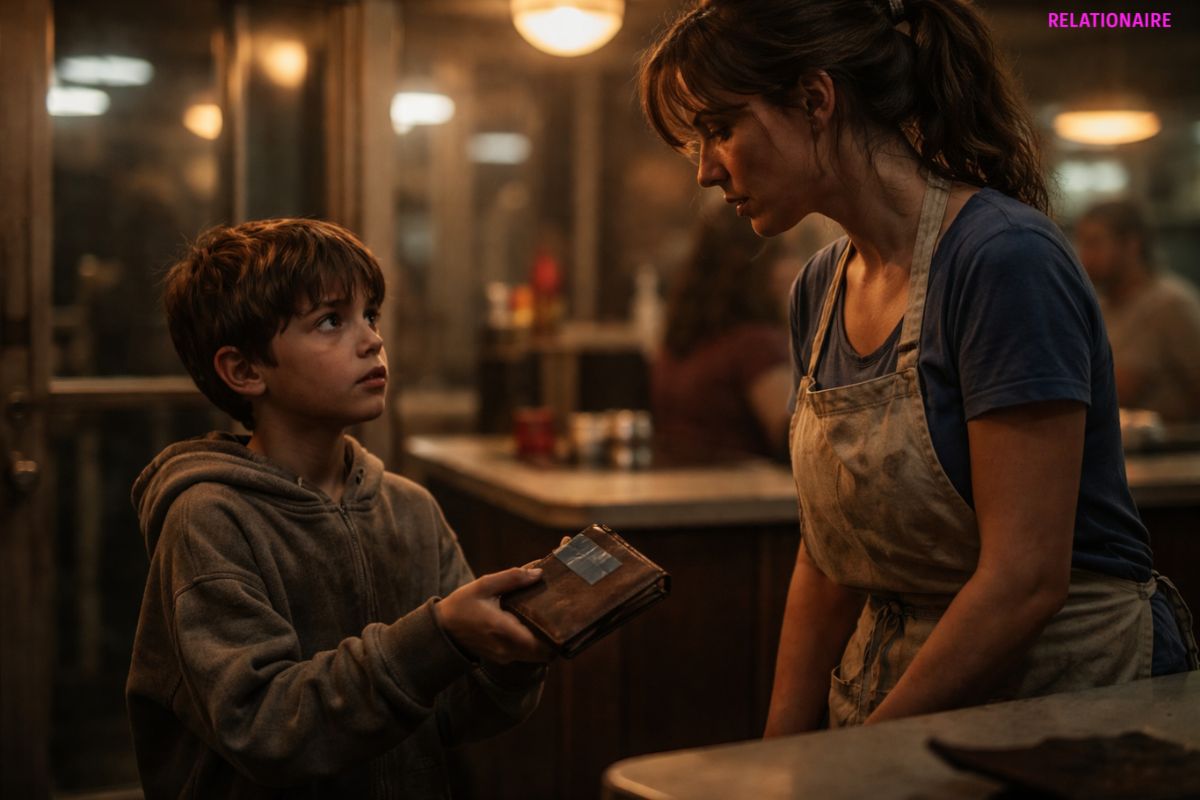
A boy stood just inside the door.
He couldn’t have been more than nine.
Maybe ten if hunger had made him smaller.
He wore a sweatshirt too thin for the weather and jeans stained at both knees. His hair was matted on one side like he’d slept in a car seat or on someone’s couch. His sneakers were muddy, the left lace trailing loose behind him.
In one hand, he held her wallet.
Mae knew it before her brain caught up. The duct tape. The broken snap.
For one second, relief hit so hard it made her dizzy.
“Oh my God,” she whispered.
The whole diner seemed to pause.
The boy walked forward slowly, like he knew rooms full of adults could turn dangerous without much warning. He placed the wallet on the counter with careful fingers.
“I found it,” he said.
Mae grabbed it so fast she hated herself a little.
“Where?” she asked.
“In the alley by the dumpster.”
Mr. Hanley made a sound in his throat.
Mae opened the wallet.
Her ID was there.
Her debit card.
The prayer card.
Ivy’s photos.
But the cash—
She flipped through again, faster this time, then again.
Nothing.
The bills were gone.
The tiny remaining hope in her chest dropped like a stone.
Her face must have changed because the boy took half a step back.
Tasha leaned in. “Was there money in it?”
Mae looked at her, then at the boy.
“Yes.”
The diner went still in a different way.
Mr. Hanley turned fully on his stool. “How convenient.”
“Sir,” Tasha said.
But he was already staring at the child. “You just happened to find it, did you?”
The boy’s mouth tightened.
“I did find it.”
“And the money just walked off by itself?”
Rosa came out from the kitchen, dish towel in hand. “That’s enough.”
But the suspicion was already in the room now, thick as fryer grease.
Mae hated that she felt it too.
She really hated that the wallet had come back empty.
The boy didn’t run.
That was what she would think about later.
He didn’t bolt for the door or lie bigger or cry.
He just stood there with dirty hands at his sides and looked at Mae, not defiant exactly, not innocent either. More like he knew what people saw when they looked at him and was tired of being surprised by it.
“How much was in there?” Tasha asked softly.
Mae swallowed. “Eighty-three dollars.”
Eighty-three dollars.
It sounded both small and enormous when spoken out loud.
Mr. Hanley snorted. “That’s a lot to a boy like him.”
“A boy like him?” Rosa snapped.
“You know what I mean.”
Everybody knew what he meant.
Mae’s cheeks burned.
The boy looked at the wallet in her hand.
Then at the floor.
Then back at Mae.
“I brought it back,” he said.
“That doesn’t mean you didn’t take the money,” Mr. Hanley said.
“Enough,” Rosa said, louder now.
A couple in the corner had stopped eating. The baby by the window had gone quiet. Even the spoon tapping had stopped.
Mae should have said something kind.
Or wise.
Or adult.
Instead she heard herself ask, “Did you take it?”
The boy looked at her for a long moment.
His eyes were gray. Not the bright gray of pretty children in catalogs. Flat gray. Rainwater gray. Old-sweater gray. A child’s eyes that had already learned how to close certain doors.
Then he said, “I brought it back.”
It wasn’t an answer.
Or maybe it was.
Mae opened the wallet again, this time slower, angry and shaking and ashamed of both. She checked every pocket as if the bills might appear under pressure.
That was when she found the receipt.
Folded twice and tucked behind Ivy’s school pictures.
She frowned and pulled it free.
It was from Miller’s Market two streets over.
The paper was damp at one corner, like it had been held in a sweaty hand.
There was a list scribbled on the back in uneven pencil.
Bread.
Bananas.
Soup.
Milk.
Baby milk.
Mae’s heart gave a strange, hard thud.
Below the list, in cramped handwriting that didn’t belong on a grocery receipt at all, were the words:
I took only what I needed for my sister’s milk. I left your pictures because those looked more expensive.
For a second, Mae forgot where she was.
Forgot the diner.
Forgot Mr. Hanley and Rosa and the staring customers and the ache in her feet.
She looked up at the boy.
His face had gone still.
Not guilty.
Not proud.
Just braced.
Like he had been waiting for the exact moment the room would decide what he was.
Mae heard her own voice come out thin.
“What is this?”
The boy opened his mouth.
And before he could answer, the bell over the diner door jingled again.
A police officer stepped inside, one hand resting near his belt, and said, “We got a call about a thief.”
PART 2
Officer Bell was young enough to still look uncomfortable carrying authority.
Mae noticed that first.
Not the badge.
Not the radio.
Not the way the whole diner changed shape around him, everyone sitting straighter, everyone suddenly certain they had always known exactly what happened.
Just his face.
He looked tired in the human way, not the official one.
Mr. Hanley raised his hand before anybody else could speak. “That’s him.”
The little boy didn’t move.
Mae still had the receipt in one hand and the open wallet in the other. She could feel everybody waiting for her to confirm the story they had already chosen.
Boy takes wallet.
Boy takes money.
Boy gets caught.
Simple.
Clean.
The kind of story people like because it lets them keep their own hearts tidy.
Officer Bell glanced from Mae to the boy. “Ma’am?”
Mae looked down at the receipt again.
I left your pictures because those looked more expensive.
The line should have sounded clever. Or manipulative. Or wrong.
Instead it landed somewhere deep and painful.
Because he had known the pictures mattered.
Because he had put them back.
Because somewhere between hunger and theft and whatever fear had taught him to write that note, a child had still understood that some things cost more than money.
Rosa stepped beside Mae. “The boy brought the wallet back.”
Mr. Hanley snorted. “After he emptied it.”
The officer held out a hand. “Let me see.”
Mae gave him the receipt first.
He read it once, then again slower.
His face changed a little.
“Did you write this?” he asked the boy.
The boy nodded.
“What’s your name?”
“Eli.”
“How old are you, Eli?”
“Nine.”
“You took the money?”
Eli looked at the floor. “Some of it.”
Mr. Hanley slapped the counter softly with his palm, vindicated. “There. There it is.”
“Sir,” Officer Bell said without looking at him, “be quiet.”
Mae stared at the boy. “Some?”
Eli nodded again.
“How much?” she asked.
“Thirty-eight dollars and twelve cents.”
That number was so exact it made silence spread through the room.
Mae blinked. “You know the cents?”
“I counted it at the store.”
“What store?”
“Miller’s.”
“The one on the receipt?”
He nodded.
Officer Bell crouched a little so he was closer to eye level. “Where are your parents, Eli?”
Eli said nothing.
The officer waited.
Finally the boy shrugged once. “My mom’s at work sometimes.”
“Sometimes?”
“She cleans offices at night.”
“And your dad?”
Eli’s face did not change, but something in him seemed to step backward.
“Don’t got one here.”
Officer Bell looked at the receipt again. “Your sister needs milk?”
“She’s two.”
Mae heard Tasha exhale beside her.
The officer said, “Where is she now?”
“At our apartment.”
“With who?”
Eli hesitated. “Nobody.”
The whole diner seemed to pull tight.
Mae felt cold all at once.
“Nobody?” Officer Bell repeated.
“She was sleeping.”
“You left a two-year-old alone?”
Eli’s chin lifted then, quick and defensive. “I was fast.”
That was the first time he sounded like a child.
Not wise.
Not composed.
Just scared and trying to make something bad sound smaller.
Officer Bell stood. “How long was she alone?”
“I don’t know.”
“What apartment?”
Eli didn’t answer.
“Eli.”
He looked at Mae instead.
Not the officer.
Not the customers.
Her.
As if this had somehow become a conversation between the two people tied to the wallet.
“I was gonna bring it back,” he said.
“I did bring it back,” he corrected himself, voice shaking now. “And I was gonna bring the money too.”
Mr. Hanley muttered, “With what job?”
Eli flinched.
Mae rounded on the old man so fast the stool screeched under him.
“Would you stop?”
The whole diner went quiet again.
Mae turned back to Eli.
He was gripping the hem of his sweatshirt in both fists.
“I don’t understand,” she said, softer now.
He swallowed.
“I only took what the paper said.”
“What paper?”
“The note in your wallet.”
Mae frowned. “What note?”
Eli pointed carefully, like he didn’t want to touch anything that belonged to her again. “The folded paper in the zipper part.”
Mae opened the zipper pocket she barely ever used.
Inside was a narrow slip she had shoved in there three days earlier after calling the landlord from the alley behind the diner, begging for two more days. Darren had been drunk enough to laugh and mean enough to say yes.
She unfolded it.
Rent short: $83.12
She had written it herself in a rush.
The exact amount she was still missing after patching together tips, grocery money, and the last thirty dollars from her birthday envelope.
Eli’s voice was small. “I thought that was all you had to lose.”
Mae stared at him.
“I thought if I left the cards and the pictures and some money maybe… maybe it wouldn’t break everything.”
The room blurred for a second.
He had taken thirty-eight dollars and twelve cents.
Not all of it.
Not even close.
He had decided what her hurt could survive.
As if that was a choice a child should ever know how to make.
Officer Bell asked gently, “Why thirty-eight twelve?”
Eli licked his lips. “Formula was twenty-six ninety-nine. Bread was three dollars. Bananas was one eighty-nine. Soup was two cans.” He looked toward the receipt in Mae’s hand. “There’s tax.”
The precision in it was unbearable.
Rosa turned away and wiped both cheeks with the heel of her hand like she had something in her eye.
Mae looked again at the receipt.
The list wasn’t random.
It was arithmetic.
Hunger written in pencil.
“Why didn’t you ask someone for help?” Tasha whispered.
Eli gave her a look so old it made Mae feel sick.
“Who?”
Nobody answered that.
Officer Bell took a careful breath. “I need that address, Eli. Right now.”
Eli hesitated. “Are you gonna take my sister?”
“I’m going to make sure she’s safe.”
“That means yes.”
“No, it means I’m going to make sure she isn’t alone.”
“That means yes,” Eli said again, fiercer this time, and suddenly the composure cracked. “They always say safe when they mean somewhere else.”
Mae felt the sentence go through her like cold water.
Of course he knew words like that.
Of course.
Children who had to count milk money also learned the language adults used before taking things apart.
Officer Bell knelt again. “Eli. Listen to me.”
But the boy wasn’t listening anymore.
He reached into the front pocket of his sweatshirt and pulled out a little stack of crumpled bills and coins wrapped in a rubber band.
He held them out toward Mae with a trembling hand.
“I was gonna pay first thing,” he said. “I only needed till Friday.”
Mae didn’t take it.
Couldn’t.
“Where did you get that?” Officer Bell asked.
“I been helping Mr. Pruitt carry trash bags behind the laundromat. And I rake when the leaves come down. And sometimes I bring carts in at Miller’s if the man there’s not looking.”
Mae stared at the money.
It couldn’t be much. Ones. Quarters. A few damp dollar bills folded small.
Kid money.
Work nobody should have been proud of, but he was.
He swallowed hard and looked at Mae like this mattered more than the officer, more than the room, more than anything.
“I wrote where I took it,” he said. “So you’d know I didn’t mean all the way steal it.”
That line broke something in Mae so quietly nobody else heard it.
Not all the way steal it.
There are sentences children should never need.
Officer Bell stood up slowly. “Mae, do you want to press charges?”
The question hit the room like a dropped plate.
Mr. Hanley muttered, “You’d be a fool not to.”
Mae turned and stared at him.
Then at the officer.
Then at Eli, holding out his sad little roll of money with both hands now, shoulders tight, eyes red but dry.
She thought of Ivy asleep across town with one sock on and one off, the way children slept when they still believed the night would hold. She thought of a two-year-old alone in an apartment, waiting inside a dark room that smelled like stale heat and powdered milk.
And then she thought of the note.
I left your pictures because those looked more expensive.
Mae set her wallet on the counter.
“No,” she said.
Mr. Hanley made a sound of disbelief.
Officer Bell looked at her. “No?”
“No charges.”
“Mae,” Tasha whispered, shocked.
Mae didn’t take her eyes off Eli.
“But,” she said, and now the whole room leaned toward the word, “I want to know where your sister is.”
Eli’s mouth trembled.
For one terrible second, Mae thought he still wouldn’t tell them.
Then he reached into his back pocket and pulled out a key on a blue plastic tag. Apartment 2B was written on it in black marker.
He set it on the counter beside the wallet.
And in a voice so small it almost disappeared under the buzz of the diner lights, he said:
“She cries when she wakes up and I’m not there.”
PART 3
Apartment 2B was six blocks from the diner and one whole world away.
Mae rode in the back of Officer Bell’s cruiser because she had insisted, and because once she heard that sentence, there was no going back to coffee refills and pie orders and pretending the night had not split open.
Eli sat beside her, stiff and silent.
He had stopped trying to be brave in a way adults admire. Now he just looked nine.
Very nine.
His knees were dirty. His nails were bitten down. There was a tiny tear at the collar of his sweatshirt, and one ear stuck out more than the other when he turned his head.
Mae hated that she had first seen only the empty wallet.
She hated that she understood why.
Sometimes need makes you cruel before it makes you kind.
The building on Ash Street leaned a little to one side like it was tired too. Paint peeled from the railings. One porch light flickered over a stairwell that smelled faintly of bleach, wet cardboard, and old cooking oil.
Eli was out of the car before Officer Bell fully parked.
“Slow down,” the officer called.
But Eli was already halfway up the stairs.
Apartment 2B was at the end of the hall. He jammed the key into the lock with shaking fingers and shoved the door open.
The smell hit first.
Warm milk gone sour.
Laundry that had sat too long wet.
A diaper pail not emptied soon enough.
The apartment was one room pretending to be three. A hot plate near the sink. A couch with a blanket folded into a pillow. A little mattress on the floor in the corner. Cartoon stickers peeling from a dresser drawer.
And on the mattress, awake now and standing unsteadily with sleep-swollen eyes, was a little girl in a sagging diaper and a purple shirt too big for her.
When she saw Eli, she lifted both arms.
No crying.
No panic.
Just relief so complete it quieted the whole room.
He crossed to her in two steps and picked her up. She buried her face in his neck immediately, one hand clutching the back of his sweatshirt.
“There she is,” he whispered, rocking before anybody asked him to. “There’s my Jo.”
Mae had to turn her face away.
Officer Bell stepped inside, scanning the room with the practiced eyes of someone taught to look for danger first and tenderness second.
There wasn’t much here.
A box of crackers on the counter.
Two plastic cups.
A jar of peanut butter with the spoon still inside.
An unplugged lamp.
On the dresser, beneath a chipped framed photo of both children with a woman Mae assumed was their mother, sat three dollar bills, two rolls of pennies, and an envelope.
Eli saw the officer looking.
“That’s for her medicine,” he said quickly. “When she coughs bad.”
Officer Bell nodded once.
No judgment.
Not yet.
Mae stood in the middle of the room feeling like an intruder in somebody else’s private weather.
The little girl peeked over Eli’s shoulder at her with solemn dark eyes.
“This is Mae,” Eli told her.
Mae blinked. “She doesn’t know me.”
“She should,” he said simply. “It’s your money.”
The shame of that nearly took Mae’s breath.
A few minutes later there were more people.
A woman from child services with kind shoes and tired eyes.
A neighbor from downstairs who said she checked in sometimes when their mother’s shifts went late, but tonight her bus had broken down and she hadn’t made it back in time.
Then their mother herself, running up the stairs with her work badge still around her neck, face white with fear.
Her name was Lena.
She looked about thirty and fifty at once.
When she saw the woman from child services, she froze.
When she saw Officer Bell, she put a hand to her mouth.
When she saw Eli holding Jo, she made a sound Mae would hear in her sleep for a long time.
Not a scream.
Not exactly a sob.
Just a mother’s heart tearing at the seam.
“I’m here,” she kept saying as she dropped to her knees in front of them. “I’m here, baby, I’m here, I’m here.”
Jo reached for her.
Eli didn’t.
Not right away.
He held on one extra second.
Long enough for Mae to understand that this boy had been standing in for gravity.
Keeping everything from flying apart.
Lena looked up at him with tears all over her face. “You left?”
“I got milk.”
Her eyes closed.
Mae saw the whole terrible shape of it then.
Not neglect without love.
Not carelessness.
Exhaustion.
Poverty.
A life patched together so thin one missed bus, one long shift, one sick toddler, one hungry night could tear straight through it.
The child services woman, Ms. Alvarez, spoke gently. She asked questions. She looked in the fridge. She looked at Lena’s work schedule. She looked at Jo, who seemed healthy enough except for a runny nose and the clinginess of being two and scared.
She looked at Eli longest.
Not suspiciously.
Sadly.
“As of tonight,” she said carefully, “the children are safe with their mother. But we need to talk about support, emergency contacts, supervision.”
Lena nodded too fast. “Yes. Yes, anything.”
“I’m sorry,” Eli blurted suddenly, to no one and everyone. “I was coming back. I wrote the note.”
Lena turned to him. “What note?”
Mae handed it to her.
Lena read it once and started crying harder.
Not because it was sweet.
Because it wasn’t.
Because it was a child’s attempt to make theft moral enough to survive his own conscience.
Because he had tried to protect a stranger’s heartbreak while carrying his own.
Mae reached into her apron pocket and realized she was still wearing it.
Still had order pads in there. Pens. A peppermint. Her whole ordinary night hanging from her body while everything else had changed.
She pulled out the crumpled roll of bills Eli had tried to repay her with. She had taken it without thinking when they left the diner.
Now she crossed the room and held it out to him.
“This is yours.”
He shook his head immediately. “No.”
“Yes.”
“I took it.”
“You were bringing it back.”
His face tightened. “Still took it.”
Mae nodded. “You did.”
The room went still again.
Children deserve truth too.
She crouched so she was at eye level.
“And I was angry,” she said. “I needed that money. I was scared.”
He looked at her, listening with his whole face.
“But scared people don’t always see clearly,” Mae said. “I saw an empty wallet before I saw a little boy trying to keep his sister fed.”
His mouth trembled.
“I shouldn’t have taken it,” he whispered.
“No,” Mae said. “You shouldn’t have had to decide between that and her being hungry.”
Behind her, Lena covered her mouth and wept silently.
Mae took the receipt from her pocket and smoothed it flat on her knee.
“Do you know what part broke me?” she asked him.
He shook his head.
“The pictures.”
He frowned, confused.
“You knew to leave them.”
His eyes dropped.
“My mama keeps one in her work shoe,” he said. “Of us.”
Lena made another soft sound.
Mae nodded because she understood now. Not perfectly. Not from the inside. But enough.
She tucked the money back into his hand and closed his fingers over it.
“For Jo’s medicine,” she said.
He tried to give it back.
Mae smiled through tears. “That’s not me being generous. That’s me paying attention.”
Officer Bell stepped into the hallway to make a call. Ms. Alvarez started discussing grocery assistance and a church pantry and a list of numbers Lena kept apologizing for needing.
Rosa arrived twenty minutes later with two bags of food and Tasha behind her carrying diapers. Mae hadn’t called them. They had just come.
Even Mr. Hanley, impossible old man that he was, sent a folded envelope through Rosa with forty dollars inside and no note at all.
Maybe shame can move through a room the way mercy does.
Maybe sometimes people need one child to tell the truth with his whole life before they remember how.
A week later, Mae found Eli sitting outside the diner on the curb after school with a small jar in his lap.
He stood up so fast he almost dropped it.
Inside were coins. A few ones. A five.
He held it out with both hands.
“What’s this?” Mae asked.
“Payment plan,” he said.
She laughed then, a surprised, broken little laugh.
For the first time, he smiled.
Not big.
Not movie-sweet.
Just enough to show he was still missing a baby tooth on one side.
Mae sat beside him on the curb.
Cars moved past. Somewhere down the block, a dog barked. The evening light turned the diner windows gold.
She pushed the jar gently back toward him.
“No more payment plan.”
He frowned. “But I said I would.”
Mae looked at him for a long moment.
Then she reached into her bag and handed him a paper sack.
Inside was a loaf of bread, bananas, soup, and a sealed container of toddler milk.
The exact list from the receipt.
Eli stared down into the bag.
When he looked up, his eyes were wet.
“I can’t—”
“You can,” Mae said.
He swallowed hard. “Why?”
Because you came back.
Because you left the pictures.
Because even in hunger you tried to preserve what love looked like in somebody else’s life.
Because some children get handed burdens so early they start mistaking survival for sin.
Mae didn’t say all of that.
She just touched the jar lightly and said, “You don’t owe me for being a child in a hard place.”
He looked away and nodded once.
Then, after a long silence, he asked, “Can I still come back when I have enough?”
Mae smiled.
“You can come back anyway.”
And he did.
Sometimes for soup.
Sometimes to sweep up after closing for a few dollars she knew he had earned before he ever touched a broom.
Sometimes just to sit at the end of the counter and do homework while Mae refilled coffee and Rosa argued with the radio.
Jo came too sometimes, sticky-faced and solemn, waving a stuffed rabbit missing one eye.
Lena found steadier hours.
Ms. Alvarez helped.
The church pantry helped.
The neighbor downstairs became part of the emergency plan.
Nothing turned magical.
Bills still came.
People still got tired.
The world stayed expensive.
But every now and then, something fragile held.
Months later, Mae found the receipt again tucked behind Ivy’s school pictures.
She kept it there on purpose now.
Not as a reminder of what was taken.
As a reminder of what almost was.
How easy it had been to look at one dirty child and decide the whole story from the surface.
How close she had come to handing him over to a world already waiting to call him what he feared he was.
Instead, she had learned something from a hungry boy with muddy shoes and a folded receipt.
Sometimes what comes back to you is not what you lost.
Sometimes it is your chance to see clearly.
And sometimes the most expensive thing a person can leave untouched is the part of someone else’s life that proves they were loved.