If you’ve already read part 1 of this story on Facebook, go here for Part 2!
The first laugh came from the back of the room.
It was small. Just a sharp little sound from one of the boys near the cubbies. But once it started, the rest followed. A few giggles. A snort. Then that soft, mean ripple children make when they think someone has said something strange.
Mia stood beside her desk with both hands wrapped around a sheet of yellow construction paper.
On the paper, in careful second-grade handwriting, she had written the name of the person she wanted to bring to Grandparents Day.
Not Grandma Ruth.
Not Grandpa Eli.
Not Nana.
Not Pop-Pop.
Mr. Henry.
Mrs. Alvarez blinked at her from the front of the classroom.
“Mia,” she said gently, in the voice teachers use when they think a child has gotten mixed up, “Grandparents Day is for grandparents or someone like a grandparent.”
Mia nodded.
“I know.”
A few more laughs.
At the reading rug, one little girl whispered, “But he’s the janitor.”
Mia looked at her like that didn’t change anything.
Outside the classroom window, rain tapped against the glass in thin gray streaks. The kind that made the playground look lonely. The kind that made backpacks smell like wet fabric and the hallway fill with the squeak of sneakers.
Mrs. Alvarez crossed the room and crouched beside Mia’s desk.
Her tone softened even more. “Sweetheart, I remember you told me your grandparents live in Arizona.”
“They do.”
“So maybe we can make a card and mail them some pictures instead?”
Mia’s fingers tightened around the paper. “I want Mr. Henry to come.”
There was no attitude in her voice. No whining. She said it the way children say something they know is true, even when everyone around them is making it complicated.
Mrs. Alvarez looked up for half a second, toward the open classroom door, where another teacher passing by had already slowed to listen.
Mr. Henry.
Everyone in the building knew Mr. Henry.
He was sixty-eight, maybe older. No one seemed sure. He wore blue work shirts with his name stitched above the pocket, and his keys always made a small clinking sound before he turned a corner. He moved slowly because of his left knee, which bothered him in cold weather, but he never seemed to miss anything.
A leaky faucet in the girls’ bathroom.
A jammed locker.
A loose desk leg.
A broken pencil sharpener.
He fixed what broke. He mopped what spilled. He carried folding chairs for assemblies and salted the walkway when it iced.
He also seemed to exist, for most people, just outside the edge of things.
Adults thanked him without looking up from their phones. Kids rushed past him in the hall. Parents barely noticed him at all.
Except Mia did.
Mia noticed everything.
She noticed when the crossing guard wore gloves for the first cold morning of the year.
She noticed when the cafeteria lady’s wrist was wrapped in beige bandage tape.
She noticed when Mrs. Alvarez had red eyes after lunch and said she had “a headache.”
And apparently, now, she had noticed Mr. Henry.
Mrs. Alvarez stood. “Why don’t we talk about this later?”
“But the forms are due Friday,” Mia said.
The class laughed again, not cruelly this time, but the way children laugh when someone is accidentally serious in a moment they’ve decided is silly.
Mia’s cheeks turned pink.
Mrs. Alvarez took the paper from her gently. “Let me hold onto this for now.”
Mia let go of it.
But she didn’t smile for the rest of the morning.
At lunch, she sat quieter than usual, peeling the paper from her string cheese in tiny pieces. Her friend Lila tried to tell her a story about her grandmother bringing pink-frosted cookies next Thursday, but Mia only nodded.
Across the cafeteria, Mr. Henry was on one knee beside the trash cans, adjusting the metal hinge on the swinging lid.
His pant leg was damp near the cuff. His blue shirt had a bleach mark near the hem. One of his shoelaces was untied.
Mia watched him until the lunch monitor told her to finish eating.
That afternoon, when school let out and the rain came harder, the front office became a holding place for late pickups.
Three kids left with babysitters.
Two with older brothers.
One with a neighbor who smelled like cigarette smoke and peppermint gum.
Mia stayed in the plastic chair by the lost-and-found bin, swinging one leg and hugging her backpack.
Her mother was late again.
Not because she didn’t care. Mia knew that even at seven. Her mother worked at Mercy General down on Route 9, doing patient intake at the front desk, and sometimes a shift ran over or the bus ran behind or a frightened person started crying and everything else got delayed.
Still, late was late.
And children still waited with that stretched-out look in their eyes, trying not to ask the office secretary every four minutes what time it was.
By five o’clock, the secretary had gone home.
By five-ten, the hallway lights dimmed to evening mode.
Mr. Henry pushed his mop bucket past the office, then stopped when he saw Mia.
“Your mama running behind?”
Mia nodded.
He leaned the mop against the wall. “You eat your snack?”
She held up an empty applesauce pouch from her lunch.
“Well, that’s something.”
He disappeared for a minute, then came back with a packet of crackers from somewhere. Not school crackers in a shiny sleeve. The little peanut butter kind from the vending machine.
“I’m not supposed to take food from strangers,” Mia said.
Mr. Henry looked offended for exactly one second.
Then Mia smiled a little and took them.
“You’re not a stranger.”
He sat in the chair across from her, slow because of his knee, and pulled a tangled purple mitten from the lost-and-found bin.
“Seen this before?”
Mia shook her head.
He laid it across his lap and started working the knot free with careful hands. Hands with split knuckles. Hands that looked rough until you saw how gently they moved.
“What happens to all the lost stuff?” Mia asked.
“Most of it waits around hoping to be loved again.”
She thought about that.
“That’s sad.”
“It is.”
They sat in the hum of the empty school. Rain at the windows. A distant vacuum somewhere down the kindergarten hall. The sour-sweet smell of floor cleaner and old paper.
When Mia’s mother finally rushed in at five-twenty-three, soaked through at the shoulders, apology already on her face, Mr. Henry stood.
“No trouble,” he said before the woman could even speak.
But there were tears in her eyes anyway. The tired kind. The ashamed kind.
“Mia, baby, I am so sorry.”
Mia hugged her around the waist. “I know.”
Her mother looked at Mr. Henry then, really looked at him, as if noticing for the first time that this man had once again stayed behind in an empty building with her child.
“Thank you,” she said.
He tipped his chin once, like gratitude embarrassed him, and picked up his mop.
The next morning, Mrs. Alvarez called Mia’s mother during planning period.
She didn’t mean any harm.
She explained it as tactfully as she could. “I just wanted to check in before Grandparents Day. Mia seems very attached to Mr. Henry, our janitor, and she’s insisting on inviting him. I wasn’t sure if maybe she was feeling disappointed about not having her own grandparents nearby.”
There was a pause on the other end.
Then Mia’s mother said quietly, “She asked for Henry?”
“Yes.”
Another pause.
Longer this time.
Mrs. Alvarez heard the sound of a breath being held.
Then released.
“She wasn’t confused,” her mother said.
Mrs. Alvarez shifted in her chair. “I’m sorry?”
“She knows exactly who she picked.”
That afternoon, at recess, the story had already spread.
The janitor.
She invited the janitor.
Kids repeated it the way they repeated anything unusual, turning it into playground currency.
At pickup, two mothers standing under umbrellas by the side entrance traded that look adults give each other when they think something is sad and a little inappropriate.
“Maybe the poor thing doesn’t understand the assignment.”
“Or maybe she’s starved for attention.”
“Her mom is always late.”
Mia was right there on the steps when they said it.
She was zipping up her jacket. She heard every word.
But she didn’t cry.
She just looked past them, toward the parking lot, where Mr. Henry was crouched beside a kindergartner’s lunchbox with a screwdriver in one hand and the broken latch in the other.
The little boy stood beside him sniffling.
Mr. Henry fixed the latch, wiped the lunchbox with his sleeve, and handed it back like it mattered.
Like it had always mattered.
That night, Mia sat at the tiny kitchen table in their apartment with a box of crayons and a folded invitation form Mrs. Alvarez had finally sent home “just in case.”
Her mother stood at the stove in scrubs that smelled faintly like antiseptic and rain.
Steam rose from a pot of tomato soup.
“Mia,” she said softly, “if you want me to ask Grandma to video call that morning, we can.”
Mia kept coloring.
“I want Mr. Henry.”
“I know.”
“He waits with me.”
Her mother closed her eyes for a second.
Mia looked up. “And he fixed my lunchbox when the strap broke.”
“I know.”
“And when Kayla threw up in music, everybody said ew, but he got her water first.”
Her mother turned off the stove.
Mia lowered her voice then, like she was saying the part adults kept missing.
“He doesn’t act like I’m in the way.”
The apartment went very still.
Her mother came to the table and sat down across from her.
There were shadows under her eyes. Her nails were chipped. Her hospital badge was still clipped crooked to her scrub top.
“Mia,” she said, “why didn’t you tell me that before?”
Mia blinked. “I thought you knew.”
Then she pushed the invitation across the table.
At the top, in her careful handwriting, beneath Guest Name, she had written:
Mr. Henry Bell
And under Relationship to Student, where the form gave little blank space for one word, Mia had squeezed in four.
Her mother read them once.
Then again.
And when she looked up, her face had changed.
“What did you write?” she whispered.
Mia touched the paper with one finger.
The words were simple.
But they reframed everything.
The one who stays.
Part 2
By the next morning, Mrs. Alvarez knew she had been wrong.
Not in the harmless, everyday way adults are wrong about little things.
In the deeper way.
The kind that leaves a sting.
The kind that makes you replay your own voice and hear the gentle condescension hiding inside it.
She stood in the front office with the invitation form in her hand while the copier warmed up, and she kept looking at the line where Mia had written The one who stays.
It was in purple crayon.
The letters leaned unevenly, as if she had pressed harder on the words that mattered most.
Mr. Henry Bell.
The one who stays.
Mrs. Alvarez had taught for fourteen years. She knew how often children confused titles and roles. She knew how often they reached for whoever was nearest when family lived far away or not at all.
But this was not confusion.
This was clarity.
That unsettled her more.
When Mr. Henry came through the office at 7:05 carrying a toolbox and a thermos, she nearly stopped him right there. But he was already moving toward the first-grade wing, keys knocking softly against his hip.
He nodded at her.
“Morning.”
“Morning, Henry.”
He kept walking.
The thing about people who keep a place running is that you grow used to their motion. The rattle of their cart. The scrape of their ladder on waxed tile. Their quiet presence before the day begins and after it ends.
You think you see them.
Sometimes you only see the outline they leave.
At lunch, Mrs. Alvarez watched more carefully.
She saw Mr. Henry carry an extra tray to a boy whose wrist was in a cast.
She saw him scoop up spilled peas before a teacher even noticed.
She saw a kindergarten girl with one shoe untied lift her foot toward him without a word, and he knelt to tie it as naturally as breathing.
He never made a production of it.
He didn’t linger.
He just kept showing up where something small had gone wrong.
That afternoon, Mia’s mother came in ten minutes before dismissal, still in navy scrubs, hair twisted up with a pen, face pale from lack of sleep.
“Can we talk?” she asked.
Mrs. Alvarez nodded and led her into the empty conference room beside the library.
For a moment, neither woman sat.
Rain had finally stopped. Sunlight came through the blinds in thin gold bars. The room smelled faintly of dry erase marker and old coffee.
“I’m sorry,” Mrs. Alvarez said first. “About yesterday. I think I misread the situation.”
Mia’s mother gave a tired smile that wasn’t really a smile. “Most people do.”
She sat down and wrapped both hands around the paper cup of water Mrs. Alvarez had offered her.
“I didn’t realize,” Mrs. Alvarez said carefully, “how much Henry has meant to Mia.”
Her mother stared at the table.
Then she said, “I didn’t realize how much either. Not fully.”
That surprised Mrs. Alvarez.
Her mother laughed once under her breath, but there was no humor in it. “I’m always rushing in. Always apologizing. Always trying to get there before she starts thinking I forgot her.” She looked up quickly. “I’ve never forgotten her. Not once.”
“I know.”
“But children don’t measure love by what’s in your heart. They measure it by who’s there.”
The words sat between them.
Mrs. Alvarez felt them land.
Mia’s mother rubbed at the corner of one eye. “I work double shifts some weeks. My mom’s in Arizona with congestive heart failure. My dad died two years ago. Childcare falls through. Buses run late. Patients scream at the desk because insurance won’t cover something, and then I come here smelling like sanitizer and old coffee, and my daughter is sitting on that plastic chair again.”
Mrs. Alvarez didn’t interrupt.
“Henry was just… there,” she said. “At first I thought he was being kind. Then I realized he’d been kind for months.”
She swallowed.
“Once, Mia came home with a note in her backpack because another kid had made fun of her shoes. The soles were separating. I didn’t have money till Friday. The next morning, her shoes were on the mat by our apartment door with the sole glued and clamped overnight. No note. No signature. Just fixed.”
Mrs. Alvarez’s breath caught.
“I knew it was him because I saw the same glue on his cart that week.”
She looked down at her hands.
“Another time, Mia lost one mitten on the playground. The next day there was a pair in her cubby. Not new. Washed. Folded together. Child-sized. Still warm from the dryer.”
Mrs. Alvarez thought of the purple mitten in his lap after school.
“He’s done that for other kids too,” Mia’s mother said. “Lunchboxes. coat zippers. backpacks. Cracked glasses in a little case. No one sees half of it because he does it quietly.”
“And Mia sees all of it.”
A soft nod.
“She does.”
They sat in the silence that follows truth.
Then Mrs. Alvarez asked the question she had not wanted to ask but needed to.
“Will he come?”
Mia’s mother looked up.
And for the first time, uncertainty crossed her face.
“I don’t know if she’s invited him.”
“She hasn’t?”
“She said she wanted to. I thought she meant through me. But this morning she kept folding paper in her room before school and wouldn’t let me look.”
At 3:18, when the final bus had left and pickup was thinning out, Mia slipped away from the office chair where she was waiting and padded down the hall toward the boiler room door.
She held something behind her back.
A drawing, folded into quarters.
Mr. Henry was kneeling by the baseboard heater outside the nurse’s office, tightening a vent cover.
“Mister Henry?”
He looked over his shoulder. “You need something, peanut?”
She came closer.
His face changed a little at the sight of her expression. Children had a way of carrying ceremony in their bodies when something mattered.
“What’s that?” he asked.
She held out the paper.
He dried his hands on his work pants before taking it.
Inside was a drawing in crayon.
Two people standing in front of the school.
One tall, one small.
The tall one had silver hair and a blue shirt and very large keys hanging from his side. The small one had a purple backpack and a lopsided smile. Above them, in shaky letters, Mia had written:
Grandparents Day
At the bottom was one sentence:
Will you come be mine?
Mr. Henry looked at it for a long time.
Too long.
Mia’s fingers twisted together.
“You don’t have to if you’re busy,” she said quickly. “And you’re not really old-old, just school old, and I know it’s called Grandparents Day, but—”
He set the paper carefully on his knee.
Then he took off his glasses.
That was when Mia got scared.
Adults take off their glasses for different reasons. To clean them. To read small print. To pinch the bridge of their nose when they’re tired.
But these were tears.
“I’m sorry,” Mia whispered. “I didn’t mean to make it weird.”
Mr. Henry made a sound like a cough and a laugh got tangled together.
“You didn’t make it weird.”
“Yes I did.”
“No, ma’am.” His voice was rough now. “No, ma’am, you surely did not.”
She looked relieved for half a second.
Then he said, almost to himself, “I just haven’t been invited to anything like that in a very long time.”
The hallway seemed to quiet around them.
No copier.
No phones.
Just the distant bang of a locker and the old building settling into evening.
Mia took one step closer. “So you can come?”
Mr. Henry looked down at the drawing again.
His thumb moved over the paper, stopping where she had colored in the little blue shirt.
When he spoke, the words came carefully, like he had to lift each one.
“There’s something you ought to know first.”
Mia’s eyes widened.
At the end of the hall, unnoticed by either of them, Mrs. Alvarez had turned the corner carrying a stack of worksheets. Mia’s mother was just behind her, reaching into her purse for her keys.
They both heard his next words.
And both stopped cold.
“I had a granddaughter once,” Mr. Henry said.
He swallowed.
“She was about your age when I last saw her.”
The worksheets slipped from Mrs. Alvarez’s hands and scattered across the floor.
Mr. Henry looked up.
Mia turned.
And in the sudden stillness of that hallway, with papers fanned out like white leaves around their feet, Mia’s mother whispered the question no one had known to ask.
“What do you mean,” she said, “last saw her?”
Part 3
For a second, nobody moved.
The papers stayed on the floor.
Mia stood between them all, small and still, her purple backpack hanging from one shoulder. Mr. Henry remained on one knee beside the vent cover, the folded drawing in his hand.
Something had opened in the hallway.
Something tender and old.
Mia’s mother was the first to step forward.
“What do you mean?” she asked again, quieter this time.
Mr. Henry put his glasses back on, though it was clear he didn’t need them to see what was in front of him. He needed them to steady himself.
His eyes went to Mia first.
Then to the two women.
Then down to the waxed floor.
“I don’t usually talk about it at work,” he said.
No one told him he had to.
But sometimes truth, once loosened, doesn’t go back neatly.
He rose slowly, one hand braced on his knee. For a moment he looked older than Mia had ever seen him. Not weak. Just worn in a way that had been hidden by motion.
“My daughter moved out west after her divorce,” he said. “Nevada first. Then Oregon, I think. We were never… easy with each other.”
He gave a small, embarrassed breath through his nose.
“I was a hard man when I was younger. Harder than I knew.”
The hallway held still around him.
“When her mama died, I didn’t know how to be soft after that. Didn’t know how to grieve without turning everything into rules.” He rubbed his thumb against the edge of Mia’s drawing. “My daughter was sixteen when she started telling me I only knew how to fix things made of metal.”
Mia looked down at his hands.
He noticed.
A sad smile touched his mouth.
“She may not have been completely wrong.”
Mrs. Alvarez bent and gathered the fallen worksheets, not because they mattered, but because grief is easier to hear when your hands are busy.
Mr. Henry went on.
“There were years we barely spoke. Then a few phone calls. Then holiday cards. Then less.” His voice thinned. “I got one picture of my granddaughter when she was five. Missing her front tooth. Holding a stuffed rabbit by one ear. After that…” He shook his head. “I sent birthday checks. They came back twice. Different forwarding address every time. Eventually, no address at all.”
Mia’s mother had one hand over her mouth.
“You never found them?” she asked.
He looked almost ashamed of that.
“I tried. Not the way a better man might have. But I tried.”
The fluorescent lights hummed overhead.
From somewhere outside came the sound of a car door slamming in the pickup lane.
“I kept thinking,” he said, “that if I gave it time, if I stopped saying the wrong thing long enough, maybe one day there’d be a letter.” He looked down at Mia’s crayon drawing again. “One day there’d be some little voice asking me to show up.”
Mia stepped closer until her coat brushed his work pants.
“I am asking.”
It was such a child’s sentence.
Simple. Immediate. No speech inside it.
No performance.
Just truth.
Mr. Henry closed his eyes for a moment.
When he opened them, they were wet.
Mia’s mother sat down abruptly in one of the plastic hall chairs. She looked tired in a way that had nothing to do with her shift. Tired like something inside her had given way.
“I thought I was failing her,” she said softly, almost to herself.
Mia turned. “You’re not.”
Her mother gave a broken laugh. “Baby, I’m late all the time.”
“You still come.”
The words hit harder than anything else said that day.
Because they weren’t denial.
They were discernment.
Not a child pretending absence didn’t hurt.
A child naming what remained.
You still come.
Her mother began to cry quietly then, the kind of crying people do when they’ve held themselves together for too long in parking lots and buses and break rooms and grocery store lines.
Mia went to her without hesitation and laid one hand on her arm.
Not hugging yet.
Just touching.
Steadying.
The way she had seen adults do in hospitals, maybe. The way someone does when they know the person beside them needs dignity more than fuss.
Mr. Henry looked away to give them privacy. Even now.
Even in his own ache.
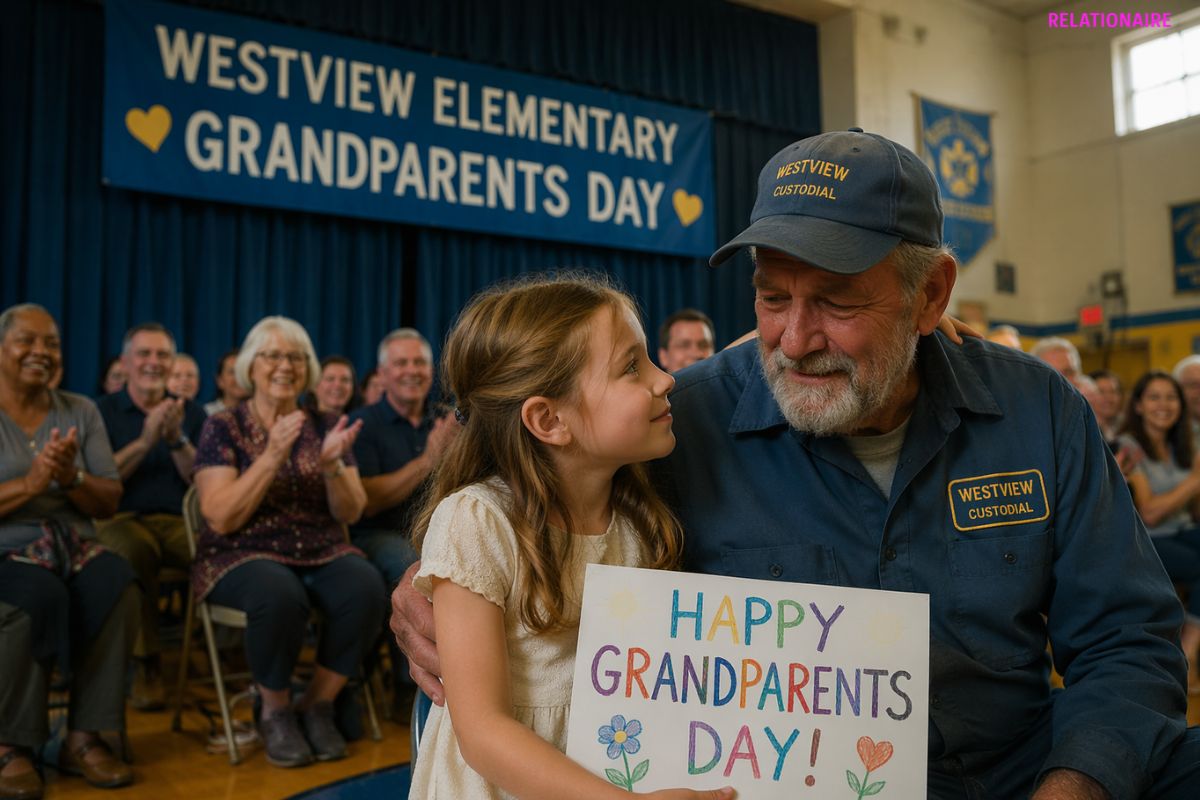
Grandparents Day was three mornings later.
The multipurpose room was dressed in paper sunflowers and hand-painted signs. Folding chairs filled by rows. A table by the wall held coffee in big silver urns, powdered creamer, and supermarket muffins arranged on plastic trays.
Grandmothers came in perfume and cardigans.
Grandfathers came with canes, suspenders, and old stories ready in their mouths.
One child came with an aunt.
Another with a foster dad.
One little boy brought the neighbor from downstairs who walked him to the bus every morning.
Mrs. Alvarez greeted each guest at the door with a smile that felt more thoughtful this year than it had in years before.
At 8:12, Mia was still scanning the hall.
Her hair was in two uneven braids. She wore a blue dress with a missing button at the cuff and white sneakers that had been scrubbed cleaner than their age allowed.
“You okay?” her mother whispered beside her.
Mia nodded.
Then shook her head.
Then nodded again.
At 8:14, Mr. Henry appeared in the doorway.
For a moment, Mia didn’t seem to recognize him.
He wasn’t wearing his blue work shirt.
He had on a dark jacket and a pale button-down tucked into pressed slacks. His hair was combed neatly back. In one hand he carried a small paper bag folded at the top.
His other hand hovered uncertainly near the door, as if he was ready to leave if he had mistaken the invitation.
The room quieted in that subtle way rooms do when something true is walking in.
Mia didn’t wave.
She ran.
She crossed the floor so fast one braid came loose, and when she reached him, she wrapped both arms around his waist with all the force in her tiny body.
Mr. Henry made a sound no one in the room would ever forget.
Not exactly a laugh.
Not exactly a sob.
Something pulled from a place he had kept locked for years.
He bent carefully, because of his knee, and put one hand on the back of her head.
“Mornin’, peanut,” he said.
“You came.”
“I did.”
She stepped back and looked at him with solemn approval. “You look handsome.”
That got a real laugh out of him.
“Well,” he said, “I was aiming for cleaned up.”
Mia took his hand and led him to the student tables decorated with paper placemats. On hers, she had written in green marker:
Mia + Mr. Henry
Not “guest.”
Not “visitor.”
Just both their names.
Side by side.
When it was time for the children to introduce who they had brought, Mrs. Alvarez stood near the microphone but let the kids do the speaking themselves.
A boy introduced his nana and said she made the best banana pudding in the world.
A girl introduced her grandfather and said he let her steer the tractor even though her mother hated it.
Then Mia stepped up.
She looked small behind the microphone.
But not nervous.
Just clear.
“This is Mr. Henry Bell,” she said. “He fixes things at our school.”
A few adults smiled politely.
Then Mia added, “But that’s not the main thing.”
The room changed.
She looked at Mr. Henry, then back at the crowd.
“He waits with kids when people are late.”
Her mother lowered her head.
“He finds mittens. He fixes lunchboxes. He helps when somebody is embarrassed, so it doesn’t feel worse.”
Now no one was smiling the polite way anymore.
“He knows where the quiet Band-Aids are in the nurse’s office,” Mia continued. “And he ties shoes even if they’re not untied very bad.”
A ripple of laughter moved through the room, soft and wet-eyed.
Mia held the microphone with both hands.
“My grandparents live far away,” she said. “But Mr. Henry is family because he keeps showing up.”
Nothing moved.
Not the coffee line.
Not the folding chairs.
Not even the children.
Mr. Henry looked down hard at the table, blinking fast.
Mrs. Alvarez felt her own throat close.
Then Mia said the last part.
The part that stayed.
“Some people are family from the beginning,” she said. “And some people become family by staying.”
There it was.
No sermon.
No performance.
Just a seven-year-old girl saying, in plain language, what half the room had learned too late in life.
After the applause, after the crafts and muffins and badly sung songs, parents lingered.
Not because of the coffee.
Because something in the room had been rearranged.
The lunch lady brought Mr. Henry an extra muffin wrapped in a napkin for later.
The crossing guard came in off her route just to shake his hand.
One father thanked him for fixing his son’s backpack zipper last winter. He had never known who did it.
A grandmother in a red coat pressed his arm and said, “The world needs men who stay.”
Mr. Henry did not know where to look.
Mia solved that by staying near him all morning.
At the very end, when chairs were being folded and paper scraps swept into piles, he handed her the small paper bag he had brought.
Inside was a stuffed rabbit.
Old, but clean.
One button eye replaced with black thread.
Its fur faded soft from age and careful washing.
Mia lifted it gently. “Who is this?”
He swallowed.
“Her name was Clover,” he said. “My granddaughter’s.”
Mia looked up at him.
“You can keep her,” he said. “I think… I think she’s been waiting around hoping to be loved again.”
Mia’s face changed with recognition.
She remembered.
Most of it waits around hoping to be loved again.
Very carefully, like she understood some gifts were heavier than they looked, she hugged the rabbit to her chest.
Then she reached for his hand.
“You can visit her.”
He laughed through tears.
“Can I?”
“Yes,” she said. “Because that’s how family works.”
That afternoon, for the first time in months, Mia’s mother was not late.
She signed Mia out, thanked Mrs. Alvarez, and stood with Henry under the awning while buses pulled away.
The sky was clear after so many days of rain.
Children’s voices drifted from the playground.
Mia skipped ahead with Clover tucked under one arm.
Her mother looked at Henry and said what she should have said long before.
“You helped raise my little girl in the cracks where I couldn’t get there fast enough.”
Henry shook his head, uncomfortable.
“I just waited with her.”
“Yes,” she said. “Exactly.”
He looked out at Mia, who had stopped to crouch beside a dandelion growing through the edge of the sidewalk.
“She noticed more than I thought,” he said.
Her mother smiled with tears in her eyes. “She always does.”
Mia turned and called, “Are you both coming?”
Both.
The word hung in the afternoon air, light as nothing, heavy as everything.
They walked to the parking lot together.
One tired mother.
One old janitor.
One child who understood before any of them that love is not always the person who shares your blood or your name.
Sometimes it is the person who learns your waiting.
Sometimes it is the one who kneels beside what is broken.
Sometimes it is simply the one who stays long enough for your heart to recognize home.
And sometimes, the people who save us never announce themselves at all.
They just keep showing up until one honest child says their name out loud.