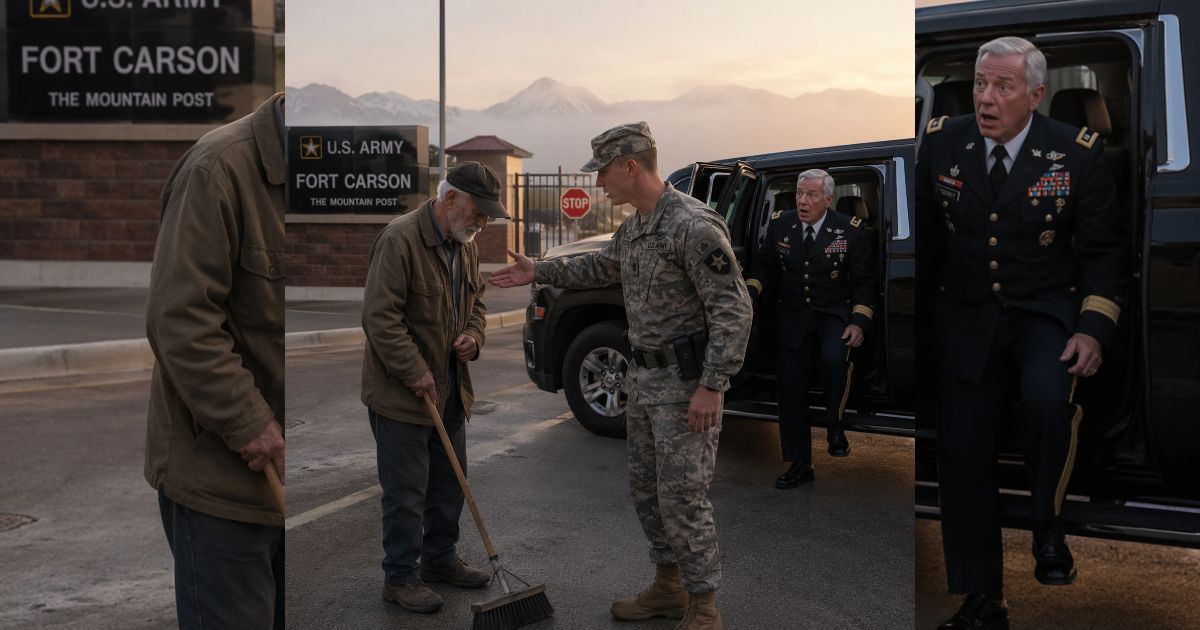
The Young Guard Told the Old Janitor to Get Lost. Ten Minutes Later, a Decorated General Stepped Out of a Black SUV, Took Off His Cap, and Called Him by a Rank Nobody on That Base Had Heard in Forty Years.
“You don’t belong here, sir.”
The young gate guard said it with the kind of clipped confidence that comes from a fresh uniform, polished boots, and a rulebook still warm in your hands.
He didn’t say it cruelly.
But he didn’t say it kindly, either.
He said it like the matter was already settled.
Like a broom in an old man’s hand was all the proof anyone needed.
Aaron Mitchell looked up from the strip of sidewalk he had been sweeping just outside the east gate of Fort Lincoln.
Fog still sat low over the road.
The sun had not fully climbed yet.
Everything felt pale and cold and unfinished.
Aaron lowered his eyes.
He adjusted his grip on the broom, stepped back behind the painted line near the curb, and said nothing.
That was what made some people uncomfortable about him.
He almost never defended himself.
He never snapped back.
Never demanded respect.
Never reminded anybody how old he was, or how many mornings he had stood there while others were still sleeping.
He simply gave a small nod, as if the boy in uniform had every right in the world to correct him, then went back to sweeping damp leaves away from the gate.
A few soldiers nearby glanced over and smirked.
One of them muttered something under his breath.
Another gave a short laugh.
To them, Aaron Mitchell was just part of the scenery.
The old civilian with the broom.
The one who showed up before sunrise.
The one who cleaned the stretch of pavement outside the base better than the maintenance crew cleaned the inside.
The one who never asked for anything.
Never crossed the yellow security line.
Never made a scene.
Never explained himself.
He was seventy-two years old, though most people guessed older.
Time had worked on him hard.
So had silence.
His beard had gone fully gray years ago, and not the handsome silver people liked to romanticize, but a rough, weather-beaten gray that made him look like he had been standing out in the wind longer than other men had been alive.
He wore the same canvas jacket most mornings.
Same worn boots.
Same old watch with a cracked leather band.
At 5:45 sharp, he arrived.
Not 5:44.
Not 5:46.
At 5:45, every single morning, he came walking down the road from the direction of the town, carrying a broom in one hand and a small satchel over his shoulder.
He would stop near the east gate.
Stand still for one quiet moment.
Look past the fence.
Then begin.
Left to right.
Curb to gate.
Bench to gutter.
Paper scraps.
Leaves.
Dust.
Sand.
Bottle caps.
Bits of windblown trash other people had trained themselves not to see.
He swept with patience.
With rhythm.
With precision.
Not like a man killing time.
Like a man honoring something.
Some of the younger soldiers thought it was funny.
Some found it sad.
A few called him the ghost janitor.
One private once joked that if the base ever got inspected, the old guy outside would probably pass faster than half the people inside.
Most of them never bothered to learn his name.
Private First Class Jason Miller did.
Jason had grown up in a military family in a little town outside Tulsa.
His father had worn a uniform.
His grandfather had too.
He had been raised to notice posture, tone, and the things people carried without speaking about them.
The first morning he paid real attention to Aaron Mitchell, it was because of the flag.
The bugle had just sounded.
A handful of soldiers near the gate straightened automatically.
A couple did it lazily.
One was still half-looking at his phone.
Aaron, standing outside the line with his broom resting against his shoulder, did not move quickly.
He did not jerk into position.
He became still in one clean motion, like stillness itself had once been drilled into his bones so deeply it no longer required thought.
Chin level.
Shoulders set.
Eyes forward.
Not theatrical.
Not showy.
Just exact.
That was when Jason first wondered whether the old man had served.
The second time he wondered was three days later, when he brought Aaron a cup of coffee.
Aaron accepted it with both hands.
Looked at the cup.
Then at Jason.
Their eyes met for one brief second.
Aaron gave him the smallest nod Jason had ever seen.
It looked less like gratitude than recognition.
Not of the coffee.
Of the gesture.
Like a man from one world noticing that another man still understood its language.
After that, Jason started paying attention.
He noticed Aaron watched every military vehicle that entered the gate.
Not nervously.
Not suspiciously.
He watched with the quiet alertness of somebody whose eyes still tracked movement the way they were trained to long ago.
He noticed Aaron’s boots were old, but always clean.
His jacket was faded, but always zipped straight.
His satchel was worn thin at the corners, but handled with care.
He noticed Aaron never begged.
Never drifted toward groups.
Never tried to sell anybody anything.
Never asked for money.
Never asked for work.
Never asked to come inside.
He just swept.
And waited.
For what, Jason could not tell.
One morning the fog hung thick and low, and Jason was posted at the east side checkpoint before dawn.
Aaron was already there.
Not sweeping.
Standing.
He held something in his hand.
A photograph.
Jason could only see the edge of it from where he stood.
Old paper.
Creased badly.
Corners worn soft with time.
Aaron stared at it the way some people stare at a church pew after the service is over.
Not because they have nowhere else to be.
Because they are still standing in the middle of something that hasn’t let go of them.
Then he slipped it back into his satchel, picked up the broom, and went back to work.
A week later, wind caught Aaron’s jacket as he bent to sweep a cluster of leaves from under the bench outside the fence.
For half a second, Jason saw the inside lining.
There was stitching there.
Old stitching.
A faded name patch.
MITCHELL.
Jason felt something in his mind catch.
Not a memory exactly.
More like a loose thread brushing his hand.
Mitchell.
He had heard that name before.
Not in person.
In training.
In one of those dry classroom case studies most soldiers stopped listening to halfway through.
A lecture about missing personnel, incomplete records, and a classified operation from decades back that had ended in confusion, unanswered questions, and a commander who never officially came home.
The name had been buried inside the briefing.
Captain Aaron Mitchell.
Special Recon.
Operation Thunderline.
Status: presumed killed in action.
No confirmed remains.
No final recovery.
No proper homecoming.
Just a line in a file and a name on a memorial wall.
Jason told himself he was reaching.
It was a common enough name.
The old man outside the gate could be anybody.
A retired welder.
A groundskeeper.
A lonely widower with too much time and not enough company.
Still, that night Jason went to the base library.
Not the main polished wing where current manuals sat in straight rows.
The back archive room.
Dusty shelves.
Old binders.
Retired training material.
Faded case studies nobody touched unless they were assigned to.
He spent two hours pulling out records with words like recovery, identification, classified, unresolved.
Most of it was vague.
Names redacted.
Dates partial.
Mission summaries trimmed down to almost nothing.
But Thunderline was there.
Just enough to unsettle him.
Extraction mission overseas.
Compromised.
Seven survivors recovered.
Field commander missing.
Identity unresolved.
File status closed under classified exception.
No photograph.
No clean explanation.
No closure.
Jason sat with the folder open in front of him and felt the same thing he felt whenever a story was too neat on the outside and broken underneath.
The old man at the gate stood too straight.
Watched too closely.
Moved too carefully.
And every morning, he looked through the fence like he was standing outside something that once belonged to him.
The next day Jason brought it up in the barracks.
Not seriously at first.
Just enough to hear the room react.
“You ever think that old guy with the broom might’ve served?” he asked while tugging on his boots.
Corporal Davis laughed before Jason had even finished.
“Served what? Coffee?”
A couple of men grinned.
One shook his head.
Another said, “If he was really some retired hero, he wouldn’t be sweeping sidewalks before breakfast.”
Sergeant Talbot, older than the others and usually harder to amuse, looked up from his locker and said, “People romanticize old men because it makes them feel better. Most stories are smaller than you want them to be, Miller.”
That should have ended it.
It almost did.
But then Jason said the name.
“Aaron Mitchell.”
That got a pause.
Small.
Barely there.
Sergeant Talbot frowned like he had heard it too.
Not enough to agree.
Enough to dislike the subject.
“You need a hobby,” Talbot said finally, and shut his locker harder than necessary.
Jason dropped it after that.
At least out loud.
But he kept watching.
And the more he watched, the less Aaron Mitchell looked like a harmless old civilian with a broom and the more he looked like a man carrying out a duty no one else had assigned him.
Then the new base commander arrived.
Colonel David Roark.
Forty-six years old.
Sharp jaw.
Sharp records.
Sharp opinions.
The kind of man whose uniforms never seemed to crease naturally because even the fabric appeared to know it had better behave around him.
He was efficient, disciplined, and committed to protocol in a way that made people stand straighter before he had even spoken.
Within three days, new perimeter rules were posted.
No lingering near gates.
No unauthorized civilians within marked zones.
No exceptions based on habit, familiarity, or harmless appearance.
The order made sense on paper.
Most new orders do.
It was the kind of order that looked clean in a briefing binder.
It did not account for men like Aaron Mitchell.
At 6:00 the following morning, two military police officers approached Aaron while he was clearing leaves from the outer sidewalk.
Jason saw them from the checkpoint.
Their posture was respectful.
Their tone was firm.
“Sir,” one said, “we’re going to need you to step back from the perimeter.”
Aaron straightened slowly.
“I’m outside the line,” he said.
“New command policy,” the other MP replied. “No civilian presence this close to the gate for extended periods.”
Aaron looked down at the yellow paint.
Then at the broom in his hand.
Then at the gate.
It was such a small movement.
But Jason saw something pass across his face.
Not anger.
Not embarrassment.
Something quieter than that.
Something like an old bruise being pressed.
“I’ve been cleaning this stretch for years,” Aaron said.
“I understand, sir,” the first MP answered. “But the order stands.”
Aaron nodded.
No argument.
No pleading.
He leaned the broom against the bench, crouched, and reached for his satchel.
The zipper snagged.
He tugged once.
The bag slipped.
A small metal box fell out, hit the concrete, and burst open.
Nothing dramatic happened.
No one shouted.
No alarms sounded.
But for a second, the entire morning seemed to hold its breath.
Inside the box lay objects that did not belong to the life people had assigned him.
A medal in a dark velvet case, worn at the edges.
A faded unit patch.
A stack of folded papers tied with string.
The photograph Jason had seen from a distance.
And beneath it all, a nameplate wrapped in cloth.
The older MP stared.
Jason came out from the checkpoint without thinking.
A logistics clerk named Rodriguez, who had been carrying forms across the yard, stopped short when he saw the patch.
“I know that insignia,” he said.
Nobody answered him.
Rodriguez took one careful step closer.
“I’ve seen it in an archive presentation,” he said, voice lower now. “Old Special Recon material. Thunderline.”
Jason’s pulse kicked hard.
Aaron moved slowly, not hiding the contents, not displaying them either.
He picked up the photograph first.
Brushed a little grit from it with his thumb.
Then reached for the medal case.
The younger MP looked uncertain.
“What is all this, sir?” he asked, and for the first time the authority in his voice had started to weaken.
Aaron did not answer immediately.
Jason crouched down near him.
Not too close.
Just close enough to see the photo.
Eight young men in uniform.
A helicopter behind them.
Smoke somewhere in the distance, though the image was so worn it was hard to tell what belonged to the original photograph and what belonged to age.
All of them were dirty, tired, and smiling in that restrained, half-exhausted way men smile when they are too disciplined to call themselves lucky.
Jason’s eyes went to one face.
Then to Aaron’s.
Same eyes.
Younger jaw.
Same stillness, even in a picture.
He looked up.
“Sir,” Jason said quietly, “were you Captain Aaron Mitchell?”
Aaron closed the medal case.
His hands did not tremble.
But his voice, when it came, had the weight of a door opening in a house that had been shut too long.
“Once,” he said.
Jason felt the cold run all through him.
The MP beside him looked back and forth between them.
Rodriguez whispered, “No way.”
Aaron kept his eyes on the photograph.
“Not everybody came home the same,” he said.
Jason stood so quickly he nearly lost his footing.
He did not stop to ask permission.
He did not stop to explain.
He ran straight toward headquarters.
Through the yard.
Past two startled privates.
Across the admin wing.
Up the front steps.
He burst into Captain Lena Walters’ office with enough force to make the clerk outside flinch.
Captain Walters looked up from her desk, stunned and irritated in equal measure.
“Miller,” she snapped, “you better have a reason.”
He was breathless.
He didn’t care.
“I think the man outside the east gate is Captain Aaron Mitchell.”
Silence.
Then a blink.
Then a different kind of silence.
Captain Walters sat back slowly.
“Say that again.”
Jason did.
This time steadier.
He told her about the patch.
The photo.
The metal box.
The name.
Her expression changed one degree at a time.
First disbelief.
Then caution.
Then recognition of risk.
Not physical risk.
Institutional risk.
The kind that travels through offices, archives, and old decisions like a crack through glass.
She stood.
“Stay here,” she said.
He didn’t.
By the time she made it to the outer office, Jason was already on her heels.
Within minutes, phones were ringing.
Records were being pulled.
Archived personnel lists requested.
A secure contact line opened to someone above Colonel Roark.
Then someone above that.
By noon, everyone on base could feel it.
No official statement.
No public announcement.
Just a strange pressure in the air.
Officers whispering.
Clerks moving faster.
People checking old systems that had not been touched in years.
Colonel Roark himself came down to the east gate just before lunch.
He stood across from Aaron Mitchell with Captain Walters at his side.
Jason watched from a distance.
Roark was composed, but too composed.
That was how Jason could tell he was rattled.
“Mr. Mitchell,” Roark said, “we are reviewing some historical discrepancies.”
Aaron gave the faintest nod.
“Seems you are.”
“If you have documentation relevant to an active federal military review, we would appreciate your cooperation.”
Aaron looked at the gate again.
Then at the broom.
Then back to Roark.
“I’ve cooperated every morning for twenty years,” he said quietly.
It was not rude.
That made it land harder.
Roark opened his mouth, then closed it.
Some truths do not need volume to become painful.
The review moved fast after that.
Not because bureaucracy had grown a conscience overnight.
Because somewhere above the base, somebody with rank and memory had heard the name Aaron Mitchell and refused to let it stay buried.
At 3:40 that afternoon, a black SUV rolled through the side entrance of Fort Lincoln.
No lights.
No motorcade.
No spectacle.
It did not need any.
The vehicle stopped near the command building.
Doors opened.
A tall older man stepped out in full dress uniform.
General Richard Hawthorne.
Broad shoulders still straight despite the years.
A slight drag in one leg.
Medals across his chest.
Lines in his face that did not come from age alone.
He ignored the officers hurrying toward him.
Ignored the colonel who had moved quickly from headquarters to greet him.
Ignored the salutes waiting in the air.
He scanned the base once.
Then again.
Then his eyes settled on the east gate.
On the old man standing beside a bench, one hand resting lightly on a broom.
General Hawthorne walked toward him without a word.
The crowd behind him grew without meaning to.
People stopped where they were.
Mechanics.
Clerks.
Young soldiers.
Kitchen staff coming off shift.
Admin officers.
Even the men who had laughed that morning now stood quiet with the uneasy feeling that they had misread something badly.
Jason moved closer but stayed back.
He wanted to hear.
He did not want to break whatever this was.
Aaron looked up as Hawthorne approached.
For one suspended second, neither man spoke.
Then the general removed his cap.
Held it against his chest.
His face changed.
Not softened.
Broken open.
Like a man who had carried one memory in locked storage for most of his life had just found it standing in daylight.
His voice came out rough.
“Captain Aaron Mitchell,” he said. “Is that really you?”
Nobody moved.
The young guard from that morning looked like the ground had shifted under him.
Aaron’s eyes stayed on the general.
His answer was small.
“Hello, Richard.”
Hawthorne stopped three feet away.
His mouth worked once before any words came.
“You saved my life.”
The sentence landed harder because he didn’t try to dress it up.
No formal language.
No speech.
No ceremony.
Just the raw truth.
“I thought you were gone,” Hawthorne said, and his voice cracked in a way that made several younger soldiers glance away out of instinctive respect. “I was told you never made it out.”
Aaron looked down at the photograph in his hand.
“Depends what you mean by out,” he said.
A mechanic nearby set down a wrench he had been holding.
Metal touched concrete.
The sound echoed sharper than it should have.
Colonel Roark stood still as stone.
Captain Walters looked at Aaron with the kind of expression people wear when history has suddenly stepped out of abstraction and become embarrassingly human.
General Hawthorne turned then.
Not away from Aaron.
Toward the crowd.
His voice changed.
It took on command.
“This man is not a loiterer,” he said.
Not loud.
He did not need loud.
“He is Captain Aaron Mitchell, former field commander of Special Recon Unit Thunderline. He was listed as dead. He should not have been. The reason I am standing here today is because he stayed behind when the rest of us got out.”
You could feel the shock move through the people around him.
No one gasped dramatically.
Real shock is quieter than movies make it.
It travels in posture.
In widened eyes.
In mouths that forget to close.
In the sudden reordering of every careless thought someone had five minutes earlier.
The young gate guard who had told Aaron to move along looked like he might stop breathing if nobody reminded him how.
General Hawthorne stepped back.
Then, in full view of everyone on that base, he gave Aaron Mitchell a formal salute.
The kind reserved not for sentiment, but for honor.
It lasted only a few seconds.
But it changed the entire square.
One by one, soldiers straightened.
Some slower than others.
Some with confusion still on their faces.
Some with shame.
Some with awe.
Then hands rose.
A private near the motor pool.
A sergeant by the admin building.
An MP at the gate.
Captain Walters.
Rodriguez.
Jason.
Finally Colonel Roark himself.
All saluting the quiet old man with the broom.
Aaron stood still for a moment longer.
Then he raised his own hand.
It shook once.
Only once.
He held the salute.
Returned it.
And in that moment, Fort Lincoln did not see a janitor.
It saw a chapter it had misplaced.
Later, after the crowd eased back and official cars started arriving, Aaron and General Hawthorne sat together on the weathered bench by the gate.
No podium.
No cameras allowed near them.
Just two old men with the past sitting down between them.
Jason was not close enough to hear every word.
But over the next two days, enough was gathered from interviews, archived notes, recovered records, and the quiet testimony of both men that the story finally took shape.
Not as legend.
As something sadder.
And better.
And far more human than legend.
In 1977, Aaron Mitchell had led a covert recovery mission known as Operation Thunderline.
The details remained classified even now, but the broad outline was clear enough.
A team had gone in to retrieve Americans being held in an isolated compound overseas.
The plan had failed almost from the moment it began.
Bad intel.
Failed communications.
A shifting timetable.
Broken visibility.
The kind of layered chaos that turns clean plans into broken fragments.
Mitchell had gotten his men and the recovered personnel to the extraction point.
He had stayed behind long enough to make sure the aircraft carrying the others got out.
That much had always been known from surviving testimony.
What happened after had been the part nobody got right.
Mitchell had not died that morning.
He had been separated in the confusion.
Wounded, disoriented, and without proper identification after emergency measures taken in the field, he vanished into the kind of bureaucratic darkness that only seems impossible until it happens to someone real.
The classified nature of the operation made it worse.
Records were partial.
Names protected.
Cross-checks delayed.
Medical intake inconsistent.
By the time Mitchell surfaced in a military-affiliated hospital months later under a provisional identity, he was not in a condition to correct anyone clearly.
His memory came and went.
He knew he had belonged to something.
Knew he had not finished something.
Knew names in flashes.
Voices.
Commands.
A photograph.
A flag.
But enough time had passed, and enough files had already been closed, that he was shunted through a system that handled him like an unfinished form.
Temporary designation.
Limited treatment.
Transfer.
Review pending.
Review delayed.
Transfer again.
Somewhere inside the machine, Captain Aaron Mitchell became a problem without a clean box to fit in.
And because people are often more loyal to paperwork than truth, the paperwork won.
General Hawthorne, then a young lieutenant, had spent years believing his commander died so the others could live.
He had carried that belief into every promotion.
Every ceremony.
Every retirement speech he ever attended for someone else.
He had saluted Mitchell’s name on memorial walls.
He had spoken of him in closed rooms when leadership was discussed.
He had thought grief was the final form of loyalty left to him.
And all the while, Aaron Mitchell had been alive.
Not living grandly.
Not living loudly.
Just living quietly enough to disappear.
At some point, years later, pieces of memory returned.
Then more.
Then almost all of it.
By then his old unit no longer existed.
His listed status still said dead.
His family ties had thinned out and broken.
And something inside him, something hard to explain to people who had never been lost in plain sight, made him stop short of demanding the world rearrange itself for him.
He had gone once to a records office, according to one note found in a town archive.
He had left after three hours with a stack of referrals and no answer.
He had written letters.
Some came back.
Some never did.
Some were answered with language so formal it might as well have been a locked door.
Years passed.
He took simple jobs.
Warehouse sweeping.
Night janitor work.
Church maintenance.
Rail depot cleanup.
Nothing permanent.
Nothing that asked too many questions.
When Fort Lincoln opened near the town where he had eventually settled, he began walking past its eastern perimeter in the mornings.
At first he only stopped to watch the flag go up.
Then one day he picked up a piece of litter by the curb.
The next day he brought a broom.
And that became the shape of his life.
When General Hawthorne asked him, later that night in a private meeting, why he had never forced the issue harder once his memory returned, Aaron’s answer sat in the room like something too plain to defend and too honest to attack.
“I didn’t want to walk in somewhere waving ghosts around,” he said. “And I didn’t know if anybody wanted them back.”
That answer broke Captain Walters’ heart when she heard it.
Jason could tell.
It broke something in Hawthorne too.
A man can survive being owed gratitude.
It is harder to survive learning someone you admired believed the world had no room for him anymore.
The verification took forty-eight hours.
Old handwriting samples.
Archived mission details.
Survivor testimonies.
Medical indicators.
Recovered correspondence.
Photographs.
Chain-of-command records.
A scar identified in an old intake file.
A phrase Mitchell used repeatedly that matched field communication logs from Thunderline.
Piece by piece, the system that had once erased him was forced to confirm him.
Captain Aaron Mitchell was officially alive.
He had been alive all along.
Fort Lincoln prepared a formal recognition ceremony.
People from regional command came in.
Representatives from the federal veterans office arrived.
Retired service members who had once served in adjacent units called each other and drove through the night.
A small press pool gathered outside the perimeter hoping for a statement.
Aaron wanted none of it.
If General Hawthorne had not personally asked him to attend, he likely would have stayed home.
Even then, he came in the same jacket.
The uniform tailored for him waited untouched in a garment bag.
When Captain Walters offered it gently, Aaron shook his head.
“This is the life I’ve been wearing,” he said. “Feels dishonest to show up in anything else.”
Rows of chairs were set up beneath the morning sky.
Flags.
Podium.
Honor detail.
Music.
Ceremony language drafted and redrafted by people who suddenly wanted every word to sound worthy.
Aaron stood off to the side until he was called.
The crowd rose when he stepped forward.
He looked almost uncomfortable with the sound of so many people standing for him.
Not proud.
Not false humble.
Just deeply unused to being looked at.
General Hawthorne spoke first.
Not long.
Not theatrically.
He spoke of duty.
Of lost records.
Of institutional failure.
Of the debt owed not only by men whose lives had been spared, but by a system that had benefited from Mitchell’s sacrifice and then neglected the man himself.
Colonel Roark spoke next.
He was visibly humbled, and unlike many men in command, he did not hide behind language.
He said Fort Lincoln had failed to ask the right questions.
He said protocol without humanity becomes blindness.
He said the base would remember that lesson.
Jason never forgot that part.
It was the first time he had seen a commander tell the truth in a way that cost him pride.
Then Aaron was called to the podium.
He walked there slowly.
Not from weakness.
From deliberation.
The applause went on longer than he wanted.
He raised one hand and the crowd quieted.
He looked down once.
Then up.
His voice, when he began, carried less force than the others.
Yet every person there leaned in to hear it.
“I appreciate what’s been done today,” he said.
He paused.
His eyes drifted to the flag above them.
“But I didn’t come back for medals.”
No one moved.
“I didn’t stay near this base to be discovered. I didn’t come out here every morning hoping somebody important would notice me.”
A breeze lifted the edge of his jacket.
He rested one hand on the podium.
“I came because I needed to know the flag still went up.”
There are moments when a crowd becomes so quiet it feels almost alive.
This was one of them.
Aaron continued.
“I needed to know the place still stood. Needed to know somebody still showed up before daylight and did things the right way. Maybe that doesn’t make sense to everybody. That’s all right.”
He swallowed once.
“I’m grateful for the kindness. I am. But I don’t need a house on base. I don’t need a title. I’ve had enough closed rooms in my life.”
A few heads bowed.
Some people were already crying silently.
Not loudly.
Not dramatically.
Just the quiet kind that happens when dignity hits grief at the right angle.
Aaron looked toward Colonel Roark.
Then toward General Hawthorne.
Then back to the crowd.
“What I’d like,” he said, “if the command will allow it, is permission to raise the flag here each morning.”
That was all.
No demands.
No bitterness.
No list of what had been taken.
Just a request to keep serving.
General Hawthorne stood before anyone else could react.
“Captain Mitchell,” he said, voice firm now, “has earned the right to raise any flag on any post in this country.”
That brought the crowd to its feet again.
This time Aaron did not try to stop them.
He only nodded once and stepped back.
The formal recognitions followed.
His honors were restored.
His status corrected.
His retirement record amended with full dignity.
Long-denied benefits reinstated.
A housing package offered.
Medical care guaranteed.
Compensation for decades of administrative failure authorized.
The officials expected him to show gratitude the way people often expect from men who have been denied too long.
Aaron thanked them.
Then accepted only what he needed.
He chose a modest apartment in town over base housing.
Declined public interview requests.
Turned down a book proposal before it was even fully explained to him.
When a regional reporter asked, from outside the gate, whether he wanted America to hear his full story, Aaron answered without breaking stride.
“America already has more stories than it listens to,” he said. “I’d rather do the work.”
And he did.
The gates of Fort Lincoln began opening a few minutes early every morning.
Not for command traffic.
For Aaron Mitchell.
At 5:50 he would arrive carrying a folded flag under one arm and the same broom in the other hand.
The first week, only the honor detail showed up regularly.
The second week, a few more soldiers began drifting over.
The third week, spouses from base housing started bringing coffee and standing quietly at the back.
Then the children came.
It began with one boy in dinosaur pajamas holding his father’s hand.
He stood under the pale morning sky and watched Aaron clip the flag into place with careful, practiced fingers.
He watched the old man smooth the fabric once before the raise.
Watched the way he stood when the flag started up.
Watched the way every movement seemed to matter.
The next morning, the boy came back.
This time his little sister came too.
Then a family from the duplexes near the south lot.
Then another.
Before long, the morning flag raising became something no schedule had officially created and nobody wanted to miss.
Children came in slippers, sneakers, school uniforms, winter jackets, raincoats.
Mothers wrapped in cardigans.
Fathers in training gear.
Teenagers pretending not to care until the moment Aaron saluted.
No speeches.
No production.
Just a man, a flag, and a routine so sincere it made people feel steadier for having witnessed it.
The children called him Mr. Mitchell at first.
Then Captain.
Then, among themselves, something softer.
The Flag Man.
They asked him questions in the awkward direct way children do.
“Why do you fold it like that?”
“Why do you stand so still?”
“Were you really a hero?”
“Did you know a general?”
“Do you miss your friends?”
Aaron never answered more than the question deserved.
“The flag gets folded carefully because people should handle important things carefully.”
“I stand still because some moments deserve your full attention.”
“Hero’s a big word. I was responsible for people. That’s smaller and harder.”
“Yes, I knew a general once. Back when he was loud and thin.”
That one made the adults laugh.
And when a little girl asked if he missed his team, Aaron looked at the flag for a long second before answering.
“Every day,” he said.
He did not say more.
He did not need to.
Jason Miller became part of the morning ritual without ever meaning to.
He still served on active duty.
Still rotated through ordinary assignments.
Still filled out forms and got corrected for things and complained about mess hall eggs like everyone else.
But every chance he got, he found himself near the east gate before dawn.
At first because he was curious.
Then because he was learning.
Aaron never formally mentored him.
Never said, Come here, son, let me teach you something about honor.
He taught by doing things the same careful way every day whether someone noticed or not.
He taught by showing up on cold mornings when his hands were stiff and his breathing was slow.
By straightening the rope after the flag was tied.
By picking up candy wrappers by the curb before anyone else saw them.
By thanking privates and colonels in the same tone.
By never using the weight of his story to make other people smaller.
One morning, after a wet spring wind had nearly pulled the flag sideways during the raise, Jason stayed behind to help Aaron gather the rope and clips.
“You ever get tired of people calling you a hero?” Jason asked.
Aaron glanced at him.
“Not tired,” he said.
Jason waited.
Aaron looped the rope carefully.
“Just wary.”
“Why?”
“Because when people call you a hero long enough, sometimes they stop expecting you to be a person.”
Jason thought about that for days.
The story of Aaron Mitchell spread beyond Fort Lincoln even without his help.
Nearby military schools sent cadets to observe the flag raising.
Not for spectacle.
For leadership studies, they said.
But what they really came for was something harder to put in a curriculum.
A living example of duty without performance.
A state academy eventually proposed a small ethics library named in Aaron’s honor.
He resisted at first.
“Libraries should be named after people who wrote books,” he said.
General Hawthorne, now nearing retirement, smiled and answered, “Some men write them in other people.”
That was the kind of line Aaron usually disliked.
Too polished.
Too ceremonial.
But for once he let it pass.
The Aaron Mitchell Ethics Library was built in a quiet brick building beside the academy chapel.
Not grand.
Not flashy.
Inside were case studies about integrity, missing records, reintegration, command responsibility, and the unseen costs of institutional neglect.
Aaron’s story was part of it, but not the center.
That was his condition.
“If you’re going to use my name,” he said, “use it to keep this from happening to somebody else.”
General Hawthorne took that condition seriously.
So did Captain Walters.
So, eventually, did people far above them.
A set of procedural reforms moved through the system over the next year.
Nothing dramatic enough for headlines.
Just the kind of dry policy changes that save real people later.
Improved verification for unresolved personnel cases.
Expanded review requirements for unidentified veterans entering care.
Secondary identity tracking in classified operations.
Mandatory follow-up reviews when records and testimony conflict.
Most people would never know those reforms existed.
Aaron liked that.
“If it works,” he said to Jason one morning, “the person it helps probably won’t ever know my name. That sounds about right.”
Fort Lincoln changed in quieter ways too.
The young guard who had once told Aaron to move along asked if he could speak with him privately.
Jason happened to see them standing near the bench after sunrise.
The guard looked sick with shame.
Aaron listened.
Then patted the young man once on the shoulder.
Whatever was said remained between them.
But from that day on, the guard was the first to arrive at the east gate when Aaron approached.
Not to make up for the past publicly.
Just to greet him right.
Colonel Roark changed too.
His edges did not disappear.
He was still precise.
Still strict.
Still a man built for systems.
But something in him had been forced open by the realization that order had nearly taught him to ignore a person of enormous value standing right outside his gate.
He began saying something in leadership briefings that spread through the base because it sounded so unlike the version of him people had known before.
“Protocol is a tool,” he would say. “It is not permission to stop seeing people.”
No one told jokes about the old man with the broom anymore.
The broom itself became almost symbolic without Aaron intending that either.
Children drew it in pictures.
Cadets mentioned it in essays.
A chaplain once said during a small chapel service that everyone on base now understood what the broom meant.
Not shame.
Not reduction.
Not the tragedy of a forgotten man.
Stewardship.
The willingness to care for what belongs to all of us when no applause is expected.
Aaron hated hearing himself turned into metaphor.
But he let the chaplain keep talking because the congregation included children, and children sometimes need ideas shaped into things they can hold.
The years passed.
Aaron stayed in his little studio apartment two miles from base.
He kept very little.
A worn recliner.
A kettle.
A narrow bookshelf.
A framed photograph from Thunderline turned face down most of the time.
A wooden case in the corner containing his restored medals, the folded uniform he rarely touched, and the broom he still used.
He walked to base whenever weather allowed.
When rain came hard or the heat turned brutal, General Hawthorne’s driver, after retirement and on his own time, occasionally offered rides.
Aaron accepted maybe one in ten.
He preferred his feet.
“Walking clears the noise,” he would say.
On his eightieth birthday, Fort Lincoln organized a quiet gathering beneath the flagpole.
No press.
No outside staging.
Just the people who belonged there.
The morning watch.
Families from base housing.
Children who were no longer children.
Cadets who had driven in before dawn.
Captain Walters, now promoted.
Colonel Roark, older and less rigid in the face.
General Hawthorne, fully retired, leaning on a cane he pretended not to need.
The gifts were modest.
A hand-carved walking stick from a rehab patient on base who said Aaron had taught him, without ever knowing it, how to keep showing up after life rearranged itself.
A quilt from a group of spouses stitched with small embroidered flags in the corners.
Dozens of handwritten notes from children.
One drawing showed Aaron with a broom in one hand and the entire sunrise in the other.
Jason, now a sergeant, read a note signed by the whole morning watch.
“To the man who reminded us that service is what you do when nobody is grading your posture, we stand better because you stood first.”
Aaron looked down for several seconds before responding.
When he did, his voice was rougher than usual.
“That’s too many words for this hour,” he said, which made everyone laugh softly.
Then, after a pause, he added, “But thank you.”
Later, after the crowd drifted away and the sun had climbed higher, Aaron sat with General Hawthorne on the bench near the east gate.
Same bench where the truth had cracked open years earlier.
Same gate.
Same road.
Traffic came and went beyond them.
For a while they said nothing.
Then Aaron looked at the general and said, almost like he still didn’t believe it, “I never expected to be remembered.”
Hawthorne smiled, the tired smile of a man who had learned that grief and affection use some of the same muscles.
“That,” he said, “was always your blind spot, Captain.”
Aaron looked over.
Hawthorne continued.
“You thought being needed and being remembered were two different things.”
Aaron considered that.
Then shook his head once.
“You always did talk too much.”
Hawthorne laughed.
The kind that slips out old and genuine.
“I learned from officers with poor habits,” he said.
The children kept coming.
Even as the years rolled forward and Aaron slowed.
Even when his joints stiffened.
Even when colder mornings made him pause at the curb before stepping onto the path.
Even when he needed the walking stick more often than not.
He never rushed the flag.
Never handed the task off casually.
On mornings when he was especially tired, Jason or another soldier would stand closer, ready in case Aaron asked.
He almost never asked.
But he had changed in one important way.
He no longer believed asking for help made him less himself.
That may have been the deepest healing of all.
Once, during a windy fall morning, a little boy no older than six asked why Mr. Mitchell still came every day if it hurt.
Aaron looked down at him.
Then at the flag.
Then out toward the road.
“Because some things are worth carrying carefully,” he said.
The boy nodded like he fully understood.
Maybe he did.
Children often understand important things before they understand how to explain them.
When Aaron was eighty-five, the doctors began suggesting he slow down.
Not dramatically.
Just ordinary age.
Breathing issues.
Arthritis.
A tired heart.
He listened politely.
Then continued as long as he could.
The base chaplain said once, in private, that Aaron had become something harder to define than morale and simpler to describe than inspiration.
He was conscience made visible.
The memory of what the place claimed to value, embodied by a man who had nothing left to gain from embodying it.
Aaron never liked language like that.
But the chaplain was not wrong.
When Aaron Mitchell died, he did it the way he had done nearly everything else in the last half of his life.
Quietly.
No spectacle.
No grand farewell speech.
No final statement saved for posterity.
He died in his sleep in the little studio apartment two miles from Fort Lincoln, one hand resting against the walking stick beside his bed.
Jason was the one who got the call first from the apartment manager because Aaron still had him listed as a contact.
Jason drove there in uniform.
Not because he had to.
Because it felt right.
The apartment was neat.
Kettle washed.
Books aligned.
Broom in the corner.
Uniform case closed.
On the small table near the chair sat a folded note in Aaron’s handwriting.
Not a dramatic one.
Not the kind movies invent.
Just practical instructions.
Who should receive the photograph.
Where the medals should be displayed.
A request that no one make a circus of things.
At the bottom, one final line:
Raise it on time.
Jason had to sit down after reading that.
Not because the note was long.
Because it was so deeply, painfully Aaron.
The funeral was military, but restrained.
Just as he would have wanted.
Soldiers, veterans, cadets, children, families, old friends, new ones, people who had only met him once and never quite forgotten him.
General Hawthorne attended in his wheelchair by then.
Captain Walters stood with tears visible and unhidden.
Colonel Roark bowed his head for longer than anyone else during the prayer.
The young gate guard who had once dismissed Aaron came in dress uniform and stood at the back until Jason found him and pulled him closer.
Fort Lincoln could have turned it into a grand public tribute.
It did not.
That was one of the ways people finally proved they had listened.
But the truest memorial happened the next morning.
At exactly 6:00 a.m., seven flags were raised at seven different posts across the country.
Not because Aaron had asked for that.
Because General Hawthorne, Captain Walters, and Jason had quietly arranged it together after reading Aaron’s note and realizing that some gestures become right simply because they echo the truth of a life.
At each location, the flag was raised by someone whose life had been shaped by Aaron Mitchell.
A soldier who had met him.
A former cadet.
A young officer who had studied his case.
A guard who had learned humility from him.
A sergeant who had once brought him coffee.
When the ceremonies ended, each location sent a folded flag to a local school, library, or community center with a handwritten note tucked inside.
Not signed by command.
Not branded by agency.
Just a simple sentence:
Honor is what you keep doing when no one owes you applause.
At Fort Lincoln, the east gate bench remained.
So did the flagpole.
So did the morning gathering.
Jason Miller, now older, took over the raising at first because nobody else could make himself do it without hearing Aaron’s footsteps in the pause before dawn.
He carried the same broom for a while.
Not every day.
Just on certain mornings when leaves collected by the curb and something in him knew exactly what to do.
The children still came.
Then new children.
Then the children of those children.
Some knew the whole story.
Some only knew that an old man once stood there every morning and taught an entire base how to tell the difference between rank and character.
The Ethics Library expanded.
The procedural reforms remained in place.
Young officers continued to study the Mitchell case, not because it was glorious, but because it was instructive in all the ways institutions fail and all the ways one person can remain decent without applause.
General Hawthorne died a few years later.
Before he did, he made one request of Jason.
“Don’t let them turn him into marble,” he said.
Jason understood exactly what he meant.
It is easy to honor a person so heavily that you smooth away everything human about them.
The confusion.
The hurt.
The years of being overlooked.
The small apartment.
The quiet coffee.
The broom.
So Jason did his best.
Whenever someone new came to the base and heard the story for the first time, Jason told it carefully.
Not as myth.
Not as a recruitment speech.
As truth.
He told them Aaron Mitchell was a captain.
Yes.
A man of sacrifice.
Yes.
A leader people owed their lives to.
Yes.
But he also told them Aaron Mitchell had once stood outside a gate in the cold while younger men laughed at him.
He told them Aaron Mitchell had carried his own history in a dented metal box because the system had no shelf ready for him.
He told them the hardest thing about honor is not earning it.
It is living like it still matters after nobody is watching.
That was the legacy.
Not just the mission.
Not just the salute.
Not even the general’s cracked voice at the gate.
It was the daily choice.
To care for what belonged to others.
To show up.
To straighten the rope.
To pick up the trash.
To keep the flag from tangling.
To remain gentle without becoming weak.
To remain humble without disappearing.
To keep faith with duty after duty had failed to keep full faith with you.
There are people like that in every town.
Most are not famous.
Most are not introduced with speeches.
They are the bus driver who waits for the late child in the rain.
The school custodian who notices the lonely kid and leaves a light on in the hallway a little longer.
The crossing guard who never misses a morning.
The church volunteer who stacks chairs after everyone else has gone home.
The quiet man at the park carefully folding a flag no one asked him to raise.
You pass them all the time.
Sometimes you nod.
Sometimes you don’t.
Sometimes you mistake their silence for smallness.
That was the lesson Fort Lincoln never forgot.
Look again.
Ask better questions.
The person doing humble work in front of you may be carrying more dignity, more grief, more discipline, and more history than you have learned to recognize on sight.
Aaron Mitchell never asked for recognition.
Never chased a headline.
Never tried to make the world kneel around what he had endured.
He asked for a flag.
A little work.
A chance to keep serving.
And in the end, that was why he mattered so deeply.
Because the world had once misplaced him, and instead of becoming bitter enough to stop caring, he kept showing up before dawn with a broom in one hand and duty still alive in the other.
Every morning at Fort Lincoln, when the sky begins to pale and the day is not yet fully awake, people still gather by the east gate.
Some out of habit.
Some out of respect.
Some because somebody once brought them as children and the rhythm stayed with them.
They stand quietly.
The rope is checked.
The flag is clipped.
The breeze is measured.
Then the raise begins.
And somewhere in the stillness between darkness and first light, before the anthem finishes and before the day rushes in with all its noise, there is always one brief moment when the whole base feels the same thought without needing to say it aloud.
Some people leave behind buildings.
Some leave speeches.
Some leave titles etched into polished plaques.
Aaron Mitchell left a standard.
A way of showing up.
A way of carrying pain without handing it to everyone else.
A way of serving that outlived rank, attention, and even grief itself.
That is why the story never quite faded.
Not because he was larger than life.
Because he was faithful inside an ordinary one.
And on cold mornings, when wind moves across the pavement outside the east gate and last night’s leaves gather along the curb, there are still days when Jason Miller, older now and grayer than he ever expected to become, reaches for the broom before anyone asks.
He sweeps left to right.
Curb to gate.
Bench to gutter.
Not rushed.
Not lazy.
With the same quiet precision that catches the eye if you pause long enough to notice.
And if a young soldier ever wonders why a man with a rank on his sleeve would take the time to sweep a patch of concrete at dawn, Jason only smiles and says the words Aaron taught him without ever meaning to teach them.
Because this matters.
Even when no one is watching.
Thank you so much for reading this story!
I’d really love to hear your comments and thoughts about this story — your feedback is truly valuable and helps us a lot.
Please leave a comment and share this Facebook post to support the author. Every reaction and review makes a big difference!
This story is a work of fiction created for entertainment and inspirational purposes. While it may draw on real-world themes, all characters, names, and events are imagined. Any resemblance to actual people or situations is purely coincidenta