The waitress who pulled a freezing boy in a wheelchair out of the rain after closing had no idea his father was watching from across the street—and quietly deciding her kindness would change all three lives.
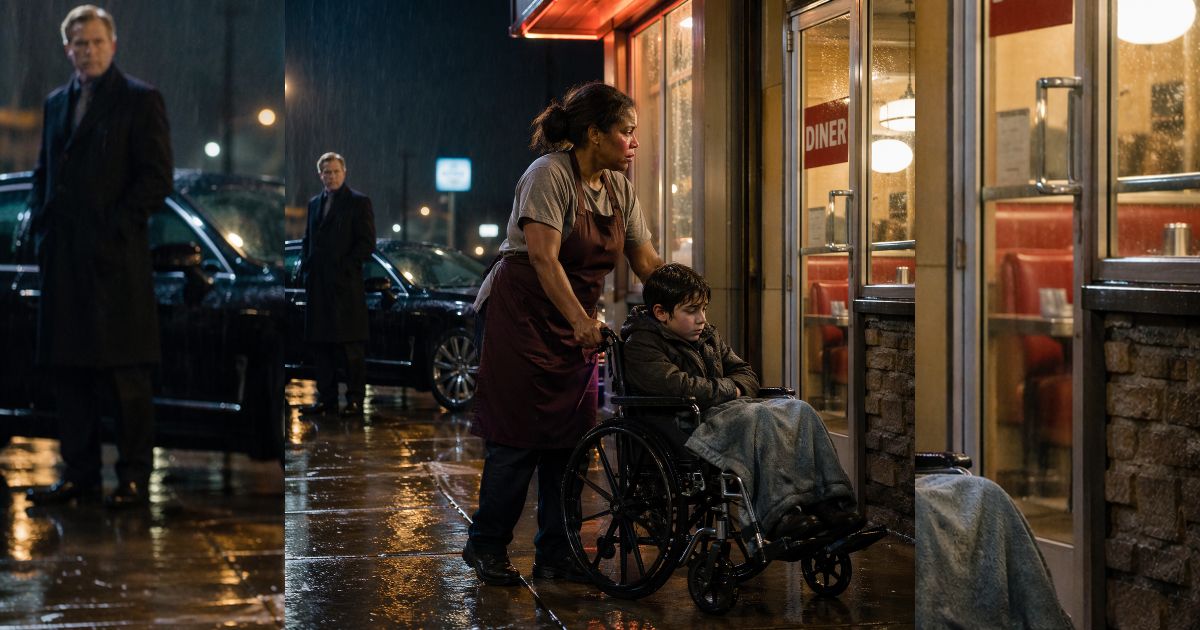
Serena Carter had already flipped the diner sign to CLOSED when she saw the wheelchair snag on a crack in the sidewalk.
The boy jerked forward, small hands gripping the wheels, his thin coat dark with rain. He was sitting alone under the weak red glow of the neon sign, shoulders shaking so hard Serena could see it through the glass.
She did not stop to think.
She shoved the rag onto the counter, pushed through the front door, and let the cold slap her full in the face.
“Hey, baby,” she called, hurrying down the slick step. “What are you doing out here?”
The boy looked up so fast it almost seemed like fear.
He could not have been older than ten. Wet dark hair clung to his forehead. A faded blanket was spread over his lap, the kind that had been washed so many times it had lost all softness. His eyes were wide and blue and tired in a way no child’s eyes should be.
“I’m waiting for my dad,” he said.
Serena glanced down the street.
Nothing but wet pavement, a blinking pawn shop sign, and the shine of headlights far off at the corner. The whole block looked tired. The whole city did, this late.
“In this weather?” she asked.
He gave the smallest shrug.
Serena felt that old ache rise in her chest, the one she got whenever she saw somebody trying too hard to be brave. She had seen grown men do it. She had seen her mother do it. She had done it herself often enough.
“Well,” she said, crouching beside him, “you can wait inside. It’s warmer in there, and I’ve got soup.”
He hesitated.
She softened her voice even more. “You don’t have to be scared of me. I’m Serena. I work here.”
The boy swallowed. “My dad told me to stay put.”
“Then we’ll stay put inside,” she said. “You can see the whole street from the window. If he comes, we’ll know.”
That did it.
He gave one small nod.
Serena moved behind the wheelchair and eased him over the threshold, lifting the front wheels over the metal strip at the door. Warm air met them all at once. The smell of coffee, toast, and dish soap wrapped around them like something solid.
She took him to the back booth near the old radiator, the one that clicked and hissed but still worked harder than half the people she knew.
“There,” she said. “That better?”
He nodded again, this time faster.
Serena grabbed two clean towels from the kitchen and draped one over his shoulders. The other she used to dry his hair as gently as she could. He sat still for it, blinking up at her like he was not used to anybody fussing over him.
“What’s your name?” she asked.
“Daniel.”
“That’s a strong name.”
He looked down, but she caught the hint of a smile.
Serena moved to the grill without another word. She did not ask whether he was hungry. She had spent enough years working doubles at the Lexington Diner to know hunger on sight. It was in the way people looked at food before it touched the table. It was in how careful they tried to sound when they said they were fine.
A few minutes later she set down a grilled cheese cut in halves, a bowl of tomato soup, and a glass of milk.
Daniel stared at it like it might disappear.
“This one’s mine,” Serena said. “So don’t argue.”
His fingers trembled when he picked up the sandwich.
The first bite made him close his eyes.
That nearly undid her.
“It’s good?” she asked lightly.
He swallowed and nodded hard. “Best thing I ever had.”
Serena laughed under her breath. “Either you’re very sweet or you’ve had a tragic life in grilled cheese.”
That pulled a tiny sound from him. Not quite a laugh. Close enough.
Across the street, behind dark glass, Raymond Holt watched every second.
His driver kept both hands on the wheel. Nora Winters, his executive assistant, sat beside him with a tablet on her lap. Neither one said a word at first.
Raymond did not like surprises.
He liked schedules, numbers, outcomes. He liked rooms where every person knew who held power before a meeting even started. He liked plans that stayed plans.
He did not like sitting in a black car at eleven-thirty at night, watching a waitress in a worn apron feed his son with more tenderness than he had managed all week.
“I told him to wait five minutes,” Raymond said at last.
Nora kept her eyes forward. “It’s been thirty-two.”
“I know how long it’s been.”
His tone would have shut down most people.
Nora had worked for him eleven years. She only said, “The call with Tokyo ran long.”
Raymond’s jaw tightened. He hated excuses, especially when they were true.
Daniel had not wanted to stay at the office. He hated the executive floor, hated the silence, hated the way everyone looked at his wheelchair before they looked at him. So Raymond had told the driver to circle the block while he finished the investor call and sent Daniel ahead to the diner entrance where the awning stretched out over the sidewalk.
He had assumed the rain would let up.
He had assumed Daniel would be fine for a few minutes.
He had assumed too much.
Now he watched the waitress tuck a napkin into Daniel’s lap and lean on the edge of the booth while the boy talked. Whatever she said, it made Daniel smile in a way Raymond had not seen in months.
There was no calculation in her face.
No awareness of cameras or money or consequence.
Just care.
That bothered him more than it should have.
“Find out who she is,” he said quietly.
Nora looked over. “Tonight?”
“Tonight.”
“She gave your son soup, Raymond. She didn’t break into the building.”
“That is not the point.”
Nora waited.
Raymond kept his gaze on the diner window. “People are never as simple as they look.”
But even as he said it, he knew he was trying to push the feeling away.
The truth sat harder than pride.
That woman had done, in less than ten minutes, what money had not bought him all year.
Inside the diner, Daniel had finished every bite on the plate.
Serena slid the last half of her own shift pie toward him. “Dessert?”
His eyes widened. “Really?”
“Really.”
He looked toward the window, then back at her. “My dad says sugar after nine is a terrible decision.”
Serena lowered her voice as if sharing something serious. “Then tonight we’ll be terrible together.”
That time he laughed for real.
The sound was small, but it filled the diner.
Serena felt herself smiling back before she could help it. “There it is. Knew you had one in you.”
Daniel took a careful bite of pie. “My dad works a lot.”
“That what he tells you?”
He nodded.
Serena rinsed a mug at the counter so she could give him space without going far. “Parents tell themselves a lot of things.”
Daniel considered that.
Then, very softly, he asked, “Do you think he forgot me?”
Serena’s hand stopped in the sink.
No child should ever ask that question like he already knows the answer might be yes.
She dried her hands and came back to the booth.
“I think grown folks get lost in their heads,” she said. “That’s different from forgetting. Still hurts, though.”
Daniel looked at her for a long second. “You talk like my grandma.”
“That is the nicest thing anybody said to me all month.”
He smiled again.
Then the front door opened and a gust of cold air rolled through the diner.
A woman in jeans, sneakers, and a gray hoodie stepped inside. Blonde hair tucked into a baseball cap. No jewelry. No makeup. Nothing remarkable, except the way her eyes took in the whole room in one sweep.
Serena knew that look.
That was not a customer’s look.
That was a person arriving with a purpose.
The woman walked straight toward the booth and put on a warm expression so smooth it felt rehearsed.
“Hey, champ,” she said to Daniel. “Time to go.”
Daniel looked up, confused.
Serena stayed where she was.
The woman crouched beside the wheelchair. “Your ride’s outside.”
Daniel wiped his mouth with the napkin. “I’m waiting for my dad.”
“I know,” the woman said. “He sent me.”
Serena folded her arms.
“You know him?” she asked.
The woman turned, smile still in place. “I’m his aunt.”
Serena looked at Daniel. “That right, sweetheart?”
Daniel’s fingers tightened around the napkin.
It was just a pause.
Barely a beat.
But Serena had been alive too long not to know what fear looked like when it was trying to behave itself.
“He said to wait for my dad,” Daniel whispered.
The woman’s smile thinned by one invisible degree.
Serena took one step closer. “Then maybe he waits.”
The woman stood slowly. “Ma’am, I’m sure you mean well, but this is a family matter.”
Serena did not move. “Then the family can answer a simple question. What’s his middle name?”
The woman said nothing.
Daniel stared at the table.
For a second the whole diner went quiet except for the radiator clicking and the coffee maker settling behind the counter.
Then the woman exhaled and let the smile drop.
“His father is outside,” she said, lower now. “And he sent me in because he does not want a scene.”
Serena’s eyes narrowed. “A scene from who?”
The woman met her gaze. “From a man who already knows he made a mistake.”
That answer landed differently.
Still, Serena did not like the way the woman had entered. She did not like the lie. She did not like any part of this.
She crouched by Daniel one more time. “You want to go with her?”
Daniel looked toward the window. Then, after a long moment, he nodded.
Serena pressed her lips together.
“All right,” she said. “But he takes this.”
She went to the pie case, grabbed the biggest chocolate chip cookie left, wrapped it in wax paper, and tucked it into Daniel’s hand.
“For the road.”
He looked up at her with sudden warmth. “Thank you, Serena.”
“You’re welcome, baby.”
When the woman wheeled him toward the door, Serena followed close enough to see the black sedan parked across the street.
The back door opened.
A tall man in a dark coat stepped out.
Even from the diner entrance Serena could tell exactly what kind of man he was.
The kind people moved for before being asked.
He had broad shoulders, silver at his temples, and the stillness of someone who spent most of his life being obeyed. Rain dotted his coat but somehow did not seem to belong on him.
Daniel’s face changed when he saw him.
Not fear.
Not exactly relief either.
Something more complicated. Something practiced.
“Dad,” he said.
The man bent slightly, helped guide the chair into place, tucked the blanket better around Daniel’s knees, and said something Serena could not hear.
Then he looked up.
Straight at her.
It was not a grateful look. Not unfriendly. Just sharp. Measuring. Like he was trying to solve a problem and had realized the answer was a person.
Serena held that gaze a second longer than was polite.
Then she went inside and locked the diner door.
She told herself that was the end of it.
It should have been.
But some nights follow you home.
Her apartment on West Fayette was four flights up in a building that always smelled faintly of radiator heat and somebody else’s onions. The hallway light on her floor had been blinking on and off for a week. Management had taped a note beside it promising repairs “soon,” which in that building meant never.
Serena kicked off her wet shoes and counted the cash in her apron pocket at the kitchen table.
Rent. Electric. Bus pass. Groceries.
The numbers did not stretch because numbers never cared who was tired.
She had picked up double shifts all week because the dishwasher’s cousin got married and half the staff had suddenly remembered they had families. Her feet throbbed. Her shoulders ached. The tiny apartment was cold enough that she could see her breath by the window.
Still, she kept thinking about Daniel.
The hesitation in his voice.
The question: Do you think he forgot me?
She hated questions that children had no business knowing how to ask.
She had just pulled a blanket tighter around herself on the couch when there was a knock at the door.
Serena froze.
Nobody came by at midnight unless they had bad news or bad sense.
The knock came again. Three measured taps.
She crossed the apartment quietly and looked through the peephole.
The man from the car stood in the hall.
Dark coat. Straight posture. Hands empty.
Still, he looked like trouble.
Serena did not open the door all the way. Just enough to keep the chain on.
“Yes?”
“My name is Raymond Holt,” he said.
His voice was deep and controlled, like he had spent years making sure it never revealed more than he meant it to.
“You Daniel’s father?”
“I am.”
Serena leaned one shoulder against the door. “Then you found your son.”
“Yes.”
He did not add thank you.
That irritated her immediately.
“And?”
Raymond glanced once at the flickering hallway light, then back at her. “May I come in for a moment?”
“No.”
A tiny shift crossed his face. Not anger. More like surprise that anyone still said no to him without softening it.
Serena kept her hand on the door. “You can talk right there.”
Rainwater darkened the shoulders of his coat. He had either walked up from the street or stood outside longer than he needed to.
“I owe you something,” he said.
Serena almost laughed. “You owe your son an apology.”
That landed.
Good, she thought.
Raymond took it without flinching. “You are not wrong.”
The chain stayed where it was.
She waited.
He reached into his coat slowly, and Serena’s body tightened before her mind caught up. But all he pulled out was a thick envelope.
“I’m not here to insult you,” he said. “I know what money can look like in a moment like this.”
“Then save us both some time and don’t wave it around.”
“That is not what this is.”
He held the envelope out through the narrow opening.
Against her better judgment, Serena took it.
Her name was written on the front in clean, plain print.
Inside was a formal offer letter on heavy paper.
Serena read the first line once.
Then again.
Then she looked up at him like he had lost his mind.
“You want me to do what?”
“Work for my company.”
She gave a short laugh of pure disbelief. “Sir, I pour coffee and tell truckers when the pie is fresh.”
“You also read people in seconds, speak without fear, and chose to protect a child you did not know.”
Serena stared at him.
Behind him, the hallway bulb buzzed and flashed.
He went on. “I have vice presidents with perfect degrees who cannot do what you did in that diner tonight.”
“You watched me long enough to decide all that?”
“Yes.”
“That is not flattering.”
“I did not mean it to be.”
That, oddly enough, sounded honest.
Serena looked back at the paper.
The salary made her pulse jump. It was more money than she had seen in one place outside a bank app that did not belong to her.
Benefits. Retirement. Stock options she barely understood. Title: Director of Community Strategy and Public Affairs.
She laughed again, softer this time, because what else was there to do?
“You don’t know anything about me.”
“I know enough.”
“No, you know a moment. Those are not the same thing.”
For the first time, some heat entered his eyes. “A moment is usually all a person needs to show you who they are.”
Serena folded the paper back into the envelope and handed it out.
He did not take it.
“I’m not a charity project,” she said.
“That is precisely why I am here.”
“Then what is this?”
Raymond’s gaze held hers steadily. “A debt.”
She almost shut the door.
Something in her face must have warned him, because he spoke before she could move.
“When people do something decent for my son,” he said, “I do not forget it.”
The hallway went still.
Serena drew a slow breath. “Most people who talk about debts want control.”
His answer came without delay. “I already have control. That isn’t what I’m offering.”
That was such an arrogant thing to say that it circled all the way back to honest.
She hated that.
“I’m not qualified.”
“Qualifications can be taught.”
“What if I say no?”
“Then I thank you and leave.”
“Just like that?”
“Yes.”
Serena searched his face for the hook hidden behind the bait.
There had to be one.
Men like him did not appear at midnight with job offers because a waitress gave their child soup.
“Why me?” she asked quietly.
Raymond’s expression changed then. Not by much. Just enough to show the answer cost him something.
“Because you saw Daniel,” he said. “Not the chair. Not the inconvenience. Him.”
That hit harder than she expected.
She thought of the way Daniel had looked at the sandwich like it was comfort made visible. The way he asked whether his father had forgotten him. The way this man stood in a shabby hallway admitting, in the only language he seemed to know, that he had failed.
Serena looked down at the envelope.
Six figures.
Insurance.
A way out of counting bills at a kitchen table that shook if you leaned on it wrong.
A door opening where there had been no door at all.
Her mother’s voice rose from memory: Never let folks with money make you feel like gratitude is rent.
Serena lifted her chin. “I’m not saying yes tonight.”
“I did not ask you to.”
“How long?”
“Forty-eight hours.”
She almost smiled. “You schedule everything?”
“Yes.”
“That sounds exhausting.”
“It is.”
For the first time, the corners of his mouth moved. Not a smile. The ghost of one.
Serena noticed against her will that he looked tired.
Not rich-man tired. Not bored tired.
Bone-deep tired.
The kind that comes from holding too much in place with too little softness.
She tucked the envelope under her arm. “I’ll think about it.”
Raymond gave one small nod. “That is all I ask.”
Then he stepped back, and Serena shut the door and stood there for a long time with her hand still on the lock.
The apartment was silent again.
Only now it felt like silence before weather.
Serena did not sleep much that night.
By morning she had talked herself out of the job three times and back into it four. By lunch she had listed every reason it was a bad idea. By dinner she had realized all her reasons sounded a lot like fear dressed up as principle.
She called him from the pay phone outside the corner store because she did not want a rich man’s voice living in her cheap apartment.
Nora answered on the second ring.
“Office of Raymond Holt.”
Serena almost hung up at the polished tone, but she held on. “This is Serena Carter.”
A pause.
Then Nora’s voice sharpened very slightly. “One moment.”
Raymond came on. “Have you decided?”
Serena looked out at the street, at the little grocery across from the laundromat, at a boy on a bike hopping a broken curb like the world belonged to him.
“I’ll take the interview,” she said.
Another small pause.
“It is not an interview,” Raymond said. “It is your job if you want it.”
Serena closed her eyes. “That is exactly the kind of sentence that makes me nervous.”
“It should. Be at Holt Industrial at eight Monday morning.”
“Holt Industrial?”
“Our parent company.”
“See, that sounds even more dangerous.”
This time she heard it.
A real brief laugh, low and rough, like he had forgotten what it sounded like in his own throat.
“Monday,” he said, and the line clicked dead.
Serena stared at the receiver.
Then she laughed too, because there was no graceful way to walk into a new life. Sometimes you just tripped.
Monday morning, Holt Industrial rose over downtown Baltimore like a polished promise.
Glass. Steel. Quiet money.
Serena stood outside the lobby doors in a blazer she found at a thrift store in Canton and heels she already regretted. The security guard at the desk looked at her badge twice before he looked at her face once.
She noticed.
She noticed everything.
The receptionist with the fixed smile who asked if she was there to cater breakfast.
The young analyst who held the elevator because he assumed she worked facilities, then had to recover mid-sentence when he saw the executive floor access on her badge.
The woman in pearls who said, “You must be the new diversity consultant,” and then blinked when Serena answered, “No, ma’am. I’m the new director.”
Serena smiled through all of it.
She had survived worse places with worse people and less comfortable shoes.
Nora met her outside the executive suite.
Today she wore a charcoal dress, low heels, and the expression of a woman who could organize a disaster before most people had finished naming it.
“Ms. Carter.”
Serena took in the crisp haircut, the tablet, the efficient posture. “You got a first name?”
“Nora.”
“Good. Then I’m Serena.”
Nora’s mouth almost moved. “This way.”
Raymond’s office was bigger than Serena’s whole apartment.
Maybe bigger than her whole floor.
Floor-to-ceiling windows looked out over the harbor. Bookshelves lined one wall. A long table stood opposite a desk so clean it looked ceremonial. There were no family photos. No clutter. No softness except a single framed drawing propped beside a stack of reports.
A child’s drawing.
Blue marker. A square sun in the corner. A stick figure in a wheelchair beside a very tall man.
Serena saw it before Raymond turned around.
He stood at the window with one hand in his pocket. Dark suit. White shirt. Tie precise. He looked like someone had taught a storm how to dress.
“You’re late,” he said.
Serena checked the clock on the wall. “By ninety seconds.”
“That is late.”
“Good morning to you too.”
Raymond faced her fully.
Nora stayed by the door, unreadable.
Serena set her bag on the chair and looked at him straight on. “Let me ask before we do this all day. Do you actually want me here, or did guilt hire me?”
The room went still.
Nora’s eyes flicked up from her tablet.
Raymond studied Serena for a long moment. “Sit down.”
“That wasn’t an answer.”
“It will be.”
She sat.
Raymond moved behind the desk but did not sit right away. “I hired you because you can do something this company has forgotten how to do.”
“Which is?”
“See people before you see function.”
Serena leaned back slowly. “That sounds nice on a poster. What does it mean in this office?”
“It means half the executives in this building think numbers are clean because they are typed in small black print instead of said out loud.”
That was not what she expected.
He finally took his chair.
“Holt Industrial has grown faster than its conscience,” he said. “I intend to correct that.”
Serena raised a brow. “And you think I’m the woman to drag a whole company toward a conscience?”
“No,” Raymond said. “I think you are the woman to make it expensive not to have one.”
For the first time that morning, she smiled.
Nora handed Serena a folder. “Your schedule. Department briefings. Media overview. Current labor dispute. Community engagement plan. A list of everyone who has already decided you do not belong here.”
Serena looked up. “You’re joking.”
Nora did not smile. “Only partly.”
Raymond said, “You begin with me.”
That turned out to mean twelve straight hours of meetings.
No warm-up.
No easing in.
Just names, divisions, contracts, press coverage, personnel tensions, city council concerns, supplier disputes, worker retention problems, and a pending proposal from a private equity partner called Orion Group that wanted Holt to outsource a large piece of manufacturing support overseas.
By noon Serena’s head was full.
By two she understood two things.
First, Raymond did not waste words.
Second, the company had spent years sanding down every human problem until it could be called a strategic adjustment.
“Say it plain,” she told him during a break.
They were alone in his office. Rain tapped lightly at the glass. Someone had left lunch on the sideboard, untouched.
“Plain?” Raymond asked.
“Plain. What happens if this Orion thing goes through?”
He slid a report across the desk.
She skimmed it.
Then looked up. “You’ll close the east-side support plant.”
“Yes.”
“That’s almost nine hundred people.”
“Yes.”
“And you’re telling the board no?”
“Yes.”
Serena dropped the report. “Then why do they think it’s still a conversation?”
“Because they believe efficiency is always moral if it is profitable.”
“And you?”
Raymond met her eyes. “I believe some losses echo longer than a quarterly gain.”
The words sat between them.
Simple. Heavy.
Serena thought of her mother coming home from the textile mill with her lunch cooler still full because they had laid off half the floor before noon. Thought of neighbors packing up couches in pickup trucks because rent rose faster than wages. Thought of whole blocks changing names before the people who lived there could afford to stay.
She nodded once. “All right.”
The Orion meeting was at three.
By three-fifteen Serena was already tired of Philip Langford.
He was sixty if he was a day, with silver hair brushed back and the kind of tan that said golf, not labor. He wore a navy suit that probably cost more than Serena had made in the last six months before Holt hired her. His two associates nodded every time he breathed.
He barely looked at her when he entered the room.
That was his first mistake.
“We appreciate your concern,” Langford was saying, fingers steepled, voice smooth as polished stone. “But the market punishes sentiment.”
“Communities are not sentiment,” Raymond said.
“They are, when measured against scale.”
Serena watched the exchange for a minute.
Langford talked like people were weather. Unfortunate sometimes, but never personal.
He slid a glossy packet across the table. “This gives Holt a leaner future. Cleaner lines. Better margins. A stronger message to investors.”
Serena opened the packet.
The words on the page were as bloodless as hospital walls.
Optimization.
Realignment.
External transition.
Not one line said what it actually meant.
So she said it.
“You want to tell nine hundred Baltimore families that their jobs are gone and call it cleaner lines.”
The room shifted.
Langford finally turned to her.
His eyes moved over Serena’s face, then her blazer, then back to the papers like he could return her to the background by deciding she belonged there.
“And you are?”
“Serena Carter. Director of Community Strategy.”
One of his associates gave the faintest blink at the title.
Langford smiled thinly. “Of course. Well, Ms. Carter, what we want is a sustainable future.”
Serena folded her hands. “For who?”
“For the company.”
She tilted her head. “You say that like the company doesn’t include the people who built it.”
“That is a charming way to frame it.”
There it was.
Not loud. Not rude enough to quote later.
Just clean little contempt.
Serena had spent her whole life meeting men who mistook calm for permission.
She gave him none.
“Let’s frame it another way,” she said. “You cut nine hundred workers. That story hits every local station by dinner. Churches talk about it on Sunday. School boards hear it Monday. City contracts get harder. Your consumer trust slips. Good people stop applying because they do not believe in your word. But yes, the spreadsheet looks pretty for a quarter.”
One associate reached for the packet.
Langford did not.
He leaned back, studying her with new attention. “That is an emotional argument.”
“No,” Serena said. “It’s a longer one.”
Raymond said nothing.
He just watched.
Serena took the packet and flipped to a page she had marked during lunch.
“Page fourteen,” she said. “Your model assumes labor stability in the new market for five years. That number is fantasy. You know it. Your own footnotes show volatility inside thirty months.”
One of the associates looked down fast.
Langford’s expression tightened.
Serena went on, voice level. “You are not selling Holt a future. You are selling them a temporary shine and hoping the consequences arrive after you’ve cashed out.”
The room was silent.
Then Raymond picked up the packet for the first time and said, “That is also how I read it.”
Langford looked from Serena to Raymond and back again.
For the first time, he saw what she was doing there.
And for the first time, Serena saw something like satisfaction in Raymond’s face.
Not because she had impressed him.
Because she had told the truth without asking permission.
After the meeting, Nora caught Serena by the elevators.
“You changed the temperature in that room,” she said.
Serena slipped off one heel for half a second and flexed her aching toes. “Was it too much?”
Nora considered. “It was exactly enough.”
That surprised Serena more than praise from Raymond would have.
She looked at Nora more closely.
Behind the polished edges, there was tiredness there too. And maybe, hidden deep, the trace of amusement.
“You never told me,” Serena said.
“Told you what?”
“That you have a soul.”
Nora’s mouth twitched. “Careful. I have a reputation.”
The weeks that followed moved fast enough to feel unreal.
Serena learned which executives said “concern” when they meant “control.” Which board members smiled only when they were lying. Which reporters could be trusted with off-record truths and which ones turned every quote into a knife.
She learned that Raymond drank coffee like it was fuel, black and fast. That he reread contracts at midnight. That he answered Daniel’s texts within minutes even when he did not answer anyone else’s for hours.
She also learned that Daniel came by the office every Thursday after physical therapy because the driver’s route home passed the building and because, though Raymond would never say it, he liked knowing his son was one floor away.
The first Thursday Serena saw him again, he rolled into her office doorway holding a paper bag.
“I brought backup,” he announced.
Serena looked up from a media brief. “Backup?”
He reached inside the bag and pulled out a wrapped cookie.
“The cafeteria lady said you work too much.”
Serena pressed a hand to her chest. “She sees me. What a gift.”
Daniel grinned.
He looked better now. Warmer. Stronger. Less like a child trying to disappear before someone else decided he was in the way.
Serena waved him in. “Come on then. Save me.”
He rolled inside and looked around her office.
It was smaller than Raymond’s and twice as lived in already. Serena had put up a bulletin board filled with photographs from neighborhood events, employee family days, and community cleanups. She kept a jar of peppermints on the shelf and a bright throw pillow on the chair by the window just because the room needed one soft thing.
Daniel noticed all of it.
“You made it less scary,” he said.
Serena smiled. “That was the idea.”
He looked toward the hallway. “Dad’s in a meeting.”
“Then I guess you’re stuck with me.”
“Good.”
It slipped out so quickly and honestly that Serena had to look away for a second.
Daniel opened his cookie. “Did he tell you he used to hate my art?”
Serena laughed. “No, baby. I think he’d rather swallow a stapler than admit to hating art.”
Daniel laughed too. “He said my sun was the wrong shape.”
“What sun?”
Daniel pointed toward the executive corner of the floor. “The drawing in his office. I made it when I was seven.”
Serena turned back slowly. “That drawing?”
He nodded. “He kept it anyway.”
Something in that detail stayed with her.
So did the rest once Daniel got comfortable enough to keep talking.
His mother had died four years earlier after a long illness Serena would not pry into. Daniel did not speak about it dramatically. He spoke the way children sometimes do when grief has lived in the house so long it has become furniture.
“She used to make grilled cheese with mayonnaise on the bread instead of butter,” he said. “Said it browned better.”
Serena blinked. “That woman knew things.”
Daniel nodded. “Dad pretended he didn’t like it, but he always ate two.”
“Now that,” Serena said, “I believe.”
When Raymond appeared in the doorway twenty minutes later, he stopped at the sight of them.
Daniel at Serena’s side table, sketching on the back of a printout.
Serena leaning over to admire a badly proportioned dog with enormous ears.
The pause was brief.
Still, Serena felt it.
“Am I interrupting?” Raymond asked.
Daniel didn’t even look up. “Yes.”
Serena coughed to hide her laugh.
Raymond’s face stayed composed, but something in his eyes eased. “We need to go.”
Daniel held up the sketch. “Serena says the dog has emotional depth.”
Serena nodded solemnly. “It’s all in the eyebrows.”
Raymond looked at the page. Then at her. “I see.”
He didn’t.
But Daniel did, and that was enough.
Over time, the Thursday visits became routine.
Then the routine became important.
Daniel brought Serena drafts of school speeches and half-finished essays. Serena helped him find stronger endings. She told him where his jokes landed and where they dragged. She never softened her notes just because he was a child. Daniel loved that most.
“You treat me normal,” he told her once.
Serena set down her red pen. “That’s because you are.”
He looked out the window for a moment. “A lot of people talk to me like I’m five.”
“Well, I already know you’re not five, because your opinions are too loud.”
That made him grin.
But when he left, Serena sat very still at her desk.
Because some children say the deepest things while trying not to sound deep at all.
Raymond saw more than he let on.
He saw Daniel come home lighter on Thursdays.
He saw the way his son spoke more at dinner when Serena had been part of the afternoon. He saw him start asking questions again. Start laughing in the car. Start fighting to stay up later to finish stories instead of drifting quiet at seven.
Raymond also saw something else.
His company changed around Serena the way a room changes when somebody opens a window.
Not fast.
Not clean.
But noticeably.
She learned the names of the janitors and the names of their children. She remembered the security guard’s mother was having knee surgery. She went down to the plant floor and asked workers what was slowing production instead of just reading what middle managers wrote about it.
Half the staff adored her by Christmas.
The other half resented her before they had reason.
Especially Eric Callaway.
Senior vice president. Ten years in the company. Perfect hair. Perfect cufflinks. Perfect voice for pretending a knife was a handshake.
Eric never challenged Serena directly at first.
He preferred drift.
A comment in a meeting about whether she was “ready for that level of complexity.”
A joke about her being “Raymond’s social conscience in heels.”
A pleasant suggestion that perhaps community optics should remain separate from “actual strategic operations.”
Serena smiled through all of it.
Then wrote everything down after.
One night, after a board dinner that left her wanting to scrub her own skin, she found Nora in the executive pantry pouring stale coffee.
“You hate him too, huh?” Serena asked.
Nora glanced over. “Eric?”
“He says my title like he found it in a cereal box.”
Nora leaned against the counter. “Eric says a lot of things.”
“That helpful, is it?”
“It is if you know what he doesn’t say.”
Serena waited.
Nora lowered her voice. “He is patient. He likes to build consensus while pretending it built itself. Men like that are more dangerous than the loud ones.”
Serena took that in.
Then she asked, “Why are you telling me?”
Nora looked into her coffee. “Because you should know where the floor dips.”
It was not friendship yet.
But it was the beginning of trust.
The spring brought a crisis that did not look like one from outside.
A local neighborhood group accused Holt Industrial of backing out of an apprenticeship promise tied to city tax incentives. The board wanted to ignore it. Legal wanted to issue a statement with no admissions and no specifics. Eric wanted to wait it out.
Serena drove to the church basement where the meeting was being held and found fifty angry residents, two local reporters, and a pastor with enough disappointment in his voice to shake the walls.
She did not bring security.
She did not bring a script.
She brought a legal pad and listened for ninety minutes.
When she came back, Raymond asked, “How bad?”
Serena dropped the pad onto his desk. “Bad enough if we lie. Fixable if we don’t.”
He skimmed the notes. “We made the promise.”
“Yes.”
“The program stalled in procurement.”
“Yes.”
“Because?”
“Because everybody forgot actual people were waiting on the other side of the paperwork.”
Raymond looked up.
Serena folded her arms. “This is what I keep telling you. Neglect sounds cleaner in corporate language. It’s still neglect.”
He did not argue.
Within a week Holt relaunched the apprenticeship program, publicly, with dates and names attached. Serena insisted on that part. If a promise could not survive a name beside it, it was not a promise.
The story turned from criticism into reluctant praise.
Employees noticed.
So did the board.
So did Eric.
It happened in May.
A Thursday.
Daniel was at Serena’s office coloring a flyer for the summer youth fair while Raymond sat in a finance review three doors down.
Nora came in without knocking, which meant something was wrong.
“Daniel,” she said gently, “your father needs the hall for a minute.”
Daniel looked between them. “Am I in trouble?”
“No,” Serena said at once.
Nora’s face was too calm.
That scared Serena more than panic would have.
Once Daniel rolled out, Nora shut the door.
“We have a problem.”
Serena stood.
Nora held out a printed email.
At first Serena only saw her own name in the header.
Then the rest of it came into focus.
A confidential internal report on restructuring projections had been forwarded to a reporter at the Baltimore Record from an address routed through Serena’s credentials.
The body of the email suggested Holt was preparing to cut urban apprenticeship programs and move jobs out of state while publicly claiming the opposite.
Serena read it twice.
Then a third time.
Her palms went cold.
“This is fake.”
“I know,” Nora said.
“Who’s seen it?”
“Two reporters. The board. Legal. Raymond.”
Serena looked up sharply. “The board?”
“They were cc’d ten minutes after the reporter confirmed receipt.”
That was not a leak.
That was a setup.
And whoever had done it had done it with craft.
Serena set the paper down very carefully because if she moved too fast she might throw something.
“My credentials were never out of my sight.”
Nora nodded. “Then someone didn’t need your password. They only needed a route that looked like yours.”
Serena thought of every meeting, every hallway glance, every smooth insult dressed as concern.
Then she thought of being the newest executive in a company full of older white men who already believed she was a symbol first and a strategist second.
Easy target.
Easy story.
Easy removal.
“Where is Raymond?”
“In his office.”
Serena did not wait.
She crossed the executive floor so fast one of the assistants flattened herself against the wall. Raymond was standing behind his desk when Serena entered, jacket off, tie loosened, expression carved from stone.
He did not tell her to sit.
Good, because she would not have.
“This is not me,” she said, dropping the printout in front of him.
He looked at it, then at her. “I know.”
The words should have helped.
They did not. Not yet.
“Do you?” Serena shot back. “Because I’m real curious how much ‘I know’ matters against a board full of people who already think I got here by accident.”
Raymond’s jaw tightened.
“It matters to me.”
“That’s not what I asked.”
Silence stretched.
Then he said, “The board is asking for your suspension pending investigation.”
There it was.
Clean. Cold. Expected.
Still, it hit hard enough to rock her.
Serena stepped back and laughed once, a flat sound with no humor in it at all. “Of course they are.”
Raymond came around the desk.
“That will not happen.”
She stared at him. “You can’t promise that.”
“I just did.”
“Why?”
He held her gaze. “Because whoever did this understood the board well enough to know exactly where they would look first. That makes this about more than a leak.”
Serena crossed her arms tight over her chest because suddenly she felt exposed in her own skin. “You saying I was chosen.”
“Yes.”
“Because I’m new.”
“Yes.”
“Because I’m Black.”
Raymond did not answer right away.
He did not need to.
The truth sat there between them with a face everyone in the building knew and no one liked naming.
Serena’s voice dropped. “Say it.”
He looked at her steadily. “Yes.”
The room went very quiet.
She turned away, walked to the window, and pressed her fingers to the glass.
Below them, traffic slid along Pratt Street in neat lines like the city had never broken a promise in its life.
Serena had worked too hard to get here.
Too hard to let somebody fold her into a story that convenient.
Behind her, Raymond said, “Nora is tracing the route now.”
Serena turned. “Then I’m helping.”
“No.”
That one word snapped in the air.
Serena stepped toward him. “You think I’m going to sit in my office while somebody builds a case with my face on it?”
“You are the subject of the investigation.”
“I am also the person being framed.”
“That is precisely why you stay out of sight.”
She laughed again, sharper this time. “That may be how your world works, Raymond, but I did not survive mine by waiting quietly while people got my name wrong.”
He said nothing.
Then, more softly than before, “I know.”
That shifted her anger sideways.
Not gone.
Just changed.
Because she believed he did know.
Maybe not in the same way.
But enough to hear the fear under the fight.
“What if we can’t prove it fast enough?” she asked.
Raymond’s eyes did not leave hers. “Then we make the board regret every second they assumed the easiest answer was the correct one.”
Serena stood still.
It was not an elegant promise.
It was better.
It sounded like him.
And somehow that made it feel solid.
By seven that evening, the executive floor had emptied enough to hear the hum of the lights.
Serena, Nora, and Raymond worked from the war room off legal, the one with no windows and too many screens. Pizza boxes sat unopened on the side table. Coffee turned bitter in the pot. Everybody had loosened into fatigue.
Nora pulled up login logs and server routes.
“Whoever did this piggybacked from an external relay,” she said. “That part is good. But they tested the route twice yesterday before sending the real thing.”
Serena leaned over her shoulder. “Can we trace the tests?”
“Already am.”
Raymond stood at the whiteboard, jacket off, sleeves rolled, making columns in block letters.
ACCESS.
MOTIVE.
TIMING.
He looked less like a billionaire then and more like a man trying to keep a roof from collapsing with his own hands.
Serena watched him a moment longer than she meant to.
Then she said, “It’s somebody who knew I’d be with Daniel this afternoon.”
Nora’s fingers paused over the keys. “Why?”
“Because that bought them a window,” Serena said. “Everybody knows I keep Thursdays lighter after three if Daniel’s coming by. Whoever did this knew exactly when I would not be watching my inbox.”
Raymond turned.
Nora nodded slowly. “That narrows it.”
“Not enough,” Serena said.
“It does if we cross-reference building access,” Nora replied.
The next three hours passed in layers.
Server records.
Calendar entries.
Assistant logs.
Meeting schedules.
Printer timestamps.
Serena made a list of every person who had reason to want her gone, then hated how long it was.
At ten-forty, Nora straightened in her chair.
“I found something.”
Raymond was beside her in two steps. Serena came around the other side.
Nora pointed at the screen. “Secondary relay was authorized through a dormant admin channel tied to executive finance.”
Raymond’s voice turned flat. “Who has clearance?”
“Three current. One former. One delegated.”
“Names.”
Nora read them off.
Eric Callaway was on the list.
Serena felt something cold settle into place.
“Check calendar overlap,” she said.
Nora did.
Eric had left the building at two-thirty, according to the official schedule.
But his badge had pinged a side entrance at three-oh-eight.
Exactly when Daniel arrived.
Exactly when Serena was in her office with her guard down.
Raymond said nothing for a long second.
Then: “Again.”
Nora reran it.
Same result.
Serena folded her arms tighter. “He came back.”
Nora clicked into another log. “And used the eighteenth-floor printer.”
Raymond looked at the paper copy of the fake email on the table.
“Printed before forwarding,” he said.
“Which means he wanted hard copies ready for the board,” Serena finished.
Nora opened expense approvals. “There’s more.”
She pulled up a set of draft consulting agreements between Holt and Orion Group.
One side letter had been routed through Eric’s office, not procurement. The retention bonus language was buried in an appendix.
If outsourcing passed, Eric’s division received a private performance package large enough to buy half Serena’s block outright.
Serena stared at the screen. “He tried to sell people’s jobs and then frame me when I made it harder.”
Raymond’s face had gone still in the dangerous way she was starting to recognize.
“Print everything,” he said.
Nora hesitated. “Should legal—”
“No,” Raymond said. “Not yet.”
Serena looked at him. “Why not?”
“Because if legal moves before the board sees the full pattern, Eric will claim process errors, misunderstanding, delegated authority, anything he can dress in clean language.”
He turned to Serena.
“I want him in the room when the floor disappears.”
Serena should not have felt satisfaction at that.
She did anyway.
The board meeting was called for eight the next morning.
Serena arrived in a navy suit and no fear she could name without insulting herself. She had slept ninety minutes on the couch in the war room with Nora’s scarf folded under her head. Her eyes burned. Her back ached. She had never felt more awake.
The boardroom held twelve people and enough expensive wood to build a house.
Most of the board members were already seated.
Some looked irritated. Some looked curious. Two would not meet her eyes at all.
Eric Callaway sat three seats down from the head of the table, composed and polished, one hand resting beside a legal pad as if this were any other Friday.
He smiled when Serena entered.
That was his mistake.
Raymond came in behind her.
No greeting.
No wasted motion.
He took his seat at the head of the table and said, “We are here to resolve the leak involving Ms. Carter.”
One of the board members, Howard Pike, adjusted his glasses. “Given the sensitivity of the matter, I still recommend administrative leave until facts are settled.”
Serena remained standing.
Raymond said, “Then let us settle them.”
He nodded once to Nora, who distributed folders down both sides of the table.
Paper whispered.
Faces changed.
Howard Pike frowned. “What is this?”
“Evidence,” Serena said.
Her own voice surprised her.
Calm.
Clear.
Stronger than she felt.
She looked down the table at the men who had almost reduced her to a rumor before breakfast.
“You wanted a culprit,” she said. “You just reached for the easiest one.”
No one interrupted.
So she kept going.
“The forwarded email was routed through a relay tied to executive finance, tested twice the day before the leak, and printed from the eighteenth-floor executive printer at three-twelve yesterday afternoon. At that time, my badge was logged on another floor. I was with Mr. Holt’s son. Multiple witnesses can confirm it.”
Eric shifted in his chair.
Small movement.
Still visible.
Serena placed both palms lightly on the table.
“The same executive finance channel is attached to side agreements with Orion Group. Side agreements that include hidden retention compensation linked to restructuring approval.”
Howard Pike flipped pages faster.
Across from him, a board member named Linda Morris went pale.
Eric finally spoke. “This is absurd. Correlation is not proof.”
Raymond looked at him. “No. But the bank transfers are.”
Eric’s color changed.
Nora slid one final page onto the table.
Wire details.
Timing.
A consulting deposit routed through a shell advisory partner into an account tied to Eric’s holding company.
Not criminal enough to thrill a headline.
Damaging enough to end a career in one clean breath.
Eric pushed back from the table. “This is a misinterpretation of an approved compensation structure.”
“Approved by whom?” Serena asked.
He looked at her like he wanted her to disappear.
That, more than anything, gave her strength.
She had seen that look before.
On landlords.
On managers.
On men who believed discomfort was beneath them until it arrived wearing a woman’s face and speaking in complete sentences.
“Say it plain,” she told him. “If you’re going to ruin somebody’s name, at least have the courage to use real words.”
He said nothing.
Raymond stood.
The room stilled.
“Effective immediately,” he said, each word clipped and cold, “Eric Callaway is terminated for cause. Access is revoked. Legal review begins today. Orion negotiations are suspended. The board will receive a full governance reform package by Monday.”
Eric rose halfway, outrage finally breaking through. “You cannot do this without review.”
Raymond’s gaze did not move. “I just did.”
Eric looked toward the board for allies.
He found none.
Because greed is a lonely language once the paperwork is public.
Security was not called.
There was no shouting.
No drama for the hallway to feed on.
Just the slow, humiliating collapse of a man who had believed the right polish could hide rot forever.
As Eric gathered his things, he looked once at Serena.
His expression held anger, disbelief, and something smaller beneath both.
He had genuinely thought she would break easier.
That was the insult she would remember longest.
After he left, Howard Pike cleared his throat.
“Ms. Carter,” he said, voice thinner now, “it appears the board moved too quickly.”
Serena looked at him for a second.
Then another.
“You think?”
Linda Morris closed her folder carefully. “We owe you an apology.”
Serena almost laughed.
Almost.
Instead she said, “What you owe me is a company that stops mistaking convenience for truth.”
Raymond did not speak.
But when Serena took her seat at last, he looked at her with a kind of quiet respect that felt more valuable than any apology in the room.
The story never fully made the papers.
That was Raymond’s doing and Serena’s choice.
The company announced an executive separation and a pause in restructuring review. Governance updates followed. The apprenticeship program expanded. Orion walked.
Inside the building, though, nothing was quite the same.
People who had looked through Serena before now looked at her carefully.
Some out of respect.
Some out of fear.
She accepted both.
Two weeks later, Daniel graduated from middle school.
The ceremony was in a public auditorium with folding chairs, bad acoustics, and proud families packed shoulder to shoulder. Balloons bobbed in the lobby. Somebody’s grandmother shouted the moment the first violin note hit.
Serena sat beside Raymond in the second row.
Daniel rolled across the stage in a pressed blue shirt and tie, diploma folder balanced on his knees, grin wide enough to light the whole place.
When his name was called, Serena stood before she remembered she was supposed to stay seated.
So did Raymond.
Daniel spotted them both and laughed mid-roll, which nearly wrecked the principal’s timing.
Afterward, outside under a warm June sky, Daniel held up his diploma folder like a trophy.
“I told you I’d make honors,” he said.
“You sure did,” Serena said, hugging him carefully around the shoulders.
Raymond adjusted Daniel’s collar. “You worked for it.”
Daniel looked between them, eyes bright with mischief.
“You know what this means.”
Serena narrowed her eyes. “Should I be worried?”
“Yes,” Daniel said. “Celebration grilled cheese.”
Serena gasped. “At last, a sensible plan.”
Raymond sighed like he had no power at all in his own life. “I knew this would become a tradition.”
“It became a tradition the minute you showed up for seconds,” Serena said.
Daniel burst out laughing.
Raymond gave her a dry look. “That was once.”
“Twice,” Daniel corrected.
“Traitor.”
They went to the diner.
Not the Lexington this time. The old owner had retired and sold it six months earlier. But there was a little place near Patterson Park with red booths and good soup and a waitress who called everybody honey without sounding false.
Serena ordered for all three of them.
When the sandwiches came, Daniel held up his half before taking a bite.
“To terrible decisions after nine.”
Serena clinked her lemonade glass against his milk. “To the best ones.”
Raymond looked at them, then lifted his coffee.
For a brief second he seemed unsure what to say.
Then he said, “To being seen.”
The words were simple.
But they landed deep.
Serena looked at him and knew he meant more than dinner.
More than that first rainy night.
Maybe even more than Daniel.
He meant himself too.
That was the thing about love in some people.
It did not enter like music.
It entered like truth.
Slow. Uncomfortable. Impossible to unhear once spoken.
Years changed them in ways none of them could have predicted.
Serena did not become soft inside Holt Industrial.
She became sharper.
Smarter.
Harder where she needed to be.
She pushed through a supplier fairness review that made half the board groan and three city councils take notice. She built a paid mentorship track for local high school seniors. She rewrote community agreements so promises carried deadlines and consequences. She made executives visit the neighborhoods they loved naming in press releases.
Not all of them thanked her.
That was fine.
She had not come to be liked.
Raymond changed too, though more quietly.
He left the office earlier on Thursdays.
Then sometimes on Tuesdays as well.
He started attending Daniel’s school meetings himself instead of sending a driver and a signed note. He learned which teachers talked to Daniel and which ones talked around him. He got worse at pretending not to care about art, which Daniel exploited shamelessly.
One winter afternoon Serena found Raymond in his office holding a watercolor Daniel had made of the harbor at sunset.
“You’re staring,” she said from the doorway.
Raymond looked up. “I am evaluating.”
“That painting has got you by the throat.”
“It does not.”
She leaned against the frame. “Mm-hmm.”
He set the painting down carefully, which told the whole story.
Serena smiled.
Then she noticed something on his desk.
A small glass frame.
Inside was the old drawing from years ago. The square sun. The impossible dog. The stick-figure father and son.
Next to it was a newer sketch.
Three figures now.
One tall.
One seated.
One with a cloud of curly hair and impossible heels.
Serena went quiet.
Raymond saw where she was looking.
“Daniel updated it,” he said.
“I can see that.”
“He was very firm that the shoes were important.”
“They usually are.”
Raymond looked at the sketch for a long moment. “He said families can expand without changing shape.”
Serena’s throat tightened unexpectedly.
That child, she thought.
Always saying the deepest thing in the room like he had merely noticed the weather.
By the time Daniel left for college, Serena was vice president of strategy and public trust.
The title made Nora snort the first time she heard it.
“Public trust,” Nora repeated. “Only you would make the board sign off on a phrase that sounds like they owe people decency.”
“They do,” Serena said.
Nora had changed too.
She smiled more now, though never enough to ruin her edge. She and Serena had become something better than colleagues and more reliable than friends who only showed up for birthdays.
They were women who had watched each other in the dark and stayed.
That was stronger.
The foundation came later.
Not Raymond’s idea at first, though he funded half of it before the sentence was finished.
Serena wanted a place where local teenagers could get tutoring, job coaching, digital training, and a real path into the city’s industries without being talked down to or turned into somebody else’s photo op.
Raymond wanted it named after Serena.
Serena absolutely refused.
They argued for three weeks.
Daniel solved it in twenty seconds.
“Call it Carter-Holt,” he said over Sunday dinner. “One of you taught the company how to see people. The other one paid for the chairs.”
Serena laughed so hard she nearly spilled her tea.
Raymond looked offended on principle.
Then he agreed.
At the ribbon cutting, the crowd spilled onto the sidewalk.
Teenagers in fresh shirts.
Grandmothers in church hats.
City officials.
Former Holt apprentices now working full-time jobs.
Employees from the east-side plant.
People from Serena’s old neighborhood who still could not believe the woman from West Fayette now gave speeches without losing her plain voice.
The building had big windows, bright classrooms, a computer lab, and a kitchen where somebody was already making grilled cheese for the after-school crowd.
Serena stood at the podium and looked out at all of it.
At the edge of the front row sat Raymond, older now, still straight-backed, silver heavier at the temples. Beside him sat Nora with a clipboard because Nora would die with a clipboard in hand if given the choice. Beside them sat Daniel, home from college for the weekend, taller through the shoulders, sketchbook under one arm, grin already ready.
Serena cleared her throat.
Then she did what she had done from the start.
She spoke plain.
“Years ago,” she said, “I worked nights at a diner a few miles from here. I thought survival meant keeping my head down and making it to the next bill. Then one rainy night a boy rolled up under the neon sign and changed my whole direction without even knowing it.”
The crowd quieted.
Serena went on.
“He was cold. He was hungry. And what struck me most was not that he needed help. It was how used to needing it alone he seemed.”
She paused just long enough.
“That night taught me something I have spent every year since trying to protect. A person does not become valuable when the right people notice them. They were valuable before anyone thought to look.”
Silence held.
Real silence.
The kind that means a room is listening with its full heart.
Serena smiled and looked down at Daniel. “Some investments pay in dollars. Some pay in headlines. And some pay in the simple miracle of a young person realizing the world has a place for them after all.”
Daniel lifted two fingers to his temple in a mock salute.
Serena laughed softly, then stepped back from the podium.
Applause rose through the hall.
Warm. Strong. Earned.
When the ceremony ended, people crowded the lobby.
Someone from the local paper asked Raymond how it felt to see the foundation open.
He glanced toward Serena, who was kneeling beside a high school student helping her rewrite a resume bullet point for the third time.
Then he said, “It feels like proof.”
“Proof of what?” the reporter asked.
Raymond did not take his eyes off Serena.
“That kindness scales.”
Later, after the crowd thinned and the folding chairs were stacked, Serena found Daniel in the teaching kitchen making a terrible sandwich.
He had cheese on one side, tomato on the other, and no understanding of heat.
She leaned on the counter. “That poor bread didn’t do anything to you.”
Daniel laughed. “I’m experimenting.”
“You’re committing a public act.”
He held up the spatula. “Want to help?”
Serena came around the island and fixed the pan, the butter, the angle, the timing.
When the sandwich came off the griddle, golden and crisp, Daniel took one bite and closed his eyes exactly the way he had years ago in the diner booth.
Serena felt the memory hit both of them at once.
He opened his eyes, smiling.
“Still the best thing ever.”
From the doorway, Raymond said, “That is dramatic.”
Daniel pointed the spatula at him. “You had two at graduation.”
Raymond folded his arms. “I regret nothing.”
Serena turned and laughed.
The late afternoon light poured through the big windows, warm over the counters, warm over the stacked chairs, warm over the three of them standing there like life had been planning this all along.
Maybe it had.
Or maybe lives only look planned once you survive enough of them.
Serena looked around the room one more time.
At the students pinning notices to the community board.
At Nora arguing with a caterer while secretly wrapping up leftovers for staff.
At Daniel handing half his sandwich to his father and pretending not to notice how quickly Raymond took it.
At the sign over the lobby that read CARTER-HOLT FOUNDATION in clean black letters.
Years earlier, Serena had thought rescue always came dressed like certainty.
Money.
Answers.
An unlocked door.
But now she knew better.
Sometimes rescue looked like a booth near a radiator.
Sometimes it looked like a little boy asking if he had been forgotten.
Sometimes it looked like a man who had built his whole life on control learning, one hard inch at a time, how to love out loud.
And sometimes it looked like a tired waitress who opened a diner door in the rain because leaving someone outside had simply never been in her nature.
The world had not turned gentle overnight.
Bills still came.
People still lied.
Power still tried, every day, to rename harm into strategy and distance into discipline and neglect into necessity.
But every now and then, one act of kindness reached farther than the people inside it could see.
Far enough to pull a child out of loneliness.
Far enough to crack open a man who had mistaken control for care.
Far enough to carry a woman from a late-night diner shift to a life large enough to hold others too.
Serena watched Daniel hand Raymond the better half of the sandwich and felt something steady settle in her chest.
Not pride exactly.
Not relief.
Something fuller.
Something like gratitude without debt.
She had fed one cold child on a rainy night because it was the decent thing to do.
Everything after had grown from that simple choice.
Not magic.
Not fate.
Just proof that seeing someone clearly can change the shape of a life.
And in the end, that was the investment that paid the longest.
Thank you so much for reading this story!
I’d really love to hear your comments and thoughts about this story — your feedback is truly valuable and helps us a lot.
Please leave a comment and share this Facebook post to support the author. Every reaction and review makes a big difference!
This story is a work of fiction created for entertainment and inspirational purposes. While it may draw on real-world themes, all characters, names, and events are imagined. Any resemblance to actual people or situations is purely coincidenta