If you’ve already read part 1 of this story on Facebook, go here for Part 2!
“So this is where our money went?”
Lena’s voice broke on the last word.
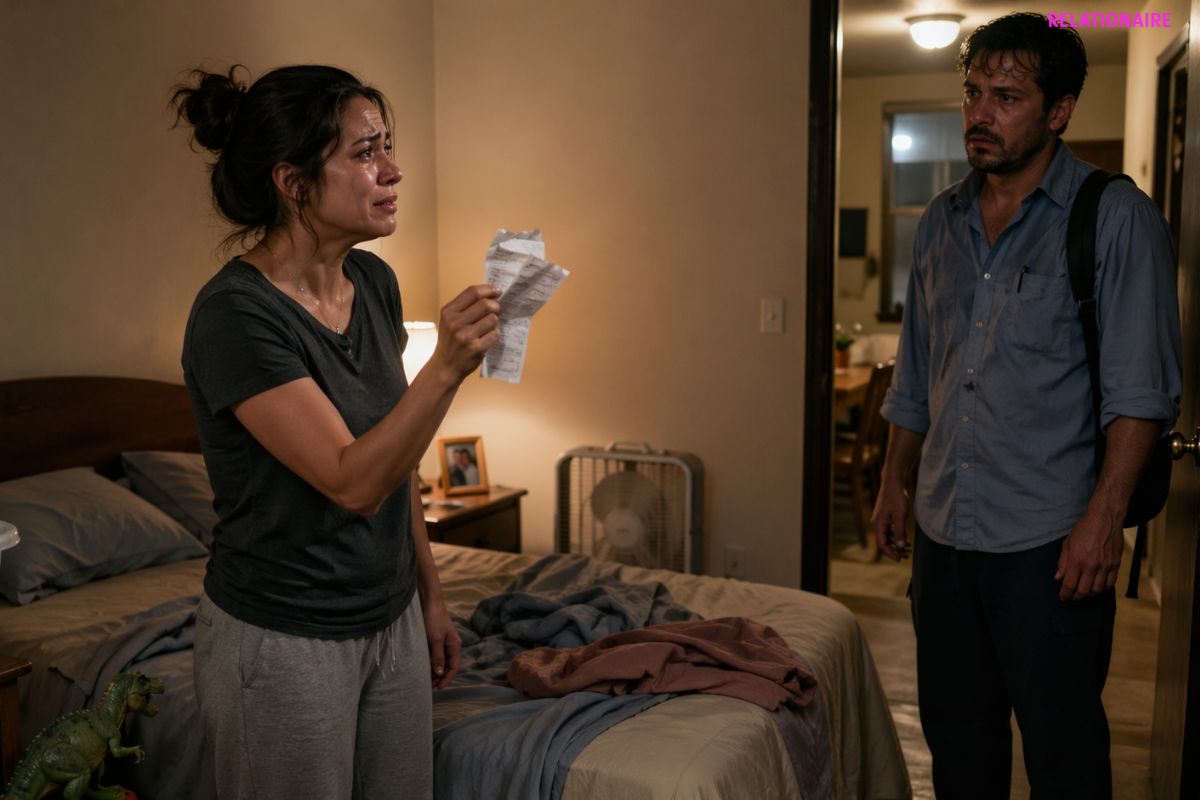
She stood in the bedroom with a fistful of hotel receipts crushed in her hand, tears shining on her cheeks, while Eric stopped in the doorway like he had walked into a wall.
“While I was skipping meals to save this family,” she said, her breathing uneven now, “you were paying for a hotel room for another woman?”
For one long second, neither of them moved.
The bedroom was small and close with summer heat. A box fan rattled in the corner. A pile of folded laundry sat on the chair by the dresser. Their son’s plastic dinosaur was half-hidden under the bed, one green tail sticking out like a witness.
Eric still had his work bag on one shoulder.
His face looked tired. Not angry. Not guilty in the way she had imagined guilt would look. Just tired.
But Lena was too hurt to notice the difference.
She threw the receipts onto the bed.
White slips of paper scattered over the faded blue comforter. Pinecrest Motor Lodge. Room 214. Paid in cash. Again. Again. Again.
Not once.
More than once.
That was the part that had hollowed her out.
It wasn’t one mistake. It was a pattern.
A secret that had eaten through weeks of their life while she stood at the grocery store putting things back on the shelf one by one because the card kept getting declined too fast.
It was the money missing from the envelope in the kitchen drawer.
It was the ATM withdrawals.
It was the late nights. The weekends. The silence.
It was the way Eric had started showering the second he got home, like he wanted the day off his skin before he even looked at her.
And it was the perfume.
Not hers.
Never hers.
Eric slowly set his bag down by the dresser.
“Lena,” he said quietly, “that room wasn’t what you think.”
She laughed, but it came out sharp and ugly.
“Then whose perfume was on your shirt?”
He didn’t answer right away.
That hurt more than if he had shouted.
Lena folded her arms tight over her stomach because she could feel herself shaking. She hated crying in front of him like this. Hated how grief and anger made her voice sound small.
In the next room, she could hear the television low and tinny. Owen was watching cartoons on the couch with a bowl of dry cereal because there was no milk left.
Their son was six.
Old enough to notice when the lights were turned off for one day before the payment cleared.
Old enough to ask why Mommy said she wasn’t hungry so often.
Old enough to feel the coldness between two adults and not know what to call it.
Lena had spent the last four months doing quiet math in her head.
If she skipped lunch at the diner, that saved a little.
If they bought generic cereal, that saved a little.
If Owen wore his sneakers another month with taped soles, that saved a little.
There was always some new little way to make their life smaller.
And now she knew where the missing pieces had gone.
To a motel room.
To some woman.
To a version of betrayal so cheap and ordinary it made her feel sick.
“Say something,” she whispered.
Eric dragged a hand over his face.
He looked older than thirty-six in that moment. Gray dust from the warehouse still clung to the cuff of his shirt. One of his buttons was hanging by a thread.
But Lena’s heart had moved beyond pity now.
“You want me to say I’m sorry?” he asked.
“I want you to tell me the truth.”
He swallowed.
For a second, she thought he might.
Then he looked away.
That was it.
That was the final cut.
She stepped back like she couldn’t bear the sight of him. “You know what hurts the most? I kept trying to defend you in my own head. I kept telling myself maybe I was tired, maybe I was paranoid, maybe stress was making me crazy. But the receipts are real. The cash withdrawals are real. The lies are real.”
His jaw tightened. “I lied because I didn’t know how to explain it.”
“Oh, that’s good.” Tears spilled again, and she wiped them away angrily. “That’s really good. So there is something to explain.”
“Lena—”
“No.” Her voice rose, then she lowered it immediately, glancing toward the living room. “No. You don’t get to calm me down in my own house when I’m the one standing here with proof in my hand.”
Eric closed his mouth.
She stared at him, waiting for the confession.
The apology.
The name.
Anything.
Instead he said, “Please don’t do this in front of Owen.”
The sentence hit her like an insult.
Lena let out a disbelieving laugh. “You should’ve thought about Owen before you started spending our money on secrets.”
At that, something in Eric’s face changed.
Pain, maybe.
Not guilt. Not exactly. Just pain.
And that only confused her more.
She wanted him to look like a villain. She wanted him to make this easy. Easy to hate. Easy to leave. Easy to explain.
Instead he looked like a man carrying something too heavy to set down.
But she was already too deep in the hurt to wonder why.
That night she slept on the couch.
Or tried to.
The apartment was too hot. The couch springs pressed into her ribs. Around midnight, she heard Eric moving quietly in the bedroom, then the front door opening and closing.
Again.
He was leaving again.
Lena sat up in the dark so fast the blanket slid to the floor.
For a moment, she stayed frozen.
Then she stood, shoved her feet into sandals, grabbed her keys, and went after him.
She didn’t think.
Didn’t pray.
Didn’t even breathe right.
She just followed the dim red glow of his taillights through town like they were dragging the last of her trust behind them.
Past the twenty-four-hour gas station.
Past the closed thrift store.
Past the church with the peeling white sign out front.
And then there it was.
Pinecrest Motor Lodge.
The same buzzing vacancy sign from the receipt.
Eric’s truck pulled into the lot.
Lena parked across the street with her headlights off and gripped the steering wheel so hard her fingers ached.
Her whole body felt hollow.
She watched him get out of the truck.
Watched him take a paper pharmacy bag from the passenger seat.
Watched him disappear through the motel lobby door.
She should have driven away.
She should have gone home, crawled onto the couch, and saved herself the final image.
Instead she crossed the street on shaking legs.
The lobby smelled like stale coffee and bleach.
A television muttered behind the front desk.
And then she heard Eric’s voice from the sitting area near the vending machine.
Soft.
Gentle.
“It’s okay,” he was saying. “Take your time.”
Lena turned the corner with her heart in her throat, ready to see the woman who had taken everything she didn’t have left to lose.
But the person sitting in the chair beside Eric was not a woman.
It was an old man in a borrowed flannel shirt.
Thin.
Gray.
One side of his face drooping slightly.
A hospital bracelet hanging from his wrist.
And even before her mind caught up, Lena knew him.
Knew the slope of his shoulders.
Knew the old scar near his eyebrow.
Knew the ruin of him.
Her father.
The man who had walked out when she was nine and never once came back.
The man whose absence had sat at every birthday and every school event and every hard year after like an empty chair no one could move.
Lena stopped so suddenly the heel of her sandal twisted under her.
Her father looked up.
Eric turned.
The color drained out of his face.
And when Lena heard herself say, “What is he doing here?” she realized, all at once, that she had not even been asking the right question.
PART 2
No one spoke for a moment after that.
The motel lobby felt too small for the shock inside it.
A soda machine buzzed against the far wall. Rain tapped faintly against the glass door. The clerk at the desk glanced up, sensed trouble, and looked back down like he wanted no part of whatever this was.
Lena stared at her father and felt the room tilt.
He was thinner than memory.
Smaller, somehow.
The man she remembered had been loud and restless and hard around the edges. This man looked worn down to the bone. His face was pale. His right hand trembled against the arm of the chair. The hospital bracelet still circled his wrist, and on the floor beside him sat a pair of cracked boots with brand-new laces.
That detail undid her for a second.
New laces.
Someone had bought him laces.
Eric.
Of course.
“What is this?” Lena asked again, but it came out weaker this time.
Eric set the pharmacy bag down slowly. “Lena, let me explain.”
Her father tried to push himself up from the chair. He wobbled. Eric reached out on reflex to steady him.
That touch lit a fresh fire in Lena’s chest.
Not because it was wrong.
Because it looked kind.
Because Eric had used his kindness on the one man she had spent half her life trying to forget.
“You brought him here?” she asked.
Her father swallowed hard. “Lena—”
“Don’t say my name like you know me.”
He closed his mouth.
Eric looked at her with the kind of careful face people use around explosives.
“He had a stroke,” Eric said. “Three weeks ago.”
Lena blinked.
Her father stared at the floor.
“He was discharged from County General,” Eric continued. “There wasn’t a bed open at the shelter, and he couldn’t stay on the street like that.”
“So you rented him a room.”
“Yes.”
“With our money.”
Eric didn’t dodge it. “Yes.”
The honesty landed harder than excuses would have.
Lena laughed once, but there was nothing funny in it. “So all those cash withdrawals. All those lies. All those weekends. You were here. With him.”
Her father made a broken sound in his throat. “I told him not to.”
Lena turned on him so fast he flinched.
That small flinch made something twist inside her. She hated that weakness in him. Hated that time had made him frail enough to stir pity when she had spent years feeding on anger instead.
“You don’t get to say anything,” she said. “Not yet.”
He nodded like he agreed.
For a second, that almost made it worse.
Eric rubbed the back of his neck. “I found him by accident.”
Lena looked at him.
“A guy from the warehouse said he thought he’d seen someone sleeping behind the hardware store. He mentioned the name. I went to check.”
“And then what?” she asked. “You decided to become his savior?”
Eric’s face tightened, but he kept his voice low. “No. I decided I couldn’t leave him there when he could barely lift his right arm.”
Lena looked back at her father.
There it was now that Eric had said it.
The weakness on one side. The slower blink. The crooked line of his mouth.
A real stroke.
Not some trick.
Not some story.
A real body breaking down in real time.
She hated that truth for making the room more complicated.
Because cheating would have been simple. Devastating, yes. But simple.
This was not simple.
This was her husband using grocery money and gas money and overtime and lies to keep alive the one man she had buried in her heart years ago.
“The perfume,” she said suddenly, looking at Eric. “The shirt.”
Her father answered before Eric could.
“A nurse hugged me when they discharged me,” he said, eyes still lowered. “I cried. She smelled like… I don’t know. Powder. Flowers. Probably that.”
Lena stared at him.
He gave a helpless shrug with one shoulder. “I’m not proud of much these days.”
The room went quiet again.
Every piece of evidence she had stacked in her mind was still real. The receipt. The cash. The lies. The late nights.
But the shape of the truth was changing under her feet.
Not adultery.
Mercy.
Not betrayal the way she had imagined.
A secret built out of compassion and fear and terrible judgment.
“You should have told me,” she whispered.
Eric nodded immediately. “I know.”
“Then why didn’t you?”
He looked at her for a long moment before answering.
Because Eric never rushed hard words.
Because even now, he was careful with her.
“Because every time your dad came up, you said you never wanted to see him again. And I believed you.”
“I meant it.”
“I know,” he said. “But I also know what your face does every Father’s Day.”
That made her jaw tighten.
He kept going softly.
“I know the way you watch older men with their grandkids in the park. I know how quiet you get when Owen asks why he doesn’t have a grandpa. I know what pain sounds like when somebody has had so much of it, they stop naming it.”
Lena looked away.
Out through the lobby window, rain streaked the glass. The neon from the vacancy sign smeared red and blue across the wet pavement.
Ordinary night. Extraordinary hurt.
Her father shifted in his chair, then winced.
Eric crouched to pick up the pharmacy bag and set it on the table nearby. Lena looked inside without meaning to.
Blood pressure medicine.
A cheap comb.
Packets of crackers.
Adult diapers.
A folded brochure from a rehab center.
The humiliation of that bag was so total it made her chest hurt.
Her father caught her looking and turned his face away.
“He didn’t want you to see me like this,” Eric said.
Lena let out a sharp breath. “That’s rich.”
“I didn’t want you ambushed.”
She looked at him. “This feels a lot like an ambush.”
His eyes softened, but he didn’t argue.
Fair.
Everything about this was fair.
Her father finally spoke again, voice rough and unsteady. “I wasn’t trying to come back and ruin your life.”
Lena stared at him.
A thousand old pictures flashed through her.
Her mother at the sink with reddened hands and unpaid bills under a coffee mug.
The apartment after he left, too quiet in the mornings.
The way her mother stopped buying lipstick.
The church ladies bringing casseroles they all pretended were about kindness and not pity.
The empty seat at the father-daughter breakfast in fifth grade.
The way Lena had learned, too young, not to expect people to stay.
“And yet,” she said, “you somehow keep managing.”
He bowed his head.
“I know.”
There it was again.
Not defense.
Not denial.
Not the old charm she remembered him using when rent was due and apologies were easier than change.
Just shame.
Real, exhausted shame.
And God help her, shame looked more human than she wanted it to.
“I lost your number years ago,” he said quietly. “Then I lost your address. Then enough time passed that I didn’t think I deserved to look.”
“That didn’t stop you from letting him help you.”
“No,” he said. “It didn’t.”
His honesty struck her harder than a lie would have.
Eric stood back up and faced her.
“I was trying to get him stable first,” he said. “Then I was going to tell you. I found a rehab place willing to evaluate him. I didn’t know if you’d want to see him, speak to him, or walk away forever. I just… wanted you to have a real choice. Not one made in a parking lot while he was half-sick and sleeping outside.”
Lena stared at him.
This man she had accused in her heart.
This man who had spent their last extra dollars on motel nights and medicine and shoelaces and probably meals he never mentioned.
This man who had hidden it not because he was faithless, but because he knew exactly how much her father had broken in her.
Her anger was still there.
But now it had company.
Regret.
Confusion.
A grief so old it felt like part of her skeleton.
Eric held the rehab brochure toward her.
Not forcing.
Just offering.
“I found him,” he said. “But what happens next should be your decision.”
Lena looked at the paper and felt her heartbeat in her throat.
If she took it, she would be stepping into a life she had spent years refusing.
If she didn’t, she would leave this motel exactly as she came in: certain of one thing, and wrong about almost all of it.
Her fingers twitched.
Then, slowly, she reached for the brochure.
PART 3
Lena did not forgive her father that night.
She did something harder.
She sat down.
That was all.
She sat in the cracked motel chair across from him while Eric stepped outside to give them space, and she looked at the face she had imagined a thousand times over the years in a thousand different ways.
Sometimes dead.
Sometimes drunk.
Sometimes laughing somewhere, untouched by what he had done.
She had never imagined him like this.
Quiet.
Ashamed.
Old.
He kept both hands folded in his lap, as if even they no longer belonged to him.
“You look like your mother,” he said finally.
Lena’s eyes went cold. “You don’t get to start there.”
He nodded. “You’re right.”
That simple agreement disarmed her more than an apology would have.
No performance. No speech.
Just a man too tired to hide from what he had been.
“You left us with nothing,” she said.
“I know.”
“You left me waiting at windows.”
His mouth trembled. “I know.”
“You left Mom to carry everything.”
He shut his eyes. “I know.”
Her anger rose hot again. “Then why?” she asked. “Why leave? Why stay gone? Why make me grow up with this hole in me and never once come back to face it?”
For a moment, she thought he might dodge the truth.
But maybe illness had stripped something from him. Maybe shame had finally beaten pride.
“When I left,” he said, voice low and rough, “I told myself it would only be for a little while. I thought I’d make money. Get straight. Come back better.” He laughed bitterly at himself. “Then I lost one job, then another. Started drinking harder. Started gambling because I thought one lucky break could fix everything. By the time I understood how far gone I was, I was too ashamed to let you see it.”
Lena stared at him.
“That’s not love,” she said.
“No.” He looked at her then, really looked. “It was cowardice.”
The word landed in the room and stayed there.
Cowardice.
Not a tragic excuse. Not a romantic downfall. Not bad luck.
Cowardice.
And somehow that truth, ugly and plain, gave her more peace than anything softer could have.
Because it named what had happened without asking her to bless it.
Eric came back in a few minutes later with coffee in paper cups and a small bag of chips from the vending machine. He set one cup beside Lena without speaking.
She looked up at him, and the ache in her chest shifted.
All week she had been looking at the wrong man as if he were the danger.
All week the person betraying her in her imagination had actually been carrying the ugliest burden in silence, trying to protect everyone from a harder collision.
That shame sat heavy in her.
Not because she had questions.
Because she had stopped listening long enough to make one story out of pain and then believed it completely.
Later that night, after they got home and Owen was asleep, Lena stood in the kitchen while Eric rinsed out Owen’s cereal bowl.
The apartment smelled faintly of dish soap and old coffee. A streetlight pushed pale gold through the blinds.
“I’m sorry,” she said.
Eric turned the water off.
“For what?”
The gentleness in his voice made it worse.
“For thinking the worst,” Lena said. “For following you. For all the things I believed before I knew.”
Eric dried his hands on a towel. “You had reasons.”
“I still should’ve trusted you.”
He leaned back against the counter, tired all the way through. “And I still should’ve told you sooner.”
They stood there in the quiet with both truths between them.
It did not erase the hurt.
But it gave it shape.
The next morning, Lena called the rehab center.
The woman on the phone had a warm, practical voice. Yes, there was a short-term bed. Yes, they could evaluate him. Yes, paperwork would be needed. Yes, financial assistance might be possible if they moved quickly.
Lena wrote everything down on the back of one of the motel receipts.
That felt right somehow.
Taking the paper that had represented betrayal and turning it into directions for something else.
Something harder.
Something cleaner.
Three days later, she and Eric took her father to the rehab center.
He wore the same flannel shirt Eric had bought him, but it was washed now. His hair was combed. His boots were still cracked, but the new laces held.
When they reached the front entrance, he stopped walking.
Rain had just ended. Water dripped from the awning in slow, bright beads. Cars hissed through the parking lot. Somewhere nearby, a nurse laughed at something someone said.
Her father tightened his grip on the cane and looked at Lena like a man standing before a judge.
“I don’t expect forgiveness,” he said. “Not now. Maybe not ever.”
Lena said nothing.
He swallowed. “I only need you to know that leaving you was the worst thing I ever did. I can’t fix it. I know that. But if there’s anything decent left in me, I want to spend what’s left trying.”
Her throat burned.
Not because she believed him completely.
Because a part of her did.
And belief, when you have been abandoned, is its own kind of terror.
“I’m not doing this for you,” she said at last.
He nodded. “I know.”
“I’m doing it for the little girl I used to be. Because she deserved one adult in this story to make the right choice.”
That broke him.
He bent his head and cried there under the awning, not with drama, not loudly, just the helpless crying of a man who had run out of places to hide from himself.
Lena did not move to comfort him.
She wasn’t there.
Maybe she never would be.
But she also didn’t turn away.
That mattered too.
Weeks passed.
Rehab helped.
His speech got clearer. He gained a little weight. He started writing things down because talking for too long tired him. One afternoon, he gave Lena an envelope with her name on it in shaky handwriting.
She opened it at the kitchen table after Owen went to bed.
Inside was one page.
No begging.
No sermon.
Just memory.
I remember your yellow raincoat. I remember how you ate peas one at a time. I remember you once fell asleep on my shoulder at the county fair, and I stood there longer than I needed to because I didn’t want to wake you. I remembered you badly. But I remembered you always.
Lena sat with the letter for a long time.
Then she folded it and put it in the drawer beside the grocery receipts, school forms, and the hospital bracelet from when Owen was born.
Important things.
Painful things.
Proof that a life had happened.
Months later, Owen had a school picnic at the park.
Children ran across the grass with sticky hands and paper plates. Parents unfolded lawn chairs. Somebody burned hot dogs near the pavilion. It was one of those ordinary bright Saturdays that never feel important until later.
Lena turned at the sound of a cane tapping the path.
Her father stood at the edge of the picnic area in a clean button-up shirt, thinner still but standing straighter now. In one hand he carried a paper grocery bag.
He had called first. He had asked permission. He had promised he would leave if she said no.
Owen looked up at her.
“Is that him?”
Lena nodded slowly.
“My grandpa?”
The word hit low in her chest.
She looked at her father, then at Eric standing beside the cooler with juice boxes in his hand, watching quietly, not pushing, not retreating.
“Yes,” she said.
Her father stepped closer and held out the paper bag.
Inside was a box of frozen blueberry waffles.
The expensive kind.
Lena stared at it.
A memory rose so fast it almost took her breath.
Owen, months earlier, standing in the kitchen in dinosaur pajamas asking, “Are we out of waffles forever?”
And Eric saying, “I’ll get you waffles soon, buddy.”
Her father cleared his throat. “You said once, years ago, that when kids get something good, they remember it.”
Lena let out a sound that was half laugh, half sob.
Because it was so small.
Because it was too late.
Because it was not enough.
Because it mattered anyway.
Owen took the waffles and looked up at him. “Thank you.”
Her father’s eyes filled instantly.
He nodded once and blinked hard.
Eric came to stand beside Lena, their shoulders touching.
She slipped her hand into his.
No one said anything wise.
There was no neat speech waiting at the end of this.
Just a little boy holding waffles in a sunlit park.
A husband who had spent motel money on mercy.
A woman who had thought the worst and then had to live inside the shock of being wrong.
And an old man learning, late and clumsily, that remorse does not erase the past but can still bow before it.
Lena would think later that healing rarely arrives looking noble.
Sometimes it looks like a motel receipt with someone else’s name on it.
Sometimes it looks like new laces in old boots.
Sometimes it looks like medicine in a paper bag and a husband too gentle to defend himself.
And sometimes love does not fix what was broken.
It simply stays.
Long enough for the wound to stop being the only thing you can see.