If you’ve already read part 1 of this story on Facebook, go here for Part 2!
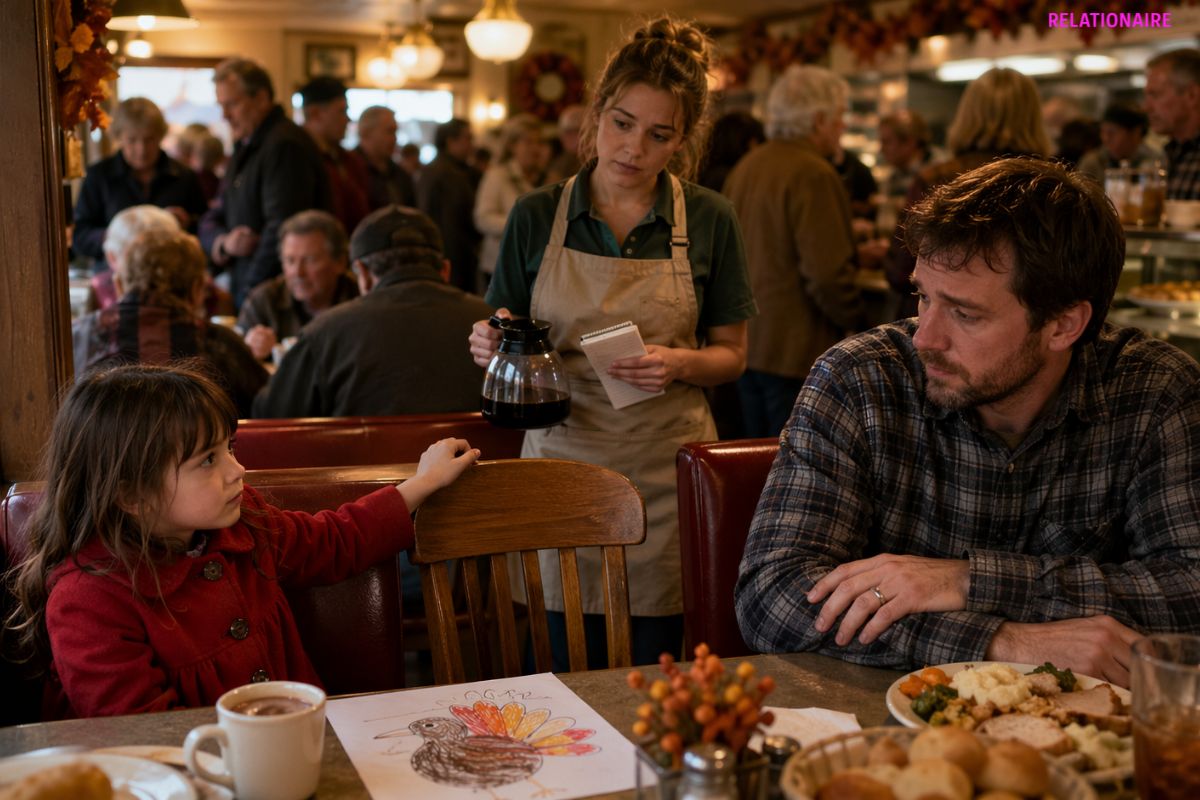
By noon, every table in the diner was full, people were standing shoulder to shoulder near the pie case, and a little girl in a red coat was refusing to let anyone sit in the empty chair at her table.
I noticed her because grown men in work boots were waiting for seats, a tired mother with two boys was balancing paper hats and juice boxes, and this tiny girl kept putting her hand on the back of that chair like she was guarding treasure.
“Sweetheart,” her father said, low and strained, “someone needs to sit there.”
“No,” she said.
Not loud. Not bratty.
Just no.
It was Thanksgiving, and if you’ve ever worked a diner on Thanksgiving, you know people don’t come in carrying their best selves. They come in lonely, rushed, hungry, grieving, pretending they aren’t grieving. They come in with wrinkled church clothes and half-finished sentences and faces that look fine until you ask if they want coffee.
I’d been on my feet since six that morning.
My apron pocket was full of bent receipts and loose change. My shoes were sticky from maple syrup and spilled Coke. The cook was snapping at everyone. The dishwasher had gone home sick. And Table 7 — the one by the front window, with the little girl and her father — had become the center of every irritated glance in the room.
Because there were only two of them.
And they were sitting in a four-top.
With one chair deliberately empty.
The father looked like the kind of man who had forgotten how to sleep properly. Early thirties maybe. Nice face, but worn thin. Wedding ring still on. Flannel shirt, clean but old. He kept apologizing with his eyes before he opened his mouth.
“I’m sorry,” he told me when I came by with the coffee pot. “She’s just… she wants to keep that seat open.”
The little girl stared out the window, chin barely above the table, both hands wrapped around a mug of hot chocolate she wasn’t drinking.
She had dark bangs cut a little crooked, like somebody had tried to trim them at home and given up halfway through. There was a paper turkey on the table she’d made from crayons and a kid’s menu. On one feather she had written MOM in careful block letters.
“How old is she?” I asked.
“Six.”
He said it like an apology too.
“Her name’s Lucy.”
Lucy didn’t look at me. She just kept one hand on the chair beside her.
I leaned down a little. “Lucy, honey, there are a lot of people waiting today.”
“I know.”
Her voice was soft, matter-of-fact.
“This seat is taken.”
Her father closed his eyes for half a second.
“I’m sorry,” he said again. “Her mom used to come here with us every Thanksgiving. Since…” He stopped, rubbed the back of his neck. “Since she died, Lucy’s had this thing about empty chairs.”
Something in me tightened, then loosened.
I looked at the paper turkey again. MOM.
“Oh,” I said.
It was one of those small words that means I understand and also I don’t know what to do with your pain.
The room behind me was loud with silverware and football on the mounted TV and people calling for more rolls, but at that table it suddenly felt very quiet.
Lucy finally looked at me.
Her eyes were serious in a way little kids’ eyes shouldn’t have to be.
“She’s not for my mom,” she said.
I thought I’d heard her wrong.
“What?”
“The chair,” Lucy said. “It’s not for my mom.”
Her father gave a tired little laugh, the kind people use when they’re embarrassed in public and want to smooth the edges over.
“She says things,” he murmured. “I think it helps her.”
I nodded, but I was already being called from the counter. Order up. Side of gravy. Extra toast. Real life rushing back in hard.
So I left them with their menus.
But I kept watching.
People kept glancing over, annoyed. One older man in a denim jacket actually stepped toward the table and asked, “Y’all using this seat or not?”
Before the father could answer, Lucy put her hand flat on the chair and said, “We are.”
The man stared at her, then at the father.
The father turned red. “Sir, I’m sorry. We’ll order fast and be out of here soon.”
The man muttered something under his breath and walked off.
I should have been irritated.
Honestly, part of me was.
Holiday shifts make patience feel expensive.
But every time I passed their table, I saw the father trying so hard not to come apart in front of his daughter. He kept folding and unfolding his napkin. Kept checking his phone like maybe there’d be a message from someone who might save him from sitting through Thanksgiving alone with a child who still made room for the dead.
And Lucy sat there in her red coat, protecting that chair.
Not playful. Not dreamy.
Certain.
When I brought their food — turkey plate for him, grilled cheese for her because she “didn’t like Thanksgiving food” — Lucy asked me for an extra plate.
“What for?” I said.
“So nobody puts anything on her seat by accident.”
Her father inhaled sharply. “Lucy.”
“It’s okay,” I said automatically, though I wasn’t sure it was.
I brought the plate.
She laid it on the table in front of the empty chair like some kind of quiet place marker. Then she straightened the fork and spoon beside it with painstaking care.
My throat burned for no reason I wanted to name.
Near one o’clock, the line at the door got worse.
A family of five left angry after hearing the wait time.
The hostess looked at me like do something.
I looked toward Table 7.
The father had barely touched his food. Lucy had eaten half her sandwich and was now drawing on a napkin, tongue pressed to the corner of her mouth in concentration.
I walked over one more time and lowered my voice.
“Sir, I hate to ask, but there are a lot of people waiting. Maybe just for a little while—”
He looked mortified before I even finished.
“I know,” he said. “I know. I’m sorry. Lucy—”
“No.”
She didn’t even look up from the napkin.
He put both hands on the table and bent his head like he was trying not to snap.
“Lucy, enough.”
That made her look up.
Not scared. Not defiant.
Just wounded.
“She needs it,” Lucy said.
“Who?” he asked, too sharply.
The whole table seemed to freeze.
I stood there holding my order pad, suddenly feeling like I had walked into a room smaller than a diner and much more dangerous.
Lucy glanced toward the front door.
“For the lady,” she said.
Her father let out a breath that turned into a humorless little laugh. “What lady?”
“The one who’s coming.”
He looked at me then, and I saw it plain as day — exhaustion, grief, embarrassment, and underneath all of it, fear.
Not fear that his daughter was being difficult.
Fear that she meant it.
“I’m sorry,” he whispered to me. “She’s been saying strange things lately.”
Before I could answer, the bell over the diner door gave a dull little jingle.
Cold air rushed in.
And an older woman stepped inside alone.
She paused just past the threshold, one hand still on the door, taking in the packed room with that particular look people get when they realize there’s nowhere for them to go and nobody waiting for them anywhere else.
Gray coat.
Small overnight bag.
Snow-damp shoes.
She looked tired in a holiday kind of way.
The kind that doesn’t come from travel.
The kind that comes from not being expected.
The hostess started toward her with an apology already forming, but Lucy was out of her seat before either of us could speak.
She stood there in her red coat, beside the empty chair she’d been protecting all afternoon, and said in a clear, steady voice that cut straight through the clatter of plates:
“That’s who the chair was for.”
Part 2
For a second, nobody moved.
Not me. Not the hostess. Not the father.
Even the older woman just stood there with the cold air curling around her legs, like she wasn’t sure she had heard right.
Lucy didn’t seem to notice the silence she had created.
She just looked at the woman the way children sometimes look at things adults have already decided not to understand.
Like it was simple.
Like it had been simple all along.
Her father stood up so fast his chair scraped the floor.
“Lucy,” he said, his face burning. “Come back here right now.”
But Lucy didn’t.
She walked to the woman, stopped a few feet away, and said, softer this time, “You can sit with us.”
The woman blinked. She was maybe late sixties. Early seventies. Neatly dressed, but in that careful way that told you the clothes had lasted because she had made them last. Her lipstick was faded. Her gloves were still on. She held that small overnight bag like it contained everything she hadn’t planned to carry today.
“Oh,” she said. “Honey, that’s very kind, but I couldn’t.”
“Yes, you could,” Lucy said.
The father reached them then, one hand hovering awkwardly near Lucy’s shoulder.
“I am so sorry,” he told the woman. “My daughter— she doesn’t always—”
“I do too,” Lucy said.
He shut his eyes.
I should have stepped in. I probably would have, if the woman had looked offended. But she didn’t.
She looked startled.
And then something in her face changed.
Not because of Lucy’s words, exactly.
Because of the empty chair.
Because of the plate set neatly in front of it.
Because of the fork and spoon lined up so carefully by such small hands.
The woman looked at the father. Really looked at him. At the wedding ring still on his finger. At the way grief had settled into the corners of his mouth. At the way he was apologizing for taking up room.
Then she looked at Lucy again.
“What makes you think that seat is for me?” she asked.
Lucy shrugged one shoulder.
“You looked like you were trying to leave before anyone saw.”
The woman’s face folded in on itself for one raw second.
I felt it all the way from the coffee station.
The father did too. I could tell by how his hand dropped from Lucy’s shoulder.
Nobody in the diner said a word.
It was Thanksgiving. A room full of people. And all at once it felt like every person there knew something private had just been touched.
The woman swallowed.
“Well,” she said, and her voice trembled despite her effort, “that may be the truest thing anyone’s said to me all year.”
Lucy reached for the overnight bag before the woman could protest.
It probably weighed more than Lucy thought it would, because she nearly tipped sideways, but she managed to drag it toward the table in a clumsy, determined little shuffle.
“See?” she said. “You’re staying.”
A few people laughed then, softly. Not mean. Relieved.
The father put a hand over his mouth.
He looked wrecked.
The woman glanced at him, almost asking permission.
He nodded at once. Too fast.
“Please,” he said. “If you’d like to.”
So she sat.
I brought another menu, another mug, another set of silverware. My hands were steadier than I felt. The hostess stopped glaring at the empty chair. The line at the door kept moving. Somehow the whole diner exhaled and went back to being a diner again.
But I kept looking at that table.
The woman introduced herself as Eleanor.
Lucy immediately asked if she wanted turkey or pie first, as if those were the only two reasonable options in the world.
Eleanor smiled at that. A real smile, but careful around the edges, like it hadn’t been used much lately.
“Pie first sounds rebellious,” she said.
“It is,” Lucy told her seriously.
Her father almost laughed. The sound surprised him.
I can’t explain why that mattered. It just did.
When I came back with coffee for him and tea for Eleanor, the father was saying, “We didn’t mean to make a scene.”
Eleanor shook her head. “I’m grateful for it.”
Lucy had gone back to her grilled cheese, apparently satisfied that the problem of the empty chair had been solved. Kids are strange that way. They can shatter the emotional architecture of a whole room and then go back to eating fries.
I topped off the father’s coffee. “You okay?”
He gave me the look people give when they’re too tired to lie well.
“Not really,” he said.
Then, as if embarrassed by his own honesty, he added, “But I will be.”
Eleanor wrapped both hands around her teacup.
“I wasn’t going to come in,” she said quietly.
He looked up.
“There weren’t any tables,” she went on. “And I suppose I’m at the age where people assume being alone on a holiday means you prefer it.”
Something about the way she said it made me stop writing down order modifications and just listen.
Lucy looked at her. “Did your family go somewhere?”
Eleanor smiled without smiling. “Something like that.”
The father opened his mouth like he might redirect the conversation, but Eleanor answered anyway.
“My son moved to Arizona last year. His wife’s family is there. My daughter…” She paused. “My daughter died eleven months ago.”
The father went completely still.
So did I.
Lucy set down half a fry.
“I’m sorry,” she said.
Not in the sing-song way kids are taught to say polite things.
She meant it.
Eleanor’s throat worked.
“She was forty-two,” she said. “A teacher. Loud laugh. Could never keep a plant alive. She used to call me every Sunday whether she had news or not.”
The father stared at the untouched cranberry sauce on his plate.
“My wife used to do that with her dad,” he said after a moment. “Call just to say nothing.”
There it was.
The first time he had said wife out loud in more than fragments.
Eleanor nodded like she understood the cost of that word.
“What was her name?” she asked.
He looked at Lucy before he answered.
“Anna.”
Lucy said it with him, and something in that shared sound made me turn away for a second under the pretense of reaching for the coffee pot.
Because I’d seen grief before.
In diners, mostly. In hospitals, once. At my own kitchen table too, if I was being honest.
But there is something about hearing the name of the dead spoken softly in public that makes the air itself feel fragile.
Eleanor asked to see Lucy’s drawing.
Lucy handed over the napkin she’d been working on.
It was a little crooked picture of the table. Three people. One empty chair. And, just inside the doorway, another person with gray hair and a blue bag.
Eleanor stared at it for so long I thought she might cry.
“When did you draw this?” she asked.
“Before you came.”
The father made a small sound in his throat.
“Lucy,” he said, “honey…”
“She said not to leave it empty,” Lucy replied.
He froze.
It was subtle, but I saw it.
So did Eleanor.
“Who said?” she asked gently.
Lucy frowned, as if the answer were obvious.
“Mom.”
The father pushed back from the table so suddenly his knee hit the underside hard enough to rattle the plates.
I thought he might be angry.
Instead he looked terrified.
Not at Lucy.
At himself.
“Lucy,” he whispered, “what did you say?”
“She said someone would need it,” Lucy said. “I thought maybe she meant her. I didn’t know who her was yet.”
The diner sounds came back strange and far away.
The football game on TV.
A dropped spoon.
Someone laughing too loudly in a corner booth.
At Table 7, nobody moved.
Eleanor set the napkin down with both hands, as carefully as if it were something breakable and holy.
Then she looked at the father, her expression altered by some thought she had not expected to have in this place, on this day.
“You said your wife’s name was Anna,” she said.
He nodded slowly.
Eleanor pressed her lips together.
Then she reached into her purse with trembling fingers and pulled out a folded envelope, worn soft at the edges, and laid it on the table between them.
“My daughter,” she said, “worked with a woman named Anna.”
The father stared at the envelope like it might explode.
Eleanor’s voice dropped.
“She asked me, if I ever found her husband and little girl, to give them this.”
Part 3
Nobody at that table touched the envelope for a long time.
It sat there between the gravy boat and Lucy’s crayons, plain white and creased from being carried too many days in the same purse, as if Eleanor had brought it everywhere because not bringing it hurt worse.
I was standing three booths away with a pot of decaf in my hand, pretending to wipe a clean counter.
The father was staring at the handwriting like he already knew it.
Maybe grief teaches you the shape of a person so completely that even ink can break your heart.
Lucy leaned closer.
“Is it from Mom?”
He swallowed hard.
“I think so.”
His voice cracked on the last word.
Eleanor folded her hands in her lap to stop them from shaking.
“My daughter, Marjorie, was a hospice social worker,” she said softly. “She told me once about a young mother she couldn’t forget. Said the woman was more worried about the people she was leaving than herself.”
The father shut his eyes.
Anna had been sick, then. Not an accident. Not sudden.
A leaving with time to look it in the face.
That changed everything and somehow made it ache more.
“She volunteered where Anna was toward the end,” Eleanor continued. “They weren’t lifelong friends. Just… two women who kept finding each other in the same room. My Marjorie used to come home and talk about her. About how brave she was. About how funny she was, even bald and exhausted. About how she kept asking practical things, like where to hide Christmas money and whether a six-year-old would remember the sound of her laugh.”
The father’s whole face crumpled.
Lucy slid her hand into his.
That was the part that undid me.
Not the letter.
Not the coincidence.
That tiny hand, reaching without drama because she already knew where the pain was.
He opened the envelope carefully, like roughness might erase the words.
There was only one page inside.
A note in neat blue ink.
He looked at the first line and covered his mouth.
Lucy leaned against his arm.
Eleanor stared down at the table, giving him privacy inside a public place.
After a moment, he looked at Lucy, then at Eleanor, then at me for some reason, maybe because I was there and human and witnessing it.
“Can I…” He stopped to breathe. “Can I read it out loud?”
Eleanor nodded.
Lucy whispered, “Yes.”
So he did.
“Ben,” he read, and his voice trembled so badly he had to begin again. “Ben, if this note ever reaches you, then I was right about two things. First, you kept the ring on too long. Second, Lucy noticed more than you thought she did.”
He laughed once and cried at the same time. A terrible, beautiful sound.
The whole diner seemed to soften around it.
He kept reading.
“I know you’ll both try to carry me in ways that are too heavy. So I’m asking for something instead. Leave room. Not for me. Don’t do that to yourselves. Leave room for the living. Leave room at tables. In schedules. In your hearts. In the small ordinary parts of the day. Someone will need it. And when Lucy insists on kindness, listen to her. She comes by that honestly.”
Lucy’s mouth opened a little.
Like she had known and not known.
Ben had tears falling freely now, dropping onto the paper.
He read the last part slower.
“There’s also a woman named Marjorie who sat with me once when I was afraid to sleep. If life is strange and generous, maybe our people will meet one day. If they do, tell them thank you for me. Love always, Anna.”
Nobody in that booth moved.
Nobody in half the diner moved, if I’m being honest.
There are moments when strangers become witnesses, and witnesses become part of the mercy.
Eleanor was crying quietly, a napkin pressed under one eye.
“My daughter never told me there was a letter,” she said. “Only that there was a family she hoped would someday know how much they were loved.”
Ben looked at her like the room had tipped.
“How did you find us?”
She gave the saddest little smile.
“I didn’t. Not really. After Marjorie died, I found the note tucked in one of her address books with your wife’s first name and this town. That was all. I’ve been carrying it for months. I nearly drove through last winter. Then again in spring. I kept talking myself out of it.”
Lucy frowned. “Why?”
Eleanor looked at her honestly. “Because grief makes you strange. And because I didn’t know if finding you would make anything better.”
Lucy considered that.
Then she said, “It did.”
Simple as a bell.
No sermon. No decoration.
It did.
Ben broke then. Not loudly. Worse. He bent over the letter and cried with the kind of helplessness that comes when a person has been upright too long.
Lucy climbed off the booth and into his lap, though she was getting a little big for it. She tucked herself against his chest and let him hold her while he shook.
Eleanor reached across the table and put her hand over his wrist.
Not claiming anything.
Just staying.
I brought them fresh coffee they didn’t ask for, boxed up the pie they forgot to eat, and told the hostess Table 7 could sit as long as they wanted. Nobody argued.
An hour later, when the rush had thinned and the windows had gone silver with afternoon, I saw Lucy and Eleanor sitting side by side in the booth, heads bent over the kid’s menu while Lucy explained her paper turkey like it was serious art.
Ben was on the phone in the parking lot, crying and laughing again. Probably calling someone he should have called months ago. Maybe Anna’s father. Maybe his own brother. Maybe just somebody living.
When he came back in, his face was raw but different.
Not fixed.
Just open.
He sat down and asked Eleanor where she was staying.
She admitted she hadn’t booked anywhere. She’d only meant to stop for coffee before turning back.
Ben looked at Lucy.
Lucy looked at the empty pie plate.
Then at Eleanor.
Then at the chair.
“You can come to our house,” she said. “We have room now.”
Ben let out a breath and, for once, didn’t rush to correct her.
He looked at Eleanor. “Only if you want to. No pressure. But… no one should be alone today if they don’t want to be.”
Eleanor started crying all over again.
So that’s how it happened.
A little rental house on Maple Street with one missing person in every room made space for another lonely soul carrying her own absence. One holiday dinner became the first of many. Eleanor started coming by on Sundays with pound cake and stories about her daughter. Ben fixed the loose step on her porch in February. Lucy drew both dead women into every family picture for a while, then slowly stopped needing to.
Not because they were forgotten.
Because they had settled into the walls the way love sometimes does.
By spring, Eleanor had her own mug at their house.
By summer, Lucy called before school starts and dentist appointments and thunderstorms she didn’t like.
By Christmas, Ben had finally taken off his ring.
Not because Anna mattered less.
Because he had finally understood what she asked of him.
Leave room for the living.
I still work at that diner.
People come and go. Plates break. Coffee burns. Holidays pull old bruises to the surface.
But every Thanksgiving, I set one table by the window with an extra chair turned slightly out.
Not because I’m sentimental.
Because I saw what happened when a child refused to let grief become the only guest at the table.
Sometimes the people we think are making no sense at all are the only ones who can still recognize an empty place for what it really is.
Not denial.
Not madness.
An opening.
And every now and then, if grace is feeling generous, the right person walks through the door.