If you’ve already read part 1 of this story on Facebook, go here for Part 2!
The slap landed so hard that Lina’s head turned sideways.
The sound of it filled the whole living room.
Even the old clock on the wall seemed too loud after that.
Mira stood there breathing hard, one hand still raised, her gold bangles trembling against her wrist. Her face was red with anger. Her eyes were sharp, wild, almost hurt.
“Stop stealing my son’s money and sending it to your poor family!”
Lina didn’t answer right away.
She just pressed one hand to her cheek and stared at her mother-in-law as if the pain wasn’t the worst part. The worst part was that this had happened in front of Arman.
Her husband stood beside the sofa in his wrinkled office shirt, tie loosened, laptop bag still hanging from one shoulder. He looked stunned. Not angry. Not protective. Just frozen.
That hurt too.
The apartment smelled faintly like fried onions and eucalyptus oil. Dinner was still on the stove. A pot simmered low in the kitchen. Lina had been cooking soup for Mira because the doctor said soft food would be easier on her stomach after treatment.
Treatment Lina had helped pay for.
But nobody in that room knew that yet.
Mira pointed toward Lina’s handbag on the dining chair.
“Don’t look at me like I’m cruel,” she snapped. “I saw the bank alert on Arman’s phone. Money is missing. Again. And your family always needs something.”
Lina’s fingers tightened against her cheek.
“My family didn’t ask for anything.”
Mira laughed, short and bitter.
“Poor people always ask. Some ask with words. Some ask with tears.”
Arman finally found his voice.
“Mom—”
“No,” Mira cut him off. “You are too blind to see it. She came into this house quiet and humble, and you thought that meant she was good. I have lived long enough to know the difference between goodness and strategy.”
Lina looked down.
That, more than anything, made Mira angrier.
She hated how calm Lina stayed.
Hated how Lina never fought back.
Hated how that silence made her feel louder than she wanted to be.
When Arman married Lina two years earlier, Mira had smiled in front of relatives and served extra cake and told people she was happy for them. But inside, she had been ashamed.
Not of Lina exactly.
Of what the marriage meant.
Her son, her only son, a university graduate with a steady job and polished shoes and careful savings, had married a woman from a family everyone in the neighborhood whispered about. Lina’s father had died in debt. Her younger brother had left school to work odd jobs. Her mother cleaned other people’s laundry for cash.
Even after the wedding, Lina kept wearing the same simple sandals until the straps thinned white.
She never asked for jewelry.
Never asked for new curtains.
Never asked for anything.
And somehow that made Mira trust her less.
Women who asked for nothing, in Mira’s mind, were usually waiting for more.
That evening, when Mira had seen the bank notification flash across Arman’s phone while he was showering, everything inside her hardened. A transfer. An amount large enough to make her chest burn. A name she didn’t recognize because the screen disappeared too quickly.
She didn’t ask.
She assumed.
And now here they were.
Lina took a slow breath.
The left side of her face was beginning to redden. There was a tiny nick inside her lower lip where her tooth had caught the skin. She could taste metal.
Still, when she spoke, her voice stayed low.
“I didn’t steal from Arman.”
“Then explain it,” Mira said.
Lina looked at Arman.
He looked back at her, but there was something in his face she couldn’t read. Exhaustion. Fear. Maybe even guilt.
“I can explain,” Lina said softly. “But not like this.”
“Not like this?” Mira took a step closer. “You think you get to choose the tone after taking money from this family?”
The soup in the kitchen began to boil over.
No one moved.
A thin trail of broth hissed onto the burner.
Arman finally set down his bag and walked past them to turn the stove off. He didn’t say anything as he did it. He just stood there for a second with one hand on the pot, shoulders tight, like a man who wanted the room to become smaller.
Lina watched him.
She knew that look.
He had been carrying something for weeks.
Late-night calls on the balcony.
Bills folded small and tucked into his wallet.
That one afternoon when he sat in the parked car downstairs for twenty whole minutes before coming inside.
But every time she asked, he smiled and said work was just stressful.
Mira followed Lina’s gaze and mistook it for calculation.
“There,” she said sharply. “Look at her. She always does that. Always looking to see how much your silence will let her get away with.”
Lina’s eyes filled, but the tears didn’t fall.
Not yet.
“I never wanted anything from this house,” she said. “Not once.”
“Then what was the money for?”
The room went very still.
Outside, someone’s television echoed faintly through the apartment wall. A child laughed somewhere down the hall. Ordinary sounds. Everyday sounds. The kind that make pain feel even stranger because life keeps going around it.
Lina lowered her hand from her cheek.
When she spoke again, there was no anger in it. That was what made Arman finally turn toward her fully.
“There are things you don’t know.”
Mira folded her arms.
“Then say them.”
Lina looked at the floor for one brief second, then toward the small wooden cabinet near the window.
Inside that cabinet was a white envelope.
Inside the envelope were receipts, a hospital bracelet, a gold-shop paper slip, and one folded note she had prayed nobody would see until she was ready.
Arman noticed the direction of her eyes.
His face changed.
“What envelope?” he asked.
Mira’s expression faltered for the first time.
Lina swallowed.
Her voice was barely above a whisper.
“The money wasn’t for my family.”
Then she turned toward the cabinet and said, “If you want the truth, open the top drawer.”
PART 2
Arman crossed the room first.
Not because he was brave.
Because he was afraid of what would happen if his mother got there before him.
The drawer stuck halfway, the way it always did in humid weather. He yanked it harder than he meant to. Inside were old batteries, a roll of tape, expired coupons, a tiny sewing kit, and beneath all that, a white envelope with Lina’s name written on the front in neat blue ink.
His hands shook when he picked it up.
Mira stayed where she was.
Her anger had not disappeared, but something else had entered it now. Something colder. Uncertainty.
Lina stood beside the dining chair, one hand resting on the back of it as if the room had tilted slightly under her feet.
“Open it,” she said.
Arman slid out the contents one by one.
A hospital receipt.
Another one.
A pharmacy invoice.
A discharge summary.
And then a small pink paper from a gold buyer downtown.
Mira frowned.
Arman stared at the papers as if they were written in another language.
“What is this?”
Lina’s eyes went to Mira.
Not accusing.
Not triumphant.
Just tired.
“It’s your mother’s treatment,” she said. “The deposit for the scans. The medication they wouldn’t release until someone paid. The follow-up bill from last month.”
Mira blinked.
“No,” she said quickly. “Arman paid that.”
Arman didn’t answer.
Lina did.
“He wanted you to believe he had.”
The words landed differently than the slap had.
Quieter.
But harder.
Arman sat down heavily on the edge of the sofa, still holding the papers. The color had gone from his face.
“Lina…”
His voice cracked on her name.
Lina looked at him then, and for the first time that night, there was hurt in her eyes that had nothing to do with Mira.
“You lost your bonus,” she said softly. “And then your company cut overtime. I saw the emails you left open on the laptop. I saw the hospital estimate in your bag. You kept saying you’d manage. You kept saying your mother didn’t need to know.”
Mira looked slowly from one of them to the other.
“What is she talking about?”
Arman rubbed both hands over his face.
His shoulders curled inward.
It made him look suddenly younger, like a boy caught trying to hold up a collapsing roof with his bare hands.
“I was going to figure it out,” he said. “I didn’t want to worry you.”
Mira’s voice sharpened.
“So she paid instead?”
Lina nodded once.
“I sold my wedding gold.”
The room went silent.
Mira stared at her as if she had misheard.
“What?”
“The bangles, the chain, the earrings your relatives gave me. I sold all of it.”
Arman stood up too fast.
“You sold your wedding gold?”
Lina let out one breath that sounded almost like a laugh, except there was no humor in it.
“What else was I supposed to sell?”
Arman looked back down at the gold-shop slip in his hand. Date. Amount. Signature.
Real.
All of it real.
Mira sank slowly into the chair near the window.
For a long moment she said nothing at all.
Then, almost defensively, she whispered, “Why wouldn’t you say this?”
Lina turned to her.
Because this was not the moment Mira expected. Not a daughter-in-law finally fighting back. Not a wounded speech full of blame.
Lina’s voice stayed gentle.
“Because you were sick.”
Mira’s mouth parted, but no words came.
Lina continued.
“And because Arman was ashamed he couldn’t cover everything. He loves you. He didn’t want you lying in that hospital bed thinking you were a burden.”
Mira looked at her son.
Arman nodded once without lifting his head.
That was when something in Mira’s face cracked.
Not fully.
Just enough.
She looked down at her own hands. At the knuckles stiff with age. At the bracelet she still wore. At the hand that had struck a woman who had quietly sold her own wedding gold to make sure medicine reached the counter on time.
But guilt did not come cleanly.
It came tangled with pride.
With shame.
With the stubborn wish to still not be the worst person in the room.
She stood abruptly.
“If this is true,” she said, voice unsteady now, “why was there another transfer today?”
Lina froze.
Arman looked up.
“What transfer?”
“The one on your phone,” Mira said, turning toward him. “The one that started this.”
Arman pulled out his phone and opened the alert history. He stared. Then his brow furrowed.
“That wasn’t money to her family.”
“Then to who?”
He looked at Lina.
Lina looked away.
That was answer enough.
Mira’s voice went thin. “To who, Lina?”
No one spoke.
Finally Lina said, “It doesn’t matter.”
“It matters now.”
Lina pressed her lips together.
Arman stepped closer to her, not demanding this time. Just confused. Worried.
“Lina, what is it?”
She hesitated so long that Mira’s breathing turned shallow.
Then Lina crossed to the bedroom, opened the wardrobe, and brought back a cloth pouch. She held it for a moment before placing it on the table.
Inside were small bills, carefully folded.
Coins.
A pharmacy receipt.
And three unopened letters with her mother’s handwriting on them.
Mira frowned.
Arman picked one up, but Lina stopped him.
“Don’t.”
Her voice was raw now.
Not angry. Raw.
Mira stared at the envelopes.
“Why are they unopened?”
Lina’s eyes filled again.
“Because I knew if I read them, I would want to send money.”
The words seemed to empty the air from the room.
She sat down at last, as if standing had become too difficult.
“My mother has been asking for help for months,” she said. “My younger brother needs medication for his lungs. Sometimes they don’t have enough. Sometimes my mother writes and says not to worry, which means I should worry more.”
Arman closed his eyes.
Mira did not move.
“But every time I had anything saved,” Lina went on, “your mother needed another test. Another prescription. Another ride to the clinic. Another soft blanket because the hospital was cold. So I kept the letters closed. I told myself I would help my family later.”
Mira looked physically ill.
Lina gave a small, broken smile.
“That transfer today wasn’t to my family either. It was to the hospital. They called and said there was still a balance from your last visit. I paid the rest.”
Mira’s hand rose to her mouth.
The same mouth that had called her a thief.
Arman sat beside Lina, but carefully, like he wasn’t sure he deserved closeness yet.
“You should have told me,” he said.
Lina laughed once, quiet and painful.
“You should have told me too.”
That landed.
Hard.
Arman bowed his head.
And Mira, for the first time in years, had no defense ready. No suspicion to hide behind. No sharp line to rescue her dignity.
Only the image of Lina at a gold shop counter.
Handing over the pieces every bride is told to keep.
Smiling politely, maybe.
Saying it was fine, maybe.
Then coming home and making soup for the very woman who would later slap her and call her greedy.
Mira stood and walked unsteadily to the sink. She gripped the edge of it.
The kitchen light made everything too clear.
The dish towel drying on the oven handle.
The cut vegetables still waiting on the board.
The cracked mug Lina always used because she said it felt better in her hand.
A life had been happening here while Mira was busy misreading it.
She turned slowly.
Her eyes were wet now.
But before she could say a word, Lina spoke first.
“I’m tired,” she said.
Not dramatically.
Not to punish them.
Just plainly.
As if it were the simplest truth in the room.
Arman looked up at her.
Mira did too.
And both of them understood she wasn’t only talking about that night.
PART 3
The next morning, Mira woke before sunrise.
For a few seconds, she didn’t remember.
Then she saw the glass of water Lina had left by her bedside, covered with a saucer to keep dust out, the way she always did.
And memory came back all at once.
The slap.
The envelope.
The letters.
The sentence that had kept echoing in her head all night.
I’m tired.
Mira sat on the edge of her bed and looked at her hands for a long time.
They looked older than they had the day before.
The apartment was quiet. No television. No kettle. No light footsteps from the kitchen.
That was wrong.
Lina was always up first.
Mira wrapped her shawl around her shoulders and walked to the hallway.
The kitchen was empty.
On the stove sat a pot of rice porridge already cooked and still warm, covered carefully. Beside it was a sticky note in Lina’s neat writing.
For your medicine. Don’t skip breakfast.
Mira had to grip the counter.
Even now.
Even after last night.
Still kind.
That was what made it unbearable.
Arman emerged from the bedroom looking like he hadn’t slept. His eyes were swollen. He saw the note and looked away immediately.
“Where is she?”
“She went to work,” he said.
Mira turned sharply.
“With that mark on her face?”
Arman swallowed.
“She said they need her at the tailoring shop. She said missing a day means losing pay.”
Mira closed her eyes.
There was no dramatic music in moments like this. No lightning. No lesson written across the walls. Just a small kitchen, a cheap note, warm porridge, and the knowledge that some people continue loving you long after you have made yourself hard to love.
By noon, Mira could not sit still anymore.
She opened Lina’s cupboard looking for nothing in particular and found everything she deserved to find.
A packet of tea Lina never drank because it was Mira’s favorite.
A receipt for Mira’s blood pressure medicine.
A folded clinic schedule with Mira’s appointment times circled in red.
And beneath a stack of fabric, one of the unopened letters from Lina’s mother.
Mira knew she had no right.
Still, with shaking hands, she opened it.
The paper was thin. The writing uneven.
My dear Lina, don’t send anything this month. Your brother’s coughing is worse, but we are managing. Please look after your husband’s mother first. Old people do not say when they are suffering. We can wait a little longer. Eat well if you can. I know you will tell me not to worry, so I am trying not to. Your mother.
Mira sat down right there on the floor.
She read it again.
And again.
Then she pressed the letter to her chest and wept so hard she could barely breathe.
Not because Lina had sacrificed for her.
That was part of it.
But because Lina’s family — the same family Mira had judged as needy, shameless, grasping — had shown more grace toward her than she had ever shown toward them.
They had less.
And still they had made room for her suffering.
By evening, Mira asked Arman for the address of the tailoring shop.
The shop was narrow and hot, with fluorescent lights that made everyone look tired. Thread scraps littered the floor. A fan turned lazily overhead. Women sat bent over machines, shoulders rounded, feet working pedals in steady rhythm.
Lina was at the back hemming a school uniform.
There was still a faint bruise on her cheek.
Mira nearly turned around when she saw it.
But Lina looked up first.
Their eyes met.
Lina’s hands stopped moving.
For a moment neither of them spoke.
Then Mira walked toward her slowly, clutching her handbag with both hands like she needed something to hold her together.
The other women noticed. Of course they noticed. A room like that noticed everything.
Mira didn’t care.
When she reached Lina’s table, she set the handbag down and opened it.
Inside was her gold bracelet.
Her last one.
The thick one she had sworn she would keep until death because it was all that remained from her own wedding.
She placed it gently beside the fabric.
“Sell this,” she said, voice trembling. “Send the money to your mother.”
Lina stared at the bracelet, then at Mira.
“No,” she whispered.
“Yes.”
“Mama—”
It was the first time Lina had ever called her that.
Maybe by accident.
Maybe out of habit from old hope.
Maybe because pain loosens truths before pride can stop them.
Whatever the reason, the word broke Mira open completely.
She dropped to her knees beside Lina’s chair.
The whole shop went silent.
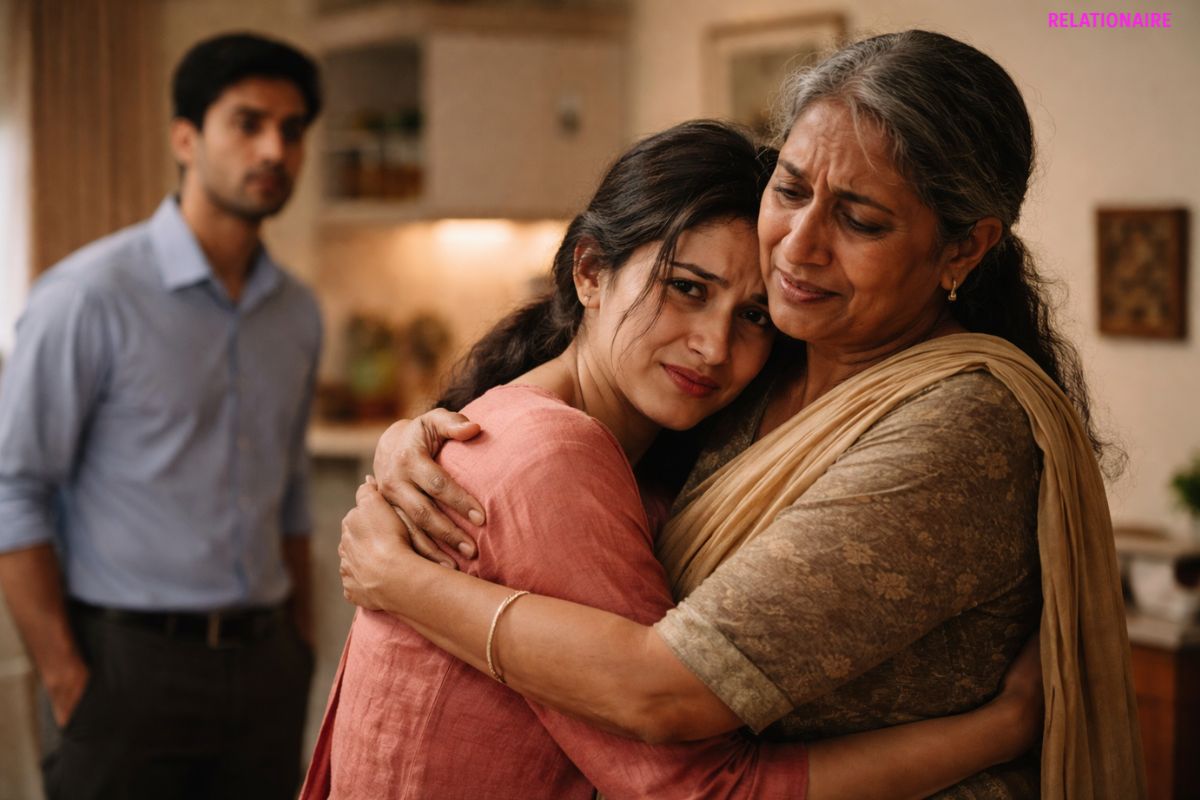
“I was wrong,” Mira said, crying now without dignity, without control, without trying to look strong. “I was cruel, and I was wrong. I kept looking for proof that you were taking from us. All this time, you were the one holding us together.”
Lina’s eyes filled instantly.
Mira took both her hands.
“I thought poverty made people hungry in the worst way. But it was my pride that made me ugly. Not your family. Mine.”
Lina shook her head through tears.
“Mama, please get up.”
But Mira couldn’t yet.
Not until she said the part that had sat like a stone in her chest all day.
“You sold your wedding gold for me. You let me insult you. And still you made my breakfast this morning.”
A sob caught in her throat.
“I don’t know how to live with that kind of shame unless you let me spend the rest of my life repaying it.”
By then Lina was crying too.
So was one of the older seamstresses by the wall.
Lina knelt down and lifted Mira up with both arms.
Not because the apology erased everything.
It didn’t.
But because forgiveness is sometimes less about what is deserved and more about what pain has already cost everyone.
When they held each other, it was awkward at first. Then real.
The kind of embrace people don’t plan.
The kind built from fracture.
That night Mira went home and made two decisions.
She sold the bracelet.
And the next weekend, she rode three hours by bus with Lina to visit her mother.
She carried fruit, medicine, and an envelope of cash that made Lina cry all over again. When Lina’s mother opened the door, Mira did not stand there pretending to be generous. She bowed her head and said the hardest words an older person can say when pride has ruled too long.
“I have wronged your daughter.”
Lina’s mother, thin and tired and softer-eyed than Mira deserved, simply touched her arm and invited her inside.
No speech.
No punishment.
Just room.
Sometimes grace enters a house more quietly than guilt.
Months later, neighbors would still talk. They always did.
But now when someone made a cutting remark about daughters-in-law from poor families, Mira was the first to answer.
“My daughter saved my life,” she would say.
Not daughter-in-law.
Daughter.
And every time she said it, she meant it a little more.
Arman changed too. He stopped hiding money problems and started telling the truth before silence could become damage. Lina stopped saying she was fine when she wasn’t. The apartment stayed small. Bills still came. Nothing became magical.
But tenderness began to live there more openly.
And that changed everything.
Because sometimes the deepest regret does not come from losing love.
It comes from discovering love was standing in front of you the whole time, holding your pain with both hands, while you were too blinded by fear to recognize it.