If you’ve already read part 1 of this story on Facebook, go here for Part 2!
Maya hated grocery shopping with her mother more than almost anything.
Not because of the store.
Because of what her mother became inside it.
The second they walked through the sliding doors, Denise’s face tightened like someone had turned an invisible screw behind her eyes. She stopped being the mother who hummed old songs while washing dishes. She stopped being the woman who braided Maya’s hair before school when Maya was little and still let her.
She became a calculator.
“Don’t touch that.”
“Put it back.”
“We have cereal at home.”
“That brand costs too much.”
“Maya, I said no.”
Every aisle felt like a test Maya had already failed.
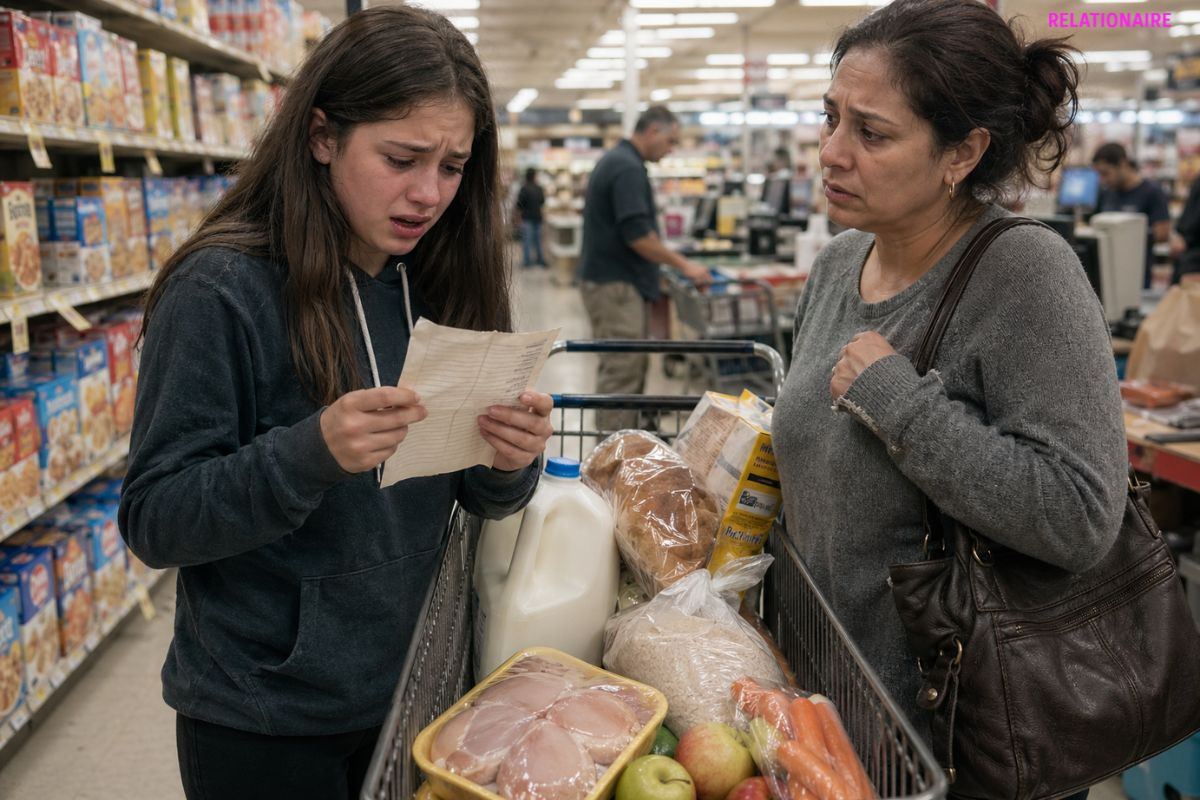
That Friday evening, the grocery store was packed with tired people buying tired dinners. A baby cried near the pharmacy. Somewhere by the bakery, someone dropped a plastic container and it cracked open with a sharp pop. The air smelled like oranges, floor cleaner, and warm rotisserie chicken.
Maya walked two steps behind her mother with her arms folded, watching Denise compare two jars of peanut butter like the wrong choice might ruin their lives.
“It’s thirty cents,” Maya muttered.
Her mother didn’t look up. “Thirty cents matters.”
“It’s peanut butter.”
“It’s money.”
Maya rolled her eyes so hard they almost hurt.
She was sixteen. Old enough to understand that money didn’t grow on trees, as her mother loved saying. Old enough to know their apartment had thin walls, the car made a coughing sound before it started, and the electric bill sat unopened on the kitchen counter for three days last month.
But she was also old enough to be exhausted by it.
Every no felt personal.
No to new sneakers, even though hers had a split near the toe.
No to the school hoodie everyone was buying.
No to pizza after her choir concert because “we have food at home.”
No to the birthday dinner she pretended not to care about.
And always, always, no in the grocery store.
Her mother dropped the cheaper peanut butter into the cart.
Maya stared at it. “That one tastes like cardboard.”
“Then put jelly on it.”
“That’s not the point.”
Denise pushed the cart forward. “Then what is the point?”
Maya didn’t answer.
Because the real point was too ugly to say in the middle of aisle five.
The point was that Maya was tired of being the girl who checked prices before she asked for anything.
Tired of pretending she didn’t want things.
Tired of watching her friends buy iced coffees after school while she said she wasn’t thirsty.
Tired of her mother making every small want feel like greed.
They turned into the cereal aisle, and that was where it happened.
It was such a stupid thing to break over.
A box of cinnamon cereal with a cartoon tiger on the front.
Maya picked it up without thinking. It was the kind she loved when she was younger, the kind Denise used to buy on the first grocery trip after payday. Back then, Maya would eat it dry from a plastic cup while watching Saturday morning cartoons on the couch.
She held the box against her chest.
Denise saw it and sighed.
Not loudly.
That was almost worse.
“Maya.”
“What?”
“Put it back.”
“It’s on sale.”
“It’s still too much.”
“It’s three dollars and ninety-nine cents.”
“We’re not buying it.”
Maya laughed, but it came out sharp. “Of course we’re not.”
Her mother’s hand tightened on the cart handle. “Don’t start.”
“I’m not starting anything. I’m just standing here holding cereal like a criminal.”
A woman at the end of the aisle glanced over.
Denise lowered her voice. “Put it back.”
“No.”
“Maya.”
“No, Mom. For once, can you not act like I’m asking for a diamond necklace?”
Denise’s mouth went small.
That should have been Maya’s warning.
But she was embarrassed. And hungry. And angry in the way teenagers are when their hurt has nowhere soft to land.
“It’s cereal,” Maya said, louder now. “It’s not that serious.”
Her mother reached for the box.
Maya pulled it back.
“Maya, enough.”
“No. You do this every time. You make everything miserable. You turn buying food into some kind of lecture. You don’t even let me breathe without reminding me what everything costs.”
Denise’s eyes flicked toward the woman nearby, then back to her daughter. “We’ll talk in the car.”
“No, we won’t,” Maya snapped. “You’ll talk. You always talk. You’ll tell me how hard life is and how I should be grateful for off-brand crackers and frozen vegetables.”
Her mother went very still.
Maya felt the words coming and did not stop them.
“You know what? Sometimes I think you like saying no.”
Denise blinked once.
Maya’s throat burned, but pride kept her standing tall.
“I think it makes you feel powerful,” she said. “Like if you can’t control anything else, at least you can control me.”
The aisle went quiet in that strange way public places do when strangers pretend not to listen.
Denise looked at the cereal box.
Then at Maya.
For a second, her face changed.
Not anger.
Not exactly.
Something more tired than anger.
Something that made her look older than forty-two.
She reached into her purse, pulled out her wallet, and opened it with hands that weren’t quite steady.
“Fine,” she said.
Maya stared at her.
Denise took out a five-dollar bill. It was folded in half, then in half again. She held it out.
“Get the cereal.”
Maya didn’t take it.
The victory felt wrong.
Her mother placed the bill on top of the cereal box.
“Get it,” Denise repeated, quietly. “Since that’s what this is about.”
Then she turned the cart around and walked toward the end of the aisle.
Maya stood there with the cereal pressed against her ribs and the five-dollar bill sliding slowly down the cardboard.
Her face was hot.
The woman at the end of the aisle suddenly found the oatmeal fascinating.
Maya wanted to disappear.
She threw the cereal into the cart harder than she meant to. It landed on top of a bag of rice and crushed the corner of a loaf of bread.
Her mother didn’t say anything.
That silence followed them through the rest of the store.
At checkout, Denise unloaded everything in careful order. Cold items together. Cans together. Bread last, even though the loaf was already dented.
Maya stood beside the cart pretending to text, though her phone screen was black.
The cashier scanned the groceries. Beep. Beep. Beep.
Denise watched the total climb.
Maya watched Denise watch it.
There was something almost painful in the way her mother’s eyes moved from the register screen to the conveyor belt, then to the little stack of coupons in her hand.
“Do you have a store card?” the cashier asked.
Denise gave the number.
The total dropped by four dollars and eighteen cents.
Denise exhaled so softly Maya almost missed it.
Then came the cereal.
Beep.
The number changed.
Denise’s face did not.
But Maya saw her thumb rub once over the edge of her wallet.
Outside, the sky was turning the color of dirty dishwater. The parking lot smelled like rain and car exhaust. Maya loaded bags into the trunk while her mother returned the cart.
Neither of them spoke on the ride home.
The cereal box sat on Maya’s lap like evidence.
At their apartment, Denise carried most of the bags herself. Maya took two and walked ahead.
Inside, the kitchen light flickered once before staying on.
The apartment was small, but Denise kept it clean. A dish towel hung over the oven handle. A faded photo of Maya at age six was stuck to the fridge with a magnet shaped like a strawberry. On the table sat a stack of mail, an empty glass, and the blue purse Denise carried everywhere.
Maya put the groceries away in silence.
Her mother unpacked the rice, the beans, the chicken thighs, the bananas already going brown at the stems.
When Maya reached for the cereal box, Denise touched it first.
Not grabbing.
Just touching.
“I’ll put it up,” Denise said.
“Why? Afraid I’ll eat it?”
Her mother closed her eyes for half a second.
Maya immediately wished she could pull the words back.
But Denise only placed the cereal in the cabinet.
Then she took her purse from the table and headed toward the bedroom.
Something slipped out.
A folded paper fluttered down near Maya’s foot.
“Mom,” Maya said, but Denise didn’t hear her. Her bedroom door clicked shut.
Maya bent down.
At first she thought it was a receipt.
Then she saw her mother’s handwriting.
Small.
Tight.
Careful.
Milk — 3.49
Eggs — 2.99
Rice — 5.20
Bread — 1.89
Chicken — 7.34
Bananas — 1.10
Maya lunch snacks — 4.00
Cereal? — 3.99
Numbers were written down the side. Some crossed out. Some circled. At the bottom, below a line where everything had been added twice, was one sentence.
Maya read it once.
Then again.
Her chest went cold.
If not enough, skip mine again.
Behind her, her mother’s bedroom door opened.
“Maya,” Denise said softly.
Maya turned around with the paper shaking in her hand.
And for the first time all night, her mother looked scared.
PART 2
Denise saw the paper before she saw Maya’s face.
For one second, neither of them moved.
The apartment hummed with small sounds: the refrigerator, the faucet dripping once into the sink, a car passing outside with its bass too loud.
Maya’s fingers tightened around the grocery list.
“What does this mean?” she asked.
Her voice sounded younger than sixteen.
Denise took one step forward. “It’s nothing.”
Maya almost laughed. Not because anything was funny, but because that was what adults said when something was clearly breaking open.
“It doesn’t look like nothing.”
“Maya, give me the paper.”
“No.”
Her mother stopped.
The word hung between them.
Maya looked down again, hoping maybe she had read it wrong. Maybe “skip mine” meant coffee. Or shampoo. Or some coupon. Something normal. Something that did not make her remember all the nights her mother said she had eaten at work.
All the mornings Denise packed Maya’s lunch before making her own coffee and calling it breakfast.
All the times Maya found only one plate in the sink.
Her stomach twisted.
“Mom.”
Denise pressed her lips together.
“Are you skipping meals?”
The question landed harder than a shout.
Denise looked toward the kitchen cabinets, then the floor.
That was answer enough.
Maya’s face crumpled before she could stop it. “How long?”
“Maya—”
“How long?”
Denise rubbed her forehead with the heel of her hand. “Not like you’re thinking.”
“How am I thinking?”
“Like I’m starving myself in a dramatic way. I’m not. Sometimes I eat at work. Sometimes I’m just not hungry.”
“You always say you’re not hungry.”
“That can be true.”
“But is it?”
Denise didn’t answer.
Maya’s throat tightened. She looked toward the cabinet where the cereal sat, bright and stupid and expensive.
“I yelled at you,” Maya whispered.
Denise’s eyes softened immediately. “You were upset.”
“I said you liked saying no.”
“You didn’t know.”
“But you did.” Maya held up the paper. “You knew. You knew you were writing this and you still let me stand there and say all that.”
Denise looked tired enough to fall over.
“I’m your mother,” she said. “You’re allowed to be a child.”
“I’m sixteen.”
“You’re still my child.”
That sentence should have comforted her.
Instead it made Maya cry.
Not loud. Not dramatic. Just sudden tears slipping down her cheeks while she stood in the kitchen with the grocery list in her fist.
Denise reached for her, then stopped, unsure whether she was allowed.
That hesitation hurt Maya most.
All these years, she had thought her mother’s carefulness was control. She had called it nagging. She had rolled her eyes at coupons, discount meat, off-brand soap, the way Denise checked receipts in the car before pulling out of the parking lot.
Now the same memories came back wearing different clothes.
Her mother at the stove, saying, “I’ll eat later,” while sliding the bigger piece of chicken onto Maya’s plate.
Her mother making soup too thin, then calling it “lighter.”
Her mother laughing when Maya asked why she never bought the yogurt she liked anymore.
“Tastes changed,” Denise had said.
Maya now understood that sometimes taste was just another thing poverty took quietly.
“Why didn’t you tell me?” Maya asked.
Denise leaned against the counter. “Because I didn’t want you carrying it.”
“I was carrying something anyway.”
Her mother looked at her.
“I was carrying being angry at you,” Maya said. “That’s not better.”
Denise’s eyes filled, but she blinked the tears back. She was too practiced at that. Too good at making pain behave.
Maya hated noticing it.
Denise sat at the kitchen table like her legs had finally given up. The chair creaked under her. For the first time, Maya saw how thin her wrists looked.
“I thought it would be temporary,” Denise said.
“What would?”
“The tightness. The juggling.” She gave a small, humorless smile. “That’s what I called it in my head. Juggling. Rent, electric, groceries, your school fees, gas. Then your dad missed two months of child support. Then the clinic cut my hours. Then the car needed repairs.”
Maya knew pieces of that.
Not the whole shape.
Her father lived two towns away with a new wife and twin toddlers. He called on holidays and sometimes sent money late with long explanations. Maya had learned not to wait by the window for him years ago.
Denise never badmouthed him.
That used to annoy Maya too.
Now she wondered how many angry words her mother had swallowed so Maya would not have to hate anyone.
“I didn’t want you to think less of him,” Denise said, as if reading her mind.
Maya wiped her face with her sleeve. “I don’t know what I think.”
“That’s allowed.”
“No, it’s not.” Maya laughed through tears. “You’re always allowing everyone else to be messy while you just… disappear.”
Denise looked down at the grocery list.
“I didn’t disappear.”
“Yes, you did. You disappeared into being okay.”
That was the line that broke something.
Denise covered her face.
Not completely. Just enough to hide her mouth.
Maya had seen her mother frustrated. She had seen her angry. She had seen her tired. But she had almost never seen her cry.
It scared her.
Because mothers were supposed to be walls.
And Maya was realizing, all at once, that walls cracked too. They just did it quietly, where no one was looking.
She sat across from Denise.
The grocery list lay between them.
“Do you skip dinner a lot?”
Denise hesitated.
“Please don’t lie.”
Her mother’s voice came out thin. “Sometimes.”
“How many times this week?”
“Maya.”
“How many?”
Denise looked at the table.
“Three,” she said.
Maya made a sound like she had been hit.
“Mom.”
“I make sure you eat.”
“That’s not the same as us being okay.”
“No,” Denise whispered. “It isn’t.”
The refrigerator kicked on behind them.
Maya stared at the faded strawberry magnet holding her six-year-old photo. In it, she had missing front teeth, a crooked smile, and no idea her mother had been carrying storms behind her.
“What do we do?” Maya asked.
Denise let out a breath. “We don’t panic.”
“I’m already panicking.”
“I know.”
“I can get a job.”
“No.”
“You didn’t even think about it.”
“You go to school.”
“I can work weekends.”
“Maya—”
“You can’t just keep skipping food and then tell me my job is to be a child.”
Denise’s face tightened. “My job is to keep you safe.”
“And who keeps you safe?”
The question silenced the room.
Denise looked away.
Maya thought of her grandmother, Nana Ruth, who lived twenty minutes away and called every Sunday after church. Denise always answered cheerfully and said things were fine.
Fine.
Maya hated that word now.
“Does Nana know?” she asked.
Denise shook her head quickly. “No.”
“Why not?”
“Because she has enough on her plate.”
“Nana would want to know.”
“She worries.”
“She loves you.”
“That’s why I don’t tell her everything.”
Maya stared at her mother and saw the family pattern for the first time.
Everyone protecting everyone by hiding.
Everyone calling it love.
Everyone going hungry in different ways.
That night, Maya did not eat the cereal.
Neither did Denise.
They made rice and eggs, and Maya divided the portions herself. When her mother tried to take the smaller plate, Maya switched them back.
Denise smiled sadly. “You’re stubborn.”
“I learned from someone.”
They ate at the table in quiet bites.
Afterward, Maya went to her room but did not sleep.
She lay under her blanket listening to her mother move around the apartment. Cabinet closing. Water running. The soft click of the front door lock being checked twice.
At 11:18, Maya picked up her phone.
Her thumb hovered over her father’s name.
Then Nana Ruth’s.
Then back again.
She did not know which choice would help and which would make everything worse.
At 11:23, she sent a message.
Not to her father.
To Nana.
Are you awake? I need to tell you something about Mom. Please don’t say I told you.
The reply came less than one minute later.
Baby, I’m putting on my shoes.
Maya sat up in bed, heart pounding.
Because in families like theirs, love did not always knock softly.
Sometimes it came over in the middle of the night with a coat over pajamas and a purse full of tissues.
And sometimes, it brought the truth no one was ready to say out loud.
PART 3
Nana Ruth arrived at 11:51 carrying a casserole dish, though no one had asked for food.
That was how she entered every crisis.
With foil on top.
She knocked once, then used the spare key Denise did not know Maya knew about. The door opened quietly, and Nana stepped inside in house slippers, a long coat, and the determined expression of a woman who had raised three children on one paycheck and prayer.
Maya met her in the hallway.
“Where is she?” Nana whispered.
“Bedroom.”
“Crying?”
“I don’t know.”
Nana’s face softened. “That means yes.”
Maya looked down.
“I shouldn’t have texted.”
“Yes, you should have.” Nana set the casserole on the counter. “Families don’t get points for suffering in private.”
The bedroom door opened.
Denise stood there in an old T-shirt and sweatpants, her eyes red, her hair pulled back too tight.
The moment she saw her mother, her face changed.
Not into relief.
Into embarrassment.
“Mom,” Denise said. “Why are you here?”
Nana Ruth took off her coat. “Because my granddaughter texted me like she was carrying a brick in her chest.”
Denise looked at Maya.
Maya braced herself for anger.
But Denise only looked hurt.
Not betrayed.
Just hurt that the pain had escaped her hands.
“I told you not to tell anyone,” Denise said softly.
“You never said that.”
Denise closed her eyes. “I thought it was understood.”
Nana walked past both of them into the kitchen. “Well, I understand plenty. I understand there is not enough food in this house if my daughter is writing notes about skipping her own meals.”
Denise froze.
Maya did too.
Nana Ruth turned.
“Don’t look surprised. I was poor before you were born. I know the handwriting.”
For a second, nobody spoke.
Then Denise’s shoulders dropped.
All the fight went out of her at once.
“I didn’t want you worrying,” she said.
Nana’s face softened in a way that made Maya’s throat ache. “Baby, I have been worrying about you since the day they put you in my arms.”
Denise sat down hard at the table.
Nana sat beside her.
Maya stood by the counter, unsure where to put her body in a moment that felt too private and completely hers at the same time.
“I’m embarrassed,” Denise whispered.
Nana reached for her hand. “I know.”
“I’m forty-two years old.”
“And?”
“I should be able to buy groceries.”
“You are buying groceries.”
Denise shook her head. “Not enough.”
“Enough to feed your daughter.”
“That’s not enough.”
“No,” Nana said. “It isn’t. But it is love. And love needs help sometimes.”
Denise cried then.
Quietly at first. Then with one hand over her eyes, like she was trying to keep the tears from taking up space.
Maya had never seen her mother look so much like someone’s child.
Nana held her hand and let her cry without rushing to fix it. That was its own kind of mercy.
After a while, Nana stood and opened the casserole.
“Eat.”
Denise gave a broken little laugh. “Mom.”
“I did not come here at midnight to discuss feelings with hungry people.”
Maya almost smiled.
They ate chicken and noodles from chipped bowls at the kitchen table under the flickering light.
Denise ate slowly, like each bite came with guilt attached.
Nana noticed.
Of course she did.
“Do not apologize to the food,” she said.
Denise looked at her.
“Eat it.”
So Denise did.
The next morning, everything looked the same but felt different.
The same cabinets.
The same unpaid bill on the counter.
The same cereal box in the cabinet, unopened.
But the secret had been named, and that changed the air.
Nana stayed for breakfast and made eggs with toast, cutting the toast diagonally the way she had when Maya was little.
Then she opened her purse and pulled out a folded envelope.
Denise immediately shook her head. “No.”
“You don’t know what it is.”
“It’s money.”
“It is.”
“No.”
“Yes.”
“Mom, I can’t.”
“You can.”
“I don’t want charity.”
Nana’s voice sharpened. “Then don’t call it charity. Call it me not letting my child go hungry while I have a freezer full of food and a church pantry begging people to take extra produce.”
Denise looked away.
Maya watched her mother’s pride fight her need.
It was painful to see.
Not because Denise was wrong to want dignity.
But because Maya finally understood how heavy dignity could become when a person tried to carry it alone.
Nana pushed the envelope across the table.
“This is for groceries. And next week you and I are going to sit down with your bills. Not because you failed. Because numbers are less scary when two people look at them.”
Denise stared at the envelope.
Then she covered it with her hand.
“Okay,” she whispered.
One word.
It sounded like surrender.
It also sounded like rescue.
That afternoon, Maya went to the grocery store again with her mother.
At first, neither of them mentioned the cereal aisle.
They moved slowly through produce. Denise picked up apples, then put two back.
Maya noticed and put one back in the bag.
Denise smiled faintly. “Teamwork?”
“Teamwork.”
They compared prices, but this time it did not feel like a lecture. It felt like being trusted with the truth.
At the dairy case, Maya reached for the store-brand yogurt.
Then paused.
“What kind did you used to like?” she asked.
Denise blinked. “What?”
“Yogurt. You said your tastes changed, but I don’t think they did.”
Her mother looked at the rows of containers.
“Peach,” she said after a moment.
Maya picked up four peach yogurts and put them in the cart.
Denise opened her mouth.
Maya raised one eyebrow.
“Don’t start,” Maya said gently.
Her mother laughed.
It was small.
But real.
At checkout, Maya unloaded the groceries. When the cereal box came from the cart, Denise looked at it.
Maya had chosen a smaller box this time.
Still cinnamon.
Still special.
But cheaper.
Denise touched the corner. “You didn’t have to.”
“I know.”
The cashier scanned it.
Beep.
Maya did not feel guilty.
Not exactly.
She felt aware.
There was a difference.
That night, they ate dinner together. All three of them, because Nana came back “just to return a bowl” and somehow stayed for meatloaf.
Denise took a full plate.
Maya watched without meaning to.
Her mother noticed.
“I’m eating,” Denise said.
“I see.”
“I’ll keep eating.”
Maya nodded.
“And you’ll tell me when you’re scared instead of turning into a tiny thundercloud in aisle seven?”
Maya looked down at her plate. “I’ll try.”
“That’s fair.”
After dinner, Maya opened the cereal box.
She poured three small bowls.
One for herself.
One for Nana.
One for her mother.
Denise stared at the bowl in front of her, then smiled in a way that made her eyes shine.
“I used to buy this for you when you were little,” she said.
“I remember.”
“You’d eat all the marshmallow-looking pieces first.”
“They weren’t marshmallows.”
“They were sugar wearing costumes.”
Maya laughed.
For a few minutes, they were not a family under strain.
They were just three generations at a kitchen table eating cereal at night, listening to the rain tap against the window.
Later, after Nana left and the dishes were done, Maya found the grocery list in the trash.
She pulled it out.
Denise saw her.
“You don’t need to keep that,” she said.
Maya smoothed the paper on the table.
“Yes, I do.”
Her mother’s face tightened. “Maya, I don’t want you remembering me that way.”
“I’m not.”
“Then how?”
Maya looked at the numbers. The crossed-out cereal. The sentence at the bottom that had cracked her childhood open in one night.
“I’m remembering that you loved me even when I didn’t recognize it.”
Denise’s eyes filled again.
Maya folded the list carefully and tucked it into the back of the family photo frame on the fridge.
Not to shame her mother.
Not to keep score.
To remember.
Years later, Maya would still think about that grocery list.
Not every day.
But on certain days.
When she had her own apartment.
When money was tight.
When she stood in a store holding something small and unnecessary and heard her mother’s voice in her head.
Thirty cents matters.
She would understand then that some parents do not say “I love you” in grand speeches.
Some say it by cutting coupons.
By taking the smaller piece.
By pretending they already ate.
By saying no with a broken heart because yes costs more than they have.
And sometimes, a child grows up the moment they realize love was never absent.
It was standing beside them in the cereal aisle, counting pennies, trying not to cry.