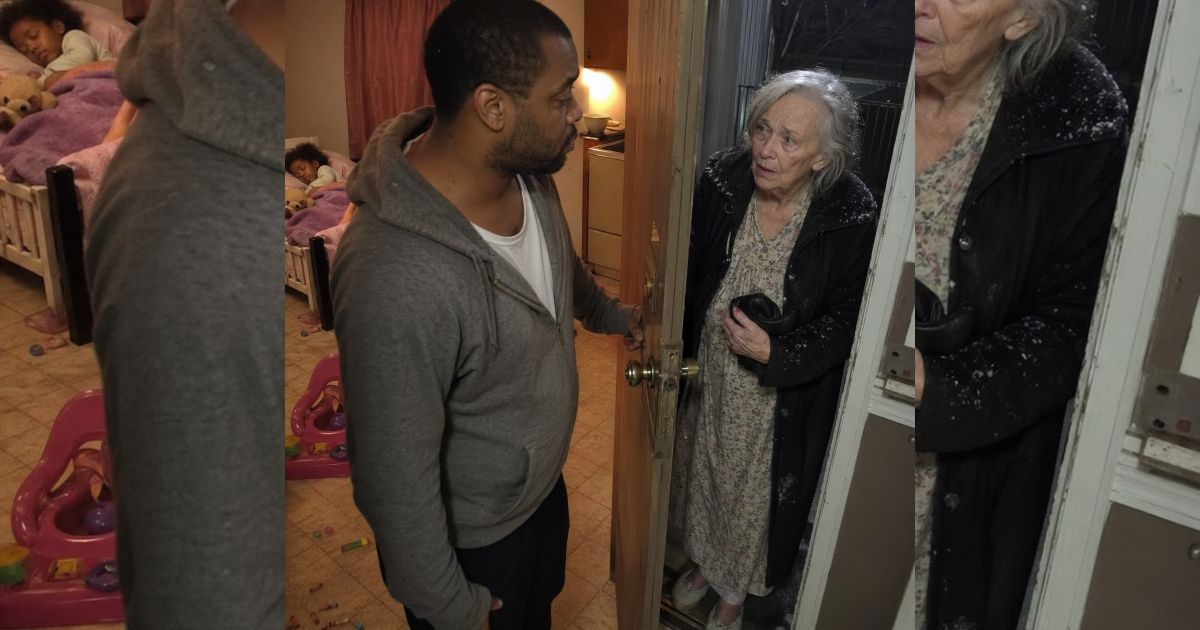
A Broke Single Dad Opened His Door at 2:17 A.M. for a Freezing Stranger—By Morning, His Little Girl Was Calling Her Grandma
The doorbell screamed again.
Marcus Cole sat straight up in bed, heart pounding so hard he felt it in his throat.
2:17 a.m.
Nobody rang a doorbell at 2:17 in the morning unless something had gone wrong.
He turned fast toward the little alcove off the living room, where his four-year-old daughter, Zoey, slept under a purple blanket with one foot hanging out.
She didn’t wake.
Thank God.
The bell rang again.
Longer this time.
Marcus swung his legs over the side of the mattress and felt the cold floor bite the bottoms of his feet. He had been asleep for maybe forty minutes after two back-to-back shifts—first stocking shelves at an auto parts store, then washing dishes and running food at a little neighborhood grill.
His body begged him to lie back down.
But the doorbell kept ringing.
He grabbed his old gray hoodie from the chair, pulled it over his undershirt, and moved through the dark apartment, stepping around Zoey’s coloring books and plastic building blocks.
His apartment was small.
One bedroom.
A living room that also served as his sleeping space.
A kitchen so narrow he could touch both counters if he stretched out his arms.
But it was clean.
It was theirs.
And Marcus protected it like it was a castle.
At the door, he stopped.
His hand hovered near the lock.
He leaned close to the peephole.
What he saw made his breath catch.
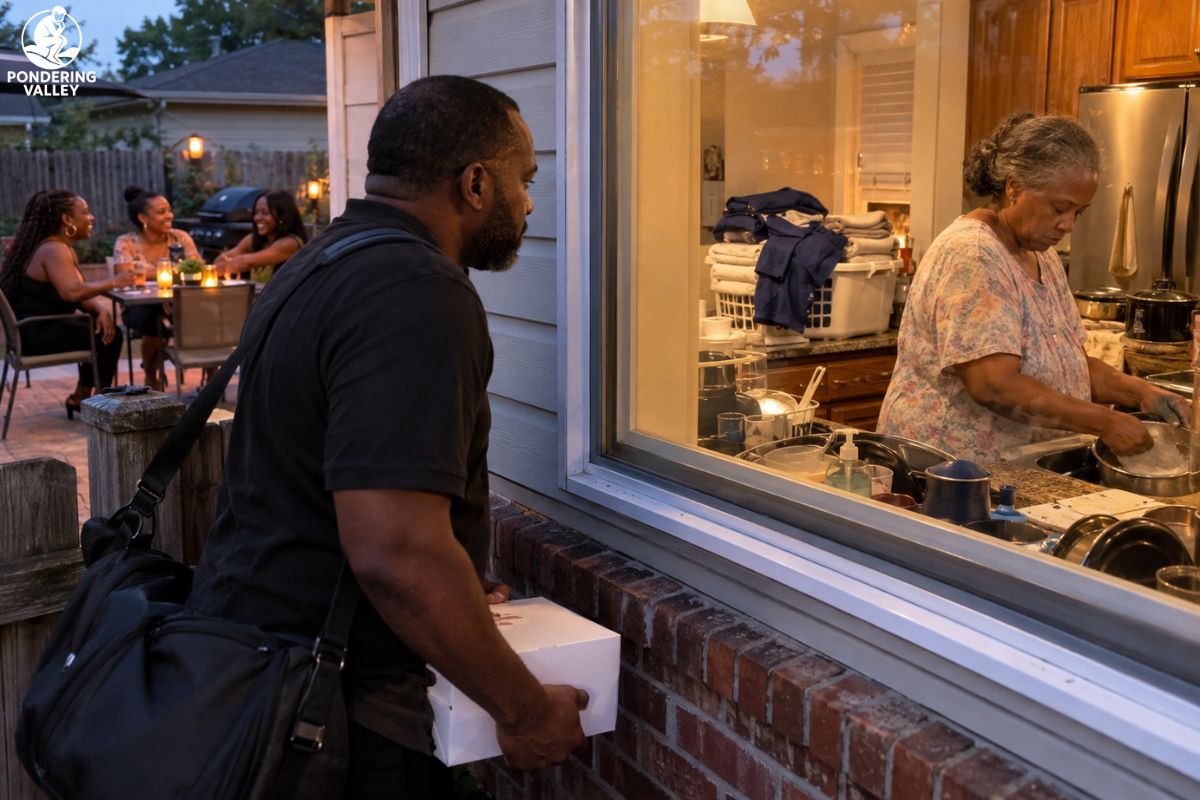
An elderly woman stood in the hallway, soaked from the snow, shivering so hard her thin shoulders jerked under a dark winter coat that hung open.
Her silver hair stuck damply to her forehead.
Under the coat, she wore a pale floral nightgown.
On her feet were house slippers.
House slippers.
In the middle of a Detroit winter night.
She clutched a small black purse to her chest with both hands, like it was the only thing keeping her upright.
Marcus stared.
His first thought was simple.
Trouble.
Not the kind that shows up angry.
The kind that shows up helpless.
The kind that pulls you in before you know what it will cost.
The bell rang again.
The woman pressed the button with one shaking finger, then whispered something Marcus couldn’t hear.
He swallowed.
He was a single father.
He was tired.
He was behind on rent by twelve days.
He had $47 in his wallet and a daughter sleeping twenty feet away.
He knew how fast a good deed could turn ugly when people didn’t understand the whole story.
An exhausted man.
A confused elderly woman.
The wrong hour.
The wrong assumptions.
One phone call from a neighbor could bring questions he could not afford.
He pressed his forehead gently against the door.
“Lord,” he whispered. “Please don’t let this be something I can’t fix.”
The woman outside swayed.
That was all it took.
Marcus unlocked the deadbolt.
The hallway air rushed into his apartment like ice water.
“Ma’am?” he said carefully. “Are you all right?”
The elderly woman looked up.
Her pale blue eyes tried to focus on him, then drifted away, then came back.
For one second, her face filled with relief.
“Oh, Tommy,” she whispered. “Why did you leave me out here so long, sweetheart? I was so cold.”
Marcus froze.
“I’m sorry, ma’am,” he said softly. “I’m not Tommy.”
She blinked.
Her mouth trembled.
“You’re not?”
“No, ma’am. My name is Marcus.”
The woman looked past him into the apartment as if she expected someone else to appear.
“I was coming home,” she said. “I know I was. I had the address. I had it right here.”
She patted her purse, then frowned like the purse had betrayed her.
“I was going to see Catherine,” she whispered. “My daughter. But the bus… the streets… everything moved.”
Marcus felt something inside him sink.
She wasn’t drunk.
She wasn’t trying to cause trouble.
She was lost.
Completely lost.
And she was freezing.
“Do you know Catherine’s phone number?” Marcus asked.
The woman opened her purse with trembling hands. Receipts, tissues, a small comb, a folded church program, and peppermint candies spilled toward the zipper.
She stared at them like they belonged to somebody else.
“I don’t know,” she said, and her voice broke. “I don’t know why I can’t remember.”
Marcus looked down the hallway.
Nobody else had opened a door.
Not one neighbor.
Not one curious face.
Just him, this lost woman, and the snow melting from her coat onto the hallway floor.
He thought of his grandmother.
The way she used to say, “Baby, character is what you do when helping somebody makes your own life harder.”
He hated how clearly he heard her voice.
“Come inside,” Marcus said.
The woman stared at him.
“Inside?”
“Yes, ma’am. You can’t stay out here. You’ll get sick.”
She stepped forward slowly.
Her knees shook.
Marcus offered his arm, careful not to grab her, careful not to scare her.
She placed her cold hand on his sleeve.
“Thank you, Tommy,” she whispered. “Your mother raised you right.”
Marcus closed the door behind them and turned the lock.
The click sounded louder than it should have.
Like a promise.
Like a warning.
He guided her to the couch and helped her sit. She was so cold that her fingers looked almost stiff around the purse strap.
“Wait here,” he said. “I’ll get you a blanket.”
She nodded, then looked around the room.
Her gaze moved over the secondhand coffee table, the laundry basket by the wall, Zoey’s tiny shoes lined up near the door, the stack of unpaid envelopes Marcus had flipped facedown on the counter.
“Such a sweet place,” she murmured.
Marcus almost laughed.
Sweet was not the word most people would use.
But from her mouth, it didn’t sound like pity.
It sounded like she meant it.
He took the thickest blanket from his bed and wrapped it around her shoulders.
Then he filled the kettle and searched the cabinet.
One tea bag left.
Chamomile.
He had been saving it for Zoey when she had trouble sleeping.
He used it anyway.
While the water heated, he looked toward his daughter.
Still asleep.
Still safe.
He took a breath.
“You said your daughter’s name is Catherine?” he asked from the kitchen.
“Yes,” the woman said.
“Do you know her last name?”
The woman’s face tightened.
“Williams,” she said after a moment. “Catherine Williams.”
“That’s good,” Marcus said. “That helps.”
“She’s very important now,” the woman added, with a tired smile. “Always rushing. Always on the phone. But she was the sweetest little thing once. Chocolate on her cheeks. Ribbons crooked in her hair.”
Marcus set the mug in front of her.
“Can you sip a little?”
She wrapped both hands around it.
“I didn’t mean to be a bother,” she said.
“You’re not a bother.”
But even as Marcus said it, fear pressed behind his ribs.
Because she was.
Not because she wanted to be.
Not because she had done anything wrong.
But because life had already stretched him so thin that one unexpected human need felt like a storm.
He should call someone.
But who?
The police?
An ambulance?
Adult protective services?
He imagined bright lights outside his building.
Questions.
Forms.
Strangers looking around his apartment, noticing the mattress in the living room, the thin groceries, the way his work boots had holes near the toes.
He imagined someone asking why he had opened the door.
Why he had not called sooner.
Why his little girl was living in a one-bedroom apartment with a father who worked two jobs and still could not stay ahead.
The woman sipped the tea.
Her hands shook less.
“Where is the little one?” she asked suddenly.
Marcus stiffened.
“My daughter is sleeping.”
“Oh,” the woman said, eyes softening. “A child in the house. Then I must be quiet.”
Something about that sentence settled him.
She was confused, yes.
But not dangerous.
She was somebody’s mother.
Somebody’s grandmother, maybe.
Somebody who had once cut crusts off sandwiches and stayed up late with feverish children.
Marcus pulled the chair from the small kitchen table and sat near the couch.
He did not sleep.
Not really.
He drifted in and out with his arms folded, waking every time the woman shifted, every time the old heater groaned, every time Zoey mumbled in her sleep.
Once, near 4:00 a.m., the woman woke and said, “Tommy, did you lock the back door?”
Marcus said gently, “Yes, ma’am. Everything’s locked.”
She smiled and slept again.
At 6:45, his phone alarm buzzed.
Marcus slapped it silent and sat up, neck stiff, back aching.
Morning had crept into the apartment in thin gray lines.
On the couch, the elderly woman slept curled under his blanket, her face finally peaceful.
For a moment, Marcus let himself believe he had done the right thing and nothing terrible would come from it.
Then he remembered work.
He was supposed to be at the auto parts store by eight.
After that, the lunch rush at the grill.
Missing even one shift could set off a chain reaction he could not stop.
Rent.
Electric bill.
Daycare fees.
Groceries.
Gas.
He rubbed both hands over his face.
“Daddy?”
Zoey stood in the alcove, hair wild, purple pajamas twisted, teddy bear pressed to her chest.
Her eyes moved past him to the couch.
“Who’s that lady?”
The woman stirred.
Her eyes opened.
For one second, she looked frightened.
Then she saw Zoey.
Her whole face changed.
“Oh my,” she breathed. “What a beautiful child.”
Zoey moved closer to Marcus’s leg.
“She got lost last night,” Marcus said, crouching beside his daughter. “Her name is Miss Eleanor. She needed a warm place to stay.”
Zoey studied the woman seriously.
“Were you scared?”
Eleanor’s eyes filled.
“Yes, sweetheart,” she whispered. “I was.”
“When I get scared,” Zoey said, “Daddy sings the pancake song.”
Marcus closed his eyes for half a second.
Not the pancake song.
Eleanor smiled.
“The pancake song?”
Zoey nodded.
“It’s not a real song. Daddy made it up because we don’t always have pancakes.”
Marcus felt the words hit him in the chest.
Children tell the truth with no idea how sharp it is.
Eleanor looked at him, but not with pity.
With understanding.
“I used to make pancakes for my Catherine,” she said. “Chocolate chip ones. She liked extra syrup. So much syrup her father said she was eating breakfast soup.”
Zoey giggled.
Marcus stood and went to the refrigerator, though he already knew what was inside.
A half gallon of milk.
Two eggs.
A little butter.
A container of old leftovers he did not trust.
In the cabinet, pancake mix.
The kind that needed milk and eggs.
He could make some.
Barely.
But if he used the eggs, there would be nothing easy for Zoey’s dinner.
He looked at his wallet on the counter.
Forty-seven dollars.
Friday was three days away.
“Daddy,” Zoey said, “can Miss Eleanor have pancakes with us?”
Eleanor looked embarrassed.
“Oh, no. I don’t need anything fancy.”
Marcus knew that tone.
The tone of someone who had spent a lifetime pretending not to need what they needed.
He heard it in himself every day.
He forced a smile.
“You know what?” he said. “We’ll go to the grill. They make better pancakes than I do.”
Zoey gasped like he had announced a trip to the moon.
“With chocolate chips?”
“With chocolate chips.”
“And syrup?”
“Extra syrup.”
Eleanor pressed one hand to her chest.
“That sounds lovely.”
Marcus smiled because they were both looking at him like he had just performed a miracle.
Neither of them knew the miracle would cost him almost everything in his wallet.
An hour later, Marcus pushed open the glass door of the Corner Grill with Zoey holding one hand and Eleanor walking carefully on his other side.
The place smelled like coffee, toast, grilled onions, and bacon grease.
It was not pretty.
Vinyl booths patched with tape.
A specials board with crooked chalk writing.
A bell over the door that sounded tired.
But it was honest.
And it was where Marcus knew how to keep moving even when his bones ached.
Mara, the hostess, looked up from rolling silverware.
Her eyebrows lifted.
“Marcus? Thought you called the parts store.”
“I did,” Marcus said quietly. “Family situation.”
Mara’s eyes moved to Eleanor, then Zoey.
Marcus could see the questions forming.
He answered only the one that mattered.
“They’re going to sit in booth seven while I work.”
Mara lowered her voice.
“Boss is already in a mood.”
“He’s always in a mood.”
“That doesn’t mean you should feed him a reason.”
Marcus gave her a tired smile and led Zoey and Eleanor to the corner booth near the kitchen window.
It had the best view.
From there, he could keep one eye on his daughter while taking orders.
Eleanor slid into the booth with care, wearing a borrowed skirt and sweater Marcus had found in a donation bag by the laundry room.
The clothes did not fit well.
But she still sat with her back straight, hands folded in her lap, like she was waiting for tea in a fancy hotel.
Zoey climbed opposite her and placed Teddy on the table.
“This is where Daddy works,” she said proudly.
“It’s wonderful,” Eleanor said.
Marcus looked around at the scuffed floor and chipped mugs.
“You’re being kind.”
“I’m being honest,” Eleanor said. “A place that feeds people is always important.”
That sentence stayed with him.
He left them with menus and went to the back to clock in.
The head cook, Daryl, barely looked up from the grill.
“You late.”
“I know. I’m sorry.”
“Sorry don’t bus tables.”
“I’ll make it up.”
Daryl snorted.
“You always say that.”
Marcus tied on his apron and moved.
Coffee.
Water.
Orders.
Toast.
Silverware.
Refills.
Smile.
Apologize.
Keep moving.
He had learned how to make exhaustion invisible.
Every few minutes, he looked toward booth seven.
Eleanor was showing Zoey how to fold a napkin into a little bird.
Zoey’s mouth hung open in wonder.
Marcus felt a strange ache watching them.
Zoey had never known a grandmother.
His mother had passed before Zoey could form memories.
Zoey’s mother had left when Zoey was six months old and never settled into being part of their lives.
So it had been Marcus.
Only Marcus.
Bedtime stories.
Doctor visits.
Tiny ponytails that came out crooked.
Lunches packed with whatever he could afford.
Birthday cupcakes from boxed mix.
Every scraped knee.
Every fever.
Every question he did not know how to answer.
He loved being her father.
But sometimes he wished she had one more person in the world who looked at her like she was a blessing.
Eleanor looked at her that way.
Marcus approached the booth with his notepad.
“All right, ladies,” he said. “What are we having?”
“Chocolate chip pancakes!” Zoey shouted.
“Inside voice,” Marcus said automatically.
Zoey covered her mouth and whispered, “Chocolate chip pancakes.”
Eleanor laughed.
“I’ll have the same,” she said. “If that’s all right.”
Marcus glanced at the prices.
He already knew them.
But seeing them still hurt.
Two pancake plates.
Coffee.
Milk for Zoey.
Tax.
Tip, if he dared leave one for his own coworker.
He could skip his own meal.
No problem.
He did it all the time.
“Three pancake plates,” he said.
Zoey blinked.
“You too, Daddy?”
“Me too.”
Because if he didn’t eat, Zoey would notice.
And if Zoey noticed, she would offer him half of hers.
He could not take food from his child’s plate.
Not today.
When the plates came, Eleanor clapped softly.
“Oh, Catherine would have loved this,” she said.
Marcus sat for two minutes before the rush swallowed him again.
From the kitchen, he watched Eleanor cut Zoey’s pancakes into neat triangles.
No one had ever cut Zoey’s pancakes like that.
Marcus cut them fast.
Fork in one hand, bill in the other, mind already on the next thing.
Eleanor took her time.
Like the meal mattered.
Like Zoey mattered.
“Marcus.”
Jose Alvarez appeared beside him at the coffee station, holding a fresh pot.
Jose worked mornings at the grill and evenings cleaning offices. He had three kids, a bad knee, and a laugh loud enough to make the whole kitchen turn around.
Today, he was not laughing.
“Brother,” Jose said softly, “who is that?”
“Lady got lost last night,” Marcus said under his breath. “Showed up at my door freezing.”
Jose looked toward the booth.
“You know her?”
“No.”
Jose’s eyes widened.
“Man.”
“I know.”
“You called somebody?”
“I tried to get information from her. She remembers her first name, her daughter’s name, not much else.”
Jose lowered his voice even more.
“You gotta be careful.”
Marcus nodded.
“I know that too.”
“I’m serious.”
“So am I.”
Jose looked back at Eleanor, who was now using the syrup bottle to draw a smiley face on Zoey’s plate.
His expression softened despite himself.
“You couldn’t leave her out there.”
“No.”
“No,” Jose repeated. “You couldn’t.”
The lunch rush hit hard.
By noon, every booth was full.
By 12:30, Daryl was barking about toast, Mara was complaining about tables turning too slowly, and Marcus had spilled coffee on his own sleeve.
Eleanor and Zoey stayed in booth seven, coloring on napkins with crayons Marcus kept in his apron for emergencies.
At 1:10, the small television mounted in the corner switched from a daytime talk show to local news.
Marcus barely heard it at first.
Then the anchor said the name.
“Police and family members are asking for help locating seventy-five-year-old Eleanor Williams, last seen yesterday evening after leaving a senior residence outside the city.”
Marcus stopped moving.
The plate in his hand tilted.
A fry slid off and hit the floor.
On the screen was Eleanor.
Not the Eleanor sitting in booth seven with syrup on her sleeve.
A polished photograph.
Silver hair brushed.
Pearls at her neck.
Kind eyes.
The anchor continued.
“Mrs. Williams lives with early memory loss and may appear confused. She was believed to be trying to visit her daughter in the Detroit area. She was last seen wearing a floral nightgown and a dark winter coat. Her family says they are deeply concerned because of the freezing temperatures.”
Marcus’s hands went cold.
The screen changed to show a woman in a dark coat standing beside a driveway, eyes red, face strained.
“My mother is gentle,” the woman said into a cluster of microphones. “If someone sees her, please keep her warm and call the number on the screen. Please. We just want her home.”
Marcus stared at the number.
He grabbed a receipt from the counter and wrote it down so fast the pen tore the paper.
Jose was already beside him.
“That’s her.”
“I know.”
“Call.”
Marcus reached for the wall phone near the break area.
His fingers fumbled.
He dialed.
Ring.
Ring.
Then an automated message.
He hung up and dialed again.
Same thing.
Again.
Same thing.
His chest tightened.
“Why put a number on TV if nobody answers?” he whispered.
Jose looked toward booth seven.
Eleanor was laughing with Zoey, unaware that her face had just appeared on television as a missing person.
Marcus tried again.
No answer.
Daryl shouted from the grill.
“Marcus! Food dying in the window!”
Marcus ignored him.
He dialed a fifth time.
Automated message.
He left his name, the grill’s address, and said Eleanor was safe.
Then he hung up, breathing hard.
“What now?” Jose asked.
Marcus looked at the TV, then at Eleanor, then at Zoey.
“I take her home.”
“Now?”
“Now.”
“You sure? Police might be coming here.”
“And what do I say when they ask why I kept her overnight?”
“You helped her.”
Marcus gave him a look.
Jose understood.
Good intentions did not always protect poor people from suspicion.
Good intentions did not always protect a father who already looked one missed bill away from falling apart.
Marcus untied his apron.
“I need to get her back before this gets bigger.”
Jose rubbed a hand over his face.
“Cab to that area won’t be cheap.”
“I know.”
“You got it?”
Marcus did not answer.
Jose reached into his pocket.
“No.”
“Take it.”
“Jose, no.”
“Take it,” Jose said firmly. “And don’t make me feel weird by arguing.”
He pressed folded bills into Marcus’s hand.
Twenty-five dollars.
Marcus looked at it like it weighed ten pounds.
“I’ll pay you Friday.”
“I know.”
“I mean it.”
“I know.”
Marcus swallowed.
“One more thing.”
Jose closed his eyes.
“Man, I don’t like when people say that.”
“I can’t take Zoey across town and drag her through all this. Can you watch her here? Just until I get back?”
Jose looked toward Zoey.
She was showing Teddy the napkin bird.
“Marcus…”
“I know it’s a lot.”
“It’s a kid.”
“I know.”
“If Daryl finds out—”
“I know.”
Jose sighed.
Then he nodded.
“Go. But you come right back.”
Marcus gripped his shoulder.
“Thank you.”
He walked to booth seven with his stomach twisting.
Eleanor looked up, smiling.
“Marcus, Zoey made me a picture. It’s a purple house with yellow windows. She says I can live in the upstairs room.”
Zoey beamed.
“You can visit, though,” she added. “Because Daddy says we don’t have upstairs.”
Marcus crouched beside the booth.
“Miss Eleanor,” he said gently, “I saw something on the news. Your daughter is looking for you.”
Eleanor’s smile faded.
“My Catherine?”
“Yes, ma’am.”
Her eyes filled with fear.
“Oh no. I scared her.”
“It’s okay,” Marcus said. “We’re going to take you home.”
Eleanor pressed a hand to her mouth.
“I didn’t mean to cause trouble.”
“You didn’t.”
But the look in Zoey’s eyes told him she had heard enough to worry.
“Daddy?” she asked. “Is Miss Eleanor leaving?”
Marcus turned to her.
“For now, baby.”
Zoey’s bottom lip trembled.
“But she just got here.”
Eleanor reached across the table and took Zoey’s hand.
“Sweetheart, my daughter needs to know I’m safe.”
Zoey nodded, trying to be brave.
“Will you come back?”
Eleanor hesitated.
Memory came and went in her face like sunlight passing through clouds.
“If I can,” she said.
Zoey leaned forward and hugged her.
Hard.
Eleanor closed her eyes and held on.
Marcus looked away because some things were too tender to watch when you were already breaking.
The cab ride to Bloomfield Hills felt longer than it was.
Eleanor sat beside Marcus in the back seat, hands folded over her purse.
The farther they drove, the more the city changed.
Small brick buildings gave way to wide roads.
Corner stores gave way to clean lawns and long driveways.
Marcus watched the meter climb and felt every dollar like a small cut.
Eleanor looked out the window.
“I know this street,” she said suddenly.
Marcus turned.
“You do?”
“Yes.” Her voice grew clearer. “Catherine’s house is near here. There’s a maple tree by the drive. She had it trimmed last spring and complained the man took too much.”
Marcus almost smiled.
Memory was strange.
A daughter’s phone number vanished.
A complaint about a maple tree remained.
The cab stopped before a large house set back from the road.
Two cars were in the driveway.
A woman rushed out before Marcus had even paid.
“Mom!”
Eleanor opened the cab door with shaking hands.
The woman ran down the steps and wrapped both arms around her.
No hesitation.
No concern for the snow.
No polished control.
Just a daughter clinging to her mother.
Marcus stepped out slowly.
He felt suddenly too visible.
Too tired.
Too poor.
Too much like a man standing in front of a life he had only seen from a distance.
The woman looked at him over Eleanor’s shoulder.
“You found her?”
“She came to my apartment,” Marcus said. “Last night. She was cold and confused. I tried calling the number from the news, but—”
“You kept her warm?” the woman asked.
“Yes, ma’am.”
“You brought her here yourself?”
“Yes.”
Eleanor pulled back.
“Catherine, he gave me tea. And pancakes. And there was a little girl with curls.”
Catherine’s face changed.
The fear did not disappear, but something else entered.
Attention.
Understanding.
Gratitude, maybe.
“Please come inside,” she said.
Marcus shook his head.
“I can’t. My daughter’s waiting.”
“At least let me pay for the cab.”
“I handled it.”
Catherine looked at the cab, then back at him.
“Please.”
Marcus felt pride rise, sharp and foolish.
Then he thought of Zoey’s dinner.
He let Catherine pay the driver.
She tried to hand Marcus more cash.
He stepped back.
“No, ma’am.”
“Mr…?”
“Cole. Marcus Cole.”
“Mr. Cole, please take something for your trouble.”
“It wasn’t trouble,” he said.
But that was not true.
It had been trouble.
It had been costly.
It might cost him his job.
Still, he could not take money like that on a driveway while Eleanor watched him with wet eyes.
Catherine seemed to understand enough not to push.
“Then may I have your address?” she asked. “I’d like to thank you properly.”
Marcus hesitated.
Every instinct said no.
Then Eleanor said softly, “Please, Tommy.”
She caught herself.
“Marcus. Please.”
So he wrote it on the back of an old receipt.
His hand shook a little from cold and lack of sleep.
Catherine took it carefully, as if it were an important document.
“I won’t forget this,” she said.
Marcus nodded.
People said things like that when they were emotional.
Most forgot by morning.
He rode back in a different cab with the last of Jose’s borrowed money and coins from his own pocket.
By the time he returned to the Corner Grill, Daryl was furious.
The whole kitchen knew it.
Mara gave Marcus a look that said she had tried to cover for him and failed.
Daryl pointed toward the back hallway.
“Now.”
Marcus told Jose to keep Zoey in the booth for two more minutes and followed Daryl.
The cook stood by the dish racks, arms folded.
“You leave mid-shift without permission?”
“It was an emergency.”
“Every day somebody got an emergency.”
“This was real.”
Daryl laughed once, without humor.
“You know what’s real? Tables waiting. Orders late. Staff covering your work.”
Marcus kept his voice calm.
“I understand.”
“No, you don’t. You got too much going on, Marcus. Kid here. Phone calls. Late. Leaving. I like you, but I run a business.”
Marcus’s stomach dropped.
“Are you firing me?”
Daryl stared at him.
“I’m saying don’t come tomorrow unless I call.”
That was worse.
Not fired.
Not working.
No shift.
No pay.
Marcus nodded because begging in front of stacked dishes would not change anything.
He went back to the booth.
Zoey looked up.
“Daddy?”
“Come on, baby. We’re going home.”
“Is Miss Eleanor safe?”
“Yes.”
That was the only good thing he could give her.
“Yes, she’s safe.”
The next afternoon, Marcus sat at the kitchen table staring at $4.64 in coins.
That was what remained.
Four dollars.
Sixty-four cents.
A half tank of gas would have felt like wealth.
Zoey sat on the floor building a tower from blocks.
Every few minutes, she hummed the little tune Eleanor had sung while folding napkins.
Marcus had heard it in his sleep.
He called the auto parts store and asked for extra hours.
Nothing.
He called Daryl.
No answer.
He checked the fridge.
Milk.
One egg.
A slice of cheese.
He closed the door before Zoey saw him looking too long.
A soft knock came at the apartment door.
Marcus froze.
It was not a neighbor’s knock.
Not loud.
Not casual.
Polite.
Measured.
The kind of knock that carried paperwork behind it.
His chest tightened.
He went to the door and looked through the peephole.
Eleanor stood in the hallway.
But not the Eleanor from the snow.
This Eleanor wore a cream wool coat and a matching scarf. Her silver hair was brushed neatly back. Her eyes were clear.
Beside her stood Catherine Williams in a charcoal business suit, holding a leather folder.
Marcus opened the door slowly.
Eleanor’s face lit.
“There he is,” she said. “My midnight angel.”
Marcus felt heat rise in his cheeks.
“Mrs. Williams. You’re okay.”
“I am,” Eleanor said. “A little embarrassed, but okay.”
Catherine stepped forward.
“Mr. Cole,” she said. “Thank you for letting us come by.”
Marcus looked behind him at the small apartment.
The blanket folded on the couch.
Zoey’s toys everywhere.
The laundry he had not had time to put away.
“You didn’t have to.”
“Yes,” Catherine said. “We did.”
Zoey appeared at Marcus’s side.
“Miss Eleanor!”
She ran straight into the elderly woman’s arms.
Eleanor knelt carefully and held her close.
“Oh, there’s my sweet girl.”
“You came back,” Zoey said.
“I promised I would if I could.”
“You didn’t promise,” Zoey said seriously. “You said if you can.”
Eleanor laughed.
“Well, then I am glad I could.”
Catherine watched the exchange with a softness Marcus had not seen in her driveway.
Eleanor opened her purse.
“I brought something for you, if your daddy says it’s all right.”
Zoey looked up at Marcus.
He nodded.
Eleanor pulled out a small wooden music box painted with tiny flowers.
She opened the lid.
A little ballerina turned slowly while a soft melody filled the apartment.
Zoey gasped.
Not a small gasp.
A full-body gasp.
Like beauty had startled her.
Marcus felt his throat tighten.
He had bought Zoey warm socks.
Secondhand coats.
Crayons from discount bins.
Food.
Medicine.
Soap.
He had not bought her many beautiful things.
There had never been room in the budget for beautiful.
“It was mine when I was a little girl,” Eleanor said. “Then it was Catherine’s. Now, if your father allows it, I’d like you to have it.”
Zoey held the box like it was made of moonlight.
“Daddy?”
Marcus nodded.
“What do you say?”
“Thank you,” Zoey whispered.
Then she hugged Eleanor again.
Catherine looked at Marcus.
“May we come in?”
He stepped aside.
The apartment seemed even smaller with Catherine in it.
She sat on the edge of the couch, back straight, knees together, leather folder on her lap.
Eleanor settled on the floor with Zoey as if she had done it every Sunday for years.
Marcus remained standing.
Catherine noticed.
“Please sit, Mr. Cole.”
“It’s Marcus.”
“Then please sit, Marcus.”
He sat in the kitchen chair near the doorway.
Catherine took a breath.
“My mother told me what she remembers. My neighbors told me when you brought her home. The cab driver told me you tried to pay with crumpled bills and coins.”
Marcus looked down.
“I got her there.”
“You did much more than that.”
He said nothing.
Catherine opened the folder but did not take anything out.
“My mother left her residence confused. She thought she was visiting me. She got on the wrong bus, got off in the wrong neighborhood, and walked until she saw an apartment number that reminded her of my address. She was outside in freezing weather for we don’t know how long.”
Eleanor looked up from the floor.
“I remember the cold,” she said quietly. “And I remember the door opening.”
The room went still.
Eleanor’s clear eyes found Marcus.
“I remember being afraid,” she said. “Then I remember your face. You were tired. And worried. I could see it. But you opened the door anyway.”
Marcus’s jaw tightened.
“Anybody should have.”
“But anybody didn’t,” Catherine said.
Marcus looked at her.
She continued, voice controlled but emotional underneath.
“Several people saw my mother that night. We know because of cameras and calls that came in after the news. One person saw her at a bus stop. Another saw her near a gas station. Someone else saw her walking past an apartment building. They all thought about helping.”
Catherine paused.
“You actually did.”
Marcus had no answer for that.
Zoey wound the music box again.
The melody made the silence gentler.
Catherine leaned forward.
“My mother also told me you fed her.”
Marcus gave a small shrug.
“Pancakes.”
“With your last money.”
He looked sharply at Eleanor.
Eleanor smiled sadly.
“You counted it three times, dear. I may forget addresses, but I know the sound of a man worrying over money.”
Marcus looked away.
Catherine’s voice softened.
“Did you lose work because of this?”
“No.”
The lie came too fast.
Catherine heard it.
Eleanor heard it.
Even Zoey looked up.
“Daddy,” she said, “Mr. Daryl said don’t come unless he calls.”
Marcus closed his eyes.
Children and truth.
Always together.
Catherine did not look pleased, but she did not look surprised either.
“I’m sorry,” Marcus said. “I don’t want you thinking I helped because I expected anything.”
“I don’t think that,” Catherine said. “That is exactly why I’m here.”
She finally removed a document from the folder.
Marcus’s body tensed.
He hated documents.
Documents meant bills.
Warnings.
Denials.
Rules written by people who never had to choose between gas and groceries.
Catherine placed the paper on the coffee table.
“I own a business consulting firm,” she said. “We help small local companies organize their operations—scheduling, customer systems, supply tracking, hiring processes. We are opening a Detroit community office next month.”
Marcus waited, unsure why she was telling him this.
“I need someone to help manage that office,” Catherine continued. “Not the technical side at first. The people side. Coordinating appointments. Talking with local business owners. Making sure clients are treated with respect. Helping build trust.”
Marcus stared.
Catherine held his gaze.
“I want to offer you the position.”
For a moment, Marcus thought he had misunderstood.
Then he laughed once.
Not because it was funny.
Because it was impossible.
“Ma’am, I wash dishes and stock shelves.”
“And you raised a kind child while doing it.”
“That’s not management.”
“It absolutely is.”
Marcus shook his head.
“I don’t have a degree.”
“The role includes paid training.”
“I don’t know your business.”
“You can learn the business.”
“I don’t own suits.”
“We are not hiring your closet.”
He looked at her.
Catherine’s mouth almost smiled.
Then she became serious again.
“I have hired people with perfect résumés who could not look a worried customer in the eye. I have hired people with advanced degrees who treated receptionists like furniture. I have hired people who knew every system and forgot that systems are supposed to serve human beings.”
She tapped the paper.
“What I need for this office is judgment. Patience. Calm under pressure. Integrity when nobody is watching.”
Marcus’s voice dropped.
“You got all that from one night?”
“I got enough to ask more questions,” she said. “Then I asked them.”
His stomach tightened.
“What questions?”
“I spoke with the grill owner.”
Marcus stiffened.
“You called Daryl?”
“I did.”
“He probably told you I left mid-shift.”
“He did.”
Marcus looked down.
Catherine continued.
“He also told me you cover shifts nobody else wants. That you never take food without paying even when staff meals are offered late. That customers ask for your section because you remember their names. That you once stayed after closing to fix a broken chair because you were worried an elderly customer might sit on it the next morning.”
Marcus blinked.
Daryl had said that?
Catherine went on.
“I spoke with the auto parts store. Your supervisor said you are early when the bus runs on time and apologetic when it doesn’t. He said you learn quickly. He said you are the only employee who writes notes for older customers so they remember what they came in for.”
Marcus swallowed.
“I just… people forget.”
“Yes,” Eleanor said softly. “We do.”
Catherine looked toward Zoey.
“And your daughter told my mother that when people get lost, daddies find them.”
Zoey nodded seriously.
“Because he does.”
Marcus pressed his fingers to his eyes.
He had been tired for so long that kindness felt less like virtue and more like survival.
You helped because you hoped someday someone might help your child.
You stayed gentle because bitterness would scare her.
You gave what you could because you knew what needing felt like.
Catherine slid the paper closer.
“The starting salary is sixty-five thousand a year, with health coverage, childcare assistance during training, and a schedule that would allow you to be home most evenings.”
Marcus could not speak.
Sixty-five thousand.
The number felt unreal.
Too large to touch.
He thought of grocery shopping without adding every item twice in his head.
He thought of buying Zoey shoes before her toes pressed the front.
He thought of sleeping at night without listening for the sound of overdue notices sliding under the door.
He thought of telling his daughter yes.
Not always.
But sometimes.
Enough to feel human.
“Why?” he whispered.
Catherine’s eyes filled, though no tears fell.
“Because I spent one night imagining my mother alone in the cold. And while I was imagining the worst, you were giving her tea.”
The apartment became very quiet.
Even Zoey stopped winding the music box.
Catherine’s voice trembled only once.
“My mother could have been treated like an inconvenience. Like a problem. Like someone to avoid. Instead, she was treated like family in a home where there was barely enough for the family already living there.”
Marcus looked at Eleanor.
She had tears on her cheeks.
“You gave me dignity,” Eleanor said. “Do you understand that? Not just warmth. Dignity.”
Marcus tried to answer.
Nothing came out.
Zoey climbed into his lap, music box still in her hands.
“Daddy,” she whispered, “are you sad?”
He wrapped his arms around her.
“No, baby.”
“Then why your eyes doing that?”
Eleanor laughed through tears.
Marcus did too.
Catherine smiled.
“There is no pressure to answer this second,” she said.
Marcus looked at the paper again.
There was pressure.
Not from her.
From life.
From every bill.
Every tired morning.
Every prayer he had whispered over a sleeping child.
He looked around the apartment.
The old couch.
The tiny kitchen.
The blanket where Eleanor had slept.
The place where fear had almost made him keep the door closed.
Then he looked at Zoey.
“Can I really learn it?” he asked.
Catherine nodded.
“Yes.”
“And if I mess up?”
“Then you learn that too.”
He breathed out slowly.
“I’m interested.”
Zoey frowned.
“Interested means yes?”
Marcus kissed the top of her head.
“It means Daddy’s going to try.”
Eleanor clapped her hands softly.
Zoey copied her.
Catherine stood and extended her hand.
Marcus shook it.
This time her grip did not feel like an assessment.
It felt like a door opening.
Training was hard.
Harder than Marcus expected.
The first week, he came home with headaches from learning software systems, scheduling platforms, customer records, and words people tossed around like everybody had been born knowing them.
Workflow.
Implementation.
Vendor accounts.
Client onboarding.
He wrote everything down.
Then he rewrote it at night after Zoey fell asleep.
He asked questions until his face burned.
Sometimes younger employees explained things too fast, and he had to ask them to slow down.
Sometimes he sat in his car during lunch and breathed through the fear that Catherine had made a mistake.
But every time he thought about quitting, he remembered Eleanor on the couch, shivering under his blanket.
He remembered Zoey asking if lost people could be found.
He remembered the deadbolt in his hand.
And he kept going.
Catherine did not make it easy for him.
She was kind, but not soft.
She expected him on time.
Expected notes.
Expected follow-through.
Expected him to speak up when he didn’t understand something.
At first, that embarrassed him.
Then he realized it was respect.
She was not treating him like a charity case.
She was treating him like someone who could grow.
Eleanor visited on Sundays.
Not every Sunday at first.
Then almost every Sunday.
Catherine drove her and stayed for coffee, though she often took phone calls in the hallway.
Eleanor brought cookies, puzzles, and old stories.
Zoey brought her drawings.
Marcus brought questions about Catherine as a child, and Eleanor answered the ones she could remember.
Sometimes her memory slipped.
She called Marcus “Tommy” now and then.
No one corrected her harshly.
Marcus would just say, “It’s Marcus, Miss Eleanor.”
And she would pat his hand.
“I know, dear. I know. You just remind me of somebody my heart misses.”
That was enough.
One Sunday, Zoey asked, “Where is Tommy?”
The room changed.
Eleanor’s hands stilled around her teacup.
Catherine looked at her mother.
Marcus said softly, “Baby, that might be private.”
But Eleanor shook her head.
“No. It’s all right.”
She looked at Zoey.
“Tommy was my son. Catherine’s brother. He passed away when he was a young man.”
Zoey’s eyes widened.
“Like went to heaven?”
Eleanor smiled through sadness.
“Yes, sweetheart. Like that.”
Zoey thought about it.
Then she reached across the table and put her small hand over Eleanor’s.
“My mama doesn’t come here,” Zoey said. “So sometimes I miss somebody too, even if I don’t know how much.”
Marcus went still.
Catherine looked down.
Eleanor began to cry.
Not loud.
Just tears slipping quietly down a lined face.
Zoey climbed off her chair and hugged her.
Marcus watched, unable to move.
He had spent years trying to protect Zoey from the shape of absence.
But children feel empty chairs even when adults do not name them.
Eleanor held Zoey and rocked slightly.
“Well,” she whispered, “then we will miss our people together.”
That became the way of things.
They did not replace anyone.
They did not pretend the past had not hurt.
They simply made the present warmer.
Three months after Marcus started the new job, he moved Zoey into a better apartment.
Not fancy.
Not huge.
But two bedrooms.
A kitchen with enough cabinets.
A small balcony where Zoey insisted they needed a tomato plant.
The first night there, Marcus found her sitting on the floor in her empty bedroom, hugging the music box.
“What’s wrong?” he asked.
She looked around.
“It’s too big.”
He sat beside her.
“You don’t like it?”
“I like it. But what if we lose each other in here?”
Marcus pulled her into his arms.
“Baby, there are only four rooms.”
“That’s a lot.”
He laughed softly.
Then he became serious.
“I will always find you.”
“Promise?”
“Promise.”
She leaned against him.
“Can Miss Eleanor come see it?”
“She already asked.”
Zoey smiled.
“Good. She won’t be lost because we have an elevator.”
Marcus laughed harder than he had in weeks.
Six months after the night the doorbell rang, Marcus stood inside the Detroit community office of Catherine’s firm, reviewing a schedule with two employees who now came to him for answers.
The office was bright and simple.
Not shiny in a cold way.
Warm.
There was coffee near the front.
Comfortable chairs.
A play corner for clients who came in with children.
That had been Marcus’s idea.
Catherine had approved it in one sentence.
“People do better paperwork when their children are not melting down beside them.”
Marcus had learned that business was not just numbers.
It was how people felt when they walked in.
Did they feel small?
Did they feel foolish?
Did they feel like they belonged?
He knew what small felt like.
So he built the office against that feeling.
One afternoon, an older man came in with a box of receipts and a face full of shame.
He owned a small repair shop and could not understand the new scheduling system his nephew had set up.
“I’m probably wasting your time,” the man said.
Marcus pulled out a chair.
“No, sir. Sit down. We’ll sort it out.”
The man blinked at him.
“Just like that?”
“Just like that.”
As Marcus helped him separate invoices from appointment cards, he thought of Eleanor’s purse spilling open on his couch.
Receipts.
Tissues.
Peppermints.
A life scattered by confusion.
Everybody got lost somehow.
Not always on snowy streets.
Sometimes in bills.
Sometimes in grief.
Sometimes in pride.
Sometimes in a world that changed faster than they could keep up.
The point was not to shame people for getting lost.
The point was to open the door.
That evening, Catherine stopped by his office.
“You handled Mr. Hanley well,” she said.
Marcus smiled.
“He just needed somebody to slow down.”
Catherine nodded.
“My mother says the same about the world.”
“How is she today?”
“Clear. Stubborn. Asked if Zoey still likes oatmeal cookies.”
“She does if they have raisins.”
Catherine made a face.
“Terrible taste.”
Marcus laughed.
Catherine lingered near the doorway.
“I never told you something,” she said.
Marcus looked up.
“What?”
“The night you brought my mother home, I almost offended you.”
“You tried to give me money.”
“I wanted to give you a reward.”
“I figured.”
“I’m glad you didn’t take it.”
Marcus tilted his head.
Catherine smiled faintly.
“Not because you didn’t deserve it. Because if you had, I might have thought money was enough. It wasn’t.”
Marcus sat back.
“What was enough?”
“This,” she said, looking around the office. “A chance. And even that doesn’t feel like enough some days.”
Marcus looked through the glass wall at the front area, where a young mother bounced a baby on her knee while filling out a form.
“It was enough,” he said.
Then he thought of Zoey’s new school.
Her violin lessons.
The way she no longer asked if they had enough gas to visit the library.
The way she kept a drawer full of crayons now, not just the broken ones.
He corrected himself.
“It was more than enough.”
Catherine nodded.
“My mother wants you and Zoey to come Sunday.”
“We’ll be there.”
“She’s making pancakes.”
Marcus smiled.
“Chocolate chip?”
“Extra syrup.”
Sunday came bright and cold.
Not the cruel cold of that December night.
A clean cold.
The kind that made breath visible but did not feel angry.
Catherine’s house still made Marcus stand a little straighter when he walked in, but it no longer made him feel out of place.
Zoey ran ahead to Eleanor.
Eleanor sat in the kitchen wearing a blue cardigan, a mixing bowl in front of her and flour on her sleeve.
“There’s my girl,” she said.
Zoey climbed onto a stool.
“I’m ready.”
Marcus leaned in the doorway, watching them measure chocolate chips.
Catherine poured coffee.
“Don’t let Mom measure the syrup,” she warned. “She believes in flooding.”
Eleanor lifted her chin.
“Breakfast should feel loved.”
Zoey nodded solemnly.
“That’s true.”
Marcus laughed.
They ate at the kitchen table, not the formal dining room.
Pancakes stacked high.
Syrup sticky on Zoey’s fingers.
Coffee warm in Marcus’s hands.
Eleanor told the same story twice and forgot the ending once.
No one minded.
After breakfast, Zoey took her music box from her backpack and placed it on the table.
“I brought it so it could visit its old house,” she announced.
Eleanor touched the painted flowers.
“Oh,” she whispered. “I remember this.”
Catherine looked at her.
Eleanor opened the lid.
The tiny ballerina turned.
For a moment, Eleanor’s face shifted through years.
Little girl.
Mother.
Widow.
Woman lost in snow.
Woman found.
She looked at Marcus.
“I was so cold that night.”
“I know.”
“I could have knocked on any door.”
“Yes, ma’am.”
“But I knocked on yours.”
Marcus looked at Zoey, who was watching the ballerina spin.
“I think about that sometimes.”
“So do I,” Eleanor said.
Catherine sat quietly, hands around her mug.
Eleanor reached across the table and placed her hand over Marcus’s.
“You looked scared when you opened the door.”
“I was.”
“But you opened it.”
Marcus nodded.
“I did.”
“Why?”
He thought about giving the simple answer.
Because it was right.
Because you were cold.
Because my grandmother raised me better.
All true.
But not the whole truth.
He looked at his daughter.
Then back at Eleanor.
“Because I kept thinking, what if one day Zoey is lost and scared, and the only thing between her and the cold is a stranger deciding what kind of person to be?”
Eleanor’s eyes filled again.
Catherine looked away toward the window.
Zoey slid off her stool and came to Marcus’s side.
“I won’t get lost,” she said.
Marcus pulled her close.
“I know, baby.”
“But if I do, somebody will help.”
He kissed her hair.
“I hope so.”
Zoey looked around the table.
“No. They will. Because we help too. That’s how it works.”
No one spoke for a moment.
Because sometimes a child says the whole sermon in three sentences.
That night, after Marcus carried a sleeping Zoey into her own room, he stood by her doorway longer than usual.
Her music box sat on the dresser.
The little ballerina waited under the closed lid.
The apartment was quiet.
Warm.
Paid for.
Not perfect.
But safe.
Marcus walked to the living room and sat on the couch.
For the first time in years, he did not open a bill.
Did not count coins.
Did not check his work schedule with dread.
He just sat.
And remembered.
The bell.
The cold floor.
The fear in his chest.
The woman in the hallway, shivering and calling him by another man’s name.
He had almost not opened the door.
That truth stayed with him.
Not as shame.
As a reminder.
Kindness did not always arrive feeling beautiful.
Sometimes it arrived at the worst hour.
When you were exhausted.
When you were broke.
When you had every reasonable excuse to stay safe and keep your door closed.
Sometimes kindness looked like trouble.
Sometimes it cost your last dollars.
Sometimes it made your life harder before it made anything better.
But Marcus had learned something he would carry forever.
A miracle rarely announces itself as a miracle.
Sometimes it rings your doorbell at 2:17 in the morning wearing house slippers in the snow.
Sometimes it calls you by the wrong name.
Sometimes it sits at your table and eats pancakes with your daughter.
And sometimes, if you are brave enough to open the door, it changes the whole shape of your life.
Thank you so much for reading this story!
I’d really love to hear your comments and thoughts about this story — your feedback is truly valuable and helps us a lot.
Please leave a comment and share this Facebook post to support the author. Every reaction and review makes a big difference!
This story is a work of fiction created for entertainment and inspirational purposes. While it may draw on real-world themes, all characters, names, and events are imagined. Any resemblance to actual people or situations is purely coincidental