If you’ve already read part 1 of this story on Facebook, go here for Part 2!
My mother died on a Tuesday, and by Friday afternoon, I was angry at her for leaving behind a car full of trash.
That sounds terrible.
I know it does.
But grief does strange things to a person. It turns sadness into irritation because irritation is easier to hold. It gives you something to do with your hands.
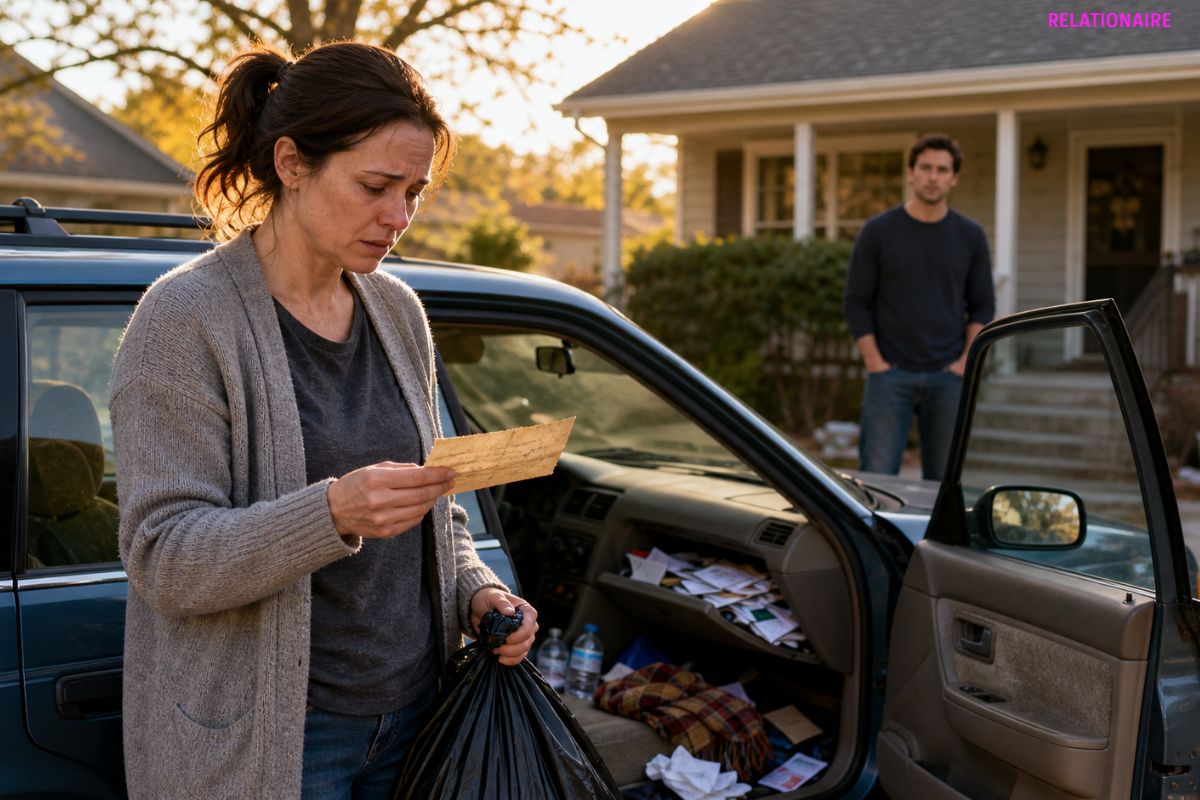
So I stood in my parents’ driveway with a black garbage bag in one hand and my mother’s old key ring in the other, staring at the blue station wagon she had driven for almost sixteen years.
The car still smelled like her.
Lavender hand lotion.
Peppermint gum.
Drive-thru coffee.
And underneath all of that, the faint dusty smell of paper she refused to throw away.
My younger brother, Caleb, leaned against the porch railing with his arms folded.
“You don’t have to do it today,” he said.
“Yes, I do.”
“Rachel.”
“What?”
“You buried Mom yesterday.”
I opened the driver’s side door and the little overhead light flickered on.
There were receipts stuffed into the door pocket. Church bulletins under the floor mat. A faded fast-food napkin with a grocery list written on it. Three empty water bottles. A scarf she had been looking for last winter.
I pulled the scarf out and felt something twist inside me.
Then I shoved it into a donation box.
“She lived like this,” I said, sharper than I meant to. “Like everything could just pile up forever and someone else would deal with it.”
Caleb looked at me, but he didn’t answer.
That was another thing about my family.
We were good at not answering.
My mother, Marianne, had been loved by almost everyone who met her. She remembered birthdays, brought casseroles, clipped coupons for people who never asked, and kept a plastic container of peppermints in her purse for children at church.
But at home, she was chaos.
Bills tucked behind the toaster. Laundry folded but never put away. Half-finished cups of tea on every windowsill. A freezer full of food with no labels. Notes taped to cabinets. Notes inside cabinets. Notes that said things like, “Don’t forget the thing,” as if anyone else could possibly know what the thing was.
Dad used to laugh about it when we were kids.
“Your mother’s brain is a snow globe,” he’d say. “Beautiful, but don’t shake it.”
After Dad died five years ago, nobody laughed as much.
Mom got worse after that. Or maybe I noticed it more because I became the one who had to help.
I helped with insurance paperwork.
Doctor appointments.
The leaking roof.
The property taxes she pretended she had under control.
I loved her. Of course I loved her.
But by the end, I was tired.
Tired of being the daughter who handled things.
Tired of her saying, “I didn’t want to bother you,” right after the problem became too big to ignore.
Tired of loving someone who made me feel guilty for being exhausted.
So I cleaned the car like I was punishing it.
I tossed old receipts. Cracked sunglasses. A packet of tissues. A grocery loyalty card that had expired years earlier. A little blue mitten, though none of the grandchildren had worn mittens that small in a long time.
Then I found the lunch bag.
It was wedged behind the passenger seat, folded flat, the fabric stained with something orange. Soup maybe. Or spaghetti sauce.
“Oh, Mom,” I whispered.
Caleb stepped closer.
“What is it?”
“Just another bag.”
I unzipped it and found a plastic spoon, two wrapped crackers, and a tiny container with three heart-shaped candies inside.
My throat tightened before I could stop it.
Mom used to pack things like that for my daughter, Lily.
Not a proper lunch. Not anything Pinterest-worthy. Just little things. Crackers. A note. A peppermint. A sticker from a sheet she kept in the junk drawer.
Lily used to love it.
I used to roll my eyes.
“Sugar before dinner, Mom?”
“She smiled, didn’t she?” Mom would say.
That was always her defense.
“She smiled.”
I threw away the spoon and crackers. I kept the little candy container without telling Caleb.
By then the sun had moved behind the maple tree and the driveway was striped with shadows. The house looked too quiet behind us. No kitchen light. No curtain moving. No mother standing at the sink, pretending she hadn’t been watching for us to arrive.
I moved to the front seat and opened the glove box.
It fell open with a tired little groan.
Papers slid out.
The owner’s manual.
Insurance cards.
More receipts.
A church directory from three years ago.
A folded map, though she hadn’t taken a trip without GPS in forever.
And then, at the very back, tucked behind a stack of napkins, I saw a recipe card.
Yellowed.
Stained.
Soft at the corners from being handled too many times.
I almost threw it straight into the bag.
It was exactly the kind of thing my mother saved. A scrap she probably meant to put somewhere else. Something she’d swear was important if you asked her, then forget where she put it five minutes later.
But when I pulled it out, I recognized the handwriting.
Not hers.
My grandmother’s.
The front said:
Chicken and Rice for Rainy Days
I stared at it.
My grandmother had died when I was twelve, but I still remembered that meal. Creamy rice. Soft carrots. Chicken that fell apart when you touched it with a fork. The smell of it filling the house on sick days, snow days, hard days.
Mom made it whenever someone was having a bad week.
She made it when I didn’t get into the college I wanted.
When Caleb broke his wrist.
When Dad lost his job for two months.
When Lily had pneumonia and I was too scared to sleep.
I turned the card over.
There was no recipe on the back.
Just a list.
Dates.
Names.
Mileage.
At first, I thought it was grocery tracking. Or maybe something for taxes. Mom had once tried to deduct the miles she drove for a church bake sale and kept records on the back of an envelope for two whole days before giving up.
I squinted at the first line.
Jan. 14 — Rachel — 18 miles
The next:
Feb. 2 — Caleb — 42 miles
Then:
Mar. 9 — Aunt June — 31 miles
My mouth went dry.
I kept reading.
Apr. 16 — Rachel — 18 miles — medicine
May 1 — Lily — 18 miles — fever
June 22 — Caleb — 42 miles — porch light on
Porch light on?
I looked up at my brother.
“What?” he asked.
I didn’t answer.
I kept reading down the card.
The dates stretched across years.
Some were smudged.
Some had tiny notes beside them.
Left soup.
Dropped inhaler.
Sat in drive.
No answer.
Heard baby crying.
Didn’t knock.
My fingers started to tremble.
Caleb came around the car door.
“Rachel?”
I held out the card.
He took it, read the first few lines, and his face changed.
Not dramatically.
Just enough.
Like someone had touched a bruise he forgot was there.
“What is this?” he said quietly.
“I don’t know.”
But that wasn’t true.
Some part of me already knew.
I thought about all those nights when I was newly divorced and too proud to ask for help.
The nights Lily was sick.
The nights I ignored Mom’s calls because I couldn’t handle her asking if I was eating, sleeping, managing, breathing.
The nights I opened my front door in the morning and found soup on the porch in an old butter container.
I always thought Caleb had brought it.
Caleb stared at the card, then whispered, “Rachel.”
“What?”
He pointed to the last line.
The ink there was darker. Newer.
Just two weeks before Mom went into the hospital.
Oct. 3 — Rachel — 18 miles — tell her someday
I stopped breathing.
Then, from behind us, the screen door opened.
Aunt June stepped onto the porch with Mom’s old cardigan wrapped around her shoulders.
She looked at the recipe card in my hand.
And before I could ask, her eyes filled.
“She never wanted you children to know,” Aunt June said.
PART 2
Aunt June came down the porch steps slowly, one hand on the railing, the other pressed against the cardigan like she was holding herself together.
Caleb and I stood beside Mom’s car like children caught touching something we weren’t supposed to see.
“What do you mean she didn’t want us to know?” I asked.
Aunt June looked at the recipe card but did not reach for it.
“That she came.”
“Came where?”
“To you. To Caleb. To me. To anyone who needed her.”
Caleb gave a short, confused laugh with no humor in it.
“Mom told us when she visited.”
“No,” Aunt June said softly. “She told you when she was invited.”
The driveway went quiet.
Somewhere down the street, a lawn mower started. A normal sound. A living sound. It felt wrong in the middle of that moment.
I looked back at the card.
Sat in drive.
No answer.
Didn’t knock.
My chest tightened.
Aunt June folded her arms.
“After your father died, your mother got afraid of being too much.”
I almost snapped, “She was too much.”
But I didn’t.
Because Aunt June’s face had that look older women get when they are about to tell you something they have carried longer than they should have.
“She knew you were tired, Rachel,” she said. “You were working full time. Raising Lily. Handling the divorce. Trying not to fall apart in front of anybody.”
I swallowed.
“She called constantly.”
“She called because she didn’t know how else to stand beside you.”
I looked away.
That landed too close.
There had been a winter after my divorce when I hated the sound of the phone. Every ring felt like a question I didn’t have the strength to answer.
Did you eat?
Did Lily sleep?
Did he send the support check?
Do you need groceries?
Can I come by?
I knew Mom meant well.
But I was thirty-eight years old, newly single, broke in ways I hid from everyone, and terrified that if my mother saw the inside of my apartment, she would know how badly I was failing.
So I pushed her away.
“I’m fine, Mom.”
“We’re okay.”
“Please don’t come over tonight.”
“I just need space.”
The word space became a wall.
I built it.
And she respected it so completely that it never occurred to me she might still be standing on the other side.
Aunt June touched the hood of the car.
“She would cook after supper, pack things in whatever containers she had, and drive over late. Sometimes after ten. Sometimes near midnight.”
“No,” I said.
It came out small.
Aunt June nodded.
“She said if you saw her, you’d feel watched. Or pitied. She didn’t want that. So she’d leave things where you’d find them.”
I thought of the porch.
The old wicker chair by my apartment door.
The mornings when I found a bag there with no note. Soup. Cold medicine. Children’s Tylenol. A carton of eggs. Once, a pair of pink gloves for Lily, still attached to the cardboard tag.
I had blamed Caleb.
I had even texted him once: You can’t keep leaving stuff without telling me.
He replied: Wasn’t me.
I thought he was lying to protect my pride.
Now he was staring at the card with his jaw tight.
“What about me?” he asked.
Aunt June looked at him.
“You were angry then.”
“I know what I was.”
His voice had an edge.
Caleb had been twenty-six when Dad died. He fell apart in a quieter, messier way than I did. He stopped coming to Sunday dinner. Stopped answering texts. Lost one job, then another. Grew a beard he didn’t trim. Let his mailbox overflow until Mom drove over and took the bills out herself.
They fought constantly.
I remembered one Thanksgiving when he yelled, “You can’t fix everything with food,” and Mom had gone into the bathroom and stayed there for twenty minutes.
I judged him for that.
I judged him so hard I never asked what he was really saying.
Aunt June’s voice softened.
“She drove to your place more than anyone’s.”
Caleb looked down.
“Why?”
“Because your porch light was how she checked if you were home.”
His face changed again.
The card shook slightly in his hand.
“Porch light on,” he read.
Aunt June nodded. “She said if your porch light was on, you were still awake. If it was off, she’d leave food in the cooler and go.”
“What cooler?”
Aunt June hesitated.
“The little red one behind your back steps.”
Caleb covered his mouth with his hand.
I remembered that cooler.
I had seen it once when I dropped off papers for him. Dirty, faded, sitting behind a stack of paint cans. I thought it was junk.
Of course I thought it was junk.
That was what I did with things I didn’t understand.
I named them junk.
Aunt June went on.
“She brought you chicken and rice. Cough drops. Work gloves one winter because your hands were cracked. She brought you a flashlight when that storm knocked the power out.”
Caleb turned away.
For a long second, all I could see was his back. Broad shoulders under an old gray T-shirt. A grown man standing in our childhood driveway, undone by a red cooler he had never asked about.
“She never said anything,” he whispered.
“She promised herself she wouldn’t make you feel ashamed.”
“And the recipe card?” I asked.
Aunt June looked at me.
“That was her way of remembering where love had gone.”
The sentence hit so gently that it hurt.
I looked at the front of the card again.
Chicken and Rice for Rainy Days
Grandma’s handwriting.
Mom’s notes.
A map of every quiet mile she drove when we believed she was at home, cluttering her kitchen, worrying too much, leaving too many voicemails.
I had spent years thinking my mother didn’t understand boundaries.
But maybe she understood them better than I did.
Maybe she stood just outside them, holding soup in the dark.
Aunt June took a breath.
“There’s more.”
I looked up.
“What do you mean?”
She pointed toward the back seat.
“Check under the spare blanket.”
The blanket was still folded across the seat. Brown fleece. Worn thin in the middle. Mom kept it there “in case someone got cold,” which used to annoy me because the car always looked like a traveling closet.
I opened the back door and pulled it aside.
Underneath sat a cardboard box.
A shoebox, really.
The lid was held on with a rubber band.
My name was written across the top.
Not Rachel.
Not Rach.
For my girl, when she stops being mad long enough to look.
I almost laughed.
Then I almost cried.
Caleb leaned in, his voice rough.
“There’s one for me too.”
There was.
Behind mine, tucked against the seat, another shoebox with his name on it.
Aunt June wiped her cheek with the heel of her hand.
“She made those after the diagnosis.”
The word dropped between us.
Diagnosis.
We had known Mom was sick at the end. Everyone knew that. But it had felt sudden. Too sudden. One hospital visit became another. One test became a quiet doctor with kind eyes. Six weeks later, she was gone.
“What diagnosis?” I asked.
Aunt June did not answer right away.
And that silence told me everything I didn’t want to know.
Caleb turned toward her.
“How long did she know?”
Aunt June’s mouth trembled.
“Longer than she told you.”
My knees felt weak.
“No.”
“She didn’t want to become one more thing you had to carry.”
I stared at the shoebox with my name on it.
All the anger I had been using to keep myself upright started to crack.
The missed calls.
The “I’m fine, sweetheart.”
The sudden insistence that she didn’t need anyone to take her to appointments.
The way she had hugged Lily too long the last time we visited.
The way she watched me leave from the kitchen window.
I had thought she was being dramatic.
I had thought she was lonely.
I had thought I had time.
Aunt June reached into her cardigan pocket and pulled out a small brass key.
“She asked me to give you this when you found the card.”
“What does it open?” Caleb asked.
Aunt June looked toward the car.
“The lockbox in the trunk.”
My hands were numb as I took the key.
I walked to the back of the station wagon. The driveway seemed longer than it had a minute ago. The whole world seemed to be holding its breath.
When I lifted the hatch, the smell of old blanket and motor oil rose into the air.
There, beside the emergency kit, was a small gray lockbox.
I fit the key into the lock.
For one second, I couldn’t turn it.
Because I knew, somehow, that once I opened it, I would never be able to go back to the version of my mother I had been angry with.
Caleb stood beside me.
Aunt June stood behind us.
And then I turned the key.
PART 3
Inside the lockbox were envelopes.
Not money.
Not legal papers.
Not some dramatic secret that would explain everything in one clean sentence.
Just envelopes.
Three for me.
Two for Caleb.
One for Lily.
One for Aunt June.
And one with all our names written together.
My mother’s handwriting was uneven, heavier in some places, as if her hand had gotten tired.
I picked up the envelope with my name on it.
For a moment, I could not open it.
I had wanted answers.
Then I had answers in my hand, and all I wanted was five more minutes of not knowing.
Caleb sat on the edge of the trunk, his shoulders folded inward. Aunt June lowered herself into one of the porch chairs. Nobody spoke.
Finally, I tore the envelope carefully along the top.
Inside was one sheet of notebook paper.
My mother had written in blue ink.
My Rachel,
If you are reading this, then you found my rainy day recipe. I know you probably rolled your eyes at the mess first. That is okay. I earned some of those eye rolls.
A laugh broke out of me, sudden and wet.
Caleb looked over.
I kept reading.
I wanted to tell you so many times. I wanted to knock on your door with soup and medicine and say, “Please let me help.” But you were working so hard to stand on your own two feet, and I remembered what that felt like.
When your father and I were first married, I thought needing help meant I was failing. Your grandmother never argued with me. She just left food on the porch and went home. I didn’t understand it then. I do now.
I pressed the page to my chest for a second.
The driveway blurred.
You were never failing, Rachel. You were tired. There is a difference.
That sentence almost took me down.
Because nobody had said it to me that plainly.
Not then.
Not when I was counting dollars at the grocery store and putting back strawberries because Lily needed cough syrup.
Not when I ate toast for dinner and told my daughter I wasn’t hungry.
Not when I sat in the bathroom with the shower running so she wouldn’t hear me cry.
You were tired.
There is a difference.
I wiped my face and kept reading.
I drove over because I needed to know you had something warm in the house. I drove over because Lily’s window light was on and I could see her little shadow moving around, and it made me feel useful in a world where I could not fix your pain.
I did not knock because love should not always ask for credit. Sometimes love should just leave the bag and go.
I looked toward the porch.
For years, I had thought my mother wanted to be needed.
Maybe she did.
But maybe she also wanted us to feel less alone without feeling less capable.
The letter went on.
I am sorry I did not tell you about being sick sooner. That may have been wrong. I was scared. Not of dying, though I was not exactly thrilled about that part. I was scared of becoming a weight in your hands. You already carried so much.
I closed my eyes.
“Oh, Mom,” I whispered.
There it was again.
Her old mistake.
The same one I made.
Trying to protect someone by hiding the thing that would hurt them more later.
Caleb opened one of his envelopes beside me.
I heard him inhale sharply.
Then his face crumpled.
Not loudly.
Not dramatically.
Just a grown son reading words from the mother he had thought he pushed away too many times.
“What did she say?” I asked gently.
He shook his head at first.
Then he read aloud, voice breaking.
My Caleb, I knew you turned the porch light on for me.
He stopped.
I stared at him.
“You did?”
He covered his eyes with the letter.
“I thought if it was on, she’d know I was still here.”
Aunt June made a small sound from the porch.
Caleb kept reading, barely able to get the words out.
You thought I was checking on you. I was. But you were checking on me too. Every time I saw that light, I drove home less afraid.
I thought of all those years we believed we were separate in our grief.
Me in my apartment.
Caleb in his little rented house.
Mom in the station wagon, driving through dark streets with containers of chicken and rice on the passenger seat.
All of us trying not to need each other.
All of us leaving lights on anyway.
The envelope for Lily was next.
She was twelve, old enough to understand death in pieces but young enough to keep forgetting and remembering all over again.
When I called her outside, she came slowly, wearing one of Mom’s old sweatshirts. It hung past her hands.
“What is it?” she asked.
I handed her the envelope.
She sat cross-legged in the driveway to read it because grief had made rules seem unimportant.
Halfway through, she smiled.
Then she cried.
Then she smiled again.
“She said she put candy in the lunch bag because you always said no,” Lily whispered.
I laughed through tears.
“I did.”
“She said grandmas are allowed to be a little sneaky.”
“That sounds like her.”
Lily turned the page over.
At the bottom, Mom had drawn a tiny heart with steam rising from it.
Underneath she wrote:
When your mama gets too quiet, make her soup. She forgets she deserves warm things too.
That was the line that undid me.
Not the illness.
Not the miles.
Not even the recipe card.
That line.
Because my mother knew me.
Even when I thought she didn’t.
Even when I reduced her to clutter and missed calls and too many questions.
She knew I got quiet when I was hurting.
She knew I fed everyone but myself.
She knew love sometimes had to be handed down like a recipe because people like us did not always know how to ask for it.
That night, we went inside and made the chicken and rice.
Not because we were hungry.
Because we didn’t know what else to do with all that love.
Aunt June sat at the kitchen table and peeled carrots with shaking hands. Caleb chopped onions too large. Lily stirred the pot like it was something sacred.
I found Mom’s old blue apron hanging behind the pantry door.
For once, I did not complain that she had kept too much.
I put it on.
In the pocket was a peppermint.
Of course there was.
While the rice cooked, Caleb went out to his truck and came back with a faded red cooler.
He set it by the back door.
None of us said anything for a while.
Then Lily walked over, placed her hand on top of it, and whispered, “Thank you, Grandma.”
The soup was too thick.
The carrots were uneven.
The kitchen smelled exactly like my childhood.
When we sat down to eat, there were only four of us at the table, but for the first time since the funeral, the house did not feel empty.
After dinner, I took the recipe card and put it in a frame.
Not the front.
The back.
The dates.
The miles.
The proof.
Years later, people would ask me why I framed a stained old card covered in numbers. They would expect a funny answer, maybe something about my mother’s clutter finally becoming useful.
I always told them the truth.
“That was my mother’s love letter.”
And it was.
Not written in pretty words.
Written in gasoline.
Midnight roads.
Porch lights.
Soup containers.
Medicine bottles.
A grandmother’s recipe carried from one generation to the next.
My mother did not love perfectly. None of us do.
She hid too much. Worried too much. Saved too much. Waited too long to tell us the hardest truth.
But she also drove eighteen miles in the dark because her daughter had a sick child and too much pride.
She drove forty-two miles because her son’s porch light was on and she needed to know he was still fighting his way through another night.
She drove to Aunt June with soup when arthritis made her hands ache.
She came close enough to help, but far enough away to let us keep our dignity.
That is the part I think about most now.
How many times love arrives quietly.
How often it looks like clutter until grief teaches you how to read it.
Sometimes the people who love us best do not make speeches.
Sometimes they just leave something warm at the door and drive home in the dark.