If you’ve already read part 1 of this story on Facebook, go here for Part 2!
The day Mason begged his father to stop walking him to class, he didn’t whisper it.
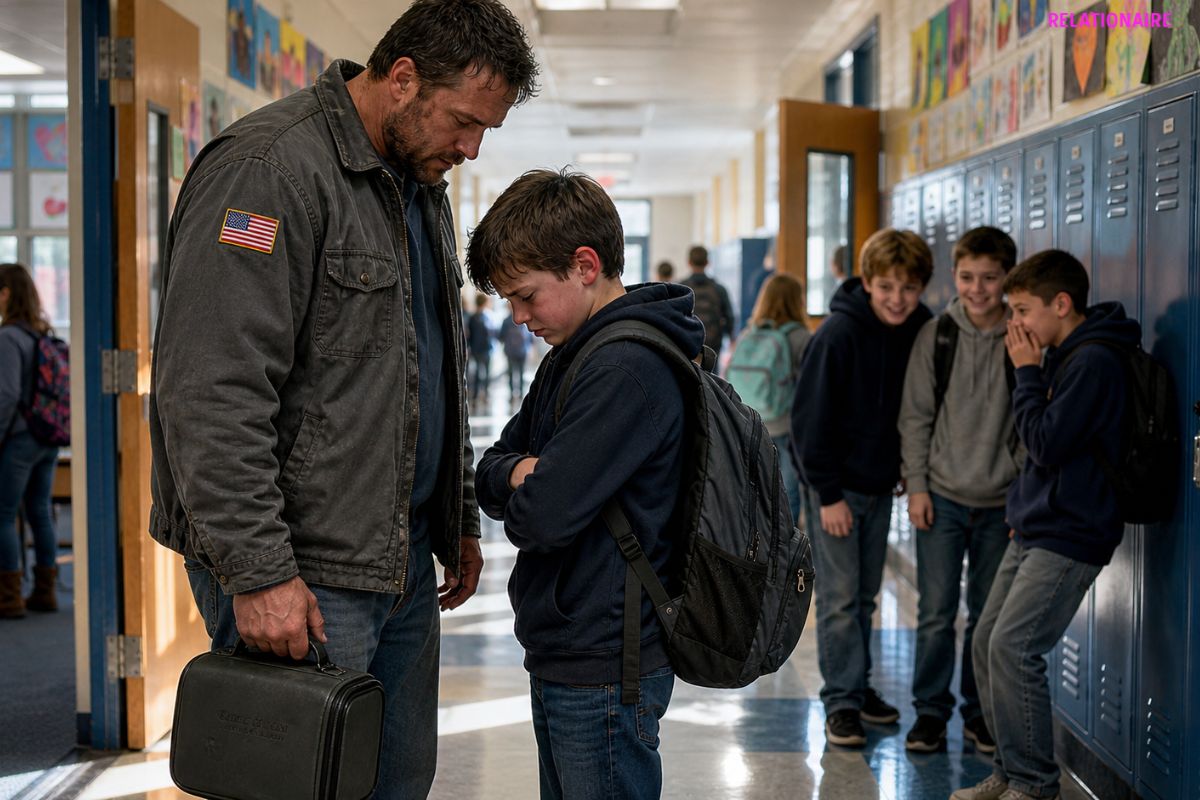
He said it in front of three boys from his fourth-grade class, with his backpack slipping off one shoulder and his ears turning red.
“Dad, please. Just stop.”
Tom froze with one hand still on Mason’s lunchbox.
The school hallway smelled like floor cleaner, pencil shavings, and breakfast pizza from the cafeteria. Kids moved around them in a loud, sticky stream, sneakers squeaking, jackets unzipping, voices bouncing off the walls.
Mason saw the boys watching.
One of them, Dylan, smirked.
“Your dad still walks you in?” he said. “What are you, kindergarten?”
The other boys laughed.
It wasn’t the loudest laugh in the world. It wasn’t cruel enough for a teacher to notice.
But to Mason, it felt like someone had peeled his skin back.
Tom looked at the boys first, then at his son.
He was still in his work boots, still wearing the faded gray jacket he wore every morning. The one with the frayed cuff and the tiny American flag patch near the shoulder. His beard was trimmed unevenly because he always shaved in a hurry. There was coffee on his sleeve.
He looked tired.
He always looked tired.
“Mase,” he said quietly, “I’m just making sure you get to—”
“I know where my class is,” Mason snapped.
A few kids turned.
Tom’s mouth closed.
Mason hated himself a little the second he said it. But the boys were still there. Their laughter was still in his ears. And every morning felt the same.
His dad parked the old blue pickup by the curb.
His dad got out.
His dad walked beside him through the front doors, past the office, past the mural with all the handprints, past the trophy case, and all the way to Room 14.
Sometimes he even waited until Mason sat down.
Not near the door.
Not in the hallway.
Right there, where everyone could see.
Mason was ten years old. He could multiply by nines. He could microwave pizza rolls. He could ride his bike around the block. He didn’t need his father standing outside his classroom like he might disappear between the coat hooks and the spelling board.
That morning, Mrs. Keller looked up from her desk.
“Good morning, Mason. Morning, Mr. Reed.”
Tom nodded, but he didn’t step inside.
Mason could feel him standing behind him.
“Dad,” he said, lower this time. “Go.”
The word landed harder than he meant it to.
Tom’s fingers tightened around the lunchbox handle before he gave it over.
For one second, Mason saw something cross his father’s face.
Not anger.
Something worse.
Hurt, maybe.
Or fear.
Then it was gone.
Tom bent slightly and said, “Okay.”
Just that.
Okay.
No lecture. No angry look. No “watch your tone.” No “after everything I do for you.”
He handed Mason the lunchbox, touched two fingers to the top of his son’s backpack like he always did, then turned around and walked back into the hallway.
The boys near the lockers snickered again.
Mason stared at the floor until his shoes stopped feeling like they belonged to him.
That afternoon, when the bell rang, Mason expected his father to be waiting by the classroom door like usual.
He wasn’t.
For half a second, Mason felt relieved.
Then strange.
He walked with the rest of the kids toward the front entrance. Everybody pushed and laughed and yelled about soccer practice and snacks and whose mom was late again. Mason stepped outside into the bright September sun and scanned the curb.
The blue pickup was there.
His dad was behind the wheel.
He didn’t get out.
He didn’t wave with both hands the embarrassing way he sometimes did.
He just lifted one hand from the steering wheel, small and careful, like he was trying not to make Mason mad.
Mason walked to the truck slowly.
When he climbed in, the cab smelled like old coffee, mint gum, and the sawdust that clung to his dad’s work clothes.
Tom looked straight ahead.
“How was school?”
“Fine.”
“Good.”
They drove home with the radio low.
Mason should have felt better.
He had won.
The next morning, Tom stopped at the curb.
“You’re good from here?” he asked.
Mason kept his eyes on the school doors.
“Yeah.”
Tom nodded. “Okay.”
Mason opened the door.
Before he got out, his dad said, “Hey.”
Mason looked back, already worried someone might see.
Tom’s face was soft in a way that annoyed him.
“Have a good day, bud.”
Mason mumbled, “You too,” and hurried away.
Nobody laughed that morning.
Nobody said baby.
Dylan was too busy trying to balance a soccer ball on one foot by the bike rack. Mason walked through the front doors alone, and for the first time in months, he felt like everyone else.
For about two days, it felt great.
Then he noticed something.
On Wednesday, he forgot his math folder in the truck.
He realized it halfway down the hallway and turned back, annoyed because Mrs. Keller always made them clip missing work notes to their planners.
He ran outside.
The blue pickup was still parked by the curb.
That was weird.
The bell had rung almost ten minutes ago.
His dad should have been halfway to the job site by now.
Mason jogged to the passenger window and knocked.
Tom startled so hard his hand hit the steering wheel.
Mason flinched.
His dad rolled down the window.
“What’s wrong?” Tom asked immediately. “Are you okay?”
“I forgot my folder,” Mason said.
Tom reached over fast, grabbed it from the seat, and handed it to him.
His hand was shaking.
Not a lot.
But enough.
Mason stared.
“Dad?”
Tom pulled his hand back and tucked it under his other arm like it was cold outside.
“You better get in there,” he said. “Bell rang.”
“Why are you still here?”
Tom looked toward the school entrance.
There were no kids left outside now. Just the crossing guard folding up her sign and a teacher carrying a stack of orange cones.
“Had to answer a message,” he said.
But Mason saw his phone sitting dark in the cup holder.
At dinner that night, his father barely ate.
Mason’s mom had died when he was six, and meals at their house had gotten simple after that. Eggs and toast. Soup from a can. Chicken nuggets when Tom worked late. That night, they had spaghetti, and Tom kept twisting the noodles around his fork without lifting it.
Mason wanted to ask why he’d stayed outside the school.
But he didn’t.
He was afraid the answer would be something embarrassing.
Like his dad didn’t trust him.
Or worse, that his dad thought Mason was too little to walk himself inside even after promising he wouldn’t.
So Mason started watching.
Thursday, he looked back through the glass doors after he went in.
The pickup was still there.
Friday, he asked to use the bathroom after morning announcements and peeked through the hallway window.
Still there.
Monday, Mason waited until everyone was in class, then asked Mrs. Keller if he could take the attendance folder to the office.
He didn’t go to the office.
He went to the front window.
The blue pickup sat at the curb with its engine off.
His father was inside, both hands on the steering wheel, staring at the school doors like he was waiting for something terrible to come out.
That night, Mason felt angry in a way he couldn’t explain.
He had asked for one thing.
One thing.
To be treated like a normal kid.
But his dad had just moved the watching outside, where nobody could see him.
The next morning, Mason climbed into the truck and didn’t say good morning.
Tom noticed.
He always noticed.
“You sleep okay?”
“Why do you stay?” Mason asked.
Tom’s eyes flicked toward him.
“At school.”
The truck rolled to a stop at a red light.
Tom’s jaw moved once, like he was chewing words instead of saying them.
“I don’t stay long.”
“Yes, you do.”
The light turned green. Someone honked behind them.
Tom drove.
Mason stared at the side of his father’s face.
“You said you’d stop.”
“I did stop walking you in.”
“That’s not what I mean.”
Tom pulled up to the curb in front of the school. Kids were spilling out of minivans, dragging backpacks, calling to friends.
Mason’s chest felt hot.
“You’re still watching me like I’m a baby.”
Tom closed his eyes for just a second.
When he opened them, Mason expected him to get mad.
Instead, his father whispered, “I know.”
Mason blinked.
Tom reached into the glove box.
He didn’t pull out a permission slip, or gum, or the old napkins he kept stuffed in there.
He pulled out a small yellow envelope.
It was bent at the corners.
Mason’s name was written across the front in his dad’s handwriting.
MASON — WHEN YOU’RE OLD ENOUGH TO ASK
Tom held it like it weighed more than paper.
Then he said the one sentence that made Mason forget every kid standing outside that school.
“You weren’t supposed to remember the day I lost you.”
PART 2
Mason did not take the envelope.
He just sat there with his backpack on his lap, staring at his father.
The school bell rang somewhere behind them.
Kids hurried past the truck. Doors slammed. A teacher called out, “Let’s go, friends!”
But inside the cab, everything felt muffled.
Like the whole world had stepped into another room.
“What do you mean lost me?” Mason asked.
Tom’s fingers curled around the envelope.
He looked older than he had five minutes earlier.
Not tired.
Older.
“Mason,” he said, “you need to go inside.”
“No.”
His father looked at the school building, then back at him.
It was the first time Mason could remember saying no to his father and not being corrected for it.
Tom leaned back in his seat.
The morning sun hit the windshield and showed every scratch in the glass.
“You were five,” he said.
Mason swallowed.
Five was blurry.
Five was cartoons on the couch and dinosaur pajamas. Five was his mother’s laugh in the kitchen before she got sick. Five was a red balloon from somewhere. Five was not something he thought about much because after six, everything in their house changed.
“We went to the mall,” Tom said.
Mason looked down at the envelope.
Something moved inside him.
A tiny door opening.
“Mom was still alive?”
Tom nodded, but his face tightened.
“She was at a doctor’s appointment that day. She wanted to come with us, but she was tired. I told her I could handle one afternoon with my son.”
He tried to smile.
It didn’t stay.
“It was December. Crowded. Loud. There was a line for Santa downstairs, music playing, people everywhere. You kept asking for a pretzel.”
Mason remembered cinnamon sugar.
Not the mall.
Just the smell of it.
Tom rubbed one thumb over the steering wheel.
“I turned around to pay. Two seconds. Maybe three.”
His voice changed.
It got smaller.
“When I looked back, you were gone.”
Mason’s breath stopped halfway in his chest.
Tom kept his eyes on the dashboard.
“I thought you were behind me. Then under the table. Then by the window. Then I started calling your name.”
He laughed once, but there was no humor in it.
“I remember people staring at me like I was being dramatic.”
Mason could see it, even though he didn’t want to.
His dad younger, less gray in his beard, wearing that same old jacket maybe. Turning in circles with a paper cup of coffee in one hand and a little boy nowhere.
“How long?” Mason asked.
Tom’s mouth pressed shut.
“How long was I gone?”
“Twenty-two minutes.”
It did not sound like much.
It sounded like recess.
It sounded like one cartoon.
But Tom said it like twenty-two minutes was an entire lifetime he had been forced to live through.
“They shut the doors,” Tom said. “Security came. A woman from a store held my arm because I kept running in the wrong direction. I called your mom, then hung up before she answered because I didn’t know how to say it.”
Mason’s hands had gone cold.
“What happened?”
“They found you in the parking garage.”
Mason looked up fast.
“You walked outside?”
Tom shook his head.
“A man had taken your hand.”
The air in the truck disappeared.
Tom saw Mason’s face and quickly added, “He told you he was helping you find me. That’s all we know. A security guard saw you crying near the elevator and stopped him.”
Mason felt sick.
Not because he remembered it clearly.
Because he didn’t.
That somehow made it worse.
“I don’t remember,” he whispered.
“I know.”
“Why don’t I remember?”
“You had nightmares for a while,” Tom said. “Then they stopped. Your mom said maybe that was mercy.”
At the word mom, both of them went quiet.
A bus sighed at the curb behind them.
Mason stared at the envelope again.
“What’s in there?”
Tom looked at it like he had forgotten he was holding it.
“Things from that day. The security report. A picture your mom took that night. A note she wrote.”
Mason’s throat tightened.
“Mom wrote me a note?”
Tom nodded.
“She wrote both of us one.”
“Why didn’t you tell me?”
That came out louder.
Tom flinched.
Not because Mason scared him.
Because the question had hit the place he already hurt.
“I wanted you to have a childhood that wasn’t built around my fear,” he said.
Mason looked toward the school doors.
A childhood.
He thought of all the mornings he had rolled his eyes.
All the times he had said, “Dad, stop.”
All the times his father had reached for his backpack strap in a parking lot and Mason had jerked away.
“You made everyone think I was weird,” Mason said, but the anger had lost its teeth.
Tom nodded slowly.
“I know.”
“You made me feel like you didn’t trust me.”
“I know.”
“You promised.”
“I know, Mason.”
The third “I know” broke something.
Because Tom wasn’t arguing.
He wasn’t defending himself.
He was taking every word like he believed Mason had the right to say it.
A knock came on the driver’s window.
Mason jumped.
Mrs. Keller stood outside, smiling gently but looking concerned.
Tom rolled the window down.
“Everything okay?”
Mason opened his mouth, but no sound came.
Tom folded the envelope and slid it into his jacket pocket.
“Yes, ma’am,” he said. “We’re sorry. Mason’s coming in now.”
Mrs. Keller looked at Mason.
“You need a minute?”
Mason almost said no.
He almost got out and pretended everything was fine.
But his legs felt strange.
He nodded.
Mrs. Keller’s face softened.
“I’ll mark you present. Take your time.”
She walked back toward the building.
Mason watched her go.
Then he said something he had not planned.
“Did Mom blame you?”
Tom closed his eyes.
There it was.
The question under all the other questions.
When Tom opened his eyes, they were wet.
“No,” he said. “That was the worst part.”
Mason didn’t understand.
Tom reached into his pocket and pulled out the envelope again. He did not open it.
“She held me in the hospital hallway after your nightmares started. I kept saying, ‘I looked away.’ Over and over. And she said, ‘Tom, all parents look away. We look at the stove, the receipt, the younger child, the phone, the road. Love is not staring every second. Love is coming back.’”
His voice cracked on the last word.
Mason looked down at his shoes.
His father never cried.
Not when Mom died. Not at the funeral. Not when he came home from work with his hand bandaged. Not when the sink pipe burst and soaked the kitchen floor.
Or maybe he had.
Maybe Mason had just not been old enough to notice the places adults hide their breaking.
Tom wiped his face with the heel of his hand.
“After she passed, I got worse,” he admitted. “I’d sit outside your preschool. Then kindergarten. Then elementary. I told myself I was making sure you were safe. But part of me was still standing in that mall.”
Mason pictured his dad in the parking lot.
Not watching like a guard.
Waiting like a man who had once turned around and found the world empty.
The anger inside Mason shifted.
It did not vanish.
It became something heavier.
“Why didn’t you get help?” Mason asked.
Tom nodded like he deserved that too.
“I did. Some. At the veterans’ center. Then I stopped when your mom got sicker. Then after she died, I told myself I didn’t have time to fall apart.”
Mason thought of the old gray jacket.
The coffee.
The work boots.
The spaghetti untouched.
The truck parked long after the bell.
He thought of himself saying, “Go,” in front of everyone.
“I hated it,” Mason whispered.
Tom nodded.
“I hated needing to do it.”
That sentence sat between them.
Small.
Honest.
Ugly in a human way.
Mason looked at the envelope.
“Can I read it?”
Tom’s hand tightened.
“For a long time, I thought I’d give it to you when you were eighteen,” he said. “Then sixteen. Then when you asked. Your mom wrote that on the front.”
Mason reached for it.
This time, Tom let him take it.
The envelope felt soft from being handled too much.
Mason ran his thumb over his name.
His mother had been gone four years, but sometimes he still expected her handwriting to appear on grocery lists or birthday cards.
This was not her handwriting on the outside.
But inside, maybe.
Inside was her voice from before everything changed.
Mason started to open the flap.
Then Tom gently covered his hand.
“Not here,” he said.
Mason looked up.
His father’s face was pale.
“I want you to read it,” Tom said. “I do. But not in the truck while I’m blocking the school drop-off line with my hands shaking.”
For the first time that morning, Mason almost smiled.
Just a little.
Tom breathed out, half-laughing and half-breaking.
“How about tonight? Kitchen table. We’ll read it together.”
Mason held the envelope to his chest.
He nodded.
At school that day, everything looked too normal.
Fractions on the board.
A spelling test.
Dylan kicking Mason’s chair and whispering, “You late because your daddy had to kiss you goodbye?”
Mason turned around.
He wanted to say something mean.
Instead, he looked at Dylan’s face and suddenly wondered what scared his parents.
That was new.
At lunch, Mason didn’t eat his sandwich.
He opened his backpack and looked at the envelope tucked between his math folder and library book.
MASON — WHEN YOU’RE OLD ENOUGH TO ASK
He wanted to open it so badly his fingers hurt.
But he didn’t.
For once, he understood that some promises were not rules.
They were bridges.
That afternoon, Tom was at the curb.
Still inside the truck.
Still trying.
Mason walked toward him with the envelope in his hand.
But before he could reach the passenger door, he saw something that made him stop.
His father wasn’t looking at him.
Tom had his phone pressed to his ear.
His other hand covered his eyes.
And through the cracked window, Mason heard his father say, “I think I need to come back to group. I scared my son today.”
PART 3
Mason stood beside the truck and did not open the door.
His father’s words slipped through the cracked window and landed quietly on the sidewalk.
“I don’t want him to grow up managing me,” Tom said into the phone. “He’s ten. He should be worried about homework and whether his sneakers are cool, not whether I can breathe after drop-off.”
Mason looked down at his sneakers.
They were not cool.
They were worn at the toes and one lace had been replaced with a different color because the old one snapped.
But suddenly they mattered less.
Tom listened to whoever was on the phone.
Then he said, “Yeah. Tonight if you have room.”
Mason stepped back a little before his father could see him.
He didn’t want Tom to know he had heard.
Not yet.
When Tom finally noticed him, he startled, but not as badly as before.
“Hey,” he said, trying to sound normal. “You ready?”
Mason climbed in.
The envelope sat on his lap the whole ride home.
Neither of them spoke.
Their house was small and rented, with a porch light that flickered when it rained and a kitchen table that had one wobbly leg. Mason’s mother had bought the table at a yard sale when Mason was three. She had painted the chairs yellow, then laughed when the paint stayed tacky for two days and stuck to everyone’s jeans.
Tom made grilled cheese for dinner.
He burned one side.
Mason ate it anyway.
Afterward, Tom wiped the table even though it was already clean. Then he took two glasses from the cabinet, filled them with water, and sat across from Mason like they were about to sign important papers.
The envelope lay between them.
For a minute, neither touched it.
“You don’t have to read it tonight,” Tom said.
Mason looked at him.
“Dad.”
Tom nodded.
“Okay.”
Mason opened the envelope slowly.
Inside was a folded security report, a photo, and a piece of notebook paper.
The photo came first.
Mason stared at it.
He was small in the picture, asleep on the couch in dinosaur pajamas, one cheek red and pressed into a pillow. His mother sat on the floor beside him, her back against the couch, holding his hand while he slept. Tom sat in a chair nearby, leaning forward with his elbows on his knees.
He looked wrecked.
Mason had never seen that version of his father.
His mother’s handwriting was on the back.
He came back to us.
Mason swallowed hard.
Tom turned his face toward the kitchen window.
“You can read the note out loud or to yourself,” he said.
Mason unfolded the paper.
The handwriting was a little slanted, with big loops in the Y’s. He remembered it from birthday cards tucked in a shoebox under his bed.
My sweet Mason,
If you are reading this one day, it means you are old enough to ask why your dad holds on so tight.
I hope by then he has learned to let go a little.
I hope you have learned that his fear is not your fault.
Today was the worst day of his life, even though it ended with you safe on our couch asking for chocolate milk.
Your dad keeps saying he failed you.
He did not.
He lost sight of you for a few minutes in a crowded place, the way tired parents sometimes lose sight of what matters because the world asks them to carry too many things at once.
Then he found you.
Or maybe God, luck, a security guard, and every prayer in my body found you.
But your dad has not forgiven himself.
So if he is still holding your backpack too long, or walking too close, or watching doors like they might steal you from him, please know this:
He is not trying to make you small.
He is trying to survive loving you.
Mason stopped reading.
His eyes burned.
Tom had one hand over his mouth.
Mason looked back down.
And Tom, if you are reading this too, listen to me.
Our son is not the mall.
Our son is not that parking garage.
Our son is not the twenty-two minutes you keep replaying in your head.
He is the boy who came back.
Let him grow.
Walk beside him while he needs you.
Then behind him.
Then from farther away.
But keep walking, Tom.
Just don’t make fear the only way he knows your love.
Mason pressed the paper flat with both hands.
There was one last line.
Love can hold on.
Love can also open its hand.
For a long time, the only sound in the kitchen was the refrigerator humming.
Then Tom broke.
Not loudly.
Not dramatically.
He just bent forward, covered his face, and cried like someone who had been standing for years and finally found a chair.
Mason had imagined grown men crying differently.
Bigger, maybe.
But his father cried quietly, shoulders shaking, trying not to make too much noise in his own kitchen.
Mason got up.
He didn’t know what to do at first.
Then he walked around the table and put his arms around his father’s neck.
Tom grabbed him so fast the chair scraped backward.
“I’m sorry,” Tom whispered into Mason’s shirt. “I’m sorry, buddy. I’m so sorry.”
Mason held him tighter.
“I’m not mad you were scared,” he said.
Tom pulled back and looked at him.
Mason wiped his nose with his sleeve.
“I’m mad you made me feel like I had to be scared too.”
Tom’s face crumpled again, but he nodded.
“You’re right.”
That mattered.
Not because it fixed everything.
Because it was the first brick in something new.
The next morning, Tom drove Mason to school.
The old blue pickup rattled at every stop sign.
The envelope was no longer in the glove box. It was in Mason’s desk drawer at home, under his baseball cards and the birthday cards his mother had signed before she died.
When they pulled up to the curb, Tom turned off the engine.
Mason looked at him.
Tom smiled weakly.
“Old habit.”
Then he started it again.
Mason almost laughed.
Almost.
Tom took a breath.
“I’m going to drive to work after you go in,” he said. “I might sit here for one minute. Maybe two. But I’m not staying.”
Mason nodded.
“And tonight,” Tom added, “I’m going to that group.”
“The one on the phone?”
Tom looked surprised.
Mason looked out the window.
“I heard.”
Tom didn’t get mad.
He just nodded.
“Yeah. That one.”
Mason opened the truck door.
The school looked the same as always. Brick building. Flag moving in the wind. Kids spilling toward the entrance with backpacks and breakfast bars and messy hair.
Dylan was near the bike rack.
He looked over.
Mason felt the old embarrassment rise up.
Then he felt something else beneath it.
The photo.
The note.
His mother’s words.
He turned back.
Tom was looking at him, trying very hard not to look like he was looking too hard.
Mason sighed.
Then he stepped back toward the truck.
Tom’s face tightened.
“What’s wrong?”
“Nothing.”
Mason leaned in through the open door.
He didn’t hug his dad.
Not fully.
There were limits in front of school.
But he squeezed Tom’s shoulder once.
A small thing.
Quick enough that nobody could make a whole joke out of it.
Tom went still.
“See you after school,” Mason said.
Tom’s eyes shone.
“See you after school, bud.”
Mason walked toward the entrance.
Halfway there, he turned around.
The pickup was still there.
Tom lifted one hand.
Mason lifted his back.
Then Tom put the truck in drive.
Mason watched it pull away from the curb.
Slowly.
Carefully.
Like leaving hurt.
Like leaving was love too.
Over the next few weeks, things did not become perfect.
Tom still checked the locks twice.
Sometimes three times.
He still reached for Mason’s hood in parking lots before stopping himself.
Sometimes he sat in the truck for one minute after drop-off.
Sometimes five.
But he always left.
And Mason started telling him things again.
Small things at first.
That Dylan cheated at kickball.
That Mrs. Keller’s coffee smelled weird.
That he wanted new sneakers but not the expensive ones because he knew money was tight.
Tom listened.
Really listened.
One Friday, Mason came home with a permission slip for a field trip to the science museum.
Tom stared at it too long.
Mason saw the fear arrive.
He saw his father’s thumb press into the paper.
Crowds.
Buses.
Doors.
A hundred ways to lose sight of a child.
Mason braced for no.
But Tom picked up a pen.
His hand shook.
He signed anyway.
Then he slid the paper back.
“You know my number,” he said.
Mason nodded.
“You stay with your group.”
“I know.”
“You listen to your teacher.”
“I know, Dad.”
Tom stopped himself.
Then he smiled, tired and brave.
“Have fun.”
On the day of the field trip, Mason carried the signed permission slip in his folder like it was proof of something.
Not that his dad wasn’t afraid.
That he loved Mason enough to fight the fear where Mason could see it.
At the museum, Mason bought a tiny keychain from the gift shop with his own saved allowance. It was shaped like a blue planet.
When Tom picked him up, Mason tossed it into his lap.
“For your keys,” he said.
Tom held it carefully.
“What’s this for?”
Mason shrugged, looking out the window.
“So you remember I come back.”
Tom didn’t answer right away.
He clipped the little planet onto his keyring with hands that trembled only a little.
Years later, Mason would forget most of fourth grade.
He would forget his spelling words, the lunch table arguments, even the names of the boys who laughed.
But he would remember the blue pickup pulling away from the curb.
He would remember his father signing that permission slip.
He would remember the note his mother left behind, teaching both of them that love is not only the hand that holds.
Sometimes love is the hand that shakes as it lets go.