If you’ve already read part 1 of this story on Facebook, go here for Part 2!
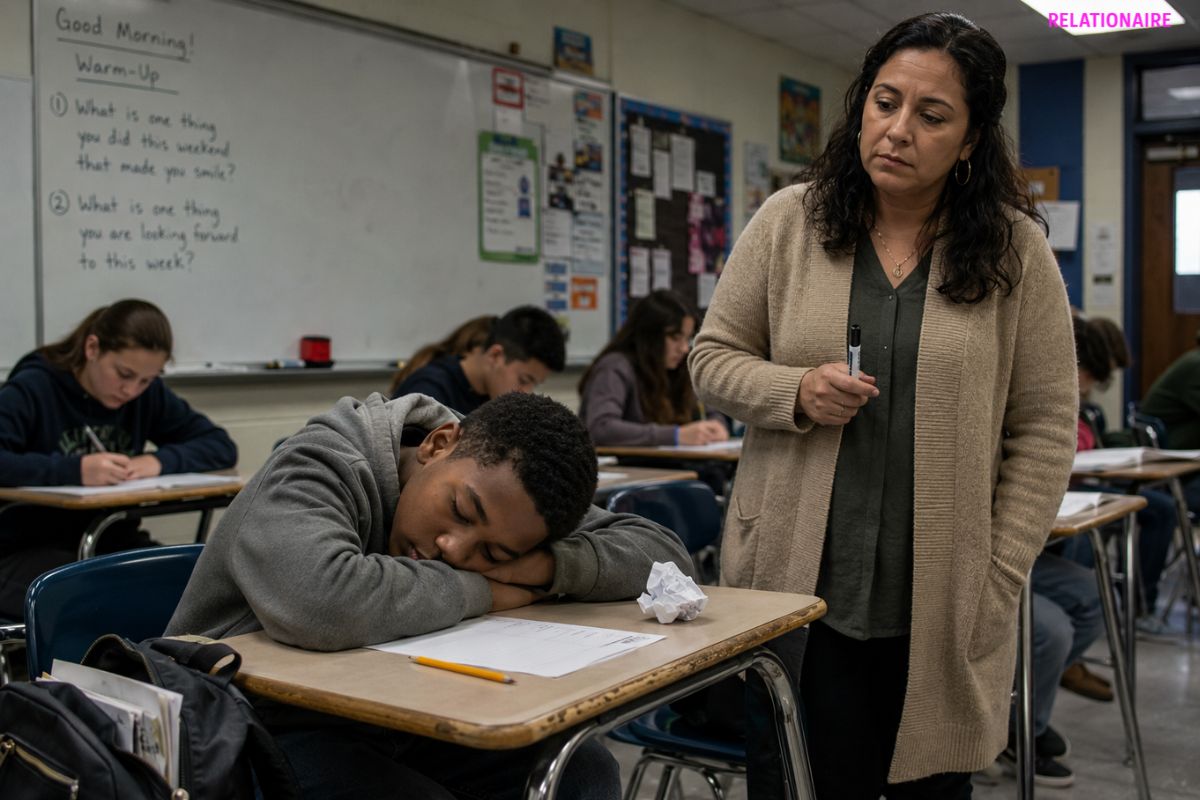
Every morning at 8:07, Marcus Bell put his head down on his folded arms and disappeared.
Not skipped class.
Not talked back.
Not caused trouble.
Just disappeared right there in Room 214, under the bright buzz of fluorescent lights, while twenty-six other seventh graders copied the day’s warm-up from the board.
Mrs. Elena Ramos noticed him the first week of October.
At first, she gave him grace.
Middle schoolers were always tired. Growth spurts. Too much screen time. Bad sleep. Busy houses. Loud siblings. Parents working late.
So the first time Marcus fell asleep, she walked by his desk and tapped it gently with two fingers.
“Marcus,” she whispered. “Stay with us, sweetheart.”
His eyes opened fast, like he had been pulled out of deep water.
“Sorry,” he said.
He sat up straight for almost three minutes.
Then his chin dropped again.
By the second week, it wasn’t just sleep.
He stopped turning in homework.
His spelling test came back blank except for his name, written in small careful letters at the top.
His reading log had coffee stains on it and no parent signature.
His backpack zipper was broken, so loose papers stuck out the side like white flags.
And every morning, no matter what Mrs. Ramos tried, Marcus fell asleep.
Not bored sleep.
Not fake sleep.
The kind where his whole body surrendered.
The kind that made his pencil roll off the desk and clatter onto the tile.
The other kids noticed too.
A boy named Tyler snickered once and whispered, “He’s gone again.”
Mrs. Ramos gave Tyler a look sharp enough to stop him mid-laugh.
But inside, her own patience was thinning.
She was tired too.
She graded essays at her kitchen table until midnight with one hand wrapped around cold tea and the other rubbing the ache in her neck.
Her husband had died two years earlier, and some nights the apartment still felt too quiet to enter.
She had twenty-seven students, three parent emails she hadn’t answered, a stack of behavior forms, two lunch debt notices tucked into her planner, and a principal reminding everyone that test scores had to improve before winter break.
So when Marcus slept through another lesson on theme and character, Mrs. Ramos felt something hard rise in her chest.
Not anger exactly.
More like disappointment.
The kind teachers hate admitting.
Because she cared.
And caring, when nothing changed, wore people down.
One Wednesday morning, she placed a sticky note on Marcus’s desk before the bell.
Please see me after homeroom.
He stared at it when he walked in.
His hoodie sleeves were frayed at the cuffs. One shoelace was tied with a knot too thick to pull apart. His eyes looked swollen with sleep.
He read the note, folded it once, and slipped it into his pocket.
Then, seven minutes later, he fell asleep on top of his warm-up sheet.
After class, the hallway flooded with noise.
Lockers slammed.
Sneakers squeaked.
Somebody dropped a glue stick cap and it rolled under the lost-and-found bin.
Marcus tried to leave with the others, but Mrs. Ramos called his name.
He stopped at the door.
“Marcus.”
His shoulders lifted like he was bracing for rain.
“Come here a second.”
He walked back slowly, dragging one hand along the edge of the desks.
Mrs. Ramos kept her voice calm.
“You can’t keep sleeping through class.”
“I know.”
“And your homework?”
“I know.”
“You’re smart,” she said. “I’ve seen it. When you’re awake, you understand things before half the class does.”
He looked at the floor.
“So help me understand what’s going on.”
Nothing.
“Are you staying up too late?”
A tiny nod.
“Video games?”
His face changed.
Just a flicker.
A small tightening around the mouth.
“No.”
“Phone?”
“No.”
“Then what?”
He swallowed.
The morning announcements crackled over the speaker before he could answer.
Good morning, Lincoln Middle School. Today is picture retake day. Please send students with forms to the cafeteria after first period.
Marcus looked at the speaker as if it had saved him.
“I have to go,” he said.
“Marcus.”
“I’m sorry.”
He was out the door before she could stop him.
At lunch, Mrs. Ramos mentioned him in the staff lounge.
Not gossip.
Concern.
At least that was what she told herself.
The staff lounge smelled like microwaved soup and dry erase markers. A copier jammed in the corner. Someone had left half a bagel beside a stack of crumpled permission slips.
“He sleeps every day,” she said, stirring creamer into coffee she didn’t want. “Every single morning.”
Mr. Lowell, the math teacher, barely looked up from his sandwich.
“That kid? Same in my class if he makes it that far.”
“He’s missing work too,” said Ms. Grant from science. “Never has materials.”
The assistant principal sighed.
“Some kids just don’t care until consequences hit.”
Mrs. Ramos didn’t like how easily that sentence settled over the table.
Some kids just don’t care.
It was simple.
Too simple.
But by Friday morning, after Marcus slept through a quiz and handed it in blank, she felt the words circling in her own head.
Some kids just don’t care.
At dismissal, she stood near the bus loop with her duty vest over her cardigan.
The air smelled like wet leaves and diesel.
Children poured out in waves, laughing, shoving papers into backpacks, holding instruments, dragging jackets behind them.
Marcus did not go to the buses.
He slipped around the side of the building.
Mrs. Ramos noticed because his backpack was easy to spot. One strap was repaired with silver duct tape.
She almost called after him.
Then she saw him stop near the cafeteria doors.
A smaller girl stood there, maybe sixth grade, with a pink backpack pressed tight to her chest. Her hair was pulled into two uneven braids. She looked scared in the way children try not to look scared.
Marcus glanced around.
Then he opened his backpack.
Mrs. Ramos watched from beside the bike rack.
He pulled out a brown paper lunch bag.
The same one Mrs. Ramos had seen on his desk that morning.
Unopened.
He handed it to the girl.
The girl shook her head.
Marcus pushed it gently into her hands.
She said something Mrs. Ramos couldn’t hear.
Marcus looked down, then reached into the broken side pocket of his backpack and pulled out a folded sheet of paper.
He pressed that into the girl’s hand too.
The girl’s face crumpled.
Marcus touched two fingers quickly to his lips, like a secret.
Then he walked away toward the back fence instead of the pickup line.
Mrs. Ramos stood frozen in her yellow duty vest.
The buses rumbled.
Children shouted.
A parent honked.
And suddenly the lazy boy, the careless boy, the boy who slept through homeroom, looked nothing like the story everyone had built around him.
Mrs. Ramos followed him.
Not close enough for him to notice.
Just close enough to see.
He cut through the alley behind the laundromat, crossed the street by the pharmacy, and stopped outside a small apartment building with peeling blue paint.
A woman was waiting on the steps.
She was thin, wearing scrubs under a winter coat, one hand gripping a stack of envelopes.
When Marcus reached her, she touched his cheek like she had been afraid he might not come home.
Then she handed him the first envelope.
Marcus opened it.
His face changed.
He read it once.
Then again.
His mother asked him something in a language Mrs. Ramos didn’t understand.
Marcus looked at the paper.
Then at his mother.
And in a voice much older than twelve, he whispered in English:
“They said we have five days.”
PART 2
Mrs. Ramos did not move.
Across the street, half-hidden behind a parked delivery truck, she watched Marcus fold the paper with hands that should have been holding a basketball, a comic book, a bag of chips from the corner store.
Not an eviction notice.
Not something with red letters at the top.
His mother pressed both hands to her mouth.
Marcus shook his head quickly, like he was trying to stop her fear before it spread.
Then he took the rest of the envelopes from her.
One by one, he opened them.
A bill.
Another bill.
A paper from the pharmacy.
A notice from the clinic.
He read each one slowly, his lips moving.
Then he translated.
Not perfectly. Mrs. Ramos could tell by the pauses.
He searched for words.
He softened some.
Skipped others.
Changed his face before he looked up, as if he knew his mother was reading him more than the paper.
His mother’s eyes filled, but she did not cry.
She just nodded.
Again and again.
That was the moment Mrs. Ramos felt shame settle into her stomach.
She had asked him if he was staying up for video games.
Video games.
She walked back to the school with her duty vest still on.
The building was nearly empty now. The hallway lights clicked off in sections. A janitor pushed a mop bucket past the front office. Somewhere down the hall, a basketball bounced in the gym.
Room 214 looked different when she entered it.
The desks were crooked.
A broken pencil sat near Marcus’s chair.
His blank quiz was still on her desk.
Name at the top.
Nothing underneath.
She picked it up and stared at it until the letters blurred.
Marcus Bell.
She stayed late that night.
Not grading.
Not answering emails.
She opened the school system and pulled up his file.
Emergency contact: Ana Bell.
One name.
No second parent.
No additional guardian.
His attendance was mostly perfect, except for a few late arrivals.
His grades had dropped hard in the last month.
Last year’s comments said the same thing from different teachers.
Bright.
Quiet.
Helpful.
Needs confidence.
This year’s comments were shorter.
Missing work.
Sleeps in class.
Unmotivated.
Mrs. Ramos leaned back in her chair.
The word unmotivated suddenly looked cruel.
The next morning, Marcus came in late.
The class was already copying vocabulary words.
He slipped into his seat without looking at anyone.
His hair was damp from rain. His hoodie smelled faintly like laundry soap and cold air.
Mrs. Ramos did not tap his desk when his head lowered.
Instead, she walked past him and placed a granola bar near his elbow.
No speech.
No attention.
Just the granola bar.
His eyes opened.
He looked at it.
Then at her.
She kept walking.
He did not eat it right away.
He slid it into his backpack.
That small movement told her more than words could have.
At lunch, she found the sixth-grade girl from the bus loop sitting alone near the end of a cafeteria table.
Her name was Lily Tran.
Mrs. Ramos learned it from the laminated name tag clipped to her backpack.
Lily was poking at a scoop of mashed potatoes with a plastic fork. Her tray had milk, peas, and a roll she had wrapped carefully in a napkin.
Mrs. Ramos sat across from her.
“Hi, Lily. I’m Mrs. Ramos. I teach seventh grade.”
Lily’s shoulders tensed.
“You’re not in trouble,” Mrs. Ramos said softly.
The girl looked at the roll in the napkin.
Mrs. Ramos noticed everything then.
How Lily’s coat was too thin.
How her backpack zipper was held together with a safety pin.
How she kept glancing toward the cafeteria doors like she expected someone to come tell her to leave.
“I saw Marcus talking to you yesterday,” Mrs. Ramos said.
Lily’s fork stopped.
“He didn’t do anything wrong,” she said quickly.
“I know.”
“He just helps me sometimes.”
“With lunch?”
Lily pressed her lips together.
Mrs. Ramos waited.
Teachers learn that sometimes silence is the door.
After a long moment, Lily whispered, “My mom and me are staying in our car.”
The cafeteria noise seemed to drop away.
A carton of milk hit the floor somewhere behind them.
Students laughed.
A lunch monitor called, “Walk, please!”
Lily kept her eyes on the table.
“Marcus found out because he saw me brushing my teeth in the bathroom before school. He said not to tell people because sometimes adults make things worse.”
The words landed hard.
Sometimes adults make things worse.
Mrs. Ramos wanted to defend every adult in the building.
She could not.
Not honestly.
“What was the paper he gave you?” she asked gently.
Lily hesitated.
Then she reached into her backpack and pulled out a folded sheet.
It was not money.
It was not a note from home.
It was a list.
Written in Marcus’s careful handwriting.
Free breakfast starts 7:20.
Nurse has toothbrushes.
Library is warm before first bell.
Don’t sleep by the back doors. Mr. Carl checks there.
Ask Ms. Nina in office for extra socks. Say nurse sent you.
At the bottom, he had drawn a small star beside one line.
If you need food for later, take mine. I’m okay.
Mrs. Ramos covered her mouth.
Lily watched her carefully, as if tears from an adult might become another problem.
“He said he knows what it feels like when grown-ups look at you like you’re a mess,” Lily whispered. “He said I’m not a mess.”
Mrs. Ramos folded the paper slowly.
She thought of Marcus asleep in homeroom.
Marcus with blank quizzes.
Marcus sliding a granola bar into his backpack instead of eating it.
Marcus translating eviction notices on apartment steps.
Marcus giving away lunch he probably needed.
And still, somehow, making sure another child knew which hallway was warm.
That afternoon, Mrs. Ramos went to the counselor.
Then the social worker.
Then the principal.
She spoke carefully, because Marcus had been right about one thing.
Adults could make things worse if they came in loud.
They could embarrass a child.
Expose a family.
Turn help into humiliation.
So they made a plan quietly.
No announcements.
No pity.
No “poor Marcus” face.
The counselor contacted Lily’s mother through the school office, careful and kind.
The principal called a community liaison who knew tenant resources.
The nurse put together a drawer of toiletries with no names attached.
The cafeteria manager, Ms. Jo, adjusted something in the system so Marcus and Lily could get breakfast and lunch without anyone saying a word at the register.
And Mrs. Ramos changed Marcus’s seat.
Not to punish him.
To protect him.
She moved him to the back corner by the window where morning sun came in soft and warm.
The next Monday, she placed a folder on his desk.
Inside were shortened assignments.
Not easier.
Just possible.
At the top, she wrote:
Do what you can. I’ll help with the rest.
Marcus opened it before class.
He stared at the note.
His jaw tightened.
For a second, Mrs. Ramos thought he might cry.
Instead, he raised his hand.
“Can I talk to you after school?”
Her heart lifted.
“Yes,” she said. “Of course.”
All day she carried that small hope around like a fragile cup.
But after the final bell, Marcus did not come.
His desk was empty.
His folder was gone.
His pencil was on the floor.
And when Mrs. Ramos stepped into the hallway, she saw Ms. Nina from the front office hurrying toward her, holding a wrinkled attendance sheet.
“Elena,” she said breathlessly. “Marcus’s mother just called.”
Mrs. Ramos knew before the woman finished.
Something had happened.
Ms. Nina’s voice dropped.
“They’re packing tonight.”
PART 3
By the time Mrs. Ramos reached the apartment building, rain had started again.
Not heavy.
Just enough to darken the sidewalk and make the cardboard boxes sag at the corners.
Marcus stood on the steps with a trash bag in each hand.
His mother was inside, moving quickly, too quickly, the way people move when fear is pushing them from room to room.
A lamp with no shade sat near the door.
A laundry basket full of folded scrubs.
A small rice cooker.
Three boxes.
That was how much of their life Mrs. Ramos could see from the sidewalk.
Marcus froze when he saw her.
For one painful second, he looked ashamed.
Like she had caught him doing something wrong.
Mrs. Ramos hated that most of all.
“Marcus,” she said softly. “I’m not here to get you in trouble.”
He looked down at the trash bags.
“They said we have to leave.”
“I know.”
His eyes snapped up.
“You know?”
“I know enough.”
His face hardened.
“Did Lily tell?”
“No.”
He stepped forward.
“She can’t get in trouble. She didn’t do anything. Her mom’s trying. They’re just—”
“I know,” Mrs. Ramos said again. “Nobody is in trouble.”
His mouth stayed open, ready to defend a child who wasn’t even there.
That was Marcus.
Exhausted.
Afraid.
Still protecting someone else.
His mother appeared behind him.
Her eyes moved from Marcus to Mrs. Ramos. She said something quietly.
Marcus answered, then turned to his teacher.
“She wants to know if you’re from the office.”
“I’m from school,” Mrs. Ramos said. “But I’m here as someone who cares about your son.”
Marcus translated.
His mother’s face changed.
Not relaxed.
But softened.
Mrs. Ramos took one step closer.
“The school has people who can help with housing resources. Tenant support. Translation. Food. Transportation if needed. We can’t fix everything tonight, but you don’t have to figure it out alone.”
Marcus listened, then translated piece by piece.
His mother put a hand on the doorframe.
The strength seemed to go out of her knees.
She spoke again.
Marcus’s voice was very quiet when he translated.
“She says she didn’t know who to ask.”
That sentence broke something open in Mrs. Ramos.
All the forms.
All the phone numbers.
All the flyers sent home in backpacks.
All the “resources available” printed in small type at the bottom of newsletters.
And still, this mother had stood on her steps with envelopes in her hand, asking a twelve-year-old to turn fear into English.
Mrs. Ramos nodded.
“We should have made it easier,” she said.
Marcus looked at her.
Not angry.
Not forgiving yet.
Just looking.
The next hour moved in pieces.
The principal arrived in jeans and a raincoat, carrying a folder of contacts.
The school social worker came with a phone pressed to her ear.
Ms. Jo from the cafeteria showed up with grocery bags and pretended she “just had extra.”
Mr. Carl, the custodian, came in his old pickup truck because someone needed to move boxes to a temporary motel room arranged through a community fund.
Nobody made a speech.
Nobody took pictures.
Nobody called them brave to their faces.
They just carried things.
That was the mercy of it.
A lamp.
A rice cooker.
A laundry basket.
A child’s backpack with a broken zipper.
At one point, Mrs. Ramos found Marcus standing in the doorway of his bedroom.
There was almost nothing in it.
A mattress.
A folded blanket.
A stack of library books.
On the floor beside the mattress was a pile of papers.
Bills.
Clinic instructions.
School notices.
Eviction warnings.
And in the middle of them, a composition notebook.
Mrs. Ramos picked it up only because it was open.
The page was filled with two columns.
English on one side.
His mother’s language on the other.
Rent increase.
Late fee.
Blood pressure.
Take with food.
Final notice.
Court date.
At the bottom of the page, in smaller writing, Marcus had copied a sentence from school.
Theme is the message underneath the story.
Mrs. Ramos touched the edge of the paper.
She could hear her own voice saying it at the board weeks ago.
She had thought Marcus was asleep.
He had heard her.
Maybe not everything.
But enough.
Marcus stepped beside her.
“I was going to turn stuff in,” he said.
“I know.”
“I just… sometimes when I get home, there’s papers. And my mom gets scared when she can’t read them. And if I sleep, she waits for me.”
He said it simply.
No drama.
No begging.
Just the truth.
Mrs. Ramos swallowed.
“Marcus, that was never supposed to be your job.”
His eyes filled then, fast and silent.
“But if I don’t do it, who will?”
She had no easy answer.
So she gave him the honest one.
“We will start helping.”
He wiped his face with his sleeve.
“My mom’s not bad.”
“I know.”
“She works. She works all the time.”
“I know.”
“She just doesn’t know the words.”
Mrs. Ramos nodded.
“Then we’ll find someone who does.”
The next few weeks did not turn into a miracle.
Real life rarely does.
Marcus did not suddenly become the perfect student.
His mother did not suddenly stop worrying.
Lily and her mother did not move into a big house with yellow curtains.
But things changed.
Quietly.
That was how schools saved people most of the time.
Not with grand gestures.
With systems made human.
A translator joined meetings.
The social worker helped Marcus’s mother apply for rental assistance and connect with a clinic that provided instructions in her language.
Lily’s family got temporary shelter, then a spot on a housing list.
Ms. Jo kept extra fruit near the end of the lunch line and never once called attention to who took it.
The nurse’s drawer stayed stocked.
Mr. Carl unlocked the library hallway early on cold mornings.
And Mrs. Ramos let Marcus sleep for twelve minutes during homeroom when he needed it.
Then she woke him gently.
Not with annoyance.
With a granola bar, a pencil, and a quiet, “Come back to us when you’re ready.”
He did.
Little by little.
He started turning in work.
Not all of it.
Enough.
He wrote a paragraph about character that made Mrs. Ramos sit down behind her desk after class.
The prompt was simple:
Who is someone in your life who shows courage?
Marcus wrote about his mother.
He wrote that courage was waking up at 4:30 every morning to clean offices where nobody knew your name.
He wrote that courage was asking your son to read scary letters because you trusted him, even though it hurt to need him.
He wrote that courage was crying in the bathroom where your child couldn’t hear.
At the end, he added one line.
I used to think courage meant not being scared. Now I think it means being scared and still packing lunch for someone else.
Mrs. Ramos kept that paper in her desk drawer.
Years later, when people talked about test scores and school rankings and data walls, she would think of Marcus Bell.
She would think of a boy asleep in homeroom because the world had kept him awake.
She would think of Lily eating half a roll from a napkin like it was treasure.
She would think of Ms. Jo’s grocery bags, Mr. Carl’s pickup truck, the nurse’s drawer, the principal standing in the rain with wet papers in her hand.
And she would remember that schools are not just places where children learn fractions and essays and state capitals.
They are places where children bring the parts of their lives they cannot carry alone.
Sometimes they bring hunger.
Sometimes fear.
Sometimes grief folded into a homework folder.
Sometimes a responsibility too heavy for their small shoulders.
And sometimes, if the right adult looks closely enough, a child who seems like he is failing is actually holding up the whole world with both hands.