If you’ve already read part 1 of this story on Facebook, go here for Part 2!
The morning Malik told his mother he wished she was a “normal mom,” the whole bus went quiet enough to hear the brakes sigh.
It happened on Route 18, the one that smelled like raincoats, coffee, and tired people trying not to look tired.
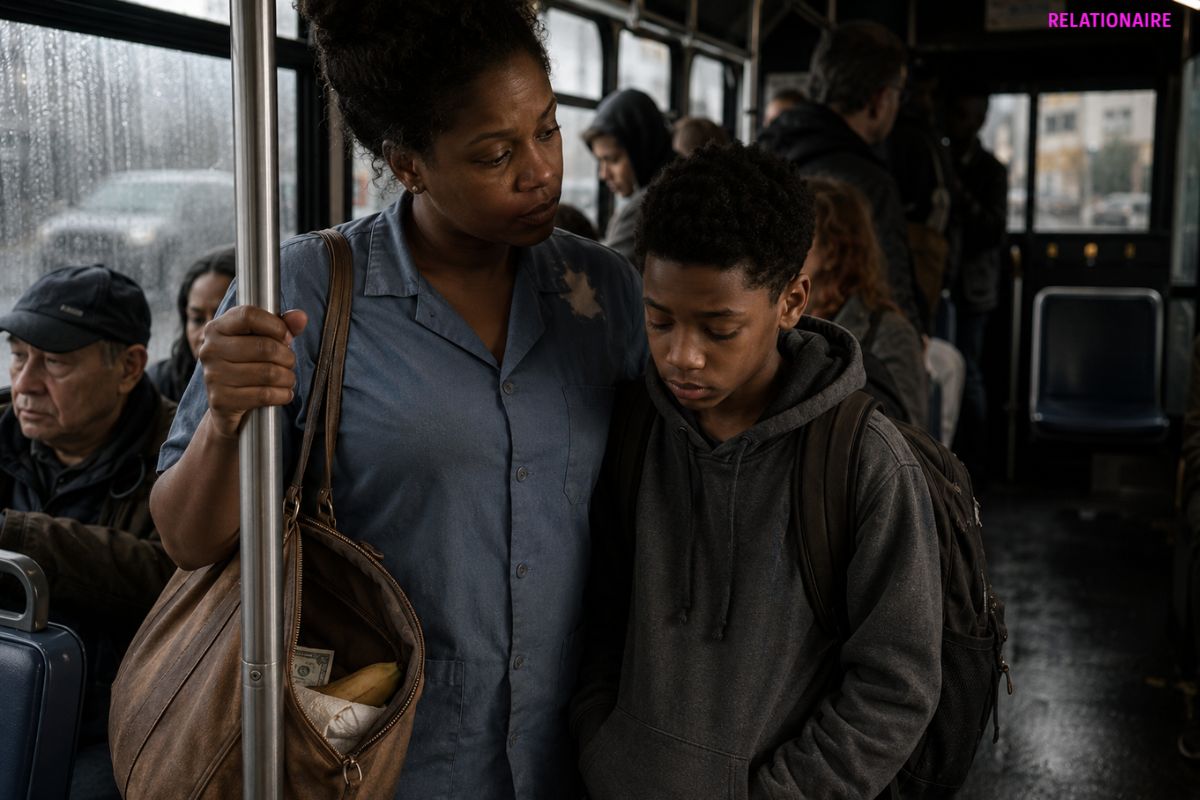
His mother, Janelle, had one hand wrapped around the metal pole and the other pressed lightly against Malik’s backpack so he wouldn’t tip forward when the driver stopped too hard.
Malik was twelve now, old enough to hate being touched in public.
“Mom,” he muttered, pulling away.
Janelle let her hand drop.
“Sorry, baby.”
“Don’t call me that.”
She looked at him then, but only for a second.
Outside, the city was still half-asleep. Gray light sat on the roofs of laundromats and corner stores. A man in a work vest yawned into his sleeve. A little girl in pink boots swung her feet under the seat.
Malik stood beside his mother because all the seats were taken.
Except one.
The last seat near the back, squeezed between a woman with grocery bags and an older man coughing into a napkin.
Janelle nodded toward it. “Go sit.”
“I’m fine.”
“You’ve got that heavy backpack.”
“I said I’m fine.”
His voice was sharper than he meant it to be.
Across the aisle, two boys from his school were sitting together. Devon and Chris. They had seen him get on with his mother at the stop near Mercy Apartments. Devon had already raised his eyebrows like he’d found something worth saving for later.
Malik stared at the floor.
His sneakers were peeling at the sides again. His mother had glued them twice with something from the dollar store. The glue had dried shiny and stiff, like a scar.
At the next stop, a woman in a navy coat climbed on with a little boy holding a lunchbox shaped like a dinosaur. The boy pointed at Malik’s backpack.
“I have that one,” he said.
Malik didn’t answer.
Janelle smiled at the child anyway.
The bus lurched. Her purse slipped down her shoulder, and for one ugly second, Malik saw what was inside: a folded electric bill, a banana wrapped in a paper towel, her work badge, and a prescription bottle with his name on it.
He pushed his eyes toward the window.
He hated that bus.
He hated how loud it was. How everyone could hear everything. How the windows fogged up in winter and stuck open in summer. How his mother always acted like it was no big deal.
Every morning, same thing.
Walk three blocks.
Wait under the cracked bus shelter.
Ride twenty-two minutes.
Get off near school.
Watch other kids climb out of minivans, SUVs, clean cars with heated seats and moms holding coffee cups.
Normal moms.
That was the phrase that had been sitting in his chest all week.
Normal moms didn’t dig for quarters at 7:10 in the morning.
Normal moms didn’t say, “Stand close, Malik,” when men argued near the back door.
Normal moms didn’t have to choose between a new backpack and groceries.
Normal moms drove.
Before the car disappeared, they used to drive too.
It was an old silver Honda with a dent above the back tire and a radio knob that popped off if you turned it too fast. Malik used to complain about it. He used to say it smelled like french fries and medicine.
But at least it was theirs.
Then one day, it was gone.
His mother said, “We’re going to use the bus for a little while.”
A little while had become eight months.
Eight months of Devon asking, “Your mom still don’t got a car?”
Eight months of Chris making engine noises when Malik walked past.
Eight months of Janelle pretending not to notice when Malik let go of her hand half a block before school.
That morning, the bus hit a pothole, and Malik’s shoulder bumped Devon’s knee.
Devon smirked.
“Careful, bus boy.”
Malik’s ears burned.
Janelle turned fast. “Excuse me?”
Devon looked away.
Malik felt something hot crawl up his neck.
“Don’t,” he snapped.
His mother blinked. “Don’t what?”
“Don’t say anything.”
“He was being rude.”
“I can handle it.”
“I know you can.”
“No, you don’t.” His voice cracked, and that made it worse. “You make everything worse.”
A few heads turned.
Janelle’s face changed just a little. Not anger. Something quieter.
Pain, maybe.
But Malik was already too embarrassed to stop.
“I’m tired of this,” he said.
The bus hummed around them.
Janelle held the pole tighter.
“Tired of what?”
“This.” He gestured at the seats, the people, the dirty floor, the windows rattling in their frames. “Riding this bus every day like we don’t have anywhere better to be.”
Her lips parted.
“Malik.”
“No.” His eyes filled, and he hated that too. “Everybody else’s mom drives them. Everybody else gets dropped off. Why can’t you just be like normal moms?”
The words landed harder than he expected.
He knew it because his mother stopped breathing for a second.
The woman with the grocery bags looked down.
The older man near the back shifted in his seat.
Devon stopped smiling.
Janelle didn’t raise her voice. She didn’t embarrass him back. She didn’t tell everyone how hard she worked or how much he had no right to say that.
She just nodded once, like she had swallowed something sharp.
Then she said, “Your stop is next.”
That was all.
Malik looked away first.
When they got off near the school, the morning air felt colder than before. Cars lined the curb. Doors opened. Parents leaned over seats to kiss cheeks, hand over forgotten homework, shout reminders about practice and lunch money.
Janelle walked beside him in silence.
At the gate, Malik slowed down.
He wanted her to say something. Anything. He wanted her to scold him so he could be mad instead of ashamed.
But she only reached into her purse and pulled out a paper bag.
“Your lunch.”
He took it without looking at her.
Inside was a peanut butter sandwich, apple slices, and the last oatmeal cookie from the pack they were supposed to share.
He knew it was the last one because he had seen her close the empty box that morning.
“Thanks,” he mumbled.
She nodded.
Her work shirt had a small bleach stain near the collar. Her eyes looked tired in a way makeup couldn’t hide.
“Have a good day,” she said.
He walked through the gate.
He didn’t turn around until he reached the steps.
She was still there.
Not waving.
Just watching to make sure he got inside.
That made him angry all over again.
Or maybe it made him sad.
He couldn’t tell anymore.
That afternoon, Malik stayed quiet on the bus home. His mother was quiet too. The silence between them felt bigger than the aisle.
At dinner, she made noodles with canned chicken and told him there was still hot sauce if he wanted some. He said no. She asked about his math test. He said fine.
Afterward, he went to his room and shut the door.
Their apartment was small, which meant a closed door didn’t keep much out.
He could still hear the sink running.
He could hear his mother’s footsteps.
He could hear her laugh softly when Aunt Tasha called, the laugh she used when she didn’t want people worrying.
Malik lay on his bed, staring at the ceiling stain shaped like a crooked heart.
Then his mother’s voice changed.
It got low.
“Tasha, please don’t start.”
Malik sat up.
The apartment went quiet except for the hum of the refrigerator.
His aunt’s voice came through the speaker, sharp and worried.
“You can’t keep letting that boy think you lost that car because you were careless.”
Malik froze.
His mother said nothing.
Aunt Tasha kept going.
“He’s old enough now, Janelle. He should know what you did.”
Malik slid off the bed and moved closer to the door.
His chest tightened.
His mother’s voice came again, barely above a whisper.
“No. He should not have to carry that.”
“Carry what?” Tasha said. “The truth? That you sold the car yourself?”
Malik’s hand closed around the doorknob.
Sold the car?
His mother let out a breath that sounded almost broken.
“I didn’t sell it for me.”
There was a pause.
Then Aunt Tasha said the words that made Malik’s whole body go still.
“You sold it to pay for his surgery.”
PART 2
Malik did not open the door.
He stood there with his fingers wrapped around the knob, listening to the apartment he thought he understood become a place full of things he had missed.
His mother’s voice was soft.
“Tasha, lower your voice.”
“He heard worse than this today,” Aunt Tasha said. “You told me what he said.”
Malik squeezed his eyes shut.
Normal moms.
The words came back meaner now.
His mother didn’t defend herself.
That was the part that hurt.
She never did.
“He was embarrassed,” Janelle said. “He didn’t mean it.”
“You always say that.”
“Because he’s a child.”
“He’s twelve.”
“He’s my child.”
The sink turned on again, then off. Malik pictured her standing in the kitchen with one hand on the counter, phone near her mouth, still wearing her work shoes because she always forgot to take them off until her feet started aching.
Aunt Tasha sighed.
“Janelle, you ride two buses to work after dropping him off. Two. You stand all day. Then you pick up extra shifts on Saturdays. And that boy thinks the car just vanished.”
“He had enough to deal with.”
“He had surgery. He got better. That doesn’t mean you disappear inside the sacrifice.”
Sacrifice.
Malik hated that word immediately.
It sounded too big for their kitchen.
Too big for the noodles still sitting in the pot.
Too big for the woman who bought store-brand cereal and pretended she liked the broken pieces at the bottom.
His mother said, “Do you remember how scared he was?”
Aunt Tasha was quiet.
Janelle went on.
“He kept saying everything sounded like he was underwater. He stopped laughing at cartoons because he couldn’t hear the jokes. He started watching my mouth when I talked.” Her voice trembled, but she held it steady. “The doctor said waiting could make it worse. Insurance covered some. Not enough.”
Malik backed away from the door.
He remembered pieces.
Hospital lights.
A blue blanket.
His mother’s face above him, smiling too hard.
The way sounds came back slowly afterward. First muffled. Then bright. Then almost too loud.
He remembered his mother crying in the car outside the hospital, but she told him it was allergies.
The car.
Their silver Honda.
He remembered waking up one morning and seeing the empty parking spot from their apartment window.
He had asked, “Where’s the car?”
His mother had tied his shoelace and said, “We’re going to try something different for a while.”
He thought she was hiding failure.
She was.
Just not the kind he imagined.
That night, Malik stayed in his room until the apartment went dark.
He did not sleep much.
Every sound felt sharpened now.
The refrigerator clicking on.
A pipe knocking in the wall.
His mother coughing once in the living room.
He heard all of it because she had made sure he could.
The next morning, Janelle knocked on his door.
“Malik. Time.”
He dressed slowly.
His backpack felt heavier than usual, though nothing new was in it.
In the kitchen, his lunch was on the table. Peanut butter again. Apple slices again. No cookie.
His mother stood near the stove, pouring coffee into a travel mug with a cracked lid.
She looked normal.
That was the awful thing.
She looked exactly like the mother he had hurt yesterday.
“Eat something,” she said.
“I’m not hungry.”
“Take a banana then.”
He looked at the banana wrapped in a paper towel.
The one from her purse yesterday.
“Is that yours?”
“It’s ours.”
That made his throat burn.
They walked to the bus stop without talking.
The morning was damp. Rain had left the sidewalk dark and shiny. Malik watched his mother step around a puddle in shoes that were starting to split near the sole.
He wanted to say he was sorry.
But sorry felt too small.
At the shelter, he saw Devon across the street with his mother. She was sitting in a black SUV, tapping at her phone while Devon climbed out with a sports drink and a bag from a bakery.
Malik looked away.
Janelle noticed.
She always noticed.
“You okay?” she asked.
He nodded.
The bus came late and crowded.
When the doors opened, warm air and the smell of wet coats rolled out. Janelle dug into her purse for their fare cards. Malik watched her fingers move past the folded bill, the work badge, the prescription bottle.
Then he saw something else tucked behind her wallet.
A small keychain.
A silver plastic H, scratched at the edges.
The keychain from their Honda.
She still carried it.
His chest ached so suddenly he almost couldn’t step onto the bus.
There were no seats at first. Then, two stops later, a man stood up near the front.
One seat.
Janelle touched Malik’s shoulder.
“Sit.”
He looked at her hand. It was dry from dish soap. There was a tiny burn mark near her thumb from the restaurant kitchen where she worked lunches.
“No,” he said.
“Malik.”
“You sit.”
Her eyebrows lifted.
“I’m fine.”
“Mom, sit.”
He said it too loudly. A woman glanced over.
Janelle studied his face.
Something passed between them, fragile and almost dangerous.
She sat.
Malik stood in front of her, one hand on the pole, knees bent the way she had taught him so the stops wouldn’t throw him forward.
At school, Devon was waiting near the gate.
“Bus boy,” he said under his breath.
Malik turned.
For a second, he wanted to shove him. He wanted to say something that would make Devon feel small too.
But then he thought of his mother standing in a kitchen at night, telling Aunt Tasha he shouldn’t have to carry the truth.
So Malik only said, “Yeah. I ride the bus.”
Devon blinked.
Malik walked past him.
All day, the truth sat beside him like another student.
In science, when the teacher asked everyone to write down something they were grateful for, Malik wrote, My ears.
Then he scratched it out.
Then he wrote, My mom.
Then he folded the paper so no one could see.
After school, Janelle wasn’t at the usual corner.
At first, Malik thought she was late.
Then ten minutes passed.
Then twenty.
The buses came and went. Parents honked. Kids scattered.
Malik checked the street again and again.
His mother was never late without calling the school office. But he didn’t have a phone. They had agreed he didn’t need one yet, which he used to hate.
Now he stood there with cold fingers and a fear he could not name.
Finally, Aunt Tasha’s blue pickup pulled up to the curb.
She leaned across the seat and pushed the door open.
“Get in.”
“Where’s Mom?”
Tasha’s face softened in a way that scared him more than if she had looked panicked.
“She’s okay.”
“Where is she?”
“At Mercy General.”
The hospital name struck him hard.
“Why?”
“She got dizzy at work. They wanted to check her out.”
Malik climbed in, barely shutting the door before asking again.
“Is she okay?”
“She’s exhausted,” Tasha said. “And stubborn.”
The pickup smelled like peppermint gum and old receipts. Malik held his backpack on his lap with both arms.
Aunt Tasha drove faster than his mother ever did.
“She told me not to tell you,” Tasha said after a while.
Malik stared at the dashboard.
“She tells everyone not to tell me anything.”
“That’s because she thinks protecting you means hiding every sharp edge.”
He looked out the window.
Rain started again, thin lines sliding down the glass.
“I heard you last night,” he said.
Tasha did not act surprised.
“I figured.”
He swallowed.
“She sold the car?”
“Yes.”
“For my surgery?”
“Yes.”
His voice came out small.
“Why didn’t she tell me?”
“Because you were nine,” Tasha said. “Because you were scared. Because after your dad left, she promised herself you would never feel like one more thing she couldn’t afford.”
Malik’s eyes stung.
“My dad left because of me?”
“No.” Tasha’s voice was firm. “No, baby. Adults make adult choices. That was not yours to carry.”
He nodded, but the guilt had already found a place to sit.
At the hospital, Janelle was in a curtained room with a blood pressure cuff on her arm and her work shoes under the bed.
She smiled when she saw him.
Not the fake one.
The tired one.
“Hey,” she said. “I’m fine.”
Malik stood at the foot of the bed.
Her hair was pulled back messy. Her face looked smaller somehow.
There was a hospital bracelet on her wrist.
He hated seeing it there.
“You didn’t tell me,” he said.
Janelle looked at Tasha.
Tasha lifted both hands. “Don’t look at me. He heard us.”
His mother closed her eyes.
When she opened them, they were full.
“Malik.”
“You sold our car.”
She rubbed her thumb over the hospital bracelet.
“I sold a car.”
“Our car.”
Her voice was gentle. “A car can be replaced.”
He stepped closer.
“You ride the bus because of me.”
“No.”
“Yes.”
“No, Malik.” She sat up straighter, wincing a little. “I ride the bus because I made a choice.”
“For me.”
“For your hearing. For your future. For every laugh I wanted you to hear. For every song. Every teacher. Every ‘I love you’ somebody might say when I’m not standing right there to repeat it.”
The room went blurry.
“You should’ve told me.”
“You were a little boy.”
“I’m not little now.”
“I know.”
“Then why are you still treating me like I am?”
That hurt her.
He saw it.
But for once, she did not look away.
“Because sometimes,” she whispered, “if I let myself admit how much you’ve grown, I have to admit how much time I lost trying to keep everything from falling apart.”
Malik didn’t understand all of it.
But he understood enough.
The nurse came in then with discharge papers and a gentle warning about rest, hydration, and not skipping meals.
Malik turned to his mother.
“Skipping meals?”
Janelle’s eyes dropped.
Aunt Tasha muttered, “Lord, give me patience.”
The nurse left.
The room became quiet again.
Malik looked at his mother, really looked at her.
The bleach stain. The dry hands. The hospital bracelet. The woman who had been standing so he could sit. Hungry so he could eat. Silent so he could feel normal.
He opened his mouth.
But no words came.
His mother reached for her purse on the chair.
Inside, the scratched Honda keychain slipped out and fell onto the floor between them.
Malik picked it up.
The little silver H sat in his palm like proof.
For the first time, he understood that some things disappear from a family not because love failed, but because love paid the price.
PART 3
Janelle was discharged that evening with a paper bag of instructions, a stern look from Aunt Tasha, and one embarrassed son who would not let her carry her own purse.
“I can hold it,” she said.
“I know.”
“Then why are you holding it?”
“Because I can.”
She looked at him.
He looked at the floor.
Aunt Tasha made a sound that was almost a laugh and almost a cry.
They stopped at a diner on the way home because Tasha insisted. Janelle tried to argue about money. Tasha told her she had already paid. Janelle tried to argue about that too.
Malik sat in the booth beside his mother instead of across from her.
The table was sticky. The menus had curled corners. A little boy two booths down was banging a spoon like a drum.
Janelle ordered soup.
Malik ordered grilled cheese because it was the cheapest thing with a picture beside it.
When the food came, he pushed half his sandwich onto her plate.
She stared at it.
“Malik.”
“I’m full.”
“You took two bites.”
“I said I’m full.”
Her mouth trembled.
She picked up the half sandwich and ate it like she was accepting an apology he still didn’t know how to say.
On the ride home, Malik held the Honda keychain in his pocket.
The next morning was Saturday.
For the first time in months, Malik woke before his mother.
The apartment was gray and quiet. He found her asleep on the couch, still in yesterday’s T-shirt, one hand tucked under her cheek. There was a folded blanket at her feet she hadn’t pulled over herself.
He covered her with it.
Then he stood there, awkward and unsure, watching her breathe.
On the coffee table were the discharge papers, an unpaid electric bill, and a grocery receipt with three items circled: bread, milk, apples.
Beside them sat his school permission slip for the spring music program.
He had left it there two weeks ago.
He had not reminded her because he figured she wouldn’t be able to come anyway.
Now he saw her handwriting at the bottom.
Janelle Brooks.
Signed.
Paid: $8.
She had paid the fee.
He sat on the floor and held the paper carefully.
Music program.
The school auditorium.
Parents in folding chairs.
Students singing too loudly.
He had almost thrown the form away because he didn’t want to stand on stage and look out at empty space where his mother should be.
But she had signed it.
She had paid.
He didn’t know when.
He didn’t know with what.
That was becoming the story of his life.
His mother kept making room for him in places where there was no room.
At noon, she woke up and found him cleaning the kitchen.
Badly.
He had used too much soap. The counter was streaked. The trash bag had ripped and left coffee grounds on the floor.
She stood in the doorway, blinking.
“What happened?”
“I’m helping.”
“You flooded the sink.”
“I’m still helping.”
For the first time in two days, she laughed.
It was small, but real.
That laugh did something to him.
It made him brave.
“I’m sorry,” he said.
The words came out rough.
Janelle’s face softened.
“For what?”
“For what I said on the bus.”
She leaned against the doorway.
“I know.”
“No, Mom. I mean it.” He wiped his hands on a dish towel. “I didn’t know.”
“You weren’t supposed to know everything.”
“But I should’ve known enough.”
She walked to him slowly.
“You are a child, Malik.”
“I know.” His eyes filled. “But I’m your child. And I don’t want you carrying everything by yourself.”
That was the sentence that broke her.
Not loudly.
Janelle did not sob or fall apart. She just covered her mouth, turned her head, and let tears slide down her face while the kitchen sink dripped behind them.
Malik stepped forward.
At twelve, he was almost as tall as she was.
Still young enough to need her.
Old enough to see her.
He hugged her first.
She held him like she had been waiting months to be allowed to.
“I never wanted you to feel guilty,” she whispered into his hair.
“I don’t.”
She pulled back.
He corrected himself.
“I do. A little. But mostly… I feel stupid.”
“You’re not stupid.”
“I was mean.”
“You were hurting.”
“That doesn’t make it okay.”
“No,” she said gently. “It just makes it something we can talk about.”
So they did.
Not all at once.
Not perfectly.
That afternoon, at the kitchen table, Janelle told him what she had hidden in pieces small enough for both of them to survive.
She told him about the appointment when the doctor said his hearing could get worse if they waited.
She told him about crying in the hospital billing office.
She told him about calling used car buyers from the parking lot and pretending her voice wasn’t shaking.
She told him his father had left before the surgery bills came, not because of Malik, but because some people run when life asks them to stand still.
She did not make his father a monster.
She did not excuse him either.
That mattered to Malik, though he didn’t know how to say it.
Then Malik told her about Devon.
About the jokes.
About letting go of her hand before the gate.
About being ashamed of the bus, then ashamed of being ashamed.
Janelle listened without interrupting.
When he finished, she reached across the table.
“I can’t promise you we’ll have a car soon,” she said.
“I know.”
“I can’t promise kids won’t be cruel.”
“I know.”
“But I can promise you this. You will never be something I regret. Not the surgery. Not the bus. Not any hard thing I had to do.”
He nodded.
She squeezed his hand.
“And you don’t have to protect me from your feelings. But you do have to respect me while you have them.”
That sounded fair.
Hard, but fair.
On Monday morning, they walked to the bus stop together.
The air was bright after rain. The street smelled like wet pavement and bakery bread from the corner shop.
Janelle wore her work shirt, the one with the bleach stain.
Malik wore the repaired sneakers.
In his pocket was the Honda keychain.
He had asked if he could keep it.
Janelle had hesitated, then pressed it into his palm.
“Just don’t lose it.”
“I won’t.”
The bus arrived crowded, as usual.
They stepped on.
Devon and Chris were near the back.
Malik saw them see him.
He felt the old heat rise in his face.
Then he felt the keychain in his pocket.
Not shame.
Proof.
At the next stop, a seat opened near the front.
Janelle nodded toward it out of habit.
“Go ahead.”
Malik shook his head.
“You sit.”
“Malik—”
“Mom.”
This time, she sat.
He stood beside her with one hand on the pole and the other lightly on the back of her seat. Not because she needed guarding.
Because he wanted to stand there.
Devon leaned across the aisle.
“Still riding the bus?”
Malik looked at him.
He could have told him everything. He could have thrown the whole story like a weapon. The surgery. The car. The hospital. His mother’s sacrifice.
But some truths are not for people who only want to laugh.
So he said, “Yeah.”
Devon snorted. “Why?”
Malik looked down at his mother.
She was pretending not to listen.
He saw the tiredness in her shoulders. The stubborn lift of her chin. The woman who had given up a car so her son could hear the world.
Then Malik looked back at Devon.
“Because my mom shows up.”
The bus went quiet again.
But this time, Malik was not embarrassed by the silence.
Janelle did not turn around.
She only reached up and touched his sleeve with two fingers.
A small thing.
A thank-you.
A don’t cry.
An I heard you.
That spring, Janelle came to the music program.
She arrived late, still in her work shoes, standing in the back because all the seats were full. Malik saw her through the stage lights, one hand pressed against her chest as the students began to sing.
For a moment, his voice caught.
Then he remembered why he could hear the piano.
Why he could hear the teacher whisper, “Ready?”
Why he could hear his own mother clap before anyone else.
So he sang louder.
Afterward, she hugged him in the hallway, surrounded by parents with car keys and clean coats and phones raised for pictures.
Aunt Tasha took one photo of them.
In it, Malik was smiling with red eyes. Janelle’s cheek was pressed against his hair. Her work badge was still clipped to her shirt.
Behind them, no one could see the bus stop outside.
No one could see the empty parking spot from months ago.
No one could see the bills, the fear, the hunger, the hospital bracelet, the keychain in Malik’s pocket.
But Malik knew.
And that was enough.
Years later, when he would hear people talk about sacrifice like it was always loud and heroic, he would think of Route 18.
He would think of a mother standing on a crowded bus so her son could sit.
He would think of a scratched silver keychain.
He would think of the day he learned that love does not always arrive in the form we want.
Sometimes it is an old car gone missing.
Sometimes it is the last cookie in a paper lunch bag.
Sometimes it is a tired mother saying nothing, because she would rather be misunderstood than make her child feel like a debt.
And sometimes, if we are lucky, we grow up in time to take the last seat we were offered and give it back.