If you’ve already read part 1 of this story on Facebook, go here for Part 2!
Everyone at Maple Ridge Elementary knew two things about Mrs. Helen Rowe.
She did not smile before 10 a.m.
And she did not accept excuses.
Not for missing homework.
Not for late permission slips.
Not for untied shoes in the hallway.
Not for “my mom forgot,” “my backpack ate it,” or “I didn’t know it was due.”
If a pencil rolled off a desk during silent reading, her eyes went to it before it hit the floor.
If a student whispered, she paused mid-sentence and waited until the room remembered how to breathe.
Parents called her old-fashioned.
Kids called her scary.
The younger teachers, the ones with colorful lanyards and soft voices, called her “intense” in the staff lounge when they thought she couldn’t hear.
But she heard everything.
That was another thing about Mrs. Rowe.
She heard the zipper on a backpack struggling.
She heard the cough a child tried to hide.
She heard the difference between a child being disrespectful and a child trying not to cry.
She had been teaching fifth grade for thirty-one years, long enough to watch kindergartners grow into parents standing in her doorway, suddenly nervous again.
Her classroom was plain.
No twinkle lights.
No beanbags.
No inspirational posters with cartoon animals.
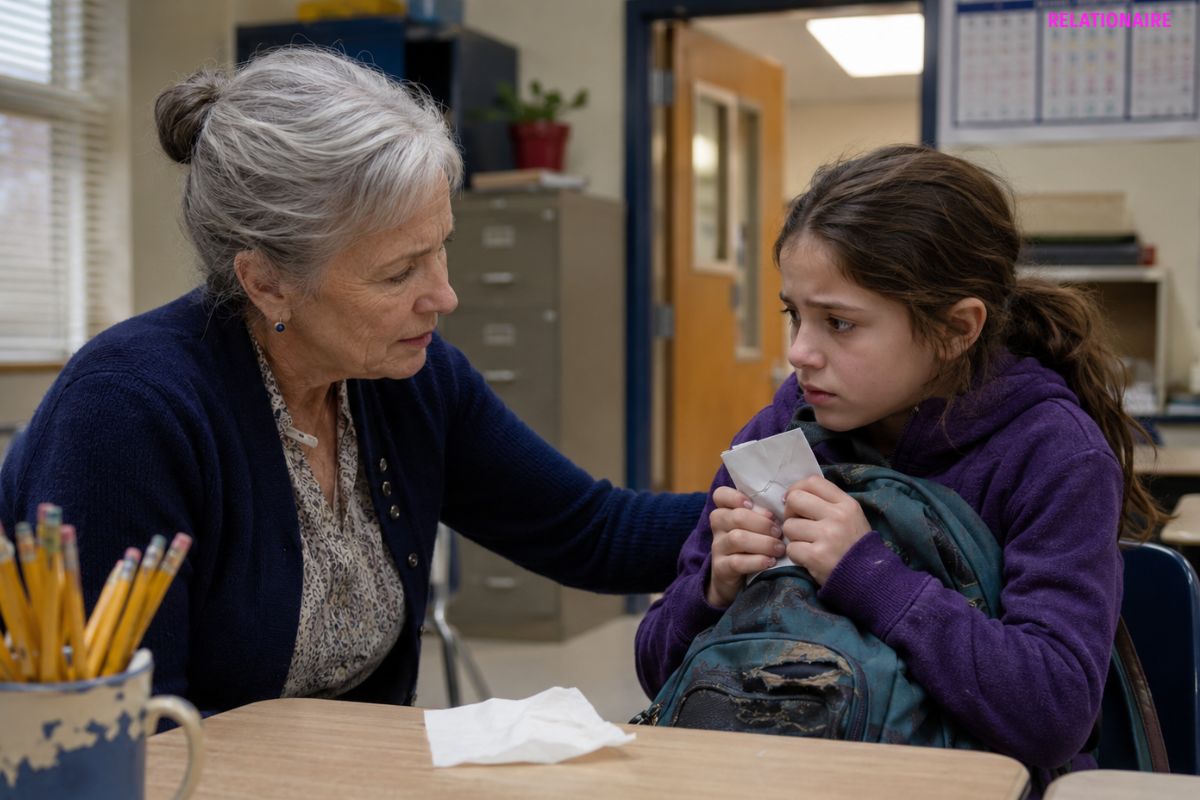
Just rows of desks, sharpened pencils in a chipped blue mug, multiplication charts laminated at the corners, and a sign above the whiteboard that read:
In this room, we do the hard thing.
Most students hated that sign in September.
By May, many of them understood it.
But that year, nobody watched Mrs. Rowe more carefully than Ava Bell.
Ava was ten years old, small for her age, with a frayed purple hoodie she wore every day even when the heat rattled through the classroom vents. Her hair was usually pulled back in a loose ponytail, the kind a child does herself in a hurry.
Before winter break, Ava was quiet, but not silent.
She raised her hand when she knew the answer.
She laughed behind her hand when Malik drew tiny mustaches on the presidents in his workbook.
She wrote her spelling words in careful blue letters and always added a little star above the lowercase i.
She had the kind of face teachers remember because it looked like it was always trying to be brave.
Then January came.
The first morning back from winter break, the school smelled like wet coats, floor cleaner, and cafeteria pancakes.
Children dragged in new backpacks and stories about cousins, video games, and snow that barely stuck to the ground.
Mrs. Rowe stood at her doorway with a clipboard, checking names as her students came in.
“Good morning, Malik. Hood down.”
“Good morning, Brianna. We walk, not slide.”
“Good morning, Ethan. I can see the candy in your pocket. Throw it away or give it to me.”
Then Ava appeared.
She was late.
Not by much. Three minutes.
But three minutes was three minutes in Room 214.
Mrs. Rowe looked up.
Ava’s purple hoodie was zipped all the way to her chin. Her backpack hung off one shoulder. The front pocket was half open, and a crumpled paper stuck out like it had been shoved there fast.
“Good morning, Ava,” Mrs. Rowe said.
Ava didn’t answer.
Mrs. Rowe waited.
The hallway behind Ava was loud with lockers closing and sneakers squeaking.
“Ava.”
The girl’s eyes lifted for half a second, then dropped to the floor.
Mrs. Rowe’s mouth became a thin line.
“In this classroom,” she said, “we greet people when they greet us.”
Ava’s fingers tightened around her backpack strap.
Still nothing.
A few kids turned to look.
Someone whispered, “She’s dead.”
Mrs. Rowe’s eyes cut across the room.
The whisper stopped.
“Take your seat,” Mrs. Rowe said.
Ava slid into her chair near the windows.
All morning, she said nothing.
Not during attendance.
Not during reading groups.
Not when Mrs. Rowe asked her to collect the math journals.
At lunch, Ava carried her tray to the end of the table and pushed peas around with her plastic fork. She ate half a roll and wrapped the other half in a napkin.
Mrs. Rowe saw it from across the cafeteria.
She also saw the way Ava looked toward the exit every time an adult passed.
At dismissal, Ava was last to pack up. Her hands moved slowly, as if each pencil weighed something.
Mrs. Rowe stood beside her desk.
“You owe me three sentences for the morning greeting,” she said.
Ava stared at the top of her desk.
“Tomorrow,” Mrs. Rowe added. “Neat handwriting.”
Ava nodded once.
That was all.
The next day, Ava brought no sentences.
The day after that, she forgot her reading log.
By Friday, her homework folder was empty except for a permission slip so wrinkled it looked like it had survived a washing machine.
Mrs. Rowe took it between two fingers.
“This was due yesterday.”
Ava looked at her shoes.
“You know the rule.”
Ava nodded.
“Then explain.”
The whole class went still.
Ava opened her mouth.
Nothing came out.
Her lips trembled once, just slightly.
Mrs. Rowe noticed.
The children noticed something else.
They noticed Mrs. Rowe holding the permission slip.
They noticed Ava not answering.
They noticed the old familiar look on their teacher’s face and waited for the hammer to fall.
Instead, Mrs. Rowe folded the permission slip and placed it on her desk.
“Recess,” she said to the class. “Line up.”
Malik’s eyebrows shot up.
Brianna whispered, “She’s not yelling?”
Mrs. Rowe turned.
Brianna stared straight ahead like she had been born that way.
Outside, the playground was bright and cold. Children ran in circles just to stay warm. The swings creaked. A red ball bounced against the brick wall.
Ava stood alone near the fence, hands tucked inside her sleeves.
Mrs. Rowe watched from the blacktop, arms crossed.
Mr. Coleman, the gym teacher, came up beside her with a whistle around his neck.
“Bell girl giving you trouble?” he asked.
Mrs. Rowe did not look at him.
“She stopped speaking.”
“Some kids do that when they want attention.”
Mrs. Rowe’s jaw tightened.
“She is not asking for attention.”
Mr. Coleman shrugged. “You know how they are after break. Routines gone. Parents let them run wild.”
Mrs. Rowe finally looked at him.
“No,” she said quietly. “I know how some children are after break.”
Something in her voice made him stop.
That afternoon, Mrs. Rowe asked Ava to stay behind.
The classroom emptied into the hallway, loud and careless, backpacks bumping against desks, chairs scraping, voices rising toward freedom.
Ava remained seated.
Her face had gone pale.
Mrs. Rowe closed the door halfway, not all the way.
That mattered.
She sat at the desk beside Ava’s instead of standing over her.
That mattered too.
“Ava,” she said, softer than her students had ever heard her say anything, “you are not in trouble.”
Ava’s eyes filled immediately.
She looked away fast, angry at the tears.
Mrs. Rowe slid a clean tissue across the desk.
Ava did not take it.
“Can you tell me why you haven’t been speaking?”
The room was quiet.
The heat clicked on.
A glue stick cap rolled slowly under a desk from somewhere, tapping against a chair leg.
Ava’s fingers crawled toward her backpack.
She pulled it into her lap.
For one second, Mrs. Rowe’s hard face changed.
Not softened exactly.
Sharpened.
As if she had just seen a shadow she recognized.
“Ava,” she said carefully, “is there something in your backpack you need me to see?”
Ava froze.
Her eyes lifted to Mrs. Rowe’s.
There was fear there.
Not the fear children had when they forgot homework.
Something older.
Something heavier.
Then Ava reached into the small front pocket of her backpack with shaking fingers and pulled out a folded piece of notebook paper.
She held it tight against her chest.
Mrs. Rowe did not reach for it.
She only whispered, “You can hand it to me when you’re ready.”
Ava stared at the paper.
Then, in a voice so small it barely sounded like a voice at all, she said the first words she had spoken all week.
“Please don’t call my grandma.”
Mrs. Rowe went still.
And for the first time all year, the strictest teacher in the school looked afraid.
PART 2
Mrs. Rowe did not ask why.
Not right away.
That was something people misunderstood about strict teachers. They thought rules meant rushing. They thought discipline meant force.
But Mrs. Rowe had learned long ago that frightened children were like birds in a classroom.
Move too fast and they flew into glass.
So she sat still.
The folded paper trembled in Ava’s hands.
“Okay,” Mrs. Rowe said. “I won’t call anyone this second.”
Ava swallowed hard.
“Promise?”
Mrs. Rowe looked at her.
“I don’t make promises I may not be able to keep.”
Ava’s face crumpled.
“But I will listen first,” Mrs. Rowe said. “That I can promise.”
The girl held the paper out.
Mrs. Rowe took it carefully.
It was a piece torn from a spiral notebook, the edge ragged with little white teeth. The writing was not Ava’s neat school handwriting.
It was rushed.
Large.
Uneven.
Mrs. Rowe unfolded it.
At the top, someone had written:
Ava, remember what I told you. Don’t talk at school. Don’t tell them anything. If they ask questions, just keep quiet. I’ll come back when I can.
There was no name.
Only a smudge near the bottom where a hand had pressed too hard.
Mrs. Rowe read it once.
Then again.
Ava watched her face like a child watches the sky for a storm.
“Who wrote this?” Mrs. Rowe asked.
Ava’s lips pressed together.
Mrs. Rowe nodded once.
“All right.”
That surprised Ava.
Adults usually hated silence. They poked at it. Filled it. Punished it.
Mrs. Rowe folded the paper exactly along its creases and placed it on the desk between them.
“Is your grandma safe?” she asked.
Ava blinked.
The question was not, “Are you in trouble?”
Not, “What did you do?”
Not, “Why are you acting like this?”
Is your grandma safe?
Ava’s eyes filled again.
“She fell,” Ava whispered.
Mrs. Rowe’s hands stayed flat on the desk.
“When?”
“Two days after Christmas.”
“Was someone with her?”
Ava nodded.
“My aunt came. But then she had to leave.”
“Where is your grandma now?”
“Home.”
“Can she walk?”
Ava shook her head.
“She says she can. But she can’t.”
Mrs. Rowe felt something cold move through her chest.
“And who is taking care of you?”
Ava stared at the folded note.
“My grandma.”
The answer sat there, impossible and true.
Mrs. Rowe leaned back slowly.
In the hallway, a child laughed. A locker slammed. The world kept sounding normal, which was one of the cruelest things about trouble.
It never stopped the bell schedule.
“Ava,” Mrs. Rowe said, “who told you not to talk?”
Ava’s chin quivered.
“My mom.”
The word came out like it had been waiting behind her teeth for years.
Mrs. Rowe had taught long enough to know that some mothers were present in papers but not in pickups. Some fathers existed only on emergency contact forms with old numbers crossed out. Some families were puzzles missing pieces nobody wanted to explain.
“Is your mom at home?”
Ava shook her head.
“She came on Christmas. She said she was staying this time.”
Mrs. Rowe waited.
“She left again.”
Ava looked ashamed, as if she had been the one who walked out.
“She wrote the note before she left. She said if school found out Grandma couldn’t take care of me, they’d take me away.”
There it was.
The real fear.
Not homework.
Not permission slips.
Not a child being difficult.
A child trying to keep the only home she had.
Mrs. Rowe closed her eyes for one second.
When she opened them, she was not in Room 214 anymore.
She was nine years old, standing in a different classroom, wearing shoes with cardboard tucked inside because the soles had holes.
She could feel the wet socks.
She could smell the sour milk in the cafeteria.
She could hear her own teacher, Miss Landry, saying in a voice too loud, “Helen, why are you always so unprepared?”
The whole room had laughed.
Helen had laughed too because sometimes children did that when humiliation came too quickly.
That same winter, Miss Landry had found Helen hiding in the coat closet during lunch with a stolen biscuit wrapped in a napkin.
Miss Landry had grabbed her wrist.
Not hard enough to bruise.
Just hard enough to make Helen remember.
“Stealing is stealing,” she had said.
No one asked why.
No one asked who was home.
No one asked why a little girl wore the same dress four days in a row.
Helen Rowe had promised herself at nine years old that if she ever became a teacher, no child in her room would have to beg in front of witnesses.
No child would be called dirty.
No child would be made to explain hunger under fluorescent lights.
But children still needed structure.
They still needed someone to notice when the structure of their whole world was falling apart.
That was why Mrs. Rowe had rules.
Line up quietly so she could see who limped.
Turn in folders daily so she could notice who had no adult signature.
No backpacks on laps so she could see who was hiding food, notes, bruises, or fear.
Greet me in the morning so I know your voice is still yours.
People called it strict.
Mrs. Rowe called it keeping watch.
She stood.
Ava flinched.
Mrs. Rowe saw it and stopped moving.
“I’m going to open my drawer,” she said. “Only my drawer.”
Ava nodded.
Mrs. Rowe crossed to the tall metal filing cabinet near the window. The bottom drawer stuck, as it always did. She pulled twice.
Inside were not files.
There were granola bars.
Small packs of crackers.
Clean socks in plastic bags.
Toothbrushes.
Travel-size shampoo.
A pack of girls’ underwear still sealed.
Deodorant.
Hair ties.
A folded sweatshirt.
A little stack of grocery gift cards held together with a rubber band.
Ava stared.
Mrs. Rowe took out crackers, a pair of socks, and a small bottle of shampoo.
She placed them in a brown paper bag.
“This is not charity,” she said, folding the top down. “This is supplies.”
Ava looked confused.
“Students need supplies,” Mrs. Rowe said. “Pencils. Paper. Sometimes socks.”
The girl’s mouth trembled.
“I didn’t steal anything.”
“I know.”
“I wrapped the roll because Grandma didn’t eat breakfast.”
“I know.”
That broke her.
Ava bent forward over her backpack and sobbed silently, which was somehow worse than loud crying.
Mrs. Rowe did not touch her at first.
She let the child keep the dignity of not being grabbed by kindness.
Then she stood beside her, close enough to be shelter, not cage.
“We are going to get help,” Mrs. Rowe said.
Ava shook her head hard.
“They’ll take me.”
“Not if we tell the truth carefully. Not if the adults do their jobs.”
“My mom said—”
“Your mom is scared too,” Mrs. Rowe said. “But scared adults sometimes give children bad instructions.”
Ava looked up.
That sentence seemed to make room in her chest.
Mrs. Rowe walked to the phone on her desk.
Not her cell phone.
The old classroom phone with the curled cord.
She pressed the front office button.
“Mrs. Nguyen,” she said when the secretary answered, “I need Ms. Patel in my room. Quietly, please.”
The school counselor arrived five minutes later with a soft cardigan and tired eyes.
Mrs. Rowe met her at the door.
“Ava Bell needs help,” she said quietly. “Grandmother injured. Mother absent. Child instructed not to speak. Possible food insecurity.”
Ava stared down at her backpack.
Ms. Patel’s face changed, but not too much.
Good counselors knew how not to look shocked.
“We’ll take this one step at a time,” Ms. Patel said.
But one step at a time still meant phone calls.
It meant reports.
It meant forms.
It meant adults asking careful questions a ten-year-old should never have had to answer.
By four o’clock, Ava sat in the nurse’s office with a juice box and crackers, while Mrs. Rowe stood in the hallway listening to Ms. Patel speak with someone from family services.
Words floated out.
Temporary support.
Home visit.
Kinship care.
Medical needs.
Safety plan.
Ava could not hear them, but she watched Mrs. Rowe’s face through the small glass window.
That was when Malik, Brianna, and two other students came back from after-school tutoring and saw Ava crying in the nurse’s office.
They saw the brown paper bag.
They saw Mrs. Rowe standing guard outside the door like a soldier.
Malik whispered, “What happened?”
Mrs. Rowe turned so sharply he stepped back.
“Nothing you need to discuss.”
“But is Ava okay?”
Mrs. Rowe’s face hardened.
“Go to pickup.”
The children hurried away.
By the next morning, whispers had grown teeth.
Ava’s mom had been arrested.
Ava had stolen from the cafeteria.
Ava was getting sent away.
Mrs. Rowe had made Ava cry.
Mrs. Rowe had called the police.
Mrs. Rowe had finally gone too far.
At 8:12 a.m., before the first bell, three parents were already in the principal’s office.
By 8:25, Mrs. Rowe was called down.
She stood from her desk, smoothed her cardigan, and looked at her class.
No one spoke.
Ava’s seat was empty.
Mrs. Rowe picked up her attendance sheet.
At the door, she paused.
“In this room,” she said, “we do not make stories out of someone else’s pain.”
Then she walked into the hallway toward the principal’s office, where angry parents were waiting to tell her what kind of teacher she was.
PART 3
The principal’s office smelled like coffee, printer toner, and the peppermint candies Mrs. Nguyen kept in a bowl for children who came in crying.
Mrs. Rowe had been in that office many times over thirty-one years.
For budget meetings.
Curriculum changes.
Parent conferences.
Once, for a retirement party where she had refused to give a speech and then cried in the parking lot afterward because half her old team was gone.
But that morning felt different.
Three parents sat in the chairs across from Principal Harris’s desk.
Mrs. Winslow, who volunteered at book fair and believed every problem could be solved with a strongly worded email.
Mr. Garner, whose son Ethan had called Mrs. Rowe “the homework police” since September.
And Malik’s mother, Mrs. Washington, still in her pharmacy scrubs, looking more worried than angry.
Principal Harris rubbed his forehead.
“Helen,” he said, “we’ve had concerns.”
Mrs. Rowe remained standing.
“I’m aware.”
Mrs. Winslow leaned forward.
“My daughter came home crying because she thinks Ava is being taken away. These children are terrified. And frankly, Mrs. Rowe, this is what happens when classrooms are run like boot camps.”
Mrs. Rowe looked at her.
“I cannot discuss Ava Bell.”
“That’s convenient.”
“It’s legal.”
Mr. Garner crossed his arms.
“My son says you made her stay after school alone. Is that true?”
“No.”
“But she was crying.”
“Yes.”
“So something happened.”
Mrs. Rowe’s voice stayed even.
“Children sometimes cry when adults finally notice they need help.”
That quieted the room.
Mrs. Washington looked down at her hands.
“My Malik said you were standing outside the nurse’s office like nobody was allowed near her.”
“That is true.”
“Why?”
Mrs. Rowe’s face shifted.
Not much.
But enough.
“Because she deserved privacy.”
There were many things Mrs. Rowe could not say.
She could not say that Ava had been trying to care for an injured grandmother by herself.
She could not say that a mother’s fear had become a child’s silence.
She could not say there were nights when the world handed children impossible instructions and then expected them to pass vocabulary tests the next morning.
So she said what she could.
“We teach children long division,” Mrs. Rowe said. “We teach them where commas go. We teach them how to show their work. But sometimes we also teach them that their pain will not become hallway entertainment.”
Principal Harris looked at her for a long moment.
He knew about the drawer.
Not everything. But enough.
He knew because, twice a year, an anonymous envelope of grocery cards appeared in his mailbox labeled: For students who need supplies. No announcement.
He had guessed.
He had never asked.
Mrs. Winslow’s voice softened, but only slightly.
“My daughter says everyone is scared of you.”
Mrs. Rowe nodded.
“Some are.”
“Does that bother you?”
“Yes.”
The answer surprised them.
Mrs. Rowe looked toward the window. Outside, buses hissed at the curb. Children climbed out wearing backpacks too big for their shoulders.
“I am not interested in being loved at eight-thirty in the morning,” she said. “I am interested in every child making it safely to three o’clock.”
No one knew what to do with that.
Before anyone could answer, Mrs. Nguyen opened the office door.
“Mr. Harris,” she said quietly. “Ava Bell’s grandmother is here.”
Mrs. Rowe turned.
A woman stood behind the secretary in the hallway, leaning heavily on a walker.
She wore a faded coat over a nightgown, and one slipper did not match the other. Her gray hair was pinned crookedly. Her face was pale from pain, but her eyes were fierce.
Ava stood beside her, holding the walker with both hands as if she could keep the whole woman upright by wanting it enough.
Mrs. Rowe moved first.
“Ava,” she said.
The girl’s eyes went straight to her.
Not the floor.
Not the wall.
To her.
“I told Grandma,” Ava said.
Her voice shook, but it was there.
“I told her everything.”
Mrs. Rowe did not speak.
Ava’s grandmother, Mrs. Bell, lifted her chin.
“I came to say I’m sorry.”
Principal Harris hurried to bring a chair, but she waved him off.
“I’m not staying. Nurse from the county is coming. Ms. Patel got it arranged.” She looked at Mrs. Rowe. “She told me you’re the one who noticed.”
Mrs. Rowe’s hands folded in front of her.
“Ava helped me understand.”
“No,” Mrs. Bell said. “Ava was trying to protect me.”
The room went still.
Mrs. Bell looked at the parents sitting there, then at Principal Harris, then back at Mrs. Rowe.
“She thought if anyone knew I fell, they’d take her. I told that child all her life not to make trouble. Be good. Be quiet. Don’t give people a reason. I thought I was teaching her manners.”
Her mouth trembled.
“I didn’t know I was teaching her to disappear.”
Mrs. Washington pressed a hand to her chest.
Ava leaned against her grandmother’s side.
Mrs. Bell reached into her coat pocket and pulled out something folded.
Not a note.
A pair of small white socks.
Still in the plastic bag.
“She came home with these yesterday,” Mrs. Bell said. “And crackers. And shampoo. Said her teacher called them supplies.”
Mrs. Rowe looked down.
Mrs. Bell’s voice broke.
“I have been ashamed all week because I couldn’t stand long enough to make her breakfast. That child was saving bread from lunch for me. And I didn’t know.”
Ava started crying again.
This time, she did not hide it.
Mrs. Rowe stepped closer, but stopped at the edge of the office rug.
“Mrs. Bell,” she said, “you have nothing to be ashamed of.”
The old woman laughed once, bitter and tired.
“Easy thing to say.”
“No,” Mrs. Rowe said. “It isn’t.”
Something in her voice made everyone look at her.
For thirty-one years, Mrs. Rowe had carried her childhood like a folded paper in her own front pocket.
Private.
Creased.
Always there.
She looked at Ava.
Then she looked at the parents.
“When I was nine,” she said, “I stole food from the cafeteria.”
No one moved.
“My mother was gone. My father drank when he was home, and he wasn’t home much. I wore wet socks through most of one winter because my shoes had holes in them. My teacher caught me with a biscuit in my coat pocket and made me empty it in front of the class.”
Ava’s eyes widened.
Mrs. Rowe’s voice stayed steady, but her hands did not.
“They laughed. I laughed too. Children do that sometimes when they are trying not to break.”
Mrs. Bell covered her mouth.
“I became strict because I never wanted chaos to hide a child,” Mrs. Rowe said. “I check folders because papers tell stories. I require greetings because silence tells stories. I watch lunch trays because hunger tells stories. I do not allow cruelty disguised as curiosity because shame can follow a person for the rest of her life.”
She paused.
“And I keep supplies because someone should have kept them for me.”
The room was silent.
Not uncomfortable silent.
The kind of silence that kneels.
Ava let go of the walker and walked to Mrs. Rowe.
Slowly.
Like she wasn’t sure if rules allowed it.
Then she wrapped both arms around her teacher’s waist.
Mrs. Rowe froze.
Every child in Room 214 knew Mrs. Rowe did not hug.
She patted shoulders.
She handed tissues.
She nodded once when work improved.
But she did not hug.
For a second, her arms hovered.
Then she lowered them around Ava’s back.
Not tight.
Just enough.
The way a door closes against cold air.
That afternoon, Mrs. Rowe returned to Room 214 with Ava beside her.
The class went quiet so fast the projector hummed louder than their breathing.
Ava stood at the front of the room.
Her purple hoodie sleeves covered half her hands.
Mrs. Rowe did not make an announcement.
She did not explain private things.
She simply looked at her class and said, “Ava has something to say. You will listen with respect.”
Ava swallowed.
“I’m not going away,” she said.
A few children exhaled.
“And I wasn’t stealing. I was saving food for my grandma.”
Malik’s face changed first.
Then Brianna’s.
Then Ethan’s.
Shame moved across the desks, small and real.
Ava looked down.
Mrs. Rowe touched the edge of the teacher’s desk.
“Class,” she said, “what do we do when we have used our mouths carelessly?”
Nobody answered at first.
Then Malik raised his hand.
“We fix it.”
“How?”
“We say sorry.”
“And then?”
He looked at Ava.
“We do better.”
One by one, the children apologized.
Not perfectly.
Children rarely do things perfectly.
But they meant it.
At recess, Malik gave Ava the front spot in four square.
Brianna left a note on Ava’s desk that said, I’m glad you’re still here.
Ethan, who had once called Mrs. Rowe the homework police, brought in three unopened packs of socks the next morning and placed them on her desk without a word.
By Friday, the drawer was no longer a secret.
Not because Mrs. Rowe announced it.
Because children notice mercy too.
A small basket appeared beside the classroom door with a handwritten sign:
Take what you need. Leave what you can. No questions.
Mrs. Rowe looked at it for a long time.
“Who wrote this?” she asked.
No one answered.
For once, she let the silence stay.
Spring came slowly that year.
Ava’s grandmother got a home aide twice a week. Ms. Patel helped with forms. Mrs. Nguyen made sure Ava had breakfast without making it feel like a rescue. Principal Harris found emergency funds that had apparently existed in a budget line nobody had looked at hard enough.
And Mrs. Rowe kept being Mrs. Rowe.
She still made students redo sloppy work.
She still confiscated candy.
She still stood at the door every morning and expected every child to look up and speak.
But now, when students said, “Good morning, Mrs. Rowe,” they understood something they hadn’t before.
She wasn’t checking manners.
She was checking for damage.
On the last day of school, Ava handed Mrs. Rowe a folded piece of notebook paper.
For one second, Mrs. Rowe’s fingers hesitated.
Then she opened it.
The writing was Ava’s again.
Neat blue letters.
A little star above every i.
Dear Mrs. Rowe,
I used to think strict meant mean.
Now I think strict can mean someone is standing close enough to catch you before you fall.
Thank you for hearing me when I wasn’t talking.
Mrs. Rowe read it twice.
Then she folded it along the creases and placed it in the top drawer of her desk.
Not the supply drawer.
The other one.
The drawer where she kept the things that helped her make it to another year.
Outside, the hallway filled with summer noise.
Squeaking sneakers.
Backpacks.
Goodbyes.
Children running toward buses, toward parents, toward whatever waited at home.
Mrs. Rowe stood at her classroom door with her clipboard, watching every face as it passed.
Some people thought school was mostly about grades.
Mrs. Rowe knew better.
Sometimes school was the first place a child learned that rules could protect them.
That silence could be heard.
That shame did not have to be public.
And that one tired adult, standing at a doorway every morning, could become the difference between a child disappearing and a child being seen.