If you’ve already read part 1 of this story on Facebook, go here for Part 2!
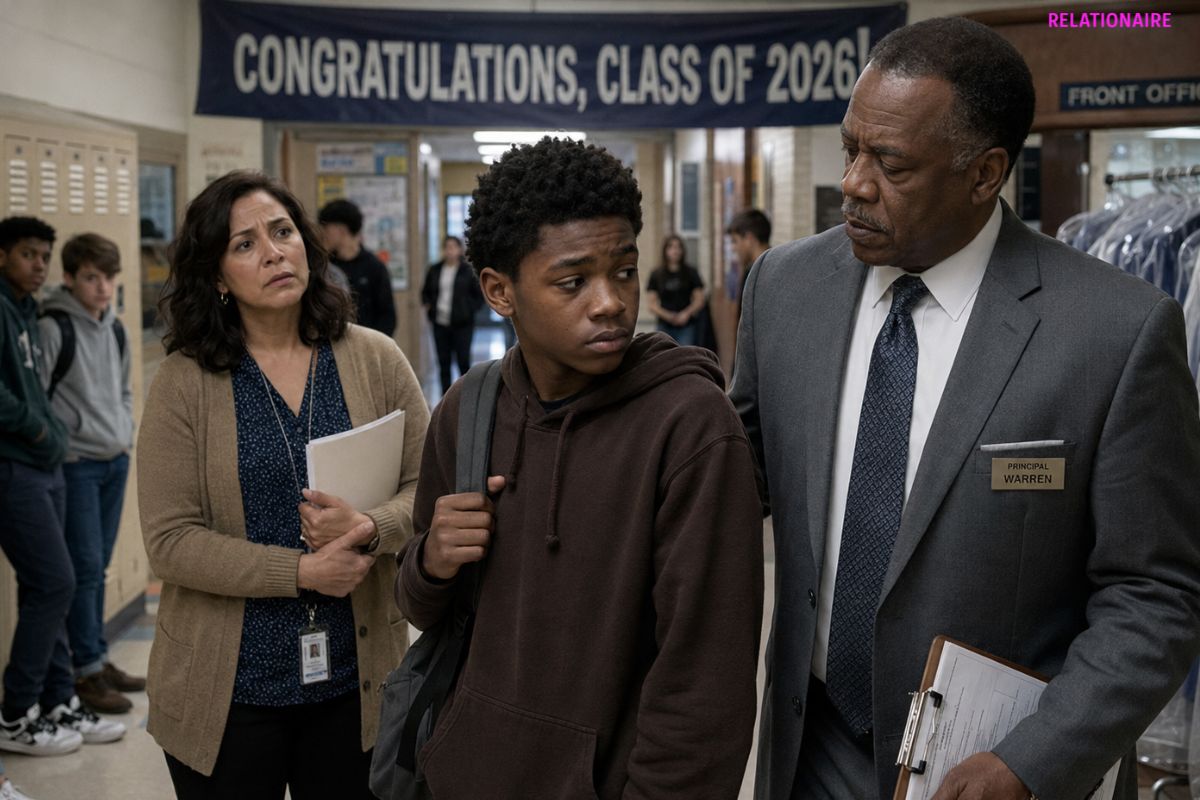
Nobody clapped when Principal Warren walked into the eighth-grade hallway.
The kids just got quieter.
Not respectful quiet.
Careful quiet.
The kind of quiet children use when they think an adult is made of rules instead of skin.
He moved down the scuffed tile floor with his clipboard tucked under one arm, his tie straight, his face unreadable. Behind him, the graduation banner drooped from one corner where the tape had given up.
CONGRATULATIONS, CLASS OF 2026!
Under it, Marcus Bell stood outside my classroom with his backpack hanging from one shoulder and his jaw locked so tight I could see it from twenty feet away.
I had taught Marcus for two years.
He was the boy who fixed broken pencil sharpeners without being asked. The boy who made the quiet kids laugh. The boy who pretended not to care about school pictures, then tucked them carefully into his binder so they would not bend.
He was also the boy who had been late fourteen times that quarter.
The boy who had three missing projects.
The boy who fell asleep during state testing with his cheek pressed against the answer sheet.
But he was not a bad kid.
I knew that.
So when Principal Warren stopped in front of him and said, “Marcus, come with me,” my stomach sank.
Marcus looked past him at me.
Just once.
Not scared exactly.
More like tired.
“Mr. Warren,” I said, stepping into the hallway, “can we talk first?”
The principal did not turn his head right away. He looked at the hallway full of students, at the boys pretending not to listen by their lockers, at the girls frozen with lip gloss still in their hands.
Then he said, “Mrs. Alvarez, I’ll speak with you after school.”
After school.
That was his answer for everything.
After school.
In writing.
Per district policy.
Please refer to the handbook.
I watched him lead Marcus toward the office, past the lost-and-found bin overflowing with sweatshirts, past the glass case full of honor roll certificates, past the graduation gowns hanging in clear plastic bags near the front office.
One of those gowns had Marcus’s name written on masking tape.
He had tried it on the day before.
It was too long, and he had laughed for the first time in a week when it swallowed his sneakers.
Now, by lunch, everyone knew.
Marcus Bell had been suspended.
Three days.
Which meant he would miss the eighth-grade picnic.
The awards breakfast.
The graduation rehearsal.
And maybe, depending on how the district interpreted the rule, the ceremony itself.
By sixth period, the rumor had grown teeth.
Marcus had threatened somebody.
Marcus had stolen something.
Marcus had been caught with something.
Marcus had finally “gone too far.”
I wanted to grab every rumor by the throat.
Instead, I stood at the front of Room 214 with a dry erase marker drying in my hand while my students stared at me with the same question.
Why didn’t you stop it?
The truth was, I had tried.
And failed.
After the final bell, I found Principal Warren in his office.
Not sitting.
Standing.
Of course he was standing.
His blinds were half-closed. His desk was covered in neat stacks: attendance forms, behavior reports, parent emails printed and highlighted. His coffee sat untouched beside the phone.
“Can you explain to me,” I said, closing the door harder than I meant to, “why you suspended Marcus Bell three days before graduation?”
He looked up.
His face did not change.
“Marcus violated the conduct policy.”
“What policy?”
He placed one hand on a folder.
“Leaving campus without permission. Refusing to comply when redirected. Insubordination.”
“That’s what you wrote?”
“That’s what happened.”
I almost laughed because it felt safer than yelling.
“Do you know what else happened? He spent all semester carrying his little sister’s backpack because she was being teased on the bus. He shared his lunch with Devon twice last week. He stayed after school to help me stack chairs because my back was acting up. That kid has more character than half the adults in this building.”
A flicker passed across his face.
Small.
Gone too fast.
“Character does not exempt a student from safety rules,” he said.
There it was.
The handbook voice.
The voice that made kids roll their eyes and teachers lower theirs.
“You’re taking graduation away from him,” I said. “Do you understand what that means to a child like Marcus?”
His hand tightened on the folder.
“A child like Marcus?”
I heard the edge in his voice and hated myself for the wording.
“You know what I mean.”
“No,” he said quietly. “I’d rather you say what you mean.”
I looked at the certificates behind him. Perfect attendance. District leadership. Staff safety compliance. All framed. All cold.
“I mean a child who doesn’t get many wins,” I said. “A child who needs one adult in this building to see more than his mistakes.”
For the first time, Principal Warren looked tired.
Not annoyed.
Not angry.
Tired.
But he blinked it away.
“Mrs. Alvarez,” he said, “I cannot discuss every detail with you.”
“Because it’s confidential?”
“Yes.”
“Or because there is no detail?”
His jaw moved once.
He looked toward the office window where Marcus’s graduation gown hung in the hallway.
Then he said, “The decision stands.”
I walked out before I said something I could not take back.
In the staff lounge, Mrs. Chen from science was eating soup out of a mug.
“He suspended him?” she asked.
I nodded.
“Poor kid.”
“Poor kid?” Mr. Daniels, the gym teacher, said from the copier. “Marcus has been a mess lately.”
“He’s thirteen,” I snapped.
“Fourteen,” Mrs. Chen corrected softly.
That made it worse somehow.
Fourteen.
Old enough for adults to call him difficult.
Young enough to still draw stars in the margins of his math packet.
I stayed late that evening grading essays I could not focus on. The building emptied around me. Lockers slammed. The after-school program kids shouted in the cafeteria. The custodian’s cart squeaked down the hallway like a tired animal.
At 6:17, I passed the front office on my way out.
Principal Warren’s door was cracked open.
His light was still on.
I could hear his voice.
Not the official one.
A lower one.
“I understand,” he said. “No, I am not asking you to ignore it. I am asking you to let me bring him in safely tomorrow morning.”
I stopped.
I knew I should keep walking.
I knew it.
But then he said Marcus’s name.
“I know what the report says about Marcus Bell,” he continued. “But if an officer shows up at graduation rehearsal, he will run. You know that. I know that. His grandmother knows that.”
My hand tightened around my tote bag strap.
Officer?
Report?
Grandmother?
There was silence.
Then Principal Warren’s voice came again, rougher now.
“No, his teacher doesn’t know. She thinks I suspended him because I’m heartless.”
My face went hot.
He gave a short, broken laugh.
“I can live with that.”
The office phone beeped.
A voicemail had started playing on speaker.
A woman’s voice filled the empty office, trembling so hard it barely sounded like speech.
“Mr. Warren, it’s Denise Bell again. Marcus didn’t come home. I checked the laundromat, I checked behind the store, I checked everywhere. Please… please don’t let them take him in front of all those kids tomorrow. He ain’t bad. He’s just scared. He heard what his uncle did and thinks it’s his fault…”
The message cracked into a sob.
And then the voicemail said something that made the hallway tilt beneath me.
“Please, Mr. Warren. If Marcus finds out his baby sister saw everything, he’ll never forgive himself.”
PART 2
I stood outside that office door with my keys in my hand and shame burning up the back of my neck.
For a few seconds, I forgot how to move.
Inside, the voicemail ended.
The building hummed.
Somewhere down the hall, a trash bag snapped open.
Principal Warren did not speak right away.
Then I heard his chair scrape.
I should have walked away.
Instead, I knocked.
The office went still.
“Come in,” he said.
When I opened the door, his face told me he already knew I had heard enough.
Not everything.
But enough.
His phone sat on the desk, the little red voicemail light blinking like a warning.
“I’m sorry,” I said.
It came out too small.
He looked down at the folder under his hand.
“Mrs. Alvarez.”
“I didn’t mean to overhear.”
“No,” he said. “But you did.”
There was no anger in it.
That made it worse.
I stepped inside and closed the door gently this time.
“What is happening to Marcus?”
Principal Warren rubbed his thumb over the edge of the folder, back and forth, until the corner softened.
“I can’t give you all of it.”
“I know.”
He studied me.
Maybe deciding whether I meant it.
Finally, he said, “Marcus left campus today because he received a message that frightened him. He tried to go home. When security stopped him, he panicked.”
“Why?”
Principal Warren looked at the graduation gown outside the office window.
“Because there was an incident at his apartment complex last night involving his uncle. Police are investigating. Marcus believes he caused it.”
My chest tightened.
“Did he?”
“No.”
The answer was immediate.
Firm.
“Then why would he think that?”
“Because children make themselves responsible for adult damage all the time.”
That sentence landed heavier than anything he had said before.
I thought of Marcus sleeping through tests.
Marcus staring at the clock.
Marcus flinching when the hallway got too loud.
All the small signs I had seen.
All the signs I had not understood.
“What happened to his sister?” I asked.
Principal Warren’s eyes lifted.
“That part is not mine to tell.”
I nodded, but it hurt.
He opened the folder just enough to slide out a wrinkled emergency contact form.
I recognized Marcus’s handwriting in the corner, where he had doodled a tiny basketball next to his name.
Only one contact line was filled.
Denise Bell — Grandmother.
Under “Parent/Guardian 2,” a name had been crossed out so hard the paper had almost torn.
“His grandmother has been trying,” Principal Warren said.
The way he said trying told me he meant more than phone calls.
Rent.
Food.
Laundry.
Court dates.
Two children with different schools and one woman’s tired hands holding the whole thing together.
“The suspension was protective,” he said.
I looked at him.
He must have seen the question in my face because he answered it before I could ask.
“If Marcus came tomorrow, he would be pulled from rehearsal in front of two hundred students. Possibly questioned. Possibly placed in a patrol car if he ran or resisted. I requested time to coordinate with the family, the school social worker, and the youth officer. The cleanest way to keep him home without drawing attention was a conduct suspension.”
I sat down without meaning to.
The chair across from his desk creaked.
“So everyone thinks he’s in trouble.”
Principal Warren nodded.
“In a way that is familiar enough not to invite more questions.”
I hated how much sense it made.
I hated that I had called him heartless.
I hated that Marcus had to be protected by looking guilty.
“Why didn’t you tell me?” I asked.
“Because you love your students loudly.”
I blinked.
It did not sound like an insult.
But it still stung.
He leaned back, and for the first time, I noticed the lines around his mouth. The loosened tie. The tiny stain on his cuff from coffee or cafeteria chocolate milk.
“You would have defended him,” he said. “In the hallway. In the staff lounge. To other students. And every defense would have told people there was more to know.”
I looked down.
He was right.
I would have.
I had already done it.
“How long have you been dealing with this?”
He did not answer at first.
Then he said, “Since the first week Marcus stopped turning in homework.”
That was six weeks ago.
Six weeks.
While the rest of us complained about missing assignments, Principal Warren had been reading between the blanks.
“I called home,” I said weakly.
“I know.”
“I emailed.”
“I know.”
“She never answered.”
“She works nights at the hospital laundry,” he said. “And mornings at the grocery store bakery. She sleeps from two to five when she can. Her phone has been cut off twice.”
A memory flashed in my mind.
Marcus sitting at his desk, eyes red, tracing circles on a spelling test he had failed.
I had written: See me after class.
He had not come.
I had been irritated.
God, I had been irritated.
“What can I do?” I asked.
Principal Warren looked at me for a long moment.
Then he slid Marcus’s folder fully open.
Inside were not just discipline forms.
There were sticky notes.
Times.
Names.
Phone numbers.
A printed map of the apartment complex.
A list of agencies.
A copy of a grocery store receipt clipped to a school lunch envelope.
At the bottom of the stack was a small yellow note in Principal Warren’s square handwriting:
Graduation gown set aside. Do not return to vendor.
My throat closed.
“You kept his gown.”
“I’m not taking graduation from him,” he said.
His voice was quiet.
“But I may not be able to give it back the way he imagined.”
The next morning, Marcus did not come to school.
By third period, the whole eighth grade had decided what that meant.
“He got expelled,” someone whispered.
“No, he’s in jail,” another said.
“Stop,” I said too sharply.
Twenty-seven faces looked up at me.
Some embarrassed.
Some curious.
Some frightened because kids always know when adults are scared, even when we smile.
I turned to the board.
The lesson was supposed to be about persuasive writing.
Claim.
Evidence.
Reasoning.
I stared at those words until they blurred.
Then I capped the marker.
“Today we’re going to talk about what we do when we don’t know the whole story.”
No one spoke.
I did not say Marcus’s name.
I could not.
But I talked about rumors.
About how fast they run.
About how easy it is to turn a person into one mistake because it makes the world feel simpler.
A girl in the second row lowered her eyes.
A boy in the back stopped tapping his pencil.
Then Devon, Marcus’s best friend, raised his hand.
“Mrs. Alvarez?”
“Yes?”
His voice was small.
“Can we sign his yearbook anyway?”
The room went still.
I looked at Marcus’s empty desk.
There was a glue stick cap under it. His, probably. He was always losing them.
“Yes,” I said. “We can.”
At lunch, I carried Marcus’s yearbook from table to table.
The kids wrote what thirteen- and fourteen-year-olds write when they are trying to say love without embarrassing themselves.
You better come back, bro.
You were funny sometimes.
Thanks for helping me when I cried in science. Don’t tell nobody.
Graduation won’t be the same.
Devon wrote last.
He took the longest.
When he handed the yearbook back, the page was wet in one corner.
After school, I found Principal Warren in the teacher parking lot beside his old gray sedan.
He was loading two grocery bags into the back seat.
Not school supplies.
Groceries.
Cereal. Apples. Pasta. A pack of small pink socks.
He froze when he saw me.
I froze too.
Neither of us said anything.
Then he shut the door.
“For the family resource pantry,” he said.
But we both knew the pantry had closed at four.
“I didn’t see anything,” I said softly.
His shoulders dropped a little.
“Thank you.”
A car pulled into the lot too fast.
An old blue Honda with a cracked windshield.
A woman climbed out before it stopped rocking.
She was small, maybe in her late sixties, with hospital scrubs under a winter coat even though it was warm outside. Her hair was wrapped in a scarf. Her hands shook as she gripped a folded piece of paper.
“Mr. Warren,” she called.
He crossed the lot quickly.
I stayed where I was.
But her voice carried.
“They found him,” she said.
The principal went very still.
“Where?”
“Bus station,” she whispered. “He was trying to get to his uncle before court. He thinks if he tells them it was his fault, they’ll leave his sister alone.”
My hand flew to my mouth.
Principal Warren turned once toward the school building.
Toward me.
Toward the graduation gowns waiting inside.
Then Denise Bell said the sentence that broke the last piece of anger I had left.
“He won’t talk to me. But he asked for his teacher.”
PART 3
When I saw Marcus at the youth services building, he looked smaller than he had in my classroom.
Not younger.
Smaller.
As if the world had pressed down on him from every side.
He sat at the end of a plastic table in a hoodie with one sleeve stretched over his hand. His sneakers were dusty. His eyes were dry in the way children’s eyes get when they have already cried all they can.
Principal Warren stood by the door with Denise Bell.
Marcus’s little sister, Lila, was asleep against her grandmother’s hip, her face tucked into a pink jacket. One sock was new. One was old and gray at the heel.
I noticed because once you have heard the truth, every small thing becomes loud.
“Marcus,” I said.
He did not look up.
“Hey.”
His shoulders moved a little.
Not a shrug.
Not a greeting.
Just proof he had heard me.
I sat across from him.
For a moment, I was back in Room 214 watching him pretend a bad grade did not hurt.
Only now there was no worksheet between us.
Just a boy and the terrible thing he had decided about himself.
“Your class signed your yearbook,” I said.
His eyes flicked up.
Then away.
“I’m not graduating.”
“You don’t know that.”
“I’m suspended.”
I glanced at Principal Warren.
He gave no sign that I should explain.
So I stayed with what was true.
“You’re not forgotten.”
Marcus swallowed.
His voice came out rough.
“Everybody thinks I did something bad.”
I wanted to say no.
But I had heard the hallway.
I had carried the yearbook.
I had seen the way children protect themselves by becoming cruel before anyone can be cruel to them.
“Some people don’t know the whole story,” I said.
His mouth twisted.
“Story don’t matter.”
“It does.”
“No, it doesn’t.” His voice cracked. “Because Lila saw it. She saw Uncle Ray get taken. She saw the blood on the stairs. She heard me yelling at him before. I told him I hated him. I told him I wished he’d leave and never come back.”
His hands curled into fists on the table.
“And then he did something stupid, and now everybody’s saying he’s going away, and Lila won’t sleep unless the light’s on, and Grandma keeps crying in the bathroom like we can’t hear.”
He pressed his sleeve to his eyes.
“So I was gonna tell them it was my fault. Then they’d stop asking her.”
There are moments in teaching when you realize the lesson is not yours anymore.
You are not there to explain.
You are there to witness.
To sit close enough that a child does not have to be alone with the lie he built to survive.
“Marcus,” I said softly, “you are not responsible for what adults do when they are angry or hurting.”
He shook his head.
“You don’t know.”
“I know enough.”
He looked at me then.
Really looked.
So I told him what I had not planned to tell him.
“When I was fifteen, my mother got sick. I thought if I got better grades, she’d get better too. I thought if I cleaned the kitchen right, if I didn’t ask for anything, if I was easy to love, maybe the house would stop being sad.”
His face changed.
Just slightly.
“I was wrong,” I said. “But it took me years to believe that.”
Principal Warren looked down at the floor.
I wondered what old guilt he carried.
We all carry something into schools.
A lunch bag.
A gradebook.
A grief no one sees.
Marcus wiped his nose with his sleeve.
“I ran,” he said.
“Yes.”
“I cussed at Mr. Warren.”
“Yes.”
“I left campus.”
“Yes.”
“So I messed up.”
“You made scared choices,” I said. “That’s not the same as being a bad person.”
For the first time, Principal Warren stepped forward.
Marcus stiffened.
The principal noticed and stopped.
He kept his voice low.
“Marcus, I need to tell you something, and I need you to hear all of it before you decide I’m lying.”
Marcus looked away.
Principal Warren continued anyway.
“I suspended you because if you came to school yesterday, the officer assigned to the case was going to pull you from graduation rehearsal. There were too many students. Too many rumors already. I believed you might run.”
Marcus’s eyes lifted.
“I did run.”
“I know.”
“Then you were right.”
“I wish I hadn’t been.”
That landed.
Not like a rule.
Like regret.
Principal Warren took a folded plastic garment bag from Denise Bell. I had not noticed she was holding it.
Inside was Marcus’s blue graduation gown.
Still tagged with masking tape.
Still his.
“I also need you to know,” the principal said, “I never removed you from the graduation list.”
Marcus stared at the bag.
His lips parted, but no sound came out.
Denise Bell covered her mouth.
Lila stirred against her shoulder.
“The district approved an alternate plan,” Principal Warren said. “You will meet with the youth officer privately this afternoon with your grandmother and a counselor present. No hallway. No audience. No handcuffs. No shame.”
Marcus blinked hard.
“And graduation?”
“If you can follow the safety plan, you walk.”
The room went quiet.
Then Marcus put his face in his hands.
He did not sob loudly.
He just folded.
Like a child who had been holding a door shut with his whole body and finally realized someone else had come to help.
Denise moved first.
She sat beside him and wrapped one arm around his shoulders.
“I’m sorry, baby,” she whispered. “I’m so sorry you thought you had to fix this.”
Marcus leaned into her like he was five.
Principal Warren turned toward the window.
I saw him take off his glasses and press his fingers to his eyes.
Only for a second.
Then the official face returned.
But I had seen the man under it.
Two days later, graduation filled the middle school gym with folding chairs, camera flashes, perfume, floor wax, and the nervous electricity of almost-high-schoolers trying not to look emotional.
Teachers lined the wall.
Parents fanned themselves with programs.
The band played too loudly.
And in the last row of students, Marcus Bell sat in his blue gown.
It was still too long.
It still swallowed his sneakers.
But he was there.
When his name was called, the applause started polite.
Then Room 214 stood up.
All at once.
Devon first.
Then the rest.
Then Mrs. Chen.
Then Mr. Daniels.
Then parents who did not know why they were standing but stood anyway because sometimes a room can feel what it has not been told.
Marcus walked across the stage with his head down.
Halfway there, he looked at Principal Warren.
The principal held out the certificate.
Their eyes met.
Marcus took it.
Then, in front of everyone, he leaned forward and hugged him.
It was awkward.
A fourteen-year-old boy in an oversized gown hugging the principal everyone thought was made of rules.
Principal Warren froze.
Then his hand came up slowly and held Marcus’s back.
Just once.
Just enough.
The gym went quiet before it clapped.
Afterward, in the hallway, Marcus found me by the lost-and-found bin.
“Mrs. Alvarez?”
“Yes?”
He held out his yearbook.
On the inside cover, under all the messy student messages, there was one new note written in square, careful handwriting.
Marcus,
A mistake is something you did. It is not who you are.
Keep walking.
— Mr. Warren
Marcus tapped the note with his thumb.
“He’s not as mean as everybody thinks,” he said.
“No,” I said. “He isn’t.”
Across the hallway, Principal Warren was helping a parent find a missing diploma envelope. Someone had spilled punch near the office. A younger sibling was crying because his balloon had floated to the ceiling.
The school was still a school.
Messy.
Loud.
Underfunded.
Full of scuffed floors, broken zippers, late buses, unpaid lunch accounts, and children pretending they were fine.
But that day, I saw it differently.
Not as a building where rules lived.
As a place where tired adults quietly stood between children and the worst moments of their lives.
Sometimes care looks soft.
A hand on a shoulder.
A signed yearbook.
A lunch slipped into a backpack.
And sometimes care looks cold from far away because it is busy protecting someone up close.
That was the lesson I carried out of the gym that afternoon.
Not every person who seems hard has stopped feeling.
Some are simply holding the line so a child can make it safely to the other side.