If you’ve already read part 1 of this story on Facebook, go here for Part 2!
PART 1
The first Christmas Eve after my mother died, my father came home with bloodshot eyes, a cold cup of coffee, and an apology he had used too many times.
“I’m sorry, Lila,” he said, standing in the doorway with snow on his coat.
I was thirteen.
I had set two plates at the kitchen table, even though I knew better.
By then, I had already learned the sound of his pager better than the sound of his laugh. I knew how his face changed when the hospital called. His eyes would leave the room first. Then his body would follow.
That night, I pushed his plate into the sink.
“You always are,” I said.
He didn’t argue.
That was the worst part.
He never argued.
Not when he missed my winter concert in seventh grade. Not when he missed my sixteenth birthday dinner. Not when he promised he’d be home for Thanksgiving and arrived after the turkey had gone dry and my aunt had wrapped the leftovers in foil.
He just stood there in his wrinkled shirt, looking older than other people’s fathers.
“I had a patient,” he would say.
And I would think, You had a daughter, too.
By the time I was seventeen, resentment had become part of how I spoke to him.
Short answers.
Closed doors.
Headphones in.
I loved him. I did.
But love can sit beside anger for years and never introduce itself.
That December, snow came early and hard. The roads turned silver. The neighborhood disappeared under a quiet white blanket that made every house look warm except ours.
Our Christmas dinner was supposed to be at my aunt’s place at six.
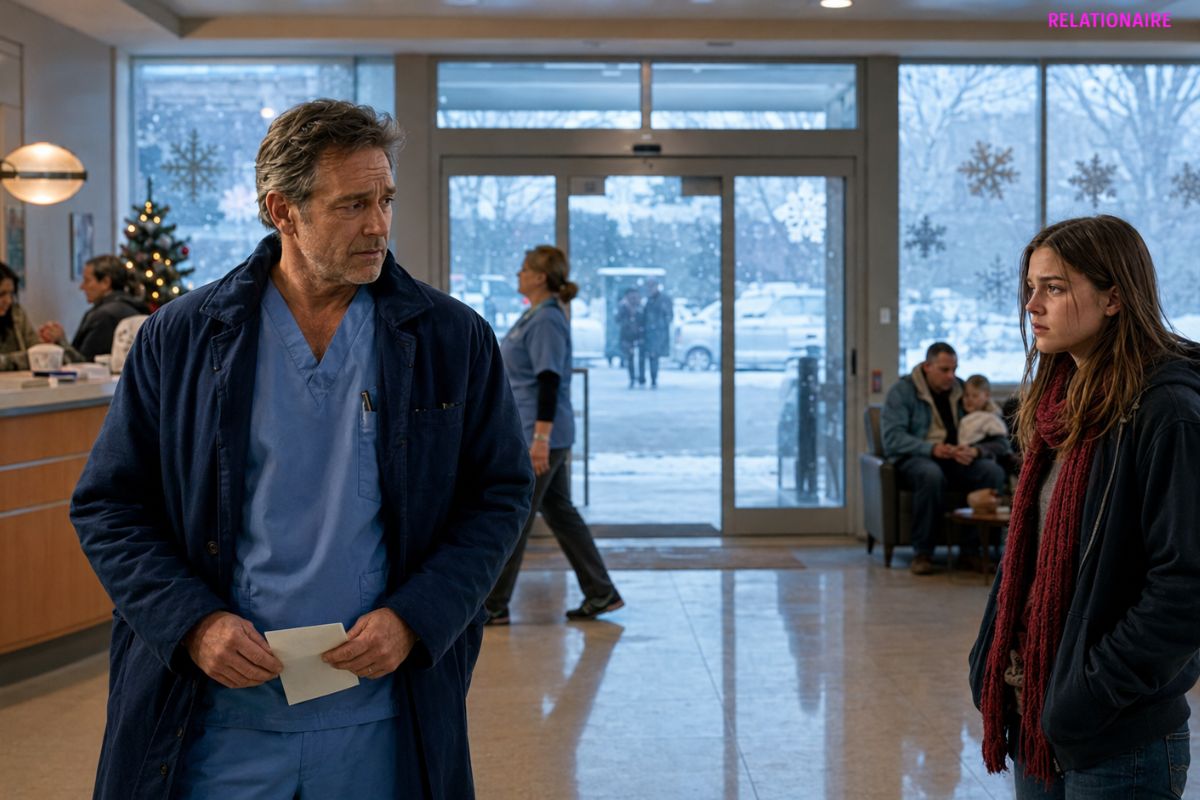
At five-thirty, Dad stood at the bottom of the stairs in his navy coat, phone pressed to his ear.
I didn’t even wait for him to speak.
“Don’t,” I said.
He looked up.
His hair had more gray than the year before. There was a crease between his eyebrows that never fully went away.
“Lila—”
“No.” I came down the stairs holding the scarf my mother had knitted, the red one she wore every Christmas. “Don’t say you’re sorry. Don’t say they need you. Don’t say it’s just a few hours.”
His hand lowered from his ear.
“The hospital called. There was a pileup on the interstate. They’re short.”
I laughed once. Not because it was funny.
“Of course they are.”
My aunt’s car couldn’t make it through the snow to get me. The buses had stopped. The roads were getting worse by the minute.
So my father said the only thing that made me hate him more.
“You can come with me and wait in the lobby. It’ll be safer than leaving you here alone if the power goes out.”
I stared at him.
“Spend Christmas Eve at your hospital?”
He swallowed.
“I know it’s not fair.”
“No,” I said, grabbing my coat. “It’s perfect. Maybe I’ll finally understand what’s more important than me.”
He flinched.
Just a little.
Enough that I saw it.
Not enough that I cared.
The hospital looked nothing like Christmas from the outside. Just bright windows, salt-stained doors, and ambulances crawling through the snow with their lights flashing silently against the storm.
Inside, someone had taped paper snowflakes to the lobby windows.
A small artificial tree leaned beside the front desk, decorated with blue gloves blown up like balloons. There was a bowl of candy canes no one touched. A volunteer in a red sweater was handing out paper cups of hot chocolate to children wrapped in blankets.
Dad walked fast, already becoming someone else.
At home, he was quiet and tired.
At the hospital, people moved aside when they saw him.
“Dr. Mercer,” a nurse called from behind the desk. “Room nine is asking for you.”
“Tell them I’m coming,” he said.
A man in a soaked work jacket stood from a chair. “Doctor? Is my wife—”
Dad stopped. Turned. Put one hand gently on the man’s shoulder.
“I’m going to check on her now,” he said. “I won’t leave until I can tell you something real.”
Something real.
I hated that line because it sounded too kind.
He looked back at me.
“Wait here. I’ll be as quick as I can.”
“You won’t,” I said.
He didn’t defend himself.
He just nodded and disappeared through the double doors.
For the first hour, I sat with my arms folded so tightly my fingers went numb.
The lobby smelled like wet coats, coffee, and disinfectant. The automatic doors kept opening to the storm. Every time they did, cold air slid across the floor and under my boots.
People came in holding pieces of themselves together.
A mother with a toddler asleep against her chest.
An old man wearing pajama pants under his winter coat.
A woman crying quietly into a tissue while a teenager rubbed her back.
And every few minutes, someone said my father’s name.
“Dr. Mercer said he’d call.”
“Dr. Mercer told us to wait here.”
“Dr. Mercer promised he would explain.”
Promised.
That word bothered me.
Because I knew what his promises were worth.
At seven-fifteen, a nurse brought me a paper cup of cocoa.
“Your dad asked me to give you this.”
I almost refused it.
But my hands were cold, so I took it.
“He always worries you don’t eat when you’re upset,” she said.
I looked at her. “He told you that?”
She smiled softly. “Your father tells us more about you than you think.”
I didn’t know what to say.
So I stared at the cup.
At eight, Dad passed through the lobby with a chart tucked under his arm. His face was pale. His stethoscope hung crooked around his neck.
“Can we go now?” I asked.
He stopped, glanced toward the hallway, then back at me.
“Soon.”
That word.
Soon.
I stood up. “No. You said a few hours.”
“I know.”
“You always know.”
His mouth opened, but behind him a woman in a green sweater rushed forward.
“Dr. Mercer?”
He turned immediately.
Her voice broke. “My father keeps asking for the doctor with the kind eyes. That’s you, right?”
Dad’s expression changed.
It softened in a way I had almost forgotten.
“What’s his name?” he asked.
“Mr. Callahan,” she said. “Thomas Callahan.”
I froze.
Callahan.
My favorite teacher was Ms. Callahan.
The woman held out a folded envelope with trembling fingers.
“He said if anything happened, you were supposed to read this first.”
Dad stared at the envelope like it had weight.
Then he turned and looked at me.
Not like a doctor.
Like a father who had been carrying a secret too carefully.
“Lila,” he said quietly, “there’s something I should have told you a long time ago.”
PART 2
I didn’t move.
The lobby noise seemed to fall away, leaving only the buzz of fluorescent lights and the soft slap of wet boots near the entrance.
Dad held the envelope but didn’t open it.
He looked at the woman in the green sweater and said, “I’ll be right there.”
She nodded, wiping her cheek with the heel of her hand. “He keeps asking if you remember the song.”
Dad closed his eyes for half a second.
“I remember.”
The song?
I wanted to ask.
I wanted to grab his sleeve and demand the whole truth right there, in the middle of the lobby, under the crooked Christmas tree with glove ornaments.
But he turned back to me.
“Lila, stay here. Please.”
“No,” I said. “You don’t get to say something like that and walk away.”
His face tightened with pain.
“I have to see him first.”
“Of course you do.”
The words came out sharp.
A nurse behind him looked away like she had heard too much.
Dad didn’t correct me. He didn’t raise his voice. He just tucked the envelope carefully inside his coat pocket, as if even paper could bruise.
“I’ll come back,” he said.
I sat down because my knees didn’t feel steady.
For the next forty minutes, I watched the hospital swallow my father again.
But this time, I couldn’t stay angry the same way.
Not cleanly.
Not easily.
Mr. Callahan.
Thomas Callahan.
I knew that name because I had seen it written in blue ink on the corner of Christmas cards on my teacher’s desk.
Ms. Callahan taught English like books were life rafts.
She was the first adult at school who noticed I had stopped turning in homework after Mom died.
Not scolded.
Not embarrassed me.
Not called me “strong,” which was the thing people said when they didn’t want to sit beside your sadness.
She had simply placed a granola bar on my desk one morning and whispered, “You don’t have to explain today. Just eat something.”
When I cried in the girls’ bathroom during winter exams, she sat outside the stall on the tile floor in her pencil skirt and read attendance emails out loud in a ridiculous voice until I laughed through my tears.
She once drove me home after rehearsal because Dad was stuck at the hospital.
I had never told him that part.
I had been too angry.
Too proud.
Too determined to keep my hurt separate from him.
At nine-twenty, a man wearing a Santa hat over his hospital badge stopped beside my chair.
“You Dr. Mercer’s daughter?”
I nodded carefully.
He handed me a wrapped sandwich from the cafeteria.
“He said turkey, no mustard.”
I stared at it.
That was what my mother used to pack me for school.
Turkey. No mustard. Apple slices if we had them.
“He remembers that?” I asked before I could stop myself.
The man smiled. “Your dad remembers everything. It’s annoying, honestly.”
He left before I could answer.
I opened the sandwich and took one bite.
The bread was a little dry.
I ate half anyway.
Across the lobby, an older woman sat alone with a prayer card folded between both hands. She kept looking toward the double doors. Every time someone came out, hope lifted her chin, then disappeared again.
At some point, Dad came through those doors.
He didn’t see me first.
He went straight to the older woman.
I couldn’t hear everything, but I saw him kneel so he wasn’t standing over her. I saw him take off his glasses. I saw her put one hand over her mouth.
He did not rush her.
No pager.
No phone.
No looking past her shoulder.
For five full minutes, my father gave that woman the kind of attention I had begged for my whole teenage life.
And that was when the unfair thought came.
Maybe he did know how to stay.
Maybe he just didn’t stay for me.
The thought hurt so much I had to stand.
I walked down the hallway before anyone could stop me.
The hospital corridors were quieter away from the emergency entrance. A janitor pushed a yellow mop bucket past a row of holiday cards taped to the wall. Somewhere, a baby cried. Somewhere else, a machine beeped with steady patience.
I found a vending machine and bought crackers I didn’t want.
When I turned, Dad was at the end of the hallway.
He looked exhausted.
Not busy.
Not distracted.
Exhausted in a way that made me feel mean before he said a word.
“I told you to wait in the lobby,” he said softly.
“I’m not six.”
“No,” he said. “You’re not.”
That answer made me angrier.
“You missed her last Christmas, too,” I said.
His face went still.
My mother had died in March. Her last Christmas had been quiet. She had wrapped gifts sitting on the couch because standing made her tired. Dad had been called in halfway through dinner.
I remembered Mom smiling too hard and saying, “Go. Someone else needs you tonight.”
I remembered hating her for letting him.
I remembered hating him more for going.
Dad leaned against the wall like the memory had weight.
“I know.”
“That’s all you ever say.”
His eyes shone, but he blinked it back.
“Because it’s true.”
“No. It’s not enough.”
He nodded.
“You’re right.”
The hallway stretched between us.
Snow hit the windows at the far end in soft, silent bursts.
“Mr. Callahan,” I said. “Is he Ms. Callahan’s father?”
“Yes.”
“How do you know him?”
Dad looked down.
For a moment, he seemed to be deciding whether to protect me or finally trust me.
“Your mother knew him first,” he said.
My breath caught.
“What?”
He touched the pocket where the envelope waited.
“When your mom was in treatment, she shared a room for one night with Mr. Callahan’s wife. Evelyn. They were both scared. Both trying not to show it. Your mother sang to her.”
A strange chill went through me.
“My mother sang?”
Dad smiled faintly.
“That old Christmas song she loved. Off-key. Quietly. Evelyn held her hand until she fell asleep.”
I pictured it, though I had never been there.
My mother in a hospital bed.
A stranger beside her.
Two women holding fear between them like a candle.
“After Evelyn passed,” Dad continued, “Mr. Callahan came back every Christmas Eve and brought cookies for the nurses. Said this place felt less lonely if he could bring something sweet into it.”
His voice broke, just barely.
“Last year, when I missed Christmas dinner, I wasn’t with a stranger. I was with him. He had just received bad news, and he asked me not to leave him alone until his daughter got there.”
Ms. Callahan.
The woman who had sat on a bathroom floor for me.
The woman who knew what grief looked like on a teenager’s face.
I swallowed hard.
“Why didn’t you tell me?”
Dad’s mouth trembled.
“Because I thought you had lost enough. I didn’t want every holiday to become another hospital story.”
I wanted to stay angry.
Some part of me still did.
But anger is harder to hold when the person you blame is bleeding quietly, too.
Before I could speak, the woman in the green sweater appeared at the end of the hallway.
Behind her stood Ms. Callahan.
My teacher.
Her hair was pulled back messily. Her coat was buttoned wrong. Her face looked smaller without the calm classroom smile she always wore.
She saw me and stopped.
“Lila?”
I could barely answer. “Ms. Callahan?”
She looked from me to my father, then pressed a hand to her chest.
“Oh,” she whispered. “You’re his daughter.”
Dad closed his eyes.
Ms. Callahan stepped closer.
Her voice shook.
“Your father is the reason mine survived last Christmas.”
The crackers slipped from my hand and scattered across the floor.
PART 3
Nobody moved for a second.
The crackers lay between us like tiny broken pieces of something I could not name.
Ms. Callahan bent to pick them up, because of course she did. Even with her father down the hall. Even with her own hands shaking.
I knelt too.
“I’m sorry,” I whispered.
She looked at me.
Not like a teacher.
Like a daughter.
“You don’t have to be sorry for being hurt.”
That nearly undid me.
Because that was exactly the kind of thing she had said after my mother died. Simple. Gentle. No demand that I become easier to love.
Dad crouched slowly, gathering the last of the crackers into his palm.
His fingers trembled.
For years, I had thought of his hands as doctor hands. Capable. Calm. Always needed somewhere else.
That night I saw they were just hands.
A man’s hands.
A father’s hands.
Tired from holding too many people at the edge of falling apart.
Ms. Callahan looked toward the room at the end of the hall.
“My dad asked for you,” she told my father. “He said there’s something in the envelope.”
Dad nodded.
“I haven’t opened it.”
“He wanted Lila there.”
I looked up.
“Me?”
Ms. Callahan’s eyes filled.
“He knows who you are.”
The room was warm and dim. Someone had taped a child’s drawing of a Christmas tree to the wall. A paper cup of water sat untouched on the table. There was a blanket folded neatly over a chair, the kind families bring from home because hospital blankets never feel soft enough.
Mr. Callahan was older than I expected.
Small under the covers. White hair combed carefully. A gold wedding ring loose on his finger.
But when he saw my father, his face changed.
“There he is,” he said, voice thin but bright. “The doctor who keeps missing dinner.”
Dad let out something that was almost a laugh and almost a sob.
“You promised not to call me that.”
Mr. Callahan turned his head toward me.
“And this must be the dinner.”
I stood frozen near the door.
Ms. Callahan touched my shoulder.
“It’s okay.”
My father sat beside the bed.
Mr. Callahan tapped the pocket of Dad’s coat.
“Read it.”
Dad took out the envelope.
His name was written on it in careful, shaky handwriting.
Dr. Mercer — if I’m too tired to say this right.
Dad opened it slowly.
Inside was one sheet of paper and a small photograph.
The photograph was old, the edges worn soft.
My mother sat in a hospital chair wearing a red scarf, the same one I had around my neck. Beside her was a woman I didn’t know, bald under a blue knit cap, smiling weakly.
Between them sat a plate of cookies.
On the back, in my mother’s handwriting, it said:
Christmas Eve. Evelyn and me. Still here.
Dad pressed the photo to his mouth.
Mr. Callahan watched him with wet eyes.
“She gave me that scarf once,” he said to me. “Not to keep. Just for ten minutes. Evelyn was cold. Your mother said red made people look braver.”
I gripped the scarf.
I could almost feel Mom’s hands in the yarn.
Mr. Callahan looked at Dad.
“Read the letter.”
Dad tried.
He really did.
But after the first line, his voice failed.
So Ms. Callahan took the paper gently and read it for him.
“Dr. Mercer,
If you are reading this, it means I got sentimental again. Forgive an old man. We become embarrassing when we know time is precious.”
Ms. Callahan paused, breathing through tears.
“You missed Christmas dinner last year because I asked you to stay until my daughter arrived. I knew you had a girl at home. You told me twice. I saw what it cost you.
But I need her to know something.
Her mother did not spend her last Christmas abandoned.
She spent it loving strangers.
She told my Evelyn about Lila. About her laugh. About how she hated peas. About how she sang too loudly in the car. She said, ‘If I don’t get as many years as I want, promise me someone will remind her she was loved enough for a lifetime.’
I promised.
Then your father promised too.
So if your daughter is angry, let her be angry. Children should not have to understand adult grief too soon.
But when she is ready, tell her this:
Every holiday he missed, he carried her with him.
Not instead of his family.
Because of them.”
Ms. Callahan stopped.
The room was silent except for the storm tapping the window.
Dad covered his face with one hand.
I had never seen him cry like that.
Not at Mom’s funeral.
Not when we packed her clothes.
Not when he found her grocery list in the junk drawer six months later and stood there staring at the word oranges.
I crossed the room before I knew I had moved.
For a moment, I was thirteen again, waiting at the table with two plates.
Then I was seventeen, standing beside a hospital bed on Christmas Eve, realizing my father had not been leaving me behind.
He had been trying to make a world where fewer people felt left behind.
“I thought you chose them,” I whispered.
Dad looked up.
His eyes were red.
“I thought if I told you how much it hurt, you’d feel responsible for me,” he said. “And you had already lost your mother. I didn’t want you to lose the chance to be a child, too.”
“I wasn’t a child,” I said, crying now. “I was lonely.”
His face crumpled.
“I know.”
This time, the words sounded different.
Not empty.
Not easy.
True.
I stepped into his arms.
He held me carefully at first, like he wasn’t sure he was still allowed to. Then tightly. So tightly I felt the pager on his belt press between us.
For once, when it buzzed, he didn’t move.
He just held me.
Mr. Callahan smiled from the bed.
“Good,” he whispered. “That’s the medicine.”
We laughed through tears.
A few minutes later, Dad had to step out to check on another patient. Of course he did.
But this time, before he left, he looked at me.
Not past me.
At me.
“I’ll come back,” he said.
And for the first time in years, I believed him.
Ms. Callahan and I sat beside her father while snow covered the parking lot outside. She told me Evelyn had loved peppermint candies. I told her my mother had burned toast every Christmas morning and blamed the toaster.
Mr. Callahan slept with the old photo resting near his hand.
At midnight, Dad returned carrying three paper cups of cocoa and a turkey sandwich cut in half.
“No mustard,” he said.
I took it.
Then I moved over so he could sit between me and the bed.
We ate Christmas dinner under fluorescent lights, beside a sleeping old man, with vending machine crackers and cooling cocoa and the kind of quiet that did not feel empty.
It felt like being gathered.
Years later, I would remember that Christmas more clearly than any perfect one.
Not because everything was fixed.
Grief does not work that way.
Anger does not vanish just because a letter explains it.
But something opened in me that night.
A door I had kept locked from the inside.
I learned that love does not always arrive on time.
Sometimes it comes late, wearing a wrinkled coat, carrying cold coffee, with apologies it does not know how to improve.
Sometimes it misses dinner because someone else is alone in a room.
Sometimes it breaks your heart before you understand the shape of it.
And sometimes, when you finally see the whole story, you realize love was there all along.
Just holding more people than you knew.