If you’ve already read part 1 of this story on Facebook, go here for Part 2!
PART 1
The little boy would not let anyone touch him.
Not the nurse with the soft voice.
Not the doctor who crouched beside the bed.
Not even his uncle, who kept saying, “It’s me, buddy. It’s Uncle Ray.”
The boy just pulled his knees to his chest, pressed his back against the raised hospital pillow, and stared at the door like the whole room was waiting to betray him.
His name was Milo.
Six years old.
Blue dinosaur pajamas.
One sock on, one sock missing.
A hospital bracelet too loose around his tiny wrist.
He had been admitted just after midnight for observation after a breathing scare at home. Nothing dramatic now, the doctor had said. He was stable. He needed rest. Fluids. Monitoring.
But Milo did not rest.
He sat upright in Room 412 like a small frightened bird trapped behind glass.
Every time someone entered, he flinched.
Every time the curtain moved, his hands gripped the blanket.
Every time a nurse came close with a thermometer, he whispered, “No.”
By 2:17 a.m., everyone on the pediatric floor knew about the boy in 412.
The one who would not drink.
The one who would not lie down.
The one who had cried so hard his voice had gone thin and scratchy.
His uncle stood beside the bed with his coat still on, one hand on the rail, trying not to look helpless.
Ray was a large man with tired eyes and work boots dusted with warehouse powder. His visitor badge was stuck crooked to his hoodie. He kept rubbing the back of his neck like there might be an answer there.
“Milo,” he said gently. “They’re trying to help.”
Milo looked away.
The nurse, Tanya, tried again.
She was good with children. Everyone said so. She carried stickers in her pocket and knew how to make a blood pressure cuff sound like a robot hug.
But that night, Milo watched her like she was holding something sharp, even when her hands were empty.
“No,” he whispered.
Tanya lowered the thermometer.
“That’s okay,” she said. “We can wait.”
Ray looked ashamed.
“I’m sorry,” he said to her. “He’s not usually like this.”
Tanya gave him the kind of smile nurses give when they have heard every version of a family apologizing for pain.
“He’s scared,” she said. “That’s all.”
But it wasn’t all.
Everyone could feel that.
There was a tightness in the room that didn’t belong only to hospitals. It felt older. Deeper. Like Milo was not just afraid of the machines, or the white coats, or the soft beep of the monitor beside him.
He was afraid of being left.
Ray tried cartoons on the wall-mounted television.
Milo turned his face toward the window.
Ray tried crackers from the vending machine.
Milo tucked his hands under his arms.
Ray tried calling him “champ,” then “buddy,” then “Milo James,” the way adults do when panic starts leaking through their patience.
Milo only whispered one word.
“No.”
At 2:43 a.m., Dr. Sloane came in.
He was kind, young, and already exhausted in the eyes. His hair was flattened on one side from a nap that had probably lasted seven minutes. He stood at the foot of the bed and spoke softly.
“Milo, I just need to listen to your lungs.”
Milo’s face crumpled.
“No.”
Ray stepped forward. “Come on, Milo. Just let him—”
“No.”
The word broke this time.
Not loud.
Worse than loud.
Small.
Terrified.
Dr. Sloane paused.
Tanya paused.
Ray closed his mouth.
For a moment, the only sound was the air vent whispering above them and the little plastic clip on Milo’s finger blinking red.
Then, from the hallway, came the squeak of wheels.
Not medical wheels.
Not a crash cart.
Not a meal tray.
A cleaning cart.
It stopped outside Room 412.
A woman in gray scrubs stood in the doorway holding a small roll of trash bags. She was short, with dark hair pinned low and a round, gentle face she seemed to keep pointed slightly downward, as though she had learned not to take up too much space.
Her name badge read: Elena Morales. Environmental Services.
She looked into the crowded room and froze.
“I’m sorry,” she said quickly. “I can come back.”
Tanya glanced at the overflowing bin near the sink. “It’s okay, Elena. Just the trash.”
Elena nodded and stepped in quietly.
She moved the way overnight hospital workers move when they understand that every room might contain someone’s worst night. Slow. Careful. No clatter. No bright cheerfulness.
She tied the first trash bag without looking at the bed.
Milo watched her.
Everyone noticed at once.
His shoulders did not rise.
His hands did not grip the blanket.
His eyes followed Elena as she crossed to the bin near the window.
Elena seemed not to notice. Or maybe she noticed everything and chose not to make him feel watched.
She lifted the bag, tied it, replaced it with a clean one, then reached for the paper towel on the floor.
Milo’s voice came out so softly that Ray almost missed it.
“She can stay.”
Elena stopped.
Tanya looked at Ray.
Ray stared at Milo.
“What, sweetheart?” Tanya asked.
Milo pointed one small finger toward Elena.
“She can stay.”
Elena’s face changed.
Not surprise exactly.
More like fear of doing the wrong thing.
“Oh,” she said. “I’m just cleaning, honey.”
Milo kept looking at her.
Ray let out a breath that sounded almost like a laugh, except it wasn’t happy. It was relief arriving too fast.
“Okay,” Ray said. “Yeah. She can stay.”
Dr. Sloane watched Milo carefully.
“Milo,” he said, “would it be okay if I listened to your lungs while Ms. Elena stays right there?”
Milo shook his head.
Then he whispered, “No. Her.”
The room went still.
Tanya frowned gently. “You want Elena to listen?”
Milo shook his head again, frustrated by all the grown-up misunderstanding.
He reached out.
Not to his uncle.
Not to the nurse.
Not to the doctor.
To the cleaner.
His little hand hovered in the air, trembling.
Elena looked at Tanya as if asking permission to be human.
Tanya nodded.
“It’s okay.”
Elena stepped closer.
Ray moved aside, swallowing hard.
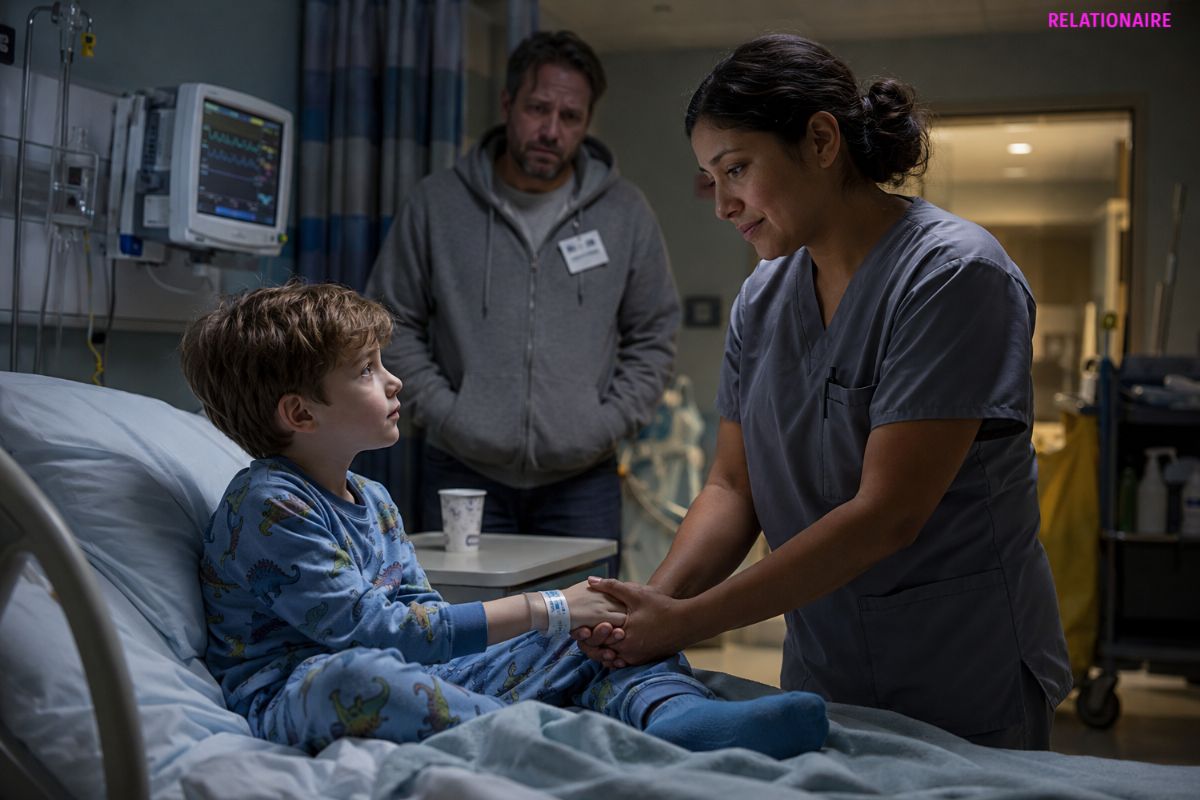
Elena stood beside the bed, her cleaning gloves already removed, her hands washed pink from the sink. Milo stared at her fingers. Then, slowly, he placed his hand in hers.
His whole body softened.
Just like that.
His knees loosened.
His shoulders dropped.
His eyes filled, but he didn’t cry.
Elena held his hand with both of hers, gently, as if she had been handed something breakable and holy.
“You’re doing good,” she whispered.
Milo leaned back against the pillow for the first time all night.
Tanya’s eyes flicked toward Dr. Sloane.
The doctor moved slowly, like approaching a sleeping cat. “Can I listen now, Milo?”
Milo didn’t answer.
But he didn’t say no.
Elena kept holding his hand.
The doctor warmed the stethoscope before placing it against Milo’s pajama top. Milo flinched once, then looked at Elena. She gave him a tiny nod.
He stayed still.
Ray turned away and wiped his face with the heel of his hand.
No one mentioned it.
The exam took less than two minutes.
Milo let them check his temperature. He drank three sips of water from a paper cup Elena held near the blanket. He even let Tanya adjust the pulse clip on his finger.
All because Elena stood there holding his hand.
When it was over, Dr. Sloane said, “That was brave.”
Milo’s eyelids were already heavy.
Elena gently tried to pull her hand away.
Milo tightened his grip.
“Don’t go.”
Ray stepped forward. “Milo, Ms. Elena has work to do.”
Milo’s face tightened again.
Elena looked down at him, then at her cart outside the door, then at the clock.
“I can stay a minute,” she said.
Tanya smiled. “I’ll let the floor know.”
Ray looked embarrassed again.
“You don’t have to do that,” he said.
Elena didn’t look at him.
She looked at Milo.
“It’s okay.”
So she stayed.
Five minutes became ten.
Ten became twenty.
The cleaner sat in the chair beside Milo’s bed while the machines hummed and the hall lights stayed dim. Her cleaning cart waited outside, half in shadow.
Milo fell asleep still holding her hand.
Ray stood at the foot of the bed, staring.
“He doesn’t do that,” he whispered.
Tanya stood beside him. “Sleep?”
“Trust strangers.”
Elena lowered her eyes.
Ray studied her then, really studied her.
“Do you know him?” he asked.
Elena shook her head.
“No.”
“Are you sure?”
“Yes.”
Ray’s voice turned careful. “Did you know his mother?”
At that, Elena’s hand stiffened around Milo’s.
Tanya noticed.
So did Ray.
Elena looked at the sleeping boy. Then she looked toward the hallway, where her cart waited with its trash bags and disinfectant wipes and the ordinary tools of invisible work.
“I didn’t know her,” Elena said.
Ray’s face tightened with confusion.
“Then why,” he whispered, “did he choose you?”
Elena did not answer right away.
Instead, she slowly reached into the pocket of her gray scrub top and pulled out a small, folded paper napkin.
Inside it was something Ray could not see yet.
Her voice dropped so low it barely rose above the monitor.
“Because I think,” Elena said, “your sister left him a memory none of you knew he still had.”
Then she opened her hand.
PART 2
In Elena’s palm was a tiny hotel-sized bottle of hand lotion.
The label was worn nearly blank from being carried too long. The cap had a thin crack along the side. The bottle was small enough to disappear in a pocket, ordinary enough that most people would never notice it.
Ray stared at it.
“That’s why?” he asked.
Elena looked at Milo, asleep with his fingers curled around hers.
“I think so.”
Tanya stepped closer but didn’t speak.
Ray’s face was guarded now. Not angry, exactly. But protective. A man who had already lost someone and was afraid grief had found a new way into the room.
“What is that?” he asked.
“Lavender and oatmeal,” Elena said quietly. “Cheap kind. From the pharmacy. I use it because the sanitizer cracks my hands.”
Ray swallowed.
The room seemed to get smaller.
Elena turned the bottle so he could see the faded purple stripe on the label.
Ray put one hand over his mouth.
For a few seconds, he wasn’t in Room 412 anymore.
He was back in his sister’s kitchen three years earlier, watching her rub lotion into her hands while Milo sat in a booster seat eating cereal from a plastic bowl.
His sister, Mara, had always smelled faintly like that.
Clean.
Warm.
Lavender, but not fancy.
Oatmeal, because her skin was sensitive.
She used to keep the same bottle in her purse, in the car, beside the sink, next to Milo’s bedtime books.
Ray had forgotten.
That was the part that hurt.
He had remembered the big things.
The hospital calls.
The funeral.
The lawyer’s office.
The day he signed papers to become Milo’s guardian with hands that shook so badly the pen scratched the page.
He remembered Mara’s laugh. Her red coat. The way she called him “Raymond” only when she was about to ask for a favor.
But he had forgotten the smell of her hands.
Milo had not.
Ray sat down hard in the chair by the window.
“Oh,” he said.
Just one word.
But it carried three years.
Elena looked uncomfortable, as if she had stepped into a family room without knocking.
“I’m sorry,” she said. “I shouldn’t have said anything.”
“No,” Ray said quickly. “No. You’re right.”
Milo shifted in the bed, still asleep. Elena gently settled her thumb over his knuckles.
Tanya touched Ray’s shoulder. “His mom passed when he was little?”
Ray nodded.
“He was three.”
No one asked how.
Hospitals teach people not to ask certain questions unless the answer is needed. And this answer wasn’t needed for his care.
Only the ache was.
Ray stared at Milo’s face.
“He barely talks about her now,” he said. “I thought maybe… maybe he didn’t remember much.”
Elena’s eyes softened.
“Children remember differently.”
Ray looked at her.
She said it like she knew.
Not from a book.
From somewhere deeper.
Tanya noticed that too.
“Elena,” she said gently, “you don’t have to stay if you need to go.”
Elena nodded, but she did not move.
Because Milo’s hand was still in hers.
The hallway outside carried on without them. A phone rang at the nurse station. Someone laughed softly near the supply closet. Wheels passed. A door clicked shut.
The hospital did what hospitals always do.
It kept moving while hearts stopped in small private ways.
Ray leaned forward, elbows on his knees.
“I thought he was just being difficult,” he whispered.
Tanya shook her head. “Fear looks like that sometimes.”
Ray rubbed his eyes.
“I got frustrated with him.”
“You were scared too.”
He didn’t answer.
That was the truth no one likes because it doesn’t make anyone innocent. It only makes everyone human.
At 3:26 a.m., Milo woke.
His eyes opened suddenly, wild for half a second.
Then he saw Elena.
His breathing slowed.
“Hi,” she whispered.
He looked at their joined hands.
Then at Ray.
Then back at Elena.
“Your hands smell like Mom’s.”
The words landed so softly that Tanya had to look away.
Ray closed his eyes.
Elena’s mouth trembled.
“I’m glad it helps,” she said.
Milo’s face pinched.
“She used to rub my back when I couldn’t sleep.”
Ray bowed his head.
He had never known that.
Or maybe he had known it once and let the years bury it under appointments and school lunches and unpaid bills and the constant terror of raising someone else’s child without breaking him more.
Milo kept talking, his voice sleepy but clear.
“She had the purple bottle.”
Ray pressed his fist to his lips.
“I remember,” he managed.
Milo looked uncertain. “You do?”
That question hurt more than accusation.
Ray moved closer to the bed.
“I do, buddy. I forgot for a while, but I remember now.”
Milo studied him.
Children know when adults are pretending.
Ray didn’t pretend.
“I’m sorry I forgot.”
Milo looked down at the blanket.
Elena gently released his hand, but he grabbed her fingers again.
“Don’t.”
“I’m right here,” Elena said.
Ray looked at her with a kind of helpless gratitude that made her look away.
“You have a family?” he asked before he could stop himself.
Tanya glanced at him, warning him without words.
Elena’s face closed a little.
“I had a daughter,” she said.
Had.
The word changed the air.
Ray understood immediately why Tanya looked down.
Milo didn’t understand the way adults do, but he heard the sadness. His small fingers loosened.
Elena gave him a smile that tried very hard.
“She was little like you,” she said.
“What was her name?” Milo asked.
“Lena.”
“That’s like your name.”
Elena nodded. “Yes.”
“Did she like dinosaurs?”
Elena’s smile broke open, just a little.
“She liked purple socks and pancakes.”
Milo thought about that.
Then he lifted his blanket and showed her his one sock.
“It’s blue.”
“It’s a very good sock.”
He almost smiled.
Almost.
Tanya stepped out to check another room. Dr. Sloane had moved on to the next patient. Ray remained near the bed, no longer trying to manage the moment, only trying to stay inside it.
Elena stayed too.
Not because anyone asked her.
Because Milo kept falling asleep and waking in fear, and each time, the smell of that lotion seemed to bring him back from somewhere lonely.
At 4:10 a.m., a supervisor appeared quietly at the door.
He was a thin man with a clipboard and kind eyes made tired by night shift schedules.
“Elena,” he said softly.
She looked up.
“I know,” she whispered.
Ray stood. “I’m sorry. We kept her.”
The supervisor took in the scene. The sleeping child. The uncle with red eyes. The cleaning cart still parked outside like a witness.
Then he said, “Room 419 can wait.”
Elena blinked.
He nodded once and walked away.
Ray sat back down.
“He’s a good man,” Elena said.
“You’re good people,” Ray replied.
She shook her head quickly, almost embarrassed.
“I just empty bins.”
But that was not true.
Not tonight.
Tonight she had emptied something else from the room.
Some of the fear.
Some of the loneliness.
Some of the silence Mara had left behind.
When morning light began softening the edges of the blinds, Milo was finally asleep for more than twenty minutes.
Ray stepped into the hallway with Elena while Tanya sat nearby charting.
The corridor smelled like coffee and floor cleaner. A nurse passed with a stack of warm blankets. Somewhere, a baby cried and was comforted.
Ray leaned against the wall.
“I don’t know how to thank you,” he said.
Elena held her cracked hands together.
“You don’t need to.”
“I do.”
She looked toward Milo’s room.
“Just remember the little things,” she said. “They matter longer than we think.”
Ray nodded, but there was something in her voice that made him ask, “Is that what you remember about your daughter?”
Elena was quiet for so long he thought he had hurt her.
Then she reached into her scrub pocket and pulled out the same small bottle of lotion.
“My daughter was here,” she said.
Ray looked at her.
“In this hospital?” he asked.
Elena nodded.
“On this floor?”
Her eyes lifted to his.
“In that room.”
Ray turned slowly toward Room 412.
Elena’s voice was almost a whisper.
“I started working nights here because I couldn’t bring myself to leave the last place I held her hand.”
PART 3
Ray did not know what to say to that.
There are sentences too heavy for comfort.
So he stood in the hallway beside Elena while morning gathered at the far windows, and for once he did not try to fix what could not be fixed.
Elena stared at the closed door of Room 412.
“When I first came back,” she said, “I could only clean the rooms with the doors open. If a bed was by the window, I couldn’t look at it.”
Ray listened.
“I told myself it was just a job. Trash, linens, floors. Keep moving. Don’t think.”
She gave a small, sad smile.
“But hospitals remember. Even when you don’t want them to.”
Ray looked at her hands.
Hands that had emptied bins.
Hands that had held mops and trash bags and disinfectant bottles.
Hands that had held Milo through the longest part of his fear.
“You stayed here?” he asked.
Elena nodded.
“My sister said it was unhealthy. Maybe it was. But at night, when rooms got quiet, I would think… at least someone should be gentle in the places where people are scared.”
Ray swallowed.
He thought of all the times he had walked past workers like Elena without seeing them.
The cleaner in the elevator.
The cafeteria woman refilling napkins.
The man pushing a linen cart at dawn.
People who made hard places softer and rarely got thanked by name.
“I’m sorry,” he said.
Elena looked confused. “For what?”
“For not noticing people like you.”
She shook her head.
“You were taking care of a child.”
“I was surviving,” Ray said. “That’s not always the same thing.”
That was the first honest thing he had said about himself in a long time.
For three years, he had been the uncle who showed up.
He signed school forms.
Packed lunches.
Learned which cereal Milo would eat and which socks had seams he hated.
He slept lightly, always listening for coughs, nightmares, footsteps in the hall.
People called him strong.
They did not see him standing over the sink some nights, gripping the counter, whispering to his sister, “I don’t know how to do this.”
Elena seemed to understand.
Maybe people who carry invisible grief recognize each other by posture.
Room 412 opened.
Tanya stepped out.
“He’s awake,” she said. “And asking for both of you.”
Both.
The word surprised Ray.
He followed Elena inside.
Milo was sitting up, hair messy, cheeks pale but calmer. The morning nurse had placed a small cup of apple juice on the tray table. A cartoon played softly with no one watching.
Milo looked at Elena first.
Then Ray.
“Are you leaving?” he asked Elena.
“I have to finish my work soon,” she said.
His face fell.
Ray stepped closer. “But I’m here.”
Milo looked at him with those serious little eyes that seemed too old for six.
“You smell like coffee.”
Ray almost laughed, but it came out broken.
“I do.”
“Mom smelled better.”
“She did,” Ray said. “A lot better.”
Milo picked at the tape near his IV line.
“Do you have her purple bottle?”
Ray’s chest tightened.
“No, buddy.”
Milo’s lower lip trembled.
Ray looked at Elena.
Elena looked down at the bottle in her pocket.
Then she did something small.
So small anyone walking by might have missed it.
She took the lotion out and placed it on the tray table beside Milo’s apple juice.
“You can keep this one for now,” she said.
Milo stared at it.
Ray shook his head gently. “Elena, you don’t have to—”
“I want to.”
Her voice was firm.
Not loud.
Firm.
Milo touched the bottle with one finger like it was a photograph.
“It’s yours,” he said.
“I have another at home.”
Ray didn’t know if that was true.
Elena smiled anyway.
Milo held the bottle to his chest.
Then he looked at Ray.
“Can Uncle Ray use some?”
Ray froze.
“Me?”
Milo nodded.
“So your hands smell right.”
The room became very quiet.
Ray held out his hands.
They were rough hands. Warehouse hands. Guardian hands. Hands that had learned to tie tiny shoes and fill out insurance forms and hold a feverish child while pretending not to panic.
Milo squeezed a little lotion into Ray’s palm.
Too much.
It made a soft splat.
For some reason, that was what broke Ray.
Not the hospital.
Not the fear.
Not even Mara’s name.
The extra lotion in his palm.
The ridiculous, sweet, ordinary mess of it.
He rubbed his hands together and closed his eyes.
There it was.
Lavender.
Oatmeal.
His sister’s kitchen.
Milo’s baby curls.
Mara laughing because Ray had tried to install a shelf upside down.
All the little things he had thought grief had taken.
Milo reached for him.
Ray sat on the edge of the bed and let the boy press his face into his shirt.
“I miss her,” Milo whispered.
Ray held him carefully, mindful of the tubes and wires.
“I do too.”
“I thought if I said it, you’d get sad.”
Ray’s eyes filled.
“Oh, buddy.”
“I didn’t want you to cry.”
Ray pulled back just enough to look at him.
“You don’t have to protect me from missing your mom.”
Milo’s chin shook.
“You cry sometimes?”
“All the time,” Ray said softly. “Mostly in the car.”
Milo considered that with deep seriousness.
“Can we cry at home too?”
Ray nodded.
“Yes. We can cry at home too.”
Elena looked toward the window.
Tanya wiped at the corner of her eye and pretended to check the monitor.
Later that morning, Milo improved enough to be discharged with instructions, follow-up care, and a stack of papers Ray folded too many times because his hands were still unsteady.
Before they left, Milo insisted on finding Elena.
They found her near the janitor’s closet, restocking gloves.
Her cart was beside her, neat and ordinary again.
Milo stood in the hallway holding Ray’s hand in one of his and the purple bottle in the other.
“Thank you,” he said.
Elena crouched down to his height.
“You were very brave.”
Milo shook his head.
“No. I was scared.”
Elena smiled.
“You can be both.”
He thought about that.
Then he held out the bottle.
Ray looked surprised.
“I thought you wanted to keep it,” he said.
Milo nodded.
“I do.”
He turned back to Elena.
“But you need it for other kids.”
Elena’s face changed.
The hallway seemed to blur around her.
Milo pushed the bottle into her hand.
“My uncle can buy us one.”
Ray nodded quickly. “Every purple bottle in town if he wants.”
Milo looked back at Elena.
“If a kid gets scared, you can hold their hand.”
Elena pressed the bottle against her chest.
For a second, she was not a hospital cleaner standing under fluorescent lights.
She was a mother.
A grieving woman.
A stranger who had become safe because of something no one could see.
Then Milo stepped forward and hugged her.
It was quick.
Awkward.
A child’s hug, all elbows and trust.
Elena closed her eyes.
When he pulled away, she touched his cheek lightly.
“You remind me of someone too,” she whispered.
Milo didn’t ask who.
Some things children understand without words.
Two weeks later, Ray returned to the pediatric floor.
Not because Milo was sick.
Because Milo had drawn something.
It showed a hospital bed, a cleaning cart, a boy in blue pajamas, and a woman holding his hand. Above them, in big uneven letters, he had written:
THANK YOU FOR SMELLING LIKE MOM.
Ray worried it might be too much.
Too personal.
Too strange.
But Elena held the drawing with both hands and cried so quietly that no one in the hallway heard.
The next time Ray visited for a follow-up appointment, the drawing was taped inside the janitor’s closet, above a shelf of gloves and paper towels.
Beside it sat a small row of purple lotion bottles.
Not one.
Five.
A nurse had brought one.
Then Tanya.
Then Dr. Sloane.
Then the night supervisor.
Then Ray, who left a whole bag of them with a note that said:
For any child who needs to remember safety.
Months passed.
Milo still had hard nights.
Grief does not vanish because one kind person shows up.
But something changed.
On nights when he missed his mother, Ray did not tell him to be brave and sleep.
He sat beside him.
He rubbed lotion into his hands.
He told stories about Mara.
Small ones.
The way she burned toast.
The way she sang the wrong words to songs.
The way she loved Milo before he was even born.
Sometimes Milo cried.
Sometimes Ray did too.
And somehow, their home became less afraid of her name.
At the hospital, Elena kept doing her job.
She emptied bins.
Mopped spills.
Replaced liners.
Moved quietly through rooms where families were tired, frightened, hopeful, and broken open by love.
Most people still didn’t notice her.
But some did.
A child would calm when she entered.
A father would nod with tired gratitude.
A nurse would whisper, “Can you come by 418 when you have a second?”
And Elena would go.
Not because it was in her job description.
Because once, in the room where she had lost everything, a little boy reached for her hand and gave part of her back.
That is how kindness often works.
Not like thunder.
Not like rescue.
Sometimes it is a quiet woman in gray scrubs.
A cracked little bottle of lotion.
A frightened child breathing easier because, for one moment, the world smells like someone who loved him.