If you’ve already read part 1 of this story on Facebook, go here for Part 2!
PART 1
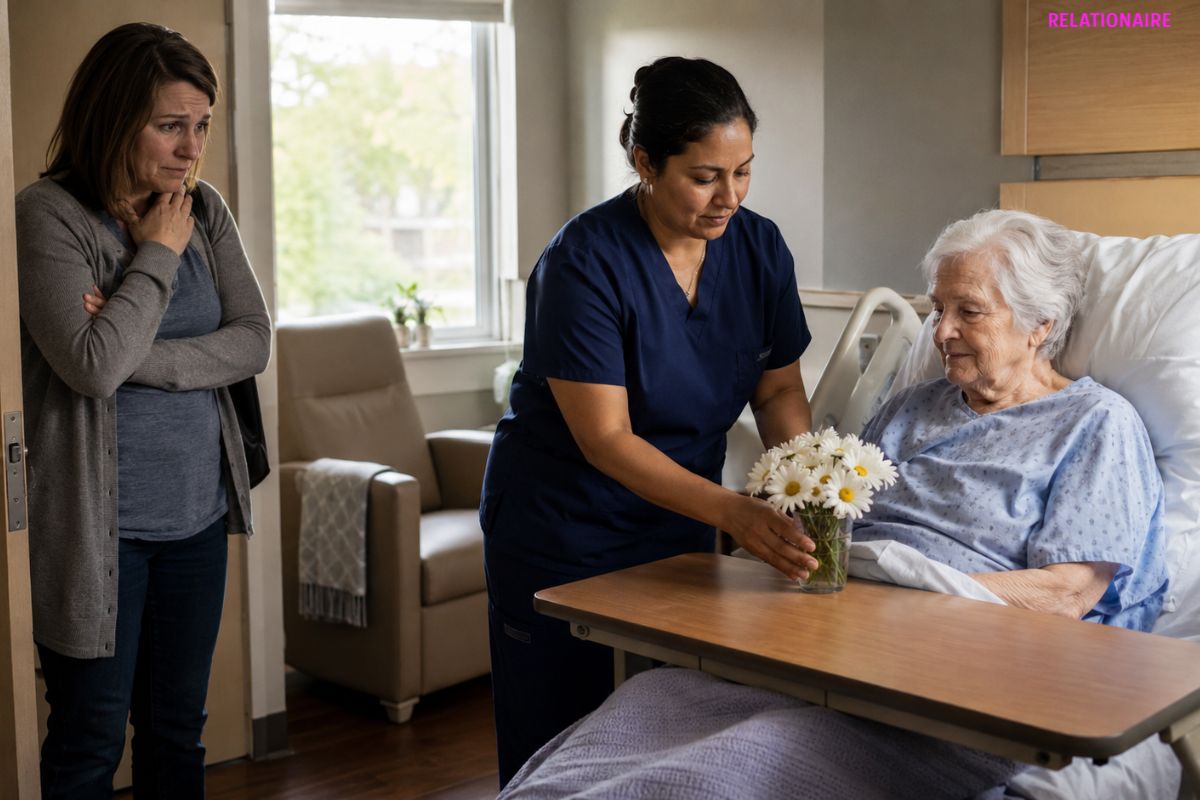
Every Monday morning, there were fresh daisies in my mother’s rehab room.
Not roses. Not lilies. Not anything expensive.
Just seven or eight white daisies in a plastic cup beside her bed, leaning toward the window like they were trying to bring the sun inside.
The strange part was, no one admitted bringing them.
My mother had been at Willow Creek Rehabilitation Center for six weeks after a fall that left her weaker than any of us wanted to say out loud. She was seventy-nine, stubborn, proud, and still the kind of woman who apologized to nurses for “being a bother” while needing help reaching the call button.
Her room always smelled faintly of lemon disinfectant and warmed-up soup.
There was a beige recliner by the window, a whiteboard with her therapy schedule, and a little drawer full of the things people brought and forgot—peppermints, lotion, crossword books, half-used tissues, a church bulletin folded in half.
And every Monday, daisies.
The first time I saw them, I smiled.
“Did Mark come by?” I asked.
My mother’s eyes moved toward the cup.
She was sitting up in bed, her silver hair brushed back, one hand resting over the hospital blanket. She looked softer than she used to. Smaller, somehow.
“I don’t know,” she said.
“You don’t know?”
She gave me a tired little smile. “People come and go, honey. Sometimes I’m sleeping.”
That answer hurt more than it should have.
My brother Mark lived twenty minutes away. I lived two hours away and drove in every Wednesday and Sunday, always guilty, always tired, always carrying bags like groceries could fix what time had broken.
Mark said he visited “when he could.”
But lately, when I asked Mom about him, she would only say, “He’s busy.”
Busy.
That word had started to feel like a locked door.
The next Monday, I called him.
“Did you bring Mom daisies?”
There was a pause.
“What?”
“Daisies. Fresh ones. Every Monday.”
“Oh.” He cleared his throat. “Yeah. Maybe. I might have.”
“You might have?”
“I mean, I’ve brought her stuff.”
“What stuff?”
“Snacks. Magazines.”
My hand tightened around the steering wheel. “Mark, she can barely read the magazines. She needs us. She waits for us.”
“I know that.”
“Do you?”
He went quiet.
And in that silence, I decided what I already wanted to believe.
He was lying.
He wanted credit for flowers he didn’t bring. He wanted to sound like a son who showed up without actually showing up.
By the time I reached Willow Creek that afternoon, my jaw ached from clenching it.
Mom was in physical therapy when I arrived, so her room was empty.
The daisies sat on the table.
Fresh water. Stems trimmed. One yellow center had dropped a tiny dusting of pollen on the white paper towel underneath.
I stood there staring at them like they had done something wrong.
Then I saw the card.
It was tucked behind the cup, half-hidden by the curtain.
Just a folded piece of paper torn from a small notepad.
On it, written in careful blue ink:
“For Mrs. Evelyn. Monday sunshine.”
No name.
I picked it up.
The handwriting wasn’t Mark’s. It wasn’t anyone’s in our family.
For reasons I couldn’t explain, that made me angrier.
Because if some stranger cared enough to do this every week, what did that say about us?
I put the note back exactly where I found it.
When Mom returned from therapy, her face was pale and damp around the hairline. A young aide pushed her wheelchair in, cheerfully promising she had done “really good work today.”
Mom nodded, but I knew that look.
She was trying not to cry.
After the aide left, I helped her back into bed. Her hand trembled against my wrist.
“Long session?” I asked.
She nodded.
Then, as if something pulled her, her eyes moved to the daisies.
And there it was.
A small change.
Her shoulders straightened.
Her chin lifted a little.
Her mouth softened, almost into a smile.
I had seen my mother do that all my life before company came over. Sit taller. Smooth her blouse. Become herself again, even if only for a minute.
“Pretty, aren’t they?” I said.
She nodded slowly.
“Your brother brought them?” she asked.
My throat tightened.
“I’m not sure.”
She looked at them for a long time.
Then she whispered, “Your father liked daisies.”
I froze.
My father had been gone twelve years. We talked about him less than we should have, mostly because every memory still seemed to have sharp edges.
“He did?”
Mom’s fingers moved over the blanket, searching for something that wasn’t there.
“Roadside flowers,” she said. “He was too cheap for florists.”
I laughed before I could stop myself.
So did she.
Just one breath of laughter. Small and cracked.
Then she closed her eyes.
That night, after I got home, I called Mark again.
“You didn’t bring the flowers.”
He sighed. “Anna—”
“Don’t lie to me.”
“I’m not lying.”
“You said maybe.”
“I said maybe because I didn’t want to get into it.”
“Get into what?”
He sounded exhausted. “You think I don’t feel bad enough?”
I stood in my kitchen with my coat still on, staring at a pile of mail I hadn’t opened.
“Then show up,” I said.
“I do.”
“When?”
“More than you know.”
“That’s convenient.”
He didn’t answer.
The next Monday, I changed my schedule.
I told my boss I had an appointment, left before sunrise, and drove straight to Willow Creek. I wanted to catch whoever was bringing those flowers.
Maybe it was a volunteer.
Maybe some church lady.
Maybe Mark had paid someone, which would somehow make me even madder.
The rehab center was quiet when I arrived. The lobby lights were still dim. A janitor’s cart sat near the front desk. Somewhere down the hall, a television murmured to no one.
Mom’s door was half-open.
Room 214.
I stopped before going in.
A woman was inside.
She wore navy housekeeping scrubs and white sneakers with gray soles. Her hair was pulled back under a cloth headband. A set of keys hung from her pocket, and a yellow cleaning cloth was draped over her shoulder.
She wasn’t visiting.
She was wiping the windowsill.
On the bedside table sat a fresh plastic cup.
And in her left hand were daisies.
Real ones.
White petals. Yellow centers. Stems wrapped in a damp paper towel.
I watched her trim the ends with a pair of small scissors, fill the cup with water from the sink, and place the flowers exactly where the morning light would touch them first.
Then she did something that made my chest tighten.
She turned toward my sleeping mother and whispered, “There you go, Mrs. Evelyn. He didn’t forget.”
He.
I stepped into the doorway.
The woman turned fast, startled, one hand flying to her chest.
“Who are you?” I asked.
Her eyes moved from my face to the visitor badge clipped to my coat.
Then to my mother.
Then back to me.
She looked ashamed, as if I had caught her stealing.
“I’m sorry,” she said softly. “I can explain.”
PART 2
The woman’s name was Rosa.
I had seen her before without really seeing her.
That was the first thing that made me feel small.
She was the woman pushing the cleaning cart past the nurse station while families demanded updates. The woman slipping into rooms after visitors left, changing trash bags, wiping coffee rings from bedside tables, gathering tissues from the floor after hard conversations.
She was always there.
And somehow invisible.
“I didn’t mean to upset anyone,” she said.
My mother slept through all of it, her mouth slightly open, one hand curled near her cheek like a child’s.
Rosa stood beside the bed with the daisies between us.
“They’re from you?” I asked.
She nodded.
“Every Monday?”
“Yes.”
“Why?”
The word came out sharper than I meant.
Rosa flinched a little, but she didn’t defend herself.
She looked at my mother instead.
“Because she sits taller when they’re here.”
I didn’t know what to say to that.
The hallway behind me stirred to life. Someone laughed softly near the nurse station. A meal cart squeaked around the corner. Morning had begun without asking anyone if they were ready.
Rosa folded the damp paper towel in her hands.
“The first week she came here,” she said, “I cleaned this room while she was awake. She was having a hard morning.”
I looked at Mom.
“She doesn’t complain,” I said.
“No,” Rosa said. “That is how I knew.”
That sentence landed quietly and stayed there.
Rosa glanced toward the door, like she expected to be told to leave.
“She was trying to reach her brush,” she said. “It had fallen on the floor. I picked it up for her. She said thank you like I had done something very important.”
That sounded exactly like Mom.
“Then she saw the little flowers on my cart.”
“You had daisies on your cart?”
Rosa nodded. “From outside. There is a ditch behind the employee lot. They grow there when the weather is kind.”
I almost smiled at that.
The weather is kind.
“She looked at them,” Rosa continued, “and she changed.”
“What do you mean?”
“She was tired. Very tired. But when she saw them, she tried to sit up straighter. Like someone she loved had walked into the room.”
I felt my throat close.
Rosa’s voice stayed soft.
“I asked if she liked daisies. She said, ‘My Harold used to bring them from the side of the road. Said the best flowers were the ones that fought to grow anyway.’”
I turned toward the window.
For a moment, I could see my father as he used to be in the driveway—work boots dusty, shirt sleeves rolled, holding a handful of crooked roadside flowers like he had won something.
My mother used to roll her eyes.
But she always put them in a glass.
“She told you that?” I asked.
“Half-asleep,” Rosa said. “Maybe she did not know she told me.”
The shame came slow.
Not dramatic. Not loud.
Just a steady warmth rising in my face as I looked at the woman I had almost accused.
“I thought my brother was lying,” I admitted.
Rosa’s expression changed, but not with judgment.
“With families,” she said carefully, “pain often looks like blame.”
That should have annoyed me.
Instead, it almost broke me.
Because she was right.
I had been angry at Mark for not being enough because I was terrified I wasn’t enough either. We had both become experts at measuring each other’s failures so we wouldn’t have to sit with our own.
Rosa moved the daisies half an inch to the left, catching the light.
“Does my mother know they’re from you?” I asked.
She shook her head.
“Why not?”
Rosa looked embarrassed.
“It is not important.”
“It is.”
“To me, no.”
I stared at her.
She smiled faintly, but her eyes were tired.
“I clean rooms,” she said. “People already have many people to thank. Nurses. Doctors. Therapists. Family. I only wanted her to have something pretty.”
Only.
That word hurt.
Only wanted.
Only noticed.
Only came every Monday with flowers from a ditch because an old woman sat straighter when beauty entered the room.
Before I could answer, Mom stirred.
Her eyes opened slowly and found me first.
“Anna?”
“I’m here.”
Then her gaze shifted to Rosa.
A small smile touched her face.
“Good morning,” Rosa said.
Mom whispered, “Morning, honey.”
Honey.
Not “miss.” Not “the cleaning lady.”
Honey.
Rosa’s whole face softened.
“I brought Monday sunshine,” she said.
Mom looked toward the flowers.
And again, like before, she changed.
Her shoulders lifted. Her fingers smoothed the blanket. The room did not look like a rehab room for a few seconds.
It looked like a woman receiving flowers from a life she had loved.
I sat beside the bed, suddenly aware that I had missed entire conversations happening in quiet corners.
After Rosa left, I asked Mom, “Do you know her well?”
Mom watched the doorway.
“She is kind,” she said.
“Yes.”
“She talks to me when everyone else is rushing.”
The words were not meant to wound me.
That made them wound more.
“What does she talk about?”
Mom looked at the daisies.
“Little things. The weather. Her grandson. The floor wax smelling too strong. She tells me which nurses are having hard days.”
I laughed softly. “She does?”
“She notices people.”
I looked down.
Mom reached for my hand. Her fingers were cool and thin.
“You notice too much pain, Anna,” she said.
I swallowed.
“I’m trying.”
“I know.”
Two words.
That was all.
And somehow they undid me.
Later that afternoon, Mark arrived.
He looked worse than I expected. Unshaven. Work shirt wrinkled. Eyes red around the edges.
I had prepared a speech.
I had carried it for weeks.
But when he walked in holding a gas station coffee and a pack of Mom’s favorite butter cookies, the speech changed shape.
He froze when he saw me.
“Oh,” he said. “You’re here.”
“Yes.”
Mom brightened. “Both my babies.”
Mark bent down and kissed her forehead.
There was such tenderness in it that I had to look away.
While Mom rested, I followed him into the hallway.
“I saw who brings the flowers,” I said.
His jaw tightened. “Anna—”
“It’s Rosa. From housekeeping.”
He nodded.
“You knew?”
He leaned against the wall and rubbed his face.
“I saw her two weeks ago.”
“And you didn’t tell me?”
“She asked me not to make a thing of it.”
I stared at him.
He looked toward Mom’s room.
“She said Mom liked not knowing. Like maybe Dad was still finding ways.”
My anger stumbled.
Mark’s voice lowered.
“I didn’t want to ruin that.”
I pressed my lips together.
For the first time in weeks, I didn’t know where to put my blame.
Then Mark reached into his pocket and pulled out something folded.
A small envelope.
Cream-colored. Soft from being handled too much.
“What is that?” I asked.
He looked at me with the strangest expression.
“Mom gave it to Rosa yesterday.”
My heart lurched.
“To Rosa?”
He nodded.
“She asked me to make sure Rosa got it if she wasn’t working today. But Rosa came in early.”
“What does it say?”
“I don’t know.”
“Did Rosa open it?”
Mark shook his head.
“She put it in her pocket and started crying.”
Through the doorway, I saw Rosa at the far end of the hall, pushing her cleaning cart slowly, one hand pressed against the pocket of her navy scrubs.
And for the second time that morning, I realized I had been standing outside the real story.
PART 3
I found Rosa in the janitor’s closet.
Not because I was looking for drama.
Because I didn’t know how to thank her in a hallway.
The closet was small and bright, smelling of soap, bleach, and cardboard boxes. Mops leaned in one corner. A radio sat on a shelf, turned low. On the inside of the door was a faded photo of a little boy missing his front teeth.
Rosa was sitting on an overturned bucket.
The envelope was in her lap.
She looked up quickly when I knocked.
“I’m sorry,” I said. “I can come back.”
“No.” She wiped under one eye. “It’s all right.”
For a second, neither of us spoke.
Then I said the only honest thing I had.
“I didn’t see you.”
Rosa looked confused.
“I mean, I saw you. But I didn’t really see you.”
Her face softened, and somehow that made it worse.
“You were worried about your mother,” she said.
“That’s not an excuse.”
“No,” she said gently. “But it is a reason.”
I stepped inside.
“May I ask what she wrote?”
Rosa looked down at the envelope.
“I don’t think it was only for me,” she said.
She handed it to me.
The front said, in my mother’s uneven handwriting:
For Rosa, who brought Harold back on Mondays.
I covered my mouth.
Rosa nodded like she understood.
“I read only the first line,” she whispered.
I unfolded the paper carefully.
The note was short. Mom’s handwriting tilted downhill, each word taking effort.
Rosa,
I know the daisies are from you.
But I also know love can use anyone’s hands.
Harold brought me flowers when we had no money, when the children were small, when the car broke down, when I was mad at him, and once when he forgot our anniversary and tried to pretend roadside daisies were the plan all along.
I always teased him.
But I kept every flower until it browned.
When you bring them, I remember being a wife before I was a patient.
I remember being chosen.
Thank you for seeing that part of me.
If my children ask, tell them I was never alone here.
I had Monday sunshine.
Evelyn
I had to stop reading for a moment.
The room blurred.
Rosa pressed a tissue into my hand without making a sound.
I thought of every time I had walked into Mom’s room counting pills, schedules, therapy updates, insurance papers, calories, distances from home.
Rosa had walked in and counted dignity.
That was the difference.
That afternoon, I brought the note to Mom.
She was awake, propped against two pillows, the daisies bright beside her.
Mark sat near the window, breaking butter cookies in half because Mom said a whole cookie felt like too much.
I sat on the edge of the bed.
“Rosa showed me your note,” I said.
Mom closed her eyes.
“Was that all right?”
“Yes.”
“Good.”
Mark looked at me, then at her.
“You knew?” he asked.
Mom smiled faintly. “I’m old, not foolish.”
For the first time in weeks, the three of us laughed.
A real laugh.
Small, but real.
Then Mom looked at us both.
“You two have been fighting in whispers.”
I opened my mouth, then closed it.
Mark looked down at his coffee.
Mom’s voice was tired but clear.
“I don’t need perfect children,” she said. “I need you not to waste each other.”
The room went still.
That was my mother.
Weak in the body, still able to put her hand directly on the truth.
Mark rubbed his eyes.
“I’m sorry,” he said.
I didn’t know if he meant to her or to me.
Maybe both.
“I’m sorry too,” I said.
And because some apologies are too big to explain all at once, we just sat there.
Three people.
A cup of daisies.
A woman in a bed remembering who she was.
After that, Mondays changed.
Not loudly.
Nothing in real life changes like a movie.
Mark still had work. I still had a long drive. Mom still had difficult therapy days. Rosa still cleaned rooms where families left coffee cups, fear, crumbs, and tears.
But we stopped acting like love only counted when it looked impressive.
Mark began coming Tuesday evenings with soup from the diner Mom liked.
I came Sundays with clean cardigans and sat long enough to stop checking the clock.
And every Monday morning, Rosa still brought daisies.
Except now, sometimes, we brought the cup.
Sometimes we washed it.
Sometimes we left a muffin on Rosa’s cart with a note that said, “For the woman who notices.”
She always looked embarrassed.
She always said, “You don’t have to.”
And every time, Mom said, “Neither did you.”
One Monday in early spring, Mom was discharged.
The word should have sounded joyful.
It did, mostly.
But there was a tenderness to packing up that room.
The drawer emptied. The whiteboard erased. The visitor badges peeled from old sweaters. The little prayer card slipped back into Mom’s purse.
Rosa came in near the end of her shift.
She stood in the doorway with her cleaning cloth in one hand and daisies in the other.
Mom was sitting in the wheelchair by the window, wearing lipstick for the first time in weeks.
“Oh,” Mom said. “Look at you.”
Rosa laughed. “Look at you.”
She placed the daisies in Mom’s lap.
No plastic cup this time.
Just stems tied with a piece of white string.
Mom held them carefully.
Then she reached for Rosa’s hand.
“I’m going home,” she said.
“Yes, ma’am.”
“But you must keep bringing them.”
Rosa blinked.
“To whom?”
Mom looked past her, toward the long hallway.
“To whoever forgets they are still someone.”
Rosa’s eyes filled.
Mark turned away.
I didn’t.
I wanted to see it.
I wanted to remember the face of a woman being thanked for work the world often steps over.
Before we left, Mom asked me to push her down the hall slowly.
Not because she needed to see the nurse station.
Not because she wanted to say goodbye to the therapists.
She wanted to pass the janitor’s closet.
The door was open.
Inside, taped beside the photo of the little boy, was my mother’s note.
For Rosa, who brought Harold back on Mondays.
Mom saw it.
She didn’t say anything.
She just touched the daisies in her lap and smiled.
A year later, when Mom’s hands were steadier, she planted daisies in a long wooden box on her porch.
Not fancy ones.
Simple ones.
White petals. Yellow centers.
Every Monday, she clipped a few and put them in a jar on the kitchen table.
Sometimes for herself.
Sometimes for my father.
Sometimes, I think, for Rosa.
And whenever I see flowers growing wild on the side of the road, I don’t think of them as weeds anymore.
I think of all the quiet people who bring beauty into rooms where no one is expecting it.
I think love does not always enter loudly.
Sometimes it comes in soft shoes, before visiting hours, carrying daisies in a damp paper towel.