If you’ve already read part 1 of this story on Facebook, go here for Part 2!
PART 1
The old woman waited three hours to be ignored by a doctor who looked right through her.
That was what everyone in the clinic believed.
And honestly, for a while, I believed it too.
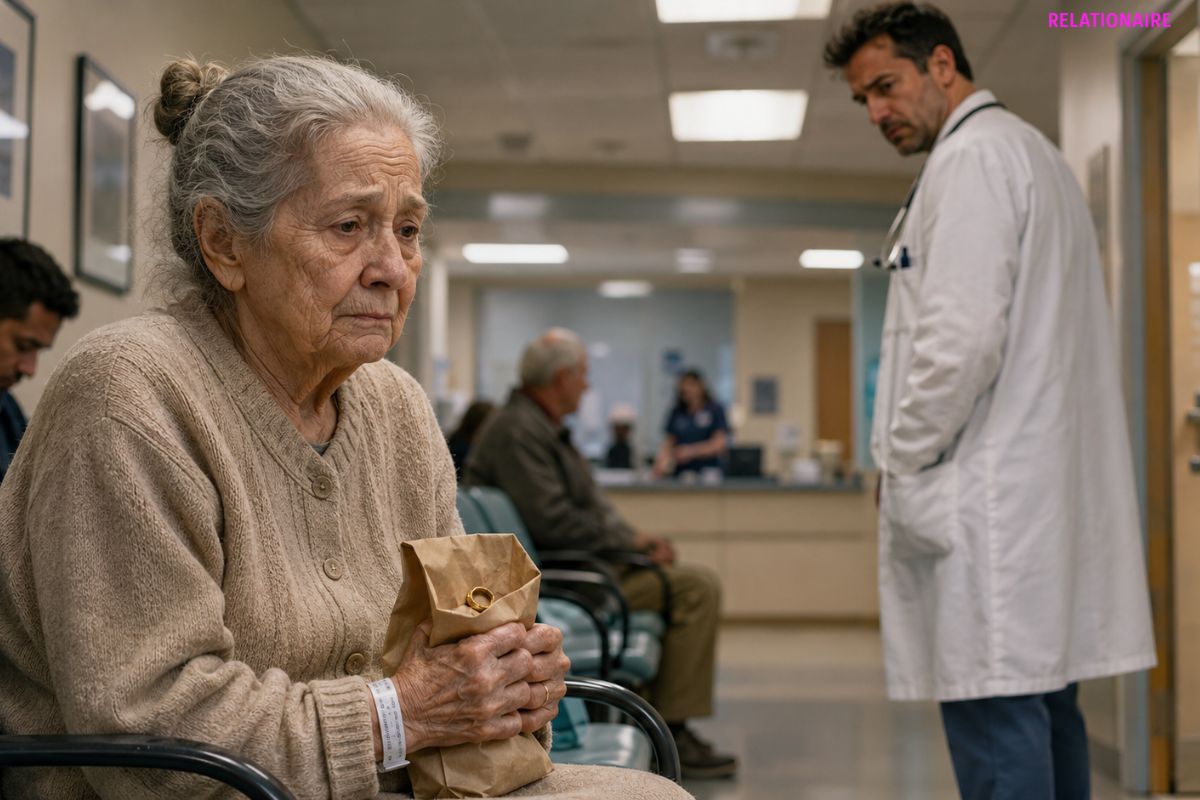
Her name was Mrs. Elena Marlow. She was eighty-one, maybe eighty-two, with a soft gray bun pinned too tightly at the back of her head and a beige cardigan buttoned all the way to her throat. She held a folded paper bag in her lap like it contained something breakable.
The clinic was packed that Thursday.
Every chair was taken. People leaned against walls. A toddler cried into his mother’s coat. Someone kept coughing near the water dispenser. The front desk printer jammed twice. The vending machine hummed like it was tired of all of us.
Mrs. Marlow sat near the end of the second row, small and straight-backed, her hospital bracelet loose around her wrist.
She arrived at 9:15.
By noon, she had not been seen.
I was working triage that day, moving between the nurse station and the waiting room with a clipboard, a pen, and a face I had trained to look calm even when nothing was calm.
Every time I passed her, she looked up.
Not demanding.
Not dramatic.
Just hopeful.
“Do you think it will be much longer?” she asked me once.
“I’m sorry,” I said. “We’re running behind.”
She nodded like she had heard that sentence many times in her life and had learned not to make trouble.
At 12:20, Dr. Thomas Hale stepped out from exam room four.
He was usually the kind of doctor people trusted immediately. Quiet voice. Careful hands. Always knelt beside older patients instead of standing over them. He remembered names. He remembered which kids were afraid of tongue depressors. He remembered who liked the door left open.
But that day, he looked different.
His hair was damp at the temples. His white coat was wrinkled. He had a cold cup of coffee in one hand and a chart in the other.
He glanced toward the waiting room.
His eyes landed on Mrs. Marlow.
And then he stopped.
Not for long.
Just one second.
But I saw it.
His face changed in a way I had never seen before. Like someone had quietly opened a door inside him that he had spent years trying to keep shut.
Mrs. Marlow saw him too.
She leaned forward a little, clutching her paper bag.
“Doctor?” she said softly.
He did not answer.
He looked down at the chart.
Then he turned and walked back through the staff door.
The whole waiting room noticed.
A man in a work uniform muttered, “Seriously?”
A young woman with a feverish child shook her head.
Mrs. Marlow sat frozen for a moment, her mouth slightly open, as if she had been left standing in the rain.
I went after him.
Dr. Hale was at the sink in the back hall, both hands braced against the counter. The water was running, but he wasn’t washing anything.
“Doctor,” I said carefully, “Mrs. Marlow is asking for you.”
He closed his eyes.
“Put her with Dr. Singh.”
I stared at him.
“Dr. Singh is already double-booked.”
“Then have her wait.”
“She’s been waiting three hours.”
“I know.”
The way he said it made me quiet.
Not angry.
Not dismissive.
He sounded like someone trying not to fall apart.
But in a crowded clinic, silence does not look like pain. It looks like neglect.
By 1:00, Mrs. Marlow was still waiting.
Her hands had started to tremble around the paper bag. She refused the crackers I offered. She refused water. She kept looking toward the hallway where Dr. Hale had disappeared.
At 1:17, she stood up.
The paper bag slipped from her lap and landed on the floor.
A small object rolled out.
An old wedding ring.
It spun once on the tile and stopped near my shoe.
The waiting room went quiet.
Mrs. Marlow bent slowly, but I got there first.
When I handed it back to her, she did not thank me right away. She stared at the ring in her palm, and her face tightened.
Then she looked past me, toward the staff door.
“I have waited long enough,” she said.
Her voice was not loud.
That made it worse.
“I came here because they told me he was kind.”
No one moved.
The man in the work uniform crossed his arms.
A woman near the window whispered, “Poor thing.”
Mrs. Marlow pressed the ring into her fist.
“He never even looked at me.”
I opened my mouth, but nothing came out.
Because she was right.
That was what it looked like.
She turned toward the front desk.
“I’d like my papers back.”
Our receptionist, Nina, looked helplessly at me.
“Mrs. Marlow,” I said, stepping closer, “please let me find another doctor for you.”
“No.” She lifted her chin. “I am old, dear. Not invisible.”
That line landed across the room like a hand on everyone’s shoulder.
Even the toddler stopped crying for a second.
Nina printed the discharge form. I hated the sound of that printer. The slow scrape of paper. The little beep at the end. It sounded too final.
Mrs. Marlow tucked the ring back into the paper bag and signed with shaky fingers.
Before she left, she turned once more toward the hallway.
Not angry now.
Hurt.
That was worse too.
“I hope,” she said quietly, “he never makes anyone feel the way he made me feel today.”
Then she walked out.
The waiting room erupted in murmurs.
“That doctor should be ashamed.”
“Some people get a white coat and forget how to be human.”
“My mother is her age. I’d be furious.”
I did not defend him.
I could not.
Because I had seen his face, but I did not know what it meant.
And I had seen hers.
That afternoon, the story spread through the clinic in the way stories do when people are tired and angry and certain they understand.
By 3:00, someone had written a complaint.
By 4:00, administration had called Dr. Hale into the small conference room.
By 5:30, he still had not come out.
I found him after closing in exam room four.
The lights were half off. The paper on the exam table was torn and crumpled. His white coat hung over the back of a chair.
He was sitting on the little rolling stool, holding Mrs. Marlow’s unsigned intake form.
I stood in the doorway.
“Thomas,” I said softly.
He did not look up.
“She was right,” he said.
I stepped inside.
“She was hurt. But you can still explain.”
He laughed once, without humor.
“No. I can’t.”
On the counter beside him was an old file box from archives. The kind nobody touched unless something serious came up.
A faded label was stuck to the front.
MARLOW, SAMUEL.
I looked from the box to Dr. Hale.
“Was that her husband?”
His fingers tightened around the paper.
For a long time, he said nothing.
Then he opened the lid.
Inside was an old chart, yellowing at the edges, with a date stamped ten years earlier.
Dr. Hale finally looked at me.
His eyes were red.
“I wasn’t ignoring her,” he said. “I was trying to figure out how to face the woman whose husband I failed to save.”
PART 2
I had worked with Dr. Hale for six years.
I had seen him tell a young father his daughter’s fever was finally down.
I had seen him sit with a confused man until the man remembered his own name.
I had seen him stay after closing because an elderly patient was afraid to go home alone and needed someone to call her neighbor.
But I had never seen him look the way he looked in exam room four.
Small.
That was the only word for it.
Not weak.
Not guilty in the dramatic way people imagine.
Just small under the weight of one memory.
He turned the old chart toward me, but I did not touch it.
“Ten years ago,” he said, “I was in my first year after residency. I thought being careful meant doing everything fast enough to prove I belonged.”
Outside, the cleaners had started their evening routine. A mop bucket rolled past the door. Somewhere down the hall, Nina was counting cash from the front desk drawer. The clinic had gone quiet in that strange after-hours way, when the chairs still looked warm from everyone who had sat in them.
Dr. Hale stared at the chart.
“Samuel Marlow came in with chest discomfort. Mild. Nothing obvious. He was joking with the nurses. Asking if he could be home by dinner because Elena was making soup.”
He swallowed.
“I was young. Too sure of myself. I looked at the first results. I thought we had time.”
He rubbed his thumb over the edge of the paper.
“I didn’t listen carefully enough.”
There it was.
Not a full confession. Not yet.
But enough.
I sat down across from him.
“What happened?”
He shook his head slowly.
“By the time things changed, it was too late to undo the delay.”
There was no graphic detail. No dramatic description. Just a sentence that had clearly lived inside him for ten years and had grown teeth.
“Was it reviewed?” I asked.
“Yes.”
“And?”
“They said the outcome might have been the same.”
“Might have been.”
He nodded.
“That’s the word that ruined me.”
He stood and walked to the counter. His coffee from morning was still there, untouched and cold. He picked it up like he needed something in his hands.
“I apologized to her that night,” he said. “I tried to. But she was surrounded by family. People crying. People asking questions. She looked at me once, and I couldn’t find words big enough.”
“What did she say?”
“Nothing.”
He looked toward the hallway.
“She just held Samuel’s wedding ring.”
I thought of the paper bag in Mrs. Marlow’s lap.
The ring rolling across the tile.
Her small voice saying, I am old, dear. Not invisible.
“And today?” I asked.
He closed his eyes.
“I heard her name at the desk. I thought it couldn’t be her. Then I saw her.”
“And you walked away.”
“Yes.”
“Why?”
His jaw tightened.
“Because for one second, I was twenty-nine again. Standing in a hospital corridor with her husband’s chart in my hand. And I hated myself so much I couldn’t breathe.”
I wanted to comfort him.
I also wanted to shake him.
Both feelings can exist in the same room. Nursing teaches you that.
“Thomas,” I said, “she waited three hours.”
“I know.”
“She thought you didn’t care.”
“I know.”
“She left humiliated.”
His face folded then.
Not loudly.
Not with a sob.
Just a break in the mouth, a lowering of the head, a hand pressed hard against his eyes.
“I know,” he whispered.
That was the thing about guilt.
It can make people kinder.
It can also make them selfish in quiet ways.
He had spent ten years punishing himself. But that day, his punishment had touched her too.
The next morning, Mrs. Marlow’s complaint was on the clinic manager’s desk.
Dr. Hale wrote a response.
Then he deleted it.
He wrote another.
Deleted that too.
By lunch, he had asked Nina for Mrs. Marlow’s phone number, then stood by the nurse station holding the receiver without dialing.
“Call her,” I said.
He shook his head.
“She deserves to decide whether she ever hears my voice again.”
“Then write.”
So he did.
Not a formal apology.
Not the kind with careful words meant to protect a career.
He wrote it by hand on clinic letterhead because he said email felt too cold.
Mrs. Marlow,
You came to our clinic yesterday and I failed you. I did not meet your eyes when you deserved dignity and care. I am sorry.
There is more I should have said ten years ago. I do not know whether I have the right to say it now. But if you are willing, I would like to apologize in person.
Dr. Thomas Hale
He stared at those last three words for a long time.
Then he added one sentence.
I remember Samuel.
That was the sentence that made my throat tighten.
We mailed it that afternoon.
Days passed.
No reply.
Dr. Hale kept working.
He examined patients. He refilled prescriptions. He knelt beside wheelchairs. He explained medication instructions slowly and twice. He laughed at jokes when patients needed him to.
But there was less light in him.
On Friday, I found him in the break room staring at a vending machine sandwich he had not opened.
“You can’t live on regret,” I said.
He gave a tired smile.
“I’ve done a decent job of it.”
“That’s not living.”
He looked down at his hands.
“My wife used to say that.”
I knew he was divorced. Most of us knew. We knew small things about one another in clinics. Who liked tea. Who cried in the supply closet. Who had a child with asthma. Who never took vacation.
But Dr. Hale rarely spoke about home.
“She left because of this?” I asked gently.
“Not just this.” He paused. “But after Samuel Marlow, I changed. I came home late. I checked every chart three times. I stopped sleeping. Stopped talking. My daughter was five. She used to bring me drawings while I sat at the kitchen table reviewing cases.”
He looked at me.
“One night she drew me without a face.”
Neither of us spoke.
“She said, ‘That’s because you don’t look at us anymore.’”
The words sat between us.
Hard.
Quiet.
True.
That afternoon, a storm came in.
Rain beat against the clinic windows. Patients arrived shaking umbrellas and apologizing for wet footprints. The front desk smelled like damp coats and coffee.
At 4:10, Nina came to the nurse station with her hand over the receiver.
“Dr. Hale,” she said, looking pale, “there’s someone here asking for you.”
He stood too quickly.
“Who?”
Nina glanced toward the waiting room.
“Mrs. Marlow.”
The whole clinic seemed to still.
I looked around the corner.
There she was.
Same beige cardigan.
Same gray bun.
Same paper bag in her lap.
But this time she was not sitting small and forgotten.
She was standing at the front desk, rain on her shoulders, one hand resting on the counter to steady herself.
Dr. Hale did not move.
I touched his sleeve.
“You asked for a chance,” I said.
His face had gone colorless.
“What if she came to finish the complaint?”
“Then you listen.”
He nodded once.
Then he walked toward her.
Slowly.
No white coat this time.
Just rolled-up sleeves, tired eyes, and the face of a man who had run from a wound for ten years and found it waiting in the lobby.
Mrs. Marlow watched him approach.
He stopped a few feet away.
“Mrs. Marlow,” he said, his voice unsteady, “I am sorry.”
She looked at him for a long moment.
Then she reached into the paper bag.
Dr. Hale flinched as if whatever she was about to pull out might break him.
But it was not the complaint.
It was Samuel Marlow’s wedding ring.
She held it in her palm between them.
“I didn’t come back because of your letter,” she said.
His eyes lifted.
She took one small breath.
“I came back because I have been trying to forgive the wrong man for ten years.”
PART 3
Nobody in the waiting room pretended not to listen.
Even the rain seemed quieter against the windows.
Dr. Hale stood in front of Mrs. Marlow with both hands at his sides, like he did not trust himself to move.
“What do you mean?” he asked.
Mrs. Marlow looked down at the ring.
Her hand trembled, but her voice did not.
“For ten years,” she said, “I told myself you took Samuel from me.”
Dr. Hale closed his eyes.
“I thought if I hated you, it would give my grief somewhere to go.”
She rubbed the ring with her thumb.
“But grief is a poor tenant, Doctor. It moves into every room.”
I saw Nina wipe her cheek behind the desk.
Mrs. Marlow continued.
“I hated the hospital. I hated the hallway. I hated the sound of shoes on tile. I hated every young doctor I saw because they all had your face.”
Dr. Hale whispered, “I’m sorry.”
“I know you are.”
That stopped him.
Not because it fixed anything.
Because it was unexpected.
Mrs. Marlow looked up then, really looked at him.
“And that is the problem.”
He stared at her.
“I saw you that night,” she said. “After Samuel was gone. Everyone thinks old women don’t notice things when they are grieving. But we notice everything. We just don’t have the strength to speak.”
Her eyes shone.
“You stood outside his room for nearly an hour.”
Dr. Hale’s mouth parted slightly.
“You remember that?”
“I remember your shoes,” she said. “Brown. Scuffed at the toes. You kept taking one step toward the door, then one step back.”
He looked down as if those shoes were still there.
“My sons were angry,” she said. “My daughter was crying. Everyone needed someone to blame. And there you were, young enough to be my son, looking like the blame had already found you.”
Dr. Hale’s face twisted.
“I made a mistake.”
“Yes,” she said.
No one breathed.
It was not cruel.
It was mercy with the truth still inside it.
“Yes,” she said again, softer. “Maybe you did. Maybe someone else would have done differently. Maybe the ending would have changed. Maybe it would not have. I am not a doctor.”
She held the ring tighter.
“But Samuel was not a chart.”
“No,” Dr. Hale said. His voice broke. “He wasn’t.”
“He was stubborn. He watered plastic plants because he said they looked thirsty. He sang badly in the car. He called every soup I made ‘famous,’ even when it was just from a can.”
A small laugh moved through her tears.
“He kept peppermints in his jacket pocket for children at church. He kissed my hand every New Year’s Eve, even the year we stayed home because I had the flu.”
Dr. Hale covered his mouth.
Mrs. Marlow stepped closer.
“And the thing I came to tell you is this.”
She placed the ring in his palm.
He tried to pull back.
“No,” he said quickly. “I can’t take that.”
“Hold it.”
He froze.
She waited until his fingers curled around the ring.
“Samuel forgave quickly,” she said. “Too quickly sometimes. It annoyed me. He once forgave a neighbor who backed into our mailbox three times.”
A few people smiled through tears.
“He used to say, ‘Elena, people are carrying things we cannot see.’”
Dr. Hale looked at the ring in his hand like it weighed more than metal.
“I did not come here to excuse everything,” she said. “I came because I am tired of carrying hatred and calling it love.”
That line broke something in the room.
Maybe in all of us.
Dr. Hale began to cry then.
Not loudly.
Just tears slipping down a face that had spent too many years staying professional.
“I’m so sorry,” he said. “I should have faced you. I should have said his name. I should have told you I think about him every time I slow down, every time I listen twice, every time I choose not to rush.”
Mrs. Marlow’s eyes softened.
“So he has been with you?”
Dr. Hale nodded.
“Every day.”
She let out a breath that sounded like pain leaving a locked room.
“Then he was not only lost.”
Dr. Hale looked at her.
She smiled sadly.
“He was remembered.”
For a moment, no one knew what to do.
Then Mrs. Marlow reached for the ring.
Dr. Hale placed it carefully back into her palm.
Like returning something sacred.
She slipped it into the paper bag, then took out another item.
A folded note.
The paper had softened at the creases from being opened many times.
“I wrote this after the funeral,” she said. “I never sent it.”
She handed it to him.
His hands shook as he unfolded it.
I could not see every word.
But I saw the first line.
Dr. Hale,
My husband died under your care, but I do not believe he died outside your concern.
Dr. Hale pressed the note to his chest.
Mrs. Marlow touched his arm.
“You should have received it ten years ago,” she said. “But I was angry. And then I was proud. And then too much time passed.”
“It’s not too late,” he said.
She nodded once.
“No. I suppose sometimes mercy arrives old and stubborn.”
He laughed through tears.
So did she.
After that, he examined her.
Properly this time.
He pulled a chair close. He looked her in the eyes. He asked about her hands, her sleep, her appetite, the little dizziness she had been pretending was nothing. He listened like listening was the whole point of medicine.
When the appointment ended, he walked her to the front desk himself.
The waiting room had filled again, because clinics always fill again. Pain does not pause for private miracles.
But people had changed.
The man in the work uniform stood to offer Mrs. Marlow his chair.
A young mother moved her stroller aside.
Nina printed her follow-up papers with red eyes and a smile she tried to hide.
Before Mrs. Marlow left, she turned to Dr. Hale.
“One more thing.”
He straightened.
“Yes?”
“Do not spend the rest of your life proving you are sorry.”
He swallowed.
She adjusted the paper bag under her arm.
“Spend it proving you are present.”
Then she walked out into the rain.
Dr. Hale stood at the glass door long after she was gone.
That evening, after the last patient left, he took something from his wallet and taped it inside his locker.
Not the note.
He kept that folded behind his badge.
This was a drawing.
Old, creased, colored in purple crayon.
A man at a kitchen table without a face.
The next week, he left work on time for the first time in months.
The week after that, he took his daughter to dinner.
She was fifteen by then. Taller. Guarded. Old enough to know apologies do not erase absence, but young enough to hope they might begin something.
He told her about Samuel Marlow.
He told her about Mrs. Marlow.
He told her he was sorry for every night his body came home but his heart stayed at the hospital.
His daughter listened.
Then she pulled a napkin from the table, borrowed his pen, and drew a quick stick figure with a face.
Two eyes.
A crooked smile.
She slid it across to him.
“There,” she said. “Start with that.”
He kept that drawing too.
Months later, Mrs. Marlow still came to the clinic.
She always brought the paper bag.
Not because she needed the ring.
Because, she told me once, “Some things remind us love was real.”
She and Dr. Hale never became sentimental about it. This was not a movie where pain disappeared because someone said the right thing.
Some days he still looked tired.
Some days she still looked sad.
But when he entered the room now, he said, “Good morning, Mrs. Marlow,” like her name deserved space.
And she always answered, “Good morning, Doctor,” like his did too.
That is what stayed with me.
Not the complaint.
Not the waiting room whispers.
Not even the apology.
It was the way two people stood on opposite sides of the same sorrow and chose, very slowly, to stop throwing stones across it.
We think forgiveness is a grand thing.
Sometimes it is just an old woman in a beige cardigan, holding a wedding ring in a paper bag, walking back into the place that hurt her.
Sometimes it is a tired doctor finally lifting his eyes.
And sometimes healing begins the moment someone says, “I remember,” and someone else says, “So do I.”