At My Husband’s Funeral, the Woman in Red Rose Up and Told a Packed Church He Never Loved Me—Then Our Family Lawyer Walked Forward With a Small Wooden Box and Said, “He Left This for You.”
“He never loved her.”
Her voice rang through the sanctuary so clearly that even the old ceiling fans seemed to stop and listen.
“She means me,” I thought, though she did not bother saying my name.
Every face in the church turned at once.
Some people looked shocked. Some looked embarrassed. A few looked almost relieved, as if the secret they had been carrying in whispers had finally stood up and introduced itself.
I did not move.
My ten-year-old son, Caleb, had his hand folded inside mine. My mother’s fingers pressed into my shoulder from the pew beside me. Between them, I felt held together and pinned in place at the same time.
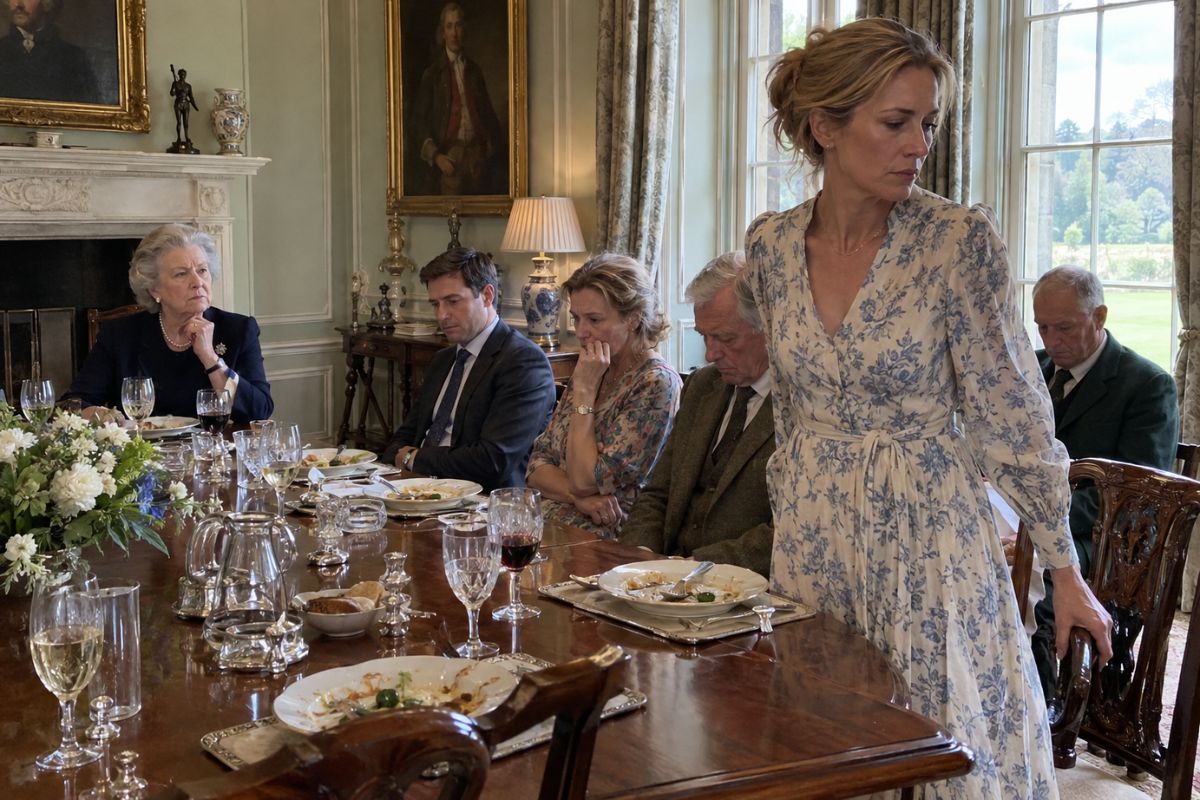
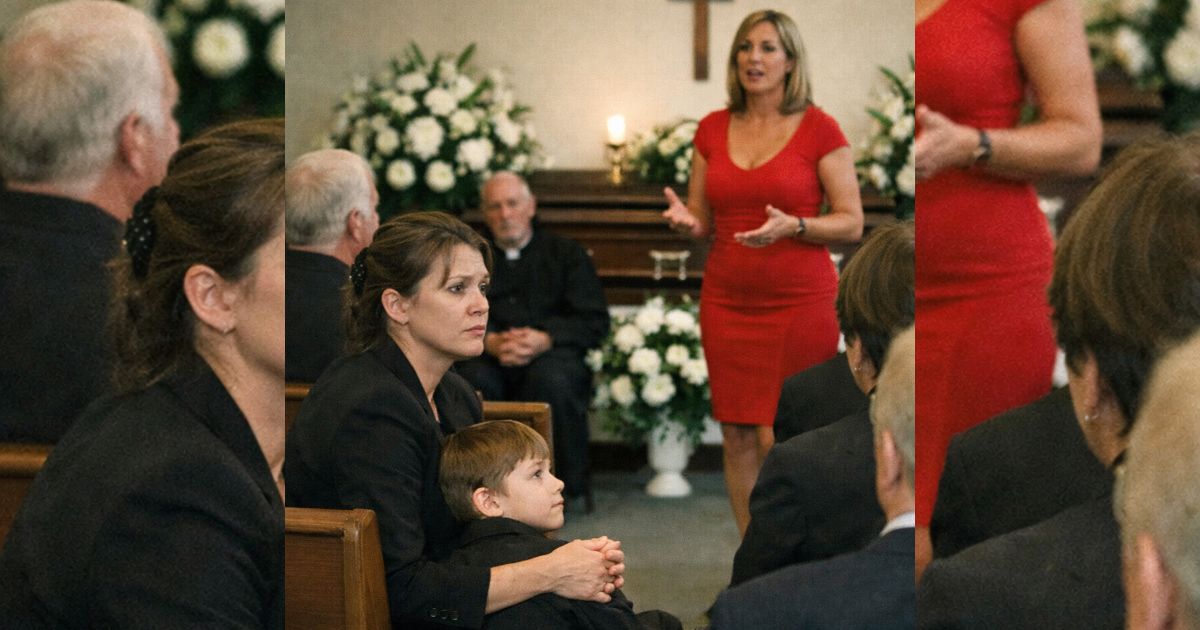
The woman stood three rows behind us in a dress so deep red it looked wrong against all that black.
Delilah Hart.
She lifted her chin a little higher, like she had earned the right to speak in the middle of my husband’s funeral.
“He stayed because of obligation,” she said. “Not love. Not devotion. Not loyalty. He told me himself.”
The pastor froze near the pulpit.
A cough rose somewhere in the back and died there. One of Julian’s old cousins shifted so hard in the pew I heard the wood groan. Even the organist had gone still.
Caleb tugged my hand.
“Mom,” he whispered, so softly only I heard it, “who is that?”
I bent toward him without taking my eyes off her.
“Just stay close to me, baby.”
That was all I could manage.
Because if I opened my mouth any wider, I was afraid every truth I had been swallowing for years would come pouring out in front of everybody.
Delilah kept talking.
“I knew Julian for five years,” she said. “Five years. He trusted me with the parts of himself none of you ever saw. He told me how trapped he was. He told me how lonely he was. He told me he felt invisible in his own home.”
A few people gasped.
My mother inhaled sharply through her nose the way she always did when she was trying not to say something sharp in church.
“We should stop this,” she muttered.
“No,” I said.
The word surprised even me.
“No. Let her talk.”
So she did.
She pressed one hand to her chest as if she were the grieving widow. As if she had any right to drape herself in heartbreak in the place where I had spent six sleepless days trying to remember whether I was mourning my husband or mourning the person I had been before I knew him fully.
Then a voice cut through the room from the side aisle.
“Miss Hart.”
It was calm. Steady. Male. Not loud, but somehow louder than anything she had said.
Roland Tate, our family attorney, stepped away from the wall where he had been standing beside the church office door.
He was a tall man in his sixties with silver hair and the kind of posture that made him look formal even in grief. He held a small wooden box in both hands.
Every eye in the room shifted from Delilah to him.
He walked to the front slowly, not with drama but with purpose, like he had already practiced each step in his mind.
He stopped near the first pew and looked directly at her.
“Julian left instructions,” he said. “Specific ones. He asked that this be delivered to you today, in public, if you attended the service.”
For the first time since she stood up, something in Delilah’s face flickered.
Confusion first.
Then curiosity.
Then the smallest lift at the corner of her mouth.
She thought it was for her.
You could see it happen.
She thought he had found a way to reach for her one last time, even from the grave.
She took the box with both hands, slowly, almost reverently. Her nails were painted the same dark red as her dress. The lid had a brass clasp. The wood was polished maple, plain but expensive, the kind of thing a person buys when they want an object to look serious.
The church went so quiet I could hear the old clock in the vestibule ticking through the open doors.
Even Caleb stopped fidgeting.
My mother’s spine went rigid beside me.
Roland stepped back.
Delilah glanced at me once.
There it was again, that look. That smug little certainty. That belief that no matter how ugly the day had become, she still held the secret center of it.
Then she opened the box.
At first she did not react.
She simply stared inside.
The silence stretched.
She reached in and lifted out a photograph with shaking fingers. She turned it over.
And then she screamed.
It was not a theatrical scream.
Not a gasp for attention. Not a cry calculated for effect.
It was the sound a person makes when the story they built their life around collapses all at once.
The photograph slipped from her hand.
The box hit the floor.
The lid swung wide.
Delilah stumbled backward one step, then another, eyes wild, face gone white. She looked from the photograph to me, then to Roland, then to the room around her as if she had forgotten there were witnesses.
“He lied,” she whispered.
Nobody answered.
Then louder, broken open now, “He lied to me.”
Her voice cracked on the last word.
She turned and hurried down the aisle, heels striking the hardwood unevenly, no pride left in them now. The doors at the back of the church slammed shut behind her so hard the flowers on the memorial table trembled.
Nobody moved for a second.
Then another.
Roland bent, picked up the photograph and the box, closed the lid, and placed it quietly on the nearest side table.
He looked at me once.
Just once.
A private acknowledgment.
I did not nod. I did not need to. He already knew.
I had known exactly what was inside that box since the night before.
Six days earlier, when Julian died, I did not cry.
That sounds cold when I say it now, but it is the truth.
People expect tears when a husband dies. They expect collapse, disbelief, shaking hands over a phone, a woman folding into herself in a kitchen while neighbors begin arriving with aluminum trays and soft voices.
I had some of that.
Not the crying.
Just the stillness.
Julian Bennett died late on a rainy Tuesday night on a stretch of highway outside Savannah. The state trooper who came to the door used the gentlest voice he had, and I remember thinking how strange it was that a man could arrive carrying news that would split a life in half and still say it like he was apologizing for stepping on a porch too early in the morning.
My mother was there because she had come over for dinner.
Caleb was upstairs building a model airplane on the floor of his room.
The trooper stood under our porch light with his hat in his hands, and before he finished his sentence, I knew.
I knew because there had been a knock on the door after dark.
I knew because the rain was slick on his shoulders.
I knew because Julian had been staying later and later at “the office,” and I had spent so much of the last year waiting for another kind of disaster that when a real one arrived, it almost felt familiar.
My mother made a sound behind me like all the air had left her body.
I thanked the trooper. I remember that. As if he had delivered flowers.
Then I closed the door, walked into the living room, and sat down on the edge of the couch.
Caleb called from upstairs, “Mom? Did Dad forget his keys again?”
I looked at the staircase and could not answer.
My mother answered for me.
Her voice broke in the middle, but she answered.
The next few days passed the way those days always do in movies and never quite do in real life.
People came.
They brought pound cake and ham biscuits and paper plates and sympathy cards with silver doves on them. They said Julian was a good man. A family man. A dependable man. They talked about his laugh, his work ethic, his firm handshake.
I thanked them all.
I said, “That’s kind of you.”
I said, “He loved this community.”
I said, “Thank you for coming.”
What I did not say was: Which version of him are you grieving?
The husband who forgot our anniversary and blamed stress?
The father who could kneel on the floor and help Caleb build a train set for two hours straight but could not make eye contact with me across a dinner table for two minutes?
The man who bought another woman a gold necklace the Christmas he bought me a cardigan and said he had been too overwhelmed to shop?
The man whose lies did not begin with thunder but with tiny paper trails?
The first time I knew something was wrong was not dramatic.
No lipstick on a collar. No perfume. No secret second phone vibrating in the night.
It was a receipt.
A tiny folded receipt in the pocket of Julian’s sport coat while I was hanging it back up after a work banquet at his firm.
A room charge from a small boutique hotel two towns over.
One night. Two guests.
I stared at it in the soft yellow light of our closet and told myself it meant something harmless.
A client dinner had run late.
A colleague had booked the room.
A billing mistake.
People do not see betrayal clearly the first time it shows itself.
They squint at it.
They tilt it toward the light.
They ask better things of it than it deserves.
A week later I found another one.
Then a charge for dinner I knew he had not eaten with me.
Then a purchase from a jewelry store just before Christmas.
When I asked him about the hotel receipt, he laughed.
Not cruelly. Not sharply. Almost warmly.
“That?” he said, loosening his tie at the kitchen counter. “That was a mess with accounting. Roland could tell you the same thing. Half those client trips get bundled together wrong.”
He kissed my forehead.
I wanted to believe him so badly I nearly did.
Then on Christmas morning I opened a boxed sweater in my favorite color and smiled like a good wife.
Later that afternoon, while Julian napped in the den and Caleb played with his new train set, I was looking for tape in the hall cabinet when I found a small velvet jewelry box stuffed behind a stack of old extension cords.
Inside was a delicate gold necklace with a tiny emerald pendant.
Not my birthstone.
Not my style.
Not for me.
I knew that before I ever asked.
That evening I sat across from him at the dining room table, the house lit soft and golden from the tree in the corner, and asked, “Who is she?”
His face changed in a way I had never seen before.
Not guilt first.
Annoyance.
As if my discovery had inconvenienced him.
“It’s not what you think,” he said.
That sentence should be engraved somewhere over the graves of bad marriages.
Because it is almost always exactly what you think.
He did not confess that night.
He did not have to.
His silence did the work for him.
Over the next month, truth came in scraps.
A name from a text preview he forgot to hide.
A lunch he said was a board meeting.
A weekend conference that never showed up on the office calendar pinned on our fridge.
Delilah Hart.
That was her name.
I said it aloud alone in my car the first time, just to feel the shape of it in my mouth.
Delilah.
A pretty name. Too pretty for the damage attached to it.
When I finally confronted him for real, it was in the kitchen after Caleb had gone to bed.
No yelling.
No thrown glasses.
No cinematic storm outside the window.
Just the refrigerator humming and Julian standing there with both hands on the counter, looking tired, older than his forty-two years, and deeply irritated that the life he had arranged for himself was becoming difficult to manage.
“How long?” I asked.
He looked down.
“Claire.”
“How long?”
He closed his eyes once.
“A few years.”
My knees almost gave out, but I stayed standing.
“A few.”
Then, because apparently the human heart is built to seek out its own breaking point, I asked, “Do you love her?”
That was the question that mattered to me then.
Not because love would make it better.
Because if he said yes, then every ordinary day of the last few years—every soccer game, every grocery run, every Sunday morning coffee, every “I’m tired,” every “Maybe next weekend”—would have been lived under a lie so large I would not know where my own life ended and the lie began.
He took a long breath.
“I don’t know,” he said.
I have often thought that “I don’t know” is more brutal than “yes.”
“Yes” would have been a wound.
“I don’t know” was erosion.
It wore everything down.
After that, we did not separate.
People always want to know why women stay after the truth comes out, as if there is one answer large enough to cover every house, every child, every exhausted heart.
I stayed because Caleb was in fourth grade and still cried if he got a stomach ache at night.
I stayed because my mother’s health had been shaky that winter and I could not handle one more collapse in the family.
I stayed because Julian kept saying he would end it.
I stayed because there are mortgages and school calendars and church directories and dinner tables and habits built over thirteen years, and none of them disappear the day a man admits he has been unfaithful.
I stayed because some part of me still believed I could stand in the middle of the wreckage and name it something else.
Maybe not love.
Maybe not forgiveness.
But survival.
Julian moved through those months like a man trying to keep two mirrors from reflecting each other.
He was attentive when Caleb was around.
He was distracted when we were alone.
Sometimes he was almost tender with me in ways that felt worse than distance.
He would bring home takeout from the little barbecue place near the courthouse because he remembered I liked the slaw there.
He would ask about my day, truly listening for three whole minutes.
He would stand at the sink and dry dishes while I washed them, and for a moment I would feel the ghost of our earlier marriage standing in the room with us.
Then his phone would buzz.
Or he would say he had to step outside.
Or a charge would appear on a statement.
Or I would see him glance at himself in the hallway mirror before leaving for a “late meeting,” smoothing his tie the way men do when they are dressing for an audience.
The first and only time I saw Delilah in person before the funeral was at a spring fundraiser for the local school foundation.
Julian had encouraged me to come.
That should have warned me.
Men who are managing secrets often become overly eager to arrange normalcy.
The event was held in the ballroom of an old inn downtown with string lights in the courtyard and tiny desserts no one really ate.
I was standing near the coffee station when I saw them across the room.
Not touching.
That would have been too obvious.
But there is a language between two people who believe themselves chosen.
A pause too long.
A private smile.
A gaze that lingers one heartbeat after politeness ends.
Julian was speaking with a group from the business council. Delilah stood beside a woman I recognized from city planning. She wore navy that night, not red, and her hair was pinned up in a careful low twist.
She was beautiful in a polished, deliberate way.
Not young enough to be called a girl. Not old enough to have surrendered ambition.
She laughed at something another man said and looked straight at Julian while she did it.
He did not look back immediately.
That almost made it worse.
It told me this had been going on long enough for caution to become instinct.
I went home that night and threw up in the downstairs bathroom without making a sound.
The next morning Caleb asked why my eyes were red, and I told him I had not slept well.
That became my answer for everything.
Why are your eyes red?
Why are you so quiet?
Why didn’t you go to dinner with Dad?
Why are you sitting in the car a minute before coming inside?
I haven’t slept well.
In truth, I had not slept well in over a year.
The night before the funeral, Roland Tate came to my house just after eight.
By then the casseroles had multiplied across every free surface in my kitchen. My mother was in the guest room with her rosary. Caleb had finally fallen asleep with one sock still on and the lamp burning beside him.
Roland sat at my table and took off his glasses.
He had known Julian since before I met him. He had drafted our wills, helped with the house closing, walked us through the paperwork when Caleb was born.
He also had the weary look of a man who had spent six days sorting not only legal documents but moral debris.
“There’s a clause,” he said, resting one palm on a folder. “One added recently.”
“Recently” was a delicate word.
I almost laughed.
Julian had not been recent with anything in our marriage except disappointment.
Roland slid the folder toward me, then stopped before letting go.
“I think I should explain this rather than have you read it cold.”
That was when I noticed the box beside his chair.
Small. Wooden. Polished. Closed.
My eyes went to it first.
“Who is it for?” I asked.
He hesitated.
That alone told me too much.
“For Delilah Hart,” he said.
The room did not tilt, exactly.
It narrowed.
All the sounds sharpened around the edges—the clock, the refrigerator, the click of the porch light outside as it turned on for the evening.
I sat back in my chair.
“And what,” I asked very carefully, “did my husband leave in a box for the woman he was seeing?”
Roland rubbed his thumb once over the bridge of his glasses.
“A photograph. And a handwritten message.”
I looked at the box again.
Julian had always loved props.
The right watch. The right pen. The right bottle of wine to bring to dinner. The right words at the right time.
Of course he had arranged one last object to speak for him.
“Why tonight?” I asked.
“Because he left instructions that it be delivered during the funeral service if she attended.”
I stared at him.
“In public?”
“Yes.”
There was a long pause.
“Did he know she was likely to come?”
Roland chose his next words with painful care.
“I believe he suspected she would.”
I laughed then, a dry, humorless sound that barely sounded human.
“Even dead, he wanted an audience.”
Roland did not argue with that.
He opened the folder and took out a folded page.
“I debated whether to show you the note.”
“Show me.”
“Claire.”
“Show me.”
He handed it over.
The handwriting was Julian’s. Clean. Controlled. Slightly right-leaning. The same writing he used on birthday cards and grocery lists and the little notes he used to leave me in the first year we were married when he traveled for work.
The message was short enough to fit in the palm of my hand and cruel enough to fill the whole kitchen.
Delilah—
For the years I took from both of you, this is the truth.
I never loved you.
I needed you when I wanted to feel chosen without having to deserve it.
I am sorry for what I made you believe.
—J
That was all.
No poetry. No excuse. No self-defense. No lie softened with sentiment.
Just a man finally stripping the fantasy bare.
My stomach turned.
Not because I pitied her more than I pitied myself.
Because the note proved something I had spent too many nights fearing.
Julian had not been living one real love and one fake one.
He had been living inside his own appetite.
He had used us both differently, but he had used us.
Roland watched my face as I read.
“Are you all right?”
“No,” I said. “But I’m not surprised either.”
He nodded once.
“He wanted the note placed in the box with the photograph.”
“What photograph?”
Roland opened the box carefully and showed me.
A glossy beach picture.
Julian and Delilah, arms around each other, smiling into some golden late-afternoon light. She was leaning into him with complete confidence. He looked relaxed, handsome, pleased with himself.
On the back, his note.
A trophy turned into evidence.
I let out a slow breath and leaned back.
“He chose this one on purpose,” I said.
“I suspect so.”
“Because she probably loved it.”
He did not answer, but he did not need to.
I looked from the photograph to the box to the folder containing the rest of Julian’s instructions and then back to Roland.
“Do it,” I said.
He blinked. “Claire, you do not have to let this happen.”
“Yes, I do.”
“Not for legal reasons.”
“No.” I folded the note carefully and placed it on the table. “Not for legal reasons.”
He waited.
I looked toward the hallway, toward the stairs where my son slept, toward the dim reflection of myself in the dark kitchen window.
“For years,” I said quietly, “I have been the person who keeps the room from cracking. I have smiled when I wanted to scream. I have accepted half-answers because a whole fight would have cost too much. I have protected his reputation more faithfully than he protected our marriage.”
Roland said nothing.
“And tomorrow,” I continued, “that woman is going to walk into church thinking she was the love story. She is going to stand there in front of my child and my mother and our entire town believing she gets to rewrite what happened. No.”
My voice shook then, but it held.
“No. Let him tell her the truth himself for once.”
Roland studied me for a long moment.
“Are you sure?”
I looked again at Julian’s handwriting.
At the final honesty of a man who had spent years rationing truth.
“No,” I said. “But do it anyway.”
After he left, I stood in the kitchen for a long time without moving.
The house had that late-night hush that makes every object look staged.
The fruit bowl. The school permission slip on the counter. Julian’s travel mug still in the dish rack from the day he died.
I went upstairs and stood in the doorway of our bedroom.
Our room then. Mine now.
His side of the bed was still slightly indented. His shoes were lined beneath the bench at the foot of it. A stack of folded undershirts sat in his open dresser drawer with the neatness of a life interrupted.
I sat on the edge of the mattress and let myself think the thought I had been pushing away all week.
I did not miss him in one simple piece.
I missed him in fragments.
I missed the man who used to rub my shoulders while I stirred pasta sauce at the stove.
I missed the father who cried when Caleb was born and kissed my forehead so reverently I thought I had married the safest man in the world.
I missed the early version of us who drove with the windows down and no destination, who sat on the front porch at our first house eating peach ice cream from the carton, who thought honesty would come naturally because love did.
I missed the hope.
But Julian himself?
By the end, he had become so split apart inside my mind that grief could not land anywhere clean.
Near midnight, I opened my closet and pulled out a black suit he had once told me was “too severe.”
That settled it.
I hung it on the bathroom door for morning.
If I had to bury him, I would not do it dressed as the version of me he preferred.
I would go as the version that survived him.
The morning of the funeral began in silence.
Not dramatic silence.
Domestic silence.
Coffee brewing and going cold. Cabinet doors opening and closing. The zipper of Caleb’s little black jacket traveling up and catching once under his chin.
He stood in the kitchen doorway with his hair damp from the shower and asked, “Do I have to wear the tie?”
“Yes,” my mother said before I could answer.
He made a face.
I almost smiled.
There is something nearly unbearable about children on hard days. They do not know when to stop being themselves.
Thank God for that.
My mother fastened a silver brooch to the lapel of my suit jacket with the concentration of a surgeon.
It had belonged to her mother.
“You look beautiful,” she said softly.
I looked at myself in the hall mirror.
Hair pulled back.
Face pale under careful makeup.
Lips painted in the same muted rose I wore on my wedding day.
The sight of that shade on my mouth nearly undid me.
Once, I had worn it because I believed my future was walking toward me in a blue suit with an open smile.
Now I wore it like armor.
Caleb came up behind me and slid his hand into mine.
“Mom?”
“Yes?”
“Will there be music?”
“There might be.”
He nodded as if that mattered.
Then, after a pause, “Do I have to talk to people?”
“Only if you want to.”
Another pause.
“Did Dad know he was going to die?”
Children can crack open a heart with one question.
I knelt in front of him so we were eye to eye.
“No, sweetheart. He didn’t.”
He nodded solemnly.
Then, because loss was still too large to hold in his mind without shrinking it into something he could actually ask, he said, “Okay.”
My mother drove us in her old Buick because I did not trust my hands on a steering wheel.
The road to the church was lined with pines and low marsh grass silvered by morning. We passed the gas station where Julian used to stop for black coffee, the little diner with the faded blue awning where we had eaten breakfast after Caleb’s kindergarten orientation, the hardware store where Julian once spent forty minutes choosing the “right” shade of porch paint and then let Caleb pick anyway.
Every ordinary landmark felt like a witness.
The church parking lot was already full.
I remember being offended by that.
Offended that so many people had somewhere to stand in relation to him.
As if his death had become community property.
Inside, the sanctuary was fragrant with white roses and lilies.
He had hated lilies.
Said they smelled too formal. Too much like hotel lobbies and old money.
I chose them anyway.
Not out of spite.
Out of indifference.
That felt even more honest.
People rose when we entered. Hands squeezed mine. Mouths moved. Soft condolences floated around me like tissue paper.
“So sorry, Claire.”
“He was such a good man.”
“We loved Julian.”
“Anything you need.”
I nodded at all of it.
Caleb stayed pressed to my side, solemn and small in his little jacket. My mother moved like a queen through enemy territory, chin high, grief pinned into place by pearls and purpose.
We sat in the front pew near the spray of white flowers and the framed photograph I had chosen for the altar.
Savannah Riverwalk, ten years earlier.
Julian holding infant Caleb on his shoulder, laughing at something just outside the frame.
It was the happiest picture I had of him because it contained no performance. Or if it did, I could not see it.
I wanted one clean memory near the casket.
One.
As people settled in around us, I scanned the room.
Friends. Cousins. Neighbors. Men from the local business association. Parents from Caleb’s school. A few old college friends Julian had not spoken to in years but who arrived now because death restores people briefly to one another.
Then I saw her.
At the back.
Under the archway.
Delilah Hart.
Even if I had never seen her photograph, I would have known.
Some people do not enter a room. They announce themselves to it first.
She wore a fitted red dress, tasteful enough to defend if challenged, provocative enough to be deliberate. Her hair fell in smooth dark waves over one shoulder. She stood perfectly straight, one hand on a small black handbag, surveying the room like someone judging whether her arrival had landed the way she intended.
It had.
My whole body went cold.
“She came,” I whispered.
My mother did not ask who.
She followed my eyes, saw the woman in red, and her jaw hardened.
“Well,” she said after a second, “I suppose some people cannot bear not being seen.”
Delilah began walking down the aisle.
Not to the front.
Not yet.
Just far enough in to ensure every whisper had a face to attach itself to.
She chose a pew three rows behind us and sat with one knee crossed over the other, calm as a guest at a recital.
Caleb noticed my tension and looked back over his shoulder.
I gently turned him forward again and smoothed the front of his jacket.
“Just listen to the nice things people say about Daddy,” I whispered.
He nodded.
The pastor began.
There were prayers, then a hymn, then remarks from one of Julian’s colleagues about leadership and service and the ways a man “shows up” in a community.
That phrase almost made me laugh.
Shows up.
People are so generous with public men. They count visibility as virtue.
The pastor spoke next about devotion to family, which felt almost comic in its wrongness. I stared at the framed photograph and tried to remember what it had once felt like to love the man in it without any shadow over the memory.
I could not reach that far back.
All I could reach was the split inside me.
The grief and the anger.
The relief and the humiliation.
The loss of a husband and the loss of the illusion that had kept my life organized.
Then Delilah stood.
And the service broke.
What happened after that lives in me with an unnatural clarity.
Her heels.
The red of her dress against the walnut pews.
The pastor’s open hands lifting slightly as if he meant to calm a child.
My mother’s whisper: “No manners. No shame.”
Caleb’s fingers tightening around mine.
The way Delilah’s voice softened at certain words, as though she truly expected the room to crown her grief as more authentic than mine.
“I knew Julian better than most of you.”
“He told me who he really was.”
“He stayed because of his son.”
“Not because he loved her.”
Her eyes on me when she said her.
I can still see them.
Not cruel, exactly.
Victorious.
That is what made it unbearable.
She did not come to wound me because she hated me.
She came because she believed herself to be the final truth.
And then Roland walked forward with the box.
Even now, when I think of that moment, I do not feel triumph.
I feel stillness.
Almost relief.
Because for once, I did not have to explain anything. I did not have to defend my own reality to someone who had benefited from denying it.
Julian, in all his selfishness, had arranged the one thing he had never given me while living beside me.
Proof that the fantasy had not belonged to her any more than the marriage had fully belonged to me.
When Delilah opened the box and saw the beach photograph, she looked almost softened for one brief second.
That was the look of recognition.
Of memory.
Of believing herself cherished.
Then she turned it over.
Then she read.
Then everything in her face came apart.
People later asked what the note said.
Not directly, of course.
Not in those words.
They asked around it.
“Did he leave instructions?”
“Was it something personal?”
“Was it legal?”
“Did she misunderstand?”
Small-town grief is never just grief. It is also administration and theater and curiosity in respectful shoes.
At the time, though, nobody asked anything.
They just watched.
Watched her drop the photograph.
Watched her lose her footing.
Watched the color drain from a woman who had walked in so certain she was carrying the most important version of the story.
When she said, “He lied to me,” a strange sound moved through the room.
Not laughter.
Nothing so ugly.
But not pity either.
Recognition, maybe.
The kind that passes through a crowd when private ugliness suddenly becomes legible.
Then she did the one thing I had not expected.
She walked toward me.
Slowly at first.
Then faster.
Her hands were trembling. Her mascara had not run, but her composure had.
Roland shifted a little, perhaps to step between us if needed, but there was nothing physical in her posture.
Only bewilderment.
She stopped a few feet from my pew.
“Why?” she asked me.
Just that.
Why.
Why would he do this to me?
Not why had he lied. Not why had he built two lives and failed both. Not why had I let the box be delivered.
Why would he do this to me.
The question landed in the sanctuary with all the innocence of self-centered pain.
I rose slowly so Caleb would be behind me, not because I feared her, but because instinct is older than civility.
I looked at her for one long moment.
Saw the heartbreak.
Saw the humiliation.
Saw, too, the woman who had taken part in my own.
Then I answered with the calmest voice I have ever had.
“Because he did it to me first.”
That was all.
No speech.
No accusation.
No list.
Just the truth reduced to a single line.
She stared at me as if I had pushed her into a mirror.
Then her shoulders dropped.
Some people break loudly.
She broke quietly.
The arrogance went out of her face first.
Then the certainty.
Then the posture.
She turned without another word and walked back down the aisle. Not fast this time. Not proud either. Just unsteady.
The doors shut behind her.
The church remained silent.
I sat down.
The pastor looked helpless.
Roland stepped forward and said, with more grace than Julian had earned, “I think we should continue.”
So we did.
That was the strangest part.
The service went on.
A hymn.
A prayer.
The final blessing.
As if twenty minutes earlier the room had not split open and shown everyone the wiring underneath.
But grief is practical. Ceremonies move forward even when dignity lags behind.
At the graveside, people kept a greater distance from me.
Not coldly.
Carefully.
As if I had become something fragile and slightly dangerous at the same time.
The burial itself passed in a blur of sunlight and low voices and the smell of damp earth. Caleb stood close enough that the sleeve of his jacket brushed mine whenever he moved. My mother kept handing out tissues to other people and never once used one herself.
When it was over, there was a reception in the church fellowship hall with ham biscuits, sweet tea, and the casseroles that appear after every Southern funeral whether anyone wants them or not.
I did not go.
I signed the last required paper.
I thanked the funeral director.
I guided Caleb to the car.
That was enough public composure for one lifetime.
The moment the car doors shut, the silence between us felt cleaner than the silence at the church had.
Caleb stared at the wooden cross the funeral home had handed him.
He turned it over in his lap a few times, then finally asked, “Mom, who was that lady?”
Children always ask the simplest version of the hardest question.
I buckled my seat belt and looked straight ahead before answering.
“She was someone your dad knew.”
He waited.
Children can hear when a sentence is incomplete.
“Did she know him from work?”
“Yes.”
“Was she his friend?”
I took a breath.
There are moments when motherhood feels like translation. You are constantly converting adult damage into something a child can carry without being crushed.
“She thought she was very important to him,” I said.
He looked down at the cross.
Then, after a long pause, “Did she hurt you?”
The directness of it almost undid me.
Because what do you say to a ten-year-old boy sitting in the back seat of a Buick after his father’s funeral, when he is trying to understand not only death but betrayal without even having the language for betrayal?
I turned toward him.
“She didn’t make the choices that hurt me most,” I said carefully. “Your dad did. But that pain belongs to the grown-up part of the story. It does not belong to you.”
He frowned a little, thinking hard.
“Did Dad love me?”
There it was.
The question that had sat under everything all week.
I turned fully in my seat then and reached back for his hand.
“Yes,” I said immediately.
Because whatever else Julian had done, whatever else he had withheld or distorted, that part had always been real. Imperfect. Inconsistent in the way tired fathers can be. But real.
“Yes,” I said again. “He loved you very much.”
Caleb nodded once, eyes shining but dry.
Then he leaned his head against the window.
My mother drove us home in silence.
That evening, after she reheated something from a casserole dish and insisted Caleb eat three bites before going upstairs, she stood with me in the kitchen while the dishes soaked.
“You were very strong today,” she said.
“No,” I said. “I was very still.”
She considered that.
“There is a difference?”
“Yes.”
She dried her hands on a towel and looked at me with the frankness only mothers and daughters can survive.
“You were both.”
Then she kissed my temple and went upstairs to check on Caleb.
I stayed in the kitchen alone.
The house felt altered.
Not emptier.
It had already been empty in the ways that mattered.
But claimed.
Quiet in a new direction.
For the first time in months, maybe years, the silence did not feel like a punishment.
It felt like space.
I took Julian’s mug from the dish rack and held it for a second.
Navy ceramic. Chipped on the bottom edge. He used it every morning and refused to throw it out because he said coffee tasted different in heavier cups.
I set it in a donation box without ceremony.
Then I went into our bedroom.
No.
My bedroom.
I stood in the doorway a long time.
The bed we had shared looked innocent from a distance.
So did his side table with the novel he never finished and the reading glasses he barely needed but wore anyway because he thought they made him look distinguished.
I opened the closet.
His suits hung in a neat line, shoulder to shoulder like men waiting politely for instructions.
I reached for the charcoal one from our last anniversary dinner.
We had gone to a steakhouse downtown. He had ordered a bottle of wine he could not really justify, and for two whole hours he had been charming. Present. So attentive I let myself believe the worst was over.
Three days later I found a charge for a beach rental on Tybee Island.
The same week, apparently.
I ran my fingers along the lapel and remembered how handsome he had looked that night.
Handsome and absent.
That was the trick of him by the end.
He could appear fully in a room while giving the truth of himself to no one.
I took the suit off the hanger, folded it carefully, and placed it in the donation box.
Then another.
And another.
I did not do it out of rage.
Rage would have been hotter, faster.
This was housekeeping of the soul.
A slow, deliberate removal of objects that no longer deserved to anchor me.
Near the back of the closet, I found the old canvas duffel he used for weekend conferences.
Inside was a mix of ordinary things and the ruins of performance.
A dry cleaner tag.
A hotel key sleeve with no key.
A charger.
A receipt for sunglasses.
And tucked into the inside pocket, a folded brochure from a beach inn on the coast.
No dates.
No notes.
Just one more small piece of a life he had carefully divided.
I stared at it for a moment, then dropped it into the trash.
I was done archiving evidence for a trial already over.
The next morning, I made pancakes.
Nothing noble about it.
Nothing symbolic in the moment.
Caleb liked pancakes, and grief had made the whole week feel like a procession of casseroles and whispered voices and adults making everything taste like obligation.
So I made pancakes.
I played an old soul playlist from my phone. Opened the kitchen blinds. Let sunlight onto the floor.
Caleb came downstairs in socks and asked, “Why are you making breakfast on a Monday?”
“Because I felt like it.”
He accepted that immediately.
Children do not question joy when it shows up in the right shape.
By the second pancake, he smiled.
By the third, he laughed because the dog sat beside his chair and stared at the syrup bottle like it had been sent from heaven.
That laugh entered the room like fresh air.
I stood at the stove with a spatula in my hand and realized, suddenly and cleanly, that I was not mourning Julian the way everyone expected.
I was mourning the woman I had been while loving him.
The one who thought if she stayed patient enough, pleasant enough, forgiving enough, clear enough, she could coax truth out of someone determined to ration it.
The one who measured strength by how much pain she could endure quietly.
The one who mistook silence for dignity.
That woman had gotten me through a lot.
She had also nearly disappeared inside it.
Over the next few days, life resumed its plain tasks.
School forms.
Thank-you notes.
Phone calls with the attorney.
Laundry.
I met with Roland in his office on Wednesday afternoon to review the formal paperwork.
He wore the same careful expression as before, as if he wanted to be kind without presuming intimacy.
We handled the house, the insurance documents, the accounts set aside for Caleb. Dry practical things.
Then he paused and folded his hands.
“There’s one other matter,” he said.
I already knew what it was.
“Delilah?” I asked.
He looked surprised, then nodded.
“She contacted the office.”
I waited.
“She wanted to know whether the note had been authentic.”
That almost made me smile.
“As if someone staged it?”
“She used the phrase ‘out of character.’”
I sat back in my chair and looked toward the window.
Outside, people moved along the sidewalk carrying coffee and legal pads and grocery bags, all of them inside their own ordinary afternoons.
“Was it out of character?” he asked gently.
“No,” I said after a moment. “It was the most in-character thing he ever did. Hurt someone honestly after hurting everyone else dishonestly.”
Roland let that sit.
“She also asked whether there were any other… provisions.”
“There weren’t.”
“No.”
I looked down at my wedding ring.
I still wore it then, though mostly because taking it off felt like another ceremony I was not yet ready to perform.
“She really thought he was going to leave me and build a life with her,” I said quietly.
Roland chose his reply carefully.
“I think she believed what suited him to tell.”
That, more than anything, was the story of Julian.
He told each person the version of reality that best protected his appetite.
To me, he said, “I’m tired. Work is demanding. You know how much pressure there is right now.”
To Delilah, he said, “You are the only one who really sees me.”
To the world, he said, “Family is everything.”
Maybe he even believed all those versions at different hours of the day.
Some people are not liars in the simple sense.
They are editors.
They cut and shape themselves to fit the room.
I finally took my wedding ring off that night.
Not because of Delilah.
Not even because of the funeral.
Because I was buttering toast for Caleb’s lunch the next day and suddenly understood that I no longer needed a symbol of promise from a man who had lived on preference.
I carried the ring upstairs and set it in the back of my dresser drawer inside the velvet box from our engagement.
No tears.
No speech.
Just placement.
I thought that would be the end of Delilah in my life.
It wasn’t.
A week later, she wrote me a letter.
Not an email.
An actual letter.
Cream stationery. My name in dark blue ink. No return address, though I recognized the careful slant of the handwriting from the envelope Roland had shown me when she contacted the office.
I almost threw it away unopened.
Instead, I sat at the kitchen table after Caleb went to bed and read it once.
Claire,
I do not know whether I am writing because I owe you something or because I am trying to make sense of my own humiliation. Maybe both.
I came to the funeral believing I had been told the truth. I believed your husband loved me. I believed he planned to leave. I believed I had been chosen in a story where you were only the obligation.
I see now how ugly that sounds.
I am not asking for your forgiveness. I do not deserve it.
I am writing because when he said those things about you to me, I wanted to believe them. It made my part in the whole thing easier to bear.
That is not an excuse.
It is just the truth.
When you answered me in the church, I understood in one sentence what I should have understood years ago.
He had not honored either of us.
I am sorry for my part in your pain.
I will not contact you again.
—Delilah
I read it twice.
Then I folded it and tucked it into the same drawer where I had placed my wedding ring.
Not because it mattered enough to keep.
Because it belonged with the other relics of a life I was no longer living but had not yet fully cleared away.
Did I forgive her?
Not that night.
Not in some shining dramatic flash.
Forgiveness, I have learned, is rarely a single decision. It is more like taking your hand off a hot surface in increments.
I did not wake up the next morning and feel sisterhood toward the woman who stood in red at my husband’s funeral and announced to a room full of people that he never loved me.
But I did feel something loosen.
Because her letter confirmed what I had begun to understand.
She had not been the winner in some contest I had lost.
She had been another audience member in Julian’s private theater.
He used different lines on us.
That was all.
In the month after the funeral, people kept trying to explain my own story back to me.
Church women said things like, “Grief can make everybody act out of character.”
Neighbors said, “I’m sure she was confused.”
A man from Julian’s office actually told me, “He was probably trying to protect everyone’s feelings.”
Protect.
There are words people use when they cannot bear to call selfishness by its right name.
I stopped correcting them.
I stopped explaining.
I stopped making Julian legible for people who had only known the polished version.
Instead, I built smaller routines.
I drove Caleb to school with the windows cracked a little so morning air could move through the car.
I took evening walks with my mother when she stayed over, and we talked about everything except Julian until one night we finally did not.
I went back to the community arts center where I had once taught beginner pottery classes before “life got too busy,” which was marriage language for “his work mattered more than my joy.”
I stood in a bright room with clay under my nails and remembered I had hands capable of making things.
That mattered more than I can say.
One Saturday, Caleb and I cleaned out the garage.
He found an old fishing rod Julian had meant to repair for two summers and never did.
“Can we keep this?” he asked.
“Of course.”
He held it for a second, thoughtful.
Then he said, “Maybe Grandpa can show me.”
My father had been gone ten years, but he still called my mother’s brother Grandpa sometimes because my uncle filled that shape in his life.
“Maybe he can,” I said.
There it was again.
The future entering softly through an ordinary sentence.
Not a dramatic rebirth.
Not some movie montage of empowerment.
Just life, still coming.
By late spring, the dogwoods out front had dropped most of their blooms, and the front porch needed painting the way it had needed painting for three years.
Julian had always said he would get to it.
One Saturday morning I bought a gallon of soft gray-blue from the hardware store and did it myself while Caleb sat on the steps eating orange slices and telling me facts about sharks he had memorized from a library book.
Halfway through, my mother pulled into the driveway with lemonade in a pitcher and stood there with one hand on her hip.
“Well,” she said, “look at you.”
I laughed.
It surprised both of us.
“What?” I asked.
“You just look like yourself,” she said.
I leaned the paint roller against the tray.
“I wasn’t sure I knew what that looked like anymore.”
She handed me a glass.
“Maybe you are getting to find out.”
I think that was the first time I understood healing not as a return but as a discovery.
There was no going back to the woman who entered the church in a black suit with a child’s hand in hers and a note in her memory and a war inside her chest.
That woman had already crossed too much ground.
But there was something ahead of her.
Ahead of me.
A life not organized around managing someone else’s lies.
Months later, when people stopped bringing food and stopped lowering their voices around me and stopped glancing over their shoulders in the grocery aisle as if betrayal might still be contagious, the story of the funeral settled into local legend.
I heard versions of it secondhand.
“She stood up in the middle of the service.”
“He left a box.”
“She read something and ran out.”
“Claire never raised her voice once.”
That last part became the detail people admired most.
They called it grace.
Poise.
Class.
Those words never sat quite right with me.
I had not been graceful.
I had been exhausted.
I had not been poised.
I had been done.
Sometimes people confuse the end of tolerance with dignity because it is quieter than they expect.
What I felt that day was not elegance.
It was the last thread snapping.
And oddly, that made room for peace.
Not immediately.
Not in one clean line.
But steadily.
The night Caleb asked if we could move his bedroom furniture around because he wanted the bed by the window.
The afternoon I found myself singing along to the radio without thinking about whether grief made that inappropriate.
The morning I poured coffee into my own favorite mug instead of Julian’s chipped navy one and realized I had not looked for it in weeks.
Tiny things.
The architecture of a new life is always built from tiny things.
Nearly a year later, on the anniversary of the funeral—not the accident, the funeral—I took the wooden box out of the cabinet where I had stored it after Roland returned it to me with the rest of Julian’s personal effects.
I had almost forgotten I still had it.
Almost.
The wood was smooth under my fingers.
For a second I thought about throwing it away.
Instead, I opened it.
The photograph was still there, though I had removed the note months earlier and shredded it.
I looked at the picture.
Julian smiling at the camera.
Delilah pressed close to him, sunlit and certain.
A moment once treasured by one person and staged by another.
I slid the photograph back into the box, closed the lid, and carried it to the fireplace.
I did not burn it.
That would have been too dramatic and too satisfying in a way life rarely is.
I simply set it on the mantel with a note to myself to take it to the attic later.
A relic.
Nothing more.
That afternoon Caleb and I drove out to Tybee and walked along the shore with our shoes in our hands.
He chased gulls. Collected shells. Asked for fries from the little stand by the pier.
I sat on a bench eating too many of them and watched him run through the edge of the water under a sky so bright it made me squint.
At one point he turned and waved both arms over his head.
“Mom! Look!”
I looked.
There was nothing to see except my son laughing in salt wind.
And somehow that was everything.
Julian’s final truth had humiliated Delilah.
It had exposed him.
It had shaken the room he once controlled.
But that was not the real ending.
The real ending was quieter.
It was this:
I no longer needed his lies to define the size of my life.
I no longer needed his note to validate what I had lived through.
I no longer needed to be the woman who sat perfectly still while someone else narrated her pain.
Sometimes I think about what would have happened if Roland had not walked forward with that box.
If Delilah had spoken and I had gone home with her words hanging in the air unanswered.
Would I have been all right eventually?
Probably.
Truth has a way of surviving even without theater.
But I am grateful, in some complicated corner of myself, that the moment unfolded the way it did.
Not because she was humiliated.
Because illusion was.
Not because I won.
Because the performance ended.
And when a performance ends, the room changes.
The lights are harsher. The silence is different. The props look smaller.
And at last, finally, everyone has to go home as themselves.
That is what I did.
I went home as myself.
Not Julian’s widow in the way people meant it.
Not the abandoned wife.
Not the woman in the front pew being watched for a reaction.
Myself.
A mother with flour on her hands the next morning.
A daughter painting her porch.
A woman relearning how to inhabit rooms without bracing for disappointment.
A person who had been lied to and had not disappeared because of it.
People say funerals are for the living.
I used to think that meant closure.
Now I think it means choice.
You stand there among flowers and hymns and polished wood and all the unfinished business the dead leave behind, and you choose.
You choose what belongs to you.
You choose what goes in the donation box.
You choose what stays in the drawer for a little while longer.
You choose which stories get to keep speaking after the service is over.
Julian’s choices built the wreckage.
Mine built the life after it.
And if you ask me what I remember most from that day, it is not Delilah’s scream.
Not the gasp in the pews.
Not even the note.
It is the feeling of Caleb’s hand in mine while the room waited for me to break.
Small hand. Warm hand. Trusting hand.
The weight of what was still mine to protect.
That was the moment everything became clear.
Not my marriage.
Not the betrayal.
My future.
It was sitting right there beside me in a child’s black jacket, asking simple questions and deserving simple truths.
So I gave them to him.
And then, one ordinary morning at a time, I started giving them to myself too.
Thank you so much for reading this story!
I’d really love to hear your comments and thoughts about this story — your feedback is truly valuable and helps us a lot.
Please leave a comment and share this Facebook post to support the author. Every reaction and review makes a big difference!
This story is a work of fiction created for entertainment and inspirational purposes. While it may draw on real-world themes, all characters, names, and events are imagined. Any resemblance to actual people or situations is purely coincidenta