He Stopped to Help a Stranded Old Man and Lost the Job Interview That Could Have Changed His Life—By Sunset, He Was Sitting Across From the One Person Who Had Been Watching Everything
“Sir, leave the jack alone before it slides.”
Marcus Reed was already in the street before he fully accepted what he was doing.
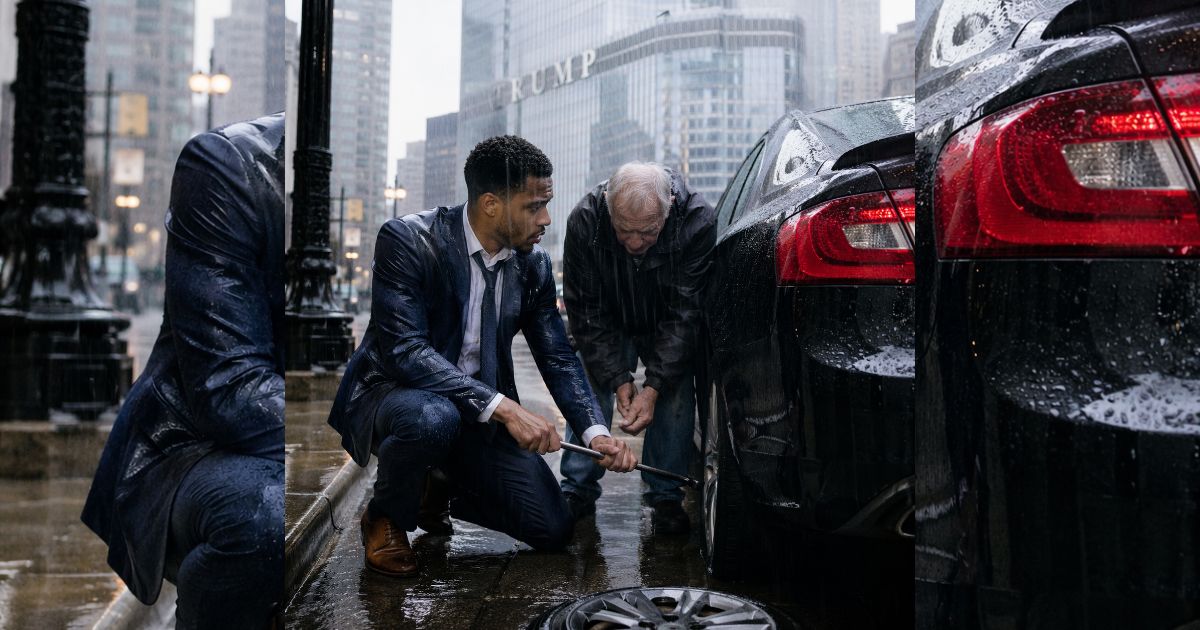
Rain hammered the hood of the black sedan hard enough to make the whole car tremble. Water rushed along the curb in dirty ribbons. A few people hurried past with their collars up and their heads down, pretending they did not see the elderly man bent over the trunk, one hand gripping a crooked umbrella and the other fighting with a spare tire that kept slipping against the wet pavement.
Beyond them, at the end of the block, a tower of glass and steel glowed through the storm.
Marcus only had to keep walking.
Just three more blocks.
One elevator ride.
One interview.
One chance.
Instead, he crossed the street.
The old man looked up, startled. He had silver hair plastered to his forehead, a rain-darkened overcoat, and the tired, proud expression of someone who hated needing help. His fingers were pink from the cold. The jack sat crooked under the frame, sunk half an inch into the soft edge of the flooded curb.
“I can manage,” the man said, though the wobble in his voice gave him away.
Marcus glanced once toward the tower again.
He could almost see the future he had spent two years chasing: a real salary, a better apartment for his mother, groceries that did not require mental math, the chance to stop introducing himself with one hand and apologizing for his zip code with the other.
His phone buzzed in his pocket.
Probably his mother.
Probably another message that said, You were made for this.
He did not reach for it.
“Not like this, you can’t,” Marcus said. “The ground’s too soft. Let me fix the angle.”
The old man studied him for half a second, maybe surprised that the young Black man in the soaked suit had stopped at all.
Marcus knew that look.
He had been meeting versions of it his whole life.
Sometimes it looked suspicious.
Sometimes dismissive.
Sometimes politely blank.
But it always carried the same quiet question underneath.
What are you doing here?
Marcus ignored it. He set his leather portfolio on the back seat, hoping the papers inside had not already curled beyond saving, then stripped off his jacket and dropped to one knee in the rain.
The cold soaked through his slacks instantly.
His good interview pants.
His only good interview pants.
He swallowed the thought and reached for the jack.
“Turn the wheel slightly toward me,” he said.
The old man blinked. “You know what you’re doing?”
Marcus gave a tight little smile. “My uncle ran an auto garage on the South Side. I spent half my summers under cars I couldn’t afford to touch. Hold the umbrella lower. Not for me. For the bolts.”
The old man obeyed.
That surprised Marcus too.
Usually men like this one did not take instructions from men like him, especially not on a downtown street in clothes that probably cost more than Marcus’s monthly rent.
Rain slid down Marcus’s neck and into his collar. His tie stuck to his shirt. His shoes were ruined already. The clean shine he had worked on the night before was gone, replaced with street water and oil-gray splatter.
He tightened the jack carefully.
Lifted.
Tested.
Adjusted again.
The sedan rose slowly.
There.
Stable.
“Now we’re talking,” Marcus muttered.
The old man let out a breath that almost turned into a laugh. “You make it sound easy.”
“It isn’t,” Marcus said. “You just don’t let the car know that.”
That got a real laugh out of him.
For one strange second, in the middle of the storm, Marcus felt his own panic loosen.
Not disappear.
Just loosen.
The old man held the umbrella while Marcus pulled the flat tire off and rolled the spare into place. His hands moved with the memory of older summers and harder days, back when the garage had smelled like rubber, old coffee, and hot metal, and his uncle Ray had believed in teaching a boy useful things before life taught him harder ones.
“You headed somewhere important?” the old man asked over the rain.
Marcus almost said no.
It would have been easier.
More dignified.
Less likely to sound like begging.
But something in him was too tired for performance.
“Yeah,” he said. “Very.”
“Work?”
“Interview.”
The old man looked at his soaked clothes, then toward the tower. “There?”
Marcus tightened the lug nuts in a star pattern.
“There.”
“You may have missed it.”
Marcus’s jaw flexed. “I know.”
The old man was quiet for a moment.
Most people would have stopped there. Said something shallow and forgettable. Tough break. Bad timing. One of those phrases that sounded sympathetic while keeping a safe distance from real disappointment.
Instead, the man asked, “Then why’d you stop?”
Marcus sat back on his heels and wiped rain and grease from his hands onto a handkerchief that was not going to survive the morning anyway.
Because my mother raised me better.
Because I know what it looks like when everyone keeps walking.
Because I can live with being late more easily than I can live with becoming the kind of man who would leave you here.
He thought all of that.
What he said was, “Because you needed help.”
The old man stared at him.
Not with pity.
Not with judgment.
Just a long, steady look, like he was filing the answer somewhere.
Marcus tightened the final bolt and stood.
“Try now.”
The old man put a hand on the car and tested the weight. Solid.
“You’ve saved me a miserable hour,” he said.
Marcus stepped back, already reaching for his jacket. “Glad I could.”
“What’s your name?”
Marcus hesitated. Then, “Marcus Reed.”
The man nodded once. “I’m Richard.”
No last name.
Just Richard.
Marcus did not ask for one.
He slipped back into his dripping jacket and grabbed his portfolio from the back seat.
The leather was wet.
He did not want to think about the resume copies inside.
“You should at least let me drive you,” Richard said. “You’ve earned that much.”
Marcus looked toward the tower again. The interview had been at nine.
His watch read 9:11.
His stomach dropped.
Still, walking now would be pointless. Running would look desperate. He was already soaked from head to toe.
He opened the passenger door and slid in.
The car smelled like cedar, leather, and rain.
Clean. Expensive. Quiet.
The kind of quiet Marcus had learned was a luxury in itself.
Richard eased the sedan back into traffic.
For a block, neither of them spoke.
Wipers beat the windshield.
Outside, downtown Chicago blurred into streaks of gray glass and rushing umbrellas.
Inside, Marcus became painfully aware of the water coming off him. His cuffs. His collar. The cheap seam on the inside of his jacket that had started to separate two winters ago and that he prayed stayed hidden now.
He gripped the portfolio in his lap.
“This interview,” Richard said at last. “What kind of position?”
“Junior analyst track.”
“At a firm like that?”
“Yes, sir.”
“You’re young for that.”
Marcus heard the surprise buried under the observation.
He was used to that too.
“I graduated early,” he said. “Worked while I was in school.”
“Where from?”
“Chicago State.”
Richard glanced at him briefly.
Not mockery.
Not approval either.
Just interest.
“And you think they’ll give a Chicago State kid a real shot?”
Marcus looked out at the rain-swept street. “I think if I know the numbers better than the room, and I work harder than the room, sometimes people run out of reasons to say no.”
“Sometimes,” Richard repeated.
Marcus gave the smallest shrug. “Sometimes is better than never.”
That drew another look.
A sharper one this time.
“You’ve said that before.”
“No, sir.”
“I don’t mean the sentence. I mean the feeling behind it.”
Marcus let out a breath through his nose.
He did not know this man.
Did not owe him honesty.
Yet the morning had already taken so much from him that pretending seemed like wasted energy.
“My whole life,” he said, “someone’s always had a reason I wasn’t the obvious choice.”
The windshield wipers swept hard left, then right.
Richard said nothing.
But the silence felt less empty now.
They pulled beneath the covered drop-off in front of the tower at 9:18.
A valet opened an umbrella, hurrying toward the sedan. Marcus reached for the handle before the man got there.
He did not want help getting out of a luxury car in front of the building he had spent months trying to enter on merit.
“Thank you for the ride,” Marcus said.
Richard put the car in park. “Marcus.”
He turned.
“For what it’s worth,” the old man said, “a lot of people would have kept walking.”
Marcus managed a faint smile that hurt more than it helped.
“A lot of people did.”
He stepped out into the drizzle.
The building rose above him, gleaming and cold. Water pooled on the marble steps. The brass handles on the glass doors shone like a promise meant for someone else.
Marcus straightened his tie.
It was hopeless.
Still crooked.
Still damp.
He squared his shoulders and went inside.
The lobby looked like another country.
Everything was polished, quiet, controlled.
Cream-colored stone floors.
Tall arrangements of white flowers.
Men and women in tailored coats carrying coffee that cost more than his breakfast.
A giant abstract painting stretched across the far wall, all sharp lines and confidence.
Marcus stood just inside the doors for one dangerous second and saw himself reflected in the glass.
Wet hair.
Wrinkled shirt.
Trouser cuffs dark with rain.
Face tight with the effort of looking composed when he felt anything but.
He looked like bad timing.
Like inconvenience.
Like someone who belonged in the service elevator, not the main one.
He made himself walk.
At the security desk, the guard looked up, took in Marcus’s state, and tried to hide his reaction behind professionalism.
“Can I help you?”
Marcus swallowed.
“My name is Marcus Reed. I have a nine o’clock interview with the investment strategy division.”
The guard checked a tablet.
His finger paused.
He looked back up. “Fourteenth floor.”
Marcus nodded once. “Thank you.”
Then the guard added, gentler than Marcus expected, “They’re strict upstairs.”
Marcus almost laughed.
As if he had not figured that out.
“I know.”
The elevator ride was short enough to be merciless.
Every reflective surface showed him what the morning had turned him into. His shirt clung to his shoulders. Water still dripped from the hem of his coat. The portfolio’s leather had gone dark and soft in spots, like a wound.
He thought of his mother, Denise, ironing that shirt in her apartment kitchen the night before because the building laundry room had eaten two quarters and refused to dry anything fully.
He thought of the cuff links at his wrists, silver and worn smooth with age, the only nice thing his grandfather had ever owned long enough to pass down.
He thought of Professor Meyers telling him, You belong in rooms like this, Marcus, even if those rooms don’t know it yet.
The elevator opened.
The receptionist on fourteen was polished in the way everything here was polished. Perfect hair. Gray jacket. Soft voice sharpened by routine.
She looked up.
Her eyes landed on Marcus.
Something flickered there.
First surprise.
Then sympathy.
Then the professional mask returned.
“Good morning.”
“Marcus Reed,” he said. “Nine o’clock interview.”
She checked her screen. Then the clock.
Then him again.
“I’m sorry, Mr. Reed.”
The way she said it told him everything before the rest came.
“Mr. Calloway has already moved on to the next candidates.”
Marcus stood still.
Some part of him had held onto a thin, stupid thread of hope all the way upstairs. Maybe the storm had delayed others too. Maybe the firm would make an exception. Maybe somebody would care that life did not always happen according to lobby clocks and polished calendars.
But her tone closed the door.
He cleared his throat. “I understand. Could you just let him know I came?”
“I can leave a note.”
“And this.”
He opened his portfolio.
The resumes inside had curled at the corners. One page had a faint gray blur where rain had touched the ink. The market notes he had prepared over the last month were still readable, but the careful order of them was gone.
He chose the least damaged resume and handed it over.
She took it with both hands, which Marcus noticed.
Not because etiquette mattered.
But because respect did.
“I’ll make sure he gets it,” she said.
He nodded.
That was all there was.
No speech.
No plea.
No dramatic second chance.
Just a building that had already moved on.
Marcus turned back toward the elevator, hearing the soft wet sound of his shoes against the hardwood floor.
When the doors closed around him, the silence finally cracked something inside his chest.
Not enough to make him cry.
He was too tired for that.
Just enough to let the truth in.
He had done the right thing.
And the right thing had cost him.
By the time he got back outside, the rain had thinned to a mist.
Sunlight pushed weakly through the clouds and turned the wet streets bright.
People were already laughing again. Ordering coffee. Checking messages. Moving on with their mornings.
Marcus stood on the sidewalk for a moment, holding disappointment so carefully it almost looked like dignity.
Then he walked to the train.
Southbridge was louder than downtown and kinder about failure.
Not kinder in words.
Nobody there had time for speeches.
Kinder in the sense that the neighborhood had seen people get knocked down so often, it no longer mistook pain for weakness.
Marcus rode home with damp clothes cooling against his skin and the city passing in blurred patches of brick, chain-link, corner stores, and murals half-faded by weather.
By the time he climbed the stairs to his mother’s building, his shoulders felt like they had been holding up the sky.
Denise opened the door before he knocked.
She had that gift.
Hearing his steps.
Knowing his mood before he named it.
Her apartment smelled like onions, soap, and the little cinnamon candle she kept by the sink because she said every home deserved one thing that felt unnecessary and lovely.
She took one look at him and reached for a towel.
“You poor thing,” she said softly.
That almost did him in.
Not because it was dramatic.
Because it was gentle.
He let her drape the towel over his shoulders like he was still twelve.
“I missed it,” he said.
Denise did not say What happened?
She just listened.
So he told her.
About the storm.
About the cab getting taken right in front of him.
About the old man.
About the tire.
About the receptionist upstairs with kind eyes and a hard clock.
When he finished, Denise leaned against the counter and folded the towel tighter around his shoulders.
“I’m proud of you,” she said.
He let out a rough breath. “For missing the biggest opportunity of my life?”
“For not becoming small just because the world was.”
He looked away.
The kitchen window rattled faintly in its frame.
Down in the alley, somebody laughed.
A radio played somewhere in the next building.
Normal life went on, which felt offensive and comforting at the same time.
“Proud doesn’t pay rent,” Marcus said quietly.
“No,” Denise agreed. “But character keeps you from becoming the kind of man who lets money decide who deserves help.”
He sat at the kitchen table.
There were old knife marks in the surface from twenty years of use.
His mother had once covered them with a plastic floral tablecloth when he was younger, but now she left the wood bare. Said a home should not apologize for surviving.
“I’m tired of surviving,” Marcus murmured.
Denise’s face changed then.
Not hurt.
Recognition.
She understood that sentence better than anyone.
She had cleaned offices downtown for sixteen years, raised him mostly alone, and still found a way to speak about people with more grace than many of them ever deserved.
“I know,” she said.
He stared at his hands.
There was still a thin line of grease under one thumbnail from the tire.
He scrubbed, but not enough.
Not enough for rich buildings.
Not enough for invisible rules.
“I thought if I worked hard enough,” he said, “I could outrun it.”
“What?”
He laughed once, but there was no humor in it. “Where I’m from. What people think when they see me before I even open my mouth. The whole thing.”
Denise took the seat across from him.
“Baby,” she said, “some people decide what you are before breakfast. You cannot build your life trying to arrive earlier than their prejudice.”
He looked up at her.
She held his gaze.
“But you can decide,” she said, “what kind of man walks into the room anyway.”
His phone buzzed on the table.
He ignored it.
Then it buzzed again.
And again.
Denise tilted her head. “That might matter.”
Marcus glanced at the screen.
Unknown number.
Downtown area code.
His heartbeat jumped so fast it hurt.
He answered.
“Hello?”
A woman’s voice came through, warm and precise. “May I speak with Marcus Reed?”
“This is Marcus.”
“Mr. Reed, my name is Natalie Quinn. I’m calling from Halbrook & Wren Capital on behalf of Mr. Richard Halbrook. He would like to invite you to the executive office this afternoon at two o’clock, if you are available.”
Marcus blinked.
Denise was watching his face now.
Something in it must have shifted, because she straightened in her chair.
“I’m sorry,” Marcus said slowly. “Could you repeat that?”
“Mr. Richard Halbrook would like to meet with you at two this afternoon.”
Marcus’s mind ran in circles.
Halbrook.
The company’s founder.
The man whose signature appeared on the annual letters to shareholders and the scholarship program brochure and the framed black-and-white photographs in the lobby.
He had not even interviewed with the founder’s division.
He had not interviewed at all.
“I think there may be some mistake,” Marcus said.
“There is no mistake,” Natalie replied. “Mr. Halbrook asked for you by name.”
Denise pressed a hand to her chest, eyes wide.
Marcus stood without realizing he had stood.
“No,” he said quickly. “I mean yes. I can come.”
“Wonderful. Security will be expecting you. Please check in at the main desk and take the executive elevator to the eighty-second floor.”
The line clicked off.
Marcus kept holding the phone.
Denise waited three full seconds.
Then, “Well?”
He looked at her.
For once in his life, words failed him for a reason that was not hurt.
“The founder wants to see me.”
Denise blinked once.
Twice.
“The founder-founder?”
He nodded.
“The top top?”
He almost smiled.
“Yes, Ma. The top top.”
She put both hands over her mouth and laughed through them, half joy, half disbelief.
“Look at God,” she whispered.
Marcus did not move.
He was afraid if he moved, the moment would break.
“This is because of the old man,” Denise said.
He thought of the silver hair. The quiet car. The long look after Marcus answered why he had stopped.
Richard.
Just Richard.
He sat back down slowly. “That old man.”
Denise pointed at him. “See? This is why I taught you to help people.”
Marcus let out a breath and rubbed a hand over his face. “It could still be nothing.”
“It is not nothing. Men like that do not call boys like you for nothing.”
There was no insult in it.
Only the blunt understanding of how the world worked.
Marcus looked at the clock.
12:07.
Time had sped up all over again.
He changed shirts.
Pressed the least-wrinkled suit he owned as best he could.
Buffed his shoes until the leather gave him back a dull shine. Not perfection. Just effort.
He swapped the rain-damaged resume for a fresh copy printed at the copy shop around the corner, where Mrs. Alvarez charged him half price during finals week because she said hardworking students should not have to choose between toner and lunch.
He stood in front of the narrow bathroom mirror and tried to make his face calm.
Not eager.
Not desperate.
Calm.
Denise appeared behind him in the reflection and adjusted his tie with the same care she had used his entire life whenever the world asked him to look more finished than he felt.
“There,” she said. “Now you look like the man I raised.”
He swallowed.
“Do you think he knows?”
“Knows what?”
“That I almost didn’t stop.”
Denise’s hands fell still.
“Almost matters less than did.”
At 1:22, Marcus stepped out of a cab in front of the same building he had left defeated that morning.
The sun was fully out now, bouncing off the glass so hard he had to squint.
The marble steps were dry.
The brass gleamed.
Everything looked cleaner, as if the storm had been somebody else’s problem.
Inside, the lobby felt different.
Not smaller.
Not friendlier.
Just less absolute.
The same guard from that morning looked up, recognized him, and straightened slightly.
“Mr. Reed,” he said.
Not Can I help you?
Not Name?
Just Mr. Reed.
He scanned the badge waiting for him and handed it across.
Black card.
Gold stripe.
Temporary executive access.
Marcus took it carefully.
“Thank you.”
The guard nodded toward a separate bank of elevators Marcus had noticed in the morning but never imagined using. “Right this way.”
On the way across the lobby, Marcus caught his reflection again in the polished stone.
Same height.
Same skin.
Same face.
Same neighborhood still waiting for him when this day ended.
But the world around that reflection had shifted.
That was the dangerous thing about institutions like this. They could make a man believe he had changed only because they had decided to look at him differently.
Marcus held on to that thought as the executive elevator lifted him higher than he had ever gone in the building.
Fortieth floor.
Fifty-second.
Sixty-eighth.
The city spread wider and flatter outside the glass.
By the time the doors opened on eighty-two, Marcus could see the lake.
The floor was quiet in a way that suggested power did not need volume.
Soft carpet.
Original art.
Low voices behind closed doors.
A woman in a navy suit approached with a calm smile.
“Mr. Reed. I’m Natalie Quinn.”
Her handshake was firm, direct.
No trace of surprise.
No trace of condescension.
Only efficiency wrapped in kindness.
“Mr. Halbrook is finishing another meeting. He asked that I make you comfortable.”
She led him to a sitting area near the windows.
From here, the city looked unreal.
Like a model built by people who never had to run for buses or stretch soup over two meals.
Natalie brought him water in a heavy glass and asked if he needed anything else.
He almost said answers.
Instead, he said, “No, thank you.”
When she walked away, Marcus set the glass down carefully and rested his portfolio on his knees.
His hands were steady.
That surprised him.
His mind was not.
It kept returning to the street.
The tire.
The old man’s questions.
The way he had said his first name and nothing more.
Richard.
Not Halbrook.
Richard.
The office doors opened.
Natalie looked up. “Mr. Reed, he’ll see you now.”
Marcus rose.
The room beyond was large but not flashy.
Dark wood. Clean lines. Bookshelves. Two framed photographs of the same city decades apart. A worn leather chair near the window that looked actually used, which somehow felt more expensive than anything decorative.
And behind the desk stood the man from the street.
Dry suit now. Crisp white shirt. Silver hair combed back. Posture easy and utterly certain.
Power transformed him.
Or maybe the street had hidden it.
He came around the desk with his hand extended.
“Marcus,” he said. “Good to see you again.”
Marcus shook it.
This time the hand felt less like an old stranger’s and more like a test revealing its answer.
“Mr. Halbrook.”
Richard’s mouth curved. “This afternoon, Richard will do.”
Marcus almost smiled. “I’m still not sure how I’m here.”
“That makes two of us,” Richard said mildly. “I had a very different morning planned.”
He gestured to the chairs in front of the desk.
Marcus sat.
The portfolio rested on his lap like a shield.
Richard did not sit immediately. He walked to the window and looked out over the city for several seconds, as if choosing the right distance from which to begin.
“At seven this morning,” he said, “my driver called in with a stomach virus. My backup was stuck in Evanston because the expressway flooded. I decided, against both common sense and my assistant’s advice, that I could drive myself.”
He turned slightly.
“Apparently I was wrong.”
Marcus let out the smallest laugh.
Richard heard it and nodded, satisfied.
“By nine fifteen,” Richard continued, “my schedule was wrecked, I was wet through, and I had learned that the company I built has a lobby staff better prepared for emergencies than I am.”
Marcus sat very still.
Richard came back to the desk and rested his fingertips on it.
“I also learned,” he said, “that a young man on his way to something important would stop in a storm to help a stranger when nobody else would.”
Marcus looked down once at his hands.
Then back up.
“Sir, I didn’t know who you were.”
“I know.”
“That matters.”
“It matters a great deal.”
Richard sat now.
The desk between them was wide, but his attention bridged it easily.
“I had Natalie pull your file.”
Marcus’s throat tightened.
“What file?”
“The one generated when you applied to our junior analyst program. Resume. transcripts. recommendation letter. writing sample.” Richard tilted his head. “Professor Meyers thinks highly of you.”
Marcus blinked. “You spoke to him?”
“I had someone in human resources verify that he exists and that he still stands by every word he wrote.”
“And does he?”
Richard’s eyes warmed just a fraction. “He said, and I quote, ‘If your firm has any sense, you will hire Marcus before another one does.’”
Marcus looked away for a second.
That hit harder than he expected.
Professor Meyers was not a sentimental man. He was the kind of teacher who crossed out lazy thinking in red ink so hard the page looked wounded. Praise from him was rare enough to feel expensive.
Richard opened a folder on his desk.
Marcus recognized his own resume.
The clean one from the application portal, not the rain-softened copies from this morning.
“I also saw the notes you brought with you,” Richard said. “The receptionist on fourteen sent them up after you left.”
Marcus’s jaw tightened. “They were probably ruined.”
“Not ruined. Damp. Somewhat tragic at the corners. But readable.”
Richard slid a page forward.
Marcus recognized his handwriting.
Southeast market exposure. Regional consumer debt patterns. Currency risk notes in the margins.
“You did not prepare like a man hoping to be chosen,” Richard said.
Marcus frowned slightly.
Richard continued, “You prepared like a man daring someone to overlook him.”
The room went quiet.
That was too close to the truth.
Marcus sat back.
He had spent years learning how to speak about himself in acceptable ways. Hardworking. Motivated. Analytical. Resilient.
But underneath all of that sat the harder truth.
He had not been trying to impress rooms like this.
He had been trying to become impossible for them to dismiss.
Richard closed the folder.
“I’m not interested in conducting a delayed version of the interview you missed,” he said.
Marcus waited.
“I want to know how you think.”
He folded his hands.
“So tell me. When you were kneeling in floodwater this morning, knowing you were likely throwing away your chance here, what did you resent more? The storm, the timing, or the fact that helping him might cost you more than walking away?”
Marcus stared at him.
It was not a technical question.
Not finance.
Not valuation models.
Not portfolio theory.
It was sharper than that.
More dangerous.
Because it required honesty instead of performance.
He answered slowly.
“The timing.”
Richard nodded once. “Not the man?”
“No.”
“Not the weather?”
“No, sir.”
“Why timing?”
Marcus exhaled. “Because the storm wasn’t personal. The old man didn’t choose to need help. But timing… timing felt cruel.”
Richard leaned back.
“Go on.”
Marcus looked at the city outside for one moment before speaking again.
“People like to talk about character like it happens in neat, inspiring moments,” he said. “But most of the time, it shows up when you finally get close to something you’ve fought for, and then life asks whether you still believe the same things under pressure.”
Richard did not blink.
Marcus continued.
“I resented that I had to prove who I was on the same morning I needed the world to reward what I’d worked for.”
Something shifted in Richard’s expression.
Not surprise.
Recognition.
“That,” Richard said quietly, “is the first truly useful thing anyone has said in this office all day.”
Marcus almost smiled again, but it faded quickly.
“Useful isn’t always enough.”
“No,” Richard said. “But it is a start.”
What followed did not feel like an interview.
It felt like a conversation Richard had been waiting years to have with the right person.
He asked Marcus what he thought made a financial institution trustworthy.
Marcus said consistency, clarity, and the willingness to tell clients unpleasant truths before pleasant ones.
Richard asked him what number people misunderstood most.
Marcus said salary.
That answer made Richard lift an eyebrow.
Marcus explained that people treated salary as stability when it was often only the polished face of debt, pressure, image maintenance, and lifestyle fear. Real stability, he said, was margin. Time. Room to survive surprises.
Richard asked where Marcus learned that.
“My mother.”
The corner of Richard’s mouth twitched. “Was she in finance?”
“No, sir.”
“Then how?”
Marcus shrugged. “She survived on not much. You learn cash flow quickly when your life depends on it.”
Richard was quiet for a moment after that.
Then he asked, “What would you have changed about the analyst program interview if you had made it upstairs on time?”
Marcus frowned, thinking.
“The posture.”
“Whose?”
“The firm’s.”
Richard leaned forward slightly.
Marcus felt the old tension rise in him. The one that came whenever truth might sound too bold for the room.
But if Richard Halbrook had wanted caution, he could have hired from a dozen polished résumés without ever calling Southbridge.
So Marcus answered.
“You ask candidates to prove they can think under pressure,” he said. “But the process mostly proves who has already been taught how to feel comfortable in a building like this. That’s not the same thing.”
Richard said nothing.
Marcus kept going.
“A man who grew up around wealth knows how to pause at the right moment, shake the right hand, wear the right suit, say ambition without sounding hungry. A man who grew up fighting for every room he entered may know the work better and still lose because he learned urgency before polish.”
Silence again.
Long enough that Marcus wondered if he had just talked himself out of the one strange opportunity the day had given back.
Then Richard asked, “And which man are you?”
Marcus met his eyes.
“I’m the one who had to learn urgency first.”
Richard sat back and laughed, not loudly, but with real appreciation.
“Good,” he said. “I’m tired of polished men who have never had to become anything.”
The conversation moved from there into numbers.
Finally.
Something Marcus could grip.
Richard slid across a page of figures from a fictional client portfolio and asked what worried him most.
Marcus identified the concentration risk first.
Then the liquidity mismatch.
Then the fact that the projections assumed a clean consumer rebound without respecting how uneven recovery looked from one zip code to another.
Richard tapped the page with a finger. “Why did you notice that last part?”
Marcus shrugged. “Because aggregate optimism usually hides whose pain is being averaged out.”
That earned him another sharp look.
“Who taught you to phrase things like that?”
“Professor Meyers taught me the theory. Southbridge taught me the rest.”
Richard was smiling now, though only with his eyes.
After an hour, Natalie entered quietly and placed a fresh pot of coffee on the sideboard.
She did not interrupt.
She did not ask how it was going.
She simply refreshed the room the way people close to power often learned to do, invisible and essential at once.
When she left, Richard stood and poured coffee for both of them himself.
Marcus noticed that too.
Men at this level often made a show of informality. Richard did not. He just moved like a man who had never forgotten what things cost.
When he returned, he carried Marcus’s cup over and handed it to him directly.
“Tell me about your father,” Richard said.
Marcus froze for half a heartbeat.
It was not the question.
It was the softness.
Richard had asked it without hunting.
Without the hunger some powerful people had for private details that might explain or reduce a person.
Marcus stared into the coffee.
“I didn’t know him well.”
“Gone?”
“Mostly.”
Richard nodded once and waited.
Marcus appreciated the waiting.
“He came and went when I was little,” Marcus said. “Then mostly went. My mother did the rest.”
“Was that enough?”
Marcus looked up.
“That’s a dangerous question to ask someone raised by a woman who did the work of two parents.”
Richard accepted the correction with a small incline of his head.
“What did she give you,” he asked, “besides endurance?”
Marcus did not have to think.
“Standards.”
That answer seemed to please him.
“Explain.”
Marcus set down the cup.
“She had a line for everything,” he said. “Not because she liked rules. Because rules were how she protected what little we had from becoming less.”
Richard listened.
“If I borrowed something, it came back cleaner. If I promised something, I did it. If somebody older needed help carrying groceries, I wasn’t too busy. If I earned something, I acted grateful but not surprised, because shrinking myself to make other people comfortable was still lying.”
He paused.
“She used to say poverty makes people think dignity is extra. She didn’t allow that in our house.”
Richard’s gaze rested on him for a long moment.
Then he rose, crossed to a bookshelf, and took down a framed photograph.
He handed it over.
A younger Richard stood in front of an old steel plant with a woman Marcus guessed was his mother. She was stout, stern-faced, wearing a housedress and sensible shoes, one hand on her son’s shoulder like she was holding him in the world by force.
“She sounds like mine,” Richard said.
Marcus studied the photograph.
There it was.
The through-line.
Not money.
Not status.
Mothers.
Women who built men in kitchens and narrow apartments and houses that always needed something repaired.
Women who taught standards before success.
Richard took the frame back carefully and returned it to the shelf.
Then he came around the desk and leaned against its edge, closer now, less formal.
“I have an offer for you,” he said.
Marcus’s pulse kicked.
Not because he expected triumph.
Because any sentence that begins that way can still break your heart.
Richard seemed to read that.
“It is not the junior analyst role.”
For a split second, disappointment flashed through Marcus so fast and old it barely felt new.
Richard kept speaking.
“It is better.”
Marcus held still.
Richard folded his arms loosely.
“For the next twelve months, I want you in the executive office as my special assistant. You will sit in on meetings you are not old enough to be invited into. You will observe strategy discussions, client negotiations, board preparation, internal reviews, and the mess that happens between polished public statements and real decision-making.”
Marcus stared.
Richard went on.
“You will work harder than you have ever worked. You will be uncomfortable often. You will be expected to speak when you have something worth saying and remain silent when you don’t. You will learn the business from the inside out.”
Marcus finally found his voice.
“Why me?”
Richard’s answer came without hesitation.
“Because I can teach technical skill. I can surround a young man with numbers until fluency becomes instinct. I cannot teach the kind of reflex that makes him stop in the rain when everyone else keeps moving.”
Marcus swallowed.
Richard’s voice softened, but only slightly.
“This company was not built by the smartest men in every room. It was built by people who could be trusted when no one was applauding.”
The words settled between them.
Heavy.
Clean.
True.
Marcus looked down at the portfolio on his lap.
The leather still bore the marks of the morning storm.
So did he.
He thought of the train ride home.
The kitchen table.
The way his mother had said proud doesn’t pay rent, but smallness costs more.
He thought of Southbridge.
Of Professor Meyers.
Of Uncle Ray.
Of the old bus stop men who had watched him in the suit like they could not quite decide whether to root for him or brace for disappointment.
He thought of all the rooms that had told him, in one language or another, Not built for you.
Then he looked up.
“What happens after twelve months?”
Richard smiled faintly. “That depends on whether you become useful, brave, and difficult to ignore.”
Marcus huffed a laugh.
“That sounds like a challenge.”
“It’s employment,” Richard said.
Marcus sat back, trying to absorb the scale of it.
A year.
Inside the executive office.
Not a favor.
Not charity.
An invitation.
Which was somehow harder to trust.
“Can I ask something?” he said.
Richard nodded.
“If I hadn’t stopped this morning—if I had walked past you and made the interview on time—what then?”
Richard considered him.
“You might have impressed a mid-level hiring panel.”
Marcus waited.
“And if I had stopped but given you my name and then spent the afternoon trying to reward you in some theatrical way,” Richard continued, “it would have insulted both of us.”
Marcus understood that immediately.
He hated the staged generosity sometimes offered to people from neighborhoods like his, the kind that arrived with cameras or speeches or a hunger to be seen helping.
Richard was offering something else.
Not rescue.
Responsibility.
“I’m not interested in turning one decent act into a fairy tale,” Richard said. “I am interested in whether the man who made that choice is as solid as I think he is.”
Marcus felt the weight of that.
It was not flattering.
It was demanding.
“I don’t want to disappoint you,” Marcus said before he could stop himself.
Richard held his gaze. “You will. At some point. Everyone disappoints everyone in any serious working relationship. The question is whether you learn cheaply or expensively.”
That startled a laugh out of Marcus.
Richard nodded once, as if laughter under pressure was another useful answer.
Then he crossed back to his desk, opened a drawer, and removed a formal document packet.
Natalie must have prepared it the moment he decided.
The speed of that realization made Marcus’s head spin.
Richard laid the packet down.
“Take this home. Read every page. Bring me questions tomorrow morning at eight.”
Marcus blinked. “Tomorrow?”
Richard’s expression was unreadable. “Unless you need more time.”
Marcus straightened.
“No, sir.”
“Good. Also stop calling me sir every other sentence. It makes me feel older than the mirror already does.”
Marcus smiled despite himself. “Yes, si—Richard.”
“That was painful to witness.”
“It’ll improve.”
“It had better.”
By the time Marcus stepped out of the executive office, the city was washed in late-afternoon gold.
Natalie walked him to the elevator bank with the calm air of someone who had seen stranger days and survived them gracefully.
At the doors, she handed him a slim folder separate from the contract packet.
“Your access details, temporary schedule, and a list of people you’ll meet next week.”
Marcus stared at it.
Next week.
Real.
Immediate.
Natalie watched his face with something close to fondness.
“He doesn’t make many impulsive decisions,” she said.
“This feels impulsive.”
“He changed three meetings to make room for you. That’s not impulse. That’s interest.”
Marcus looked down at the folder again.
“Did he know upstairs? This morning, I mean?”
“That he’d met you? No.”
“Then how—”
“Mr. Halbrook came in angry at a jack, a tire, and himself. He went upstairs to change. Thirty minutes later he asked for your application file.”
She paused.
“I have worked for him eleven years. I’ve seen him admire people. I’ve seen him respect people. I’ve seen him outmaneuver very powerful people without changing his tone. But I don’t think I have ever seen him moved by someone that quickly.”
Marcus did not know what to do with that.
Natalie seemed to recognize it.
“You don’t need to perform gratitude for me,” she said gently. “Just be ready. He hires for weight. He doesn’t like carrying anyone.”
The elevator doors opened.
Marcus stepped inside.
As they closed, Natalie added, “And Marcus?”
He looked up.
“Congratulations.”
The lobby seemed almost ordinary now.
Almost.
But the ordinary people still moved with uncommon money and uncommon certainty, so perhaps ordinary was not the word.
Marcus stepped out into the brightness of the avenue with the contract packet in one hand and the battered portfolio in the other.
He stood on the sidewalk and did the only thing that made sense.
He called his mother.
She answered on the second ring.
“Well?”
Marcus tried to speak and failed.
That was all Denise needed.
She let out a sound halfway between a laugh and a cry.
“What happened?”
“He offered me a job.”
Silence.
Then, very quietly, “What kind of job?”
Marcus looked up at the building.
Cars rolled past.
A cyclist shouted at a taxi.
The city kept going as if it did not know his life had tilted.
“He wants me working directly with him. For a year. Executive office.”
On the other end of the line, Denise sat down heavily enough that Marcus could hear the chair.
“Oh my Lord.”
He laughed then.
Really laughed.
The kind that comes after too much pressure when joy finally pries your ribs apart.
“I know.”
“Say it again.”
“He wants me working directly with him.”
“Say your full name.”
Marcus frowned, smiling. “What?”
“Say your full name so I can hear what it sounds like next to something nobody handed you.”
His throat tightened.
“Marcus Reed,” he said softly.
“That’s right,” Denise replied. “Marcus Reed.”
He took the train home that evening not because he needed to save the cab fare, though he always did, but because he wanted the long ride through familiar neighborhoods to settle the day inside him.
At each stop, people got on carrying groceries, work boots, backpacks, fatigue, little children, old griefs, and tomorrow’s plans.
Marcus watched them and thought about chance.
How close it had come to passing him by.
How easy it would be later for people to retell the story wrong.
As if goodness had been instantly rewarded.
As if helping the old man had unlocked some magical door.
That was not what happened.
What happened was uglier and more honest.
He helped.
He lost something.
He went home believing he had lost it for good.
Then another door opened because one powerful man still knew how to recognize character when it appeared in an inconvenient form.
That mattered.
Not because it made the world fair.
Because it proved fairness had not gone entirely extinct.
That night, Denise cooked more than they could afford as if abundance might become true if she treated it like a guest.
Baked chicken.
Green beans with onions.
Rice with butter.
And one small peach cobbler from the corner bakery she usually passed without stopping.
“You can’t celebrate with leftovers,” she said, as if that settled it.
Marcus read every page of the contract twice.
Then once more.
He highlighted clauses.
Wrote questions in the margins.
Called Professor Meyers, who listened in silence for nearly a full minute before saying, “I assume you have already accepted in principle and are now calling me because you distrust miracles.”
“That obvious?”
“Painfully.”
Professor Meyers sighed, but Marcus could hear the pride behind it.
“Then here is my advice: do not go into that office acting grateful to be let in. Go in ready to justify why he was right.”
The next morning, Marcus entered the building at 7:41 with polished shoes, a fresh notebook, and the kind of focused exhaustion that comes from sleeping only a few hours because the future finally arrived and had the nerve to expect punctuality.
The guard nodded him through.
Natalie met him upstairs and handed him a schedule dense enough to make his stomach tighten.
Richard arrived two minutes later carrying his own coffee and a stack of marked-up briefing papers.
No entourage.
No performance.
No dramatic welcome.
Just work.
“Morning,” he said. “Do you have questions about the contract?”
Marcus lifted the annotated copy. “Seven.”
Richard nodded approvingly. “Good. Anyone who signs a packet that thick without questions doesn’t belong near important decisions.”
The first week nearly broke him.
Not because anyone was cruel.
Because excellence at that level had stamina Marcus had only seen before in single mothers, emergency nurses, and men working double shifts without complaint.
Meetings started early and ran long.
People spoke in numbers, risk, timing, leverage, trust, reputation.
Marcus listened harder than he had ever listened in his life.
When Richard asked for his thoughts, it was never to flatter him.
It was because he expected them.
And if Marcus had nothing sharp enough to offer, Richard moved on without rescuing him.
That, Marcus learned quickly, was its own kind of respect.
Three weeks in, he made his first visible mistake.
A board memo went out with an attachment set in the wrong order.
Nothing catastrophic.
Nothing that would make headlines.
But enough to force three senior people to reshuffle talking points on the fly.
Marcus caught it halfway through the meeting and felt heat flood his face.
Afterward, he walked into Richard’s office ready for correction.
Richard did not raise his voice.
He simply asked, “Why did it happen?”
Marcus started to explain too fast.
Too many hours.
Two overlapping requests.
Natalie had sent a revision after—
Richard lifted a hand.
“That’s the weather,” he said. “I asked why the roof leaked.”
Marcus stopped.
That sentence sat with him.
He thought.
Then answered.
“Because I was trying to look faster than I was. I should have slowed down and checked the final set one more time.”
Richard nodded. “Better. Pride creates most preventable errors.”
Marcus accepted that.
Not happily.
But honestly.
“You’ll fix the follow-up note yourself,” Richard said.
“I will.”
“And Marcus?”
“Yes?”
“Do not confuse being underestimated with being entitled to sloppiness once you are finally seen.”
That one stayed with him too.
Months passed.
Autumn edged toward winter.
Marcus learned which executives confused confidence with volume. Which clients wanted reassurance more than truth. Which truths Richard was willing to say in rooms where other men preferred comfort.
He learned that wealth often dressed itself as certainty, and uncertainty often entered the room wearing cheaper shoes.
He learned that Natalie ran the executive office with the precision of a field commander and the discretion of a priest.
He learned that Richard noticed everything.
Who thanked the support staff and who treated them like wallpaper.
Who prepared.
Who performed preparation.
Who used phrases like market confidence when they meant make them stop asking questions.
And slowly, almost against his own instinct, Marcus learned to belong without pretending he had always belonged.
That was different from assimilation.
He would not flatten himself into their version of acceptable.
He kept his Southbridge barbershop appointments.
Kept taking the train some mornings just to remember the geography of ordinary struggle.
Kept having Sunday dinner with Denise, who refused to let executive schedules interfere with her green beans.
One evening in early December, Marcus and Richard were the last two in the office after a long strategy meeting.
The city outside had gone dark and glittered in cold points of light.
Richard loosened his tie, an unusual gesture that made him look briefly older and more human.
“You still think about that morning,” he said without looking up from a file.
Marcus was seated across from him reviewing notes.
He knew better than to pretend he did not understand which morning.
“Sometimes.”
“Regret?”
Marcus considered.
“No.”
“Really?”
“I regret that doing the right thing came with a cost. I don’t regret paying it.”
Richard set the file aside.
“There’s a difference,” he said, pleased.
Marcus leaned back.
“Do you ever wonder what would’ve happened if you hadn’t had the tire that day?”
Richard gave him a dry look. “My tire did not heroically flatten itself for your development.”
Marcus laughed.
“Still. Do you wonder?”
Richard looked toward the window.
“Yes,” he said at last. “But not often. Alternative histories are a hobby for people with too much time and not enough accountability.”
Marcus grinned.
Then Richard added, quieter, “Though I do wonder how many capable people this company has missed because nobody caught them in the right kind of storm.”
That stayed in the room.
Marcus saw then that Richard’s interest in him had grown beyond personal instinct. It had become a question.
About the firm.
About access.
About who got filtered out before talent could speak.
Three months later, Richard asked Marcus to sit in on a review of the junior analyst recruitment pipeline.
The room was full of senior managers, polished and confident, speaking about metrics, candidate quality, university reputation, cultural fit.
Marcus listened.
Then Richard looked at him and said, “You’ve been quiet.”
Every head turned.
Marcus could feel the old urgency rise.
The room had degrees from better schools than his. More money. More inherited ease.
But Richard had not brought him here to disappear.
So Marcus opened his notebook and spoke.
“I think your process selects for familiarity and then calls it excellence.”
Silence.
One woman in a pearl blouse blinked hard.
A man near the end of the table folded his hands.
Marcus continued anyway.
“You recruit heavily from places that already teach people how to interview for rooms like this. Then you congratulate yourselves for finding polished candidates. That is not a meritocracy. That is a mirror.”
No one interrupted.
That was worse.
He pressed on.
“You say you value grit, resilience, and independent thinking. But you penalize urgency in speech, nontraditional polish, lower-cost clothing, and schools you don’t socialize with. So you end up hiring people who look calm in your process rather than people who might actually widen the firm’s intelligence.”
A man across from him cleared his throat. “With respect, cultural fit matters.”
Marcus turned to him.
“It does. The question is whether you mean fit with the work or fit with the comfort of the people already here.”
The room went very still.
Richard did not rescue anyone.
He simply said, “Continue.”
Marcus laid out what he had seen.
How interview scoring rewarded style in ways the rubric never admitted.
How the phrase executive presence was often used as a tidy substitute for class familiarity.
How candidate feedback sometimes punished those who appeared too hungry when hunger, properly directed, had built half the city.
By the time he finished, even the pearl-bloused woman was writing notes.
Richard looked around the table.
“We’ll be revising the process,” he said.
No grand speech.
No moral applause.
Just a decision.
After the meeting, as people filed out more thoughtful than comfortable, Natalie passed Marcus a coffee and murmured, “You just made three managing directors question their own definitions. That was either brave or career-ending.”
Marcus took the cup. “Which?”
She smiled faintly. “Around here, with him in the room? Brave.”
Spring returned to Chicago by inches.
Slush became runoff. Bare trees grew soft green edges. Sidewalk cafés reappeared. People began walking like winter had insulted them personally and they were finally ready to forgive it.
On an April morning almost a year after the storm, Marcus stood once again in the lobby of Halbrook & Wren.
Not as a candidate.
Not as a stranger.
As someone expected.
His suit fit better now because he had bought it with his own real salary, though Denise still claimed no tailor on earth could improve a man as much as a mother who taught him how to stand straight.
He had grown sharper.
Not harder.
That difference mattered to him.
On his way in, he noticed an older woman near the revolving doors struggling with a wheeled shopping bag whose handle had jammed at the threshold.
People flowed around her.
Busy.
Polite.
Not cruel.
Just elsewhere in their minds.
Marcus crossed to her without thinking.
“Let me get that.”
She smiled up at him with relief. “Thank you, honey.”
He freed the handle, carried the bag to the curb, and made sure she got into her daughter’s car.
When he turned back toward the building, Richard was standing just inside the glass doors, watching.
Not smiling.
Just watching.
Marcus came in.
Richard fell into step beside him.
“You still stop,” he said.
Marcus glanced over.
“You still notice.”
Richard’s expression shifted, almost amused. “It is literally my business to notice.”
They entered the elevator together.
At eighty-two, Natalie met them with a folder and three scheduling changes, which meant the day had already started evolving before coffee fully had a chance.
Richard took the folder, then looked at Marcus.
“The board approved your transition yesterday.”
Marcus frowned. “My transition?”
Richard kept walking toward the office.
“I assumed Natalie had told you.”
Natalie, behind them, said smoothly, “I enjoy seeing honest reactions before breakfast.”
Marcus stared at both of them. “Told me what?”
Richard glanced over his shoulder.
“At the end of this quarter, you’ll move out of the assistant role. Director of strategic development rotation. Special projects across two divisions.”
Marcus stopped walking.
Natalie nearly bumped into him and, for once, looked delighted by it.
“I’m sorry,” he said. “What?”
Richard turned fully now.
“You heard me.”
Marcus searched his face for a joke and found none.
“That’s not—” He stopped, gathered himself, tried again. “That’s not entry-level.”
“No.”
“I’m not thirty.”
“Also no.”
“I still have things to learn.”
Richard lifted one eyebrow. “That condition never goes away, thank God.”
Marcus let out a breath and looked at Natalie.
She was winning a private bet with herself.
“This was discussed for months,” she said. “You were merely the last one informed because Mr. Halbrook enjoys dramatic timing when it flatters his image of himself as restrained.”
Richard ignored that.
Marcus looked back at him.
“Why?”
Richard answered simply.
“Because you are ready for harder rooms.”
There it was again.
Not flattery.
Expectation.
Marcus thought, suddenly, of the young man standing in soaked clothes in the elevator one year earlier, convinced the dream had closed before he reached the door.
He thought of Denise at the kitchen table.
Of Uncle Ray’s garage.
Of Professor Meyers’s red pen.
Of the storm.
Of the tire.
Of the fact that no version of this life had been guaranteed.
And yet here he was.
Richard glanced at his watch. “If you’re going to stand there having a personal revelation, do it while walking. We’re late.”
Marcus laughed and moved again.
As they entered the office, sunlight spread across the floor in bright clean bands.
The city beyond the glass looked huge and unfinished.
Not hostile.
Not welcoming.
Just waiting, as cities do, to see what kind of people will shape them.
Later that evening, Marcus took the train to Southbridge for dinner.
Denise had made pot roast because promotion, in her view, required gravy.
He told her everything.
She listened with her fork halfway to her mouth, then set it down and stared at him across the table like she was trying to line up the man before her with every age he had ever been.
“The same boy who used to fix the toaster by smacking the side,” she said softly.
Marcus smiled. “That was not repair. That was violence against small appliances.”
She waved that off.
“You always knew how to make stubborn things work.”
They ate.
They talked.
The kitchen light buzzed softly overhead.
Outside, kids shouted in the courtyard and somebody argued about parking.
Home.
After dinner, Denise brought out a small box from the bedroom closet.
Inside was the old pair of silver cuff links.
His grandfather’s.
She set them in Marcus’s palm.
“You’ve outgrown the idea that these were borrowed confidence,” she said. “Now they’re just yours.”
Marcus closed his fingers around them.
The metal was warm from her hand.
“You kept me steady,” he said.
Denise smiled in that tired, beautiful way mothers sometimes do when the thing they built stands before them speaking back in a full-grown voice.
“No,” she said. “I just reminded you who you already were.”
That night, on his way back to his own apartment, Marcus got off the train one stop early and walked the last half mile.
The air was mild.
The sidewalks still held the day’s warmth.
At a corner near a bus stop, he saw a teenage boy in a thrift-store blazer practicing introductions under his breath while staring into the dark reflection of a storefront window.
Marcus slowed.
The boy noticed him and looked embarrassed.
Marcus remembered that feeling with perfect clarity.
The rehearsing.
The hope hidden inside correction.
The fear of looking foolish for wanting more.
He almost kept walking.
Then he smiled.
“Interview?”
The boy nodded.
“Tomorrow.”
Marcus looked at the blazer, the nervous hands, the cheap folder gripped too tightly.
He saw himself.
A year ago.
A lifetime ago.
He stepped closer.
“Louder on your name,” he said. “Not aggressive. Just like you mean it.”
The boy straightened and tried again.
Better.
Marcus nodded.
“Good. And when you shake hands, don’t apologize with your shoulders.”
The kid frowned. “What does that mean?”
“It means half of confidence is not shrinking before anyone asks you to.”
The boy absorbed that.
Then, shyly, “Did it work for you?”
Marcus glanced up at the city beyond the block.
Lights in high windows.
Trains moving over steel.
Lives crossing in ways no one planned.
He thought of a storm.
A flat tire.
A choice that had cost him first and rewarded him later.
He thought of how easily people mistake the order of those things.
Then he looked back at the kid.
“Eventually,” he said.
And when he walked on, he did so with the quiet certainty of a man who had learned something bigger than success.
That the world may not notice your character when it is inconvenient.
It may even punish it first.
But the right life is still built the same way.
One choice at a time.
One hard room at a time.
One moment, in or out of the storm, when you decide who you are before the world tells you what that decision is worth.
Thank you so much for reading this story!
I’d really love to hear your comments and thoughts about this story — your feedback is truly valuable and helps us a lot.
Please leave a comment and share this Facebook post to support the author. Every reaction and review makes a big difference!
This story is a work of fiction created for entertainment and inspirational purposes. While it may draw on real-world themes, all characters, names, and events are imagined. Any resemblance to actual people or situations is purely coincidenta