If you’ve already read part 1 of this story on Facebook, go here for Part 2!
The truck coughed twice before it settled into its usual rough idle.
Earl Bennett kept one hand on the steering wheel for a second longer than he needed to, like he was steadying not just the truck, but himself.
The gas light had been on for nineteen miles.
He knew that because he’d reset the trip meter the moment it flickered to life just outside Millers Creek, and because when money gets thin enough, a man starts measuring hope in miles instead of minutes.
The station sat off a two-lane highway where the pavement cracked at the edges and weeds pushed through the concrete islands by the pumps. One faded banner over the windows advertised cold drinks and lottery tickets. Another promised fresh coffee, though the smell inside usually suggested it had been sitting there since sunrise.
Earl put the truck in park and turned the engine off.
For a moment, he just sat.
On the passenger seat lay a folded dark jacket he hadn’t worn in two years, a wrinkled funeral program from another burial long ago shoved halfway under it, and a white envelope with a name written on the front in shaky blue ink.
Tommy Ray Cole.
He looked at the envelope, then at the dashboard clock.
11:18.
The visitation started at noon.
The funeral was at one.
If traffic stayed light and the truck behaved, he could still make it.
If.
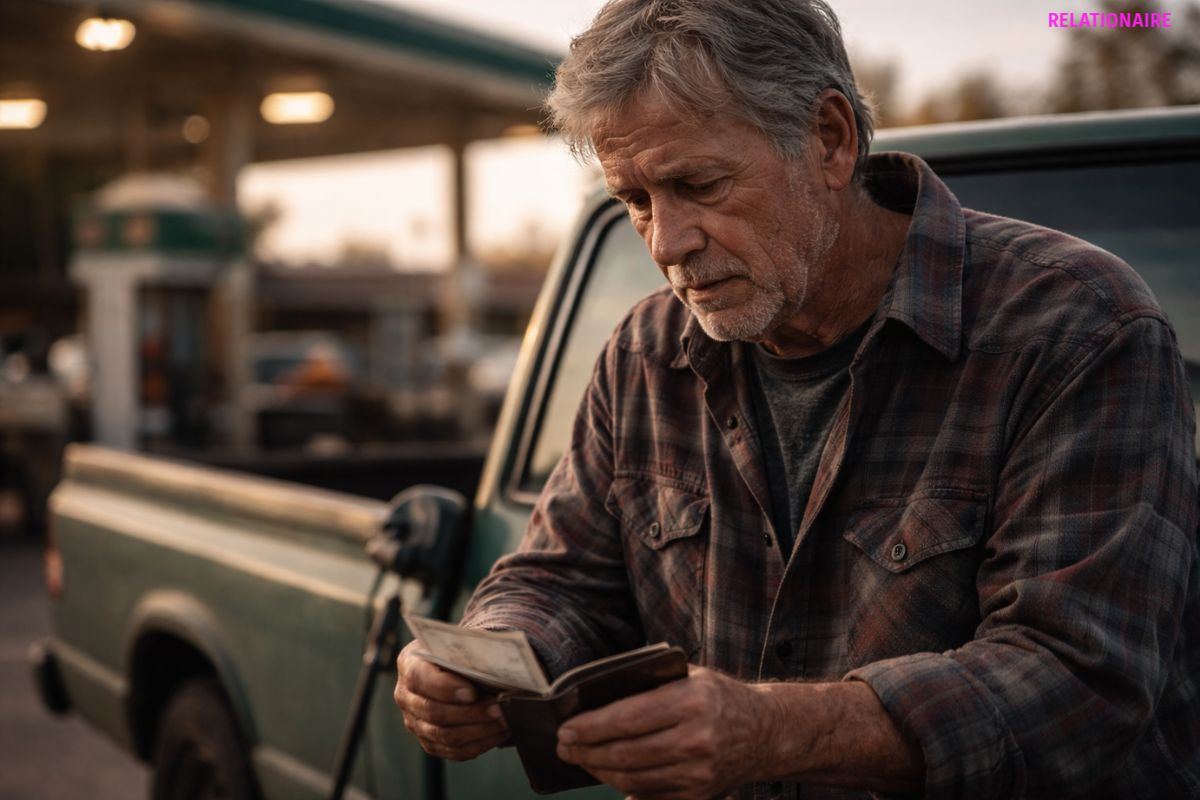
He opened his wallet before he even got out, though he already knew what was in it. A five-dollar bill softened from too many foldings. Three ones. A pair of quarters. A church receipt. His late wife’s old grocery list that he kept by accident and never threw away.
He took out the five and one of the ones.
Then he stopped.
He still had to get home.
He put one dollar back.
Four dollars.
That was what he carried to the pump in his trembling hand.
The morning air still had a little spring chill to it, but the metal nozzle felt warm from the sun. Earl lifted it slowly, like everything these days required a little caution. His shoulders had narrowed over the years. His plaid shirt hung loose on him. One cuff button was missing.
He typed the amount carefully.
$4.00.
The pump clicked, hummed, and started feeding his truck small mercies in tiny measured spurts.
A woman at the next pump glanced over once, then again.
A man in a landscaping truck watched openly while the digits crawled upward.
Something about only buying four dollars of gas in broad daylight makes people look at you like you’re either reckless, drunk, or pitiful.
Earl kept his eyes on the numbers.
1.17.
2.63.
3.41.
3.88.
When it clicked off at exactly four dollars, he let out a breath he hadn’t realized he was holding.
He set the nozzle back and stood there with his hand on the truck, doing math in his head that refused to become kinder no matter how many times he ran it.
The cemetery was thirty-eight miles away.
Then back again.
He could maybe make it there.
Maybe.
Back home was another question.
He could skip lunch.
He already had.
He could take the county roads instead of the highway on the return.
Maybe coast the downhills.
Maybe pray harder than gasoline burns.
He went inside to pay.
The bell over the door gave its tired little jingle.
Inside, the station was half-shadowed against the bright day outside. A rotating rack of motor oil stood near the counter. A little heater in the corner clicked even though it wasn’t cold enough to need it. There was a cardboard box of day-old honey buns marked half off.
Behind the register stood a young man Earl hadn’t seen before.
Maybe twenty-three, twenty-four.
Slim build. Brown skin. Clean blue work shirt with the station patch over one pocket. A name tag that read NATE. He had the look of somebody tired in the eyes but gentle in the face.
“You on pump three, sir?” he asked.
Earl nodded and laid the crumpled bills on the counter, smoothing them once with his palm. “Four even.”
The cashier glanced at the money, then looked past Earl through the front window toward the old truck.
Not in a judging way.
Just noticing.
Earl felt heat creep up his neck anyway.
“You need a receipt?” Nate asked.
“No.”
Nate tapped something on the screen, then paused.
His eyes moved to the black jacket folded awkwardly on the passenger seat.
Then to the white envelope.
Then back to Earl.
“You heading somewhere important?” he asked, quiet enough that it didn’t sound nosy.
Earl almost bristled.
Old men get tired of being handled. Tired of soft voices and careful questions, tired of people acting like every pause means frailty and every frailty needs witness.
But the truth was sitting in plain view on his truck seat.
He looked toward the window himself.
“Funeral,” he said.
The word came out flatter than he meant it to.
Nate’s hand rested on the register.
“I’m sorry,” he said.
Earl gave one short nod. “Me too.”
There was a moment after that where both men seemed to understand the conversation should end. Earl started to gather the change.
Then Nate looked back at the screen and said, “Actually… hold on.”
Earl frowned. “What is it?”
Nate bent slightly, tapped a few keys, then straightened up.
“You’re okay,” he said.
Earl stared at him. “What do you mean, I’m okay?”
“The rest was covered.”
Earl blinked. “Covered by who?”
Nate gave a small shrug. “Someone took care of it.”
Earl looked around the store. There were only two other people inside: a woman arguing softly into her phone by the coolers and a delivery driver carrying a crate of soda bottles with his shoulder.
“No one was behind me.”
Nate didn’t answer right away.
“It’s handled,” he said again. “Your tank’s full now.”
Earl actually laughed once, but there wasn’t any humor in it. “Young man, I put four dollars on that pump.”
“And now it’s full.”
“That doesn’t happen by accident.”
“No, sir.”
Earl’s mouth tightened. Pride rose up first, as hot and familiar as shame. “Then undo it.”
Nate’s expression changed just a little. Not harder. Just steadier.
“I can’t.”
“You can.”
“I can’t,” he repeated. “It’s already done.”
Earl looked through the window toward the truck. He could see the gas gauge now, the needle nudging far higher than it had any right to be.
His chest did something uncomfortable.
He hated charity that arrived like pity.
He hated needing what he hadn’t asked for.
Most of all, he hated that a stranger had seen through him so quickly.
“I didn’t ask for help,” he said.
“I know.”
“Then I can’t take it.”
Nate leaned his forearms lightly on the counter. “Sometimes taking it is the only thing left to do.”
That should have irritated him.
Instead it landed somewhere tender.
Earl swallowed. “Was it that man in the landscaping truck?”
Nate shook his head.
“The woman outside?”
Another shake.
“Then who?”
Nate looked at him for a long second, and something in that look made the air in the little gas station feel different. Less random. Less casual.
“Just somebody who knew it mattered that you got there,” he said.
Earl’s hand closed around the edge of the counter.
“Knew what mattered?”
Nate hesitated.
Then he glanced once more at the envelope on the truck seat.
When he looked back, his voice had dropped almost to a whisper.
“They knew whose funeral you were driving to,” he said.
Earl stared at him.
For a second, the old station seemed to go perfectly still. No hum from the cooler. No hiss from the coffee burner. No bell on the door. Nothing.
Only that sentence hanging between them.
They knew whose funeral you were driving to.
His first thought was that this had to be some cruel mistake.
His second was worse.
Because suddenly he was looking at the young cashier differently.
Not as a clerk.
Not as a random kind kid working a register.
But as someone who had recognized a name Earl had not spoken out loud.
And when Nate reached beneath the counter and pulled out a folded note with Tommy Ray Cole’s name written across the front in the same shaky blue ink as the envelope on Earl’s passenger seat, Earl felt the floor tilt under him.
“Sir,” Nate said softly, sliding it toward him, “before you go… I think you need to read this.”
PART 2
Earl did not pick up the note right away.
He just stared at it.
The handwriting on the front made his throat close.
Not because it was perfect.
Because it wasn’t.
The letters leaned too far right. The T in Tommy looked too tall. The y in Ray hooked back under itself.
He knew that handwriting.
He had seen it on birthday cards, on job estimates, on greasy parts receipts, on the back of old fishing photos.
Tommy’s.
His fingers shook as he lifted the paper from the counter.
“You’re telling me…” Earl began, but the rest of the sentence would not come.
Nate nodded once. “He left it here three weeks ago.”
Earl looked up so fast it hurt his neck.
“That’s impossible.”
Nate’s face tightened the way people’s faces do when they have to tell a truth they wish they did not know.
“He came in most mornings before my shift ended. Coffee, sometimes a biscuit. Always exact change. He was already sick then, though I don’t think he wanted anybody saying it out loud.”
Earl’s grip on the folded paper turned white.
Tommy had been sick for months. Everyone knew that. Small-town news traveled faster than weather. But Earl had not seen him. Not once.
Not in the hospital.
Not at home.
Not even after Tommy’s daughter called in February and said, very carefully, “Daddy asks about you sometimes.”
Earl had said he was busy.
That wasn’t the truth, and both of them knew it.
Nate spoke gently, filling the silence Earl couldn’t.
“One morning he asked me if an old green Ford with a dent in the back quarter panel still came through sometimes. Said the driver was a tall man, quiet, stubborn, looked like he carried fifty years on his shoulders.”
Earl let out a broken breath that almost sounded like a laugh.
“That sounds like Tommy.”
Nate gave the smallest smile. “It did.”
The note in Earl’s hand felt heavier than paper should.
“Why would he leave this here?”
Nate glanced toward the window again, toward the truck and the jacket and the funeral envelope sitting in the sunlight like evidence.
“Because he said if you ever came in putting only a few dollars in that truck, on a day when you were dressed like you were trying to look respectable, it would mean one of two things,” Nate said.
Earl’s heart began to pound hard enough that he could hear it.
“He said either you were finally coming to see him…” Nate swallowed. “Or you were coming to bury him.”
The store seemed to tilt again.
The box of honey buns. The scratched floor tiles. The rack of windshield fluid. All of it pulled far away.
Earl gripped the counter because his knees had gone weak.
Nate went on quietly.
“He told me if that day ever came, I was to fill your tank and give you the note. No matter what you said. No matter if you got mad.”
Earl looked at the young man then, really looked at him.
The tired eyes. The careful voice. The way he’d asked no embarrassing questions in front of anyone else. The way he’d protected a stranger’s pride without making a show of helping him.
“How did you know it was me?” Earl asked.
Nate gave a sad little shrug. “He kept a picture.”
He bent down and pulled a worn photo from beneath the register. It had been tucked into the edge of the till drawer, protected in a clear sandwich bag.
In it, two young men stood beside a fish-cleaning table sometime in the late seventies, both sunburned, both grinning so hard it made them look like boys. One held up a stringer of bass. The other had a cigarette tucked behind one ear and grease on his jeans.
Tommy.
And Earl.
Before funerals.
Before pride.
Before wives died and sons moved away and men stopped knowing how to apologize.
Earl touched the corner of the photo with one finger.
“Lord,” he whispered.
“He talked about you,” Nate said. “Not every day. Just enough that I knew your face. Said you once rebuilt an engine with him in a barn using borrowed tools and two manuals that contradicted each other.”
Earl closed his eyes.
That had been the summer he and Tommy were twenty-eight. Sweating through their shirts. Drinking warm beer after dark. Arguing over timing belts and baseball and who loved their wives better.
He had not let himself think about that summer in years.
“What happened?” Nate asked softly.
Earl opened his eyes. “Between us?”
Nate nodded.
For a long moment, Earl just looked at the note.
Then the words came out because maybe there was no point in carrying them another mile.
“My son borrowed Tommy’s truck fifteen years ago,” he said. “He was drinking. Ran it into a ditch. Nobody died, thank God, but Tommy’s leg got messed up later trying to pull it out by himself. Lost work over it. Lost money. I paid for part of the repairs but not all. My boy moved away before Tommy ever saw a dime from him.”
He swallowed hard.
“Tommy said I defended my son instead of doing what was right. He wasn’t wrong.”
Nate stayed quiet.
“That should’ve been a fight we got through,” Earl said. “Instead it turned into years. Stubborn years. My wife got sick. Then his first grandbaby was born. Then my wife died. Then his wife died. And every year that passed made it harder to knock on the door because by then you weren’t just apologizing for one thing anymore. You were apologizing for all the years you let the thing stay alive.”
The note trembled in his hands.
“When his daughter called, I should’ve gone.”
Nate’s eyes dropped for a second, then lifted again. “Maybe that’s why he left the note.”
Earl unfolded it.
The paper crackled.
The writing inside was shakier than the name on the outside, as if the hand holding the pen had already started giving out.
Earl—
If this gets to you, it means one of us ran out of time or courage. I’m sorry for my half of that. I was mad too long. You were stupid, but I was proud, and those things together can bury more years than the ground ever could.
Earl let out a sound that caught in his chest.
He kept reading.
I don’t know if you came to see me or to bury me. Either way, I wanted to make sure you got here and got home without having to count quarters. Don’t be insulted. I know you. You’d rather walk than be helped. But I also know you’d come anyway if you could.
His vision blurred.
Nate looked away and gave him that privacy like it was another gift.
There was more.
I kept thinking about that summer at the lake. How easy things were before we became men who needed winning more than we needed each other. Truth is, you were my brother longer than some blood kin ever were. That doesn’t stop being true because we wasted fifteen years.
Earl pressed the heel of his hand hard against his mouth.
At the bottom of the note, the last lines were written more unevenly, as if Tommy had needed several tries.
There’s something else you need to know. Ask Lila when you get there. I should’ve told you myself, but I was trying to find the right day and got too sick to wait for one.
Go on now. Don’t be late again.
Earl folded the letter very carefully, because grief makes people gentle with paper.
“Lila” was Tommy’s daughter.
“What does he mean, something else?” Nate asked.
Earl shook his head. “I don’t know.”
But the words had already opened a cold space in him.
Something else.
Not just forgiveness.
Not just the tank of gas.
A deeper thing waiting at the funeral.
He slipped the note into his inside jacket pocket and reached for the photo, but Nate set a hand lightly on it.
“Take it,” Earl said.
Nate smiled. “He wanted me to keep that one. Said I needed proof that men don’t always start out stubborn.”
Against everything in him, Earl let out a wet, broken laugh.
Then he pulled his wallet out and did the only thing pride could think to do.
“How much?” he asked.
Nate shook his head.
“At least let me pay you back later.”
“It’s not mine to take back.”
Earl looked down.
“Then thank you,” he said, the words rough and hard-earned.
Nate nodded. “You make it there safe, Mr. Bennett.”
The use of his name hit Earl almost as hard as the letter had.
He turned for the door, then stopped.
“Why’d you do all this?” he asked. “You didn’t know me.”
Nate’s face changed.
For the first time, grief showed plainly there.
“Because last year,” he said, “my father died in another state, and I was working double shifts and too broke to get there in time. A stranger bought me a bus ticket after hearing me on the phone outside a station in Knoxville. I never even learned her name.”
He swallowed.
“So when Tommy asked me to help you, it didn’t feel like helping a stranger.”
Earl stood there a second, unable to speak.
Then he nodded once and walked out into the hard white sunlight.
The truck door creaked open.
The seat springs complained when he sat down.
He put the key in the ignition, but before he turned it, he laid one hand over the inside pocket where Tommy’s letter rested.
The gas gauge sat full.
Not because the world had suddenly gotten easier.
Not because men stopped losing time.
Just because, somewhere between one hurt and another, someone had paid attention.
When he pulled into the church parking lot forty-three minutes later, the lot was already crowded. Dark clothes. Open car doors. Clusters of hushed people beneath budding oak trees. He could see the funeral home hearse parked near the side entrance.
And standing on the church steps, scanning each arriving car as if she had been waiting for one in particular, was Tommy’s daughter, Lila.
The moment she saw Earl’s truck, her face broke.
Not with anger.
Not even with surprise.
With something deeper. Something like relief that had been carrying fear underneath it all morning.
Earl killed the engine and stepped out.
Lila came down the steps before he had fully closed the door.
“You came,” she said, tears already in her voice.
Earl nodded, unable to trust his own.
She took both his hands in hers, cold fingers clutching hard.
“Then he was right,” she whispered.
Earl frowned. “About what?”
Lila looked toward the church doors, then back at him, and whatever she had been holding in all morning seemed to rise to the surface at once.
“He told me,” she said, “that if you came, I was supposed to give you something before they closed the casket.”
Her hand moved to her purse.
And when she pulled out a small brass key attached to a faded fish-shaped keychain Earl had not seen in fifteen years, his heart gave one stunned, painful kick against his ribs.
PART 3
For a second, Earl could not breathe.
The little brass key lay in Lila’s palm, bright against her black dress.
The fish-shaped keychain was chipped along one edge, its paint faded from blue to almost gray. A cheap thing from a bait shop, once won out of a coin machine by Tommy on a Saturday neither of them had reason to remember until now.
Except Earl did remember.
He remembered the exact place.
A marina store at Lake Harlan.
July heat.
Tommy laughing because Earl had called the little trinket foolish.
Then Tommy tossing it over and saying, “Here. Put it on something important so you’ll quit losing things.”
Earl had attached it to the metal box he kept in the shed behind his house.
The one with the old carburetor parts.
The one with his father’s socket set.
The one with the only photograph he had left of his wife at nineteen, before the babies, before the bills, before cancer took the softness from her face.
The box had gone missing the same year he and Tommy stopped speaking.
He had assumed one of the boys stole it looking for tools, or that it had gotten hauled off with junk after the roof leak.
He had searched for it once, briefly, then not again.
There was always something more urgent than grief when life kept pressing.
“What is this?” he asked, though some part of him already knew.
Lila’s eyes filled. “Daddy had your lockbox.”
Earl stared at her.
“What?”
“He found it years ago in his truck after your son borrowed it. It had slid behind the seat and gotten wedged under a panel. By the time he discovered it, you two were already not speaking.”
Earl felt the blood rush hot through his ears.
“He had it all this time?”
Lila shook her head quickly. “Not like that. He tried to bring it by once. Mama said he sat in the truck outside your place for ten minutes. Then he came home mad and said if you wanted to act like he was the villain, fine. After that, too much time passed. Then it turned into one of those things neither of you knew how to untangle.”
Earl closed his eyes.
Of course.
Of course it had been something this small. This stupid. This human.
A lost metal box. A man waiting outside another man’s house too proud to knock. Another man inside that house too proud to walk outside if he had seen him there.
Fifteen years fed by silence and assumption.
“Where is it?” Earl asked.
Lila pressed the key into his hand and curled his fingers around it.
“In the fellowship hall closet,” she said. “He made me hide it there this morning before the service. Said you needed to open it yourself.”
Earl looked at her, bewildered. “At the church?”
“He wanted it close by.” Her chin trembled. “He said if you showed up, it meant the anger wasn’t the thing that lasted. He wanted you to have it before…” She couldn’t finish.
Before they closed the casket.
Before goodbye became wood and earth.
Lila took a breath that shook.
“There’s one more thing.”
Earl had almost no room left in him for one more thing, but he nodded.
She wiped under one eye with the side of her thumb.
“The hospital bills got bad at the end,” she said. “Daddy sold a lot of things. Tools, rods, even his boat trailer. But he never sold the lockbox because he said it wasn’t his. He kept saying, ‘A man can survive carrying his own regret. It’s another thing entirely to pawn somebody else’s memory.’”
Earl bowed his head.
All at once the morning at the gas station, the full tank, the note, the photo, the years, the wasted years — all of it collapsed into one unbearable truth:
Tommy had been trying, in his stubborn way, to return more than a box.
He had been trying to return time.
A hand touched Earl’s elbow.
“Come on,” Lila whispered. “Before everybody sits.”
Inside the church, the air smelled faintly of lilies, lemon polish, and old hymnals.
Voices were hushed the way they always are in places where people are trying not to break in public. The fellowship hall sat off to the side, fluorescent-lit and plain, with folding tables lined against the walls and a coffee urn already warming for afterward.
Lila led him to a narrow storage closet near the kitchen.
There, on the floor beneath stacked cans of green beans and paper tablecloths, sat a dented gray metal lockbox.
Earl stopped in the doorway.
It looked smaller than he remembered.
Maybe grief shrinks things when you finally stand in front of them.
He knelt slowly, one knee cracking, and touched the lid with trembling fingers.
The fish keychain hung from his hand.
He slid the brass key into the lock.
For one irrational second, he was afraid it would not turn, that some final cruelty of rust or time would deny him this too.
Then it clicked.
He opened the box.
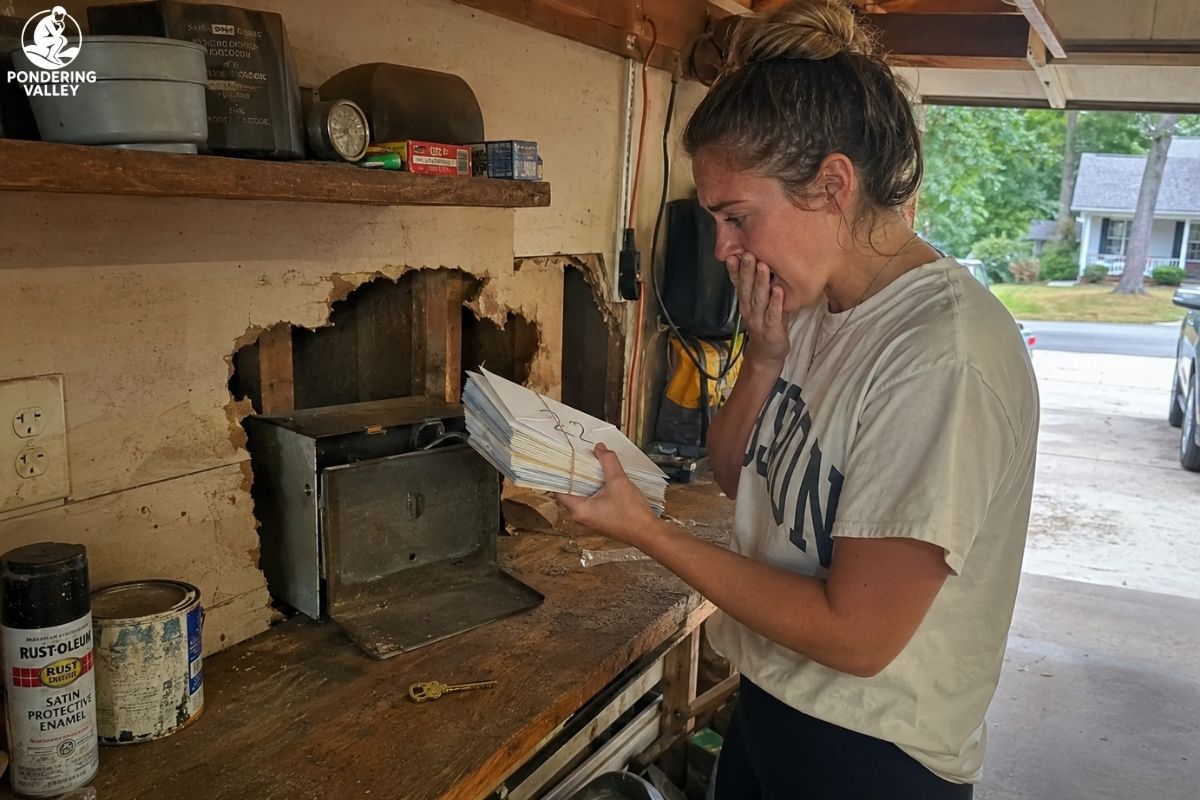
Inside, beneath a folded shop rag, lay the socket set, the carburetor parts, an envelope of old receipts, and the photograph of his wife Ruth standing in a sundress beside a clothesline, laughing at something outside the frame.
Earl made a sound that seemed to come from years ago.
He picked up the photograph with both hands.
Ruth’s hair was pinned up badly because she never had patience for it in summer. One strap of the dress had slipped down her shoulder. She looked alive in that impossible old way photographs preserve — not as memory softens people, but as they really were one ordinary second before everything that came later.
Under the photograph was another envelope.
This one had his name on it too.
He opened it with numb fingers.
Inside was a cashier’s check.
The amount was not huge. But it was enough to matter.
Attached was a note from Tommy, shorter than the first.
Sold the boat trailer. Should’ve paid this back years ago for the rest of the repairs and the tools your boy lost. Don’t argue with a dead man.
Earl laughed through tears then, a shattered sound in the little church closet.
Lila began crying with him.
When the first hymn started in the sanctuary, low and wavering through the wall, Earl closed the box and stood up with the photograph pressed to his chest.
At the casket, Tommy looked smaller than Earl had ever seen him.
That was the worst thing about funerals. Not that people were gone, though that was unbearable enough. It was that the body left behind seemed to mock all the space a person once took up in the world.
Earl stood there after the others had moved back to their pews.
He looked at the face of the man he had loved like a brother and avoided like a debt.
“I was late,” he whispered.
The church was quiet except for sniffles and the rustle of clothes.
“I was late a long time.”
Then, because pride had already cost too much, he laid one hand on the polished wood and said the thing he should have said fifteen years earlier.
“I’m sorry.”
He did not expect anything from saying it.
That was not how death worked.
But something in him loosened anyway.
Not healed.
Not erased.
Just loosened enough to let grief and gratitude sit in the same place.
After the burial, people drifted toward casseroles and coffee and the practical chores sorrow always creates. Earl remained by the graveside until the crowd thinned. The dirt was red-brown and freshly turned. A breeze moved through the cemetery grass. Somewhere beyond the trees, a dog barked twice.
Lila came to stand beside him.
“He knew you’d come,” she said.
Earl looked down at the photo in his hand, then at the keychain looped through his fingers.
“I didn’t.”
She slipped her arm through his.
“He did.”
They stood there a minute longer.
Then Earl asked the question that had been growing in him since the gas station.
“Who paid the cashier back for all this?”
Lila frowned. “What do you mean?”
“The gas. Tommy left money?”
Her expression softened.
“Oh,” she said. “No. Daddy didn’t have anything left at the end.”
Earl turned to her.
“Then how—”
“Nate did it,” she said. “He called me after you left the station. Told me not to mention it unless I had to. Said Daddy had asked him to help if the day ever came, but Daddy never gave him the money for a full tank.” She glanced toward the road. “Nate paid the difference himself.”
Earl looked back at the grave.
A young cashier on a station salary.
A man who knew what it was to almost miss a father’s funeral.
A stranger who did not just hand over gas.
He protected a man’s pride, honored a dead man’s wish, and made sure regret did not get one more victory.
Three days later, Earl drove that old truck back to the station.
The same pump.
The same cracked concrete.
The gas light was off this time.
Inside, Nate was stocking cigarettes behind the counter when he looked up and saw him.
For a second the young man seemed almost worried, as if maybe Earl had come to protest after all.
Instead, Earl laid the cashier’s check on the counter.
Not the whole one. Just a portion he’d taken to the bank and turned into cash.
“I can’t repay Tommy,” Earl said. “But I can repay the living.”
Nate started to shake his head.
Earl lifted a hand. “Don’t.”
Then he slid over something else too: a photo print made that morning at the drugstore.
It was a copy of the picture from the register drawer — the two young men by the fish-cleaning table — enlarged and framed in cheap black plastic.
“For the counter,” Earl said. “Proof men can be stupid and still mean something to each other.”
Nate looked from the frame to Earl, eyes brightening.
Then Earl did one more thing.
He asked the station owner, who had just come in from the back, to start a tab called Last Tank.
Not credit.
Not charity in a jar where people had to ask.
Just a quiet fund behind the register for anyone heading somewhere they could not afford to miss. A hospital. A funeral. A shelter. Home.
No speeches.
No forms.
No humiliation.
He put the first money in himself.
Nate added twenty before Earl even finished.
By the end of the week, the landscaping guy had thrown in ten. The woman who worked mornings at the bakery added five. Somebody dropped in a roll of quarters with no name on it.
Months later, people in town still didn’t talk much about the fund.
That was probably why it worked.
Folks used it when they had to. Repaid it when they could. Sometimes they never knew who had covered them. Sometimes that was kinder.
Earl kept the fish keychain on his truck keys after that.
The photograph of Ruth went back into the lockbox, which went onto a shelf by the kitchen instead of the shed, where important things belonged.
And every now and then, when he stopped for gas, he’d look through the station window and see Nate behind the counter noticing people the way some people notice weather — quietly, accurately, in time.
It did not fix the years Earl lost with Tommy.
Nothing could.
But there was a strange mercy in learning that even late sorrow can still open into something useful.
Sometimes all that stands between a person and one more regret is a tank of gas, a folded note, and somebody decent enough to pay attention.