If you’ve already read part 1 of this story on Facebook, go here for Part 2!
By six-thirty that morning, the hotel already smelled like burnt coffee, bleach, and bacon from the breakfast buffet downstairs.
Marisol stood in the employee break room with her purse still on her shoulder and a tiny white supermarket cake balanced carefully in both hands.
It was one of those cheap ones with too much frosting and a plastic balloon stuck in the top. The kind people bought on the way home when they remembered late. The kind meant for children, or office parties, or apologies.
Not for a fifty-two-year-old woman in a housekeeping uniform.
She looked around before opening the fridge.
Nobody.
Just the vending machine humming in the corner and the buzz of the fluorescent light overhead.
She slid the cake onto the top shelf behind somebody’s takeout container and a bottle of ranch dressing. Then she closed the fridge softly, like she was hiding something shameful.
She told herself it was ridiculous to feel embarrassed.
It was only a cake.
Only one small thing.
But the truth sat heavier than that in her chest.
For ten years, she had worked at the Briar Glen Hotel changing sheets, scrubbing shower grout, emptying trash cans people filled with half-eaten room service and crumpled receipts and evidence of lives larger than hers.
For ten years, she had moved quietly through other people’s celebrations.
Anniversary rose petals on king beds.
Birthday balloons tied to desk chairs.
Graduation gift bags.
Wedding welcome baskets.
She made their happy rooms neat again after they were done with them.
And every year on her birthday, she told herself she was too old to care.
This year she had cared enough to buy a tiny cake and eat one slice alone on her fifteen-minute break.
That was all.
No candle.
No singing.
No fuss.
Just proof that the day had happened.
Just proof that she had.
“Morning, Mari.”
She turned so fast she nearly jumped. Trina from front desk breezed in, perfume and red lipstick already perfect, phone tucked to her ear.
“Morning,” Marisol said.
Trina glanced at the fridge, then at Marisol’s face, but if she noticed anything strange, she didn’t say it. She just gave a distracted smile and moved on, already talking to a guest named Mr. Hensley about towel delivery.
Marisol headed downstairs.
By seven o’clock, she was on the fourth floor with a cart full of fresh linens, pushing through the long beige hallway while a vacuum whined somewhere in the distance.
Room 417 had makeup streaked on the bathroom towels.
Room 422 had a broken zipper from a dress lying under the bed.
Room 430 had glitter ground into the carpet and half a bottle of warm champagne sweating on the desk.
She worked fast, shoulders aching by nine.
At ten-fifteen, she found herself standing still for one strange second in front of Room 438, one hand on the doorknob, because the guest had left a birthday card on the nightstand in plain view.
Happy 30th, Jess! Big things ahead.
The pink envelope had gold stars on it.
Marisol looked away.
At eleven-thirty, her supervisor, Doreen, stopped her near the service elevator.
“You missed a hand towel in 412 yesterday.”
“I’m sorry. I’ll fix it.”
Doreen sighed the way people did around tired workers, like fatigue was a personal flaw. “Please tighten up. Corporate’s doing a walkthrough tomorrow.”
Marisol nodded.
She didn’t say she’d barely slept.
She didn’t say she’d been up half the night with her phone in her lap, staring at a date she had both dreaded and needed.
She didn’t say anything at all.
By one-fifteen, her break finally came.
Her knees hurt. Her lower back throbbed. There was bleach on the cuff of her sleeve.
She washed her hands in the break room sink, dried them on a paper towel, and smiled to herself a little despite everything.
One slice, she thought.
Maybe two.
The room was empty again.
The fridge door squeaked when she opened it.
Top shelf.
Takeout container.
Ranch dressing.
A half-gallon of milk.
No cake.
She blinked.
Then looked again, moving things around faster.
Yogurt. Soda cans. A bag of grapes. Somebody’s leftover noodles.
No cake.
The cold from the fridge rolled over her face while heat rushed up her neck.
“No,” she whispered.
She checked the lower shelf.
The drawer.
The freezer, stupidly.
Nothing.
For one awful second she thought maybe she’d put it somewhere else. Maybe she was more tired than she realized. Maybe age and stress had started playing tricks on her.
Then she remembered exactly how carefully she’d slid it behind the ranch.
Her eyes burned.
She shut the fridge too hard.
The sound cracked through the empty room.
A laugh came from the hallway outside, and humiliation hit her so fast it made her dizzy.
Someone had seen it.
Someone had taken it.
Maybe because it was funny.
Maybe because the old housekeeper with the sensible shoes and drugstore lipstick had bought herself a baby-sized birthday cake like a fool.
She grabbed her purse, pretending to search for something, trying to keep her breathing normal in case anyone walked in.
But the tears came anyway.
Not loud. Not dramatic.
Just hot and furious and impossible to stop once they started.
She pressed the heel of her hand against her eyes.
“This is stupid,” she muttered. “This is so stupid.”
The break room door opened.
Marisol turned away quickly.
A man’s voice said, “Sorry. I can come back.”
She knew him only by sight. Tall. Broad-shouldered. Usually in a dark maintenance polo with a ring of keys clipped to his belt. He had a face people probably called stern even when he wasn’t speaking. She thought his name might be Elliot or Elijah.
He stood half inside the room, holding a work order clipboard.
“I’m fine,” she said too fast.
He looked at the open fridge, then at her shaking hand, then away again like he was trying to give her privacy.
“Okay,” he said.
But he didn’t leave.
He stepped over to the vending machine, put in a dollar, and waited while it clunked and rattled. Then he picked up a pack of crackers and set them gently on the table near her purse.
“In case you skipped lunch,” he said.
Marisol stared at him.
The pity in that small gesture stung worse than if he’d laughed.
“I didn’t ask for that.”
He nodded once. “No, ma’am.”
Something in his calm voice made her angrier.
Because he had seen.
Because now somebody knew.
Because the day she had tried so hard to make invisible had become visible in exactly the wrong way.
“You don’t have to act like I’m going to fall apart,” she said, turning to face him. “It was just a cake.”
His expression changed then, very slightly.
Not smug. Not surprised.
Just… careful.
“I know,” he said.
“No, you don’t.”
The words came out sharper than she meant, and shame hit her right behind them. But once they were loose, she couldn’t stop.
“It was just a stupid little cake, and somebody thought it would be funny, and I know how this looks, but I wasn’t asking anyone for anything, I was just—”
Her voice broke.
The man set his clipboard down.
For a second he looked like he might say something soft, something unbearable.
Instead he asked, “What time do you get off?”
She stared at him through wet eyes.
“What?”
“What time?”
“Ten.”
He held her gaze for one more beat, then picked up the clipboard again.
“Okay,” he said.
And left.
Marisol stood in the silence, furious with him now too.
Who asked a question like that and then walked away?
By six o’clock she had convinced herself he was part of it.
By seven-thirty she was sure of it.
Maybe he’d taken the cake himself.
Maybe the crackers were part of the joke. Maybe he had told people. Maybe people in housekeeping were already whispering about sad little Marisol and her tiny lonely cake.
The shame of it crawled under her skin all evening.
At nine-forty, she was folding towels in the basement laundry room when she heard laughter out in the corridor.
Not one person.
Several.
She froze.
The industrial dryers roared behind her. The fluorescent lights flickered overhead. One sock lay on the concrete near the drain like something abandoned.
Then came a knock on the half-open laundry room door.
Marisol turned.
The maintenance man stood there in the doorway.
Only now he wasn’t alone.
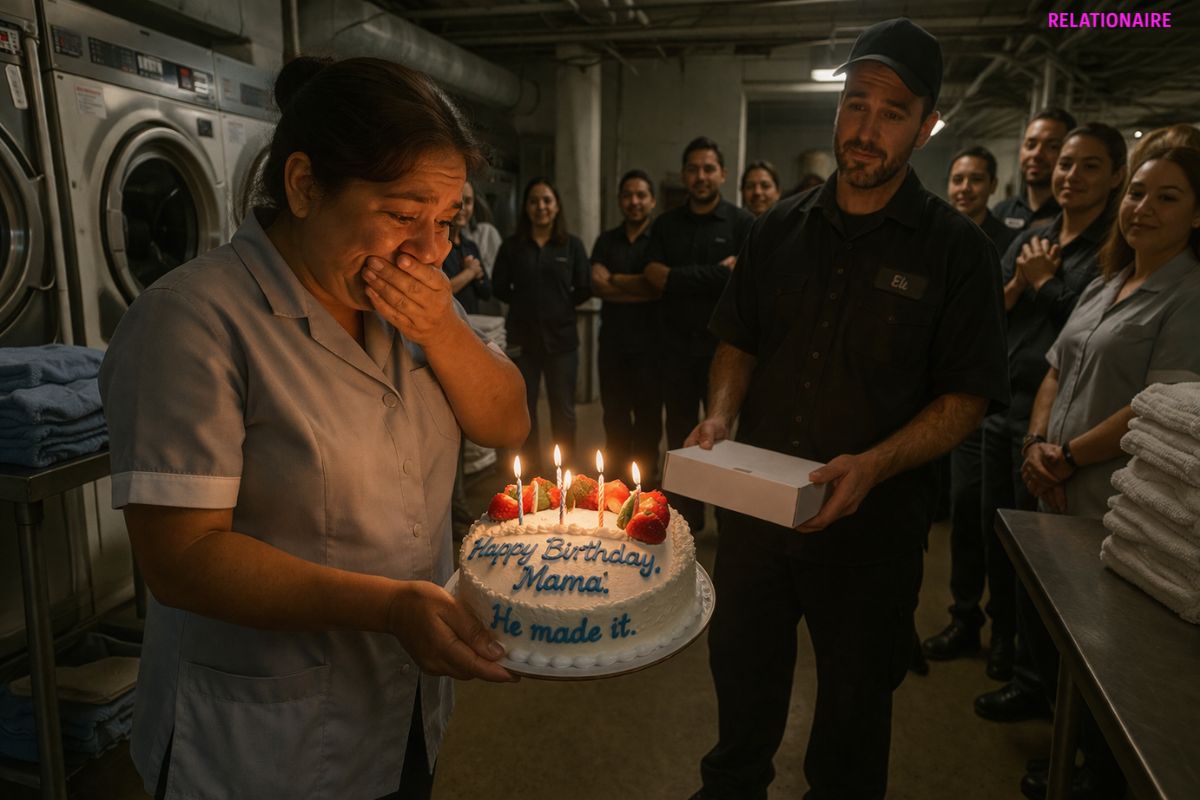
And in his hands was her missing cake.
Except it wasn’t the same anymore.
The plastic balloon had been removed.
There were real candles burning in soft gold light.
Fresh strawberries circled the top.
And written across the white frosting in careful blue icing were six words that made the room tilt under her feet.
Happy Birthday, Mama. He made it.
PART 2
For one second, Marisol thought she was going to faint.
Not because of the candles.
Not because of the people gathered awkwardly behind the maintenance man—Trina from the front desk, old Mr. Benny from security, two line cooks still in aprons, even Doreen clutching a paper plate stack like she didn’t know where to look.
Because of the writing.
Because there was only one person in the world who had ever called her Mama in that round, sleepy, affectionate voice.
And he hadn’t been able to speak for eleven years.
Her hand flew to her mouth.
The dryers kept thundering behind her, hot and loud and indifferent, but everything else dropped away. The room narrowed to the cake, the candles, and the man holding it steady like it was something breakable.
“Where…” she said, then had to stop. “Where did you get that?”
The maintenance man stepped inside.
Up close, the candlelight made his face look less hard, more tired. He had deep lines at the corners of his eyes and a small scar near his chin Marisol had never noticed before.
“Can I set this down?” he asked.
She nodded.
He placed the cake carefully on the metal folding table between towers of white towels. The scent of strawberries and grocery-store frosting rose into the warm laundry air.
Nobody sang.
Maybe they sensed this wasn’t that kind of moment.
Maybe they saw Marisol’s hands trembling too hard to hold a plate.
Trina swallowed. “Mari… we thought maybe—”
“I didn’t steal it,” the man said quietly.
She looked at him, ashamed at once because of course she had thought exactly that.
“I know that now,” she whispered, though she hadn’t known it an hour ago.
His eyes held hers a moment, and there was no triumph in them. Just understanding. Like he knew what people assumed when they were hurting.
Doreen cleared her throat. “Eli told us what happened. Well. Not everything. Just that your cake was missing and maybe tonight mattered.”
Marisol turned back to the writing.
He made it.
Two words so small they could split a heart open.
Her son, Gabriel, had been born on her birthday.
Twenty-eight years ago, after nineteen hours of labor and one terrifying stretch when the doctor stopped talking in a calm voice and started speaking in code.
All she had cared about, through the pain and blood and panic, was hearing him cry.
He had.
He had made it.
And for seventeen years, every birthday after that, Gabriel would grin and say it first thing in the morning before she could even open her eyes.
Happy birthday, Mama. I made it.
It was their joke. Their miracle. Their private little prayer of gratitude turned into ritual.
Then came the highway.
The rain.
The pickup truck crossing the line.
The hospital room full of machines and plastic and words like swelling and trauma and impossible.
Gabriel lived.
That was the cruel mercy of it.
He lived, but not in the easy ways people mean when they say it.
He came back unable to walk, speak, or feed himself without help.
His right hand moved a little. His eyes tracked light. Some days he smiled. Most days Marisol read his face the way other mothers read full sentences.
She took a second job after the accident.
Then a third for a while.
She learned how to stretch medications, how to sleep in pieces, how to carry a grown son’s weight without letting him feel like one.
She stopped celebrating birthdays.
People called her strong, which was just another way of saying nobody was coming.
Until this year.
This year, on the previous Sunday, Gabriel had blinked at her three times while she sat beside his bed in the care facility forty miles away.
Three times in a row.
The old signal for yes.
She had asked him, half teasing, “You know what next week is?”
Three blinks.
“Do you still remember what to say to me?”
His mouth had moved.
Nothing came out.
But his eyes filled, and his left hand—not the good one, the stubborn one—had twitched toward hers.
She had gone home and cried in the bathroom with the faucet running so her daughter wouldn’t hear.
Then that morning, she bought the tiny cake.
Not to celebrate getting older.
To survive the date.
To mark that he was still here.
That he had, in fact, made it.
And now those words were sitting on top of white frosting in a basement laundry room, in handwriting that did not belong to any of the people she knew.
“How did you know?” she asked.
Nobody answered immediately.
Then Eli—because Doreen had said his name and now she had it—reached into his back pocket and took out something folded.
A crumpled receipt.
Her supermarket receipt.
He smoothed it on the table beside the cake.
“I found this in the trash by the break room vending machine,” he said. “Cake, one candle, plastic forks. And on the back…”
He turned it over.
There, in Marisol’s own handwriting, was the note she had scribbled while waiting in the checkout line because if she didn’t write it down, she thought she might lose the nerve to make the day real.
For Gabriel. He made it. We both did.
Marisol let out a broken sound that wasn’t quite a sob.
“I threw it away.”
“I know.”
She pressed her hand to her chest.
“You read it?”
“I did.” He didn’t look away. “I’m sorry. I was trying to figure out whose cake it was before I asked around.”
Trina spoke softly. “He thought somebody had put it in the wrong fridge at first.”
Mr. Benny from security nodded. “Then he went to the grocery store on his break. Said the little one wasn’t enough.”
Doreen added, awkward and embarrassed, “The kitchen cut fresh strawberries. Icing was Jose’s idea.”
One of the line cooks lifted a hand. “My wife decorates cookies on weekends,” he said, like he needed her to know he hadn’t ruined it.
Marisol looked from face to face.
Not saintly faces.
Not movie faces.
Tired work faces.
A front-desk clerk with scuffed heels.
A cook with flour on his sleeve.
A supervisor who had fussed at her over a towel six hours earlier and now couldn’t meet her eyes.
A security guard with hearing aids and kind hands.
And Eli, the man she had mistaken for cold because he knew how to stand still.
“What happened to the first cake?” she asked.
This time Eli almost smiled.
“I put it in the maintenance fridge so nobody else would touch it. Then I realized if I brought back the same cake, you’d think I was returning stolen property.”
“I did think that.”
“I figured.”
That should have been funny.
Instead it hurt in the tenderest way, because he had read her exactly right.
“Why?” she asked him. “Why would you do all this for me?”
He went quiet.
For the first time all night, he looked less certain. His fingers touched the ring of keys on his belt, then fell away.
Around them, the little group shifted, as if they knew this part wasn’t theirs.
Finally he said, “Because fifteen years ago, my wife spent her birthday in a rehab room with our little girl.”
Nobody moved.
Eli kept his eyes on the cake.
“Our daughter had a fever that turned into seizures and then into brain damage before anybody understood how bad it was. My wife sat in that room all day pretending it wasn’t her birthday because saying it out loud felt selfish.” He swallowed once. “A nurse brought her a pudding cup with a candle stuck in it. Plastic spoon. Off-key singing. Tiny thing.”
Marisol could hardly breathe.
Eli’s voice stayed steady, but only just.
“My wife cried like it was the first kind thing anybody had done in months.” He looked up at her then. “I didn’t understand why, not really. I do now.”
The room went so still the dryers sounded miles away.
Then Eli reached into the pocket of his work pants again and pulled out one more thing.
A folded note.
Old. Soft at the edges. Opened too many times.
He held it toward her.
“My daughter died in November,” he said.
Marisol stared at the note without taking it.
“It was in one of her memory boxes. My wife found it after the funeral.” His voice thinned. “It’s from that nurse.”
The folded paper shook once in his hand.
“She wrote something on it that I think you need to see.”
Marisol finally reached for it.
And when she opened the note, the first line made her knees buckle.
Because it said, in careful blue ink:
Some birthdays are really about the person who stayed.
PART 3
Marisol sat down hard on the rolling laundry stool because her legs would no longer hold her.
The note trembled in her fingers.
The paper smelled faintly of dust and old cedar, like it had lived for years in a drawer that was opened only on difficult days.
Around her, nobody rushed in.
Nobody filled the silence.
That mercy mattered.
She read the line again.
Some birthdays are really about the person who stayed.
Below it, in smaller writing, the nurse had added:
When love has had to learn a harder shape, surviving counts too.
Marisol bowed her head.
For so long, birthdays had felt like accusations.
Another year.
Another measure of what her life used to be and what it had become.
Another reminder that while other women posted dinner photos and flowers and grandchildren and candles in smiling circles, she spent half her days scrubbing around strangers’ bathtubs and the other half driving to see a son who could no longer say her name.
People had admired her in the lazy way people admire endurance from a safe distance.
You’re amazing.
I don’t know how you do it.
He’s lucky to have you.
As if luck had anything to do with it.
As if love were noble because it was easy.
She had not stayed because she was good.
She had stayed because he was her son.
Because on the worst day of her life, he had still made it.
Because once someone you love survives in a broken way, you do not get to grieve only what was lost. You also have to tend what remains.
And nobody, not one person, had ever said out loud what that cost.
Until a stranger with tired eyes and a ring of keys handed her a dead nurse’s note in a basement laundry room.
Marisol pressed the paper to her lips.
When she finally looked up, she realized Trina was crying quietly against the doorframe. Mr. Benny had taken off his glasses. Doreen was staring at the floor like she regretted half the words she’d spoken in the last ten years.
Eli stood where he had been, giving her room.
“Your wife found this after the funeral?” Marisol asked.
He nodded.
“She said she wanted the note to stay with the box. I almost didn’t bring it tonight.” He rubbed one hand over his mouth. “Then I saw you in that break room, and I thought… maybe some things aren’t meant to sit in boxes forever.”
Marisol looked down at the cake again.
Happy Birthday, Mama. He made it.
Six words she would remember for the rest of her life.
“Your daughter,” she said carefully. “What was her name?”
Eli’s face changed in the smallest, saddest way.
“Hannah.”
“How old?”
“Twelve.”
The answer landed like a dropped dish.
Twelve. Still baby enough to sleep with one sock half off, old enough to have opinions about music and cereal and who got the window seat.
Marisol put a hand over her heart.
“I’m sorry.”
He nodded once, accepting it because there was nothing else to do with grief when someone offered it plainly.
After a moment, Trina sniffed and said, trying for brightness and nearly making it, “Well. Somebody better cut this cake before all the candles drown in wax.”
That broke the spell just enough.
Jose handed over the plastic knife from the kitchen.
Mr. Benny found paper plates.
Doreen muttered, “I should’ve brought napkins,” and hurried off to get some like that was the task that could save her from feeling helpless.
Marisol stood.
Her hand was still shaking when she cut the first slice.
She expected to want to hide again. To apologize. To laugh it off.
Instead, she heard herself say, “Thank you for not singing.”
A ripple of soft laughter moved around the room.
“Would’ve been terrible,” Jose said.
“Absolutely awful,” Trina agreed.
Even Marisol smiled.
She cut a second slice and held it out toward Eli.
He hesitated. “You first.”
She looked at the frosting message one more time, then slipped the first plate toward herself.
The cake was sweeter than she liked. The strawberries were cold. The frosting stuck to the roof of her mouth.
It was perfect.
For ten minutes, maybe fifteen, the laundry room stopped being a laundry room.
It became one of those strange sacred places ordinary life sometimes makes by accident.
People leaned against machines and ate supermarket cake from flimsy plates.
Jose told a story about his son setting off the smoke detector trying to make toast.
Mr. Benny admitted he once locked himself in a guest sauna for forty minutes.
Trina confessed she kept emergency mascara in three separate drawers because heartbreak had made her practical.
Even Doreen, when she came back with napkins and eyes suspiciously pink, said, “My mother used to put sliced peaches on cake because she said canned fruit made everything feel like company.”
Nobody asked Marisol to perform gratitude.
Nobody demanded her story in full.
They just stayed.
That was the gift underneath the gift.
Not rescue.
Not pity.
Company.
When her shift ended at ten, the group thinned out one by one, each person touching her shoulder or squeezing her hand on the way past.
Happy birthday, Mari.
Drive safe.
Save me a strawberry next time.
See you tomorrow.
Finally it was only Eli left, helping stack the empty plates.
Marisol folded the note carefully and tucked it into her wallet behind Gabriel’s facility ID card.
“Are you sure your wife was okay with you bringing this?” she asked.
He nodded. “She was the one who told me to.”
Something in that answer warmed the cold place grief always leaves behind.
Marisol picked up the cake box lid. “I’m taking this to Gabriel tomorrow.”
Eli looked at her.
“You can read to him what it says,” he said.
“I will.”
She paused, then added, “He understands more than people think.”
“I believe that.”
The simplicity of it nearly undid her all over again.
No awkward sympathy. No false comfort.
Just belief.
She slung her purse over her shoulder and headed toward the employee exit. Eli walked with her through the service corridor, past shelves of detergent and towers of folded linens, up into the back parking lot where the night air felt cool and clean after the hot laundry room.
Her old Corolla sat under a flickering light.
Before she opened the door, she turned back.
“I was wrong about you,” she said.
Eli gave one small shrug. “Most people are, at first.”
She laughed softly through her nose.
Then she grew serious again.
“I thought someone took that cake to humiliate me.”
“They did take it,” he said. “Just not for that.”
She looked at him for a long moment, then nodded.
The next afternoon, on her day off, Marisol drove the forty miles to Gabriel’s care facility with the remaining cake on the passenger seat and the note in her wallet.
Rain tapped gently at the windshield the whole way.
In his room, Gabriel lay near the window with his blanket folded over his legs, one hand curled, the television muttering low in the corner.
His eyes found her as soon as she walked in.
“Hi, baby,” she said, though he was twenty-eight and had stubble along his jaw now. “I brought you something.”
She set the cake box on the tray table and opened it.
The frosting words had smudged a little in the drive, but they were still there.
Happy Birthday, Mama. He made it.
Gabriel stared.
Then his eyes lifted to hers.
Marisol took his hand.
She told him everything.
About the missing cake.
About the basement laundry room.
About the people who showed up.
About Eli and Hannah and the note from the nurse.
About staying.
Halfway through, her voice gave out.
Gabriel’s fingers moved against her palm.
Just once.
Then again.
His mouth trembled with effort. His breath hitched. The sound that came out was rough and small and broken by years of distance, but it was still sound.
Still him.
“M…” he whispered.
Marisol froze.
Tears flooded her eyes so fast she couldn’t see.
Again he tried, every muscle in his face straining.
“Mama.”
The room split open.
She bent over his hand, sobbing now, laughing too, her forehead pressed against the blanket while his fingers twitched weakly inside hers.
A nurse passing in the hall looked in and then quietly kept walking.
Some moments know how to protect themselves.
Later, after the crying eased and the rain softened and she fed him tiny bites of cake with a plastic spoon, Marisol sat by the window and watched her son rest.
The note lay folded in her lap.
Outside, cars moved through the wet parking lot. Somewhere far off, a siren passed and faded.
Nothing in her life had suddenly become easy.
There would still be bills.
Still double shifts.
Still long drives and hard days and grief that arrived without warning.
But something had changed.
Not because a stranger had fixed her pain.
Because, for one night, he had seen it clearly and stayed long enough to place something gentle beside it.
Sometimes that is all the miracle looks like.
Not a life remade.
Just a hand finding yours at the exact moment you thought nobody noticed you were slipping.