He never asked for a flag, a medal, or even a “thank you.”
Just silence, and a cabin deep in West Virginia woods.
But after his daughter found the box—
The one full of letters he never mailed—
The whole town showed up for a man they never really knew.
Part 1: The Man Who Never Marched
Claire Price hadn’t spoken to her father in eleven years.
Not since the argument in the hospital parking lot—the one with all the shouting, the car door slammed too hard, and her walking away while he just stood there, blank-faced.
Now she was driving back to Elkins, West Virginia, in the fog-thick dawn, her father’s house key cold in her pocket and the funeral two days away.
Harold Price had been 79. A Vietnam medic who came home, bought a stretch of hillside cabin land, and never once joined a parade. He didn’t talk about the war. He didn’t ask for discounts. Didn’t go to the VFW. And when folks asked what he did over there, he’d say only: “Kept people breathing.”
Claire pulled off the highway onto the winding, two-lane road she’d grown up on. Early June meant the holler was alive with green—the kind of thick, wet summer growth that smelled like honeysuckle and wood rot. The truck bounced once over a rut before his house came into view: same dented mailbox, same sagging porch swing.
The dog was gone. Of course. Roscoe had died years ago.
Inside, the cabin was still. Dust floated through angled sunbeams. The smell of old paper and pipe tobacco hung in the air like a ghost. Claire stood in the doorway a moment, the silence pressing.
She didn’t cry. Not yet.
Her boots echoed on the wood floor as she stepped inside. The kitchen still had the yellow rotary phone. There was a faded calendar pinned above the sink—last month circled in red. May 23. Harold Price, expired quietly in his sleep. No dramatic collapse. No drawn-out goodbye.
She found the letters two hours later.
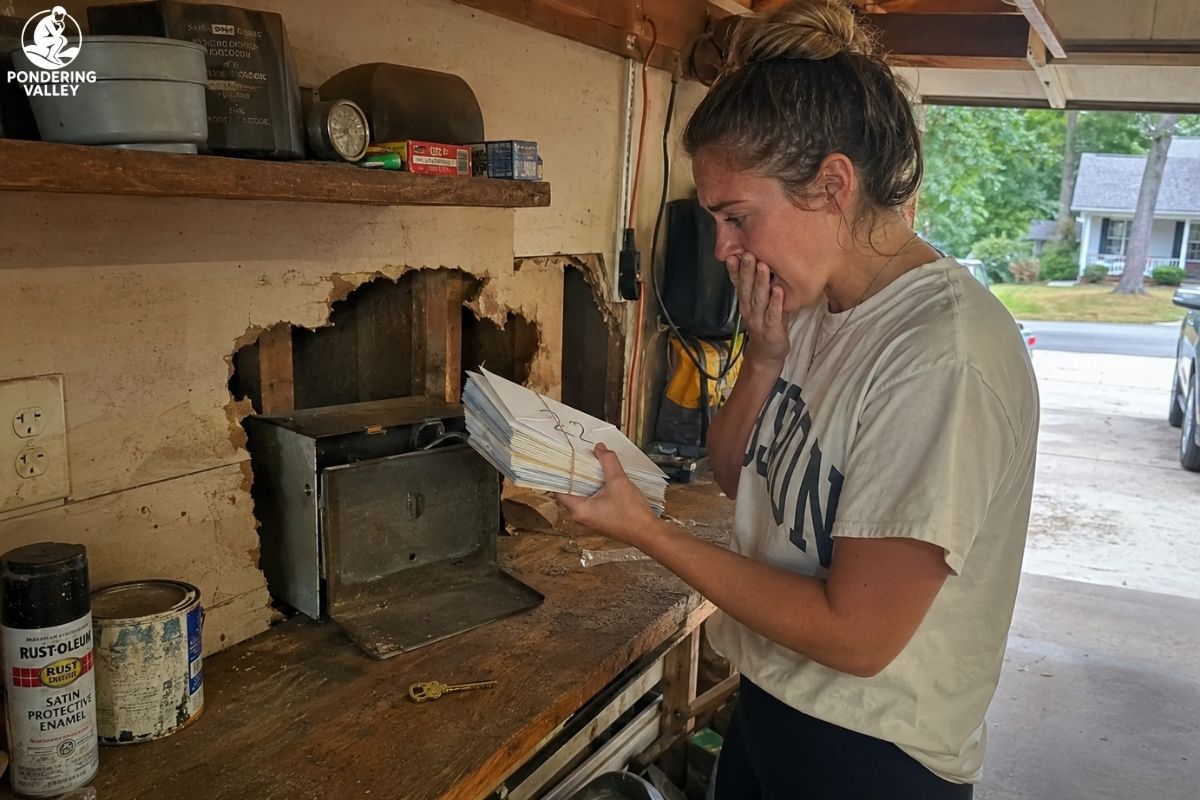
They were tucked in an army footlocker at the back of the closet, beneath a folded wool blanket and a tin of rusty medals she’d never seen him wear. The box wasn’t locked.
Each envelope was neatly addressed by hand. No stamps. Just names—first and last—and dates. Some were fifty years old.
To PFC Thomas Granger – June 3, 1969
To Sgt. Melanie Cook – October 11, 1970
To Corporal Yusuf El-Amin – March 9, 1972
Claire sat on the floor, cross-legged, staring at them. There were over a hundred. Some sealed, some not.
She opened the one on top.
Dear Thomas,
You probably don’t remember me. I was the guy with bloody hands and three morphine shots left.
You called out for your mother. I told you she was right there. I lied.
You made it. I saw you off on the chopper. I never forgot your face.
I hope you got home. I hope you got married.
– H.P.
Claire’s breath caught halfway through.
They weren’t letters of explanation. Or therapy.
They were prayers. Quiet ones. Unsent.
She read three more before setting them down. Her fingers trembled now—not from fear or even grief, but something deeper. Guilt. Regret.
She hadn’t come home. Not for Christmas, not after her mother died, not even when the VA had called last year, saying he might need help.
She remembered the way he always folded his hands during storms, quiet and still, as if listening for something no one else could hear.
Harold Price hadn’t wanted a funeral.
He’d left no instructions. Just a name at the county office, hers, and a note to cremate.
But Claire wasn’t ready to let him vanish in smoke and silence. Not yet.
The next morning, she called the town hall.
Then the newspaper. Then the American Legion, even though she knew he’d hate that.
She read one of the letters aloud at the local diner, voice shaking.
And then, somehow, word spread.
By Thursday afternoon, Main Street had folding chairs and flags. An old school band set up across from the post office. People who hadn’t known Harold Price came, holding signs that said “Doc, Thank You” and “We Remember.”
But it was what happened that night—after everyone left, and the sun dipped behind the mountains—that changed everything.
Because Claire found one final envelope, buried beneath the others.
This one was addressed to her.
Just her name.
Claire.
Inside: four lines. A confession. And a choice.
She sank to the floor, letter in hand, the words seared into her chest.
Part 2: The Letter to Claire
The envelope was thinner than the others. No military date. No salutation.
Just Claire written in his precise, all-capitals print.
Her hands trembled as she opened it, sitting on the cabin’s hardwood floor, the faint scent of tobacco and cedar filling the silence. There were no creaks from the porch swing anymore. No Roscoe. No Harold.
Only this.
Claire—
I don’t expect you to understand.
But I need you to know that I tried to stay soft in a world that taught me to go hard.
I carried boys younger than you out of fire. Watched some stop breathing in my arms. And then I came back and forgot how to talk to anyone.
I kept my silence, not because I didn’t care, but because it was the only thing that kept me from falling apart.
I was never good at being your father. But I was never not proud to be one.
The letters were my way of staying human.
If you’re reading this, I’m gone. And I won’t ask for anything. Not a flag, not a rifle volley, not a folded triangle in your hands.
But if you feel like reading any of those letters out loud—just once—maybe they’ll find their way home after all.
– H.
Claire didn’t cry. Not the sobbing kind, at least.
She just sat there and let the tears roll slow and quiet down her cheeks, like rain on the cabin roof.
He had always been that way—quiet, practical, rough as hickory bark but gentle when it counted. She remembered being five years old, cutting her knee on a rusty fence, and him carrying her inside without a word. No scolding. Just disinfectant and an old rag, and a look in his eyes like he wanted to scream but wouldn’t.
Now, three days after he died, she felt like she was finally hearing him.
The next morning, she called the funeral home. Changed the plans.
“No chapel,” she said. “No music. I’ll handle it.”
She drove into town, stopping by the post office, the high school, even the gas station where old timers still drank coffee on folding chairs by the pumps. She passed out copies of the same note:
Harold Price never asked for a parade.
But on Saturday, we’re giving him one anyway.Main Street, 10 a.m. Bring nothing but silence and maybe a memory.
I’ll be reading some letters. You might want to hear them.
That afternoon, she returned to the cabin with coffee from Joe’s Diner and laid the letters out across the kitchen table like a deck of ghosts.
She read a few more.
To Yusuf El-Amin
You were the one who told jokes even while bleeding.
I asked where it hurt and you said, “Mostly my pride.”
You didn’t flinch when I pulled the shrapnel. You looked me in the eye and said, “Doc, if I die, tell my sister I’m sorry for stealing her Walkman.”
You didn’t die.
I hope you told her yourself.
Claire smiled. And then she wept.
These weren’t just memories. They were lives stitched together by pain, dark humor, survival.
And Harold had carried them—all of them—quietly, every day.
That night, she took out a marker and a cardboard box and wrote in big letters:
“LETTERS NEVER SENT.”
Then she filled it with the ones she’d read. And the ones she hadn’t yet.
Saturday morning came with mist hanging low over the mountains and the kind of hush that made even birds quiet.
Main Street wasn’t crowded, but it wasn’t empty either.
A dozen veterans stood in pressed jackets. Some with canes. Some in jeans. All with stories folded in their silence.
Children held small flags. A dog barked once, then stopped.
And at the front, near the fire station, Claire stepped up with the shoebox in her hands and cleared her throat.
She held the first letter like it was glass.
“To Melanie Cook. October 11, 1970…”
“You told me to stop fussing. Said it was ‘just a scratch.’
I had to argue to stitch you up. You told me later the scar reminded you not to volunteer for anything that involved ‘grenade range.’
You always laughed louder than the rest of us. You kept us sane.
I hope you found a place to be loud and safe again.”
No one moved. A breeze pushed through the trees lining the road. A flag shifted. A woman near the back began to cry.
Claire read four more letters.
One to a boy from Kentucky who died three weeks before discharge.
One to a Navajo scout who always hummed while stitching his own wounds.
One to a man who didn’t speak English but squeezed Harold’s hand so tight, his fingers went numb.
And with each letter, the silence deepened. Not mournful—but sacred.
When she reached the last letter of the day, her voice cracked.
“To Claire Price.”
“I missed the first concert you ever sang in. The one where you looked like your mom with her hair curled.
I sat outside in the truck the whole time. Couldn’t go in. Couldn’t face a crowd.
But I heard your voice through the open window.
I just wanted you to know—I was there.”
She didn’t finish.
Didn’t have to.
Someone in the crowd stepped forward and laid down a photo. Then another. A dog tag. A folded letter. A bouquet of field daisies.
The road, once empty, was slowly filling with pieces of memory.
Claire sat down on the curb, the box in her lap, and let the silence do what her father had always done best:
Say everything without saying a word.
Part 3: The Ones Who Came Back
The crowd began to thin as the sun rose higher, burning off the morning mist and warming the faces that had gathered.
Some people lingered. A few hugged Claire, awkward and unsure, like touching grief might crack it wide open.
She stayed on the curb, elbows resting on the shoebox of letters, watching as the silence settled again, not empty—but full. It was the kind of quiet her father would’ve understood. A quiet earned, not given.
Then someone stepped forward.
A man. Late sixties, maybe early seventies. Tall, with a limp that made every other step shorter than the last. He wore jeans, a white button-down tucked in neat, and a ball cap that read 4th Infantry – Vietnam in faded gold thread.
He didn’t speak right away. Just looked at the box. Then at Claire.
“You got one in there with my name on it?” he asked.
Claire blinked. “What’s your name?”
He smiled faintly. “Thomas Granger. PFC, 1969. I was in Quảng Trị. Took some shrapnel to the leg and damn near lost it.”
Claire’s throat went dry.
She reached into the box, pulling slowly, carefully. The third envelope from the top.
She read the name aloud: “To PFC Thomas Granger – June 3, 1969.”
He laughed. Not a big laugh, just a short puff of disbelief.
“Forty-five years,” he said, “and I never knew your dad even remembered me.”
Claire opened the envelope. “He did.”
“Thomas—
You were my second evac that week.
You kept telling me you wanted to walk out on your own two feet. I told you we’d settle for one good one.
I never told you this, but the kid next to you didn’t make it.
You asked about him when they carried you to the chopper. You kept looking around for his helmet.
I lied. I said he’d made it.
I just wanted you to get home.”
– H.P.
Thomas was quiet for a long time.
He didn’t cry. Most men like him didn’t. But his eyes looked away the way people do when they’re trying not to drown in a memory.
“I always wondered,” he said. “About the other guy. The one next to me. I never got his name.”
Claire nodded. “Neither did Dad. But he remembered you.”
Thomas reached into his pocket and pulled out a chain. At the end of it was a dog tag—worn down to the point that only faint traces of numbers were still visible.
“I kept this,” he said. “Didn’t belong to me. I found it in my boot after I got to Da Nang. Figured someone put it there on accident.”
He placed the tag gently on the box.
“For him,” he said.
As the day wore on, more people came.
Not a parade. Not a celebration.
But one by one, folks arrived with something to offer. A photo. A patch. A name.
A woman in a wheelchair rolled up to Claire late in the afternoon. She wore a lavender scarf and had a service dog named Winnie, who leaned gently against her leg.
“I’m Melanie Cook,” she said. “Sergeant, 1970. 91st Evac.”
Claire froze. “You’re in one of the letters.”
“I know,” Melanie said, smiling. “I heard you read it this morning.”
Claire laughed once—sharp and wet. “He never sent any of them. I don’t think he ever meant to.”
Melanie shrugged. “Doesn’t mean they didn’t find their way.”
She held out something wrapped in tissue paper.
Claire opened it carefully. Inside: a folded, bloodstained field dressing. Old. Yellowed.
“He used this on me when I got hit,” Melanie said. “Told me to shut up and sit still, that I was going to be fine. I told him he was bossy.”
Claire smiled. “That sounds right.”
Melanie placed the dressing on top of the dog tag. “He saved a lot of us. And not just our bodies. He saved our hearts. Because he didn’t treat us like we were already gone.”
That night, Claire sat alone in the cabin again.
The shoebox was now half-empty. Its contents scattered across Harold’s kitchen table, surrounded by items from strangers who had never forgotten a man who never asked to be remembered.
She stared at the blank wall above the fireplace. It used to hold a mounted buck head. She’d always hated that thing.
Now it held a letter.
The one addressed to her.
Pinned up with a thumbtack. A kind of flag of surrender.
And for the first time since the day he died, she spoke aloud—not to anyone, not even to herself, but to the empty air:
“I forgive you.”
In the morning, the letter to Claire was gone.
In its place, a photograph she didn’t recognize.
It showed a younger Harold Price—maybe early thirties, shirt sleeves rolled, arms wrapped around a muddy, grinning medic unit. All of them laughing.
Claire turned it over.
On the back, in faded pencil, were the words:
Still breathing. – H
Part 4: The Woman from Quảng Trị
It was Sunday morning when she arrived.
Claire was in the cabin’s kitchen, brewing a second pot of coffee and sorting through more of her father’s letters when the gravel crunched outside. Not tires—just footsteps. Slow, deliberate.
She peeked through the screen door.
A woman stood on the porch.
Tall, wiry. Late seventies maybe, with tightly braided silver hair and a spine straight as a fence post. She wore a faded green field jacket over jeans, a canvas bag slung over her shoulder. Her face was sun-worn, lined with time but sharp with clarity.
“You’re Claire?” the woman asked.
Claire nodded.
The woman stuck out a hand. “I’m Lena Dwyer. I served with your dad in ’71. Quảng Trị, 18th Evac. He called me Dagger.”
Claire blinked. “Dagger?”
Lena grinned. “He thought my stitches were better than his. Said I was faster. Meaner, too. Might’ve been right.”
Claire opened the door.
“Come in,” she said softly.
Lena walked through the cabin like someone returning to a battlefield. Not sentimental—just observant. She paused at the kitchen table, where letters were fanned out like a makeshift memorial, her gaze landing on one envelope near the center.
She didn’t touch it.
“He wrote one to you,” Claire said.
“I know.”
“You knew about the letters?”
“I knew about the guilt.”
She reached into her bag and pulled out a weathered, spiral-bound notebook. The corners were bent, the cover soft with use.
“I kept this,” she said, laying it down gently. “Journal. Field notes, mostly. But I wrote down things your dad said. Because they stuck with me.”
Claire sat slowly across from her.
Lena flipped to a marked page.
March 13, 1971 – 0300 hours
Harold woke up shaking again. Said he saw the boy with the chest wound, the one from Firebase Mary Ann.
He told me something I can’t stop thinking about: “I don’t want medals. I want faces. If I can remember their names, maybe they won’t disappear.”
I told him he was carrying too many ghosts. He said, “Somebody has to.”
Claire’s throat tightened.
“He never talked to me like that,” she said.
“Maybe he didn’t know how,” Lena replied. “Or maybe he was saving it. For these.”
She nodded at the letters.
Claire looked down. Her hands were ink-stained from handling them. Her father’s words had soaked into her skin like river water.
“He wasn’t cold,” Lena said. “Just full. You can’t pour anything into a man like that. He’s already brimming over.”
They sat in silence a while.
The wind pushed softly through the trees outside. Birds called from the hill. Claire thought about how long it had been since she’d just… sat. No phone. No noise. No half-distracted multitasking.
Lena finally broke the silence.
“He saved my life,” she said, voice lower now. “Not in the war. After.”
Claire looked up.
“I got back stateside and couldn’t sleep more than two hours without screaming. My sister wouldn’t let me in the house. I was on a Greyhound to nowhere, thinking real dark things, when I got a letter. From Harold. No return address, just one line inside: ‘Don’t quit before the good part.’”
Claire blinked. “He mailed it?”
Lena shook her head. “No. Found me in person. Handed it to me at a bus stop in Columbus, Ohio. Didn’t say a word. Just nodded and walked away.”
Claire didn’t know what to say. She hadn’t even gotten a birthday card.
“He kept tabs on a few of us,” Lena said, as if reading her mind. “Not always directly. But enough to know we made it. Or didn’t.”
She reached into her bag again and pulled out a folded map. Old, military-style. Creased deep with years.
“This was his,” she said. “He gave it to me after the war. Told me to burn it. I never did.”
She unfolded it slowly on the table. There, marked in ink, were dozens of red dots across Vietnam. Dates scribbled beside them.
Claire leaned in.
“What are these?”
Lena ran a finger along the edge of the paper. “Rescues. MedEvacs. Moments he didn’t let someone die.”
One of the dots had a star beside it.
Claire touched it.
“Quảng Trị?”
“Yeah,” Lena said. “That was me.”
Later that afternoon, Claire walked Lena to her car.
It was a rusty Toyota pickup with a cracked windshield and a spare tire in the backseat. The kind of vehicle that belonged to someone who’d been moving a long time.
Lena turned before opening the door.
“You’re doing right by him, Claire. Whether he said it or not.”
Claire nodded. “Thank you. For coming.”
Lena smiled gently. “He was hard to know. But worth it.”
She started the engine, then leaned out the window.
“You should finish reading the letters,” she said. “There’s one more that matters.”
And with that, she drove off down the gravel road.
Claire stood there long after the truck disappeared around the bend.
Eventually, she returned to the kitchen and started sorting again, reading until her eyes ached.
And there, almost at the bottom of the box, was one more envelope.
No name.
No date.
Just three words:
“To the One I Missed.”
Part 5: The One He Missed
The envelope was different.
Thinner than the others. No crease where the flap should’ve sealed. The paper slightly yellowed, as if handled too many times but never quite brave enough to send.
To the One I Missed.
Claire sat at the kitchen table, alone again, the letter between her fingers like a weight.
She turned it over. Nothing on the back.
She inhaled slowly, deeply. And opened it.
I know your name, but I won’t write it.
Because I didn’t earn the right.You were the one I couldn’t save.
I remember the sound before I saw you—like a door slamming shut in a storm.
I ran. Sand in my teeth, dirt in my eyes, yelling for someone to help me.You were already down. And I did what I was trained to do.
Pressure. Morphine. Breath in, breath out. But you never opened your eyes.
You were too far gone, and I knew it.
But I kept working like I didn’t.I told the others you died instantly.
I lied.Because part of me thought if I worked harder—
if I was better—maybe I could’ve brought you back.
And when I came home, it wasn’t the ones I saved that haunted me.
It was you.
I dreamed your face but forgot your voice.
I remembered the heat of your blood but not the smell of the jungle around us.You’ve lived in me longer than anyone else.
And I am sorry.
– H.
Claire laid the letter down like it might shatter.
The air in the room seemed heavier. Like her father was there again—not in the way he’d been in life, tight-lipped and distant—but honest.
There was no pride in that letter. No legacy. Just loss.
And it made her realize something.
Harold Price had carried that death like a stone in his chest. A weight that kept him from getting too close to anything or anyone, including her.
She stood and walked to the fireplace, where the photograph from the day before still rested. Her father, young and alive and laughing, his arm around a fellow medic, the war years still on their faces.
Then she looked at the kitchen table. Letters stacked, opened and read. Tokens left behind by strangers who’d returned.
But this letter—this one was different.
Because this one hadn’t found anyone.
Claire picked it up again. Folded it. Slipped it into her coat pocket.
Then she took the photo from the mantel and slid it into her bag.
She didn’t know exactly what she was going to do.
But she knew she couldn’t leave that letter sitting in a box.
The next morning, she visited the county clerk’s office.
An old man named Gerald sat behind the desk, sipping coffee from a Steelers mug, wearing a flannel vest that didn’t match the heat outside.
“I’m looking for information on my father’s service records,” Claire said.
Gerald squinted. “Name?”
“Harold Price. Vietnam medic. Lived out on Miller’s Ridge.”
Gerald paused. “Doc Price? That’s your daddy?”
Claire nodded.
“Hell, everybody around here knew him, even if he didn’t want ‘em to.”
He pulled open a drawer, thumbed through a few files, then stopped.
“Got a military form he filed in 1983,” Gerald said, handing it over. “Not much. Just his unit and deployment dates.”
Claire scanned it.
Then her eyes landed on a name scribbled in the margin—faint, almost missed.
Cpl. Darren Niles.
KIA – May 14, 1971 – Firebase Anaconda.
Something in her chest twisted.
She hadn’t seen that name in any of the other letters.
That night, back at the cabin, she typed it into her laptop.
Darren Niles.
One match.
A short tribute page hosted by his hometown VFW in Ripley, West Virginia. A grainy photo of a young man in uniform. Big ears. Uneven grin. Barely twenty.
Claire stared at the screen a long time before clicking the contact link.
She wrote:
My name is Claire Price.
I believe your town’s memorial includes a man my father served with—Cpl. Darren Niles.
I’ve found a letter written by my father after Darren’s death.
I would like to bring it to you.
Three days later, Claire stood outside a small, brick community center in Ripley, holding the envelope in her hand.
An elderly woman met her at the door.
“I’m June Niles,” she said, offering a hand. “Darren was my brother.”
Claire nodded, unsure what to say.
“I never knew much about what happened to him,” June said. “Just that he didn’t come home. My parents… they didn’t talk about it.”
“I think,” Claire said softly, “this might fill in a blank.”
She handed the envelope over.
June opened it carefully, read it once.
Then again.
Then pressed it to her chest, eyes glistening.
“I always wondered if he was scared,” she whispered. “Now I know someone stayed with him.”
Claire swallowed hard.
“He did more than stay,” she said. “He carried him. All the way home.”
As they said goodbye, June touched Claire’s arm.
“Your father was a good man,” she said.
Claire nodded. “He was.”
That night, Claire drove back through the mountains.
Back to Miller’s Ridge.
Back to the cabin that still smelled of pipe tobacco and ghosts.
And for the first time, she didn’t feel like a stranger there.
Because something had shifted.
Something had been carried, delivered, and finally… released.
Part 6: Roscoe’s Trail
Claire returned to the cabin under a rising harvest moon.
The drive back from Ripley had been long, winding through the Appalachian hills like a ribbon draped across old bones. Every curve reminded her of summers she’d spent looking out the passenger window, her father silent at the wheel, Roscoe’s head hanging between the seats.
Roscoe. The mutt that never left his side.
Claire hadn’t thought of him in years—at least not in the way that mattered. Not beyond the expected old photos on the fridge, or the scratch marks still visible on the porch post where he used to stretch every morning.
But now, as she pushed open the creaking door, the silence of the cabin met her like an old friend, and something tugged at her to go back to the corner of her father’s room—the cedar chest.
That’s where he kept Roscoe’s collar.
The leather was cracked, but intact.
It still smelled faintly of rain and pine bark. She remembered the sound it made—metal tags clinking as Roscoe followed Harold through the woods, the three of them sometimes walking miles in silence.
She turned it over in her hands, and something felt… off.
Claire paused. Looked closer.
There was a small slit on the inside, barely stitched shut. A flap, maybe?
She reached for her father’s old pocketknife from the desk drawer and slipped the blade beneath the edge. With one careful tug, the seam gave way.
Inside, folded so tightly it took her several tries to pry it open, was a strip of paper.
A note.
If you find this,
then I guess I’m gone.You were always smarter than me, Claire. Better with words. Better with feelings. I know I didn’t show you much of either.
But Roscoe… he understood me when people couldn’t. When I got home from Vietnam, I didn’t talk to anyone. Not even your mother. I’d sit on the porch and watch the trees. That dog sat beside me every night for six years before I ever said a full sentence again.
He walked every trail with me. Slept at my feet. He was my first yes when I couldn’t say no to life anymore.
When he died, I buried him behind the old oak stump, next to the stone with no name. You probably never noticed it.
But I left something there.
You’ll know what to do when you see it.
– Dad
Claire read the note three times, then slowly folded it back up.
She walked out onto the porch barefoot, letting the chill of the earth ground her. The moonlight cast long shadows across the clearing. Crickets sang. The hush of leaves in the breeze felt like breath.
She followed the path down the hill, past the blackberry bushes, toward the far end of the property—where the land dipped before the tree line thickened.
The old oak was still there, its trunk scarred from lightning and time. Moss crept along its roots like memory.
And beside it, half-covered in fallen leaves, was the smooth stone.
No name. No date. Just there.
She dropped to her knees and brushed it clean.
Then she saw it.
A thin metal box, buried just beneath the soil beside the stone. The kind soldiers used for ammunition or rations. Rusted but still sealed.
Claire pried it open with a rock.
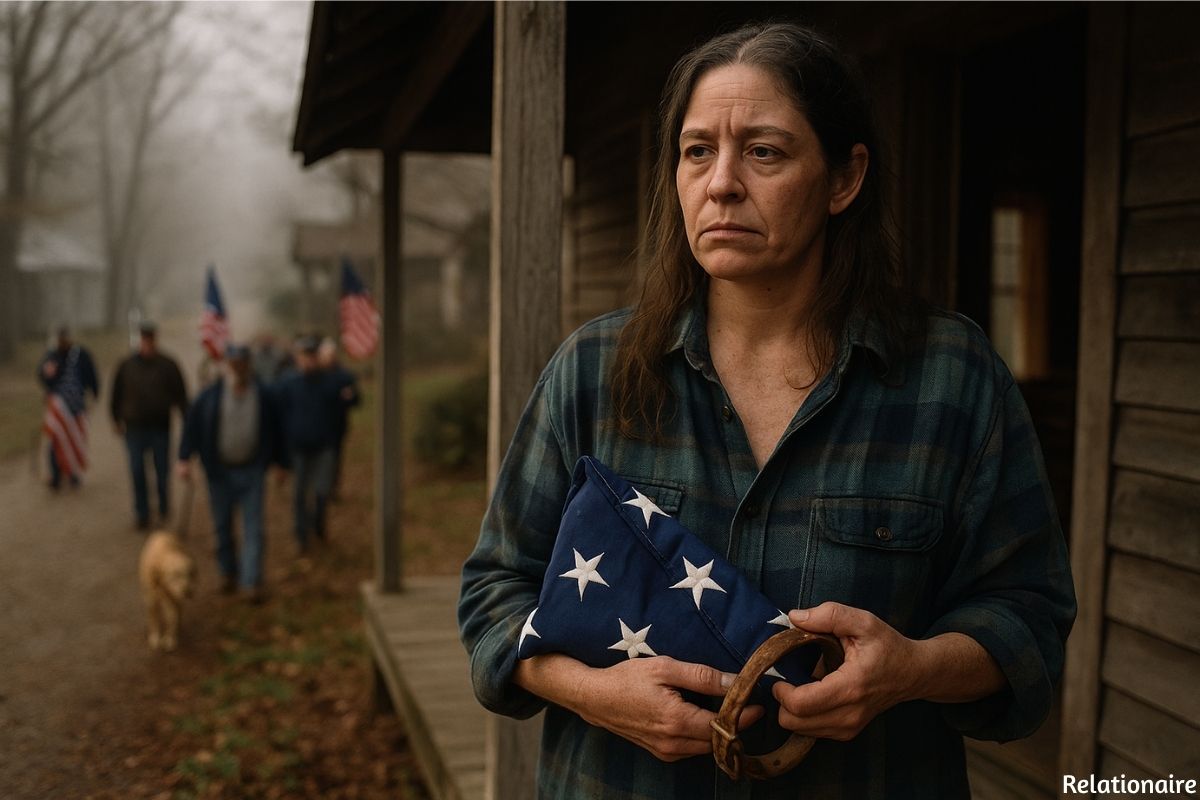
Inside: a photograph, a folded U.S. flag, and a cassette tape.
The photo showed Harold in uniform—not during war, but years later. In front of a pickup. Roscoe beside him. Claire must’ve been eight or nine then.
They were both looking at her behind the camera.
She wiped a sleeve across her eyes and picked up the cassette.
In her father’s handwriting, across the label:
“For Claire. Play it alone.”
The old tape player still sat on the shelf beside the fireplace. She found a pack of batteries in the junk drawer and slid the tape in.
She pressed Play.
Static. Then silence.
Then his voice.
Hey, kiddo.
If you’re listening to this… I’m proud of you. I know I didn’t say it much. I didn’t say a lot of things. But not because they weren’t true. Just… I was scared of how much I felt.
You were always the brave one. You left. You chased things. I stayed. Watched the same trees grow and die again and again.
I know I hurt you. I know I didn’t show up the way a father should.
(long pause)
I kept all those letters because I needed them more than they needed me. I needed to believe I hadn’t just patched up bodies—I’d kept people alive.
But with you… I didn’t need letters.
I just needed a second chance.
Maybe this is it.
Take whatever’s in the box and do what you think is right. Burn it. Bury it. Or read it out loud, like you did that day.
But don’t forget me as a ghost. Remember me as a man who tried.
That’s all I ever wanted.
Goodbye, Claire.
I love you.
She sat for a long time after the tape ended.
The cabin was quiet. But something in her had shifted again—some grief melting into peace.
She looked down at the flag.
Then out the window, where the first light of dawn was rising like hope over the ridge.
Part 7: The Things He Carried
Claire woke to birdsong and the smell of rain-soaked earth.
It had rained overnight, just enough to leave beads of water clinging to the screen windows and the scent of pine thick in the air. The cabin felt different now—less like a museum and more like a story still unfolding.
She wrapped herself in her father’s old flannel and walked barefoot into the living room, where the letters were still spread across the coffee table. Roscoe’s collar rested beside the journal, the bandana folded neatly underneath.
Claire had gathered it all the night before. Not just to organize it—but to honor it.
Because now, she understood something she hadn’t before:
Harold Price hadn’t been keeping memories.
He’d been carrying them.
She found a large wooden trunk in the attic—dusty, but strong. The kind meant for safekeeping, not display. She cleared the table and began placing each item inside carefully:
- The box of letters, arranged chronologically by war year
- The photos, including the negatives she’d scanned and printed
- The collar, coiled gently like it was still warm
- The bandana, folded and tied with string
- The dog tag left by Thomas Granger
- The letter addressed to “The One I Missed”
And last, her father’s journal. The list he’d written—the one titled Things I Carried—tucked inside the front cover.
When it was done, she closed the lid and sat with her hands resting on the top.
It wasn’t just a trunk.
It was the heart of a man who’d never learned to say what he meant, but had found other ways to leave it behind.
That afternoon, Claire drove into town with a purpose.
She stopped by the American Legion, where old men nodded solemnly as she explained what she was building. Then the VFW hall, where she shared the story with a few volunteers who offered coffee and quiet tears. At the library, the head librarian gave her an old glass display case and asked if she needed help designing a plaque.
“No plaque,” Claire said. “Not yet.”
She paused, then added, “Maybe something handwritten. Something he’d have approved of.”
Back at the cabin, Claire typed out a letter.
Not a military tribute.
Not a eulogy.
Just… a daughter writing for the man she finally knew.
My father was a medic in Vietnam.
He never told war stories. Never wore the uniform after.
He lived on a hill, raised a dog, and cooked his eggs the same way for forty years.
For a long time, I thought he didn’t care.
But now I understand—he carried things too heavy for words. So he wrote letters he never mailed. Buried memories in quiet places. And saved people in ways that didn’t make the news.
If you’re reading this, you’re part of his story now.
Maybe you’re carrying things, too.
Leave a letter. Add a name. Sit on the porch a while.
This place is for the ones who came home… and the ones who followed them in spirit.
— Claire Price
She printed it on cardstock and taped it to the inside of the display case.
It wasn’t fancy.
But it was true.
On Sunday morning, she opened the doors of the cabin.
Put a folding sign by the mailbox:
“Letters Never Sent: A Living Memorial. Open Sundays 9 to 3.”
She didn’t expect much.
But by ten, a man in a denim jacket pulled up in a truck and walked slowly up the porch steps.
“You Claire?” he asked.
She nodded.
“I served with a guy named El-Amin,” he said. “Your dad write him?”
She went to the trunk, opened the lid, and pulled out the letter.
He read it aloud on the porch. Sat down in the rocking chair. Stayed for two hours without saying another word.
Then he left a note in the guestbook: “He saved the best of us. Thank you.”
The following week, three more people came.
Then five.
Then ten.
Some were veterans. Some were children of veterans. One woman had never served or known anyone who did, but said she read about it online and “just needed to see something that made sense.”
Claire never asked questions. Just offered coffee, a chair, and space to read or reflect.
She left pens and paper on the table.
People began writing letters of their own.
Some addressed to the past.
Others to themselves.
One just said:
“To the medic who lied to me and told me I was going to be okay—thank you. You were right. I just didn’t believe it then.”
One evening, Claire found a letter taped to the porch railing.
No name.
No return address.
Just a torn scrap of paper, scrawled in messy handwriting:
*I think your father saved my brother.
We never knew who pulled him out of the fire.
But now I think maybe it was him.*
*Tell him… thank you.
Even if it’s too late.*
Claire didn’t cry.
She just folded the note, added it to the trunk, and whispered to the trees, “He heard you.”
Part 8: The Flag in the Window
The first flag went up three days after Claire opened the memorial.
It was a small one—weather-faded, the kind you stick in a flowerpot on the Fourth of July. A woman named Alma Raines brought it and quietly asked if she could place it in the front window.
Claire nodded. “Of course.”
Alma didn’t explain, and Claire didn’t ask.
She just watched the woman press the base into the soil of the sill and whisper something only the wood and glass could hear.
By the following Sunday, there were six flags.
One in the mailbox.
One stuck gently into the ground near the stump where Roscoe was buried.
One taped—crookedly—to the old porch rail, left by a boy no older than ten who only said, “My granddad was a medic too.”
Claire had started a notebook now, just labeled “Offerings” on the cover.
Inside were names, notes, drawings, and objects left behind:
- A rosary from a woman whose brother had disappeared in ’68
- A harmonica from a man who never played again after Da Nang
- A photo of two young soldiers with “H. Price?” scribbled beneath one of their faces in pencil
- A folded piece of cardboard that read simply, “I came home. He helped.”
She didn’t know who left that one.
But she placed it gently on the mantle next to the letter titled To the One I Missed.
Then came the flags on Main Street.
At first, it was just the volunteer fire station. Then the post office. Then Joe’s Diner, where a quiet man in a faded Army cap nailed one above the “Open” sign and walked away before anyone could say a word.
The local high school called and asked if they could host a reading of the letters in the gymnasium.
Claire said yes. She didn’t even pause.
She stood on the stage in front of bleachers half full of strangers—teenagers in hoodies, elderly veterans in slacks, mothers holding squirming toddlers.
She read four letters that night.
Then a fifth—her letter. The one Harold had written to her. The one that started it all.
No one clapped.
But when she looked up, half the room had tears running down their cheeks.
And every flag on the walls stood still in the breathless silence that followed.
Back in the cabin, things had begun to shift.
She’d rearranged the front room into what the townspeople now called The Listening Porch.
Two rocking chairs faced the window. A coffee station hummed in the corner. The trunk sat open, not as a relic, but as an invitation.
There was a sign above the fireplace now.
Hand-carved by someone who never gave their name.
It read:
“He never asked for a parade. So we gave him one that never ends.”
Claire spent her days answering letters now.
Not her father’s—but the ones people left behind.
Notes scribbled on napkins, postcards, scraps of receipts. Some were addressed to Harold. Others to no one at all.
She wrote back when she could.
Sometimes all she wrote was:
He heard you. He carried you. You were not alone.
And that was enough.
One morning, a man came to the door with a cane and a paper bag.
He didn’t introduce himself. Just handed her the bag and said, “I think he meant to return these.”
Inside: a pair of bloodstained combat boots, size ten.
And beneath them, folded carefully, was a napkin from a Saigon café.
Written on it in faded ink:
You keep me breathing. I’ll buy the coffee when we’re home.
— Eli
Claire stared at it for a long time.
Eli.
That name had been on her father’s Things I Carried list.
A promise I made to a dying boy named Eli.
She went back to the journal and flipped to the entry. Read it again, slower this time. There was no last name. No date.
Just a name. And a promise.
She looked at the boots.
She understood now.
Harold had carried that napkin like a receipt for a debt he could never repay.
And now, someone else had decided it was time to let it go.
That Sunday, Claire pinned the napkin to the inside of the trunk, just above the collar.
She left a note beneath it:
He never got to buy the coffee. But you brought it back anyway.
The man who brought the boots never returned.
But the next week, a different napkin appeared.
Blank.
Folded carefully.
Left under a smooth stone on the railing.
That night, Claire lit a single candle in the window.
Not for mourning.
But for presence.
The cabin no longer felt heavy. No longer full of ghosts.
It felt lived in. And lived through.
As if the silence Harold left behind had turned into something softer. Something that made room for other people’s pain—and helped carry it, just as he had done.
One evening, as the sky turned to gold, Claire stepped out onto the porch with a cup of tea and saw something new.
Across the hill, on a neighbor’s property, a flag fluttered gently in the wind.
A handmade sign was staked beneath it:
“For the medic who saved my father.”
She didn’t know who wrote it.
Didn’t need to.
The flags were everywhere now. Not for show. Not for politics.
But because people had remembered a man who spent his life refusing to be remembered.
And in doing so, they honored all the ones like him.
Part 9: Letters for the Living
Claire didn’t realize how long it had been since she’d written anything by hand.
Not a grocery list. Not a birthday card. Not even her own name, aside from forms and signatures.
But now, in the quiet warmth of her father’s cabin, she sat with a blank sheet of paper in front of her and a pen that had belonged to Harold—a simple black rollerball, its grip worn smooth with use.
The flag in the window moved gently in the breeze.
Outside, someone had left a folded paper crane on the porch.
Inside, Claire began to write.
To the woman who came and never spoke,
I saw the way your hands shook when you placed your photograph inside the trunk.
I want you to know—he saw you. Maybe not here, maybe not then, but somewhere in the long, invisible thread that connects every person who carries something heavy and never says it out loud… he saw you.*
Thank you for showing up.
– Claire
She folded it and placed it in a new box she’d labeled Letters for the Living.
It wasn’t just her father’s voice that mattered now.
People were coming every weekend, leaving their stories in corners, under rocks, on the arms of rocking chairs and tucked into mugs by the coffee station.
And something inside Claire had shifted.
She was no longer just collecting.
She was answering.
The next letter was to Thomas Granger.
He hadn’t come back since the first day—the day he found his name on one of Harold’s letters and cried without making a sound.
But he’d left his phone number scribbled on a napkin.
Claire picked up her pen.
Dear Mr. Granger,
I want you to know that I found the dog tag you left.
I keep it next to the letter he wrote you. It’s safe.
You told me you always wondered what happened to the other boy on the stretcher.
His name was Eli.
He died that day.
But you didn’t. And my father remembered your jokes. Your stubbornness. The way you kept trying to get up, even when your leg was gone.*
You mattered to him.
Thank you for carrying his silence all this time.
I hope you’re sleeping better.
– Claire
She mailed it the next morning.
No return address. Just a simple stamp and a hand-written “Thank you” on the envelope.
She didn’t expect a reply.
But she needed to say it.
Over the next week, the box filled.
Claire wrote a letter to the high school student who had left a sketch of her grandfather with the caption, “He didn’t talk. But he always stood when taps played.”
She wrote to the elderly man who brought his wife’s ashes and sat them beside the fireplace while he read two of Harold’s letters aloud.
She wrote to the child who had left behind a toy soldier with only three fingers and a note that said, “This is for your dad because he helped mine.”
One morning, she found a letter waiting for her.
No postage. Just folded in half and tucked inside the cabin doorframe.
The handwriting was careful.
Block letters, like her father’s.
Claire,
I was in the hospital tent the night your dad worked on Eli.
I remember the way he sat beside him after the others had stopped trying.
He didn’t cry. Didn’t pray. Just held the boy’s hand until the heartbeat monitor went flat.
We all thought he was made of stone.
But the next morning, he brought coffee to every cot and said:
“If I know your name, I’ll remember you. That’s a promise.”
I think he kept it.
And so will I.
– J.L.
Claire folded the note and placed it at the very front of the memorial trunk.
Not just for the words.
But for the witness.
Someone else who had seen the quiet parts of Harold Price and understood what they meant.
Later that week, a local newspaper ran a story titled “The Letters They Never Sent: One Town’s Tribute to a Medic Who Stayed Quiet.”
After that, more people came.
One man rode up on a motorcycle from North Carolina. A woman flew in from Arizona. Someone mailed a photo from Germany—a soldier standing beside a field hospital in 1971, with handwriting on the back that said, “Was he yours?”
Claire didn’t have answers for them all.
But she had a place.
And sometimes, that was enough.
By now, the flag in the window had faded from red-white-blue to something softer.
Sun-bleached. Weather-worn.
Claire thought about taking it down.
Then didn’t.
Because some things—like grief, like memory, like love—aren’t meant to stay perfect.
They’re meant to stay.
That night, she wrote one last letter before bed.
To herself.
Dear Claire,
You thought silence meant he didn’t care.
But now you know—he carried too much to speak it out loud.
And you?
You didn’t just unlock his story.
You gave it legs. Gave it breath.
You let it walk out into the world and find the people who needed it.
Don’t forget that.*
You came home, too.
– Me
She placed it in the Letters for the Living box.
Turned off the lamp.
And sat in the dark a while, listening to the wind move through the trees her father had watched for so many years.
Part 10: The Last March
They came in twos and threes, and sometimes alone.
Old men with canes. Mothers with folded photos. A kid in a hoodie holding his grandfather’s medals in a Ziplock bag. A Vietnam nurse in her original fatigues. A dog with greying muzzle and a limp.
They came to walk.
Not in uniform. Not with banners or speeches.
Just feet on gravel. Breath in mountain air. And silence—full, sacred, unbroken.
The townspeople called it “Doc’s Walk.”
Claire hadn’t planned it.
Someone—maybe Thomas Granger—mentioned it at the diner: “He never marched, so maybe we should.”
The waitress said she’d tell her cousin at the fire station. And by the end of the week, someone had printed flyers.
SATURDAY – 9AM
DOC’S LAST MARCH
From the Cabin to Main Street (1.6 miles)
For Harold. For the ones who never asked.
Claire stood on the porch that morning, her father’s flag in one hand, Roscoe’s collar looped around the other. She wore no black, no badge, no special outfit.
Just Harold’s old army shirt.
Still smelled like cedar and time.
The walk began with ten.
By the first bend, there were fifty.
Children handed out letters along the path—photocopies from Harold’s trunk, each one folded and tucked into small brown envelopes stamped “To Someone Who Needs It.”
Claire led them, slow and steady.
Down Miller’s Ridge. Past the old blackberry brush. Over the wooden footbridge her father had rebuilt three summers ago with rusted nails and quiet pride.
No one spoke.
No one needed to.
The gravel crunched like soft thunder under hundreds of feet.
Halfway down the road, someone began to hum.
Low. Gentle.
Then another joined.
It wasn’t a song. Just breath made musical—something between mourning and memory.
Claire didn’t look back. She didn’t need to.
She knew they were with her.
All of them.
By the time they reached Main Street, the entire town stood waiting.
Old men with flags. Teenagers holding signs:
“Thank You, Doc.”
“You Carried Us.”
“Letters Live On.”
A hush fell over the crowd as Claire stepped into the center of the street.
She reached into her coat pocket and pulled out her father’s last letter—the one she hadn’t read aloud yet.
The one he wrote to himself.
To the man I used to be,
You came home.
That matters.
You didn’t save everyone. You didn’t say the right things. You didn’t always show up.
But you tried.
You stayed human.
You made it to the quiet side of life. And you sat there with a dog, and a shovel, and a typewriter no one else touched.
You were afraid of parades because they felt like lies.
But maybe this silence—this walk—is what you deserved all along.
You lived.
That was enough.*
Claire folded the letter slowly.
Tears didn’t come this time.
Only warmth. Like sunlight on old shoulders.
She looked up.
A line of people—some holding hands, some not—stood from the post office to the school. On every building, a flag. In every heart, something unclenched.
The walk ended in front of the courthouse.
Claire climbed the three stone steps, turned, and said just three words:
“He made it.”
That night, the stars came out early.
No wind. No sound but the rustle of trees.
Claire sat on the porch, her father’s old flannel wrapped around her shoulders, the collar resting in her lap.
The candle in the window still burned.
So did the one in her chest.
The next morning, she opened the trunk one last time.
She added her own letter. Just one.
*To the ones still carrying something:
You don’t have to do it alone.
There’s room here.
For your name. For your silence.
For your march—however slow it is.*
– Claire
The town never called it a museum.
They just called it “Harold’s Porch.”
And on Sundays, people came—not to remember the war, but to remember the ones who returned with pieces missing and found a way to keep walking anyway.
In the end, Harold Price didn’t need a parade.
He had something better.
A daughter who forgave.
A town that listened.
And a flag in the window, forever fading in the sun.
THE END.
Thank you for marching with him.