He hadn’t touched it in fifty years.
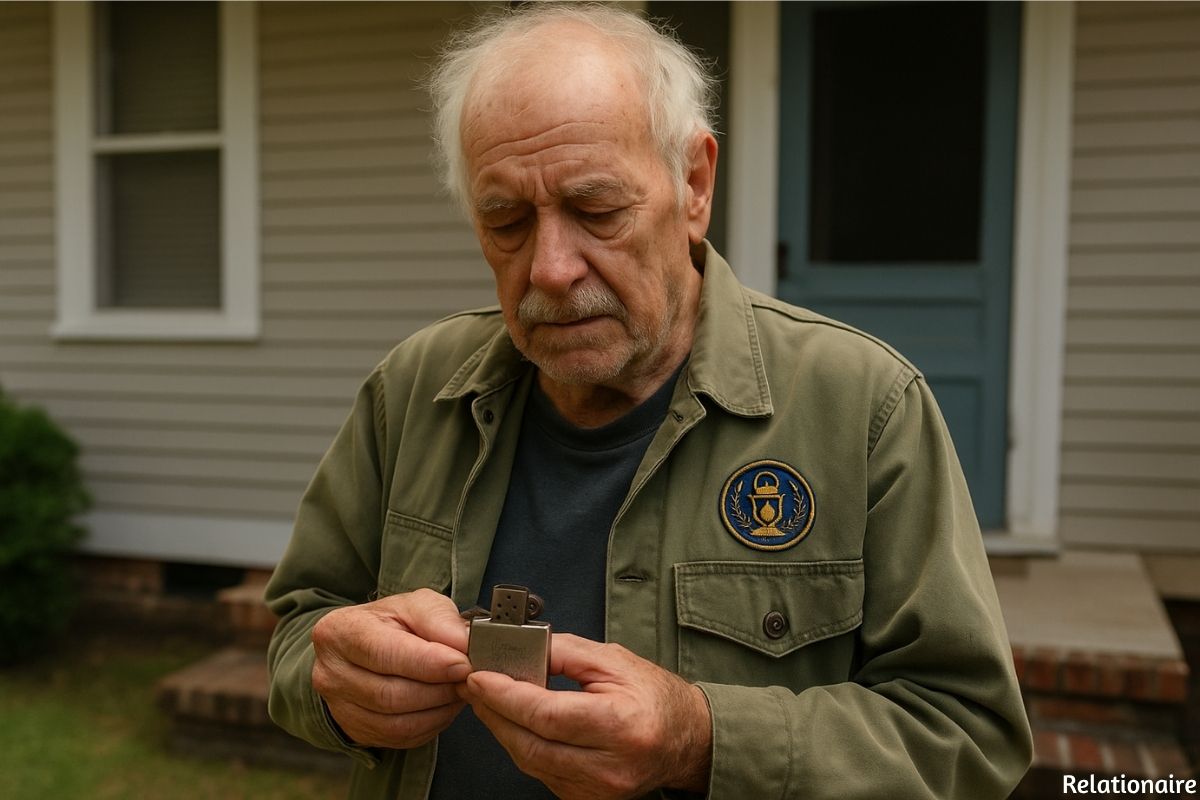
The old Zippo, scratched and silent, engraved with just a word: Forgive.
It hadn’t sparked since the jungle rains of ‘68—until yesterday.
Now Joe Mancuso is packing a bag he swore he’d never touch again.
Some debts can’t be buried. Some flames refuse to die.
PART 1 – The Flame That Waited
Joe Mancuso didn’t believe in ghosts.
But something about that lighter felt damn close.
He found it buried beneath a stack of water-damaged photo albums and warped cookbooks in his daughter’s attic—Metairie, Louisiana, mid-June, air thick as gravy. The kind of heat that makes your bones ache. He was helping Marcie pack for her move to Baton Rouge. Grandkids. Bigger backyard. Fresh start.
She handed him an old cigar box and said, “This yours, Dad?”
He took one look and sat down hard on the attic floor.
The lid creaked open like a memory: folded ration cards, a faded snapshot of a twenty-year-old version of himself, helmet slung low, lips set in that quiet, pre-war smile. Beneath it all was the Zippo—blackened along the edge, still engraved like a whisper:
15°28′12″N 107°36′00″E
FORGIVE
He hadn’t seen that lighter since the monsoon season of 1968, outside a nowhere village in Quảng Nam. He clicked it open. Flicked the wheel.
Nothing.
Tried again.
Click—flick—whoosh.
Flame.
Joe stared, not breathing. The flame held steady, silent, like it had been waiting. Waiting for him to come back.
He sat on the porch that night, a beer sweating in his palm. The lighter rested on the arm of the old rocking chair, gleaming faintly in the moonlight. His mind wandered places he’d tried to fence off years ago. But fences don’t hold in the dark.
There’d been a boy—barely ten. Dust on his cheeks. A sling of papayas in his arms. Joe remembered the boy’s sandals, falling off as he ran. He’d stepped into the firefight just as Joe’s squad opened up.
Joe dropped his rifle. Screamed.
But the bullets were already flying.
They never found the boy’s name. Never found the family. Just coordinates. Carved by a monk in stone. Coordinates and one word. The monk had handed Joe the lighter and turned away without a sound.
He’d buried it in a box. Buried it with the guilt.
Until now.
“Something wrong with it?” Marcie had asked when he brought it down.
Joe shook his head. “Something right, maybe.”
She gave him that sideways look. The one that said: I don’t understand, but I’ll let it be. She’d learned not to press. He appreciated that.
But something in him wouldn’t stay still anymore.
That night, long after the lights in the house were out, he walked to the kitchen table. Pulled out a yellow legal pad. Started writing.
TO WHOM IT MAY CONCERN
I AM TRYING TO FIND A FAMILY FROM QUẢNG NAM PROVINCE. I WAS STATIONED THERE IN 1968. A CHILD WAS—
He stopped. Scratched out the sentence. Tried again.
I am looking for peace.
The next morning, Joe called the VFW hall in Jefferson Parish. Then the Vietnamese cultural center. Then a community college in New Orleans East, where someone gave him the number for a history professor named Hannah Lê.
He called. She answered.
Her voice was soft. Patient. “What is it you’re hoping to find, Mr. Mancuso?”
“I don’t know,” he said honestly. “Maybe just someone to hear me out. Someone who understands.”
She was quiet a moment. Then: “Come tomorrow. 3 p.m. My office.”
He wrote it down, folded the paper neatly, and tucked it under the Zippo.
The next day, he dressed like it mattered. Ironed shirt. Slacks that hadn’t seen daylight since his wife’s funeral. He took the bus. Got off three stops early to walk the rest. The lighter weighed heavy in his pocket. He didn’t know what he’d say. Only that he had to say something.
He found her office tucked into a sunlit corner of the campus. Books everywhere. Framed photos of rice fields and bicycles and incense smoke. A small table held a bowl of wrapped candies and two mugs of green tea already poured.
She rose when he entered. “Mr. Mancuso?”
He nodded. “Joe.”
She smiled. “I’m Hannah.”
Her eyes were kind—but deep. As if they, too, carried history.
He sat, palms resting on his knees. Looked at the tea. Looked at her.
Then he took out the Zippo and set it on the table between them.
“I think,” he said slowly, “this damn thing wants me to make something right.”
She leaned forward, examining the engraving. Then she met his eyes.
“What happened?” she asked.
Joe looked down. Then he told her.
Not everything. But enough.
And when he was finished, she said nothing. Just reached for the lighter, turned it in her fingers, and whispered the coordinates aloud in Vietnamese.
Outside, thunder cracked over the Gulf.
Inside, Joe Mancuso took a breath that felt like it reached all the way to 1968.
Part 2 – The Boy With the Sandals
The thunder rolled again, low and long, like it had a memory of its own. Joe sat still, elbows on his knees, his hands finally empty.
Dr. Hannah Lê didn’t rush him.
She simply waited.
After a while, she asked, “Can you tell me exactly where this happened?”
Joe nodded, reached into his shirt pocket, and slid out the folded paper.
She smoothed it out on her desk. Studied the numbers.
“Fifteen degrees, twenty-eight minutes north… Quảng Nam,” she murmured, mostly to herself. “That’s near Tam Kỳ. A small village region. Not many records from the war survived out there.”
Joe rubbed his face. “I don’t need records. I need people. Or… someone who remembers.”
She looked at him then, really looked at him.
“Is it guilt you carry, Mr. Mancuso?”
He didn’t answer right away.
Instead, he reached into his back pocket and pulled out a photo. Edges curled. The color faded into sepia. Four young men in uniform, their arms slung over each other’s shoulders. One of them—second from the left—had Joe’s eyes. Clear, bright, not yet haunted.
“That’s me,” he said. “That’s before it all… changed.”
She traced her finger along the photo. “You still look like him.”
He gave a low, humorless laugh. “That boy wouldn’t recognize me now.”
They talked for another hour.
Joe told her about the day. About the mud. About the screaming over the radio. About seeing movement from the corner of his eye—thinking it was a Viet Cong runner—and pulling the trigger.
About running over after the dust settled.
About the boy.
“He was so small,” Joe whispered. “Maybe eight. Maybe ten. Just standing there with fruit in his hands. Hit low. Stomach.”
He paused.
“I think he died trying to understand what I’d done.”
That’s when his voice broke.
He hadn’t cried since Lorraine died.
Now the tears fell without drama, silent, warm.
Hannah didn’t offer a tissue. She let him be.
When he finally composed himself, she asked, “What do you want me to do?”
He looked at her, eyes steady again.
“I want to go there,” he said. “To the village. If it’s still there.”
She blinked, surprised. “You want to go to Vietnam?”
He nodded.
“I need to find that boy’s family. Or what’s left of it. I need to say it to their faces. I don’t expect anything back. I just need to give it.”
She was quiet for a long time.
Then she said, “I have an aunt who still lives near Hội An. She knows the language, the land… and some of the history. If I called her—”
Joe sat straighter. “You’d do that?”
She nodded. “Yes. But I need you to understand something.”
“I’m listening.”
“Not everyone wants apologies,” she said. “And not all wounds heal the way we think they should.”
Joe stared at the lighter between them.
“Maybe,” he said, “but some wounds don’t let you rest until you try.”
By the time he left her office, the rain had started—big, fat southern drops smacking the concrete like coins tossed from a sky tollbooth. He walked with no umbrella. Didn’t care.
Each drop cooled something hot in him.
That night, he couldn’t sleep.
He unpacked a duffel from the closet. The old one. Canvas faded, zipper rusted at the teeth. It still smelled faintly of oil and dust and long roads.
He laid it open on the bed and placed the lighter inside.
Marcie found him the next morning standing at the stove, frying eggs like it was 1965.
“You’re humming,” she said, half-amused, half-suspicious. “You never hum.”
He shrugged, cracked another egg. “I got plans.”
Her brow lifted. “Oh?”
He flipped the eggs with a grace that surprised even him.
“Vietnam,” he said simply.
She froze.
“Excuse me?”
Joe turned to her. Wiped his hands on the towel. “I’m going back. For a visit. Closure.”
She leaned against the doorway. “You sure about that?”
“I think I’ve always been sure,” he said. “I just never let myself believe I could do it.”
She exhaled. “And who’s gonna help you with this… closure trip?”
“A friend. Professor. Name’s Hannah.”
Marcie tilted her head. “She Vietnamese?”
“Yes.”
Marcie nodded slowly, something unspoken flickering in her eyes.
After a beat, she said, “You know, Dad… I think Mom would’ve liked that.”
Joe smiled. “I hope so.”
Part 3 – The Woman in Hội An
Hội An smelled like star anise, river mud, and wood smoke.
Joe Mancuso stepped off the shuttle in front of a crumbling colonial villa, its yellow walls faded with age and memory. Lanterns swayed from the awning, red and gold and quiet in the breeze. A motorbike buzzed past behind him. Somewhere nearby, someone was burning incense.
The air was different here. Thicker somehow. Not just from the heat—but from history.
And ghosts.
Hannah met him at the door. She’d flown in two days earlier, cleared the way with her aunt, arranged accommodations, smoothed out the customs process. Everything had moved fast, but she moved faster.
“You okay?” she asked, her eyes searching.
Joe nodded. “Jetlag’s got a grip on me, but I’ll live.”
“You brought the lighter?”
He tapped his chest pocket. “Right here.”
She stepped aside and waved him in. “Then let’s begin.”
Her aunt’s name was Madame Thảo, and she wore the past like silk—delicate, folded, but not fragile. Her hair was silver, pinned tight. Her voice was soft but carried weight, like water that had learned to move mountains by going around them.
She served them lotus tea in porcelain cups and sat cross-legged on the wooden floor, eyes on Joe.
“I was twelve,” she said, in crisp English, “when the Americans came through Tam Phúc.”
Joe’s ears rang at the name.
Tam Phúc.
That was the village.
“I remember a boy,” she continued. “Thin. Fast feet. Always climbing trees.” She smiled faintly. “His name was Khiêm. He used to steal mangoes from our backyard.”
Joe’s throat tightened.
He didn’t ask if it was the same boy.
He already knew.
Hannah translated gently as Joe told her aunt everything.
The patrol. The scream. The monk. The lighter.
The guilt.
Madame Thảo listened without interrupting. When he was done, she took the lighter in her hands. Ran her fingers across the coordinates.
“This was my brother’s,” she said at last.
Joe’s breath caught. “Your…?”
She nodded. “He joined a monastery after the war. Took a vow of silence. He carved this for my cousin’s family—after the boy died. It was supposed to be returned to them. But they left the country before it could be delivered.”
Joe felt the world tilt slightly.
All this time, the lighter had been a message never delivered.
An apology in limbo.
“Do you know where they went?” he asked.
She stood slowly. Walked to a shelf. Pulled down a photo album bound in cracked leather. Opened it to a black-and-white photo of a couple and two children standing on a wooden dock, bags at their feet.
“That’s Khiêm’s older sister,” she said. “She left for Đà Nẵng. Then, we heard, America.”
Joe leaned in, studying the girl’s face. She couldn’t have been older than sixteen.
“Do you know her name?”
Madame Thảo nodded.
Trần Thị Mai.
The next day, they drove north.
The road to Đà Nẵng wound along the coast, sharp cliffs to the right, rice fields and water buffalo to the left. Joe sat in the back seat, the Zippo gripped loosely in his palm, turning it over and over like a rosary.
“You okay?” Hannah asked again.
“Every mile feels like a mile back in time.”
She smiled. “Then we’re going the right way.”
They arrived at a small Buddhist temple on the outskirts of the city. The head monk—barefoot, kind-eyed—brought out a worn guest registry from the 1980s.
There it was.
Trần Thị Mai – 1982 – Visa application: New Orleans.
Joe stared at the page like it might catch fire in his hands.
New Orleans.
She’d gone where he’d lived all these years.
They’d crossed oceans only to settle a few miles apart.
That night, in the quiet of a Đà Nẵng hotel room, Joe lit the Zippo again. The flame danced steady and warm.
Forgive.
The word was no longer just carved in metal. It was etched in a path.
He picked up the phone and called Marcie back home.
She answered on the second ring. “Dad?”
“I need a favor,” he said.
“Okay…?”
“I need to find someone. She might live in New Orleans.”
Marcie hesitated. “Who?”
Joe took a breath.
“Her name’s Mai. Trần Thị Mai. She would’ve come over in the early ‘80s. Refugee visa. Might’ve been part of the Vietnamese Catholic community. Maybe runs a shop or a church group.”
“I can look,” she said. “What is she to you?”
He glanced at the lighter.
“She’s someone I owe.”
Part 4 – Her Name in the Phonebook
Joe hadn’t held a phone so tightly since the day Lorraine collapsed in the kitchen.
The line clicked, rang once. Twice. Three times.
Then Marcie answered—breathless, like she’d been running.
“I found her,” she said.
Joe’s heart missed a beat. “You what?”
“I called the Vietnamese community center on Chef Menteur Highway. Spoke to a woman named Sister Linh. She knew the name. Said Mai volunteers there twice a week.”
Joe sat down on the hotel bed, the lighter resting on his thigh like a compass finally waking up.
“She still lives in New Orleans?” he asked.
Marcie confirmed it. “Gentilly. Not far from where you and Mom used to buy coffee on Sundays.”
Of course.
Of course it would be that close.
All these years, the past hadn’t been on another continent—it’d been just across the parish line.
“I wrote down her number,” Marcie said. “Do you want me to call first? Explain?”
“No,” Joe said, after a pause. “I’ll do it.”
He waited until nightfall in Vietnam—morning in New Orleans. Sat on the balcony with the humid wind brushing his arms. The lighter lay next to the hotel phone, silent, expectant.
He dialed.
One ring.
Two.
Then: “Allô?”
Her voice was higher than he imagined. Gentle. Tired. Like someone who had known grief and built something anyway.
“Hello,” he said. “Is this… Mai Trần?”
A pause.
“Yes, who is this?”
He swallowed.
“My name is Joe Mancuso. I—I believe we may have met once. A long time ago. Or maybe… I met your brother.”
The silence grew longer.
Then she said, “You’re American?”
“Yes, ma’am.”
“And you’re calling me from…?”
“Vietnam. For now.”
Another pause. Then, softer: “Why?”
Joe closed his eyes.
“Because I’ve carried something for fifty years. And I think it may have belonged to you.”
They met a week later.
Back home.
Joe flew into Louis Armstrong International with a stiffness in his knees and a fire in his chest. He hadn’t expected to feel so nervous. But redemption, he was learning, wasn’t a straight line. It was a slow climb. One word at a time.
Mai agreed to meet him at her church—Our Lady of La Vang. Saturday morning, after the service.
The pews still smelled of incense when he arrived. Sunlight streamed through colored glass, scattering reds and blues on the worn wooden floors. In the back corner, beside a statue of the Virgin Mary, stood a woman in a pale blouse and dark skirt. Her hair streaked with gray. Her hands folded in front of her.
She looked at him. Didn’t smile. Didn’t flinch.
“You’re him,” she said.
Joe nodded. “I think so.”
She motioned to a bench outside.
They sat.
The wind stirred the palms.
For a long moment, neither of them spoke.
Then Joe reached into his pocket and held out the Zippo.
“This was supposed to be delivered to your family. A long time ago. I didn’t know… I didn’t know how to find you. I didn’t even know who I’d hurt.”
Mai took it carefully, turned it over in her palm.
Her eyes locked on the engraving. She read the word aloud:
“Forgive.”
Joe lowered his gaze.
“I don’t expect it,” he said. “I’m not asking for it. I just… I had to say I’m sorry. I had to put it in your hands.”
Mai looked at the flame-colored letters, now faint with wear.
“That boy,” she said. “Khiêm… he was my baby brother.”
Joe’s throat tightened. “I’m so sorry.”
She nodded slowly.
“After he died, my uncle—the monk—carried that lighter for years. Said it was part of Khiêm’s spirit. Part of what needed to find peace. When the war ended, he tried to find the soldier who had been there that day. But… time has its own ways of hiding things.”
Joe blinked. “You knew someone was trying to find me?”
She shook her head. “Only much later. After I came here. I thought it was just legend. Something left in the past.”
They sat quietly again.
Then she said: “You know what Khiêm used to do when he saw soldiers?”
Joe looked up.
“He’d wave,” she said. “Even when the other children ran away.”
Joe nodded, tears blurring the edges of his vision.
“I remember,” he whispered. “He smiled.”
She reached over, placed the lighter gently in his palm.
“You keep it,” she said. “It found its way back to you. Maybe now it’s yours to carry differently.”
Joe clutched the metal like a relic.
“Thank you,” he said, voice breaking.
Mai stood. “I volunteer Tuesdays and Thursdays. We make food packages for elders. You should come. Hands that work can heal more than hearts that ache.”
He looked up at her, stunned. “You’d… have me there?”
She nodded. “We all carry war. Better to carry it together.”
Then she turned and walked back into the church.
Part 5 – The Weight of Kindness
Tuesday morning in Gentilly smelled like simmered broth and fresh-cut lemongrass.
Joe Mancuso stood behind a folding table in the parish hall of Our Lady of La Vang, elbow-deep in plastic bags and styrofoam containers. A Vietnamese radio station played quietly in the background—soft traditional music that felt strangely comforting.
Next to him, a teenage boy in a Saints hoodie showed him how to fold the bags just right so they’d stack properly in the bin.
“Like this,” the kid said. “Two turns, tuck it under, done.”
Joe tried. Fumbled it. Laughed. “Well hell, not bad for a first-timer.”
The boy shrugged with a grin and moved on. Joe wiped his hands and glanced around.
Dozens of people worked quietly in rhythm. Most were Vietnamese. Some elderly, some young. A few African-American neighbors joined in. A woman in her seventies with strong hands and a softer smile handed him a bottle of water and said, “You come back tomorrow, yeah?”
Joe wasn’t sure if it was a question or a command.
He nodded anyway.
Mai arrived later. She moved through the room with a calm authority—not loud, not showy, but unmistakably known. She touched shoulders, handed out spoons, listened to someone’s blood pressure complaint, smiled at a tired mother with a toddler tugging her skirt.
When she reached Joe’s table, she handed him a stack of meal tickets.
“You good with deliveries?”
He blinked. “Sure.”
“We’re short today. Ride along with me.”
Joe followed her to a battered white van parked out back. The passenger door creaked as he climbed in.
“You ever deliver food before?” she asked.
“No,” he said. “But I’ve been delivered a few hot meals when I didn’t deserve ‘em.”
She smiled gently and started the engine.
The first stop was an apartment complex shaded by giant oaks, the air thick with jasmine. An old man with one leg came to the door on crutches and spoke to Mai in fast, lilting Vietnamese. She responded just as quickly, then turned to Joe and said, “He says thank you.”
“He doesn’t even know who I am.”
“He says it anyway,” she said. “That’s enough.”
At the second stop, a woman with rollers in her hair kissed Joe’s hand. He blushed.
At the third, no one answered. Mai left the bag on the step and slipped a note under the door: “Call me if you’re okay.”
After a few hours, they stopped at City Park to rest. The van doors open, wind rolling through, they sat under the cypress trees with a pair of banh mi sandwiches and two lukewarm cans of Coke.
Joe leaned back on the bench, watching ducks skim the surface of the lagoon.
“Was this what you expected?” Mai asked.
He shook his head. “I don’t know what I expected. But I didn’t think it would feel like… home.”
She nodded slowly.
“War scatters things,” she said. “People. Names. Stories. But kindness?” She tapped her heart. “Kindness knows how to get back.”
Joe swallowed hard. “I used to think guilt was the heaviest thing you could carry.”
“And now?”
He looked at her.
“I think it’s mercy.”
They didn’t talk about the lighter that day. Or Khiêm. Or the jungle.
They didn’t need to.
Sometimes, silence was the language of healing.
But that night, when Joe returned home and set the Zippo on his nightstand, he noticed something strange:
For the first time since it had lit up again, he didn’t feel the urge to flick it.
He just let it sit there.
Still. Quiet. At peace.
Part 6 – Letters That Were Never Sent
The next morning, Joe found himself at his kitchen table at 6:14 a.m., coffee untouched, hands hovering above a stack of old envelopes.
He hadn’t meant to dig them out.
But somewhere between waking and rising, he’d felt the pull—the need to revisit something he’d locked in a drawer for half a century.
They were letters.
All unsent.
All written to a boy who never got to grow old.
May 19, 1971
Dear Khiêm,
I don’t know your last name. I don’t even know if you had one. But I saw your face. I remember your eyes. I’m writing this because I need to believe you hear me. That maybe somewhere, somehow, the things we say still matter.
August 3, 1976
I had a son today. His name’s Michael. He’s healthy. Whole. I looked down at him and thought about how small your sandals were. I can’t get that image out of my head. Your feet running, then stopping.
October 22, 1987
I tried to tell my wife tonight. About you. About the lighter. I couldn’t. The words stopped in my throat like barbed wire.
January 9, 2004
I watched your country on television. Streets full of mopeds and lanterns and schoolchildren. I wanted to be there. I wanted to walk through a market and find someone who looked like you. I wanted to ask if they forgave me. Even if they didn’t know what I did.
There were twelve in total. Written over decades. Folded carefully. Yellowed at the edges like dried leaves.
Joe had never been a man of many words in person. But in these letters, he poured everything he never spoke aloud. The fear. The confusion. The slow, grinding regret.
And now?
Now he had someone to give them to.
He returned to Our Lady of La Vang that Thursday. Mai was leading a group of volunteers in the back garden, planting herbs for the community kitchen.
She wore gloves and a wide-brimmed hat, her voice calm as she explained how to pinch back basil to keep it growing strong.
Joe waited until the lesson was done. Then he walked over, the envelope in hand.
She glanced down at it, then up at him.
“I’ve been writing to your brother,” he said. “For fifty years. I never knew where to send them.”
She took the envelope carefully. Ran a hand over the worn paper like it might tear from the memory it held.
“Would you like me to read them?” she asked.
Joe hesitated. “Only if you want to. Only if it helps.”
Mai nodded.
“I think it might.”
They sat inside on one of the folding chairs in the community center hallway.
She opened the first letter and read aloud.
Her voice was steady.
Soft.
No judgment.
No drama.
Joe watched her face for a reaction, but her expression was unreadable—like someone tracing a familiar trail through unfamiliar woods.
When she finished the third letter, she looked at him and said, “You know what these are?”
He shook his head.
“They’re prayers,” she said.
Joe blinked. “I didn’t think I believed in prayer anymore.”
She smiled faintly. “Doesn’t matter. They believed in you.”
Later that afternoon, Mai took him to a spot in the City Park sculpture garden. Quiet. Sheltered. A bench beneath an old live oak draped in moss.
She handed him back the letters, but he shook his head.
“You keep them,” he said. “Or burn them. Or bury them. I don’t need to carry them anymore.”
Mai laid the envelope gently at the base of the tree.
“They belong here,” she said. “This tree’s been here long enough to remember.”
Joe nodded. “Good.”
And for the first time in years, he felt weightless.
Not empty.
But unburdened.
That evening, he sat on his porch and lit the Zippo.
The flame caught instantly.
It burned steady.
He watched it for a few seconds, then closed the lid.
There was no ritual to it. No grand moment.
Just a man and a lighter. A long walk back into himself.
And peace—quiet as moss, warm as a second chance.
Part 7 – The Last Patch on the Jacket
Joe stood in front of the mirror, holding the old field jacket like it might fall apart in his hands.
It was his from ‘68. Olive green, edges fraying, the left sleeve ripped just above the elbow and hand-stitched shut with dental floss by a Navy corpsman whose name he no longer remembered.
The patches were faded:
MANCUSO stitched in black thread.
U.S. ARMY above the breast pocket.
And on the right shoulder, a tattered remnant of the Americal Division insignia.
It had hung in the back of his closet for decades. Lorraine had tried to toss it once in the ’90s, but Joe had quietly rescued it from the donation pile.
He hadn’t worn it since she passed.
But today, something felt right about it.
Mai had invited him to speak.
Nothing formal—just a small veterans gathering at the community center. Vietnamese, American, and a few second-generation kids who’d never seen a battlefield but lived with its shadows.
Joe hesitated at first.
“I’m no speaker,” he’d said.
“You don’t have to be,” Mai replied. “You just have to be honest.”
That, he could do.
The room was modest. Fluorescent lights, folding chairs, a tray of sticky rice and fried egg rolls on the back table. But the faces—dozens of them—watched him with quiet intensity.
Mai introduced him.
“Joseph Mancuso served in Vietnam from 1967 to 1968,” she said. “He came home. But part of him didn’t.”
Joe stood. The jacket felt heavy, like it carried more than fabric. Like it carried names.
He stepped forward. Cleared his throat.
“My daughter says I don’t talk much about the war,” he began. “She’s right.”
A few nods from the crowd.
“I didn’t know how. Or maybe I didn’t want to know how. Some things… you don’t talk about until something else makes you.”
He pulled the Zippo from his pocket. Held it up.
“This lighter didn’t work for fifty years. Then one day, it did. I took that as a sign. Maybe it was time I did, too.”
He told them about the boy.
About the monk.
About the years that followed.
He didn’t sugarcoat it. He didn’t dramatize it. He just told the truth the way it had lived inside him: quietly, relentlessly.
When he finished, the room was silent.
Then one man—Vietnamese, mid-70s—stood up slowly.
“I fought too,” the man said. “Different side.”
Joe looked at him.
The man stepped forward. Reached into his pocket. Pulled out something wrapped in cloth.
A military patch. North Vietnamese Army.
He placed it gently on the table beside Joe.
“Maybe,” the man said, “we carry these things long enough… they stop being weapons. Start being stories.”
Joe stared at the patch, then at the man’s hand.
He reached out. Shook it.
Firm. Steady.
And in that moment, there were no uniforms. No sides. Just two old men with too many memories—and finally, the courage to share them.
Afterward, Mai found Joe folding his jacket carefully into his bag.
She handed him something wrapped in tissue.
He opened it.
A new patch.
Dark blue. Gold stitching.
A lantern, surrounded by laurel leaves. In Vietnamese, the words: Ánh Sáng Trong Bóng Tối.
Light in the Darkness.
“It’s not official,” Mai said, almost shy. “But some stories deserve to be marked.”
Joe held the patch, eyes glassy.
“I’d be honored.”
She helped him sew it that evening. The jacket was old. The patch was new.
Together, they told the truth.
Later that night, Joe placed the jacket on the back of his chair.
The Zippo rested in the pocket.
He didn’t flick it open this time.
He didn’t need to.
The light, he realized, wasn’t in the flame anymore.
It was in the telling.
Part 8 – The Fishing Trip
Joe Mancuso hadn’t been out on the water in years.
Not since his hip started acting up. Not since the boat got dry-rotted and the old engine wouldn’t turn over without smoke and curse words.
But today?
Today he was going.
Michael—his son—was waiting at the dock with a cooler and two rods already baited.
“Think we’ll catch anything?” Joe asked, stepping carefully down from the truck, the Zippo warm in his jacket pocket.
Michael laughed. “Doesn’t matter.”
Joe smiled.
Right answer.
The lake stretched out like a mirror, soft morning light rippling across its surface. Spanish moss hung like tired lace from the cypress trees. Dragonflies skimmed past the boat’s edge, and the motor purred low and steady.
Michael rowed out a bit, then cut the engine.
They floated in silence.
It was the kind of quiet Joe remembered from his youth—before deployments, before fatherhood, before ghosts.
The kind of quiet where time didn’t press so hard.
“You remember bringing me here when I was a kid?” Michael asked.
Joe nodded. “Course I do. You caught a turtle and named him Frank.”
Michael chuckled. “That turtle bit me.”
“He had good instincts.”
They laughed, and the years between them thinned.
Michael cast his line. Watched the bobber dance in the sunlight.
“You’ve changed, Dad.”
Joe turned. “That so?”
“Yeah. You used to carry something… heavy. I mean, you still do. But now it looks like you’re not carrying it alone.”
Joe leaned back in his seat, hands resting on his knees.
“I’m not,” he said.
He told Michael everything.
Not all the fine details—some were still private, sacred even—but enough. About the boy. About the lighter. About Mai.
About the letters and the patch and the room full of people who forgave without ever asking him to explain why he needed it.
Michael listened, quiet and still.
When Joe finished, he reached into the tackle box and pulled out something wrapped in a hand towel.
He handed it to his son.
Michael unwrapped it slowly.
The Zippo.
Engraved. Worn. But lit with memory.
“Keep it,” Joe said. “Someday you’ll tell your own son why it matters.”
Michael looked down at it.
“Are you sure?”
Joe nodded. “That lighter’s done its job. It burned through the silence. Now it can light the way forward.”
They stayed on the water until the sun slipped behind the trees. Caught nothing.
Didn’t care.
On the drive home, Joe rolled down the window. Let the wind tangle what was left of his white hair.
And for the first time in as long as he could remember, he didn’t feel like a man outrunning his past.
He felt like a man steering into something new.
That night, back at home, he passed the hall mirror and stopped.
His reflection looked older. Softer. Lighter.
He raised two fingers in a mock salute.
“Not bad for a guy who thought forgiveness was out of reach,” he murmured.
Then he turned off the hallway light and walked into sleep.
Part 9 – The Coordinates Revisited
Joe didn’t expect to go back to Vietnam a second time.
The first trip had been enough—he’d returned the lighter, met Mai, left behind his letters under an old tree in City Park. Closure had a strange taste: bitter at first, then warm on the tongue.
But when Hannah Lê called again in early spring, her voice careful and calm, he listened.
“My aunt’s village is rebuilding a memorial near Tam Phúc,” she said. “For all the names lost in the war. She thinks your story—Khiêm’s story—deserves to be part of it.”
Joe stared out the window. The backyard oak had just begun to bud.
“I don’t need my name on anything,” he said.
“It wouldn’t be for you,” she replied gently. “It would be for the boy.”
That was enough.
He arrived in Quảng Nam in late April.
The heat was dry this time, not the heavy, suffocating wetness he remembered from ‘68. Hannah met him at the Da Nang airport, and they drove down the same winding coast road together—this time in silence that felt like reverence, not regret.
Near Tam Phúc, the land had changed. Rice paddies stretched wider. A school had been built where the old village once stood. Children in uniforms laughed as they biked past.
Joe watched them.
So many faces like Khiêm’s.
So many lives still growing where his had ended.
The memorial was small. Just a stone wall, maybe five feet high, under a banyan tree older than the war itself. Names were etched in three languages—Vietnamese, English, and silence.
There was no ceremony.
No photographers.
Just Madame Thảo, a few village elders, Hannah, and Joe.
One of the elders stepped forward, handed Joe a small bronze plaque.
It bore no rank. No branch of service.
Just the coordinates:
15°28′12″N 107°36′00″E
And beneath them, a word etched in both English and Vietnamese:
Forgive – Tha Thứ
Joe didn’t say anything.
He couldn’t.
Instead, he knelt—knees stiff, hands trembling—and pressed the plaque into the damp soil beneath the tree.
The dirt was warm.
The air was still.
And for the first time, Joe Mancuso wept openly—not for guilt, but for grace.
Later, back in Hội An, he visited the temple where the monk had once lived. It was quiet, empty save for a single novice lighting incense.
Joe left something on the altar.
Not money.
Not a prayer.
A photo—black and white, folded at the edges—of four boys in uniform. One of them smiling with a cigarette tucked behind his ear.
He laid it down gently beside the incense.
Then walked out into the light.
That evening, Hannah joined him at a street vendor’s stall. They shared grilled fish, cold beer, and the kind of quiet that follows something true.
“Do you think it ever ends?” Joe asked.
“What?” she said.
“The past.”
Hannah shook her head. “No. But I think, if we carry it the right way, it stops crushing us.”
Joe nodded slowly.
Then smiled.
“I think I finally got my posture back.”
Part 10 – The Lighter in the Drawer
Spring came late to Metairie that year.
Joe sat on his front porch in a battered lawn chair, watching the breeze stir the dogwoods. The world smelled like cut grass, cigarette smoke from the neighbor’s porch, and rain just shy of falling.
Inside, his grandson Leo played with a model airplane on the living room rug. Eight years old, full of questions. Joe liked that about him.
He’d spent most of his life avoiding questions.
Now he welcomed them.
On the hallway wall hung a shadow box.
Inside: the Americal patch, a copy of the temple plaque, a photo of the memorial tree, and one of Joe himself—standing beside Mai, both of them smiling, eyes wet with memory.
Michael had made it.
A gift, he’d said. “So Leo knows.”
Joe didn’t think Leo would ever understand all of it.
But maybe he didn’t need to.
Maybe all he needed to understand was that some things are worth carrying, and some are worth putting down.
That night, Joe opened the top drawer of his nightstand.
The lighter lay nestled in an old handkerchief.
Still scratched. Still warm to the touch. Still marked with those quiet, unrelenting words:
15°28′12″N 107°36′00″E
FORGIVE
He didn’t light it.
He didn’t need to.
Instead, he slipped a note under it.
If you’re reading this, it’s yours now.
Be kinder than I was.
Love louder.
And listen—especially when the silence gets too loud.
– Grandpa Joe
The next morning, Joe passed peacefully in his sleep.
A heart finally light enough to rest.
They buried him in St. Louis Cemetery No. 3, near the stone path with the roses. His jacket folded at his feet. The new patch sewn proudly on the sleeve.
Mai came to the service. She stood beside Marcie and Michael, holding Leo’s hand.
When it was over, she placed a single sandalwood stick in the earth and whispered something in Vietnamese.
Then turned to Leo.
And said, “You look like your grandfather. That means something.”
Leo nodded, unsure—but listening.
That night, back at home, he found the lighter.
Read the note.
And for reasons he didn’t understand yet, he smiled.
The End
Thank you for reading “The Zippo That Wouldn’t Light.”