
She never had children.
But every name in the Bible belonged to something she loved.
Old ink, dog names, scraps of scripture—and a recipe for peach cobbler.
Now Myrtle’s gone, and her niece just turned the last page.
This was how the town learned what she’d really been doing for sixty years.
Part 1: “The Book She Left Behind”
The morning after the funeral, it rained.
Not a downpour, not the sort of storm that demands attention—just a quiet, insistent drizzle that softened the edges of the Missouri hills. The kind of weather that makes a person feel smaller, slower, and alone in a way that feels almost sacred.
Sarah Henderson stood on the porch of her aunt’s farmhouse, the Bible in her hands already damp from the air.
It was heavy—not in weight, but in history.
The edges of the pages were frayed and faintly stained with coffee. The spine had split long ago, and someone—probably Aunt Myrtle—had mended it with old masking tape that had yellowed to the color of brittle corn husks.
Sarah didn’t open it right away. She just held it, staring past the porch railing to where the old oak tree leaned over the gravel road. Its lowest limb still bore the nail where a tire swing once hung. Sarah remembered riding it—maybe once or twice—when she was little and Myrtle was still young enough to push.
That was fifty years ago.
She turned and went back inside.
The house smelled like cedar and mothballs and something else—something sweet and earthy, like canned peaches. Myrtle had lived alone since 1982, when her husband Harold died in the shed trying to fix a generator. She never remarried, never moved.
Everyone in town knew her. She was “the lady with the dogs.”
But Sarah, now 42 and divorced with two teenagers who barely returned her texts, had only known Myrtle from holiday cards and a rare phone call.
Still, she was the only family close enough—and willing enough—to take care of things.
Sarah sat at the kitchen table, the vinyl seat cushion hissing slightly as she settled. She laid the Bible down gently.
It opened naturally, as if the book had a mind of its own.
There were notes everywhere.
Not just highlights or underlines—but full sentences. Dog names written in blue ink, red pencil, faded black ballpoint. Some were under verses, others floated in the margins alongside personal notes:
“Bo – taken in after the flood”
“Ruthie – born under porch 1987”
“Pastor said no dogs in heaven—he’s wrong.”
In the center of the book, between Psalms and Proverbs, was a folded grocery receipt from 1979 and a list on yellowed notebook paper:
Myrtle’s Dogs
- Daisy – collie mix, found by train tracks
- Harold Jr. – lab, eaten socks
- Bonnie – mean to men, sweet to babies
…
14. Bluebell – husky, died last spring
Each name had a date. Each name had a memory.
Sarah ran her finger over them, slowly. The ink had blurred on a few. Some had little notes beside them: “Good with storms,” “Loved cantaloupe,” “Buried near the tulip patch.”
In the back of the Bible was a hand-drawn map. It looked like the town—West Dovell, Missouri—but done in colored pencil. A tiny red X marked several houses, each with a dog name written next to it: “Millers – Max,” “Kozlowski – Clover,” “Greene Farm – Buttons.”
It wasn’t just a record. It was a trail.
A story Myrtle hadn’t told anyone out loud.
Sarah sat back, breath catching. This wasn’t just some sentimental scribbling. It was something else.
A woman’s whole life, recorded not in grand gestures—but in rescued mutts.
And no one had noticed.
No eulogies mentioned it. The preacher had read a few verses, talked about Myrtle’s famous blackberry jam, her quiet attendance at church, her refusal to update her landline.
But no one mentioned she’d saved 14 dogs. Or 40. Or more—who could say?
Outside, the rain thickened to a soft patter on the tin roof. Sarah stood, clutching the Bible again.
She walked to the back door and looked out over the overgrown yard. A wooden cross stood in the corner near a line of uneven stones—dog graves.
It hit her all at once.
Maybe it was the weight of the book, or the stillness of the house, or the way the wind caught the edge of a loose shutter and made it knock—just once, like a soft reminder.
But in that moment, Sarah knew:
She was going to follow the map.
She was going to visit every red X.
She was going to find the people who took Myrtle’s dogs.
And she was going to learn who her aunt really was—one muddy pawprint at a time.
Part 2: “Max and the Millers”
The Miller house sat at the end of a long gravel road lined with apple trees—thick-trunked and heavy with green fruit, even this late in September.
Sarah pulled her rental car into the grass, careful not to clip the fence. The house looked exactly like she remembered from childhood: white clapboard, green shutters, a porch swing that never seemed to stop creaking in the wind.
She stood there for a second, Bible clutched in her hand, second-guessing everything.
What was she even going to say?
“Hi, you don’t know me. I’m Myrtle Henderson’s niece, and I found your name in an old Bible next to a dog named Max.”
It sounded crazy.
But then she saw the front door open—and Margaret Miller stepped out, same as she always had. Short, square-shouldered, with silver hair pulled into a bun so tight it looked like it hurt. She was wearing a plaid flannel shirt, jeans, and rubber boots streaked with dirt.
“Sarah Henderson?” Margaret called, squinting.
Sarah blinked. “Yes ma’am.”
“I heard Myrtle passed.” She came down the steps slowly. “I’m real sorry. You staying out at her place?”
Sarah nodded. “Just for a few days. I—” She hesitated, then held up the Bible. “I found this. There’s a map in it. With names. Dog names. Yours was first.”
Margaret didn’t react. She looked at the Bible for a long time, then turned and waved Sarah up the steps. “Well then. You’d better come sit a while.”
They sat at the kitchen table, which smelled like cinnamon and dust. On the windowsill was a faded Polaroid: a black dog sitting at the feet of a little boy. Both were muddy and beaming.
“That’s Max,” Margaret said quietly, following Sarah’s gaze. “And my youngest, Danny. That was ‘88, maybe.”
Sarah flipped the Bible open to the page:
“Millers – Max (Rott/Shepherd?) – afraid of thunder. Saved the boy from the creek.”
“You see that?” Margaret tapped the note. “Saved the boy. That’s no lie.”
Sarah looked up.
“It was spring. Rains were heavy that year. Danny—he was six—wandered off toward the lower field. Max must’ve followed him. Danny slipped in the creek and would’ve gone under, but that dog barked like the devil was chasing him. I found ‘em both soaked, Max’s teeth holding Danny’s shirt so he wouldn’t slip away.”
Sarah swallowed. “Did Myrtle give you Max?”
“Not give. Placed.” Margaret smiled faintly. “She came by with a box of canned food and a file folder with his shots, habits, quirks, everything. Like we were adopting a child.”
Sarah grinned. That sounded exactly right.
“You know what she said?” Margaret leaned back, eyes misting. “‘He’s not perfect, but he’s yours now. Just love him back.’”
Sarah nodded slowly. Her throat tightened.
Margaret got up and came back with a small, square box. Inside was a collar, faded red with a worn silver tag that read simply:
“Max – 1986.”
“Never threw it out,” she said. “Buried him under the apple tree out back.”
They sat in silence for a while.
Then Margaret added, “Myrtle came to his funeral.”
Sarah blinked. “She did?”
“Stood quiet. Wore that same yellow raincoat she always had. Didn’t say much—just knelt down, patted the dirt, and said, ‘He was a good one.’ That was it.” Margaret smiled. “And she brought peach cobbler.”
Sarah laughed, soft and surprised. “She did that for every dog?”
“I wouldn’t be surprised.”
Back in the car, the Bible sat open in the passenger seat.
Sarah took out a pen and added a note under Max’s name:
“Died 1999. Creek hero. Buried under apple tree. Loved a boy named Danny.”
Then she looked at the map again.
Next stop: Clover – Kozlowski house.
Sarah exhaled slowly, feeling the strange tug of something more than grief.
She wasn’t just mourning her aunt.
She was following a trail.
Not of tears—
But of tails.
Part 3: “Clover and the Kozlowskis”
The Kozlowski place was smaller than Sarah remembered.
A single-story brick ranch on the edge of town, tucked between a cornfield and a churchyard, its white shutters sagging a little with age.
The front yard had gone a little wild—dandelions creeping through the grass, a plastic pinwheel spinning slow in the breeze. But the porch was swept clean, and the wind chimes hanging by the door played a soft, uneven tune as Sarah walked up.
She knocked twice.
No answer.
She was turning to leave when the screen door creaked open.
“Can I help you?”
A man stood there, maybe mid-thirties. Clean-shaven, dark-haired, in a flannel shirt with the sleeves rolled up and paint on his hands. Behind him, a toddler in overalls clutched a plastic spoon and stared at Sarah like she was an alien.
Sarah smiled awkwardly. “Sorry. I’m looking for the Kozlowskis. I’m Myrtle Henderson’s niece.”
The man’s expression changed immediately.
“Oh wow—Myrtle. Yeah, we knew her. My mom’s inside—hold on.”
He stepped back and called out, “Mom, someone’s here about Myrtle!”
A voice called back, and a moment later, Helen Kozlowski appeared, wiping her hands on a dish towel. Her hair was shorter now, streaked with gray, but Sarah remembered her from church potlucks and Easter services years ago.
“Henderson?” Helen said, squinting. “You’re little Sarah. Lord, you look just like your mama.”
Sarah smiled. “That’s what they tell me.”
Helen opened the door wider. “Come in. You want lemonade?”
They sat at the kitchen table. The walls were covered in family photos—graduations, weddings, holidays. But Sarah’s eyes went to one tucked in the corner. A small black-and-white snapshot of a little boy hugging a skinny dog with one blue eye.
“That’s Clover,” Helen said, following her gaze. “Best dog we ever had.”
Sarah flipped open the Bible, finding the page.
“Clover – Kozlowskis. Nervous. Left eye cloudy. Loves soft music and toast crusts.”
Helen chuckled. “That was Myrtle. She used to say Clover was an old soul trapped in a half-broken body.”
Sarah looked up. “Was she?”
Helen nodded slowly. “My son, Tommy—he was born with a stutter. Had it bad. Could barely speak without locking up. It made school a nightmare.”
She paused. “Then Myrtle brought Clover.”
Sarah tilted her head. “Why?”
“Said Clover was the only one who wouldn’t flinch when Tommy tried to talk. Brought the dog over one afternoon and just… left her. Like she knew.”
Helen smiled at the memory. “Every night, Tommy would sit with Clover and read aloud. Took him three weeks to get through ‘Green Eggs and Ham.’ But he did it. And when he finished, Clover put her head on his lap like she’d been waiting her whole life to hear it.”
Sarah felt her throat tighten.
“He started talking more after that,” Helen said. “Still stuttered, but it didn’t scare him anymore. Clover didn’t care. Myrtle came by every Sunday with treats and books and stories. She said dogs didn’t fix people—they just gave them space to heal.”
Helen stood and pulled something off the fridge. A faded vet receipt, taped to a postcard.
On the postcard was a single sentence in Myrtle’s handwriting:
“Clover found her boy. Good girl.”
“She wrote that the day Clover died,” Helen said softly. “We buried her in the backyard. Tommy carved her name into a stone.”
Sarah nodded, blinking fast.
Outside, the wind chimes clinked again.
Sarah stood. “Thank you. For sharing that.”
Helen walked her to the door. “We should be thanking her. Nobody ever knew half of what she did.”
Sarah looked at the Bible in her hands. “Maybe it’s time they did.”
Back in the car, Sarah added to the margin:
“Clover – companion to Tommy. One blue eye. Helped him speak. Buried beneath oak tree. Loved toast crusts.”
She traced the red X on the map. Then she looked ahead, to the next one.
Greene Farm – Buttons.
She smiled. That name sounded like trouble.
Sarah turned the key in the ignition.
The engine hummed to life, the tires crunching softly over the gravel.
She wasn’t just chasing memories anymore.
She was chasing proof—that quiet women with soft voices and old raincoats had shaped the world in ways no one ever noticed.
And maybe that was the whole point
Part 4: “Buttons and the Farm That Wouldn’t Sell”
The Greene Farm was exactly where the map said it would be—six miles south of town, tucked between a rusted grain silo and a patch of land gone yellow with wild mustard.
Sarah rolled to a stop in front of the main gate. A hand-painted sign hung crooked on the fence:
“NO TRESPASSING – UNLESS YOU’RE LOST OR HUNGRY”
She smiled. That sounded like Walt Greene.
The last time she saw him, he’d been yelling at the mayor for paving over a creek. She remembered thick boots, a bigger-than-life voice, and a beard that looked like it belonged in a Civil War reenactment.
Now, as she approached the porch, a dog barked once—then again. Deep. Sharp.
A door creaked open, and there he was. Walt Greene, older but no less solid, stood in a worn denim jacket, arms crossed.
“Unless you’re sellin’ siding or religion, I’m not interested,” he called out.
“I’m Myrtle Henderson’s niece,” Sarah said quickly, holding up the Bible like a badge. “She passed.”
Walt went still.
Then: “You’d better come in.”
Inside, the farmhouse smelled like leather and pipe tobacco, even though there wasn’t a lit pipe in sight. Walt poured her coffee without asking and motioned toward the kitchen table.
“I figured she’d outlive all of us,” he muttered.
Sarah opened the Bible to the right page.
“Buttons – Greene Farm. Border Collie. Catches eggs mid-air. Dislikes postmen.”
Walt chuckled. “That mutt bit the same mailman three times. Still showed up every morning with a smile.”
Sarah raised an eyebrow. “Why’d Myrtle place Buttons with you?”
Walt leaned back, rubbing his jaw. “Well, I wasn’t lookin’ for a dog. Hell, I wasn’t lookin’ for anything. It was after Martha passed—my wife. I was ready to sell the land, move somewhere quiet.”
He looked out the window toward the fields. “Myrtle heard about it. Showed up in the middle of dinner with a dog, a tin of cornbread, and a note.”
Sarah leaned forward. “What’d the note say?”
He grinned. “Said: ‘You’re not done yet. This one needs a job, and so do you.’”
Buttons had spent the next five years herding chickens, keeping coyotes off the property, and sleeping at Walt’s feet like he belonged there since birth.
“She kept checking in,” Walt said, voice quieter now. “Always asked if I was treating him like family. Said Buttons had been passed over at least six times before she brought him here. I asked why. You know what she said?”
Sarah shook her head.
“Because he needs someone who won’t quit on him just because he’s loud.”
Walt exhaled. “That woman saw right through people.”
Sarah smiled. “I’m learning that.”
“She saved me, you know. Not with speeches or casseroles. Just by showing up with a dog and treating me like I wasn’t broken.”
There was a long silence. Then Walt stood up, walked to a nearby shelf, and pulled down a wooden box. Inside, wrapped in an old blue bandana, was a cracked leather collar and a brass tag: “Buttons – Property of Nobody. Loved by All.”
“Made that myself when he passed. Buried him in the west pasture under the big cottonwood.”
Sarah swallowed the lump in her throat.
Walt handed her a small photo—Buttons in the bed of a pickup, tongue out, one ear folded back like it never learned how to stand.
“I wasn’t gonna keep the farm,” he said. “But after Buttons, I figured maybe some things are worth sticking around for.”
Outside, the wind had picked up. The cottonwood Walt had mentioned leaned strong against the sky, and Sarah could just make out a patch of earth beneath it—a slight rise, like the land remembering what lay below.
She added a note to the Bible:
“Buttons – gave Walt a reason to stay. Egg-catcher, coyote-chaser, heart-healer. Buried under the cottonwood.”
She looked back toward the house. Walt stood in the doorway, one hand raised in a rough salute.
She returned it.
Back in the car, she glanced down at the Bible.
Three dogs. Three stories.
Each one reshaping what she thought she knew about Myrtle Henderson—quiet, unassuming, peach-cobbler-making Myrtle.
But Myrtle had been a force.
She’d built a legacy not in stone, not in speeches, but in fur, and loyalty, and second chances.
And Sarah was starting to believe she wasn’t just reading a story.
She was walking through it.
Part 5: “The One She Kept”
Back at Myrtle’s house, the rain had stopped.
The yard still held the smell of wet grass and the soft hush that came after a storm—like the land itself was pausing to catch its breath.
Sarah parked by the tulip patch and walked around to the back. The Bible was tucked under her arm, worn now at the corners from use. It felt more like a journal than scripture.
There, behind the rusted toolshed and the forgotten tomato cages, stood the grave markers. Seven in all—flat stones with names carved in Myrtle’s unmistakably shaky script:
“Bo.” “Ruthie.” “Harold Jr.” “Socks.” “Miss Peach.” “Bluebell.”
And the very first:
“Frankie – 1963.”
Sarah knelt in front of that one, brushing moss from the letters with her sleeve.
Frankie.
She flipped to the earliest pages of the Bible. The handwriting there was tighter, younger. Less tired.
“Frankie – lab mix, ribs showing, found in ditch outside County Line. Wouldn’t let go of my pant leg. First one.”
Next to it was a passage underlined in thick red ink:
Proverbs 12:10 – “A righteous man regardeth the life of his beast.”
Sarah whispered the verse under her breath. It didn’t sound preachy here. It sounded true.
Inside the house, she made tea the way Myrtle always had—Lipton, strong, two sugars, no cream—and sat at the kitchen table.
She opened the Bible and began reading everything about Frankie. It wasn’t just notes. It was a story:
“Didn’t bark for two weeks. Just followed me room to room.”
“First bath—broke two mugs trying to jump out of the tub.”
“Slept by the back door. Always watching the road.”
“Died July 4, 1972. Fireworks scared him, but he stayed near me anyway. Buried by the roses.”
Sarah could picture it—Myrtle, younger, standing in the garden in a raincoat, burying the dog who started it all.
There was a photo tucked in the Bible, folded into the crease between Psalms and Proverbs.
Black-and-white, a little bent.
A woman—Myrtle, no more than 20-something—smiling awkwardly in front of the porch. Next to her sat a skinny dog with a long snout and soulful eyes, half in shadow, half in sun. Frankie.
On the back, in Myrtle’s handwriting:
“We saved each other.”
Later that night, Sarah stood on the back porch and stared out into the dark. The tulip patch rustled in the wind. Somewhere an owl called once, then went quiet.
She thought of how alone Myrtle must have been after Harold died. Thought of how she never remarried, never moved.
And how, somehow, she never let that turn her bitter.
Instead, she built something quiet and holy—with muddy paws and patched blankets and grocery bags full of kibble.
Not one sermon about it.
No plaque. No obituary mention.
Just names in a Bible.
And one niece, forty years too late, learning what it meant.
Sarah walked to Frankie’s grave with a small lantern and placed the photo at its base, pressed beneath a smooth river rock. She added a single line to the Bible:
“Frankie – the beginning. The reason she never gave up.”
She looked at the map. There were still red Xs waiting. Still more people, more dogs, more bits of Myrtle hidden across the county.
But tonight wasn’t for chasing.
Tonight was for mourning.
And for gratitude.
Part 6: “Miss Peach and the Forgotten Porch”
The drive to the old Delaney house took Sarah past cotton fields and pastures browned by late September.
The mansion loomed like a memory—three stories of peeling paint and shuttered windows, its grandeur dulled by decades of southern heat and quiet neglect. Ivy clung to the brick. The porch sagged slightly in the middle.
But someone still lived there.
According to the map in the Bible, this was where Miss Peach had gone. Sarah had circled the entry:
“Miss Peach – cane corso mix. Given to Evelyn Delaney. Loves cornbread and piano music. Hates thunder. Sleeps on porch.”
Sarah parked under a dogwood tree and walked up the drive, crunching gravel underfoot. A single chime echoed from the doorbell—low, like it hadn’t been rung in years.
No answer.
She waited, unsure whether to knock again, when she heard the faint creak of wheels behind the screen door.
“Help you?” a voice asked, dry and sharp.
Sarah peered through the mesh. A woman in a wheelchair sat just behind the doorway, her hands gripping the wheels like she meant to use them as armor.
Evelyn Delaney.
“I’m Sarah Henderson. Myrtle’s niece. She passed a few days ago,” Sarah said, holding up the Bible. “I think you knew her.”
Evelyn was silent for a beat. Then she sighed, long and slow, and unlatched the door.
They sat in the front room, once a grand parlor but now full of mismatched furniture and faded rugs. Evelyn looked to be in her seventies, hair pulled back in a neat gray bun, her spine straight even in the wheelchair.
“Myrtle gave me a dog after my accident,” she said flatly. “Not out of pity. Just… showed up on my porch with a leash and a bag of cornbread.”
Sarah smiled faintly. “Sounds like her.”
“Called her Miss Peach,” Evelyn continued. “Said the name just suited her. Big dog, brindled, drooled like a busted faucet. And loyal as anything God ever made.”
Sarah opened the Bible and showed her the entry. Evelyn’s lined face softened.
“She gave me that dog before I ever went outside again.”
“What happened?” Sarah asked gently.
“Car accident. Broken hip. Torn up spine. I was bitter. Shut the curtains, fired the nurse, stopped answering the phone.” Evelyn looked out the window like she was watching a film only she could see. “I hadn’t been on the porch in six months. Then Myrtle showed up.”
Sarah leaned forward. “What did she say?”
Evelyn gave a brittle little laugh. “She said, ‘I’m not here to fix you. I’m here to introduce you to someone who won’t mind if you’re slow.’ Then she left Miss Peach on the porch, leash tied to the railing.”
“And?”
“I sat there in the doorway for an hour, watching her. That damn dog just laid her head on the porch step and waited. Didn’t whine. Didn’t bark. Just waited.”
Evelyn’s voice cracked—just slightly.
“Eventually I wheeled out there. Sat beside her. She put her head in my lap and didn’t move. That night, I left the curtains open.”
Sarah felt her eyes sting.
“We watched storms together,” Evelyn whispered. “She hated thunder, but she never left my side.”
Outside, the wind brushed the ivy along the windows.
“She passed last fall,” Evelyn said. “Seizure in her sleep. I wrapped her in my mother’s quilt and buried her beneath the porch she loved.”
She nodded toward the doorway. “You’ll see a red bowl still out there. Haven’t had the heart to bring it in.”
Sarah stood on the porch a few minutes later. The boards creaked under her steps. She saw the bowl—faded plastic, dusty but clean. A piano melody drifted through the cracked window behind her.
She turned a page in the Bible and added a note:
“Miss Peach – companion to Evelyn. Got her back outside. Watched storms. Slept by the porch. Buried with a quilt.”
She looked at the porch swing.
And for a brief second, she could almost see Myrtle there, one hand on the leash, the other offering cornbread, saying nothing but seeing everything.
As Sarah walked back to her car, Evelyn called after her from the doorway.
“She never asked for anything back, you know.”
Sarah turned. “Who?”
“Myrtle. She gave love away like it was something you couldn’t run out of.” Evelyn smiled, small and tired. “I think maybe that’s why people forget women like her. She didn’t need a thank you. Just wanted the dog to be safe.”
Sarah nodded, holding the Bible to her chest.
“She made the whole town safer,” she said.
And she meant it.
Part 7: “The Thunder List”
The next house sat on a cul-de-sac near the edge of town, newer than the others—vinyl siding, tidy yard, a plastic basketball hoop on the driveway. Sarah checked the map: a small red X with the note:
“Benny – loves apples, hates thunder. Placed with K. Reynolds. PTSD, age 9.”
No breed listed. No other details. Just that.
Sarah rang the doorbell, her breath catching with the sound. She hadn’t realized how much these visits were starting to feel like prayers—knocking on doors where Myrtle had already once left a miracle behind.
The door opened to a woman in her early fifties. Soft lines around her mouth. A sweatshirt with a faded school logo. She looked at Sarah’s Bible first, then at her face.
“You’re Myrtle’s niece,” the woman said before Sarah could speak.
“Yes,” Sarah said. “I’m… following the map she left. I think you had a dog named Benny?”
The woman’s eyes filled with something—grief, maybe, but something gentler too. Memory.
“I’m Karen Reynolds,” she said. “Come in.”
Karen handed Sarah a mug of tea. The kitchen was full of warmth—sunlight slanting through checkered curtains, the smell of cinnamon and apple peel.
“My son Sam’s at college now,” Karen said, sitting at the table. “But he still calls every time it rains.”
Sarah tilted her head.
“Because of Benny,” Karen explained. “Sam had night terrors after his dad died. Woke up screaming, especially during storms. Nothing helped. Meds, therapy, weighted blankets—nothing.”
She paused, then smiled.
“Until Myrtle knocked on our door one day with a dog that looked like he’d been built out of spare parts.”
Sarah laughed quietly. “What kind of dog?”
Karen grinned. “That’s the thing. No one knew. Big, lopsided ears—well, one ear. The other looked like it had been chewed off. One brown eye, one blue. Mutt of all mutts.”
Sarah flipped to the Bible page. Next to Benny’s name, Myrtle had scrawled:
“Not pretty. But brave.”
Karen leaned forward.
“She handed me a folder labeled ‘Benny’s Thunder Protocol.’ I’m not kidding. It was three pages long. Said he’d been terrified of storms too but learned to cope with a routine.”
“What kind of routine?”
Karen smiled wider. “She called it the Thunder List.”
She opened a drawer and pulled out a laminated sheet of paper, wrinkled and smudged with time. Across the top, in Myrtle’s looping cursive:
BENNY’S THUNDER LIST
- Close the blinds
- Turn on old radio (volume: medium-low, gospel preferred)
- Wrap in quilt (brown one with stars)
- Give apple slice
- Sit near, don’t talk
- Breathe deep
- Wait together
Sarah felt something tighten in her chest. It wasn’t just a dog manual. It was love turned procedural—step-by-step healing.
“That dog would sit by Sam through every storm,” Karen said. “Didn’t try to stop the fear. Just stayed close.”
Sarah whispered, “Wait together.”
Karen nodded. “Myrtle didn’t promise Benny would fix Sam. She said, ‘He’s just here to ride the storm with him.’ That was enough.”
Sarah added to the Bible:
“Benny – rode the storm. Helped Sam sleep. Not pretty. But brave.”
Karen looked toward the hallway. “When Benny died, Sam didn’t cry like I thought he would. Just sat by his bed and whispered, ‘Thanks for staying.’”
Sarah’s throat ached.
Karen reached across the table, placing her hand lightly over Sarah’s. “I think Myrtle knew storms don’t go away. She just taught us how to wait them out.”
Outside, gray clouds had gathered again. The wind stirred leaves across the sidewalk as Sarah walked back to the car.
She sat behind the wheel and stared at the Bible in her lap.
So many of these stories weren’t about the dogs fixing people.
They were about how people could survive, if someone—just one someone—stayed close enough not to run.
Myrtle hadn’t tried to change the world.
She’d just stayed close.
Part 8: “The Collar at the Laundromat”
The note on the map was short—barely more than a name.
“Tucker – red heeler, placed with J. Alvarez. Divorced. Two jobs. Laundry on Sundays.”
Sarah found the address scratched beside it: a faded duplex off Highway 67, wedged between a hardware store and a shuttered gas station.
The building was dull brown brick. The kind of place people passed without seeing.
She knocked on the left door. A minute passed before it opened.
A man stood there, maybe late forties, lean, cautious eyes, with a toddler balanced on one hip and a laundry basket in the other.
“Yeah?”
Sarah gave a tired smile and held up the Bible. “My name’s Sarah. I think Myrtle Henderson placed a dog with you, maybe a long time ago—Tucker?”
His face softened almost instantly.
“You’re her niece?” he said, stepping back. “Come in. I’ll put on some coffee.”
Inside, the living room was tidy but worn. Crayon drawings on the fridge. A bucket of toys tucked under the window. The toddler—barefoot and curious—watched Sarah closely, gripping a plastic dinosaur like a shield.
“I’m Julio Alvarez,” the man said, setting the basket down. “That’s Mateo. He just turned three.”
Sarah nodded. “Thanks for letting me stop by.”
Julio pulled something from the mantle—a faded red collar with a round brass tag.
TUCKER
“Be kind. He’ll notice.”
“She had that etched on the tag before she gave him to me,” Julio said, voice thick. “Said Tucker needed a quiet house. Said I probably did too.”
Sarah turned to the page in the Bible. There, tucked beside the verse Matthew 11:28—“Come to me, all who are weary…”—was a note in blue ink:
“Tucker – sensitive, smart. Watchful. Given to Julio on the worst Sunday. Good match.”
Julio was quiet for a while. Then he said, “It was my first Sunday alone with my son. My wife had just left. I was doing laundry at the 24-hour place, crying in the back seat so Mateo wouldn’t see. Myrtle came in to fold towels. Didn’t say much. Just saw me.”
He looked at Sarah. “She asked how I took my coffee. That’s all. Like she was asking if I was worth the trouble—and already knew the answer.”
Sarah nodded slowly. “Then what?”
“She showed up the next Sunday with Tucker. No leash. No fancy story. Just this dog with huge ears and a gaze that made you feel like you’d already been forgiven.”
Julio gave a small laugh. “Tucker curled up on the floor next to Mateo like they were already family.”
Sarah added to the Bible:
“Tucker – laundromat dog. Taught Mateo how to nap through sadness. Stayed until Julio could breathe again.”
“She never asked for updates,” Julio said. “But every now and then, I’d get a loaf of banana bread in the mail with a little note: ‘Still with you?’”
“She remembered,” Sarah whispered.
“Always,” Julio said. “Tucker passed last year. Kidney failure. We buried him behind the old laundromat. Manager let us plant marigolds there.”
Sarah sat with that for a moment. The image of a quiet dog curled on scuffed tile, the hum of dryers, a man trying not to fall apart.
“She placed him like a puzzle piece,” Sarah said. “Not to fix things. Just to make the shape of your life a little less broken.”
Julio smiled sadly. “That dog saved my Sundays.”
Back in the car, Sarah stared at the map. She’d visited seven red Xs now. Each one had given her something—grief, wonder, ache, peace.
But most of all: proof.
Myrtle had sewn a patchwork of healing into this town, one dog at a time.
Not with sermons. Not with charity drives.
With instinct.
And love that knew how to show up quietly.
Part 9: “The Last Envelope”
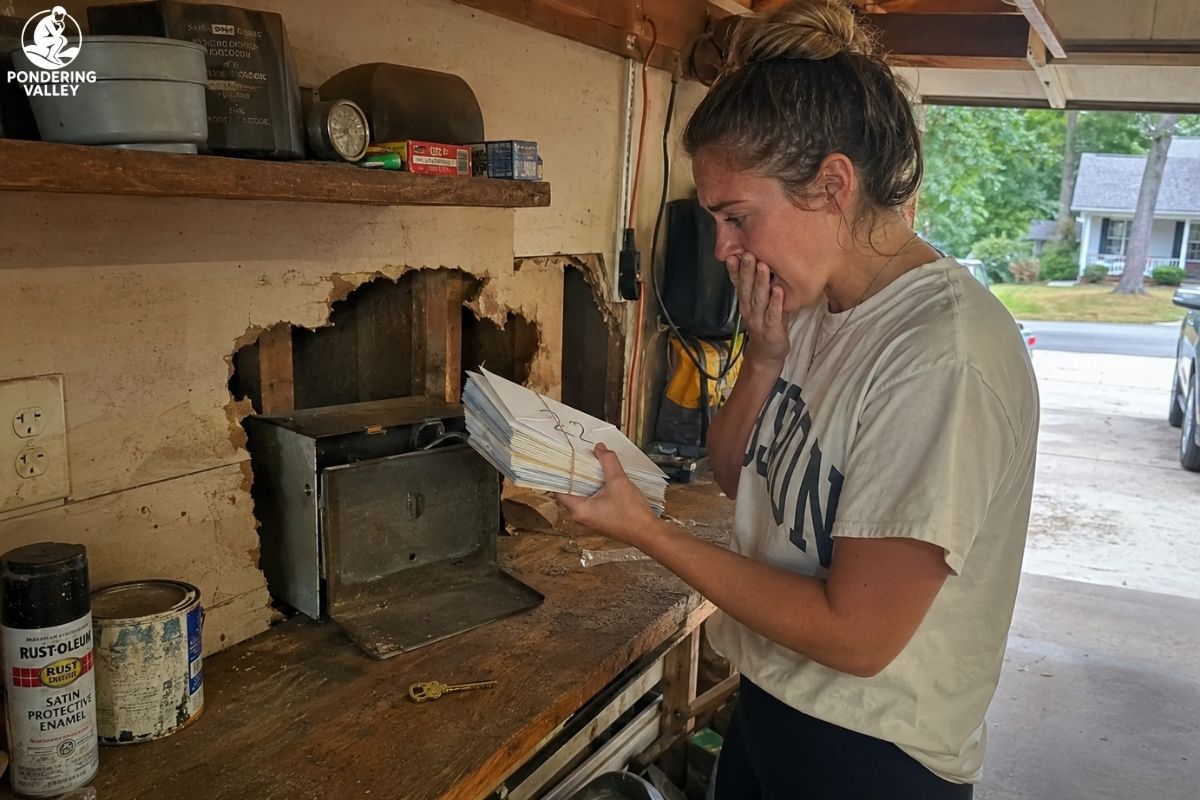
The key was taped inside the back cover.
Sarah hadn’t seen it until she closed the Bible to move it off the kitchen table and felt something catch. It was tucked in a small envelope labeled, in Myrtle’s unmistakable hand:
“If she made it this far.”
Her heart thudded. She peeled back the flap and found a tarnished brass key. Attached was a note:
“Attic. Old cedar box. I didn’t want to make it easy.”
Sarah stared at it a long while before standing. The house was quiet—just the ticking of a clock in the living room and the soft creak of wood as the day settled.
The attic was accessed through the hallway ceiling. She pulled the chain, extended the ladder, and climbed up.
It smelled like dust, cedar, and time.
Boxes lined the eaves—old tax records, Christmas ornaments, Harold’s army boots. Then she spotted it: a cedar chest near the far wall, its lid carved with a faint pattern of vines and wheat.
The key fit perfectly.
Inside were stacks of envelopes, rubber-banded bundles of paper, yellowed photographs—and one leather-bound notebook, worn to the shape of a palm.
Sarah lifted it. The front simply read:
“For Whoever Loves Them Next.”
She sat cross-legged on the attic floor and opened it.
The first page was a letter. Myrtle’s handwriting was shaky in places, but clear.
“Dear You,”
I don’t know who you are. Maybe you’re my niece. Maybe someone else. Doesn’t matter. If you’re reading this, it means you cared enough to notice what no one else did.
I didn’t save dogs. Not really. I just gave them back what life took.
And people too, sometimes.
I didn’t write sermons. I wrote routines. Chore lists. Thunder plans. But they were prayers, in their way.
I wasn’t brave. Not in the movie way. But I kept showing up. That’s the bravest thing I ever learned.
If you’ve found the notebook, it’s yours now. Do what you want with it. Burn it, bury it, publish it. But promise me this:
Keep watching for the ones no one else sees.
The quiet kids. The sad widowers. The angry women. The dogs who flinch when you move too fast.
You don’t have to fix them. Just sit close. Breathe together. Wait out the storm.
That’s all love ever was.
Yours in biscuits and belly rubs,
– Myrtle Henderson
P.S. Tell Frankie he was the first good idea I ever had.
Sarah wiped her cheek with the sleeve of her sweatshirt.
She looked through the rest of the chest—folders organized by dog name, vet records, placement letters, sometimes photos of the families Myrtle had matched with. A few were missing—lost to time or misfiled—but most were there. A paper trail of something nobody thought to call ministry.
And maybe it wasn’t.
Maybe it was just fierce, deliberate kindness.
The kind that didn’t wait for credit.
Sarah carried the notebook downstairs, the key still warm in her hand.
She sat at the table and added one last note to the Bible:
“Found the letter. Myrtle saw everything. Loved harder than most. Left a map for the rest of us.”
The red Xs were almost gone.
Only one remained. A house on the edge of a lake. No dog name. Just:
“Meadowview – the one I wasn’t sure about.”
Sarah traced her finger over the spot.
And got in the car.
Part 10: “The One She Wasn’t Sure About”
Meadowview was less a neighborhood and more a name someone painted on a wooden sign and nailed to a fence post.
Sarah had never been this far west. The road narrowed past soybean fields and willow groves before opening onto a quiet lake, its surface still and glassy under a soft gray sky.
The last red X was marked here—no dog name, no notes. Just a question:
“The one I wasn’t sure about.”
The house sat just off the water, tucked behind a curtain of old pine trees. It was small. Sagging porch. Windows with crooked curtains. A for-sale sign leaned sideways in the front yard.
Sarah stepped onto the porch and knocked.
No answer.
She waited. Knocked again.
Still nothing.
She turned to leave—
—and then she heard it.
A bark. Hoarse, surprised, low to the ground.
Then a shuffle. Nails on wood.
The door creaked open just enough for a nose to appear. Then a muzzle. Then eyes—one cloudy, one sharp gold. The dog was old. Muzzle gray. Skin loose on bone. But alert. Still waiting.
A voice called from inside. “You can come in, if he’ll let you.”
Sarah stepped into the dim light.
The house smelled of pine cleaner and old blankets. In the corner sat a man in a recliner, oxygen tubes over his ears, his hands folded around a worn photo.
He looked up at her with a tired but knowing smile.
“You Myrtle’s niece?”
Sarah nodded.
“I figured,” he said. “You got the same look. Like you’re always halfway through a goodbye.”
Sarah smiled sadly. “This the last one?”
The man nodded and patted the dog’s side. “This here’s Scout.”
She flipped open the Bible. Nothing. No entry. Just that mysterious red X on the map.
“Why wasn’t he in the book?”
The man chuckled. “Because she almost didn’t keep him.”
Sarah sat on the arm of the couch. “Tell me.”
“Scout showed up five years ago,” the man began. “Mangled paw. Skinny as a rake. Wouldn’t let anyone near him. Everyone said to put him down.”
“But Myrtle didn’t.”
“No, ma’am. She set out a pillow on her porch. Every night. Same time. Same spot. Left a bowl of broth, a folded towel, and sat in her rocker with a book.”
“How long did it take?”
“Three months. Three whole months before he let her touch him.”
Sarah shook her head. “That sounds like her.”
“She said he was the one she wasn’t sure about. Too much fear. Too much hurt. But she stayed anyway.” He reached down and stroked Scout’s back. “Eventually, she let me help. Said I’d earned it.”
“You were neighbors?”
“I was more than that. I was her second chance.”
Sarah looked at him.
The man smiled gently. “We were teenagers once. She went off to nursing school. I went to war. Things didn’t work out.” He tapped his chest. “Got hurt. Got bitter. She showed back up with a dog and forgiveness. Mostly the dog.”
Sarah blinked. “You were the one she left behind.”
“No,” he said. “She came back.”
They sat in silence for a long time.
Then he said, “When she got sick last year, she asked me to take Scout. Said I already knew how to wait.”
Sarah looked down at Scout. The dog blinked up at her, old but steady. Still loyal.
“She didn’t write him down,” Sarah said.
“She didn’t need to. He wasn’t part of the ministry. He was part of the end.”
Sarah reached for the Bible and wrote:
“Scout – the one she wasn’t sure about. Taught her to stay even when it’s hard. Stayed beside her at the end. Still waiting.”
That night, Sarah drove back to Myrtle’s house.
She took out the map, now creased and marked with checkmarks and notes. Each red X told a story. Of thunder, porch steps, healing hands, broken hearts, and old dogs who had nothing left to offer but loyalty—and gave it anyway.
She folded the map and tucked it into the back of the Bible.
Then she pulled out a clean sheet of paper. Drew a new map.
Not of the town.
But of the country.
With red Xs waiting.
Waiting for the ones no one else sees.
She didn’t need to save the world.
She just needed to keep showing up.
Like Myrtle had.
One dog at a time.